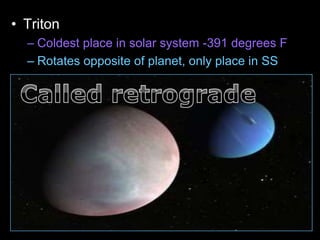
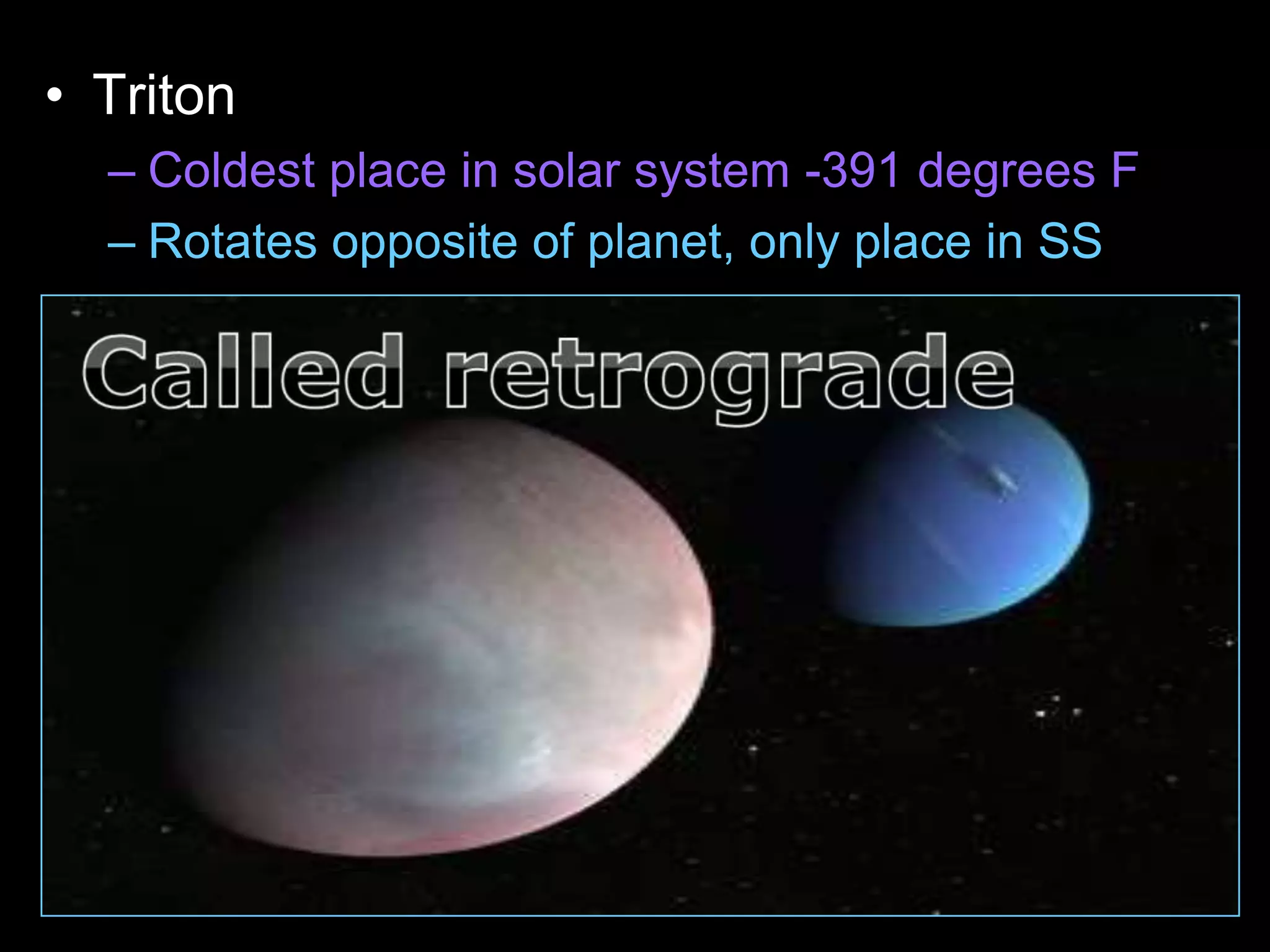




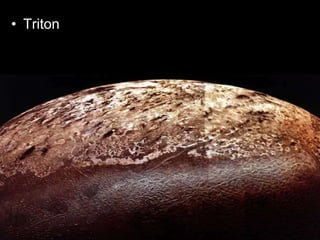
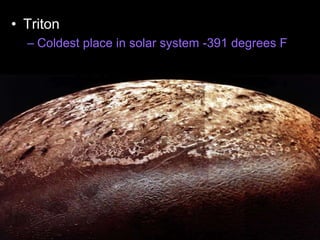
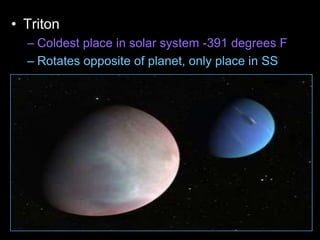
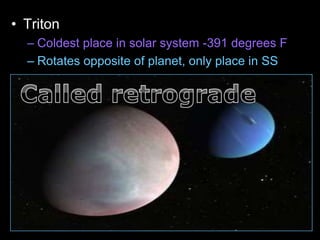
• Triton
– Coldest place in solar system -391 degrees F
– Rotates opposite of planet, only place in SS
http://sciencepowerpoint.com/Website Link:
• RED SLIDE: These are notes that are very
important and should be recorded in your
science journal.
Copyright © 2010 Ryan P. Murphy
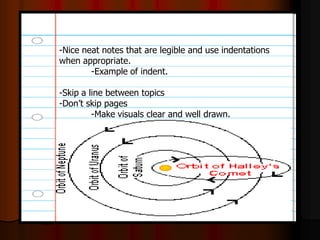
-Nice neat notes that are legible and use indentations
when appropriate.
-Example of indent.
-Skip a line between topics
-Don’t skip pages
-Make visuals clear and well drawn.
• RED SLIDE: These are notes that are very
important and should be recorded in your
science journal.
• BLACK SLIDE: Pay attention, follow
directions, complete projects as described
and answer required questions neatly.
Copyright © 2010 Ryan P. Murphy
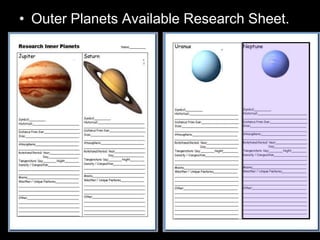
• Outer Planets Available Research Sheet.
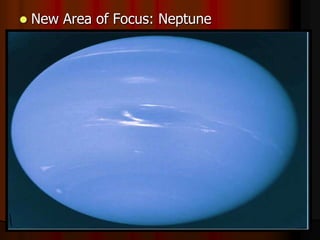
 New Area of Focus: Neptune
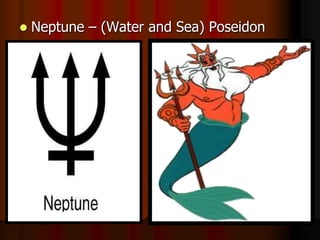
 Neptune – (Water and Sea) Poseidon
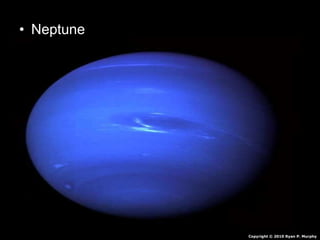
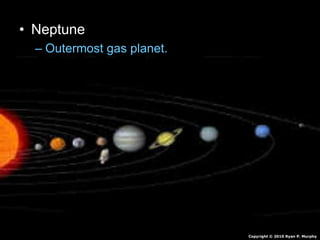
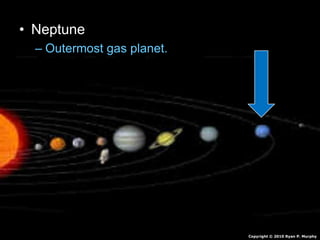
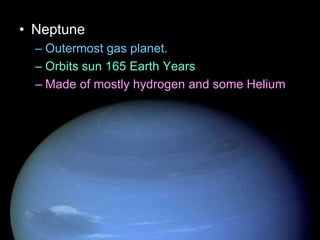
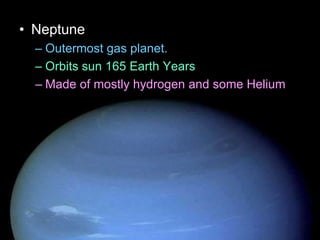
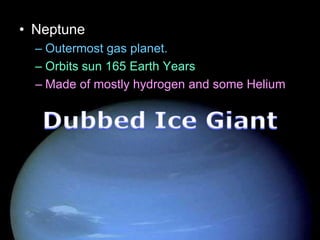
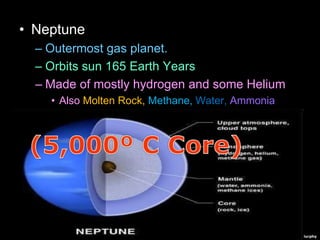
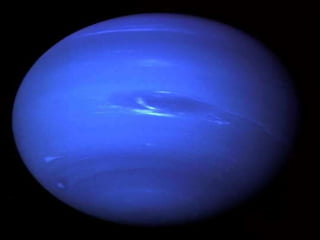
• Neptune
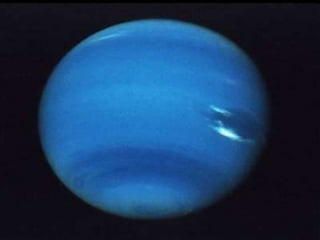
– Outermost gas planet.
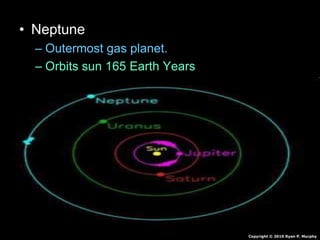
– Orbits sun 165 Earth Years
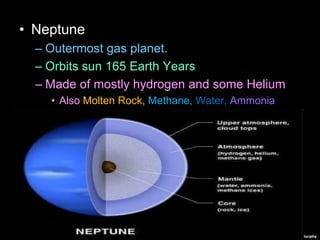
– Made of mostly hydrogen and some Helium
• Also Molten Rock, Methane, Water, Ammonia
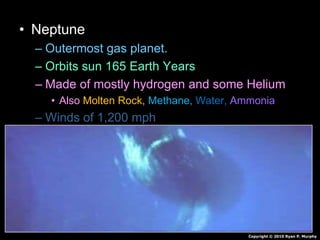
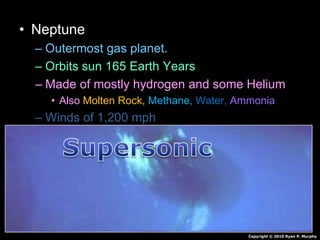
– Winds of 1,200 mph
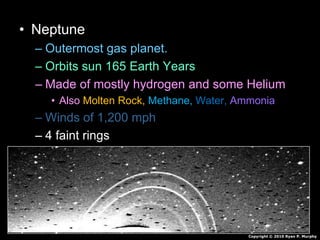
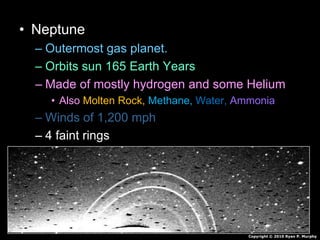
– 4 faint rings
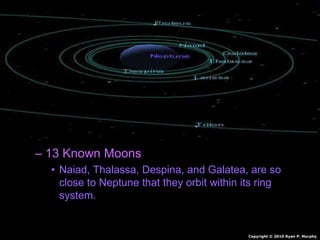
– 13 Moons
Copyright © 2010 Ryan P. Murphy
• Neptune
– Outermost gas planet.
– Orbits sun 165 Earth Years
– Made of mostly hydrogen and some Helium
• Also Molten Rock, Methane, Water, Ammonia
– Winds of 1,200 mph
– 4 faint rings
– 13 Moons
Copyright © 2010 Ryan P. Murphy
• Neptune
– Outermost gas planet.
– Orbits sun 165 Earth Years
– Made of mostly hydrogen and some Helium
• Also Molten Rock, Methane, Water, Ammonia
– Winds of 1,200 mph
– 4 faint rings
– 13 Moons
Copyright © 2010 Ryan P. Murphy
• Neptune
– Outermost gas planet.
– Orbits sun 165 Earth Years
– Made of mostly hydrogen and some Helium
• Also Molten Rock, Methane, Water, Ammonia
– Winds of 1,200 mph
– 4 faint rings
– 13 Moons
Copyright © 2010 Ryan P. Murphy
• Neptune
– Outermost gas planet.
– Orbits sun 165 Earth Years
– Made of mostly hydrogen and some Helium
• Also Molten Rock, Methane, Water, Ammonia
– Winds of 1,200 mph
– 4 faint rings
– 13 Moons
Copyright © 2010 Ryan P. Murphy
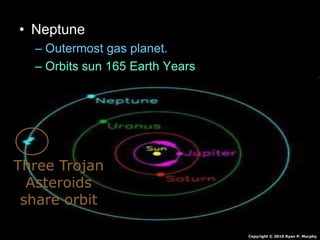
Three Trojan
Asteroids
share orbit
• Neptune
– Outermost gas planet.
– Orbits sun 165 Earth Years
– Made of mostly hydrogen and some Helium
• Also Molten Rock, Methane, Water, Ammonia
– Winds of 1,200 mph
– 4 faint rings
– 13 Moons
Copyright © 2010 Ryan P. Murphy
• Neptune
– Outermost gas planet.
– Orbits sun 165 Earth Years
– Made of mostly hydrogen and some Helium
• Also Molten Rock, Methane, Water, Ammonia
– Winds of 1,200 mph
– 4 faint rings
– 13 Moons
Copyright © 2010 Ryan P. Murphy
• Neptune
– Outermost gas planet.
– Orbits sun 165 Earth Years
– Made of mostly hydrogen and some Helium
• Also Molten Rock, Methane, Water, Ammonia
– Winds of 1,200 mph
– 4 faint rings
– 13 Moons
Copyright © 2010 Ryan P. Murphy
• Neptune
– Outermost gas planet.
– Orbits sun 165 Earth Years
– Made of mostly hydrogen and some Helium
• Also Molten Rock, Methane, Water, Ammonia
– Winds of 1,200 mph
– 4 faint rings
– 13 Moons
Copyright © 2010 Ryan P. Murphy
• Neptune
– Outermost gas planet.
– Orbits sun 165 Earth Years
– Made of mostly hydrogen and some Helium
• Also Molten Rock, Methane, Water, Ammonia
– Winds of 1,200 mph
– 4 faint rings
– 13 Moons
Copyright © 2010 Ryan P. Murphy
• Neptune
– Outermost gas planet.
– Orbits sun 165 Earth Years
– Made of mostly hydrogen and some Helium
• Also Molten Rock, Methane, Water, Ammonia
– Winds of 1,200 mph
– 4 faint rings
– 13 Moons
Copyright © 2010 Ryan P. Murphy
• Neptune
– Outermost gas planet.
– Orbits sun 165 Earth Years
– Made of mostly hydrogen and some Helium
• Also Molten Rock, Methane, Water, Ammonia
– Winds of 1,200 mph
– 4 faint rings
– 13 Moons
Copyright © 2010 Ryan P. Murphy
• Neptune
– Outermost gas planet.
– Orbits sun 165 Earth Years
– Made of mostly hydrogen and some Helium
• Also Molten Rock, Methane, Water, Ammonia
– Winds of 1,200 mph
– 4 faint rings
– 13 Moons
Copyright © 2010 Ryan P. Murphy
• Neptune
– Outermost gas planet.
– Orbits sun 165 Earth Years
– Made of mostly hydrogen and some Helium
• Also Molten Rock, Methane, Water, Ammonia
– Winds of 1,200 mph
– 4 faint rings
– 13 Moons
Copyright © 2010 Ryan P. Murphy
• Neptune
– Outermost gas planet.
– Orbits sun 165 Earth Years
– Made of mostly hydrogen and some Helium
• Also Molten Rock, Methane, Water, Ammonia
– Winds of 1,200 mph
– 4 faint rings
– 13 Known Moons
• Naiad, Thalassa, Despina, and Galatea, are so
close to Neptune that they orbit within its ring
system.
Copyright © 2010 Ryan P. Murphy
• Which fact is bogus from the list below about
Neptune?
A.) Innermost gas planet.
B.) Orbits sun 165 Earth Years
C.) Molten Rock, Methane, Water, Ammonia
D.) Winds of 1,200 mph
E.) 4 faint rings.
F.) 13+? Moons
Copyright © 2010 Ryan P. Murphy
• Which fact is bogus from the list below about
Neptune?
A.) Innermost gas planet.
B.) Orbits sun 165 Earth Years
C.) Molten Rock, Methane, Water, Ammonia
D.) Winds of 1,200 mph
E.) 4 faint rings.
F.) 13+? Moons
Copyright © 2010 Ryan P. Murphy
• Which fact is bogus from the list below about
Neptune?
A.) Innermost gas planet.
B.) Orbits sun 165 Earth Years
C.) Molten Rock, Methane, Water, Ammonia
D.) Winds of 1,200 mph
E.) 4 faint rings.
F.) 13+? Moons
Copyright © 2010 Ryan P. Murphy
• Which fact is bogus from the list below about
Neptune?
A.) Innermost gas planet.
B.) Orbits sun 165 Earth Years
C.) Molten Rock, Methane, Water, Ammonia
D.) Winds of 1,200 mph
E.) 4 faint rings.
F.) 13+? Moons
Copyright © 2010 Ryan P. Murphy
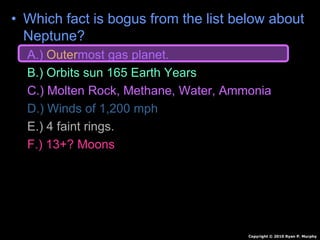
• Which fact is bogus from the list below about
Neptune?
A.) Outermost gas planet.
B.) Orbits sun 165 Earth Years
C.) Molten Rock, Methane, Water, Ammonia
D.) Winds of 1,200 mph
E.) 4 faint rings.
F.) 13+? Moons
Copyright © 2010 Ryan P. Murphy
• Which fact is bogus from the list below about
Neptune?
A.) Outermost gas planet.
B.) Orbits sun 165 Earth Years
C.) Molten Rock, Methane, Water, Ammonia
D.) Soft winds of 12 mph
E.) 4 faint rings.
F.) 13+? Moons
Copyright © 2010 Ryan P. Murphy
• Which fact is bogus from the list below about
Neptune?
A.) Outermost gas planet.
B.) Orbits sun 165 Earth Years
C.) Molten Rock, Methane, Water, Ammonia
D.) Soft winds of 12 mph
E.) 4 faint rings.
F.) 13+? Moons
Copyright © 2010 Ryan P. Murphy
• Which fact is bogus from the list below about
Neptune?
A.) Outermost gas planet.
B.) Orbits sun 165 Earth Years
C.) Molten Rock, Methane, Water, Ammonia
D.) Soft winds of 12 mph
E.) 4 faint rings.
F.) 13+? Moons
Copyright © 2010 Ryan P. Murphy
• Which fact is bogus from the list below about
Neptune?
A.) Outermost gas planet.
B.) Orbits sun 165 Earth Years
C.) Molten Rock, Methane, Water, Ammonia
D.) Extreme winds of 1,200 mph
E.) 4 faint rings.
F.) 13+? Moons
Copyright © 2010 Ryan P. Murphy
• Triton
• Triton
– Coldest place in solar system -391 degrees F
• Triton
– Coldest place in solar system -391 degrees F
– Rotates opposite of planet, only place in SS
• Triton
– Coldest place in solar system -391 degrees F
– Rotates opposite of planet, only place in SS
• Triton
– Coldest place in solar system -391 degrees F
– Rotates opposite of planet, only place in SS
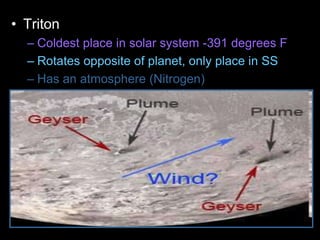
– Has an atmosphere (Nitrogen)
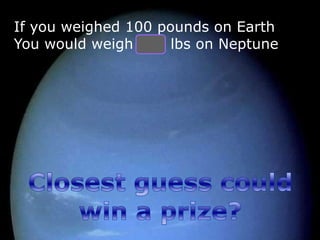
If you weighed 100 pounds on Earth
You would weigh 114 lbs on Neptune
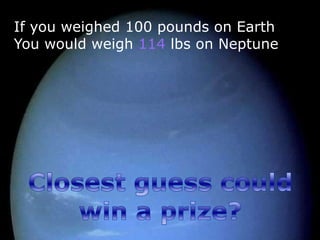
If you weighed 100 pounds on Earth
You would weigh 114 lbs on Neptune
If you weighed 100 pounds on Earth
You would weigh 114 lbs on Neptune
If you weighed 100 pounds on Earth
You would weigh 114 lbs on Neptune
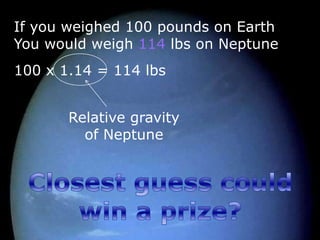
100 x 1.14 = 114 lbs
Relative gravity
of Neptune
If you weighed 100 pounds on Earth
You would weigh 114 lbs on Neptune
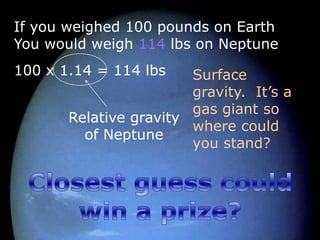
100 x 1.14 = 114 lbs
Relative gravity
of Neptune
Surface
gravity. It’s a
gas giant so
where could
you stand?
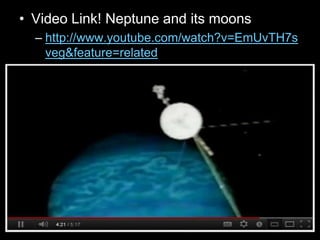
• Video Link! Neptune and its moons
– http://www.youtube.com/watch?v=EmUvTH7s
veg&feature=related
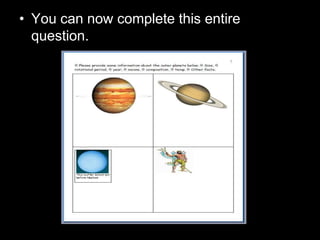
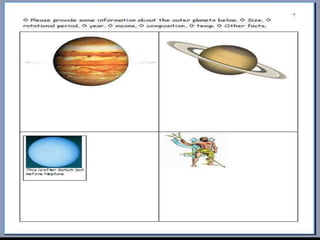
• You can now complete this entire
question.
http://sciencepowerpoint.com/Website Link:
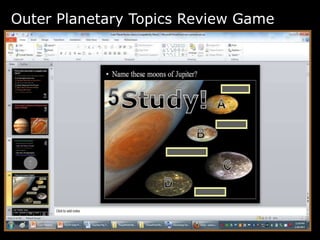
Outer Planetary Topics Review Game
• This Solar System Basics and the Sun lesson is just one
small part of my Astronomy Topics Unit. This unit
includes
• A five part 2,800 Slide PowerPoint Presentation / unit
roadmap full of activities, review questions, games, video
links, materials list, and much more.
• A 13 bundled homework package, modified version, 7
pages of unit notes, 4 PowerPoint Review Games of
100+ slides each, videos, rubrics, and much more that
all chronologically follow the unit slideshow.
• This is a fantastic unit for any Earth Science Class.
• http://sciencepowerpoint.com/Astronomy_Unit.html
Areas of Focus in the Astronomy Topics Unit:
The Solar System and the Sun, Order of the Planets, Our Sun, Life Cycle
of a Star, Size of Stars, Solar Eclipse, Lunar Eclipse, The Inner Planets,
Mercury, Venus, Earth, Moon, Craters, Tides, Phases of the Moon, Mars
and Moons, Rocketry, Asteroid Belt, NEO’s, The Torino Scale, The Outer
Planets and Gas Giants, Jupiter / Moons, Saturn / Moons, Uranus /
Moons, Neptune / Moons, Pluto's Demotion, The Kuiper Belt, Oort Cloud,
Comets / Other, Beyond the Solar System, Types of Galaxies, Black holes,
Extrasolar Planets, The Big Bang, Dark Matter, Dark Energy, The Special
Theory of Relativity, Hubble Space Telescope, Constellations, Age of the
Earth, Time, Earth events in a 12 hour day, Principle of Superposition,
Geologic Timescale, Extinction Events, Dinosaurs, and much more.
Full Unit found at...
http://sciencepowerpoint.com/Astronomy_Unit.html
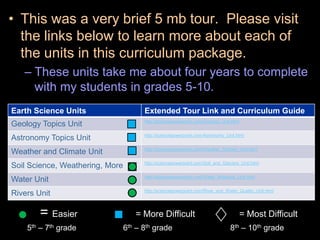
• This was a very brief 5 mb tour. Please visit
the links below to learn more about each of
the units in this curriculum package.
– These units take me about four years to complete
with my students in grades 5-10.
Earth Science Units Extended Tour Link and Curriculum Guide
Geology Topics Unit http://sciencepowerpoint.com/Geology_Unit.html
Astronomy Topics Unit http://sciencepowerpoint.com/Astronomy_Unit.html
Weather and Climate Unit http://sciencepowerpoint.com/Weather_Climate_Unit.html
Soil Science, Weathering, More http://sciencepowerpoint.com/Soil_and_Glaciers_Unit.html
Water Unit http://sciencepowerpoint.com/Water_Molecule_Unit.html
Rivers Unit http://sciencepowerpoint.com/River_and_Water_Quality_Unit.html
= Easier = More Difficult = Most Difficult
5th – 7th grade 6th – 8th grade 8th – 10th grade
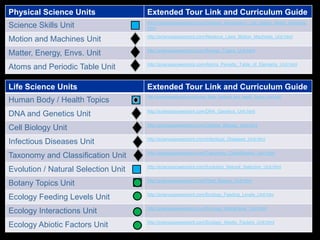
Physical Science Units Extended Tour Link and Curriculum Guide
Science Skills Unit http://sciencepowerpoint.com/Science_Introduction_Lab_Safety_Metric_Methods.
html
Motion and Machines Unit http://sciencepowerpoint.com/Newtons_Laws_Motion_Machines_Unit.html
Matter, Energy, Envs. Unit http://sciencepowerpoint.com/Energy_Topics_Unit.html
Atoms and Periodic Table Unit http://sciencepowerpoint.com/Atoms_Periodic_Table_of_Elements_Unit.html
Life Science Units Extended Tour Link and Curriculum Guide
Human Body / Health Topics
http://sciencepowerpoint.com/Human_Body_Systems_and_Health_Topics_Unit.html
DNA and Genetics Unit http://sciencepowerpoint.com/DNA_Genetics_Unit.html
Cell Biology Unit http://sciencepowerpoint.com/Cellular_Biology_Unit.html
Infectious Diseases Unit http://sciencepowerpoint.com/Infectious_Diseases_Unit.html
Taxonomy and Classification Unit http://sciencepowerpoint.com/Taxonomy_Classification_Unit.html
Evolution / Natural Selection Unit http://sciencepowerpoint.com/Evolution_Natural_Selection_Unit.html
Botany Topics Unit http://sciencepowerpoint.com/Plant_Botany_Unit.html
Ecology Feeding Levels Unit http://sciencepowerpoint.com/Ecology_Feeding_Levels_Unit.htm
Ecology Interactions Unit http://sciencepowerpoint.com/Ecology_Interactions_Unit.html
Ecology Abiotic Factors Unit http://sciencepowerpoint.com/Ecology_Abiotic_Factors_Unit.html
• More Units Available at…
Earth Science: The Soil Science and Glaciers Unit, The Geology Topics
Unit, The Astronomy Topics Unit, The Weather and Climate Unit, and The
Rivers and Water Quality Unit, The Water Molecule Unit.
Physical Science: The Laws of Motion and Machines Unit, The Atoms
and Periodic Table Unit, The Energy and the Environment Unit, and
Science Skills Unit.
Life Science: The Diseases and Cells Unit, The DNA and Genetics Unit,
The Life Topics Unit, The Plant Unit, The Taxonomy and Classification
Unit, Ecology: Feeding Levels Unit, Ecology: Interactions Unit, Ecology:
Abiotic Factors, The Evolution and Natural Selection Unit and The Human
Body Systems and Health Topics Unit
Copyright © 2010 Ryan P. Murphy
• The entire four year curriculum can be found at...
http://sciencepowerpoint.com/ Please feel free to
contact me with any questions you may have.
Thank you for your interest in this curriculum.
Sincerely,
Ryan Murphy M.Ed
www.sciencepowerpoint@gmail.com
http://sciencepowerpoint.com/Website Link:

Planet Neptune and Moons Astronomy Lesson PowerPoint

  • 1.
    • Triton – Coldestplace in solar system -391 degrees F – Rotates opposite of planet, only place in SS
  • 2.
  • 4.
    • RED SLIDE:These are notes that are very important and should be recorded in your science journal. Copyright © 2010 Ryan P. Murphy
  • 5.
    -Nice neat notesthat are legible and use indentations when appropriate. -Example of indent. -Skip a line between topics -Don’t skip pages -Make visuals clear and well drawn.
  • 6.
    • RED SLIDE:These are notes that are very important and should be recorded in your science journal. • BLACK SLIDE: Pay attention, follow directions, complete projects as described and answer required questions neatly. Copyright © 2010 Ryan P. Murphy
  • 7.
    • Outer PlanetsAvailable Research Sheet.
  • 8.
     New Areaof Focus: Neptune
  • 10.
     Neptune –(Water and Sea) Poseidon
  • 11.
    • Neptune – Outermostgas planet. – Orbits sun 165 Earth Years – Made of mostly hydrogen and some Helium • Also Molten Rock, Methane, Water, Ammonia – Winds of 1,200 mph – 4 faint rings – 13 Moons Copyright © 2010 Ryan P. Murphy
  • 12.
    • Neptune – Outermostgas planet. – Orbits sun 165 Earth Years – Made of mostly hydrogen and some Helium • Also Molten Rock, Methane, Water, Ammonia – Winds of 1,200 mph – 4 faint rings – 13 Moons Copyright © 2010 Ryan P. Murphy
  • 13.
    • Neptune – Outermostgas planet. – Orbits sun 165 Earth Years – Made of mostly hydrogen and some Helium • Also Molten Rock, Methane, Water, Ammonia – Winds of 1,200 mph – 4 faint rings – 13 Moons Copyright © 2010 Ryan P. Murphy
  • 14.
    • Neptune – Outermostgas planet. – Orbits sun 165 Earth Years – Made of mostly hydrogen and some Helium • Also Molten Rock, Methane, Water, Ammonia – Winds of 1,200 mph – 4 faint rings – 13 Moons Copyright © 2010 Ryan P. Murphy
  • 15.
    • Neptune – Outermostgas planet. – Orbits sun 165 Earth Years – Made of mostly hydrogen and some Helium • Also Molten Rock, Methane, Water, Ammonia – Winds of 1,200 mph – 4 faint rings – 13 Moons Copyright © 2010 Ryan P. Murphy Three Trojan Asteroids share orbit
  • 16.
    • Neptune – Outermostgas planet. – Orbits sun 165 Earth Years – Made of mostly hydrogen and some Helium • Also Molten Rock, Methane, Water, Ammonia – Winds of 1,200 mph – 4 faint rings – 13 Moons Copyright © 2010 Ryan P. Murphy
  • 17.
    • Neptune – Outermostgas planet. – Orbits sun 165 Earth Years – Made of mostly hydrogen and some Helium • Also Molten Rock, Methane, Water, Ammonia – Winds of 1,200 mph – 4 faint rings – 13 Moons Copyright © 2010 Ryan P. Murphy
  • 18.
    • Neptune – Outermostgas planet. – Orbits sun 165 Earth Years – Made of mostly hydrogen and some Helium • Also Molten Rock, Methane, Water, Ammonia – Winds of 1,200 mph – 4 faint rings – 13 Moons Copyright © 2010 Ryan P. Murphy
  • 19.
    • Neptune – Outermostgas planet. – Orbits sun 165 Earth Years – Made of mostly hydrogen and some Helium • Also Molten Rock, Methane, Water, Ammonia – Winds of 1,200 mph – 4 faint rings – 13 Moons Copyright © 2010 Ryan P. Murphy
  • 20.
    • Neptune – Outermostgas planet. – Orbits sun 165 Earth Years – Made of mostly hydrogen and some Helium • Also Molten Rock, Methane, Water, Ammonia – Winds of 1,200 mph – 4 faint rings – 13 Moons Copyright © 2010 Ryan P. Murphy
  • 21.
    • Neptune – Outermostgas planet. – Orbits sun 165 Earth Years – Made of mostly hydrogen and some Helium • Also Molten Rock, Methane, Water, Ammonia – Winds of 1,200 mph – 4 faint rings – 13 Moons Copyright © 2010 Ryan P. Murphy
  • 22.
    • Neptune – Outermostgas planet. – Orbits sun 165 Earth Years – Made of mostly hydrogen and some Helium • Also Molten Rock, Methane, Water, Ammonia – Winds of 1,200 mph – 4 faint rings – 13 Moons Copyright © 2010 Ryan P. Murphy
  • 30.
    • Neptune – Outermostgas planet. – Orbits sun 165 Earth Years – Made of mostly hydrogen and some Helium • Also Molten Rock, Methane, Water, Ammonia – Winds of 1,200 mph – 4 faint rings – 13 Moons Copyright © 2010 Ryan P. Murphy
  • 31.
    • Neptune – Outermostgas planet. – Orbits sun 165 Earth Years – Made of mostly hydrogen and some Helium • Also Molten Rock, Methane, Water, Ammonia – Winds of 1,200 mph – 4 faint rings – 13 Moons Copyright © 2010 Ryan P. Murphy
  • 32.
    • Neptune – Outermostgas planet. – Orbits sun 165 Earth Years – Made of mostly hydrogen and some Helium • Also Molten Rock, Methane, Water, Ammonia – Winds of 1,200 mph – 4 faint rings – 13 Known Moons • Naiad, Thalassa, Despina, and Galatea, are so close to Neptune that they orbit within its ring system. Copyright © 2010 Ryan P. Murphy
  • 33.
    Copyright © 2010Ryan P. Murphy
  • 34.
    Copyright © 2010Ryan P. Murphy
  • 35.
    • Which factis bogus from the list below about Neptune? A.) Innermost gas planet. B.) Orbits sun 165 Earth Years C.) Molten Rock, Methane, Water, Ammonia D.) Winds of 1,200 mph E.) 4 faint rings. F.) 13+? Moons Copyright © 2010 Ryan P. Murphy
  • 36.
    • Which factis bogus from the list below about Neptune? A.) Innermost gas planet. B.) Orbits sun 165 Earth Years C.) Molten Rock, Methane, Water, Ammonia D.) Winds of 1,200 mph E.) 4 faint rings. F.) 13+? Moons Copyright © 2010 Ryan P. Murphy
  • 37.
    • Which factis bogus from the list below about Neptune? A.) Innermost gas planet. B.) Orbits sun 165 Earth Years C.) Molten Rock, Methane, Water, Ammonia D.) Winds of 1,200 mph E.) 4 faint rings. F.) 13+? Moons Copyright © 2010 Ryan P. Murphy
  • 38.
    • Which factis bogus from the list below about Neptune? A.) Innermost gas planet. B.) Orbits sun 165 Earth Years C.) Molten Rock, Methane, Water, Ammonia D.) Winds of 1,200 mph E.) 4 faint rings. F.) 13+? Moons Copyright © 2010 Ryan P. Murphy
  • 39.
    • Which factis bogus from the list below about Neptune? A.) Outermost gas planet. B.) Orbits sun 165 Earth Years C.) Molten Rock, Methane, Water, Ammonia D.) Winds of 1,200 mph E.) 4 faint rings. F.) 13+? Moons Copyright © 2010 Ryan P. Murphy
  • 40.
    Copyright © 2010Ryan P. Murphy
  • 41.
    • Which factis bogus from the list below about Neptune? A.) Outermost gas planet. B.) Orbits sun 165 Earth Years C.) Molten Rock, Methane, Water, Ammonia D.) Soft winds of 12 mph E.) 4 faint rings. F.) 13+? Moons Copyright © 2010 Ryan P. Murphy
  • 42.
    • Which factis bogus from the list below about Neptune? A.) Outermost gas planet. B.) Orbits sun 165 Earth Years C.) Molten Rock, Methane, Water, Ammonia D.) Soft winds of 12 mph E.) 4 faint rings. F.) 13+? Moons Copyright © 2010 Ryan P. Murphy
  • 43.
    • Which factis bogus from the list below about Neptune? A.) Outermost gas planet. B.) Orbits sun 165 Earth Years C.) Molten Rock, Methane, Water, Ammonia D.) Soft winds of 12 mph E.) 4 faint rings. F.) 13+? Moons Copyright © 2010 Ryan P. Murphy
  • 44.
    • Which factis bogus from the list below about Neptune? A.) Outermost gas planet. B.) Orbits sun 165 Earth Years C.) Molten Rock, Methane, Water, Ammonia D.) Extreme winds of 1,200 mph E.) 4 faint rings. F.) 13+? Moons Copyright © 2010 Ryan P. Murphy
  • 45.
  • 46.
    • Triton – Coldestplace in solar system -391 degrees F
  • 47.
    • Triton – Coldestplace in solar system -391 degrees F – Rotates opposite of planet, only place in SS
  • 48.
    • Triton – Coldestplace in solar system -391 degrees F – Rotates opposite of planet, only place in SS
  • 49.
    • Triton – Coldestplace in solar system -391 degrees F – Rotates opposite of planet, only place in SS – Has an atmosphere (Nitrogen)
  • 51.
    If you weighed100 pounds on Earth You would weigh 114 lbs on Neptune
  • 52.
    If you weighed100 pounds on Earth You would weigh 114 lbs on Neptune
  • 53.
    If you weighed100 pounds on Earth You would weigh 114 lbs on Neptune
  • 54.
    If you weighed100 pounds on Earth You would weigh 114 lbs on Neptune 100 x 1.14 = 114 lbs Relative gravity of Neptune
  • 55.
    If you weighed100 pounds on Earth You would weigh 114 lbs on Neptune 100 x 1.14 = 114 lbs Relative gravity of Neptune Surface gravity. It’s a gas giant so where could you stand?
  • 56.
    • Video Link!Neptune and its moons – http://www.youtube.com/watch?v=EmUvTH7s veg&feature=related
  • 57.
    • You cannow complete this entire question.
  • 59.
  • 60.
  • 61.
    • This SolarSystem Basics and the Sun lesson is just one small part of my Astronomy Topics Unit. This unit includes • A five part 2,800 Slide PowerPoint Presentation / unit roadmap full of activities, review questions, games, video links, materials list, and much more. • A 13 bundled homework package, modified version, 7 pages of unit notes, 4 PowerPoint Review Games of 100+ slides each, videos, rubrics, and much more that all chronologically follow the unit slideshow. • This is a fantastic unit for any Earth Science Class. • http://sciencepowerpoint.com/Astronomy_Unit.html
  • 63.
    Areas of Focusin the Astronomy Topics Unit: The Solar System and the Sun, Order of the Planets, Our Sun, Life Cycle of a Star, Size of Stars, Solar Eclipse, Lunar Eclipse, The Inner Planets, Mercury, Venus, Earth, Moon, Craters, Tides, Phases of the Moon, Mars and Moons, Rocketry, Asteroid Belt, NEO’s, The Torino Scale, The Outer Planets and Gas Giants, Jupiter / Moons, Saturn / Moons, Uranus / Moons, Neptune / Moons, Pluto's Demotion, The Kuiper Belt, Oort Cloud, Comets / Other, Beyond the Solar System, Types of Galaxies, Black holes, Extrasolar Planets, The Big Bang, Dark Matter, Dark Energy, The Special Theory of Relativity, Hubble Space Telescope, Constellations, Age of the Earth, Time, Earth events in a 12 hour day, Principle of Superposition, Geologic Timescale, Extinction Events, Dinosaurs, and much more. Full Unit found at... http://sciencepowerpoint.com/Astronomy_Unit.html
  • 64.
    • This wasa very brief 5 mb tour. Please visit the links below to learn more about each of the units in this curriculum package. – These units take me about four years to complete with my students in grades 5-10. Earth Science Units Extended Tour Link and Curriculum Guide Geology Topics Unit http://sciencepowerpoint.com/Geology_Unit.html Astronomy Topics Unit http://sciencepowerpoint.com/Astronomy_Unit.html Weather and Climate Unit http://sciencepowerpoint.com/Weather_Climate_Unit.html Soil Science, Weathering, More http://sciencepowerpoint.com/Soil_and_Glaciers_Unit.html Water Unit http://sciencepowerpoint.com/Water_Molecule_Unit.html Rivers Unit http://sciencepowerpoint.com/River_and_Water_Quality_Unit.html = Easier = More Difficult = Most Difficult 5th – 7th grade 6th – 8th grade 8th – 10th grade
  • 65.
    Physical Science UnitsExtended Tour Link and Curriculum Guide Science Skills Unit http://sciencepowerpoint.com/Science_Introduction_Lab_Safety_Metric_Methods. html Motion and Machines Unit http://sciencepowerpoint.com/Newtons_Laws_Motion_Machines_Unit.html Matter, Energy, Envs. Unit http://sciencepowerpoint.com/Energy_Topics_Unit.html Atoms and Periodic Table Unit http://sciencepowerpoint.com/Atoms_Periodic_Table_of_Elements_Unit.html Life Science Units Extended Tour Link and Curriculum Guide Human Body / Health Topics http://sciencepowerpoint.com/Human_Body_Systems_and_Health_Topics_Unit.html DNA and Genetics Unit http://sciencepowerpoint.com/DNA_Genetics_Unit.html Cell Biology Unit http://sciencepowerpoint.com/Cellular_Biology_Unit.html Infectious Diseases Unit http://sciencepowerpoint.com/Infectious_Diseases_Unit.html Taxonomy and Classification Unit http://sciencepowerpoint.com/Taxonomy_Classification_Unit.html Evolution / Natural Selection Unit http://sciencepowerpoint.com/Evolution_Natural_Selection_Unit.html Botany Topics Unit http://sciencepowerpoint.com/Plant_Botany_Unit.html Ecology Feeding Levels Unit http://sciencepowerpoint.com/Ecology_Feeding_Levels_Unit.htm Ecology Interactions Unit http://sciencepowerpoint.com/Ecology_Interactions_Unit.html Ecology Abiotic Factors Unit http://sciencepowerpoint.com/Ecology_Abiotic_Factors_Unit.html
  • 66.
    • More UnitsAvailable at… Earth Science: The Soil Science and Glaciers Unit, The Geology Topics Unit, The Astronomy Topics Unit, The Weather and Climate Unit, and The Rivers and Water Quality Unit, The Water Molecule Unit. Physical Science: The Laws of Motion and Machines Unit, The Atoms and Periodic Table Unit, The Energy and the Environment Unit, and Science Skills Unit. Life Science: The Diseases and Cells Unit, The DNA and Genetics Unit, The Life Topics Unit, The Plant Unit, The Taxonomy and Classification Unit, Ecology: Feeding Levels Unit, Ecology: Interactions Unit, Ecology: Abiotic Factors, The Evolution and Natural Selection Unit and The Human Body Systems and Health Topics Unit Copyright © 2010 Ryan P. Murphy
  • 67.
    • The entirefour year curriculum can be found at... http://sciencepowerpoint.com/ Please feel free to contact me with any questions you may have. Thank you for your interest in this curriculum. Sincerely, Ryan Murphy M.Ed www.sciencepowerpoint@gmail.com
  • 68.