Compiled by
Dr. Medicherla shyam Sunder Kumar
samc108@gmail.com
BHAGVAD GITA CHAPTER 4, FLOWCHARTSBHAGVAD GITA CHAPTER 4, FLOWCHARTS
Based on teachings of
Bhagvad gita Study by Bhakti Caitanya Swami
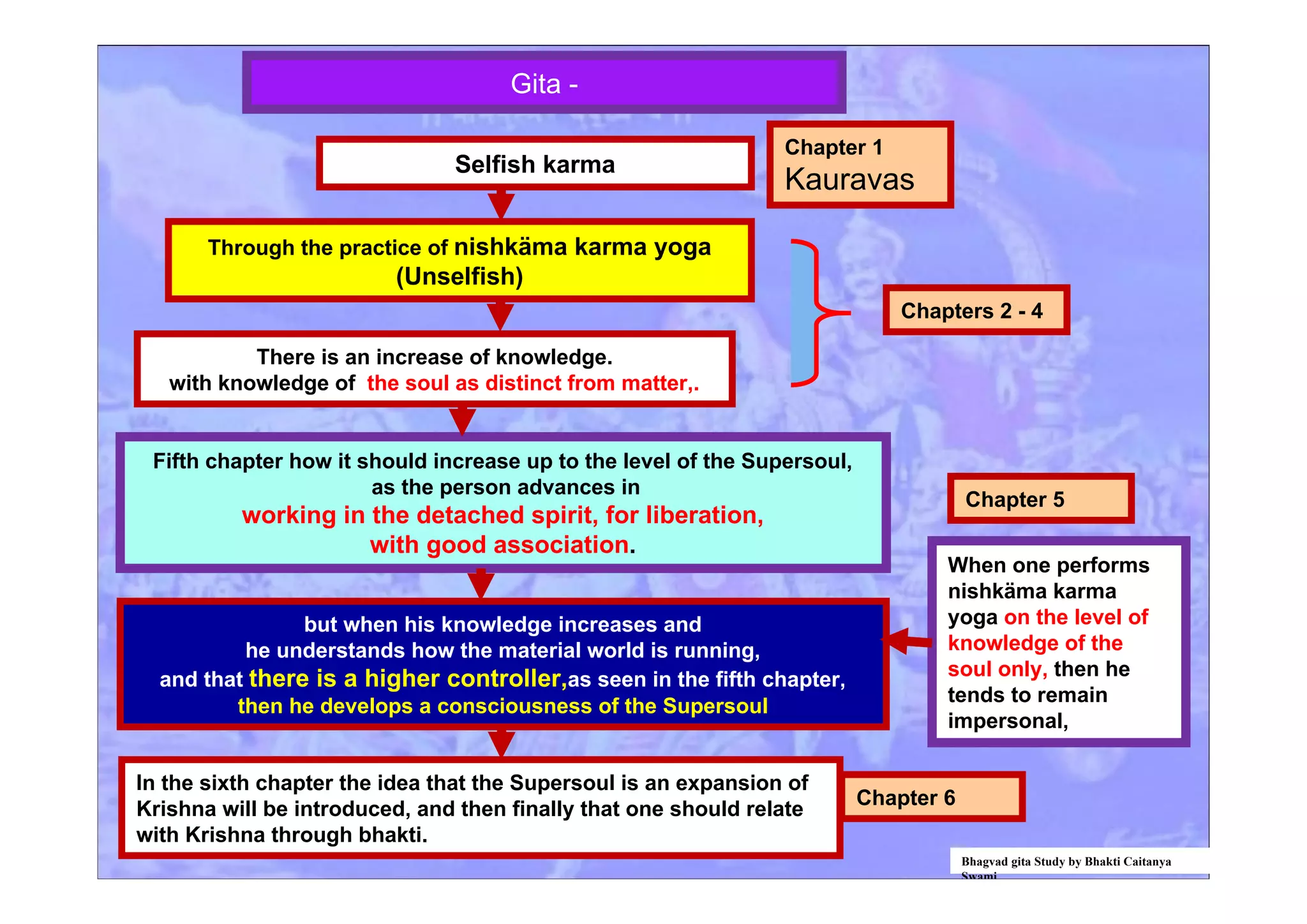
Gita -
There is an increase of knowledge.
with knowledge of the soul as distinct from matter,.
Fifth chapter how it should increase up to the level of the Supersoul,
as the person advances in
working in the detached spirit, for liberation,
with good association.
Selfish karma
When one performs
nishkäma karma
yoga on the level of
knowledge of the
soul only, then he
tends to remain
impersonal,
In the sixth chapter the idea that the Supersoul is an expansion of
Krishna will be introduced, and then finally that one should relate
with Krishna through bhakti.
Chapters 2 - 4
but when his knowledge increases and
he understands how the material world is running,
and that there is a higher controller,as seen in the fifth chapter,
then he develops a consciousness of the Supersoul
Through the practice of nishkäma karma yoga
(Unselfish)
Chapter 5
Chapter 6
Chapter 1
Kauravas
Bhagvad gita Study by Bhakti Caitanya
Swami
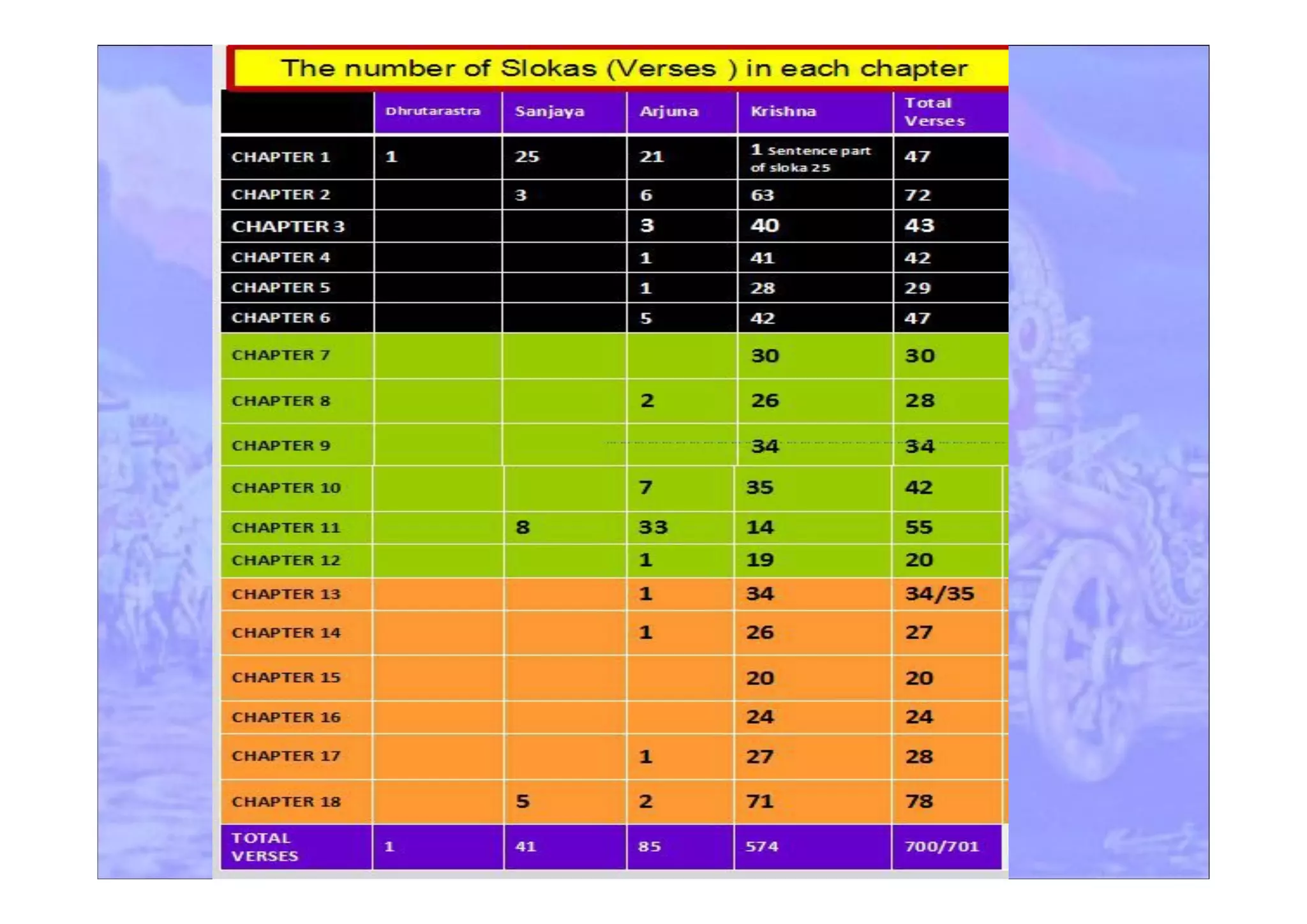
Chapter 4 :
Jnana Yoga
{42 Slokas / Verses}
Bhagvad gita Study by Bhakti Caitanya
Swami
Bhagvad gita Study by Bhakti Caitanya
Swami
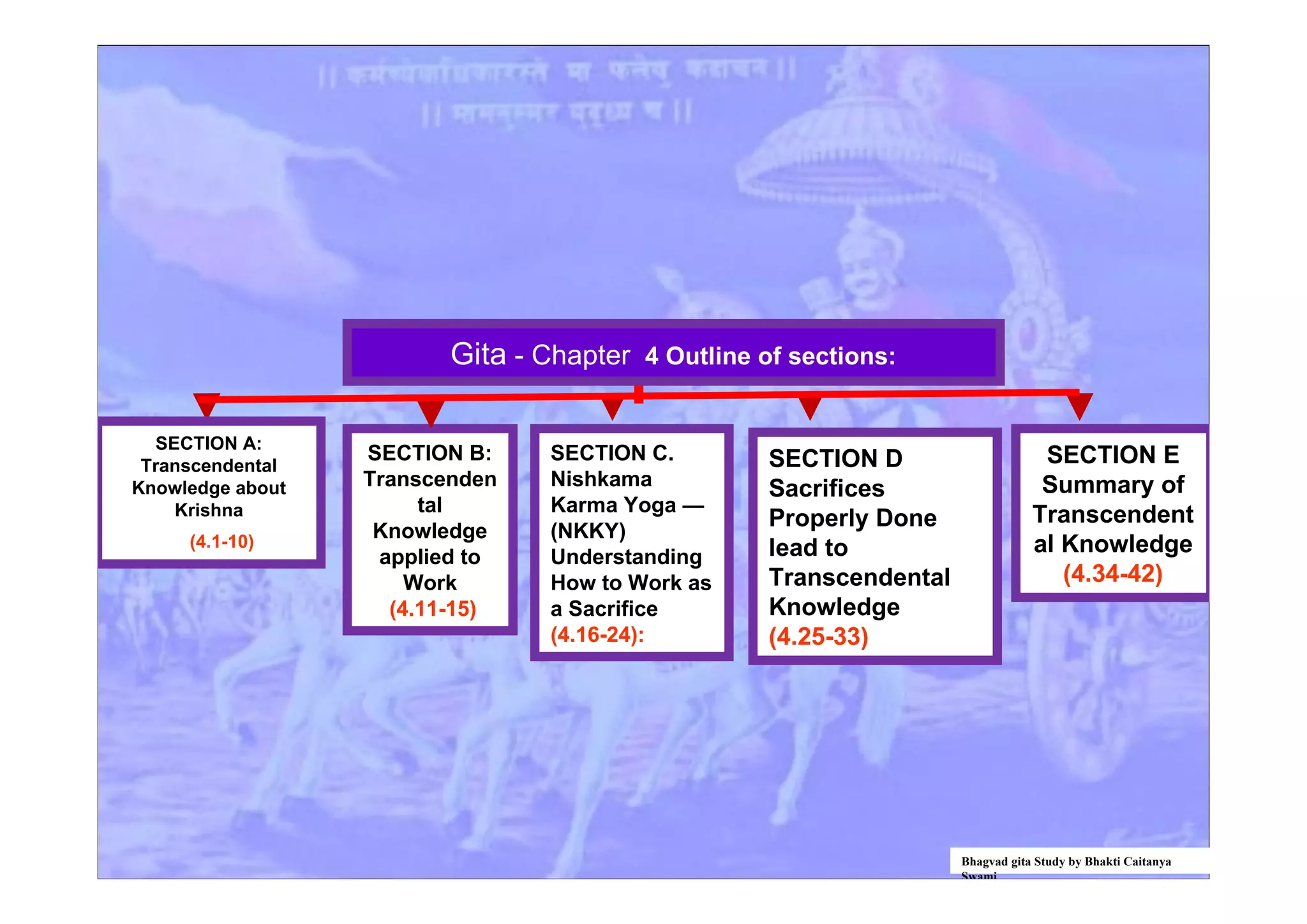
SECTION B:
Transcenden
tal
Knowledge
applied to
Work
(4.11-15)
SECTION C.
Nishkama
Karma Yoga —
(NKKY)
Understanding
How to Work as
a Sacrifice
(4.16-24):
SECTION D
Sacrifices
Properly Done
lead to
Transcendental
Knowledge
(4.25-33)
SECTION E
Summary of
Transcendent
al Knowledge
(4.34-42)
Gita - Chapter 4 Outline of sections:
SECTION A:
Transcendental
Knowledge about
Krishna
(4.1-10)
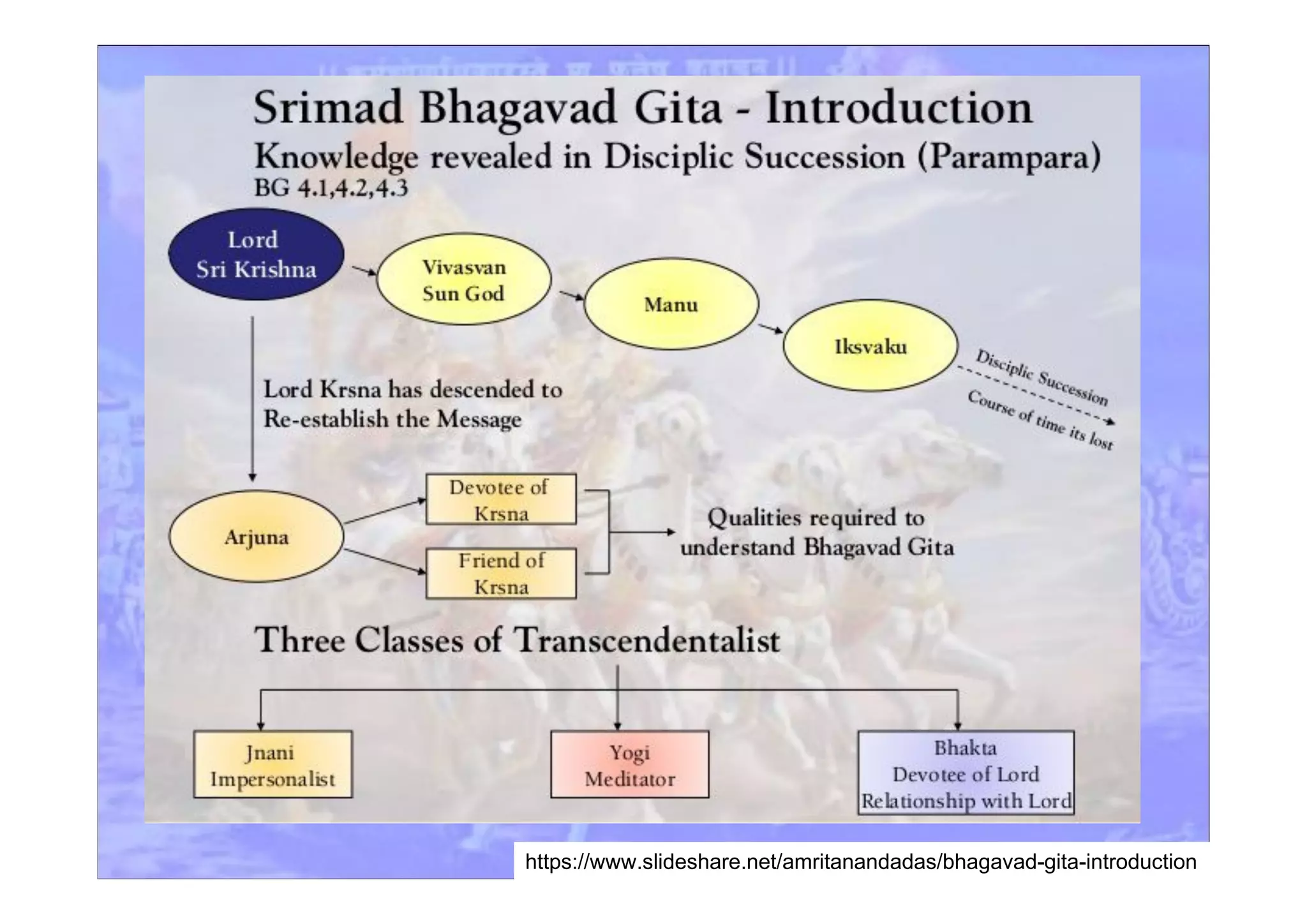
https://www.slideshare.net/amritanandadas/bhagavad-gita-introduction
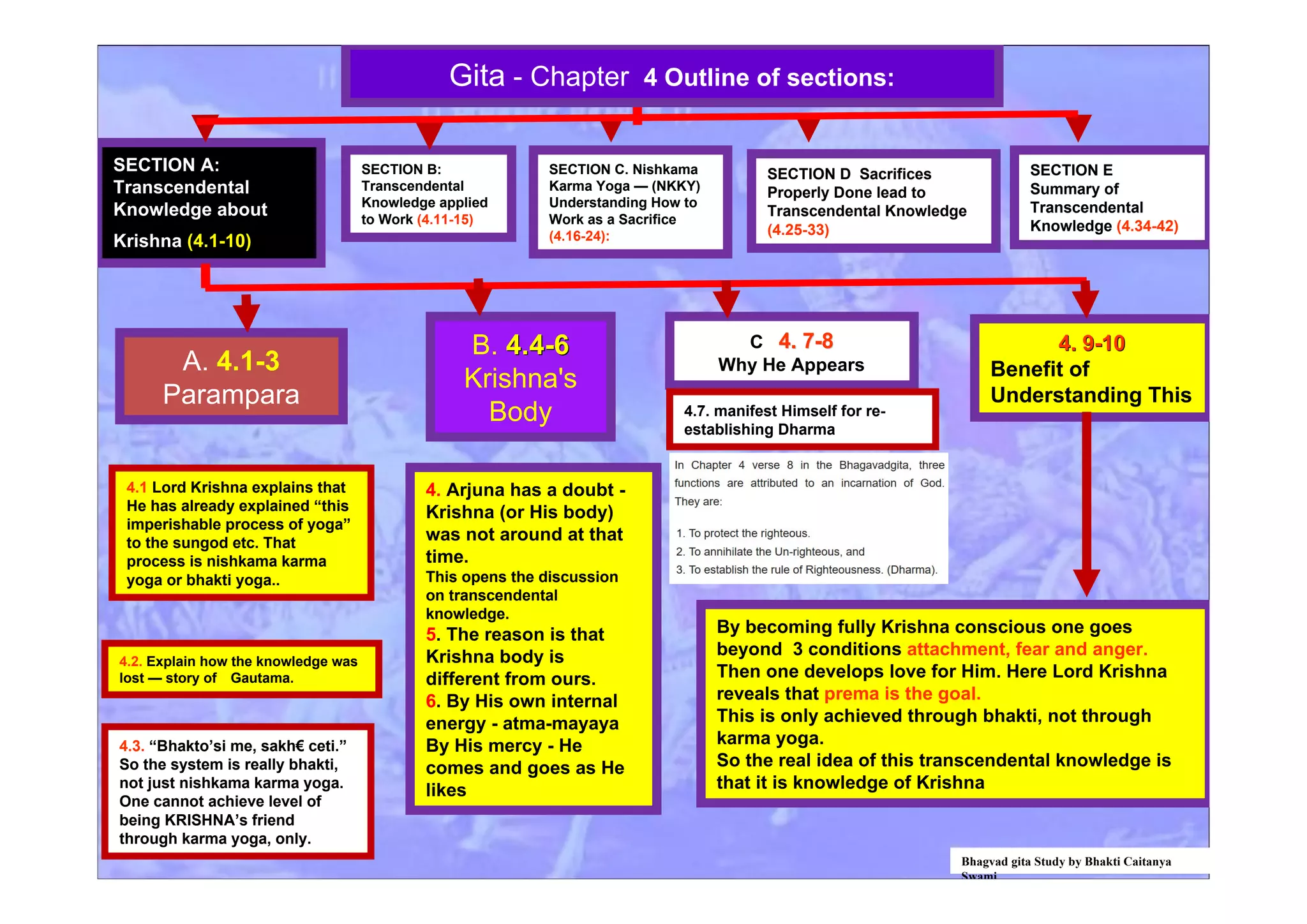
A. 4.1-3
Parampara
4. Arjuna has a doubt -
Krishna (or His body)
was not around at that
time.
This opens the discussion
on transcendental
knowledge.
5. The reason is that
Krishna body is
different from ours.
6. By His own internal
energy - atma-mayaya
By His mercy - He
comes and goes as He
likes
By becoming fully Krishna conscious one goes
beyond 3 conditions attachment, fear and anger.
Then one develops love for Him. Here Lord Krishna
reveals that prema is the goal.
This is only achieved through bhakti, not through
karma yoga.
So the real idea of this transcendental knowledge is
that it is knowledge of Krishna
B. 4.4-64.4-6
Krishna's
Body
C 4. 7-84. 7-8
Why He Appears
4. 9-104. 9-10
Benefit of
Understanding This
4.3. “Bhakto’si me, sakh€ ceti.”
So the system is really bhakti,
not just nishkama karma yoga.
One cannot achieve level of
being KRISHNA’s friend
through karma yoga, only.
4.2. Explain how the knowledge was
lost — story of Gautama.
4.1 Lord Krishna explains that
He has already explained “this
imperishable process of yoga”
to the sungod etc. That
process is nishkama karma
yoga or bhakti yoga..
SECTION A:
Transcendental
Knowledge about
Krishna (4.1-10)
SECTION B:
Transcendental
Knowledge applied
to Work (4.11-15)
SECTION C. Nishkama
Karma Yoga — (NKKY)
Understanding How to
Work as a Sacrifice
(4.16-24):
SECTION D Sacrifices
Properly Done lead to
Transcendental Knowledge
(4.25-33)
SECTION E
Summary of
Transcendental
Knowledge (4.34-42)
Gita - Chapter 4 Outline of sections:
4.7. manifest Himself for re-
establishing Dharma
Bhagvad gita Study by Bhakti Caitanya
Swami
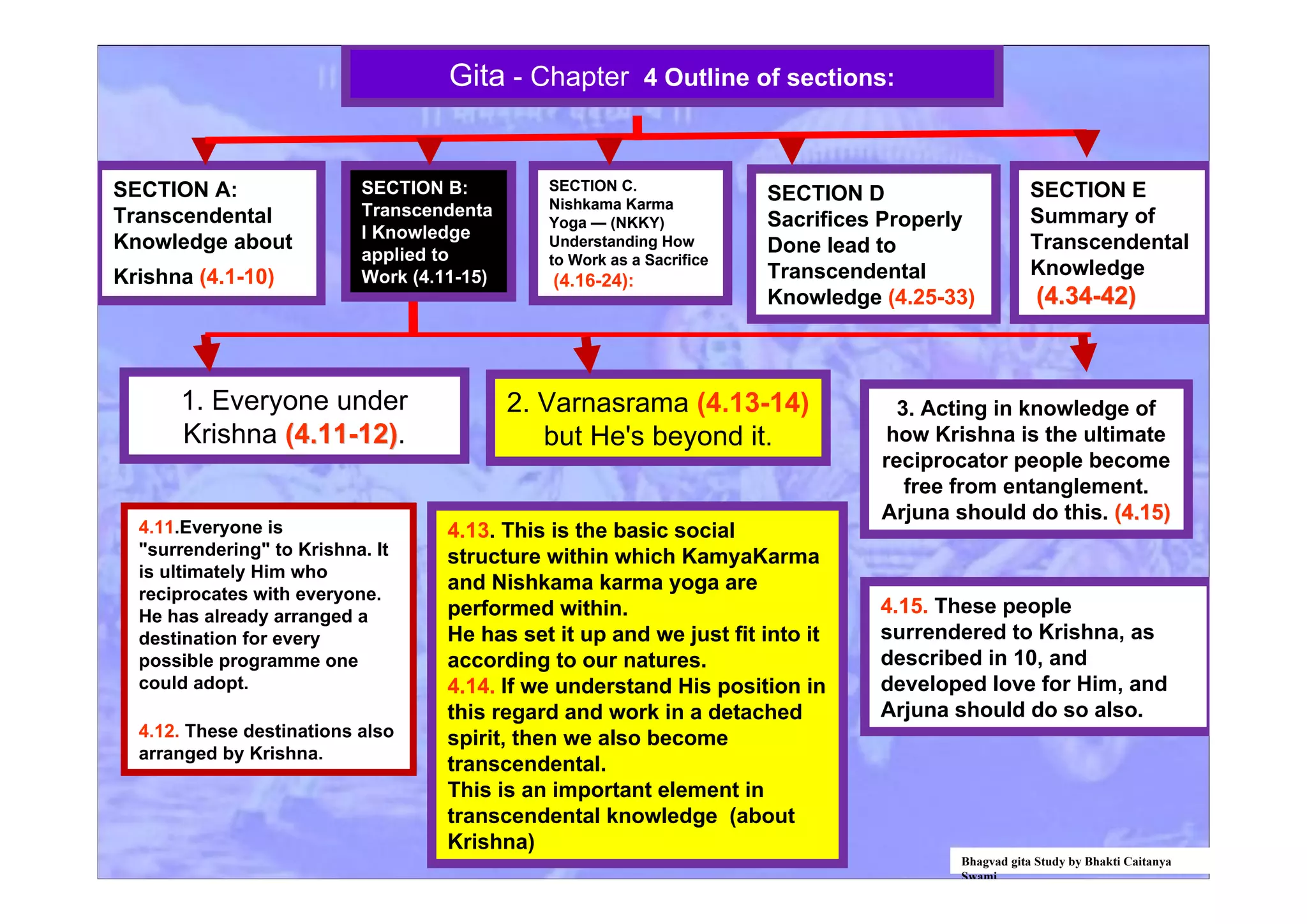
1. Everyone under
Krishna (4.11-12)(4.11-12).
4.13. This is the basic social
structure within which KamyaKarma
and Nishkama karma yoga are
performed within.
He has set it up and we just fit into it
according to our natures.
4.14. If we understand His position in
this regard and work in a detached
spirit, then we also become
transcendental.
This is an important element in
transcendental knowledge (about
Krishna)
2. Varnasrama (4.13-14)
but He's beyond it.
3. Acting in knowledge of
how Krishna is the ultimate
reciprocator people become
free from entanglement.
Arjuna should do this. (4.15)(4.15)
4.11.Everyone is
"surrendering" to Krishna. It
is ultimately Him who
reciprocates with everyone.
He has already arranged a
destination for every
possible programme one
could adopt.
4.12. These destinations also
arranged by Krishna.
4.15. These people
surrendered to Krishna, as
described in 10, and
developed love for Him, and
Arjuna should do so also.
SECTION A:
Transcendental
Knowledge about
Krishna (4.1-10)
SECTION B:
Transcendenta
l Knowledge
applied to
Work (4.11-15)
SECTION C.
Nishkama Karma
Yoga — (NKKY)
Understanding How
to Work as a Sacrifice
(4.16-24):
SECTION D
Sacrifices Properly
Done lead to
Transcendental
Knowledge (4.25-33)
SECTION E
Summary of
Transcendental
Knowledge
((4.4.34-42)34-42)
Gita - Chapter 4 Outline of sections:
Bhagvad gita Study by Bhakti Caitanya
Swami
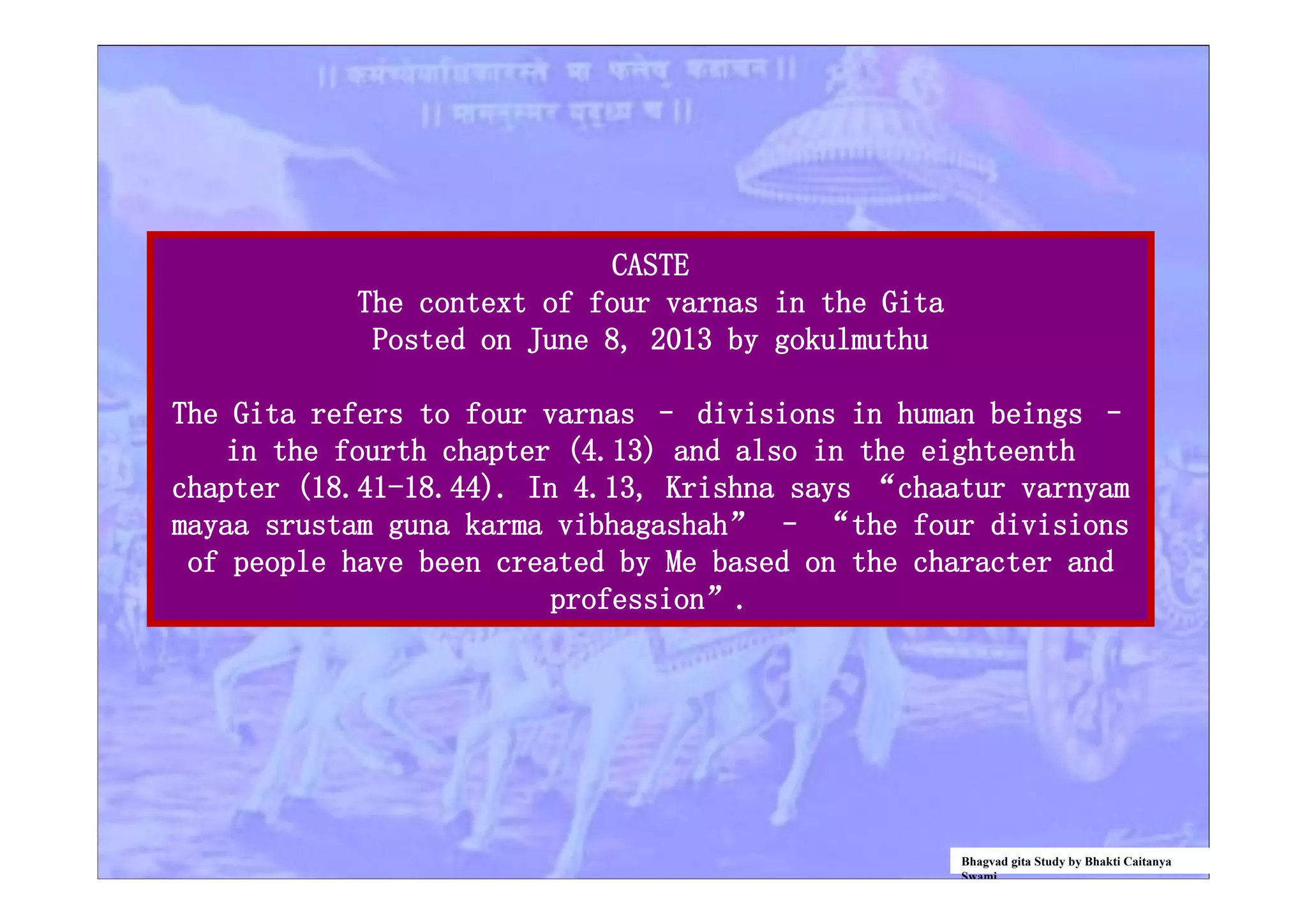
CASTE
The context of four varnas in the Gita
Posted on June 8, 2013 by gokulmuthu
The Gita refers to four varnas – divisions in human beings –
in the fourth chapter (4.13) and also in the eighteenth
chapter (18.41-18.44). In 4.13, Krishna says “chaatur varnyam
mayaa srustam guna karma vibhagashah” – “the four divisions
of people have been created by Me based on the character and
profession”.
Bhagvad gita Study by Bhakti Caitanya
Swami
When one meditates
in the morning, he is
a brahmana. .
For the kshatriya
class, (warriors
and protectors),
courage, valour,
braveness,
cleverness,
charity, authority,
and able to fight
without receding
are the expected
qualities.
For a Brahmana
(scholars or priestly
class), it should be
natural to have the
qualities such as
self control,
tranquility, penance,
cleanliness,
patience,
straightforwardnes
s, knowledge,
experience and
care.
To serve everyone is
the duty of Sudras.
When he fights for
the country, he is
indeed a kshatriya.
When he undertakes
trade activity later in
the day, he is a
vysya.
When he is doing
work for the
societies benefit, he
is a sudra.
Everyone has all these four qualities. This is the
message we must learn from Gandhi’s life.
Protecting cows,
looking after
farming and trade
are the duties of
Vysya (farmers
and tradesmen)
class.
When we categorize people based on action, with their innate
tendencies guiding them, there are no life-long brahmana or
life-long sudras
98 day http://gita108days.blogspot.com/
Sudras are entitled
to attain the goal
dharma (duty)
Vysyas, the arthha
(wealth).
Brahmanas to
moksha (liberation).
Kshatriyas are
entitled to
kamas
(aspirations)
4.164.16. By right action, he attains freedom.By wrong action man binds himself to endless samsara.
4.17.4.17. “To understand Krsna consciousness and action according to its modes, one has to learn
one's relationship with the Supreme; i.e., one who has learned perfectly knows that every living
entity is an eternal servitor of the Lord We have to understand what is:
karma, vikarma ,akarma
4.184.18. Inaction in action
It is only the ignorant that regard the Self as active. But the wise person regards the Self as actionless even when he himself is engaged in
action. Activity belongs to the senses, the body and the mind. It is a function of the Gunas.
Action in inaction
The body, the senses and the mind, regarded by the ignorant as actionless, are perceived by the wise to be active. Hence he sees action
in what the ignorant think to be inaction.
4.19.4.19. perfect spiritual knowledge; highest non-dual realization of Self). When that vision is gained,
all karma becomes ineffective and harmless. The fire of jñâna (wisdom) has the power to consume
and burn
4.20-244.20-24 describe akarma or Nishkama karma mainly in quite broad terms, which may be applied to
Krishna consciousness or less personal approaches..
SECTION A:
Transcendental
Knowledge about Krishna
(4.1-10)
SECTION B:
Transcendental
Knowledge applied
to Work (4.11-15)
SECTION C.
Nishkama Karma
Yoga — (NKKY)
Understanding
How to Work as a
Sacrifice
(4.16-24):
SECTION D Sacrifices
Properly Done lead to
Transcendental Knowledge
(4.25-33)
SECTION E
Summary of
Transcendental
Knowledge (4.34-42)
Gita - Chapter 4 Outline of sections:
Bhagvad gita Study by Bhakti Caitanya
Swami
D1. Different types of bona fide sacrifices which lead to
transcendental knowledge to differing degrees(25-32) These are all
recommended processes, coming from the Vedas. 4.25-32
Basic idea is that there are many bona fide
sacrifices which can help a person to develop
transcendental knowledge, (which may be of
brahman — not necessarily Krishna
consciousness), if they are done properly, as
per 3rd chapter section about how karma kanda
can bring one to karma yoga etc.
D2. Transcendental Kowledge leading to
liberation and ultimately Devotional Service.
(4.33)
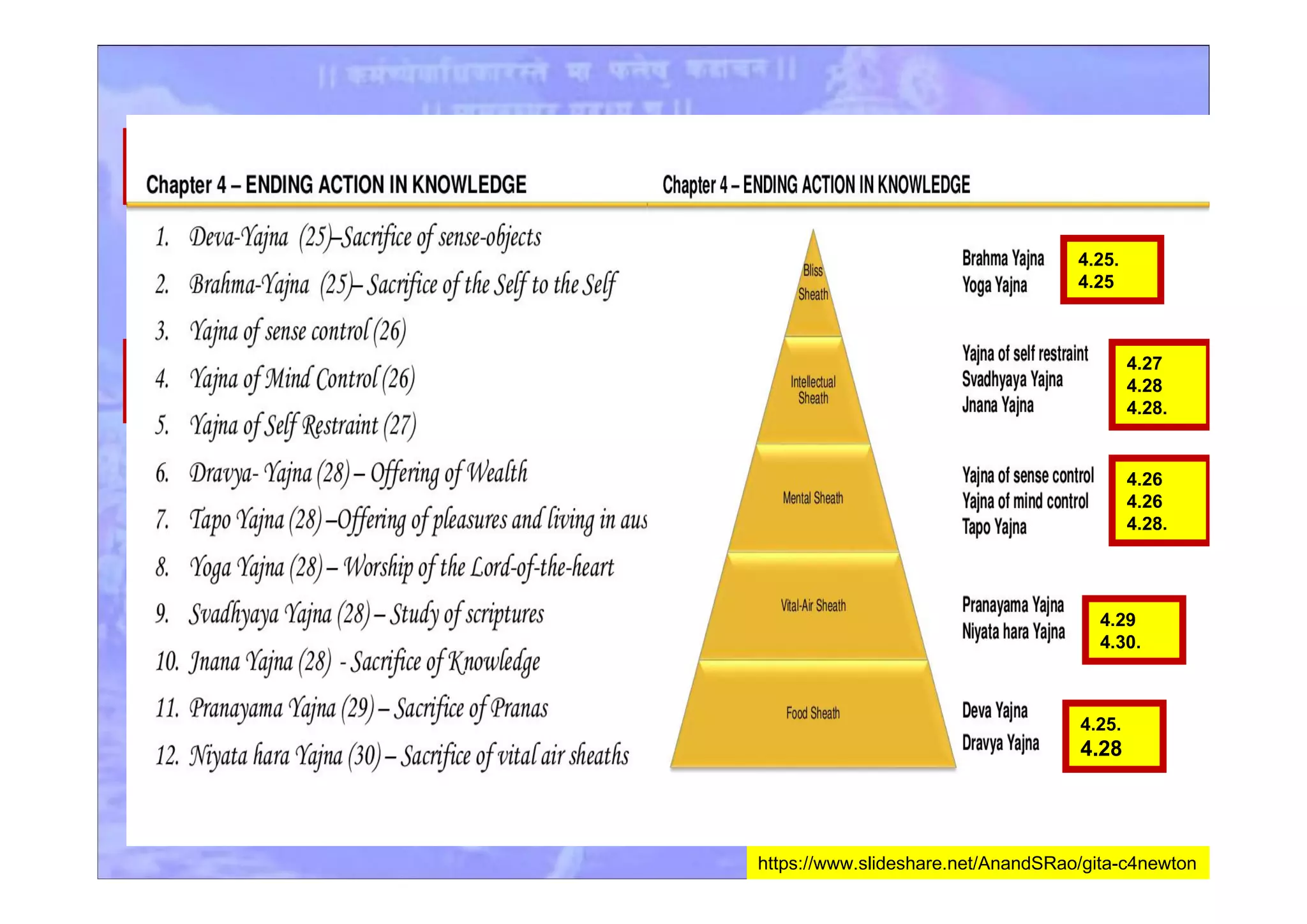
4.4.25.25. Sacrifices in demigod worship and Brahman
realization.
4.4.2626. Sacrifice of following asramas.
4.4.2727. Some, inspired by knowledge, offer the functions of
all their senses and their life energy in the fire of the
controlled mind.
4.4.28.28.Some offer wealth as sacrifice, austerities as
sacrifice. eight-fold path of yogic practices, study the
scriptures and cultivate knowledge as sacrifice, while
observing strict vows.
4.4.29.29. Part of pranayama process of astanga yoga.
4.4.3030. These are all bona fide processes and purify the
performers, and they advance towards spiritual realization.
4.4.3131. Sacrifice essential.
4.4.32.32. They are to help the performers achieve liberation.
SECTION A:
Transcendental
Knowledge about Krishna
(4.1-10)
SECTION B:
Transcendental
Knowledge applied
to Work (4.11-15)
SECTION C. Nishkama
Karma Yoga — (NKKY)
Understanding How to
Work as a Sacrifice
(4.16-24):
SECTION D
Sacrifices Properly
Done lead to
Transcendental
Knowledge (4.25-33)
SECTION E
Summary of
Transcendental
Knowledge
( 4.34-42 )
Gita - Chapter 4 Outline of sections:
Bhagvad gita Study by Bhakti Caitanya
Swami
R
P
https://www.slideshare.net/AnandSRao/gita-c4newton
4.25.
4.25
4.27
4.28
4.28.
4.26
4.26
4.28.
4.29
4.30.
4.25.
4.28
4.4.3434. What “truth” is to be learned in this way? The truth about Krishna, as explained in the beginning
of this chapter, and is going to be explained in the next verse. Also the truth of how to perform
sacrifice so you can realize K Ša. How do you get it — approach guru.
As mentioned above, there are so many sacrifices. They are all beneficial in different ways.
One needs to know which is best
4.4.35.35. This is the realization that comes through developing this knowledge. Indicates full
understanding of science of KC.
4.4.36-3836-38. The fruits of tk.
4.4.39.39. Who can achieve perfection through tk? Faithful person who follows process (of devotional
service, as described in verse 41).
4.4.4040. Not faithless.
3 varieties referred to in ppt:
ajna - no knowledge
asraddadhana - read many scriptures but have no faith
samsaya atma - doubter - may like Gita, but not accept Krishna.
41-4241-42. Results of acting in ni k€ma karma yoga or bhakti yoga on basis of transcendental knowledge.
SECTION A:
Transcendental
Knowledge about Krishna
(1-10)
SECTION B:
Transcendental
Knowledge applied
to Work (11-15)
SECTION C. Nishkama
Karma Yoga — (NKKY)
Understanding How to
Work as a Sacrifice (16-
24):
SECTION D Sacrifices
Properly Done lead to
Transcendental Knowledge
(25-33)
SECTION E
Summary of
Transcendental
Knowledge
((4.4.34-42)34-42)
Gita - Chapter 4 Outline of sections:
Bhagvad gita Study by Bhakti Caitanya
Swami
4.34
PROSTRATION INQUIRY SERVICE
physical surrender by
prostration before the
Master
The student should be ever
ready to raise doubts about
bondage and liberation and
about knowledge and
ignorance etc
Service does not imply any
physical service or offering
of material objects but it
means the attunement of
the student to the principles
of life advised to him by the
Master.
an intellectual attitude of
humility, reverence and
obedience when he
approaches the teacher for
receiving instructions. The
student should exhibit
readiness to understand,
grasp and follow the
Master's instructions.
Discussions between the
teacher and the taught bring
forth the best from the
teacher which gets
transferred to the student.
OM SHANTI
OM SHANTI
OM SHANTI
Om- let all the deficiencies of this book go away
Tat- let this give Bhagavan great happiness
Sat- let this give true lasting benefits

BHAGVAD GITA CHAPTER 4 , FLOWCHARTS

  • 1.
    Compiled by Dr. Medicherlashyam Sunder Kumar samc108@gmail.com BHAGVAD GITA CHAPTER 4, FLOWCHARTSBHAGVAD GITA CHAPTER 4, FLOWCHARTS
  • 2.
    Based on teachingsof Bhagvad gita Study by Bhakti Caitanya Swami
  • 3.
    Gita - There isan increase of knowledge. with knowledge of the soul as distinct from matter,. Fifth chapter how it should increase up to the level of the Supersoul, as the person advances in working in the detached spirit, for liberation, with good association. Selfish karma When one performs nishkäma karma yoga on the level of knowledge of the soul only, then he tends to remain impersonal, In the sixth chapter the idea that the Supersoul is an expansion of Krishna will be introduced, and then finally that one should relate with Krishna through bhakti. Chapters 2 - 4 but when his knowledge increases and he understands how the material world is running, and that there is a higher controller,as seen in the fifth chapter, then he develops a consciousness of the Supersoul Through the practice of nishkäma karma yoga (Unselfish) Chapter 5 Chapter 6 Chapter 1 Kauravas Bhagvad gita Study by Bhakti Caitanya Swami
  • 4.
    Chapter 4 : JnanaYoga {42 Slokas / Verses} Bhagvad gita Study by Bhakti Caitanya Swami
  • 6.
    Bhagvad gita Studyby Bhakti Caitanya Swami SECTION B: Transcenden tal Knowledge applied to Work (4.11-15) SECTION C. Nishkama Karma Yoga — (NKKY) Understanding How to Work as a Sacrifice (4.16-24): SECTION D Sacrifices Properly Done lead to Transcendental Knowledge (4.25-33) SECTION E Summary of Transcendent al Knowledge (4.34-42) Gita - Chapter 4 Outline of sections: SECTION A: Transcendental Knowledge about Krishna (4.1-10)
  • 7.
  • 8.
    A. 4.1-3 Parampara 4. Arjunahas a doubt - Krishna (or His body) was not around at that time. This opens the discussion on transcendental knowledge. 5. The reason is that Krishna body is different from ours. 6. By His own internal energy - atma-mayaya By His mercy - He comes and goes as He likes By becoming fully Krishna conscious one goes beyond 3 conditions attachment, fear and anger. Then one develops love for Him. Here Lord Krishna reveals that prema is the goal. This is only achieved through bhakti, not through karma yoga. So the real idea of this transcendental knowledge is that it is knowledge of Krishna B. 4.4-64.4-6 Krishna's Body C 4. 7-84. 7-8 Why He Appears 4. 9-104. 9-10 Benefit of Understanding This 4.3. “Bhakto’si me, sakh€ ceti.” So the system is really bhakti, not just nishkama karma yoga. One cannot achieve level of being KRISHNA’s friend through karma yoga, only. 4.2. Explain how the knowledge was lost — story of Gautama. 4.1 Lord Krishna explains that He has already explained “this imperishable process of yoga” to the sungod etc. That process is nishkama karma yoga or bhakti yoga.. SECTION A: Transcendental Knowledge about Krishna (4.1-10) SECTION B: Transcendental Knowledge applied to Work (4.11-15) SECTION C. Nishkama Karma Yoga — (NKKY) Understanding How to Work as a Sacrifice (4.16-24): SECTION D Sacrifices Properly Done lead to Transcendental Knowledge (4.25-33) SECTION E Summary of Transcendental Knowledge (4.34-42) Gita - Chapter 4 Outline of sections: 4.7. manifest Himself for re- establishing Dharma Bhagvad gita Study by Bhakti Caitanya Swami
  • 9.
    1. Everyone under Krishna(4.11-12)(4.11-12). 4.13. This is the basic social structure within which KamyaKarma and Nishkama karma yoga are performed within. He has set it up and we just fit into it according to our natures. 4.14. If we understand His position in this regard and work in a detached spirit, then we also become transcendental. This is an important element in transcendental knowledge (about Krishna) 2. Varnasrama (4.13-14) but He's beyond it. 3. Acting in knowledge of how Krishna is the ultimate reciprocator people become free from entanglement. Arjuna should do this. (4.15)(4.15) 4.11.Everyone is "surrendering" to Krishna. It is ultimately Him who reciprocates with everyone. He has already arranged a destination for every possible programme one could adopt. 4.12. These destinations also arranged by Krishna. 4.15. These people surrendered to Krishna, as described in 10, and developed love for Him, and Arjuna should do so also. SECTION A: Transcendental Knowledge about Krishna (4.1-10) SECTION B: Transcendenta l Knowledge applied to Work (4.11-15) SECTION C. Nishkama Karma Yoga — (NKKY) Understanding How to Work as a Sacrifice (4.16-24): SECTION D Sacrifices Properly Done lead to Transcendental Knowledge (4.25-33) SECTION E Summary of Transcendental Knowledge ((4.4.34-42)34-42) Gita - Chapter 4 Outline of sections: Bhagvad gita Study by Bhakti Caitanya Swami
  • 10.
    CASTE The context offour varnas in the Gita Posted on June 8, 2013 by gokulmuthu The Gita refers to four varnas – divisions in human beings – in the fourth chapter (4.13) and also in the eighteenth chapter (18.41-18.44). In 4.13, Krishna says “chaatur varnyam mayaa srustam guna karma vibhagashah” – “the four divisions of people have been created by Me based on the character and profession”. Bhagvad gita Study by Bhakti Caitanya Swami
  • 11.
    When one meditates inthe morning, he is a brahmana. . For the kshatriya class, (warriors and protectors), courage, valour, braveness, cleverness, charity, authority, and able to fight without receding are the expected qualities. For a Brahmana (scholars or priestly class), it should be natural to have the qualities such as self control, tranquility, penance, cleanliness, patience, straightforwardnes s, knowledge, experience and care. To serve everyone is the duty of Sudras. When he fights for the country, he is indeed a kshatriya. When he undertakes trade activity later in the day, he is a vysya. When he is doing work for the societies benefit, he is a sudra. Everyone has all these four qualities. This is the message we must learn from Gandhi’s life. Protecting cows, looking after farming and trade are the duties of Vysya (farmers and tradesmen) class. When we categorize people based on action, with their innate tendencies guiding them, there are no life-long brahmana or life-long sudras 98 day http://gita108days.blogspot.com/ Sudras are entitled to attain the goal dharma (duty) Vysyas, the arthha (wealth). Brahmanas to moksha (liberation). Kshatriyas are entitled to kamas (aspirations)
  • 12.
    4.164.16. By rightaction, he attains freedom.By wrong action man binds himself to endless samsara. 4.17.4.17. “To understand Krsna consciousness and action according to its modes, one has to learn one's relationship with the Supreme; i.e., one who has learned perfectly knows that every living entity is an eternal servitor of the Lord We have to understand what is: karma, vikarma ,akarma 4.184.18. Inaction in action It is only the ignorant that regard the Self as active. But the wise person regards the Self as actionless even when he himself is engaged in action. Activity belongs to the senses, the body and the mind. It is a function of the Gunas. Action in inaction The body, the senses and the mind, regarded by the ignorant as actionless, are perceived by the wise to be active. Hence he sees action in what the ignorant think to be inaction. 4.19.4.19. perfect spiritual knowledge; highest non-dual realization of Self). When that vision is gained, all karma becomes ineffective and harmless. The fire of jñâna (wisdom) has the power to consume and burn 4.20-244.20-24 describe akarma or Nishkama karma mainly in quite broad terms, which may be applied to Krishna consciousness or less personal approaches.. SECTION A: Transcendental Knowledge about Krishna (4.1-10) SECTION B: Transcendental Knowledge applied to Work (4.11-15) SECTION C. Nishkama Karma Yoga — (NKKY) Understanding How to Work as a Sacrifice (4.16-24): SECTION D Sacrifices Properly Done lead to Transcendental Knowledge (4.25-33) SECTION E Summary of Transcendental Knowledge (4.34-42) Gita - Chapter 4 Outline of sections: Bhagvad gita Study by Bhakti Caitanya Swami
  • 13.
    D1. Different typesof bona fide sacrifices which lead to transcendental knowledge to differing degrees(25-32) These are all recommended processes, coming from the Vedas. 4.25-32 Basic idea is that there are many bona fide sacrifices which can help a person to develop transcendental knowledge, (which may be of brahman — not necessarily Krishna consciousness), if they are done properly, as per 3rd chapter section about how karma kanda can bring one to karma yoga etc. D2. Transcendental Kowledge leading to liberation and ultimately Devotional Service. (4.33) 4.4.25.25. Sacrifices in demigod worship and Brahman realization. 4.4.2626. Sacrifice of following asramas. 4.4.2727. Some, inspired by knowledge, offer the functions of all their senses and their life energy in the fire of the controlled mind. 4.4.28.28.Some offer wealth as sacrifice, austerities as sacrifice. eight-fold path of yogic practices, study the scriptures and cultivate knowledge as sacrifice, while observing strict vows. 4.4.29.29. Part of pranayama process of astanga yoga. 4.4.3030. These are all bona fide processes and purify the performers, and they advance towards spiritual realization. 4.4.3131. Sacrifice essential. 4.4.32.32. They are to help the performers achieve liberation. SECTION A: Transcendental Knowledge about Krishna (4.1-10) SECTION B: Transcendental Knowledge applied to Work (4.11-15) SECTION C. Nishkama Karma Yoga — (NKKY) Understanding How to Work as a Sacrifice (4.16-24): SECTION D Sacrifices Properly Done lead to Transcendental Knowledge (4.25-33) SECTION E Summary of Transcendental Knowledge ( 4.34-42 ) Gita - Chapter 4 Outline of sections: Bhagvad gita Study by Bhakti Caitanya Swami
  • 14.
  • 15.
    4.4.3434. What “truth”is to be learned in this way? The truth about Krishna, as explained in the beginning of this chapter, and is going to be explained in the next verse. Also the truth of how to perform sacrifice so you can realize K Ša. How do you get it — approach guru. As mentioned above, there are so many sacrifices. They are all beneficial in different ways. One needs to know which is best 4.4.35.35. This is the realization that comes through developing this knowledge. Indicates full understanding of science of KC. 4.4.36-3836-38. The fruits of tk. 4.4.39.39. Who can achieve perfection through tk? Faithful person who follows process (of devotional service, as described in verse 41). 4.4.4040. Not faithless. 3 varieties referred to in ppt: ajna - no knowledge asraddadhana - read many scriptures but have no faith samsaya atma - doubter - may like Gita, but not accept Krishna. 41-4241-42. Results of acting in ni k€ma karma yoga or bhakti yoga on basis of transcendental knowledge. SECTION A: Transcendental Knowledge about Krishna (1-10) SECTION B: Transcendental Knowledge applied to Work (11-15) SECTION C. Nishkama Karma Yoga — (NKKY) Understanding How to Work as a Sacrifice (16- 24): SECTION D Sacrifices Properly Done lead to Transcendental Knowledge (25-33) SECTION E Summary of Transcendental Knowledge ((4.4.34-42)34-42) Gita - Chapter 4 Outline of sections: Bhagvad gita Study by Bhakti Caitanya Swami
  • 16.
    4.34 PROSTRATION INQUIRY SERVICE physicalsurrender by prostration before the Master The student should be ever ready to raise doubts about bondage and liberation and about knowledge and ignorance etc Service does not imply any physical service or offering of material objects but it means the attunement of the student to the principles of life advised to him by the Master. an intellectual attitude of humility, reverence and obedience when he approaches the teacher for receiving instructions. The student should exhibit readiness to understand, grasp and follow the Master's instructions. Discussions between the teacher and the taught bring forth the best from the teacher which gets transferred to the student.
  • 17.
    OM SHANTI OM SHANTI OMSHANTI Om- let all the deficiencies of this book go away Tat- let this give Bhagavan great happiness Sat- let this give true lasting benefits