Jessina Branyan-Samuel
Medical Terminology-Biology 120
The Nervous System
Suffixes: -plegia and -paresis
The Nervous System
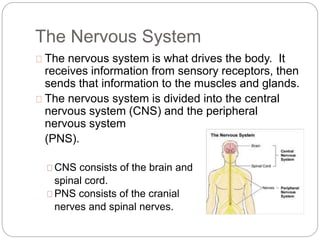
The nervous system is what drives the body. It
receives information from sensory receptors, then
sends that information to the muscles and glands.
The nervous system is divided into the central
nervous system (CNS) and the peripheral
nervous system
(PNS).
CNS consists of the brain and
spinal cord.
PNS consists of the cranial
nerves and spinal nerves.
The Nervous System
Central
Nervous
System (CNS)
The CNS consists of
the brain and spinal
cord.
The sensory nerves
carry information to the
CNS and motor nerves
carry commands away
from the CNS.
Peripheral
Nervous
System (PNS)
The PNS consists of
the cranial nerves and
spinal nerves.
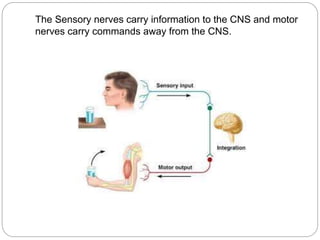
The Sensory nerves carry information to the CNS and motor
nerves carry commands away from the CNS.
Sometimes the sensory input and/or motor
output are compromised due to disease,
illness, or accidents.
Two suffixes that are related to the nervous system
and affected are:
-plegia
-paresis
-plegia
-plegia means paralysis
Examples of medical terms using –plegia;
monoplegia meaning paralysis of one limb.
paraplegia meaning paralysis of the lower portion
of the body and both legs.
quadriplegia meaning paralysis of all four
extremities.
-paresis
-paresis means weakness
Examples of medical terms using –paresis;
hemiparesis meaning weakness or loss of motion
on one side of the body.
monoparesis meaning muscle weakness in one
limb.
Causes related to –plegia
Bell’s palsy is paralysis on one side of the face due to
inflammation of a facial nerve. The patient isn’t able
to control saliva, tearing of the eye, or expression.
However, most will recover.
Guillain-Barre syndrome is disease of the nervous
system causing the nerves to lose their myelin
covering due to an autoimmune reaction. Loss of
sensation or muscle control starts in the legs, move to
the trunk eventually paralyzing the diaphragm.
Spinal cord injury (SCI) is damage to the spinal cord,
it can be either bruised or completely severed.
Causes related to -paresis
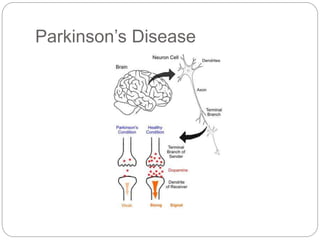
Parkinson’s Disease is a chronic disorder of the nervous system.
Muscular weakness is one symptom, others are fine tremors, rigidity,
and shuffle gait. Please refer to diagram on the next slide for an
example of the affect of Parkinson’s disease.
Transient ischemic attack (TIA) is temporary interference with blood
supply to the brain. This causes symptoms like hemiparesis, dizziness,
numbness, possible leading to a full stroke.
Amyotrophic lateral sclerosis (ALS) is a disease specifically with muscle
weakness due to the degeneration of the motor neurons of the spinal
cord.
Multiple sclerosis is an inflammatory disease of the CNS with extreme
weakness and numbness because of myelin insulation loss.
Myasthenia gravis is a disease with severe muscle weakness and
fatigue due to missing neurotransmitter at a synapse.
Parkinson’s Disease
Some of these pathologies can be treated with
some form of medical or physical treatment such
as; medication or physical therapy, with a goal of
partial or full recovery. Others will demand a long
term treatment plan.
References
Fremgen, Bonnie F., & Frucht, Suzanne S. (2013).
Medical Terminology A Living Language. Pearson
Education.
The Nervous System [Online image]. Retrieved July 8th, 2014
from
http://www.urmc.rochester.edu/MediaLibraries/URMCMedia/hh/s
ervices-centers/Neurosurgery/Nervous-System-small.jpg
[Untitled image of the CNS-Sensory Input and motor output].
Retrieved July 8th, 2014 from
http://t3.gstatic.com/images?q=tbn:ANd9GcTLxph2648yH5arzjM
-lKFDmBpG1Q7KuwBaeqFZ_Whu1-XCR-V5Og
[Untitled image of diagram showing affects of Parkinson’s
Disease]. Retrieved July 9th, 2014 from
http://www.science.ca/images/Brain_Calne.jpg

Ch. 12 the nervous system-JBS

  • 1.
    Jessina Branyan-Samuel Medical Terminology-Biology120 The Nervous System Suffixes: -plegia and -paresis
  • 2.
    The Nervous System Thenervous system is what drives the body. It receives information from sensory receptors, then sends that information to the muscles and glands. The nervous system is divided into the central nervous system (CNS) and the peripheral nervous system (PNS). CNS consists of the brain and spinal cord. PNS consists of the cranial nerves and spinal nerves.
  • 3.
    The Nervous System Central Nervous System(CNS) The CNS consists of the brain and spinal cord. The sensory nerves carry information to the CNS and motor nerves carry commands away from the CNS. Peripheral Nervous System (PNS) The PNS consists of the cranial nerves and spinal nerves.
  • 4.
    The Sensory nervescarry information to the CNS and motor nerves carry commands away from the CNS.
  • 5.
    Sometimes the sensoryinput and/or motor output are compromised due to disease, illness, or accidents. Two suffixes that are related to the nervous system and affected are: -plegia -paresis
  • 6.
    -plegia -plegia means paralysis Examplesof medical terms using –plegia; monoplegia meaning paralysis of one limb. paraplegia meaning paralysis of the lower portion of the body and both legs. quadriplegia meaning paralysis of all four extremities.
  • 7.
    -paresis -paresis means weakness Examplesof medical terms using –paresis; hemiparesis meaning weakness or loss of motion on one side of the body. monoparesis meaning muscle weakness in one limb.
  • 8.
    Causes related to–plegia Bell’s palsy is paralysis on one side of the face due to inflammation of a facial nerve. The patient isn’t able to control saliva, tearing of the eye, or expression. However, most will recover. Guillain-Barre syndrome is disease of the nervous system causing the nerves to lose their myelin covering due to an autoimmune reaction. Loss of sensation or muscle control starts in the legs, move to the trunk eventually paralyzing the diaphragm. Spinal cord injury (SCI) is damage to the spinal cord, it can be either bruised or completely severed.
  • 9.
    Causes related to-paresis Parkinson’s Disease is a chronic disorder of the nervous system. Muscular weakness is one symptom, others are fine tremors, rigidity, and shuffle gait. Please refer to diagram on the next slide for an example of the affect of Parkinson’s disease. Transient ischemic attack (TIA) is temporary interference with blood supply to the brain. This causes symptoms like hemiparesis, dizziness, numbness, possible leading to a full stroke. Amyotrophic lateral sclerosis (ALS) is a disease specifically with muscle weakness due to the degeneration of the motor neurons of the spinal cord. Multiple sclerosis is an inflammatory disease of the CNS with extreme weakness and numbness because of myelin insulation loss. Myasthenia gravis is a disease with severe muscle weakness and fatigue due to missing neurotransmitter at a synapse.
  • 10.
  • 11.
    Some of thesepathologies can be treated with some form of medical or physical treatment such as; medication or physical therapy, with a goal of partial or full recovery. Others will demand a long term treatment plan.
  • 12.
    References Fremgen, Bonnie F.,& Frucht, Suzanne S. (2013). Medical Terminology A Living Language. Pearson Education. The Nervous System [Online image]. Retrieved July 8th, 2014 from http://www.urmc.rochester.edu/MediaLibraries/URMCMedia/hh/s ervices-centers/Neurosurgery/Nervous-System-small.jpg [Untitled image of the CNS-Sensory Input and motor output]. Retrieved July 8th, 2014 from http://t3.gstatic.com/images?q=tbn:ANd9GcTLxph2648yH5arzjM -lKFDmBpG1Q7KuwBaeqFZ_Whu1-XCR-V5Og [Untitled image of diagram showing affects of Parkinson’s Disease]. Retrieved July 9th, 2014 from http://www.science.ca/images/Brain_Calne.jpg