Chapter 8
Dealing with the
Competition
PowerPoint by Karen E. James
Louisiana State University - Shreveport
©2003 Prentice Hall, Inc.

To accompany A Framework for

Slide 1 in
Objectives
 Understand how a company
identifies its primary competitors
and ascertains their strategies.
 Review how companies design
competitive intelligence systems.

©2003 Prentice Hall, Inc.

To accompany A Framework for

Slide 2 in
Objectives
 Learn how a company decides
whether to position itself as a
market leader, a challenger, a
follower, or a nicher.
 Identify how a company can
balance a customer vs. competitor
orientation.
©2003 Prentice Hall, Inc.

To accompany A Framework for

Slide 3 in
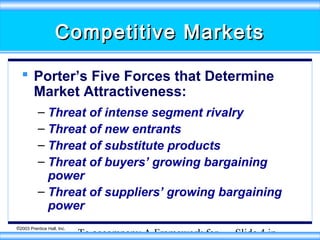
Competitive Markets
 Porter’s Five Forces that Determine
Market Attractiveness:
– Threat of intense segment rivalry
– Threat of new entrants
– Threat of substitute products
– Threat of buyers’ growing bargaining
power
– Threat of suppliers’ growing bargaining
power
©2003 Prentice Hall, Inc.

To accompany A Framework for

Slide 4 in
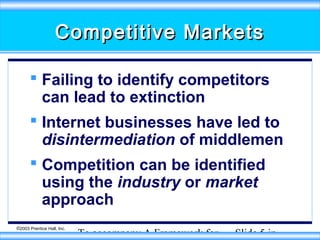
Competitive Markets
 Failing to identify competitors
can lead to extinction
 Internet businesses have led to
disintermediation of middlemen
 Competition can be identified
using the industry or market
approach
©2003 Prentice Hall, Inc.

To accompany A Framework for

Slide 5 in
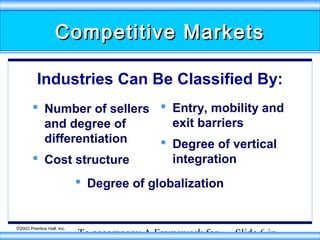
Competitive Markets
Industries Can Be Classified By:
 Number of sellers  Entry, mobility and
exit barriers
and degree of
differentiation
 Degree of vertical
 Cost structure
integration
 Degree of globalization

©2003 Prentice Hall, Inc.

To accompany A Framework for

Slide 6 in
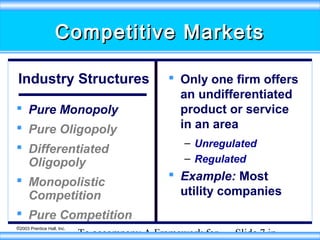
Competitive Markets
Industry Structures
 Pure Monopoly
 Pure Oligopoly
 Differentiated
Oligopoly
 Monopolistic
Competition
 Pure Competition
©2003 Prentice Hall, Inc.

 Only one firm offers
an undifferentiated
product or service
in an area
– Unregulated
– Regulated

 Example: Most
utility companies

To accompany A Framework for

Slide 7 in
Competitive Markets
Industry Structures
 Pure Monopoly
 Pure Oligopoly
 Differentiated
Oligopoly
 Monopolistic
Competition
 Pure Competition
©2003 Prentice Hall, Inc.

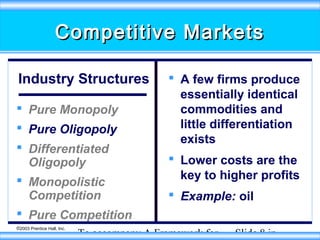
 A few firms produce
essentially identical
commodities and
little differentiation
exists
 Lower costs are the
key to higher profits
 Example: oil

To accompany A Framework for

Slide 8 in
Competitive Markets
Industry Structures
 Pure Monopoly
 Pure Oligopoly
 Differentiated
Oligopoly
 Monopolistic
Competition
 Pure Competition
©2003 Prentice Hall, Inc.

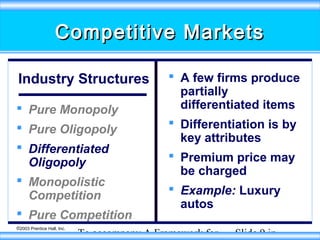
 A few firms produce
partially
differentiated items
 Differentiation is by
key attributes
 Premium price may
be charged
 Example: Luxury
autos

To accompany A Framework for

Slide 9 in
Competitive Markets
Industry Structures
 Pure Monopoly
 Pure Oligopoly
 Differentiated
Oligopoly
 Monopolistic
Competition
 Pure Competition
©2003 Prentice Hall, Inc.

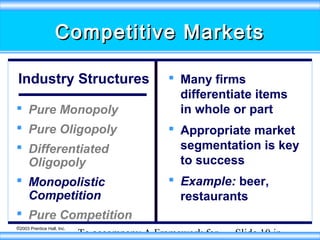
 Many firms
differentiate items
in whole or part
 Appropriate market
segmentation is key
to success
 Example: beer,
restaurants

To accompany A Framework for

Slide 10 in
Competitive Markets
Industry Structures
 Pure Monopoly
 Pure Oligopoly
 Differentiated
Oligopoly
 Monopolistic
Competition
 Pure Competition
©2003 Prentice Hall, Inc.

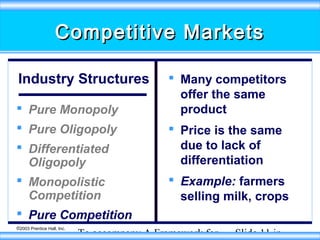
 Many competitors
offer the same
product
 Price is the same
due to lack of
differentiation
 Example: farmers
selling milk, crops

To accompany A Framework for

Slide 11 in
Competitive Markets
 A broader group of competitors
will be identified using the
market approach
 Competitor maps plot buying
steps in purchasing and using
the product, as well as direct and
indirect competitors
©2003 Prentice Hall, Inc.

To accompany A Framework for

Slide 12 in
Competitor Analysis
 Key characteristics of the
competition must be identified:
– Strategies
– Objectives
– Strengths and Weaknesses
Effect

a firm’s competitive position in
the target market

– Reaction Patterns
©2003 Prentice Hall, Inc.

To accompany A Framework for

Slide 13 in
Competitor Analysis
Competitive Positions in
the Target Market
 Dominant

 Tenable

 Strong

 Weak

 Favorable

 Nonviable

©2003 Prentice Hall, Inc.

To accompany A Framework for

Slide 14 in
Competitive Intelligence Systems
 Designing the system involves:
– Setting up the system
– Collecting the data
– Evaluating and analyzing the data
– Disseminating information and
responding to queries
©2003 Prentice Hall, Inc.

To accompany A Framework for

Slide 15 in
Competitive Intelligence Systems
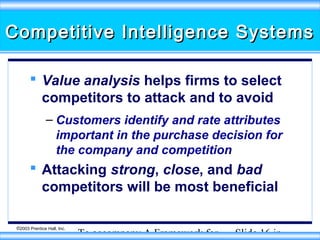
 Value analysis helps firms to select
competitors to attack and to avoid
– Customers identify and rate attributes
important in the purchase decision for
the company and competition

 Attacking strong, close, and bad
competitors will be most beneficial
©2003 Prentice Hall, Inc.

To accompany A Framework for

Slide 16 in
Designing Competitive Strategies
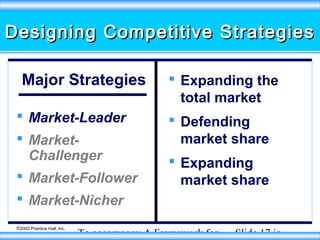
Major Strategies
 Market-Leader
 MarketChallenger
 Market-Follower

 Expanding the
total market
 Defending
market share
 Expanding
market share

 Market-Nicher
©2003 Prentice Hall, Inc.

To accompany A Framework for

Slide 17 in
Designing Competitive Strategies
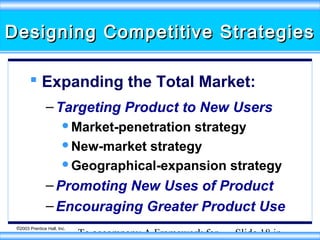
 Expanding the Total Market:
– Targeting Product to New Users
Market-penetration

strategy
New-market strategy
Geographical-expansion strategy

– Promoting New Uses of Product
– Encouraging Greater Product Use
©2003 Prentice Hall, Inc.

To accompany A Framework for

Slide 18 in
Designing Competitive Strategies
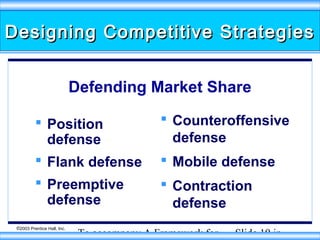
Defending Market Share
 Position
defense
 Flank defense

 Counteroffensive
defense

 Preemptive
defense

 Contraction
defense

©2003 Prentice Hall, Inc.

 Mobile defense

To accompany A Framework for

Slide 19 in
Designing Competitive Strategies
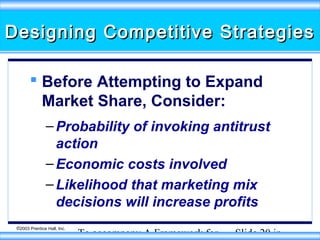
 Before Attempting to Expand
Market Share, Consider:
– Probability of invoking antitrust
action
– Economic costs involved
– Likelihood that marketing mix
decisions will increase profits
©2003 Prentice Hall, Inc.

To accompany A Framework for

Slide 20 in
Designing Competitive Strategies
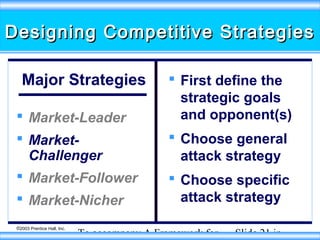
Major Strategies
 Market-Leader
 MarketChallenger
 Market-Follower
 Market-Nicher
©2003 Prentice Hall, Inc.

 First define the
strategic goals
and opponent(s)
 Choose general
attack strategy
 Choose specific
attack strategy

To accompany A Framework for

Slide 21 in
Designing Competitive Strategies
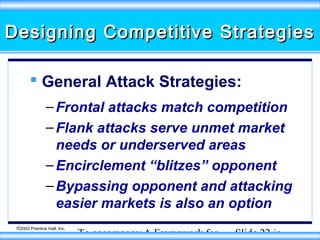
 General Attack Strategies:
– Frontal attacks match competition
– Flank attacks serve unmet market
needs or underserved areas
– Encirclement “blitzes” opponent
– Bypassing opponent and attacking
easier markets is also an option
©2003 Prentice Hall, Inc.

To accompany A Framework for

Slide 22 in
Competitive Markets
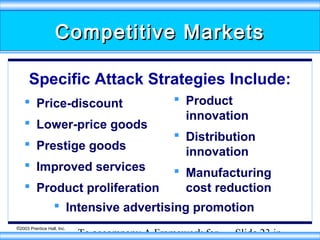
Specific Attack Strategies Include:
 Price-discount
 Lower-price goods
 Prestige goods
 Improved services

 Product
innovation
 Distribution
innovation
 Manufacturing
cost reduction

 Product proliferation
 Intensive advertising promotion
©2003 Prentice Hall, Inc.

To accompany A Framework for

Slide 23 in
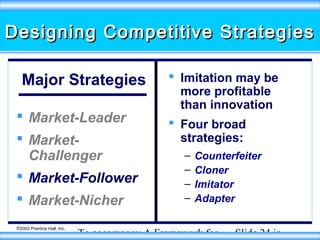
Designing Competitive Strategies
Major Strategies
 Market-Leader
 MarketChallenger
 Market-Follower
 Market-Nicher
©2003 Prentice Hall, Inc.

 Imitation may be
more profitable
than innovation
 Four broad
strategies:
–
–
–
–

Counterfeiter
Cloner
Imitator
Adapter

To accompany A Framework for

Slide 24 in
Designing Competitive Strategies
Major Strategies
 Market-Leader
 MarketChallenger
 Market-Follower
 Market-Nicher
©2003 Prentice Hall, Inc.

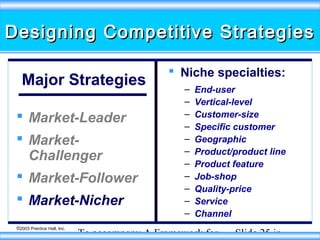
 Niche specialties:
–
–
–
–
–
–
–
–
–
–
–

End-user
Vertical-level
Customer-size
Specific customer
Geographic
Product/product line
Product feature
Job-shop
Quality-price
Service
Channel

To accompany A Framework for

Slide 25 in
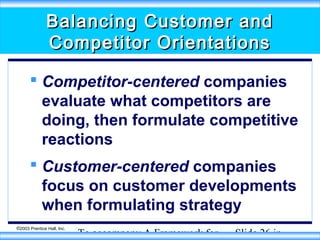
Balancing Customer and
Competitor Orientations
 Competitor-centered companies
evaluate what competitors are
doing, then formulate competitive
reactions
 Customer-centered companies
focus on customer developments
when formulating strategy
©2003 Prentice Hall, Inc.

To accompany A Framework for

Slide 26 in

Kotler08exs dealing with the competition

  • 1.
    Chapter 8 Dealing withthe Competition PowerPoint by Karen E. James Louisiana State University - Shreveport ©2003 Prentice Hall, Inc. To accompany A Framework for Slide 1 in
  • 2.
    Objectives  Understand howa company identifies its primary competitors and ascertains their strategies.  Review how companies design competitive intelligence systems. ©2003 Prentice Hall, Inc. To accompany A Framework for Slide 2 in
  • 3.
    Objectives  Learn howa company decides whether to position itself as a market leader, a challenger, a follower, or a nicher.  Identify how a company can balance a customer vs. competitor orientation. ©2003 Prentice Hall, Inc. To accompany A Framework for Slide 3 in
  • 4.
    Competitive Markets  Porter’sFive Forces that Determine Market Attractiveness: – Threat of intense segment rivalry – Threat of new entrants – Threat of substitute products – Threat of buyers’ growing bargaining power – Threat of suppliers’ growing bargaining power ©2003 Prentice Hall, Inc. To accompany A Framework for Slide 4 in
  • 5.
    Competitive Markets  Failingto identify competitors can lead to extinction  Internet businesses have led to disintermediation of middlemen  Competition can be identified using the industry or market approach ©2003 Prentice Hall, Inc. To accompany A Framework for Slide 5 in
  • 6.
    Competitive Markets Industries CanBe Classified By:  Number of sellers  Entry, mobility and exit barriers and degree of differentiation  Degree of vertical  Cost structure integration  Degree of globalization ©2003 Prentice Hall, Inc. To accompany A Framework for Slide 6 in
  • 7.
    Competitive Markets Industry Structures Pure Monopoly  Pure Oligopoly  Differentiated Oligopoly  Monopolistic Competition  Pure Competition ©2003 Prentice Hall, Inc.  Only one firm offers an undifferentiated product or service in an area – Unregulated – Regulated  Example: Most utility companies To accompany A Framework for Slide 7 in
  • 8.
    Competitive Markets Industry Structures Pure Monopoly  Pure Oligopoly  Differentiated Oligopoly  Monopolistic Competition  Pure Competition ©2003 Prentice Hall, Inc.  A few firms produce essentially identical commodities and little differentiation exists  Lower costs are the key to higher profits  Example: oil To accompany A Framework for Slide 8 in
  • 9.
    Competitive Markets Industry Structures Pure Monopoly  Pure Oligopoly  Differentiated Oligopoly  Monopolistic Competition  Pure Competition ©2003 Prentice Hall, Inc.  A few firms produce partially differentiated items  Differentiation is by key attributes  Premium price may be charged  Example: Luxury autos To accompany A Framework for Slide 9 in
  • 10.
    Competitive Markets Industry Structures Pure Monopoly  Pure Oligopoly  Differentiated Oligopoly  Monopolistic Competition  Pure Competition ©2003 Prentice Hall, Inc.  Many firms differentiate items in whole or part  Appropriate market segmentation is key to success  Example: beer, restaurants To accompany A Framework for Slide 10 in
  • 11.
    Competitive Markets Industry Structures Pure Monopoly  Pure Oligopoly  Differentiated Oligopoly  Monopolistic Competition  Pure Competition ©2003 Prentice Hall, Inc.  Many competitors offer the same product  Price is the same due to lack of differentiation  Example: farmers selling milk, crops To accompany A Framework for Slide 11 in
  • 12.
    Competitive Markets  Abroader group of competitors will be identified using the market approach  Competitor maps plot buying steps in purchasing and using the product, as well as direct and indirect competitors ©2003 Prentice Hall, Inc. To accompany A Framework for Slide 12 in
  • 13.
    Competitor Analysis  Keycharacteristics of the competition must be identified: – Strategies – Objectives – Strengths and Weaknesses Effect a firm’s competitive position in the target market – Reaction Patterns ©2003 Prentice Hall, Inc. To accompany A Framework for Slide 13 in
  • 14.
    Competitor Analysis Competitive Positionsin the Target Market  Dominant  Tenable  Strong  Weak  Favorable  Nonviable ©2003 Prentice Hall, Inc. To accompany A Framework for Slide 14 in
  • 15.
    Competitive Intelligence Systems Designing the system involves: – Setting up the system – Collecting the data – Evaluating and analyzing the data – Disseminating information and responding to queries ©2003 Prentice Hall, Inc. To accompany A Framework for Slide 15 in
  • 16.
    Competitive Intelligence Systems Value analysis helps firms to select competitors to attack and to avoid – Customers identify and rate attributes important in the purchase decision for the company and competition  Attacking strong, close, and bad competitors will be most beneficial ©2003 Prentice Hall, Inc. To accompany A Framework for Slide 16 in
  • 17.
    Designing Competitive Strategies MajorStrategies  Market-Leader  MarketChallenger  Market-Follower  Expanding the total market  Defending market share  Expanding market share  Market-Nicher ©2003 Prentice Hall, Inc. To accompany A Framework for Slide 17 in
  • 18.
    Designing Competitive Strategies Expanding the Total Market: – Targeting Product to New Users Market-penetration strategy New-market strategy Geographical-expansion strategy – Promoting New Uses of Product – Encouraging Greater Product Use ©2003 Prentice Hall, Inc. To accompany A Framework for Slide 18 in
  • 19.
    Designing Competitive Strategies DefendingMarket Share  Position defense  Flank defense  Counteroffensive defense  Preemptive defense  Contraction defense ©2003 Prentice Hall, Inc.  Mobile defense To accompany A Framework for Slide 19 in
  • 20.
    Designing Competitive Strategies Before Attempting to Expand Market Share, Consider: – Probability of invoking antitrust action – Economic costs involved – Likelihood that marketing mix decisions will increase profits ©2003 Prentice Hall, Inc. To accompany A Framework for Slide 20 in
  • 21.
    Designing Competitive Strategies MajorStrategies  Market-Leader  MarketChallenger  Market-Follower  Market-Nicher ©2003 Prentice Hall, Inc.  First define the strategic goals and opponent(s)  Choose general attack strategy  Choose specific attack strategy To accompany A Framework for Slide 21 in
  • 22.
    Designing Competitive Strategies General Attack Strategies: – Frontal attacks match competition – Flank attacks serve unmet market needs or underserved areas – Encirclement “blitzes” opponent – Bypassing opponent and attacking easier markets is also an option ©2003 Prentice Hall, Inc. To accompany A Framework for Slide 22 in
  • 23.
    Competitive Markets Specific AttackStrategies Include:  Price-discount  Lower-price goods  Prestige goods  Improved services  Product innovation  Distribution innovation  Manufacturing cost reduction  Product proliferation  Intensive advertising promotion ©2003 Prentice Hall, Inc. To accompany A Framework for Slide 23 in
  • 24.
    Designing Competitive Strategies MajorStrategies  Market-Leader  MarketChallenger  Market-Follower  Market-Nicher ©2003 Prentice Hall, Inc.  Imitation may be more profitable than innovation  Four broad strategies: – – – – Counterfeiter Cloner Imitator Adapter To accompany A Framework for Slide 24 in
  • 25.
    Designing Competitive Strategies MajorStrategies  Market-Leader  MarketChallenger  Market-Follower  Market-Nicher ©2003 Prentice Hall, Inc.  Niche specialties: – – – – – – – – – – – End-user Vertical-level Customer-size Specific customer Geographic Product/product line Product feature Job-shop Quality-price Service Channel To accompany A Framework for Slide 25 in
  • 26.
    Balancing Customer and CompetitorOrientations  Competitor-centered companies evaluate what competitors are doing, then formulate competitive reactions  Customer-centered companies focus on customer developments when formulating strategy ©2003 Prentice Hall, Inc. To accompany A Framework for Slide 26 in