Rethinking Marketing
Cultivating Relationships
Ahead of Building Brands

Presented By : Bijoy E.V (bijoyev@yahoo.com)
Venue: IBS-B
Date: 2011 (Dec 18 – Dec 21)
Ref: Roland T. Rust, - Christine Moorman, and Gaurav Bhalla
Idea in Brief
Most of the companies are still depend on mass media
     marketing to drive impersonal transactions


                    As an alternative
 Companies can interact with customers with the help
 of Powerful technologies like D/W for understanding
            and interacting with customers
       Which can help to radically reorganize in
     “Cultivating Relationships” ahead of building
                        brands.
                             .
Basic Changes in Views
  Shift from pushing individual products to building long-term
                    customer relationships.

• Marketing Department to “Customer Department”
  • Replaces the CMO to Customer Officer
  • Brand Managers to Customer managers

• Shift the firm’s focus
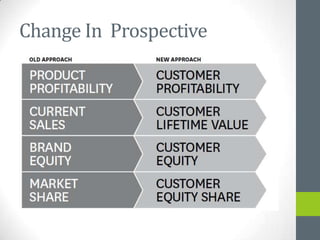
       Product Profitability to Customer profitability
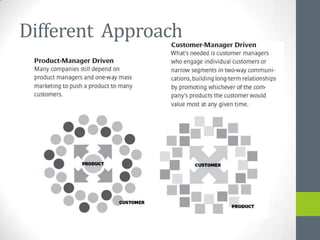
Different Approach
Idea in Action ( Cont..)
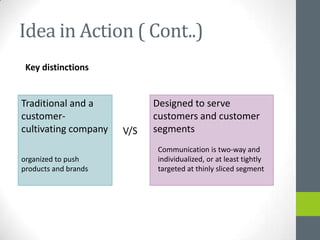
 Key distinctions


Traditional and a           Designed to serve
customer-                   customers and customer
cultivating company   V/S   segments
                            Communication is two-way and
organized to push           individualized, or at least tightly
products and brands         targeted at thinly sliced segment
Cultivating Customers
• IBM – Energy efficiency or server consolidation, and
      coordinates its marketing efforts across products
      for a particular customer

• IBM’s insurance practice - IBM’s Insurance Process
       Acceleration enables customer and industry specialists to
       build fast and flexible processes for Insurance

• Tesco - Investments in analytics that have improved customer
       retention, data-collecting thru loyalty card.
• American Exp - Spending ability to a trusted circle. Offering
       special Membership Rewards
New Roles & Responsibilities
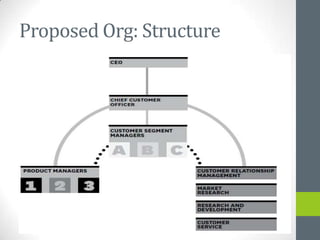
• CCO
  • reporting to the CEO
  • designing and executing the firm’s customer relationship strategy
  • promotes a customer centric culture and removes obstacles to
    the flow of customer information
  • Increasing the profitability of the firm’s customers, as measured
    by metrics such as customer lifetime value (CLV)
• Customer managers
  • Ultimate expression of marketing - Identify customers’ product
    needs.
  • Brand Managers, under the customer managers’ direction, supply
    the products
Proposed Org: Structure
Change In Prospective
In house-Impact
• Market research.
  • Touch customers—including finance (the source
  • Scope of analysis shifts from an aggregate view to an individual
    view of customer
  • Shifts its attention to acquiring the customer input that will drive
    improvements in customer-focused metrics
• Research and development.
  • Customer must be brought into the design process, Eg: Nokia
    Beta labs, P&G.
• Customer service
  • In-house to ensure long-term relationships. (Eg: Delta Airlines call
    centre locations)
Building CLV
1. Companies need to focus less on product profitability and
   more on customer Profitability
2. Pay less attention to current sales and more to CLV
3. Shift their focus from brand equity (the value of a brand) to
   customer equity (the sum of the lifetime values of their
   customers).
4. Pay less attention to current market share and more
   attention to customer equity share – more relevant to
   shareholder value.
Key Note

      Deriving this Competitive way to serve customers.

Transformation must be driven from the top down. But however
               daunting, the shift is inevitable.

Rethinking Marketing

  • 1.
    Rethinking Marketing Cultivating Relationships Aheadof Building Brands Presented By : Bijoy E.V (bijoyev@yahoo.com) Venue: IBS-B Date: 2011 (Dec 18 – Dec 21) Ref: Roland T. Rust, - Christine Moorman, and Gaurav Bhalla
  • 2.
    Idea in Brief Mostof the companies are still depend on mass media marketing to drive impersonal transactions As an alternative Companies can interact with customers with the help of Powerful technologies like D/W for understanding and interacting with customers Which can help to radically reorganize in “Cultivating Relationships” ahead of building brands. .
  • 3.
    Basic Changes inViews Shift from pushing individual products to building long-term customer relationships. • Marketing Department to “Customer Department” • Replaces the CMO to Customer Officer • Brand Managers to Customer managers • Shift the firm’s focus Product Profitability to Customer profitability
  • 4.
  • 5.
    Idea in Action( Cont..) Key distinctions Traditional and a Designed to serve customer- customers and customer cultivating company V/S segments Communication is two-way and organized to push individualized, or at least tightly products and brands targeted at thinly sliced segment
  • 6.
    Cultivating Customers • IBM– Energy efficiency or server consolidation, and coordinates its marketing efforts across products for a particular customer • IBM’s insurance practice - IBM’s Insurance Process Acceleration enables customer and industry specialists to build fast and flexible processes for Insurance • Tesco - Investments in analytics that have improved customer retention, data-collecting thru loyalty card. • American Exp - Spending ability to a trusted circle. Offering special Membership Rewards
  • 7.
    New Roles &Responsibilities • CCO • reporting to the CEO • designing and executing the firm’s customer relationship strategy • promotes a customer centric culture and removes obstacles to the flow of customer information • Increasing the profitability of the firm’s customers, as measured by metrics such as customer lifetime value (CLV) • Customer managers • Ultimate expression of marketing - Identify customers’ product needs. • Brand Managers, under the customer managers’ direction, supply the products
  • 8.
  • 9.
  • 10.
    In house-Impact • Marketresearch. • Touch customers—including finance (the source • Scope of analysis shifts from an aggregate view to an individual view of customer • Shifts its attention to acquiring the customer input that will drive improvements in customer-focused metrics • Research and development. • Customer must be brought into the design process, Eg: Nokia Beta labs, P&G. • Customer service • In-house to ensure long-term relationships. (Eg: Delta Airlines call centre locations)
  • 11.
    Building CLV 1. Companiesneed to focus less on product profitability and more on customer Profitability 2. Pay less attention to current sales and more to CLV 3. Shift their focus from brand equity (the value of a brand) to customer equity (the sum of the lifetime values of their customers). 4. Pay less attention to current market share and more attention to customer equity share – more relevant to shareholder value.
  • 12.
    Key Note Deriving this Competitive way to serve customers. Transformation must be driven from the top down. But however daunting, the shift is inevitable.

Editor's Notes

  • #7 Clubcard - to track which stores customers visit, what they buy, and how they pay. This information has helped Tesco tailor merchandise to local tastes and customize offerings at the individual level across a variety of store formats. (Shoppers who buy diapers for the first time at a Tesco store, for example, receive coupons by mail not only for baby wipes and toys but also for beer )American Exp - existing customers’ spending ability to a trusted circle of family members or partners while introducingthe brand to potential new customers
  • #8 CMO: Companies as diverse as Chrysler, Hershey’s, Oracle, Samsung, Sears, United Airlines, Sun Microsystems, and Wachovia now have CCOsUSAA - top managers spend two or three hours a week on the call-center phones with customers.Tesco- managers spend one week a year working in stores and interacting with customers as part of the Tesco Week in Store (TWIST) program.
  • #12 1. Focus less on product profitability - Products that may be unprofitable but strengthen customer relationships.2. pay less attention to current sales and more to “customer lifetime value” (CLV)3. shift their focus from brand equity (the value of a brand) to customer equity (the sum of the lifetime values of their customers)4. Customer equity share - the value of a company’s customer base divided by the total value of the customers in the market