Compassion
Focused
Therapy
Facillitator: Tammy Kontuk
M.Sc. R.Psych
Session 1
 Welcome and overview
Welcome.. We are so glad you
are here…
 Goal of CFT: To develop a new type of
strength within.. The strength of compassion
 Overview of CFT
 Getting to know each other:
 Say a bit about yourself
 What you hope to get from the program
How do we work together?
 Guidelines for group safety, treatment agreement
 Things to consider for group readiness
 Behavior that disrupts the group
 Expectations about whether it will help
 Ability to participate and share
 Can opt out if this is not the time
 You are always welcome back
Measuring success:
 Questionnaires
 Self-compassion measure
 Compassion toward others measure
 Patient Health Questionnaire (for depression)
 Generalized Anxiety Questionnaire (for Anxiety)
CFT: Core Ideas
 Shame and Self-Criticism can be life-long and
crippling
 What is Shame?
 “The painful emotional state related to thinking of
the self as bad, undesirable, defective and
worthless”
 It can become central to our identities
 It can prevent us from contacting our emotions
Core Ideas
 Shame can get in the way of other treatments,
and can result in more “stuckness”
 Shame makes other emotional problems
worse
 Shame causes a “threat response” in the
brain (more on this later)
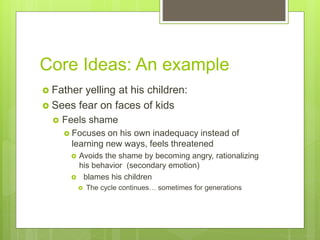
Core Ideas: An example
 Father yelling at his children:
 Sees fear on faces of kids
 Feels shame
 Focuses on his own inadequacy instead of
learning new ways, feels threatened
 Avoids the shame by becoming angry, rationalizing
his behavior (secondary emotion)
 blames his children
 The cycle continues… sometimes for generations
Goal: Compassionate Self-
correction
 Self-compassion doesn’t mean we don’t self
correct….
 Example of self-compassion:
 “It makes sense I would struggle with parenting,
because of my own experiences, but it’s not the
sort of parent I want to be, it’s time I committed to
interacting with my kids differently.
 Notice when you do something wrong.. Feel guilt,
not shame, and turn the focus on doing better in
the future
Compassion: The Strength to
Move Toward the Pain
 Shame causes people to shut down and turn
away from the struggle
 Compassion help people to move toward their
pain and work through it in helpful ways
 Compassion: Sensitivity to notice suffering
and Motivation to help alleviate it
Moving toward the pain..
 Instead of avoiding the pain we maintain a
warm, forgiving approach to suffering
 CFT teaches us to be able to tolerate
suffering (distress tolerance)
 CFT teaches us to be skillful in order to be
helpful to ourselves
 We will develop the “compassionate self” our
most wise, kind and confident selves
Shifting from Judgment to
Understanding
 Instead of self-attacking, we try to understand
what has lead us here
 “it’s not about who you are, but what has
happened to you”
 We set the stage for compassion to arise
through understanding our journey, how we
got here
Judgment to Understanding
 Our struggles are rooted in things that we did
not Choose or Design
 Move from blaming and shaming to
understanding and helping the self
The Evolution of our Brain…
 Emotions are grouped into three types,
according to their function in evolution:
 Threat (identifying and responding)
 Reward (pursuing goals and rewards)
 Safeness, contentedness, peace, connection
 Behavior makes sense when we see how it
meets evolutionary needs i.e. Sweet, salty
fatty foods…
Evolved brains…
 Our brains are old and tricky… they work in
ways that we didn’t choose or design
 Make quick connections
 Future and past focused
 Attention to threat or danger dominates
 We want to move from something is wrong
with me to I understand this is how my
brain works
Early life experiences
 Early experiences shape how well we can
regulate our emotions and to help
ourselves feel safe
 Early environments can teach us to fear the
connection with others that we need to feel
safe and worthy
 The way we learn to respond to early
environments is Not our Fault.
Learning to Feel Safe…
 Learning the “how and why” of emotions helps
us to make sense of them
 Compassion allows us to approach our
difficult emotions and work them out instead
of avoiding them
 Compassion allows us to begin to form warm,
nurturing relationships with others: the
foundation for feeling safe in the world

Cft session 1

  • 1.
  • 2.
  • 3.
    Welcome.. We areso glad you are here…  Goal of CFT: To develop a new type of strength within.. The strength of compassion  Overview of CFT  Getting to know each other:  Say a bit about yourself  What you hope to get from the program
  • 4.
    How do wework together?  Guidelines for group safety, treatment agreement  Things to consider for group readiness  Behavior that disrupts the group  Expectations about whether it will help  Ability to participate and share  Can opt out if this is not the time  You are always welcome back
  • 5.
    Measuring success:  Questionnaires Self-compassion measure  Compassion toward others measure  Patient Health Questionnaire (for depression)  Generalized Anxiety Questionnaire (for Anxiety)
  • 6.
    CFT: Core Ideas Shame and Self-Criticism can be life-long and crippling  What is Shame?  “The painful emotional state related to thinking of the self as bad, undesirable, defective and worthless”  It can become central to our identities  It can prevent us from contacting our emotions
  • 8.
    Core Ideas  Shamecan get in the way of other treatments, and can result in more “stuckness”  Shame makes other emotional problems worse  Shame causes a “threat response” in the brain (more on this later)
  • 9.
    Core Ideas: Anexample  Father yelling at his children:  Sees fear on faces of kids  Feels shame  Focuses on his own inadequacy instead of learning new ways, feels threatened  Avoids the shame by becoming angry, rationalizing his behavior (secondary emotion)  blames his children  The cycle continues… sometimes for generations
  • 11.
    Goal: Compassionate Self- correction Self-compassion doesn’t mean we don’t self correct….  Example of self-compassion:  “It makes sense I would struggle with parenting, because of my own experiences, but it’s not the sort of parent I want to be, it’s time I committed to interacting with my kids differently.  Notice when you do something wrong.. Feel guilt, not shame, and turn the focus on doing better in the future
  • 12.
    Compassion: The Strengthto Move Toward the Pain  Shame causes people to shut down and turn away from the struggle  Compassion help people to move toward their pain and work through it in helpful ways  Compassion: Sensitivity to notice suffering and Motivation to help alleviate it
  • 13.
    Moving toward thepain..  Instead of avoiding the pain we maintain a warm, forgiving approach to suffering  CFT teaches us to be able to tolerate suffering (distress tolerance)  CFT teaches us to be skillful in order to be helpful to ourselves  We will develop the “compassionate self” our most wise, kind and confident selves
  • 15.
    Shifting from Judgmentto Understanding  Instead of self-attacking, we try to understand what has lead us here  “it’s not about who you are, but what has happened to you”  We set the stage for compassion to arise through understanding our journey, how we got here
  • 17.
    Judgment to Understanding Our struggles are rooted in things that we did not Choose or Design  Move from blaming and shaming to understanding and helping the self
  • 18.
    The Evolution ofour Brain…  Emotions are grouped into three types, according to their function in evolution:  Threat (identifying and responding)  Reward (pursuing goals and rewards)  Safeness, contentedness, peace, connection  Behavior makes sense when we see how it meets evolutionary needs i.e. Sweet, salty fatty foods…
  • 19.
    Evolved brains…  Ourbrains are old and tricky… they work in ways that we didn’t choose or design  Make quick connections  Future and past focused  Attention to threat or danger dominates  We want to move from something is wrong with me to I understand this is how my brain works
  • 20.
    Early life experiences Early experiences shape how well we can regulate our emotions and to help ourselves feel safe  Early environments can teach us to fear the connection with others that we need to feel safe and worthy  The way we learn to respond to early environments is Not our Fault.
  • 21.
    Learning to FeelSafe…  Learning the “how and why” of emotions helps us to make sense of them  Compassion allows us to approach our difficult emotions and work them out instead of avoiding them  Compassion allows us to begin to form warm, nurturing relationships with others: the foundation for feeling safe in the world

Editor's Notes

  • #5 Review group guidelines document
  • #6 Give phq, GAD-7, self-compassion scales
  • #21 Add edward tronick still face
  • #22 End with 5 minute self-compassion break