Grief Reaction &
Grief Therapy
Dr Chaitanya Lata Singh
Dr Prerna Khar
Guide: Dr Smita Panse
Moderator: Dr Manjeet Santre
Contents
• Definition
• Manifestations of normal grief
• Grief and depression
• Determinants of grief
• Mourning process
• Abnormal grief reaction
• Diagnosing complicated grief
• Grief counselling
• Grief therapy
Definitions
• BEREAVEMENT- Refers to loss.
• GRIEF – Emotional ,cognitive ,functional and
behavioural responses to death.
• MOURNING – Behavioural manifestations of grief.
Attachment theory
• Attachment comes from a need for safety and security.
• When the attachment figure disappears or is threatened,
response is intense anxiety and emotional protest.
• Bowlby concludes that there are good biological reasons for
every separation to be responded to an automatic,instinctive
way with aggressive behaviour.
Manifestations of normal grief
1. Feelings
2. Physical sensation
3. Cognitions
4. Behaviours
Manifestations of normal grief
1. Feelings –
• Sadness – it is most common feeling in the bereaved people.
Often manifested with crying.
• Anger- it is frequently experienced after a loss. It comes from
2 sources ;
1) from a sense of frustration that there was nothing one could
do to prevent death.
2) From a kind of regressive experience that after loss of close
one.
• Guilt and self – reproach – usually the guilt is manifested
over something that happened or something that was
neglected at the time of death . most of the time it is
irrational.
• Anxiety- survivors fear they will not be able to take care of
themselves on their own. Second , heightened sense of
personal death awareness
Manifestations of normal grief
• Loneliness – feeling frequently expressed by those who have
lost spouse or who were used to a close day-by-day
relationship.
• Fatigue-
• Helplessness-
PHYSICAL SENSATION
Commonly reported sensations experienced by people in grief;
• tightness of chest and throat, dry mouth
• oversensitivity to noise ,
• sense of depersonalization,
• breathlessness ,
• weakness in muscles , lack of energy,
cognitions
• Disbelief- it is often the first thought that comes to mind
especially if the death was sudden.
• Confusion- many newly bereaved people say that their
thinking is very confused, they have difficulty in
concentrating.
• Preoccupation-this is an obsession with thoughts about
diseased. Sometimes preoccupation takes form of intrusive
thoughts or images of diseased person.
• sense of presence- in this the grieving person may think the
diseased is somehow still in the current area of time and
space.
• Hallucinations-they are usually transient illusory experiences
occurring within weeks of loss. They can be visual type or
auditory type.
cognitions
BEHAVIOURS
• Sleep disturbances- includes difficulty going to sleep or early
morning awakening. Sometimes require medications but in
normal grief they usually correct themselves.
• Appetite disturbances- can manifest in both overeating and
undereating. Undereating is more frequently seen.
• Social withdrawal- its common to withdraw from other
people after a loss.
behaviours
• absent- minded behaviour-newly bereaved people may
find themselves acting in absent minded way or doing
things that may ultimately harm them.
• Visiting places or carrying objects that reminds of the
diseased
• Some people avoid the places or things that trigger painful
feelings of grief.
• Dreams of the diseased-it can be normal type of dreams or
distressing dreams or nightmares giving some clues to were
the person in the whole process of mourning.
behaviours
determinants of grief
1. who the person was.
2. Nature of the attachment
3. Mode of death
4. Historical antecedents
5. Personality variables
6. Social variables
7. Concurrent stresses
grief and depression
grief
• No loss of self esteem.
• guilt associated with some
specific aspect of loss.
• Prolonged and marked functional
impairment not seen.
• World looks poor and empty .
depression
• Commonly seen.
• Overall sense of culpability.
• It is common in it.
• Person feels poor and empty.
Mourning process
Phase 1 – period of numbness that occurs close to the time
of the loss.
Phase 2- phase of yearning in which the person yearns for
the loss one to return and denies the permanence of loss.
Phase 3- disorganized and despair , bereaved person finds
it difficult to function in environment.
Phase 4- reorganized behaviour, person begin to pull
himself back to life.
Tasks of mourning
TASK 1- to accept the reality of loss
• Is to come full face with the reality that the person is dead and
will not return.
• Denying the facts of the loss can vary from slight distortion
to full blown delusion.
• Fully completing this task takes time , traditional rituals like
funeral helps towards acceptance.
Task of mourning
TASK 2-To work through to the pain of grief
• Necessary to work through this pain or it will manifest itself
through some symptoms of aberrant behaviour.
• Essential for the bereaved person to go through this pain in
order to get the grief work done.
Tasks of mourning
TASK 3-to adjust to an environment in which the diseased is
missing
• depends on the relationship and the role played by diseased.
• Attempts to fulfil the diseased role may fail leading to lowered
self esteem.
• Outcome- progress towards a recognition of his changed
circumstances by redefining his goals or else state of
suspended growth.
Tasks of mourning
TASK 4- to emotionally relocate the diseased and move on with
life-
• one never loses memories of a significant relationship.
• Task is not to give up their relationship with diseased but to
enable them to go on living effectively in the world without
them.
• mourning ends when mourner no longer reactivate the
representation of the dead in daily living.
Why people fail to grieve
1. Relational factors
2. Circumstantial factors
3. Historical factors
4. Personality factors
5. Social factors
Relational factors
• Unexpressed hostility most frequently hinders people from
adequately grieving.
• Sometimes death may reopen residual feelings of old
wounds.in this the victims often suffer from low self esteem
and self blaming which can lead to complicated grief.
Circumstantial factors
• There are certain specific circumstances that make it
difficult for a person to bring grief to satisfactory
conclusion
• If there are multiple loses such as occurring in
earthquakes,
Airplane crashes as it become difficult for the family
members to go through an adequate grieving period.
Historical factors
• People with past history of complicated grief havehigher
probability of having it again.
• People with history of depressive illness are at higher risk of
developing a complicated grief.
• There is some evidence that persons experiencing complicated
grief reactions felt insecure in their childhood and were
ambivalent towards mother.
Personality factors
• Those whose personalities do not tolerate dependency feelings
well will have difficulty grieving.
• Self concept
Social factors
• If the loss is socially unspeakable for eg. Suicidal death.
• Social factor that complicates a grief reaction happens when
the loss is socially negated means when the person around
him act as the loss never happened.
• Absence of social support network. Kind of support matrix
here includes people who knew the diseased and who can then
give each other support.
How the grief goes wrong
Chronic grief reaction
• It is the one that is excessive in duration and never comes to a
satisfactory conclusion.
• The person undergoing such grief are very much aware of the
fact the fact that they are not getting through the process of
mourning.
• In this the therapist and client has to assess which of the tasks
of grieving are not being resolved and why. Then intervention
is focussed on the resolution of these tasks.
Delayed grief reaction
• in this the person may have an emotional reaction at the time
of loss but it is not sufficient for the loss.
• The person may experience the symptoms of grief over some
subsequent and immediate loss, but the intensity of grieving
is excessive.
Exaggerated grief reaction
• In this the person experiencing the intensification of a normal
grief reaction feels overwhelmed and resorts to maladaptive
behaviour.
• It includes major psychiatric disorders that develop following
a loss like;
depression , substance use disorder, anxiety disorder, post
traumatic stress disorder or mania.
Masked grief reaction
• patients experience symptoms and behaviours which cause
them difficulty but do not see or recognize the fact that these
are related to the loss.
• masked grief generally turns up in one of 2 ways ;
Either it is masked as a physical symptom
Or it is masked through some type of aberrant maladaptive
behaviour.
Diagnosing complicated grief
• clue 1- the person being interviewed cannot speak of the
diseased without experiencing intense and fresh grief.
• Clue 2- some relatively minor event triggers off an intense
grief reaction
• Clue 3- themes of loss come up in a clinical interview. It is
important to listen to themes and watch for the possibility of
unresolved grief.
Diagnosing complicated grief
• Clue 4- someone who preserves the environment of the
diseased just as it was when the death occurred maybe
harbouring an unresolved grief reaction.
• Clue 5-physical symptoms like those, the diseased experienced
before death often occur annually around the time of the
anniversary of death or in holidays.
Diagnosing complicated grief
• Clue 6- those who make radical changes in their lifestyle
following a death or who exclude from their friends , family
members maybe experiencing unresolved grief.
• Clue 7-long history of subclinical depression often earmarked
by persistent guilt and lowered self esteem.
• Clue 8-compulsion to imitate the dead person , comes from
the need to compensate for the loss by identifying oneself with
the diseased
Diagnosing complicated grief
• Clue 9-many times self destructive impulses can be
stimulated unresolved grief.
• Clue 10-unaccountable sadness occurring at a certain time
can be clue to unresolved grief.
• Clue 11-phobia about illness or death often related to specific
illness that took the diseased.
Introduction
• Loss of a significant other causes a broad range of grief reactions
which are normal
• Most people are able to cope with these reactions and address the 4
tasks of mourning on their own
• Some people experience high levels of distress
• An initial high level of distress -best predictors of later distress.
• Indicative of risk for a poor bereavement outcome.
• Counseling- help bring about a more effective adaptation to the loss
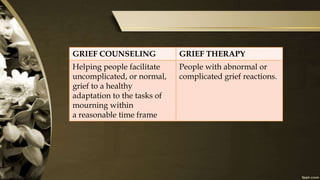
GRIEF COUNSELING GRIEF THERAPY
Helping people facilitate
uncomplicated, or normal,
grief to a healthy
adaptation to the tasks of
mourning within
a reasonable time frame
People with abnormal or
complicated grief reactions.
Goals
1) Increasing the reality of the loss
2) Deal with both the emotional and behavioral pain
3) Helping overcome various impediments to readjustment after the loss
4) Helping find a way to maintain a bond with the deceased while
feeling comfortable reinvesting in life.
At-risk Bereaved
• Young
• Poor social support
• Highly dependant on the deceased
• Ambivalent relationship with the deceased
• Cultural background prevents expressing grief
• Death-loss of income/relocation/difficulty handling children
• Past history of depression
• May appear to cope well initially-feelings of self
reproach/anger
Principles
1: Help the Survivor Actualize the Loss
• Certain sense of unreality- it did not really happen.
• 1st grief task- complete awareness -person is dead & will not return.
• Accept this before dealing with the emotional impact
• Help survivors talk about the loss
• Shakespeare (Macbeth) -“Give Sorrow words; the grief that does not speak
knits up the o’erwrought heart and bids it break.”
• Visiting the gravesite-reality of the loss
• Patient listening unlike kin
Contd….
2: Help the Survivor to Identify & Experience Feelings
• Many feelings may not be recognized-d/t pain and
unpleasantness
• Or not felt to the degree needed for an effective resolution
• Some feelings that are most problematic to survivors are:
-Anger
-Anxiety & Helplessness
-Personal death awareness
-Guilt
-Helplessness
-Loneliness.
• Important to express sadness
• Experiencing the affect more important than just expressing it
Contd…
3: Assist Living Without the Deceased
• Facilitating ability to live without the deceased and to make
decisions independently.
• Use a problem-solving approach
• Loss of a decision maker
• Loss of a sexual partner
• Discouraged from making major life-changing decisions too
soon after a death.
Contd…
4: Help Find Meaning in the Loss
• Some who cannot find the answer - become involved in
activities related to the manner of death that took the loved
one.
• Some losses challenge a person’s sense of him- or herself by
challenging the notion that he or she is worthy-low self
esteem
Contd…
5: Facilitate Emotional Relocation of the Deceased
• Some people are hesitant to form new relationships- believe this
will dishonor the memory of deceased
• Hesitate - feel that no one an ever fill the place of the deceased
• It’s all right to fill the void with a new relationship.
• Some people may jump into new relationships
Contd…
6: Provide Time to Grieve
• Sometimes family members are eager to get over the loss
and its pain and to move back into a normal routine
• 3 moths after the demise/ 1st anniversary/holidays-critical
periods-latent feelings can be expressed requiring support
Contd…
7: Interpret “Normal” Behaviour
• Hallucinations, heightened distractibility, and a
preoccupation with the deceased-can be part of normal grief
• Quite common for people to feel they are going crazy,
particularly those who have not sustained a major loss before
Contd…
8:Allow for Individual Differences
• Grieving -interpersonal variability, variation in the
intensity of affective reactions.
• Family members may not understand this- counselling
Contd…
9: Examine Defenses and Coping Styles
• Greatest risk are those bereaved who are recovering alcoholics /
strong family histories of alcoholism.
• Enquire about any drug use
• Active emotional coping -most effective
• Avoidant emotional coping- least effective
10: Identify Pathology and Refer
• Chronic or prolonged grief reactions
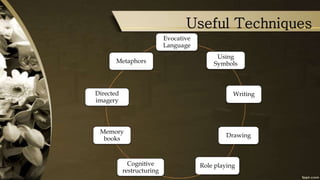
Useful Techniques
Evocative
Language
Using
Symbols
Writing
Drawing
Role playingCognitive
restructuring
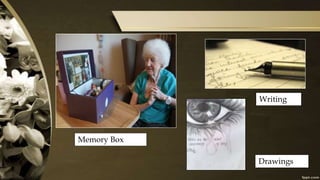
Memory
books
Directed
imagery
Metaphors
Memory Box
Drawings
Writing
Indications
(1) Prolonged grief
(2) Delayed grief
(3) Exaggerated grief response
(4) Grief manifestations through some masked somatic or
behavioral symptom
Goals
• Resolve the conflicts of separation
• Better adapt to the death
• Resolution of these conflicts- patient to experience
thoughts & feelings that he or she has been avoiding.
• Therapist provides the social support necessary & gives
the patient permission to grieve
Procedures
1. Rule Out Physical Disease
• Grief may present with somatic symptoms
• Important to rule out actual disease
2. Set Up the Contract and Establish an Alliance
-Patient agrees to explore his or her relationship with deceased
-Past relationships-explored only if they directly affect response
to the immediate bereavement
Contd…
3. Revive Memories of the Deceased
• Talk about the person
• Build groundwork of positive memories- help the patient if
he or she is resisting experiencing negative feelings
• If the patient comes to treatment aware of only negative
feelings-positive memories and affects need to be retrieved
• In case of multiple losses-explore the least complicating first
Contd…
4. Assess Which of the Four Mourning Tasks the Patient Is
Struggling With
I- Nature of the attachment to the deceased
II-Ok to have mixed feelings. Redefine the relationship
III-a:Problem solving/role playing
-b: Helped to explore how the loss has affected sense of self
IV-Permission to stop grieving
-Sanctioning new relationships
-Moving on with life is not an affront to the memory of the
lost loved one.
Contd…
5. Deal With Affect or Lack of Affect Stimulated by Memories
-Explore ambivalent feelings which are undersurface
-In case of a violent death-patient may focus on only the
disturbing aspects
-Help remember the deceased in a positive and comforting way
-Guilt- reality testing is important
Contd…
6. Explore and Defuse Linking Objects Symbolic objects (belongings/
reminders)
• Represent the conflicting wish to annihilate the deceased & at the
same time keep him or her alive
• Both of these wishes are condensed in the linking object
• Different from keepsakes/token of remembrance which don’t create
so much anxiety when lost
• Useful to bring for therapy- towards the end, if patients themselves
stop bringing it -therapy was effective
Contd…
7. Help the Patient Acknowledge the Finality of the Loss
• “Chronic hope for reunion.”
• Important to assess-may reflect hope for decision
making/inability to lead an independent life
8. Design a New Life Without the Deceased
• Envision what they would want for themselves
• Articulate new life goals
Contd…
9. Assess and Help the Patient Improve Social Relationships
• Friends may avoid due to uncomfortable
situations(mourning)
• Often feel stigmatized in social settings-avoid the same
Contd…
10) Help the Patient Deal With the Fantasy of Ending
Grieving
• What would they lose in giving up the grief-some feel they
will forget the person
• Some feel relinquishing grief-make others think they dint
care
Techniques
A)Gestalt therapy technique of the empty chair(Barbato &
Irwin, 1992)
• Talking to the deceased has a greater impact than talking
about the deceased
• Useful for completing unfinished business, handling guilt
and regrets
• Alterations-having the patient switch chairs and talk for the
deceased as well as to the deceased
Grief Resolution Therapy
Modification of Gestalt therapy technique
3 phases
1) Cognitive restructuring for decision to re-grieve
2) Using guided imagery
-Relive
-Revise
-Revisit
-Final scene
3) Future oriented identity reconstruction
Contd…
B) Role-playing psychodrama
• Play the role of both themselves and the deceased person
• Talking back and forth until a particular conflict is resolved
Contd…
C) Homework
• Monitoring of affect and paying attention to the cognitions
that stimulate the affect
• Letters to the deceased can be written & shared with the
therapist
• Makes the therapy shorter and more effective
Evaluating Results
3 types of changes:-
1) Subjective Experience
2) Behavioral Change
3) Symptom Relief
4) Scales-TRIG (Texas Revised Inventory of Grief)
- Hogan Grief Inventory
-Inventory of Complicated Grief
Counsellor’s Own Greif
• Bereavement in others also touches the counselor personally in
three ways
1) Aware of our own losses
2) Counselor’s own feared losses
3) One’s own personal death awareness
• Thus explore one’s own history(s) of loss(s)
• Loss History questionnaire
Stress & Burnout
• Professional burnout-progressive professional ineffectiveness-
under too much stress that is badly managed
• 3 guidelines:-
1) Know your own personal limitations.
2) Can avoid burnout by practicing active grieving
3) Know how to reach out for help and know where his or her own
support comes from
References
• Grief Counseling and Grief Therapy: A Handbook for the
Mental Health Practitioner-J. William Worden
• Melges et al. Greif Resolution Therapy: Reliving, Revising,
Revisiting. American Journal Of Psychotherapy. Vol XXXIV,
no 1, January 1980
• Synopsis of Psychiatry-Death, dying, bereavement
• Comprehensive Textbook Of Psychiatry
THANK YOU!!

Grief reaction and therapy

  • 1.
    Grief Reaction & GriefTherapy Dr Chaitanya Lata Singh Dr Prerna Khar Guide: Dr Smita Panse Moderator: Dr Manjeet Santre
  • 2.
    Contents • Definition • Manifestationsof normal grief • Grief and depression • Determinants of grief • Mourning process • Abnormal grief reaction • Diagnosing complicated grief • Grief counselling • Grief therapy
  • 3.
    Definitions • BEREAVEMENT- Refersto loss. • GRIEF – Emotional ,cognitive ,functional and behavioural responses to death. • MOURNING – Behavioural manifestations of grief.
  • 4.
    Attachment theory • Attachmentcomes from a need for safety and security. • When the attachment figure disappears or is threatened, response is intense anxiety and emotional protest. • Bowlby concludes that there are good biological reasons for every separation to be responded to an automatic,instinctive way with aggressive behaviour.
  • 5.
    Manifestations of normalgrief 1. Feelings 2. Physical sensation 3. Cognitions 4. Behaviours
  • 6.
    Manifestations of normalgrief 1. Feelings – • Sadness – it is most common feeling in the bereaved people. Often manifested with crying. • Anger- it is frequently experienced after a loss. It comes from 2 sources ; 1) from a sense of frustration that there was nothing one could do to prevent death. 2) From a kind of regressive experience that after loss of close one.
  • 7.
    • Guilt andself – reproach – usually the guilt is manifested over something that happened or something that was neglected at the time of death . most of the time it is irrational. • Anxiety- survivors fear they will not be able to take care of themselves on their own. Second , heightened sense of personal death awareness Manifestations of normal grief
  • 8.
    Manifestations of normalgrief • Loneliness – feeling frequently expressed by those who have lost spouse or who were used to a close day-by-day relationship. • Fatigue- • Helplessness-
  • 9.
    PHYSICAL SENSATION Commonly reportedsensations experienced by people in grief; • tightness of chest and throat, dry mouth • oversensitivity to noise , • sense of depersonalization, • breathlessness , • weakness in muscles , lack of energy,
  • 10.
    cognitions • Disbelief- itis often the first thought that comes to mind especially if the death was sudden. • Confusion- many newly bereaved people say that their thinking is very confused, they have difficulty in concentrating. • Preoccupation-this is an obsession with thoughts about diseased. Sometimes preoccupation takes form of intrusive thoughts or images of diseased person.
  • 11.
    • sense ofpresence- in this the grieving person may think the diseased is somehow still in the current area of time and space. • Hallucinations-they are usually transient illusory experiences occurring within weeks of loss. They can be visual type or auditory type. cognitions
  • 12.
    BEHAVIOURS • Sleep disturbances-includes difficulty going to sleep or early morning awakening. Sometimes require medications but in normal grief they usually correct themselves. • Appetite disturbances- can manifest in both overeating and undereating. Undereating is more frequently seen. • Social withdrawal- its common to withdraw from other people after a loss.
  • 13.
    behaviours • absent- mindedbehaviour-newly bereaved people may find themselves acting in absent minded way or doing things that may ultimately harm them. • Visiting places or carrying objects that reminds of the diseased • Some people avoid the places or things that trigger painful feelings of grief.
  • 14.
    • Dreams ofthe diseased-it can be normal type of dreams or distressing dreams or nightmares giving some clues to were the person in the whole process of mourning. behaviours
  • 15.
    determinants of grief 1.who the person was. 2. Nature of the attachment 3. Mode of death 4. Historical antecedents 5. Personality variables 6. Social variables 7. Concurrent stresses
  • 16.
    grief and depression grief •No loss of self esteem. • guilt associated with some specific aspect of loss. • Prolonged and marked functional impairment not seen. • World looks poor and empty . depression • Commonly seen. • Overall sense of culpability. • It is common in it. • Person feels poor and empty.
  • 17.
    Mourning process Phase 1– period of numbness that occurs close to the time of the loss. Phase 2- phase of yearning in which the person yearns for the loss one to return and denies the permanence of loss. Phase 3- disorganized and despair , bereaved person finds it difficult to function in environment. Phase 4- reorganized behaviour, person begin to pull himself back to life.
  • 18.
    Tasks of mourning TASK1- to accept the reality of loss • Is to come full face with the reality that the person is dead and will not return. • Denying the facts of the loss can vary from slight distortion to full blown delusion. • Fully completing this task takes time , traditional rituals like funeral helps towards acceptance.
  • 19.
    Task of mourning TASK2-To work through to the pain of grief • Necessary to work through this pain or it will manifest itself through some symptoms of aberrant behaviour. • Essential for the bereaved person to go through this pain in order to get the grief work done.
  • 20.
    Tasks of mourning TASK3-to adjust to an environment in which the diseased is missing • depends on the relationship and the role played by diseased. • Attempts to fulfil the diseased role may fail leading to lowered self esteem. • Outcome- progress towards a recognition of his changed circumstances by redefining his goals or else state of suspended growth.
  • 21.
    Tasks of mourning TASK4- to emotionally relocate the diseased and move on with life- • one never loses memories of a significant relationship. • Task is not to give up their relationship with diseased but to enable them to go on living effectively in the world without them. • mourning ends when mourner no longer reactivate the representation of the dead in daily living.
  • 22.
    Why people failto grieve 1. Relational factors 2. Circumstantial factors 3. Historical factors 4. Personality factors 5. Social factors
  • 23.
    Relational factors • Unexpressedhostility most frequently hinders people from adequately grieving. • Sometimes death may reopen residual feelings of old wounds.in this the victims often suffer from low self esteem and self blaming which can lead to complicated grief.
  • 24.
    Circumstantial factors • Thereare certain specific circumstances that make it difficult for a person to bring grief to satisfactory conclusion • If there are multiple loses such as occurring in earthquakes, Airplane crashes as it become difficult for the family members to go through an adequate grieving period.
  • 25.
    Historical factors • Peoplewith past history of complicated grief havehigher probability of having it again. • People with history of depressive illness are at higher risk of developing a complicated grief. • There is some evidence that persons experiencing complicated grief reactions felt insecure in their childhood and were ambivalent towards mother.
  • 26.
    Personality factors • Thosewhose personalities do not tolerate dependency feelings well will have difficulty grieving. • Self concept
  • 27.
    Social factors • Ifthe loss is socially unspeakable for eg. Suicidal death. • Social factor that complicates a grief reaction happens when the loss is socially negated means when the person around him act as the loss never happened. • Absence of social support network. Kind of support matrix here includes people who knew the diseased and who can then give each other support.
  • 28.
    How the griefgoes wrong
  • 29.
    Chronic grief reaction •It is the one that is excessive in duration and never comes to a satisfactory conclusion. • The person undergoing such grief are very much aware of the fact the fact that they are not getting through the process of mourning. • In this the therapist and client has to assess which of the tasks of grieving are not being resolved and why. Then intervention is focussed on the resolution of these tasks.
  • 30.
    Delayed grief reaction •in this the person may have an emotional reaction at the time of loss but it is not sufficient for the loss. • The person may experience the symptoms of grief over some subsequent and immediate loss, but the intensity of grieving is excessive.
  • 31.
    Exaggerated grief reaction •In this the person experiencing the intensification of a normal grief reaction feels overwhelmed and resorts to maladaptive behaviour. • It includes major psychiatric disorders that develop following a loss like; depression , substance use disorder, anxiety disorder, post traumatic stress disorder or mania.
  • 32.
    Masked grief reaction •patients experience symptoms and behaviours which cause them difficulty but do not see or recognize the fact that these are related to the loss. • masked grief generally turns up in one of 2 ways ; Either it is masked as a physical symptom Or it is masked through some type of aberrant maladaptive behaviour.
  • 33.
    Diagnosing complicated grief •clue 1- the person being interviewed cannot speak of the diseased without experiencing intense and fresh grief. • Clue 2- some relatively minor event triggers off an intense grief reaction • Clue 3- themes of loss come up in a clinical interview. It is important to listen to themes and watch for the possibility of unresolved grief.
  • 34.
    Diagnosing complicated grief •Clue 4- someone who preserves the environment of the diseased just as it was when the death occurred maybe harbouring an unresolved grief reaction. • Clue 5-physical symptoms like those, the diseased experienced before death often occur annually around the time of the anniversary of death or in holidays.
  • 35.
    Diagnosing complicated grief •Clue 6- those who make radical changes in their lifestyle following a death or who exclude from their friends , family members maybe experiencing unresolved grief. • Clue 7-long history of subclinical depression often earmarked by persistent guilt and lowered self esteem. • Clue 8-compulsion to imitate the dead person , comes from the need to compensate for the loss by identifying oneself with the diseased
  • 36.
    Diagnosing complicated grief •Clue 9-many times self destructive impulses can be stimulated unresolved grief. • Clue 10-unaccountable sadness occurring at a certain time can be clue to unresolved grief. • Clue 11-phobia about illness or death often related to specific illness that took the diseased.

  • 38.
    Introduction • Loss ofa significant other causes a broad range of grief reactions which are normal • Most people are able to cope with these reactions and address the 4 tasks of mourning on their own • Some people experience high levels of distress • An initial high level of distress -best predictors of later distress. • Indicative of risk for a poor bereavement outcome. • Counseling- help bring about a more effective adaptation to the loss
  • 39.
    GRIEF COUNSELING GRIEFTHERAPY Helping people facilitate uncomplicated, or normal, grief to a healthy adaptation to the tasks of mourning within a reasonable time frame People with abnormal or complicated grief reactions.
  • 40.
    Goals 1) Increasing thereality of the loss 2) Deal with both the emotional and behavioral pain 3) Helping overcome various impediments to readjustment after the loss 4) Helping find a way to maintain a bond with the deceased while feeling comfortable reinvesting in life.
  • 41.
    At-risk Bereaved • Young •Poor social support • Highly dependant on the deceased • Ambivalent relationship with the deceased • Cultural background prevents expressing grief • Death-loss of income/relocation/difficulty handling children • Past history of depression • May appear to cope well initially-feelings of self reproach/anger
  • 42.
    Principles 1: Help theSurvivor Actualize the Loss • Certain sense of unreality- it did not really happen. • 1st grief task- complete awareness -person is dead & will not return. • Accept this before dealing with the emotional impact • Help survivors talk about the loss • Shakespeare (Macbeth) -“Give Sorrow words; the grief that does not speak knits up the o’erwrought heart and bids it break.” • Visiting the gravesite-reality of the loss • Patient listening unlike kin
  • 43.
    Contd…. 2: Help theSurvivor to Identify & Experience Feelings • Many feelings may not be recognized-d/t pain and unpleasantness • Or not felt to the degree needed for an effective resolution • Some feelings that are most problematic to survivors are: -Anger -Anxiety & Helplessness -Personal death awareness -Guilt -Helplessness -Loneliness. • Important to express sadness • Experiencing the affect more important than just expressing it
  • 44.
    Contd… 3: Assist LivingWithout the Deceased • Facilitating ability to live without the deceased and to make decisions independently. • Use a problem-solving approach • Loss of a decision maker • Loss of a sexual partner • Discouraged from making major life-changing decisions too soon after a death.
  • 45.
    Contd… 4: Help FindMeaning in the Loss • Some who cannot find the answer - become involved in activities related to the manner of death that took the loved one. • Some losses challenge a person’s sense of him- or herself by challenging the notion that he or she is worthy-low self esteem
  • 46.
    Contd… 5: Facilitate EmotionalRelocation of the Deceased • Some people are hesitant to form new relationships- believe this will dishonor the memory of deceased • Hesitate - feel that no one an ever fill the place of the deceased • It’s all right to fill the void with a new relationship. • Some people may jump into new relationships
  • 47.
    Contd… 6: Provide Timeto Grieve • Sometimes family members are eager to get over the loss and its pain and to move back into a normal routine • 3 moths after the demise/ 1st anniversary/holidays-critical periods-latent feelings can be expressed requiring support
  • 48.
    Contd… 7: Interpret “Normal”Behaviour • Hallucinations, heightened distractibility, and a preoccupation with the deceased-can be part of normal grief • Quite common for people to feel they are going crazy, particularly those who have not sustained a major loss before
  • 49.
    Contd… 8:Allow for IndividualDifferences • Grieving -interpersonal variability, variation in the intensity of affective reactions. • Family members may not understand this- counselling
  • 50.
    Contd… 9: Examine Defensesand Coping Styles • Greatest risk are those bereaved who are recovering alcoholics / strong family histories of alcoholism. • Enquire about any drug use • Active emotional coping -most effective • Avoidant emotional coping- least effective 10: Identify Pathology and Refer • Chronic or prolonged grief reactions
  • 51.
  • 52.
  • 54.
    Indications (1) Prolonged grief (2)Delayed grief (3) Exaggerated grief response (4) Grief manifestations through some masked somatic or behavioral symptom
  • 55.
    Goals • Resolve theconflicts of separation • Better adapt to the death • Resolution of these conflicts- patient to experience thoughts & feelings that he or she has been avoiding. • Therapist provides the social support necessary & gives the patient permission to grieve
  • 56.
    Procedures 1. Rule OutPhysical Disease • Grief may present with somatic symptoms • Important to rule out actual disease 2. Set Up the Contract and Establish an Alliance -Patient agrees to explore his or her relationship with deceased -Past relationships-explored only if they directly affect response to the immediate bereavement
  • 57.
    Contd… 3. Revive Memoriesof the Deceased • Talk about the person • Build groundwork of positive memories- help the patient if he or she is resisting experiencing negative feelings • If the patient comes to treatment aware of only negative feelings-positive memories and affects need to be retrieved • In case of multiple losses-explore the least complicating first
  • 58.
    Contd… 4. Assess Whichof the Four Mourning Tasks the Patient Is Struggling With I- Nature of the attachment to the deceased II-Ok to have mixed feelings. Redefine the relationship III-a:Problem solving/role playing -b: Helped to explore how the loss has affected sense of self IV-Permission to stop grieving -Sanctioning new relationships -Moving on with life is not an affront to the memory of the lost loved one.
  • 59.
    Contd… 5. Deal WithAffect or Lack of Affect Stimulated by Memories -Explore ambivalent feelings which are undersurface -In case of a violent death-patient may focus on only the disturbing aspects -Help remember the deceased in a positive and comforting way -Guilt- reality testing is important
  • 60.
    Contd… 6. Explore andDefuse Linking Objects Symbolic objects (belongings/ reminders) • Represent the conflicting wish to annihilate the deceased & at the same time keep him or her alive • Both of these wishes are condensed in the linking object • Different from keepsakes/token of remembrance which don’t create so much anxiety when lost • Useful to bring for therapy- towards the end, if patients themselves stop bringing it -therapy was effective
  • 61.
    Contd… 7. Help thePatient Acknowledge the Finality of the Loss • “Chronic hope for reunion.” • Important to assess-may reflect hope for decision making/inability to lead an independent life 8. Design a New Life Without the Deceased • Envision what they would want for themselves • Articulate new life goals
  • 62.
    Contd… 9. Assess andHelp the Patient Improve Social Relationships • Friends may avoid due to uncomfortable situations(mourning) • Often feel stigmatized in social settings-avoid the same
  • 63.
    Contd… 10) Help thePatient Deal With the Fantasy of Ending Grieving • What would they lose in giving up the grief-some feel they will forget the person • Some feel relinquishing grief-make others think they dint care
  • 64.
    Techniques A)Gestalt therapy techniqueof the empty chair(Barbato & Irwin, 1992) • Talking to the deceased has a greater impact than talking about the deceased • Useful for completing unfinished business, handling guilt and regrets • Alterations-having the patient switch chairs and talk for the deceased as well as to the deceased
  • 65.
    Grief Resolution Therapy Modificationof Gestalt therapy technique 3 phases 1) Cognitive restructuring for decision to re-grieve 2) Using guided imagery -Relive -Revise -Revisit -Final scene 3) Future oriented identity reconstruction
  • 66.
    Contd… B) Role-playing psychodrama •Play the role of both themselves and the deceased person • Talking back and forth until a particular conflict is resolved
  • 67.
    Contd… C) Homework • Monitoringof affect and paying attention to the cognitions that stimulate the affect • Letters to the deceased can be written & shared with the therapist • Makes the therapy shorter and more effective
  • 68.
    Evaluating Results 3 typesof changes:- 1) Subjective Experience 2) Behavioral Change 3) Symptom Relief 4) Scales-TRIG (Texas Revised Inventory of Grief) - Hogan Grief Inventory -Inventory of Complicated Grief
  • 69.
    Counsellor’s Own Greif •Bereavement in others also touches the counselor personally in three ways 1) Aware of our own losses 2) Counselor’s own feared losses 3) One’s own personal death awareness • Thus explore one’s own history(s) of loss(s) • Loss History questionnaire
  • 70.
    Stress & Burnout •Professional burnout-progressive professional ineffectiveness- under too much stress that is badly managed • 3 guidelines:- 1) Know your own personal limitations. 2) Can avoid burnout by practicing active grieving 3) Know how to reach out for help and know where his or her own support comes from
  • 71.
    References • Grief Counselingand Grief Therapy: A Handbook for the Mental Health Practitioner-J. William Worden • Melges et al. Greif Resolution Therapy: Reliving, Revising, Revisiting. American Journal Of Psychotherapy. Vol XXXIV, no 1, January 1980 • Synopsis of Psychiatry-Death, dying, bereavement • Comprehensive Textbook Of Psychiatry
  • 72.

Editor's Notes

  • #5 They develop early in life and are usually directed towards a few specific individuals.
  • #7 In the loss of any important person there is a tendency to regress, to feel helpless , to feel unable to exist without the person
  • #8 Like not taking the person to hospital early. It can range From a light sense of insecurity to a panic attack and the more intense nd persistent anxiety.
  • #10 Many times survivor seeks a physician for these.
  • #12 More seen shortly after death.
  • #13 NO. of specific behaviour frequently associated with normal grief reaction
  • #14 it can also include not reading newspaper or watching television.
  • #15 Often underlying this behaviour is fear of loosing memories.
  • #17 In both classic symptoms of sleep disturbances, appetite disturbances and intense sadness. Becks triad in depression Majority of depression of bereavement are transient and require no professional attention., there s a growing appreciation that some depression that persist throughout the 1st yr of bereavement are clinically significant.more common in people with past history of depression.
  • #19 Bizarre eg of delusion includes keeping the dead body for days before notifying it to anyone.
  • #20 Not everyone experiences the same intensity of pain or feels it in the same way, but it is impossible to loose someone you have been deeply attached without experiencing same level of pain.The proper action of a friend is felt to be distraction of a mourner from his or her grief.
  • #21 A loss of a husband may or maynot be the loss of a sexual partner, companion ,financial help nd so on depending the role played by him. Not only the bereaved have to adjust to the loss of roll previously played by diseased but death also confronts them with the challenge of adjusting to their own sense of self.
  • #22 Canbe understood by an example of a teenage girl whose father had died and finally she bagan to move through the issues she wrote to her mother it does not mean that I love my dad less but there are other people to be loved
  • #25 Soldier missing wife is unaware that he s alive or not. Consequently is unable to go through an adequate grieving proess
  • #27 Coz the resolution of grief demands the experiencing of universal feelings of helplessness thus the individual who normally function most competently on the surface maybe the very ones thrown more heavily by a major loss.
  • #28 In such circumstances there is tendency for family and friends to keep quiet about the circumstances surrounding death thus leading to non resolution of grief. Eg many single woman who get preganant nd choose to terminate a baby.often the family is not told about the same.
  • #29 Leading to abnormal grief reaction
  • #30 Anniversary rxn r common for ten years or longer but they do not indicate chronic rxn
  • #31 Sometimes called inhibited / suppressed / postponed grief rxn A pregnant women who lost her child in accident but ws adviced nt to get too upset as it would jeoparadize the current preganancy.she followed the advice but consequently when her last child left home her grief was intense.it can also occur when watching someone else go through grief eg in movies
  • #42 Cultural background/social position
  • #43 Help to talkWhere did the death occur? How did it happen? Who told you about it? Where were you when you heard? What was the funeral like? What was said at the service
  • #44 1.anger probably comes from two sources: from frustration and from a sense of regressive helplessness.This anger is real, and it must go somewhere, so if it is not directed toward the deceased (the real target), it may be deflected onto other people such as/self-self harm 2.Guilt-not having helped the person enough/taken to hospital/ not feeling sad enough/ parents-how could they let the child suffer. 3.Personal death awareness-you will also die one day/ reminded of a near death accident
  • #45 Problem solving approach-What are the problems the survivor faces and how can they be solved? Life changing decisions. selling property/ changing jobs or careers/or adopting children, avoid-Good judgment is difficult to exercise during acutegrief, when there is increased risk of a maladaptive response
  • #46 Activities:philanthropic, political, or caretaking Loss of self-esteem often goes hand in hand with loss of self-effi cacy and the best intervention is to help the person reestablish a sense of control by heightening awareness of areas in which his or her attempts to exercise control have been successful.
  • #51 Emotional coping:use of humor, the ability to reframe or redefine a difficult situation, adequate emotional regulation skills, and the ability to accept social support. Avoidant coping:Blame, distraction, denial, social withdrawal, and substance abuse
  • #52 Evocative language-”Your son died” vs you lost your son. Symbols-letter written by the deceased/jewellery/belongings/photo Cog restruc: “No one will ever love me again,” a thought that is certainly not provable in the present Imagery-imagine talking to the deceased. Metaphor-a visual aid-talk to it to express feelings
  • #56 Permission that may have been lacking around the time of the death.
  • #58 Memories-What do you miss about him?” “What don’t you miss about him?” “How did she disappoint you?” Finally, lead the person into a discussion of memories of hurt, anger, and disappointment.
  • #59 I-accept the reality of the loss II-task II (to process the pain of grief) III-task IIIa (external adjustments) III b- internal and spiritual) IV-.task is to move on emotionally.help the patient find some kind of enduring connection with the deceased and thus be free to embark on a new life and cultivate new relationships
  • #60 Especially when describing the person as a larger than life figure- eg he was the best dad/ world class-such statements usually have underlying ambivalent feelings Violent death-EMDR/ systematic desensitization may be used
  • #61 Generally, linking objects are chosen from one of four categories: (1) some belonging of the deceased’s, such as something he or she wore, like a watch or a piece of jewelry; (2) something with which the dead person extended his or her senses, like a camera, which would represent a visual extension; (3) a representation of the deceased, such as a photograph; (4) something that was at hand when news of the death was received or when the mourner saw the dead body
  • #63 Indian setting-unauspicious for a widow to attend a naming ceremony/ wedding
  • #66 Positive changes with the deceased before the loss- suggestions for greiving intrduced-ur strong enough to greive 3 rs-each session of 20 mins Relive events-relationship with deceased before the demise, arrival of news and your feelings, funeral procedure, goodbye walk from the grave/pyre Rearrage the scene in your imagination/ remove obstacles/crowd Revisit- express feelings loudly/ deal with conflicts Use present tense in each stage-therapist may have to actively participate-remove unwanted ppl 3) Prohect a year ahead-imagine walking with the deceased-if pt says its not pssible as the person has died-therapy is effective.
  • #69 1) increased feelings of self-esteem and less guilt.They make comments like “The pain, which has been tearing me to pieces, is now gone. report is an increase in positive feelings about the deceased. They are able to think about he deceased and relate their positive feelings to positive experiences 2) Searching behavior stops, they begin to socialize again, or they begin to form new relationships. Patients whohave previously avoided religious activities begin to return to them.People who have avoided visiting the gravesite now visit without itbeing suggested. 3) fewer body aches and abatement
  • #70 Esp if similar to our own loss.If own loss is adequately resolved, can be more helpful to the bereaved if the loss our client is experiencing is similar to the one we most fear, our apprehension can get in the way of an effective counseling relationship 3) This situation is especially diffi cult when the person who’s being grieved is similar to the counselor in terms of age, sex, or professional status, all of which can greatly increase the anxiety of the counselor. Gives an idea about the process of mourning, coping strategies that can be used and how long it can take for resolution to occur -what is helpful/ not helpful. Know your own limitations
  • #71 How many patients you can handle 2) When a patient dies, it is important for the counselor to go through this period of active grieving. Attend the funeral service of the person with whom they were working. It is also important that they allow themselves to experience their sadness and other feelings after someone dies