Anger Management 9
Session Protocol
Dr. Dawn-Elise Snipes PhD, LMHC
Executive Director, AllCEUs.com
AllCEUs Unlimited CEUs $59 | Addiction Counselor Certificate Training $149 | Specialty Certificates $89 1
Objectives
 Learn about anger and it’s functions
 Explore events and cues
 Develop an anger control plan
 Learn about the aggression cycle and how to change
it
 Review the ABCDEs and thought stopping
 Assertiveness and conflict resolution skills
 Alternatives for expressing anger
 Relaxation Interventions
 Explore how past learning from your family of origin
can influence current behavior
AllCEUs Unlimited CEUs $59 | Addiction Counselor Certificate Training $149 | Specialty Certificates $89 2
Session One: Learn About Anger
 Anger is an emotion triggered by a threat which
prompts the fight (aggression) or flight reaction
 Hostility refers to a set of attitudes, thoughts and
judgments that motivate aggressive behaviors.
 Aggression is behavior that is intended to protect
oneself by causing harm or injury to another
person or damage to property. (Fight or Flee)
 Many times what we initially perceive as a threat
is not currently one
AllCEUs Unlimited CEUs $59 | Addiction Counselor Certificate Training $149 | Specialty Certificates $89 3
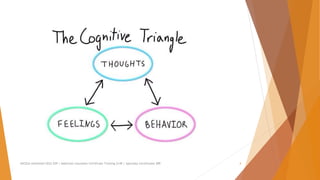
AllCEUs Unlimited CEUs $59 | Addiction Counselor Certificate Training $149 | Specialty Certificates $89 4
Session 1 cont.
 Misperceptions
 Example: Fire alarm
 Example: Sean and Elias
 Initial experience: Brewster perceived a danger
 Future experiences—Elias is associated with a threat
 Example: Rescues
 Initial experience: A man hurt you
 Future experiences are overgeneralized: All men are dangerous
 Example: Domestic Violence
 Initial experience: Raised voices leads to violence
 Future experiences: Anytime someone raises their voice it is a
threat
AllCEUs Unlimited CEUs $59 | Addiction Counselor Certificate Training $149 | Specialty Certificates $89 5
Session 1
 Anger becomes a problem when it is felt too
intensely, is felt too frequently, or is expressed
inappropriately
 How does anger affect you:
 Physically: Sleep, pain, GI, immunity
 Emotionally: Regret, guilt, feeling helpless
 Socially: Fear vs. respect, negative impact on relationships
 Occupationally: How you work with others, customer service
 Spiritually: Your sense of connectedness to and impact
within the world, karma
 Environmentally: Break stuff, holes in walls, throw out
things impulsively
AllCEUs Unlimited CEUs $59 | Addiction Counselor Certificate Training $149 | Specialty Certificates $89 6
Session 1…
 Anger initially has apparent payoffs (e.g., releasing
tension, controlling people).
 In the long-term, however, these payoffs often lead to
negative consequences.
 What benefits/payoffs does anger have for you?
 Habits are things we do almost automatically.
 In what ways is anger a habit
 How can you use mindfulness to start to break that habit?
 I am angry?
 What am I angry about?
 Is this actually a threat to me?
 What is the best response in this situation to help me achieve my
goals
AllCEUs Unlimited CEUs $59 | Addiction Counselor Certificate Training $149 | Specialty Certificates $89 7
Session 1
 Identify anger control strategies you have used in
the past
 Which ones worked? Why?
 Which ones didn’t work? Why?
AllCEUs Unlimited CEUs $59 | Addiction Counselor Certificate Training $149 | Specialty Certificates $89 8
Session 1
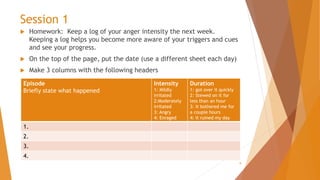
 Homework: Keep a log of your anger intensity the next week.
Keeping a log helps you become more aware of your triggers and cues
and see your progress.
 On the top of the page, put the date (use a different sheet each day)
 Make 3 columns with the following headers
9
Episode
Briefly state what happened
Intensity
1: Mildly
irritated
2:Moderately
irritated
3: Angry
4: Enraged
Duration
1: got over it quickly
2: Stewed on it for
less than an hour
3: It bothered me for
a couple hours
4: It ruined my day
1.
2.
3.
4.
Session 2: Identifying Triggers, Events & Cues
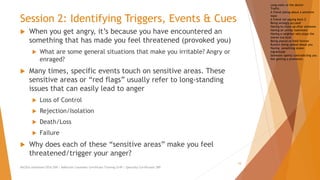
 When you get angry, it’s because you have encountered an
something that has made you feel threatened (provoked you)
 What are some general situations that make you irritable? Angry or
enraged?
 Many times, specific events touch on sensitive areas. These
sensitive areas or “red flags” usually refer to long-standing
issues that can easily lead to anger
 Loss of Control
 Rejection/Isolation
 Death/Loss
 Failure
 Why does each of these “sensitive areas” make you feel
threatened/trigger your anger?
AllCEUs Unlimited CEUs $59 | Addiction Counselor Certificate Training $149 | Specialty Certificates $89
10
Long waits at the doctor
Traffic
A friend joking about a sensitive
topic
A friend not paying back $
Being wrongly accused
Having to clean up after someone
Having an untidy roommate
Having a neighbor who plays the
stereo too loud
Being placed on hold forever
Rumors being spread about you
Having something stolen
Ingratitude
Someone openly contradicting you
Not getting a promotion
Session 2 cont…
 Cues are indicators that you are getting angry.
 Cues can be broken down into four cue categories:
 Physical Cues (how your body responds; e.g., with an increased heart rate,
tightness in the chest, feeling hot or flushed)
 Behavioral Cues (what you do; e.g., clench your fists, raise your voice, stare
at others)
 Emotional Cues (other feelings that may occur along with anger; e.g., fear,
hurt, jealousy, disrespect)
 Cognitive Cues (what you think about in response to the event; e.g., hostile
self-talk (“I’ll fix her little red wagon!”), images of aggression and revenge)
 Review your anger log from last week and identify your common cues.
 What strategies can you use to become more aware of and deal with
these cues?
AllCEUs Unlimited CEUs $59 | Addiction Counselor Certificate Training $149 | Specialty Certificates $89 11
Session 3: Vulnerabilities
 Vulnerabilities are those things that make you more
likely to respond with anger
 Types
 Emotional: Overwhelmed, irritable about something else,
stressed out, feeling sensitive or vulnerable
 Cognitive: Expecting a negative outcome from a situation,
person or meeting
 Physical: Low blood sugar, alcohol, too much caffeine, pain,
illness, insufficient sleep
 Social: Being in situations that make you feel more on edge, or
around people that tend to trigger anger or be negative
themselves
 What are your vulnerabilities and how can you best prevent
or mitigate them?
AllCEUs Unlimited CEUs $59 | Addiction Counselor Certificate Training $149 | Specialty Certificates $89 12
Session 3..cont
 Homework from last week
 What was the highest number you reached
 What triggered that anger episode
 What were the cues associated with the behavior
 Physical
 Behavioral
 Emotional
 Cognitive
 What strategies did you use to avoid reaching 10 on the
anger meter?
 Are there particular “threat themes?”
 What vulnerabilities may have existed that day?
AllCEUs Unlimited CEUs $59 | Addiction Counselor Certificate Training $149 | Specialty Certificates $89 13
Session 4: Anger Control Plan
 An effective plan should include both immediate and preventive
strategies
 Immediate Strategies
 Time out
 When might you use it. How might you do it?
 Distract with activities (doing something or listening to music),opposite
emotions or taking a mental vacation
 Block the situation from your mind temporarily (Thought Stopping)
 What are some thought stopping statements you can use?
 Practice mindfulness in 3s
 Breathe!
 Talk to a friend or journal
 Create meaning.
 Exercise
 Radically Accept---It is what it is.
AllCEUs Unlimited CEUs $59 | Addiction Counselor Certificate Training $149 | Specialty Certificates $89 14
Session 4 cont…
 Preventative Strategies
 What general things can you do to prevent or minimize
vulnerabilities?
 Emotional
 Mental
 Physical
 Social
 When you are vulnerable for some reason, what can you do
to reduce the chances that you will get angry?
 Emotional
 Mental
 Physical
 Social
AllCEUs Unlimited CEUs $59 | Addiction Counselor Certificate Training $149 | Specialty Certificates $89 15
Session 4 cont…
 Review your anger log from last week. What immediate
strategies could you have used? What preventative
strategies might have made a difference?
 Develop a plan to start reducing one or two vulnerabilities
each month
AllCEUs Unlimited CEUs $59 | Addiction Counselor Certificate Training $149 | Specialty Certificates $89 16
Session 5: The Aggression Cycle
 An episode of anger can be viewed as consisting of three phases:
 Escalation: Event and responses/cues/thoughts/feelings
 What can you do when you notice emotional, physical, cognitive or social cues?
 Explosion: Verbal or physical aggression urges
 What can you do when you have the urge to be aggressive?
 Postexplosion: Negative Consequences (emotional, cognitive, legal, social,
physical)
 Review your anger log from last week and identify the event that
got you most angry or had the most negative consequences and
identify what you could have done to
 Reduce the escalation
 Prevent the explosion
AllCEUs Unlimited CEUs $59 | Addiction Counselor Certificate Training $149 | Specialty Certificates $89
17
Session 5
 Cognitive Distortions are unhelpful ways of perceiving things.
 Think about a time something happened and you thought it was
one way, but you turned out to be wrong.
 Types
 Personalization (All my fault/All about me)
 3 other explanations
 Minimization of the positive (Trained monkey)
 What good happened, is happening or could come out of this?
 Selective abstraction/Only seeing what you expect to see/Mental
Filter
 What are all the facts (Try taking someone else’s point of view)
 Exaggeration of the negative/catastrophizing
 How likely is this to happen
AllCEUs Unlimited CEUs $59 | Addiction Counselor Certificate Training $149 | Specialty Certificates $89 18
Session 5
 Cognitive Distortions
 All or nothing
 Find the exceptions
 Control fallacy
 What parts do you have control over?
 Overgeneralization
 How is this situation different?
 Arbitrary inference (Flying)
 What is the evidence
 Emotional Reasoning: I feel angry, therefore this must be a threat.
 What are the facts?
 Review your anger log and identify any cognitive distortions that
were in play.
 What cognitive distortions were/are common in your family?
AllCEUs Unlimited CEUs $59 | Addiction Counselor Certificate Training $149 | Specialty Certificates $89 19
Session 6: The A-B-C-D-E Model
 “A” stands for an activating event. The activating event is the
“event” or red-flag event.
 “B” represents our beliefs about the activating event. It is not the
events themselves that produce feelings such as anger; it is our
interpretations and beliefs about the events.
 “C” stands for the emotional consequences. These are the feelings
experienced as a result of interpretations and beliefs concerning the
event.
 “D” stands for dispute. This part of the model involves identifying any
unhelpful beliefs and reframing them in alternate ways.
 Identify the FACTS for and against your beliefs (Don’t use emotional
reasoning.)
 Make sure you are not confusing high and low probability events
 Identify and address thinking errors/cognitive distortions
AllCEUs Unlimited CEUs $59 | Addiction Counselor Certificate Training $149 | Specialty Certificates $89 20
Session 6: The A-B-C-D-E Model
 “E” stands for evaluate your response options and choose the
one that gets you closer to those people and things that are
important in your life.
 “Is this worth my energy?”
 What is the best way to handle this?
 Reviewing your anger log, identify the most intense anger
episode from last week and apply the ABCDE model
 What strategies are you currently using to:
 Become more aware of cues?
 Reduce vulnerabilities?
 Deal with anger to prevent it from escalating?
AllCEUs Unlimited CEUs $59 | Addiction Counselor Certificate Training $149 | Specialty Certificates $89 21
Session 7: Assertiveness
 The basic message of aggression is that my feelings, thoughts, and
beliefs are very important and your feelings, thoughts, and beliefs are
unimportant.
 The basic message of passivity is that your feelings, thoughts, and
beliefs are very important but my feelings, thoughts, and beliefs are
unimportant.
 The basic message of assertiveness is that my feelings, thoughts, and
beliefs are important and your feelings, thoughts, and beliefs are
equally important.
 Win/Win
 Dialectics
 What are some of the advantages of acting assertively when trying to
resolve conflicts?
 What might some of the drawbacks to assertiveness be?
AllCEUs Unlimited CEUs $59 | Addiction Counselor Certificate Training $149 | Specialty Certificates $89 22
Session 7
 Conflict Resolution Model
 1) Identify the problem.
 2) Identify the cues.
 3) Identify the specific impact
 Own your beliefs and emotions (I felt that…, I thought that…, It
caused…)
 4) Deciding whether to resolve the conflict.
 5) Addressing and resolving the conflict.
 Create a win-win by expressing how changing the situation in the
future will benefit that person
 What are some ways you can resolve the conflict
 Review your anger log for last week and apply the conflict
resolution model to one episode.
 What strategies are you using that seem to be helping?
AllCEUs Unlimited CEUs $59 | Addiction Counselor Certificate Training $149 | Specialty Certificates $89 23
Session 8: Anger and the Family
 We learn a lot about how to interpret events and cope with
distress by observing our family.
 How was anger expressed in your family while you were growing up?
 How did your father express anger?
 How did your mother express anger?
 Were you ever threatened with or exposed to physical violence?
 How were other emotions, such as happiness and sadness, expressed in
your family?
 Was emotional expression limited to feelings of anger and frustration, or
were many different kinds of emotions expressed?
 What role did you take in your family? (Hero, rescuer, victim, wallflower,
scapegoat?)
AllCEUs Unlimited CEUs $59 | Addiction Counselor Certificate Training $149 | Specialty Certificates $89 24
Session 8: Anger and the Family
 We learn a lot about how to interpret events and cope with
distress by observing our family.
 What messages did you receive about your father and men in general?
 What messages did you receive about your mother and women in general?
 Did you feel accepted and loved, or did you feel like you couldn’t do
anything right?
 How did your family deal with failure?
 What feelings, thoughts, and behaviors carry over into your relationships
today?
 What purpose do these behaviors serve today?
 Review your anger management plan from the past 7 weeks.
What has changed? What progress have you made? What still
needs to change? What strategies are working well?
AllCEUs Unlimited CEUs $59 | Addiction Counselor Certificate Training $149 | Specialty Certificates $89 25
Session 9: Anger Myths
 Using what you have learned, dispute the following anger
myths…
 Myth #1: Anger is inherited.
 Myth #2: Anger automatically leads to aggression.
 Myth #3: You must be aggressive to get what you want.
 Myth #4: Venting anger is always desirable.
 Myth #5: Anger is a negative emotion.
 Myth #6: Anger is all in your head.
 Myth #7: Venting or ignoring your anger makes it go away
 Myth #8: Men are angrier than women
 Men and women get angry over different things and often express it
differently
 Men are more likely to be aggressive and impulsive in their expressions of
anger, women are more likely to use an indirect approach,
like cutting someone out of their lives, or stuff it and keep it in
AllCEUs Unlimited CEUs $59 | Addiction Counselor Certificate Training $149 | Specialty Certificates $89
26
Session 9
 Myth #9 "The older you get, the more angry you are. "The
data show that the angriest people are 14-year-old boys."
 "As you go from 14 to 22 or so, it levels off and stays low, through
adulthood," he said. "As you get into middle age, in the 50s and
60s, it starts to go up again, but it never gets to the level it was
when you were 14."
 Myth # 10: Anger results from human conflict.
 Sometimes yes, sometimes no. People can get irritable by being
exposed to foul odors, aches and pains, and hot temperatures —
none of which involve (or can be blamed on) the actions of others.
Then they may react to something with unnecessary anger.
AllCEUs Unlimited CEUs $59 | Addiction Counselor Certificate Training $149 | Specialty Certificates $89 27
Summary
 Anger is a natural emotion. It is designed to alert people
that there MIGHT be a problem.
 When people are vulnerable or learned maladaptive ways
of dealing with anger or simply never learned healthy
coping skills they can experience anger management
problems
 Excessive anger negatively impacts people emotionally,
mentally, physically, socially, occupationally, legally and
spiritually.
 Effective anger management involves preventing
vulnerabilities, being aware of and working on “sensitive
areas” or “threat areas,” preventing anger whenever
possible and developing immediate coping responses to
deal with it when it occurs.
AllCEUs Unlimited CEUs $59 | Addiction Counselor Certificate Training $149 | Specialty Certificates $89 28

Anger management 9-12 Session Treatment Protocol

  • 1.
    Anger Management 9 SessionProtocol Dr. Dawn-Elise Snipes PhD, LMHC Executive Director, AllCEUs.com AllCEUs Unlimited CEUs $59 | Addiction Counselor Certificate Training $149 | Specialty Certificates $89 1
  • 2.
    Objectives  Learn aboutanger and it’s functions  Explore events and cues  Develop an anger control plan  Learn about the aggression cycle and how to change it  Review the ABCDEs and thought stopping  Assertiveness and conflict resolution skills  Alternatives for expressing anger  Relaxation Interventions  Explore how past learning from your family of origin can influence current behavior AllCEUs Unlimited CEUs $59 | Addiction Counselor Certificate Training $149 | Specialty Certificates $89 2
  • 3.
    Session One: LearnAbout Anger  Anger is an emotion triggered by a threat which prompts the fight (aggression) or flight reaction  Hostility refers to a set of attitudes, thoughts and judgments that motivate aggressive behaviors.  Aggression is behavior that is intended to protect oneself by causing harm or injury to another person or damage to property. (Fight or Flee)  Many times what we initially perceive as a threat is not currently one AllCEUs Unlimited CEUs $59 | Addiction Counselor Certificate Training $149 | Specialty Certificates $89 3
  • 4.
    AllCEUs Unlimited CEUs$59 | Addiction Counselor Certificate Training $149 | Specialty Certificates $89 4
  • 5.
    Session 1 cont. Misperceptions  Example: Fire alarm  Example: Sean and Elias  Initial experience: Brewster perceived a danger  Future experiences—Elias is associated with a threat  Example: Rescues  Initial experience: A man hurt you  Future experiences are overgeneralized: All men are dangerous  Example: Domestic Violence  Initial experience: Raised voices leads to violence  Future experiences: Anytime someone raises their voice it is a threat AllCEUs Unlimited CEUs $59 | Addiction Counselor Certificate Training $149 | Specialty Certificates $89 5
  • 6.
    Session 1  Angerbecomes a problem when it is felt too intensely, is felt too frequently, or is expressed inappropriately  How does anger affect you:  Physically: Sleep, pain, GI, immunity  Emotionally: Regret, guilt, feeling helpless  Socially: Fear vs. respect, negative impact on relationships  Occupationally: How you work with others, customer service  Spiritually: Your sense of connectedness to and impact within the world, karma  Environmentally: Break stuff, holes in walls, throw out things impulsively AllCEUs Unlimited CEUs $59 | Addiction Counselor Certificate Training $149 | Specialty Certificates $89 6
  • 7.
    Session 1…  Angerinitially has apparent payoffs (e.g., releasing tension, controlling people).  In the long-term, however, these payoffs often lead to negative consequences.  What benefits/payoffs does anger have for you?  Habits are things we do almost automatically.  In what ways is anger a habit  How can you use mindfulness to start to break that habit?  I am angry?  What am I angry about?  Is this actually a threat to me?  What is the best response in this situation to help me achieve my goals AllCEUs Unlimited CEUs $59 | Addiction Counselor Certificate Training $149 | Specialty Certificates $89 7
  • 8.
    Session 1  Identifyanger control strategies you have used in the past  Which ones worked? Why?  Which ones didn’t work? Why? AllCEUs Unlimited CEUs $59 | Addiction Counselor Certificate Training $149 | Specialty Certificates $89 8
  • 9.
    Session 1  Homework:Keep a log of your anger intensity the next week. Keeping a log helps you become more aware of your triggers and cues and see your progress.  On the top of the page, put the date (use a different sheet each day)  Make 3 columns with the following headers 9 Episode Briefly state what happened Intensity 1: Mildly irritated 2:Moderately irritated 3: Angry 4: Enraged Duration 1: got over it quickly 2: Stewed on it for less than an hour 3: It bothered me for a couple hours 4: It ruined my day 1. 2. 3. 4.
  • 10.
    Session 2: IdentifyingTriggers, Events & Cues  When you get angry, it’s because you have encountered an something that has made you feel threatened (provoked you)  What are some general situations that make you irritable? Angry or enraged?  Many times, specific events touch on sensitive areas. These sensitive areas or “red flags” usually refer to long-standing issues that can easily lead to anger  Loss of Control  Rejection/Isolation  Death/Loss  Failure  Why does each of these “sensitive areas” make you feel threatened/trigger your anger? AllCEUs Unlimited CEUs $59 | Addiction Counselor Certificate Training $149 | Specialty Certificates $89 10 Long waits at the doctor Traffic A friend joking about a sensitive topic A friend not paying back $ Being wrongly accused Having to clean up after someone Having an untidy roommate Having a neighbor who plays the stereo too loud Being placed on hold forever Rumors being spread about you Having something stolen Ingratitude Someone openly contradicting you Not getting a promotion
  • 11.
    Session 2 cont… Cues are indicators that you are getting angry.  Cues can be broken down into four cue categories:  Physical Cues (how your body responds; e.g., with an increased heart rate, tightness in the chest, feeling hot or flushed)  Behavioral Cues (what you do; e.g., clench your fists, raise your voice, stare at others)  Emotional Cues (other feelings that may occur along with anger; e.g., fear, hurt, jealousy, disrespect)  Cognitive Cues (what you think about in response to the event; e.g., hostile self-talk (“I’ll fix her little red wagon!”), images of aggression and revenge)  Review your anger log from last week and identify your common cues.  What strategies can you use to become more aware of and deal with these cues? AllCEUs Unlimited CEUs $59 | Addiction Counselor Certificate Training $149 | Specialty Certificates $89 11
  • 12.
    Session 3: Vulnerabilities Vulnerabilities are those things that make you more likely to respond with anger  Types  Emotional: Overwhelmed, irritable about something else, stressed out, feeling sensitive or vulnerable  Cognitive: Expecting a negative outcome from a situation, person or meeting  Physical: Low blood sugar, alcohol, too much caffeine, pain, illness, insufficient sleep  Social: Being in situations that make you feel more on edge, or around people that tend to trigger anger or be negative themselves  What are your vulnerabilities and how can you best prevent or mitigate them? AllCEUs Unlimited CEUs $59 | Addiction Counselor Certificate Training $149 | Specialty Certificates $89 12
  • 13.
    Session 3..cont  Homeworkfrom last week  What was the highest number you reached  What triggered that anger episode  What were the cues associated with the behavior  Physical  Behavioral  Emotional  Cognitive  What strategies did you use to avoid reaching 10 on the anger meter?  Are there particular “threat themes?”  What vulnerabilities may have existed that day? AllCEUs Unlimited CEUs $59 | Addiction Counselor Certificate Training $149 | Specialty Certificates $89 13
  • 14.
    Session 4: AngerControl Plan  An effective plan should include both immediate and preventive strategies  Immediate Strategies  Time out  When might you use it. How might you do it?  Distract with activities (doing something or listening to music),opposite emotions or taking a mental vacation  Block the situation from your mind temporarily (Thought Stopping)  What are some thought stopping statements you can use?  Practice mindfulness in 3s  Breathe!  Talk to a friend or journal  Create meaning.  Exercise  Radically Accept---It is what it is. AllCEUs Unlimited CEUs $59 | Addiction Counselor Certificate Training $149 | Specialty Certificates $89 14
  • 15.
    Session 4 cont… Preventative Strategies  What general things can you do to prevent or minimize vulnerabilities?  Emotional  Mental  Physical  Social  When you are vulnerable for some reason, what can you do to reduce the chances that you will get angry?  Emotional  Mental  Physical  Social AllCEUs Unlimited CEUs $59 | Addiction Counselor Certificate Training $149 | Specialty Certificates $89 15
  • 16.
    Session 4 cont… Review your anger log from last week. What immediate strategies could you have used? What preventative strategies might have made a difference?  Develop a plan to start reducing one or two vulnerabilities each month AllCEUs Unlimited CEUs $59 | Addiction Counselor Certificate Training $149 | Specialty Certificates $89 16
  • 17.
    Session 5: TheAggression Cycle  An episode of anger can be viewed as consisting of three phases:  Escalation: Event and responses/cues/thoughts/feelings  What can you do when you notice emotional, physical, cognitive or social cues?  Explosion: Verbal or physical aggression urges  What can you do when you have the urge to be aggressive?  Postexplosion: Negative Consequences (emotional, cognitive, legal, social, physical)  Review your anger log from last week and identify the event that got you most angry or had the most negative consequences and identify what you could have done to  Reduce the escalation  Prevent the explosion AllCEUs Unlimited CEUs $59 | Addiction Counselor Certificate Training $149 | Specialty Certificates $89 17
  • 18.
    Session 5  CognitiveDistortions are unhelpful ways of perceiving things.  Think about a time something happened and you thought it was one way, but you turned out to be wrong.  Types  Personalization (All my fault/All about me)  3 other explanations  Minimization of the positive (Trained monkey)  What good happened, is happening or could come out of this?  Selective abstraction/Only seeing what you expect to see/Mental Filter  What are all the facts (Try taking someone else’s point of view)  Exaggeration of the negative/catastrophizing  How likely is this to happen AllCEUs Unlimited CEUs $59 | Addiction Counselor Certificate Training $149 | Specialty Certificates $89 18
  • 19.
    Session 5  CognitiveDistortions  All or nothing  Find the exceptions  Control fallacy  What parts do you have control over?  Overgeneralization  How is this situation different?  Arbitrary inference (Flying)  What is the evidence  Emotional Reasoning: I feel angry, therefore this must be a threat.  What are the facts?  Review your anger log and identify any cognitive distortions that were in play.  What cognitive distortions were/are common in your family? AllCEUs Unlimited CEUs $59 | Addiction Counselor Certificate Training $149 | Specialty Certificates $89 19
  • 20.
    Session 6: TheA-B-C-D-E Model  “A” stands for an activating event. The activating event is the “event” or red-flag event.  “B” represents our beliefs about the activating event. It is not the events themselves that produce feelings such as anger; it is our interpretations and beliefs about the events.  “C” stands for the emotional consequences. These are the feelings experienced as a result of interpretations and beliefs concerning the event.  “D” stands for dispute. This part of the model involves identifying any unhelpful beliefs and reframing them in alternate ways.  Identify the FACTS for and against your beliefs (Don’t use emotional reasoning.)  Make sure you are not confusing high and low probability events  Identify and address thinking errors/cognitive distortions AllCEUs Unlimited CEUs $59 | Addiction Counselor Certificate Training $149 | Specialty Certificates $89 20
  • 21.
    Session 6: TheA-B-C-D-E Model  “E” stands for evaluate your response options and choose the one that gets you closer to those people and things that are important in your life.  “Is this worth my energy?”  What is the best way to handle this?  Reviewing your anger log, identify the most intense anger episode from last week and apply the ABCDE model  What strategies are you currently using to:  Become more aware of cues?  Reduce vulnerabilities?  Deal with anger to prevent it from escalating? AllCEUs Unlimited CEUs $59 | Addiction Counselor Certificate Training $149 | Specialty Certificates $89 21
  • 22.
    Session 7: Assertiveness The basic message of aggression is that my feelings, thoughts, and beliefs are very important and your feelings, thoughts, and beliefs are unimportant.  The basic message of passivity is that your feelings, thoughts, and beliefs are very important but my feelings, thoughts, and beliefs are unimportant.  The basic message of assertiveness is that my feelings, thoughts, and beliefs are important and your feelings, thoughts, and beliefs are equally important.  Win/Win  Dialectics  What are some of the advantages of acting assertively when trying to resolve conflicts?  What might some of the drawbacks to assertiveness be? AllCEUs Unlimited CEUs $59 | Addiction Counselor Certificate Training $149 | Specialty Certificates $89 22
  • 23.
    Session 7  ConflictResolution Model  1) Identify the problem.  2) Identify the cues.  3) Identify the specific impact  Own your beliefs and emotions (I felt that…, I thought that…, It caused…)  4) Deciding whether to resolve the conflict.  5) Addressing and resolving the conflict.  Create a win-win by expressing how changing the situation in the future will benefit that person  What are some ways you can resolve the conflict  Review your anger log for last week and apply the conflict resolution model to one episode.  What strategies are you using that seem to be helping? AllCEUs Unlimited CEUs $59 | Addiction Counselor Certificate Training $149 | Specialty Certificates $89 23
  • 24.
    Session 8: Angerand the Family  We learn a lot about how to interpret events and cope with distress by observing our family.  How was anger expressed in your family while you were growing up?  How did your father express anger?  How did your mother express anger?  Were you ever threatened with or exposed to physical violence?  How were other emotions, such as happiness and sadness, expressed in your family?  Was emotional expression limited to feelings of anger and frustration, or were many different kinds of emotions expressed?  What role did you take in your family? (Hero, rescuer, victim, wallflower, scapegoat?) AllCEUs Unlimited CEUs $59 | Addiction Counselor Certificate Training $149 | Specialty Certificates $89 24
  • 25.
    Session 8: Angerand the Family  We learn a lot about how to interpret events and cope with distress by observing our family.  What messages did you receive about your father and men in general?  What messages did you receive about your mother and women in general?  Did you feel accepted and loved, or did you feel like you couldn’t do anything right?  How did your family deal with failure?  What feelings, thoughts, and behaviors carry over into your relationships today?  What purpose do these behaviors serve today?  Review your anger management plan from the past 7 weeks. What has changed? What progress have you made? What still needs to change? What strategies are working well? AllCEUs Unlimited CEUs $59 | Addiction Counselor Certificate Training $149 | Specialty Certificates $89 25
  • 26.
    Session 9: AngerMyths  Using what you have learned, dispute the following anger myths…  Myth #1: Anger is inherited.  Myth #2: Anger automatically leads to aggression.  Myth #3: You must be aggressive to get what you want.  Myth #4: Venting anger is always desirable.  Myth #5: Anger is a negative emotion.  Myth #6: Anger is all in your head.  Myth #7: Venting or ignoring your anger makes it go away  Myth #8: Men are angrier than women  Men and women get angry over different things and often express it differently  Men are more likely to be aggressive and impulsive in their expressions of anger, women are more likely to use an indirect approach, like cutting someone out of their lives, or stuff it and keep it in AllCEUs Unlimited CEUs $59 | Addiction Counselor Certificate Training $149 | Specialty Certificates $89 26
  • 27.
    Session 9  Myth#9 "The older you get, the more angry you are. "The data show that the angriest people are 14-year-old boys."  "As you go from 14 to 22 or so, it levels off and stays low, through adulthood," he said. "As you get into middle age, in the 50s and 60s, it starts to go up again, but it never gets to the level it was when you were 14."  Myth # 10: Anger results from human conflict.  Sometimes yes, sometimes no. People can get irritable by being exposed to foul odors, aches and pains, and hot temperatures — none of which involve (or can be blamed on) the actions of others. Then they may react to something with unnecessary anger. AllCEUs Unlimited CEUs $59 | Addiction Counselor Certificate Training $149 | Specialty Certificates $89 27
  • 28.
    Summary  Anger isa natural emotion. It is designed to alert people that there MIGHT be a problem.  When people are vulnerable or learned maladaptive ways of dealing with anger or simply never learned healthy coping skills they can experience anger management problems  Excessive anger negatively impacts people emotionally, mentally, physically, socially, occupationally, legally and spiritually.  Effective anger management involves preventing vulnerabilities, being aware of and working on “sensitive areas” or “threat areas,” preventing anger whenever possible and developing immediate coping responses to deal with it when it occurs. AllCEUs Unlimited CEUs $59 | Addiction Counselor Certificate Training $149 | Specialty Certificates $89 28