Presenter name(s), title(s)
Title of Presentation
Compassion-Focused
Therapy:
Theory and Practice of CFT
By: Justin La Rose MA
Personal Counsellor
Case 1 - Marie
– 21 year old student
– Emotional Abuse inflicted by Mother
– Recently sexually abused by date
– Hx of Bipolar - rapid-cycling hypomanic
episodes
– Dx – MDE with ADHD (attentional)
– Self-criticism and shame
Case 2 - Victoria
– 25 year old graduate student
– Long hx of mental health disturbances
– Varied ED's; GAD; MDE; BDD
– OCD – recently developed.
– Profound self-loathing and body shame
Case 3 - Boris
–35 year old graphic designer
– Raised in an "emotional vacuum" - no love, no
support; constant fear;
– Hx of multiple mental illness – depression,
anxiety, PTSD, self-harm (cutting)
– Began hearing voices at age of 9 – now
meets DSM criteria for Schizophrenia
– Feels immense shame for being a "psycho"
What is Compassion?
• Dalai Lama
• "sensitivity to the suffering of self and others and a
deep commitment to try to relieve it"
• Buddhist Psychology – Eightfolds Path
What Is CFT?
• Developed to treat shame, self-loathing, and
self-attack (self-criticism).
• CFT is transdiagnostic and is useful for
working with diverse conditions such as
depression, anxiety, trauma, and psychosis.
• CFT is a new model of psychological
functioning - it draws upon the science of
human nature, evolution, and attachment
A Word on Shame
• Recognized as a major component in many
illnesses
• Involves two key components
– Internal and external shame
External Shame
– External shame is marked by thoughts and feelings
that others view the self negatively with feelings of
anger or contempt and/or that the self is seen as
having characteristics that make one unattractive and
thus rejectable or vulnerable to attacks from others.
– One experiences the ‘self’ as ‘living in the minds of
others’ as a rejectable person can make the social
world unsafe and activates a range of defences such
as wanting to hide, conceal and ‘not be seen’, and
can have a powerful inhibitory effect on information
processing such that a person can feel his or her
mind become blank or confused
Internal Shame
– Internal shame emerges with the development of self-
awareness and how one exists for others.
– The focus of attention is on the self, with self-directed
attention, feelings and evaluations of self as
inadequate, flawed or bad. A key component of
internal shame is thus self-evaluation and self-
criticism.
– External and internal shame can be fused together –
referred to as the ‘exposed self’.
– Episode of shame the person experiences the outside
world turning against him or her, and his or her own
self-evaluations and sense of self (internal world) also
become critical, hostile and persecuting
Why Is Shame Hard to Work With In CBT?
1. Shame is NOT a core belief
– A threat focused mind set
2. Self attack is a particular form of NAT
– Does not respond well to evaluation and
evidence
3. Based on inter intra relational experiences
– How we live in other peoples minds
Can We Understand Then....
– How We Naturally Develop an ability to
feel soothed and safe
– The functional origin of shame and self-
criticism
– How symptoms or diagnosis can be seen
as a set of strategies used to manage
threat and manage feelings of shame
What Is CFT?
• CFT is a therapy focus not a new school of
therapy
• Contextualize Mind in its Environment
• Therapy is not technique driven but process
driven
– A way of being with yourself and your clients
• Evolutionary model of social mentality theory
– Symptoms of psychopathology relate to social
threats
Evolution and The Brain
• CFT - Our brains are the product of evolution,
and that we live with the legacy of brains that
were not designed with our happiness and
wellbeing in mind.
• Different parts of our brains have different
motivations, abilities, and interests.
• The way our brains are built, and the context
in which they have developed, affects our
experiences and how we can live our lives.
Evolution and the Brain
– The reptilian brain is concerned with: territory,
food, sex, survival, temperature
– The mammalian brain is concerned with:
living in groups, hierarchy, status, caring
– The human brain is concerned with: extended
care-giving, attachments, thinking m
THE CFT MODEL
• CFT proposes that human beings have three
systems for managing their emotional states.
Each system has different motivations, foci of
attention, thoughts, emotions, and body feelings.
Each system is associated with different parts of
the brain, and with different neurochemistry
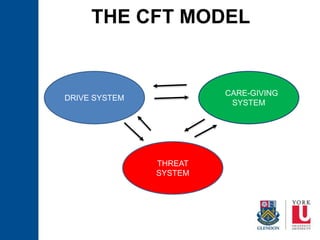
THE CFT MODEL
DRIVE SYSTEM
THREAT
SYSTEM
CCARE-GIVING
SYSTEM
THE CFT MODEL
THE CFT MODEL
THREAT
SYSTEM
DRIVE
SYSTEM
CARE-GIVING
SYSTEM
Motivation Survive Achieve, win Look-after, soothe
Attention Threat-Focused Goals,
Advantage
Empathy to
distress
Thoughts About Danger Achieving Caring, Soothing
Emotions Fear, anxiety Positive,
motivated
Safeness
Physiology Highly Aroused Aroused Calm
Behaviour Fight or Flight Focused Look-after,soothe
THE CFT MODEL
• We are all born with threat systems that are ready for action.
• If our other emotion systems are well developed we have
choices about which system we use at any particular time.
• Some people have not had the opportunities for their care-
giving system to be as well developed.
• This means they have fewer ways of coping with the stresse
that everyone faces in life. People in the threat mindset are
more likely to try and cope by Fight or Flight - avoiding things
(ight) or being self-critical (self-fight).
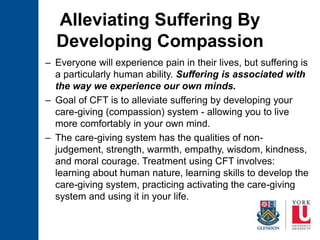
Alleviating Suffering By
Developing Compassion
– Everyone will experience pain in their lives, but suffering is
a particularly human ability. Suffering is associated with
the way we experience our own minds.
– Goal of CFT is to alleviate suffering by developing your
care-giving (compassion) system - allowing you to live
more comfortably in your own mind.
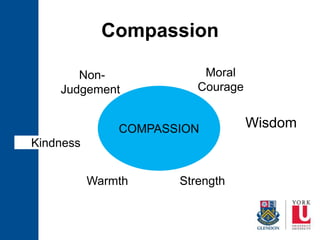
– The care-giving system has the qualities of non-
judgement, strength, warmth, empathy, wisdom, kindness,
and moral courage. Treatment using CFT involves:
learning about human nature, learning skills to develop the
care-giving system, practicing activating the care-giving
system and using it in your life.
Compassion
COMPASSION
Non-
Judgement
Warmth
Moral
Courage
Strength
Wisdom
Kindness
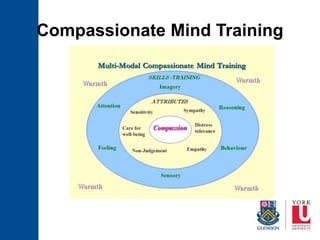
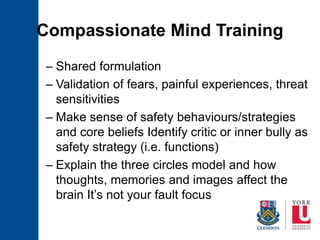
Compassionate Mind Training
– Shared formulation
– Validation of fears, painful experiences, threat
sensitivities
– Make sense of safety behaviours/strategies
and core beliefs Identify critic or inner bully as
safety strategy (i.e. functions)
– Explain the three circles model and how
thoughts, memories and images affect the
brain It’s not your fault focus
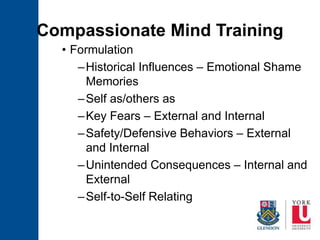
Compassionate Mind Training
• Formulation
–Historical Influences – Emotional Shame
Memories
–Self as/others as
–Key Fears – External and Internal
–Safety/Defensive Behaviors – External
and Internal
–Unintended Consequences – Internal and
External
–Self-to-Self Relating
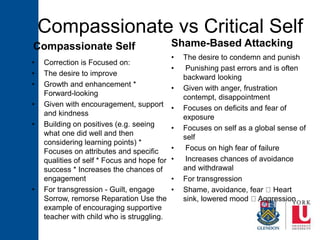
Compassionate vs Critical Self
Compassionate Self
• Correction is Focused on:
• The desire to improve
• Growth and enhancement *
Forward-looking
• Given with encouragement, support
and kindness
• Building on positives (e.g. seeing
what one did well and then
considering learning points) *
Focuses on attributes and specific
qualities of self * Focus and hope for
success * Increases the chances of
engagement
• For transgression - Guilt, engage
Sorrow, remorse Reparation Use the
example of encouraging supportive
teacher with child who is struggling.
Shame-Based Attacking
• The desire to condemn and punish
• Punishing past errors and is often
backward looking
• Given with anger, frustration
contempt, disappointment
• Focuses on deficits and fear of
exposure
• Focuses on self as a global sense of
self
• Focus on high fear of failure
• Increases chances of avoidance
and withdrawal
• For transgression
• Shame, avoidance, fear Heart
sink, lowered mood Aggression
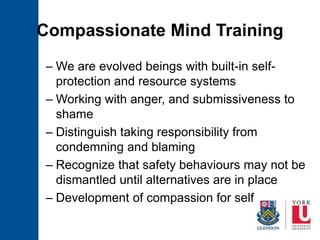
Compassionate Mind Training
– We are evolved beings with built-in self-
protection and resource systems
– Working with anger, and submissiveness to
shame
– Distinguish taking responsibility from
condemning and blaming
– Recognize that safety behaviours may not be
dismantled until alternatives are in place
– Development of compassion for self
Compassionate Mind Training
– Discuss compassion as a focus and ‘direction of
travel’
– Note the foci of compassion: Compassion for others
to self; from self to others and from self-to-self.
– Through the therapeutic relationship mindfulness with
re-focusing of attention, behaviour, thoughts and
feelings
– Use letter writing and imagery (of self and others)
Orientating to compassionate self-identity
Conclusion
• CFT targets the activation of the soothing
system so that it can be more readily accessed
and used to help regulate threat based emotions
of anger, fear, and disgust and shame.
• Developing and living in a compassionate mind
is a life long process
• Learning to deal with life struggles with
compassion – life will always be hard
Contact: justinjlarose@gmail.com
Questions?

Compassion focused therapy

  • 1.
  • 2.
    Compassion-Focused Therapy: Theory and Practiceof CFT By: Justin La Rose MA Personal Counsellor
  • 3.
    Case 1 -Marie – 21 year old student – Emotional Abuse inflicted by Mother – Recently sexually abused by date – Hx of Bipolar - rapid-cycling hypomanic episodes – Dx – MDE with ADHD (attentional) – Self-criticism and shame
  • 4.
    Case 2 -Victoria – 25 year old graduate student – Long hx of mental health disturbances – Varied ED's; GAD; MDE; BDD – OCD – recently developed. – Profound self-loathing and body shame
  • 5.
    Case 3 -Boris –35 year old graphic designer – Raised in an "emotional vacuum" - no love, no support; constant fear; – Hx of multiple mental illness – depression, anxiety, PTSD, self-harm (cutting) – Began hearing voices at age of 9 – now meets DSM criteria for Schizophrenia – Feels immense shame for being a "psycho"
  • 6.
    What is Compassion? •Dalai Lama • "sensitivity to the suffering of self and others and a deep commitment to try to relieve it" • Buddhist Psychology – Eightfolds Path
  • 7.
    What Is CFT? •Developed to treat shame, self-loathing, and self-attack (self-criticism). • CFT is transdiagnostic and is useful for working with diverse conditions such as depression, anxiety, trauma, and psychosis. • CFT is a new model of psychological functioning - it draws upon the science of human nature, evolution, and attachment
  • 8.
    A Word onShame • Recognized as a major component in many illnesses • Involves two key components – Internal and external shame
  • 9.
    External Shame – Externalshame is marked by thoughts and feelings that others view the self negatively with feelings of anger or contempt and/or that the self is seen as having characteristics that make one unattractive and thus rejectable or vulnerable to attacks from others. – One experiences the ‘self’ as ‘living in the minds of others’ as a rejectable person can make the social world unsafe and activates a range of defences such as wanting to hide, conceal and ‘not be seen’, and can have a powerful inhibitory effect on information processing such that a person can feel his or her mind become blank or confused
  • 10.
    Internal Shame – Internalshame emerges with the development of self- awareness and how one exists for others. – The focus of attention is on the self, with self-directed attention, feelings and evaluations of self as inadequate, flawed or bad. A key component of internal shame is thus self-evaluation and self- criticism. – External and internal shame can be fused together – referred to as the ‘exposed self’. – Episode of shame the person experiences the outside world turning against him or her, and his or her own self-evaluations and sense of self (internal world) also become critical, hostile and persecuting
  • 11.
    Why Is ShameHard to Work With In CBT? 1. Shame is NOT a core belief – A threat focused mind set 2. Self attack is a particular form of NAT – Does not respond well to evaluation and evidence 3. Based on inter intra relational experiences – How we live in other peoples minds
  • 12.
    Can We UnderstandThen.... – How We Naturally Develop an ability to feel soothed and safe – The functional origin of shame and self- criticism – How symptoms or diagnosis can be seen as a set of strategies used to manage threat and manage feelings of shame
  • 13.
    What Is CFT? •CFT is a therapy focus not a new school of therapy • Contextualize Mind in its Environment • Therapy is not technique driven but process driven – A way of being with yourself and your clients • Evolutionary model of social mentality theory – Symptoms of psychopathology relate to social threats
  • 14.
    Evolution and TheBrain • CFT - Our brains are the product of evolution, and that we live with the legacy of brains that were not designed with our happiness and wellbeing in mind. • Different parts of our brains have different motivations, abilities, and interests. • The way our brains are built, and the context in which they have developed, affects our experiences and how we can live our lives.
  • 15.
    Evolution and theBrain – The reptilian brain is concerned with: territory, food, sex, survival, temperature – The mammalian brain is concerned with: living in groups, hierarchy, status, caring – The human brain is concerned with: extended care-giving, attachments, thinking m
  • 16.
    THE CFT MODEL •CFT proposes that human beings have three systems for managing their emotional states. Each system has different motivations, foci of attention, thoughts, emotions, and body feelings. Each system is associated with different parts of the brain, and with different neurochemistry
  • 17.
    THE CFT MODEL DRIVESYSTEM THREAT SYSTEM CCARE-GIVING SYSTEM
  • 18.
  • 19.
    THE CFT MODEL THREAT SYSTEM DRIVE SYSTEM CARE-GIVING SYSTEM MotivationSurvive Achieve, win Look-after, soothe Attention Threat-Focused Goals, Advantage Empathy to distress Thoughts About Danger Achieving Caring, Soothing Emotions Fear, anxiety Positive, motivated Safeness Physiology Highly Aroused Aroused Calm Behaviour Fight or Flight Focused Look-after,soothe
  • 20.
    THE CFT MODEL •We are all born with threat systems that are ready for action. • If our other emotion systems are well developed we have choices about which system we use at any particular time. • Some people have not had the opportunities for their care- giving system to be as well developed. • This means they have fewer ways of coping with the stresse that everyone faces in life. People in the threat mindset are more likely to try and cope by Fight or Flight - avoiding things (ight) or being self-critical (self-fight).
  • 21.
    Alleviating Suffering By DevelopingCompassion – Everyone will experience pain in their lives, but suffering is a particularly human ability. Suffering is associated with the way we experience our own minds. – Goal of CFT is to alleviate suffering by developing your care-giving (compassion) system - allowing you to live more comfortably in your own mind. – The care-giving system has the qualities of non- judgement, strength, warmth, empathy, wisdom, kindness, and moral courage. Treatment using CFT involves: learning about human nature, learning skills to develop the care-giving system, practicing activating the care-giving system and using it in your life.
  • 22.
  • 23.
  • 24.
    Compassionate Mind Training –Shared formulation – Validation of fears, painful experiences, threat sensitivities – Make sense of safety behaviours/strategies and core beliefs Identify critic or inner bully as safety strategy (i.e. functions) – Explain the three circles model and how thoughts, memories and images affect the brain It’s not your fault focus
  • 25.
    Compassionate Mind Training •Formulation –Historical Influences – Emotional Shame Memories –Self as/others as –Key Fears – External and Internal –Safety/Defensive Behaviors – External and Internal –Unintended Consequences – Internal and External –Self-to-Self Relating
  • 26.
    Compassionate vs CriticalSelf Compassionate Self • Correction is Focused on: • The desire to improve • Growth and enhancement * Forward-looking • Given with encouragement, support and kindness • Building on positives (e.g. seeing what one did well and then considering learning points) * Focuses on attributes and specific qualities of self * Focus and hope for success * Increases the chances of engagement • For transgression - Guilt, engage Sorrow, remorse Reparation Use the example of encouraging supportive teacher with child who is struggling. Shame-Based Attacking • The desire to condemn and punish • Punishing past errors and is often backward looking • Given with anger, frustration contempt, disappointment • Focuses on deficits and fear of exposure • Focuses on self as a global sense of self • Focus on high fear of failure • Increases chances of avoidance and withdrawal • For transgression • Shame, avoidance, fear Heart sink, lowered mood Aggression
  • 27.
    Compassionate Mind Training –We are evolved beings with built-in self- protection and resource systems – Working with anger, and submissiveness to shame – Distinguish taking responsibility from condemning and blaming – Recognize that safety behaviours may not be dismantled until alternatives are in place – Development of compassion for self
  • 28.
    Compassionate Mind Training –Discuss compassion as a focus and ‘direction of travel’ – Note the foci of compassion: Compassion for others to self; from self to others and from self-to-self. – Through the therapeutic relationship mindfulness with re-focusing of attention, behaviour, thoughts and feelings – Use letter writing and imagery (of self and others) Orientating to compassionate self-identity
  • 29.
    Conclusion • CFT targetsthe activation of the soothing system so that it can be more readily accessed and used to help regulate threat based emotions of anger, fear, and disgust and shame. • Developing and living in a compassionate mind is a life long process • Learning to deal with life struggles with compassion – life will always be hard
  • 30.