Study of Fluids 
Presented By: 
Sadhana Singh
Outlines 
• Introduction 
• Classes of Fluids 
• Properties of Fluids 
• Types of Fluids Flow 
• Fluids in Motion 
• Applications of Fluids 
• Conclusions 
• References 
12/4/2014 Fluids 2
Introduction 
• A fluid is anything that flows, usually a liquid or a gas 
• Fluids are treated as continuous media, and their 
motion and state can be specified in terms of the 
velocity u, pressure p, density ρ , etc evaluated at 
every point in space x and time t 
• A fluid cannot resist a shear stress by a static deflecti 
on and it moves and deforms continuously as long 
as the shear stress is applied 
12/4/2014 Fluids 3
Cont’d… 
• Fluid mechanics is the study of fluids either in motion 
(fluid dynamics) or at rest (fluid statics) 
• Both liquids and gases are classified as fluids 
• If the fluids are at rest, the study of them is called 
fluid statics 
• If the fluids are in motion, the study of them is called 
fluid dynamics 
12/4/2014 Fluids 4
Cont’d… 
• The science and technology of the mechanical 
properties of liquids is called hydraulics 
• Similarly, the science and technology of the 
mechanical properties of air and other gases is called 
pneumatics 
12/4/2014 Fluids 5
Cont’d… 
• The Fluid density is defined as: 
12/4/2014 Fluids 6
Cont’d… 
• The science and technology of the mechanical 
properties of liquids is called Hydraulics. 
• Similarly, the science and technology of the 
mechanical properties of air and other gases is called 
pneumatic. 
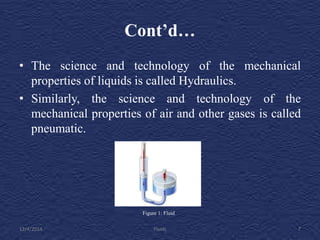
Figure 1: Fluid 
12/4/2014 Fluids 7
Cont’d… 
Figure 2: Effects of Viscosity and shape on the fluid flow 
12/4/2014 Fluids 8
Classes of Fluids 
• Two classes of Fluids are: 
 Liquids 
Are composed of relatively close‐packed molecules 
with strong cohesive forces 
Liquids have constant volume 
Will form a free surface in a gravitational field if 
unconfined from above 
12/4/2014 Fluids 9
Cont’d… 
• In a liquid, the particles move fast enough that they 
can’t stay in a rigid structure but they still want to 
stay close by. 
Figure 3: Liquid crystals 
12/4/2014 Fluids 10
Cont’d… 
Gases 
Molecules are widely spaced with negligible cohesive 
forces 
A gas is free to expand until it encounters confining 
walls 
A gas has no definite volume, and it forms an atmosp 
here when it is not confined 
Gravitational effects are rarely concerned 
12/4/2014 Fluids 11
Cont’d… 
• In a gas, however, the particles are moving even 
faster and fly by each other, bouncing off the edges 
of the container. 
Evaporation: a liquid 
molecule becoming a gas 
molecule 
Figure 4: Gas molecule 
12/4/2014 Fluids 12
Solids 
• In a solid, the particles are moving slowly enough 
that this attraction keeps them in a rigid structure. 
• Has definite volume 
• Has definite shape 
• Molecules are held in specific locations 
by electrical forces 
• vibrate about equilibrium positions 
• Can be modeled as springs connecting molecules 
12/4/2014 Fluids 13
Cont’d… 
Figure 5: Both are solids 
12/4/2014 Fluids 14
Properties of Fluids 
• Density or Mass Density: 
Density or mass density of a fluid is defined as ratio 
of the mass of a fluids to its volume. Thus mass per 
unit volume of a fluid is called density. 
Thus unit of density in S.I. is kg/m3 
12/4/2014 Fluids 15
Cont’d… 
• Specific weight or weight density: 
Specific weight or weight density of a fluid is defined 
as ratio between the weights of fluids and to its 
volume. Thus weight per unit volume of a fluid is 
called weight density. 
Thus unit of specific weight in S.I. is N/m3 
12/4/2014 Fluids 16
Cont’d… 
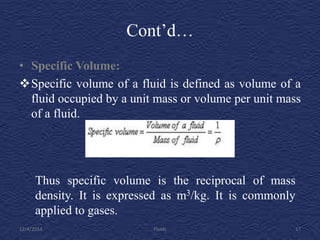
• Specific Volume: 
Specific volume of a fluid is defined as volume of a 
fluid occupied by a unit mass or volume per unit mass 
of a fluid. 
Thus specific volume is the reciprocal of mass 
density. It is expressed as m3/kg. It is commonly 
applied to gases. 
12/4/2014 Fluids 17
Cont’d… 
• Specific gravity: 
Specific gravity is defined as the ratio of weight 
density of a fluid to the weight density of a standard 
fluid. 
12/4/2014 Fluids 18
Types of Fluids Flow 
• Fluid evenness: Steady or unsteady flow 
• Fluid squeezability: Compressible or incompressible 
flow 
• Fluid thickness: Viscous or nonviscous flow 
• Fluid spinning: Rotational or irrotational flow 
• Division of flows with respect to distance 
12/4/2014 Fluids 19
Fluid evenness: Steady or unsteady flow 
• Fluid flow can be steady or unsteady, depending on 
the fluid’s velocity: 
• Steady. In steady fluid flow, the velocity of the fluid 
is constant at any point. 
• Unsteady. When the flow is unsteady, the fluid’s 
velocity can differ between any two points. 
12/4/2014 Fluids 20
Fluid squeezability: Compressible or 
incompressible flow 
• Fluid flow can 
be compressible or incompressible, depending on 
whether you can easily compress the fluid. 
• Liquids are usually nearly impossible to compress, 
whereas gases (also considered. a fluid) are very 
compressible. 
12/4/2014 Fluids 21
Fluid thickness: Viscous or nonviscous 
flow 
• Liquid flow can be viscous or nonviscous. Viscosity is 
a measure of the thickness of a fluid, and very gloppy 
fluids such as motor oil or shampoo are called viscous 
fluids. 
• Viscosity is actually a measure of friction in the fluid. 
When a fluid flows, the layers of fluid rub against one 
another, and in very viscous fluids, the friction is so 
great that the layers of flow pull against one other and 
hamper that flow. 
12/4/2014 Fluids 22
Fluid spinning: Rotational or irrotational 
flow 
• Fluid flow can be rotational or irrotational. If, as you 
travel in a closed loop, you add up all the components 
of the fluid velocity vectors along your path and the 
end result is not zero, then the flow is rotational. 
12/4/2014 Fluids 23
Division of flows with respect to distance 
• Uniform flow – constant section area along flow path 
• Non-uniform flow – variable section area 
12/4/2014 Fluids 24
Laminar Flow 
Flow along parallel paths 
 Shear stress proportional to velocity gradient 
(τ = μ⋅du/dy) 
• Disturbances in the flow are rapidly damped by 
viscous action 
12/4/2014 Fluids 25
Turbulent Flow 
Fluid particles moves in a random manner and not in 
layers 
 Length scales >> molecular scales in laminar flow 
 Rapid continuous mixing 
 Inertia forces and viscous forces of importance 
Figure 6: Turbulent Flow 
12/4/2014 Fluids 26
Fluids in Motion 
• All fluids are assumed in this treatment to exhibit 
streamline flow. 
• Streamline flow is the motion of a fluid in which 
every particle in the fluid follows the same path past a 
particular point as that followed by previous particles. 
Figure 7: Streamline flow 
12/4/2014 Fluids 27
Fluid System And Control Volume 
• Fluid system: Specified mass of fluid within a closed 
surface 
• Control volume: Fix region in space that can’t be 
moved or change shape. Its surface is called control 
surface. 
12/4/2014 Fluids 28
Applications 
• Fluids is extremely important in many areas of 
engineering and science. Examples are: 
Biomechanics 
Blood flow through arteries 
Meteorology and Ocean Engineering 
Movements of air currents and water currents 
Chemical Engineering 
Design of chemical processing equipment 
12/4/2014 Fluids 29
Cont’d… 
Mechanical Engineering 
Design of pumps, turbines, air-conditioning 
equipment, pollution-control equipment, etc. 
Civil Engineering 
Transport of river sediments 
Pollution of air and water 
Design of piping systems 
Flood control systems 
12/4/2014 Fluids 30
Conclusions 
• A fluid is a substance that continually deforms(flows) 
under an applied shear stress. 
• Fluids are a subset of the phases of matter and 
include liquids, gases, plasmas and, to some 
extent, plastic solids. 
• Fluids can be defined as substances which have 
zero shear modulus or in simpler terms a fluid is 
a substance which cannot resist any shear 
force applied to it. 
12/4/2014 Fluids 31
References 
• http://www.dummies.com/how-to/content/the-different-types-of- 
fluid-flow.html 
• Genick Bar Meir, “ Basics of fluid mechanics”, July 25, 2013. 
• M. Bahrami, “Introduction and properties of fluids”, Spring 
2009. 
• T. J. Pedley, “Introduction to Fluid dynamics”, LECTURES 
ON PLANKTON AND TURBULENCE. C. MARRASÉ, E. 
SAIZ and J.M. REDONDO (eds.), 1997. 
• Bird, Byron; Stewart, Warren & Lightfoot, Edward 
(2007). Transport Phenomena. New York: Wiley, Second 
Edition. p. 912. ISBN 0-471-41077-2. 
12/4/2014 Fluids 32
12/4/2014 Fluids 33

Study of fluids

  • 1.
    Study of Fluids Presented By: Sadhana Singh
  • 2.
    Outlines • Introduction • Classes of Fluids • Properties of Fluids • Types of Fluids Flow • Fluids in Motion • Applications of Fluids • Conclusions • References 12/4/2014 Fluids 2
  • 3.
    Introduction • Afluid is anything that flows, usually a liquid or a gas • Fluids are treated as continuous media, and their motion and state can be specified in terms of the velocity u, pressure p, density ρ , etc evaluated at every point in space x and time t • A fluid cannot resist a shear stress by a static deflecti on and it moves and deforms continuously as long as the shear stress is applied 12/4/2014 Fluids 3
  • 4.
    Cont’d… • Fluidmechanics is the study of fluids either in motion (fluid dynamics) or at rest (fluid statics) • Both liquids and gases are classified as fluids • If the fluids are at rest, the study of them is called fluid statics • If the fluids are in motion, the study of them is called fluid dynamics 12/4/2014 Fluids 4
  • 5.
    Cont’d… • Thescience and technology of the mechanical properties of liquids is called hydraulics • Similarly, the science and technology of the mechanical properties of air and other gases is called pneumatics 12/4/2014 Fluids 5
  • 6.
    Cont’d… • TheFluid density is defined as: 12/4/2014 Fluids 6
  • 7.
    Cont’d… • Thescience and technology of the mechanical properties of liquids is called Hydraulics. • Similarly, the science and technology of the mechanical properties of air and other gases is called pneumatic. Figure 1: Fluid 12/4/2014 Fluids 7
  • 8.
    Cont’d… Figure 2:Effects of Viscosity and shape on the fluid flow 12/4/2014 Fluids 8
  • 9.
    Classes of Fluids • Two classes of Fluids are:  Liquids Are composed of relatively close‐packed molecules with strong cohesive forces Liquids have constant volume Will form a free surface in a gravitational field if unconfined from above 12/4/2014 Fluids 9
  • 10.
    Cont’d… • Ina liquid, the particles move fast enough that they can’t stay in a rigid structure but they still want to stay close by. Figure 3: Liquid crystals 12/4/2014 Fluids 10
  • 11.
    Cont’d… Gases Moleculesare widely spaced with negligible cohesive forces A gas is free to expand until it encounters confining walls A gas has no definite volume, and it forms an atmosp here when it is not confined Gravitational effects are rarely concerned 12/4/2014 Fluids 11
  • 12.
    Cont’d… • Ina gas, however, the particles are moving even faster and fly by each other, bouncing off the edges of the container. Evaporation: a liquid molecule becoming a gas molecule Figure 4: Gas molecule 12/4/2014 Fluids 12
  • 13.
    Solids • Ina solid, the particles are moving slowly enough that this attraction keeps them in a rigid structure. • Has definite volume • Has definite shape • Molecules are held in specific locations by electrical forces • vibrate about equilibrium positions • Can be modeled as springs connecting molecules 12/4/2014 Fluids 13
  • 14.
    Cont’d… Figure 5:Both are solids 12/4/2014 Fluids 14
  • 15.
    Properties of Fluids • Density or Mass Density: Density or mass density of a fluid is defined as ratio of the mass of a fluids to its volume. Thus mass per unit volume of a fluid is called density. Thus unit of density in S.I. is kg/m3 12/4/2014 Fluids 15
  • 16.
    Cont’d… • Specificweight or weight density: Specific weight or weight density of a fluid is defined as ratio between the weights of fluids and to its volume. Thus weight per unit volume of a fluid is called weight density. Thus unit of specific weight in S.I. is N/m3 12/4/2014 Fluids 16
  • 17.
    Cont’d… • SpecificVolume: Specific volume of a fluid is defined as volume of a fluid occupied by a unit mass or volume per unit mass of a fluid. Thus specific volume is the reciprocal of mass density. It is expressed as m3/kg. It is commonly applied to gases. 12/4/2014 Fluids 17
  • 18.
    Cont’d… • Specificgravity: Specific gravity is defined as the ratio of weight density of a fluid to the weight density of a standard fluid. 12/4/2014 Fluids 18
  • 19.
    Types of FluidsFlow • Fluid evenness: Steady or unsteady flow • Fluid squeezability: Compressible or incompressible flow • Fluid thickness: Viscous or nonviscous flow • Fluid spinning: Rotational or irrotational flow • Division of flows with respect to distance 12/4/2014 Fluids 19
  • 20.
    Fluid evenness: Steadyor unsteady flow • Fluid flow can be steady or unsteady, depending on the fluid’s velocity: • Steady. In steady fluid flow, the velocity of the fluid is constant at any point. • Unsteady. When the flow is unsteady, the fluid’s velocity can differ between any two points. 12/4/2014 Fluids 20
  • 21.
    Fluid squeezability: Compressibleor incompressible flow • Fluid flow can be compressible or incompressible, depending on whether you can easily compress the fluid. • Liquids are usually nearly impossible to compress, whereas gases (also considered. a fluid) are very compressible. 12/4/2014 Fluids 21
  • 22.
    Fluid thickness: Viscousor nonviscous flow • Liquid flow can be viscous or nonviscous. Viscosity is a measure of the thickness of a fluid, and very gloppy fluids such as motor oil or shampoo are called viscous fluids. • Viscosity is actually a measure of friction in the fluid. When a fluid flows, the layers of fluid rub against one another, and in very viscous fluids, the friction is so great that the layers of flow pull against one other and hamper that flow. 12/4/2014 Fluids 22
  • 23.
    Fluid spinning: Rotationalor irrotational flow • Fluid flow can be rotational or irrotational. If, as you travel in a closed loop, you add up all the components of the fluid velocity vectors along your path and the end result is not zero, then the flow is rotational. 12/4/2014 Fluids 23
  • 24.
    Division of flowswith respect to distance • Uniform flow – constant section area along flow path • Non-uniform flow – variable section area 12/4/2014 Fluids 24
  • 25.
    Laminar Flow Flowalong parallel paths  Shear stress proportional to velocity gradient (τ = μ⋅du/dy) • Disturbances in the flow are rapidly damped by viscous action 12/4/2014 Fluids 25
  • 26.
    Turbulent Flow Fluidparticles moves in a random manner and not in layers  Length scales >> molecular scales in laminar flow  Rapid continuous mixing  Inertia forces and viscous forces of importance Figure 6: Turbulent Flow 12/4/2014 Fluids 26
  • 27.
    Fluids in Motion • All fluids are assumed in this treatment to exhibit streamline flow. • Streamline flow is the motion of a fluid in which every particle in the fluid follows the same path past a particular point as that followed by previous particles. Figure 7: Streamline flow 12/4/2014 Fluids 27
  • 28.
    Fluid System AndControl Volume • Fluid system: Specified mass of fluid within a closed surface • Control volume: Fix region in space that can’t be moved or change shape. Its surface is called control surface. 12/4/2014 Fluids 28
  • 29.
    Applications • Fluidsis extremely important in many areas of engineering and science. Examples are: Biomechanics Blood flow through arteries Meteorology and Ocean Engineering Movements of air currents and water currents Chemical Engineering Design of chemical processing equipment 12/4/2014 Fluids 29
  • 30.
    Cont’d… Mechanical Engineering Design of pumps, turbines, air-conditioning equipment, pollution-control equipment, etc. Civil Engineering Transport of river sediments Pollution of air and water Design of piping systems Flood control systems 12/4/2014 Fluids 30
  • 31.
    Conclusions • Afluid is a substance that continually deforms(flows) under an applied shear stress. • Fluids are a subset of the phases of matter and include liquids, gases, plasmas and, to some extent, plastic solids. • Fluids can be defined as substances which have zero shear modulus or in simpler terms a fluid is a substance which cannot resist any shear force applied to it. 12/4/2014 Fluids 31
  • 32.
    References • http://www.dummies.com/how-to/content/the-different-types-of- fluid-flow.html • Genick Bar Meir, “ Basics of fluid mechanics”, July 25, 2013. • M. Bahrami, “Introduction and properties of fluids”, Spring 2009. • T. J. Pedley, “Introduction to Fluid dynamics”, LECTURES ON PLANKTON AND TURBULENCE. C. MARRASÉ, E. SAIZ and J.M. REDONDO (eds.), 1997. • Bird, Byron; Stewart, Warren & Lightfoot, Edward (2007). Transport Phenomena. New York: Wiley, Second Edition. p. 912. ISBN 0-471-41077-2. 12/4/2014 Fluids 32
  • 33.