TEFL  III Bloom`s Taxonomy  (Classification of learning objectives)
Presentation objectives Develop a better understanding of the three categories of learning objectives  Differentiate the three domains of Bloom’s taxonomy
CLASSIFICATION OF LEARNIG OBJECTIVES Cognitive Domain Affective Domain Psychomotor Domain
Cognitive domain  involves mental operations at all levels Affective domain  involves feelings, attitudes, and values at various levels Psychomotor domain  involves  development of the body and skills it performs,   physical  skills at all levels   BLOOM’S THREE CATEGORIES OF LEARNIG OBJECTIVES
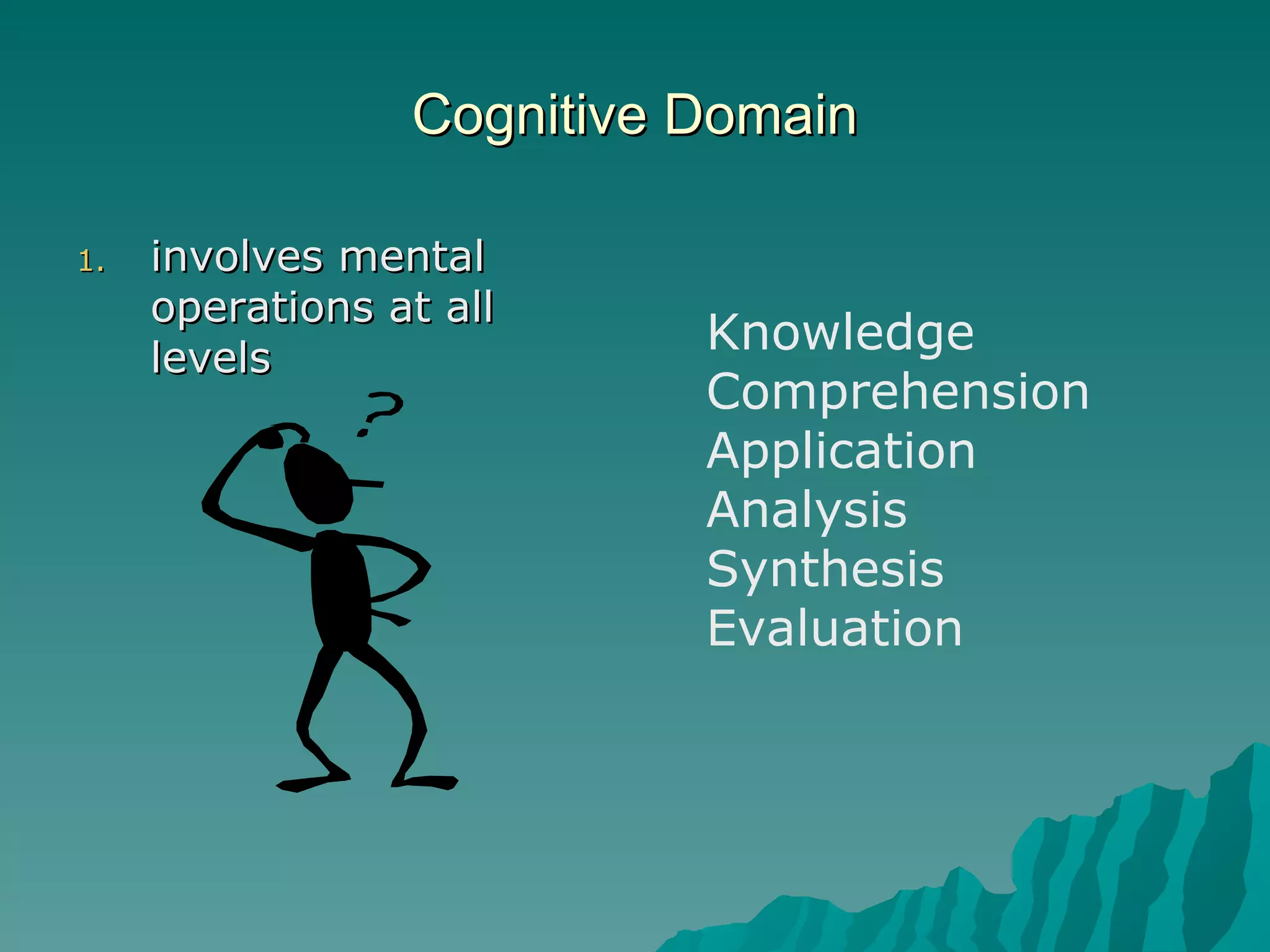
Cognitive Domain involves mental operations at all levels Knowledge Comprehension Application Analysis Synthesis Evaluation
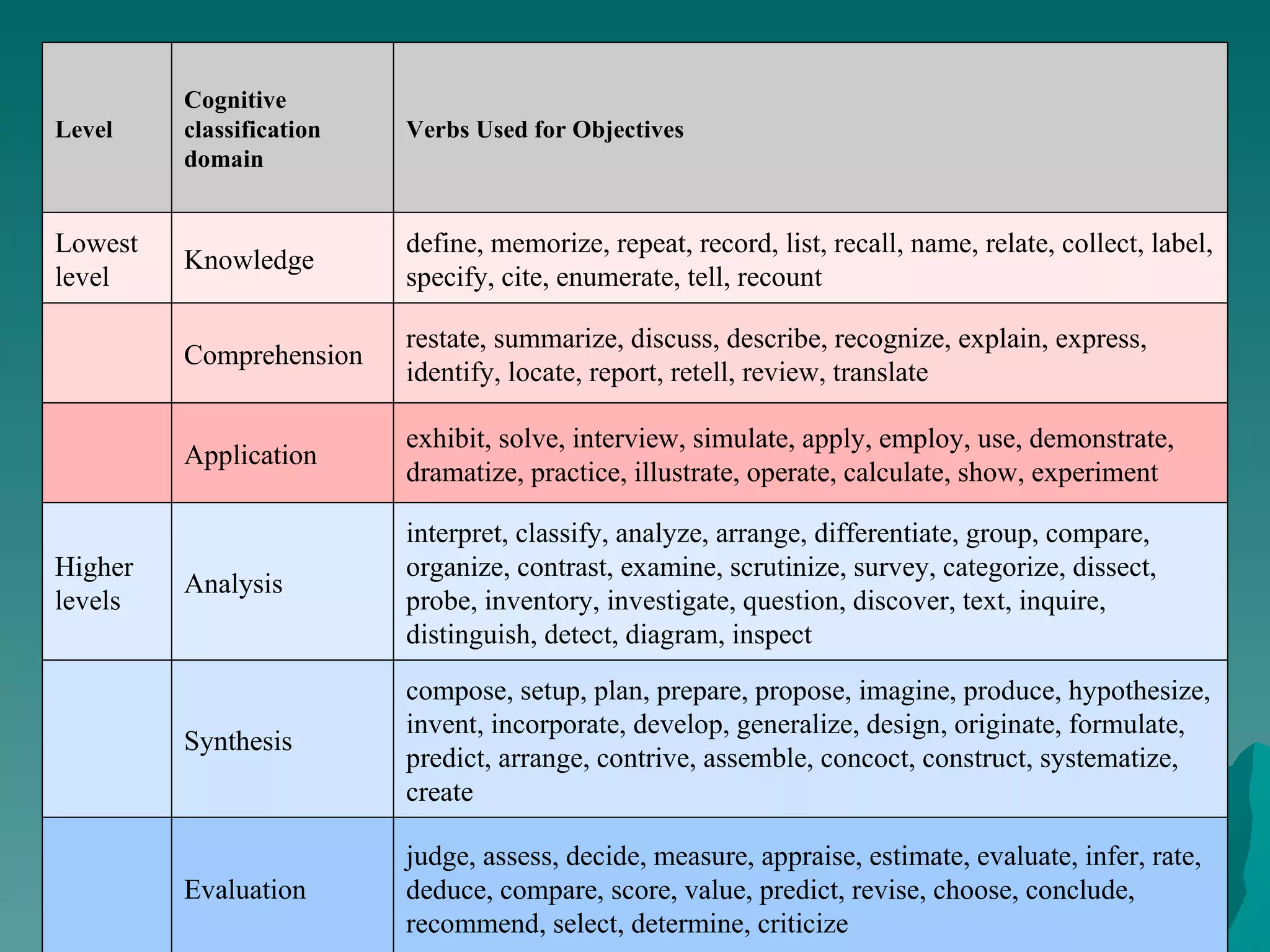
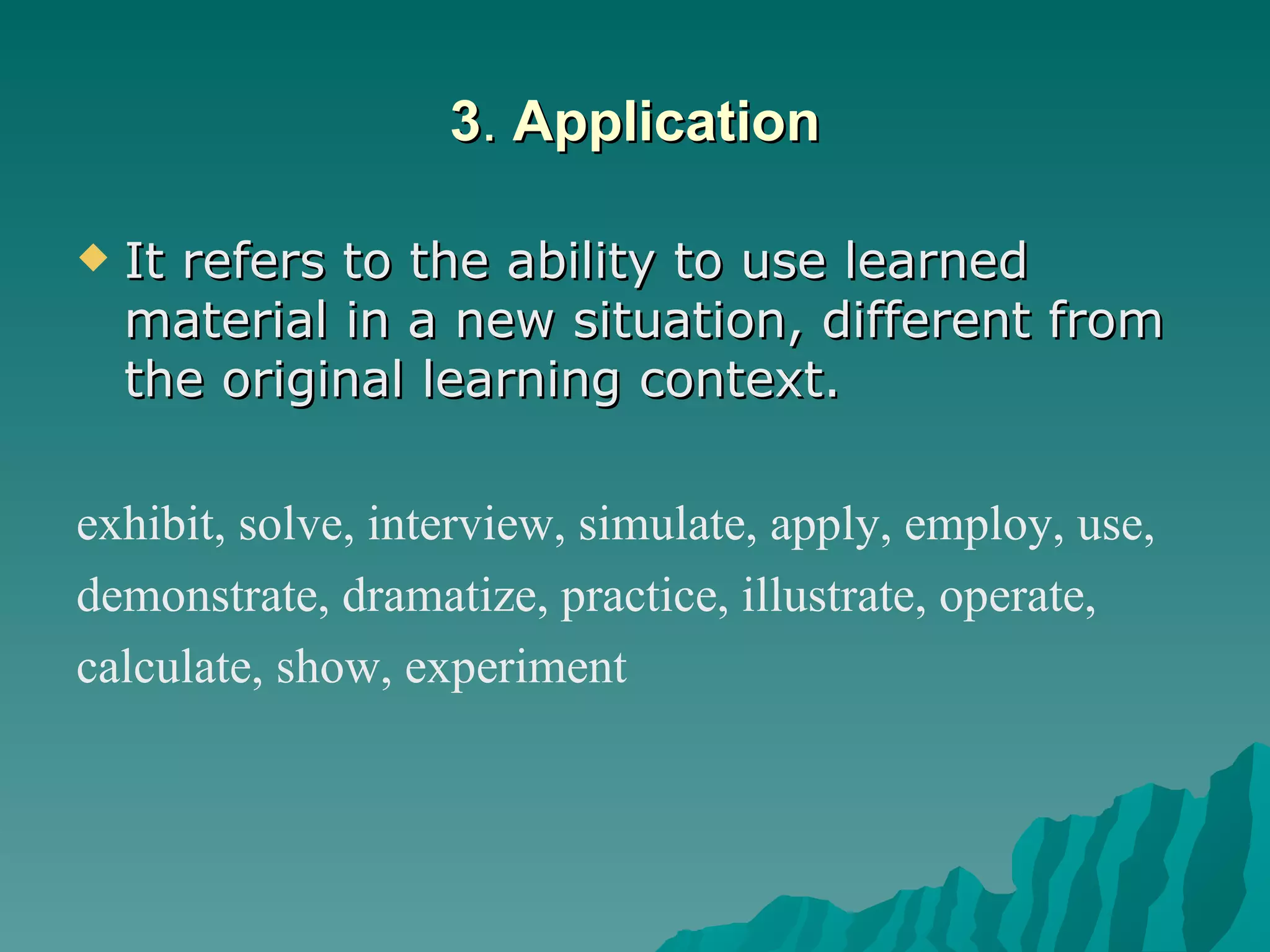
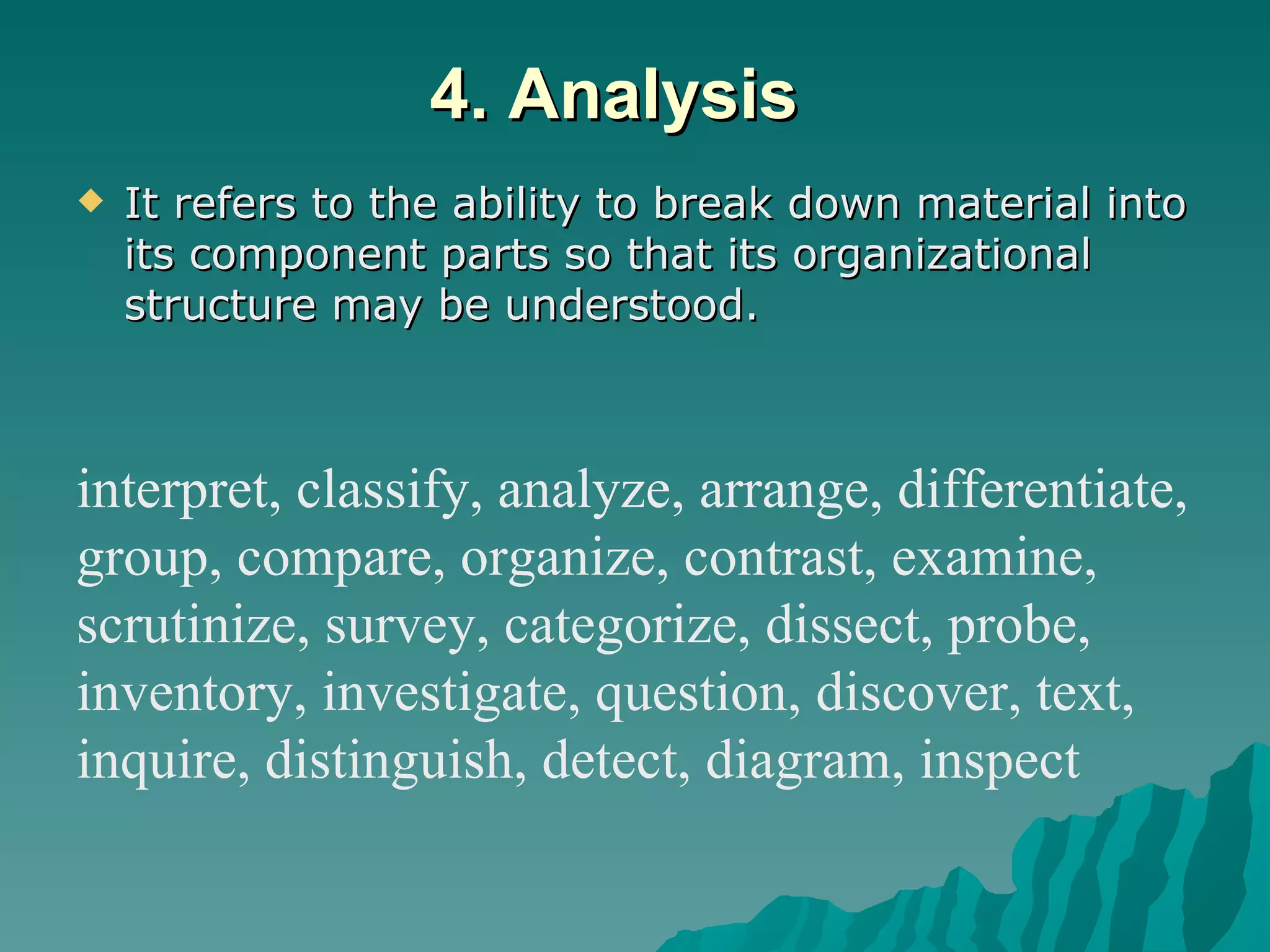
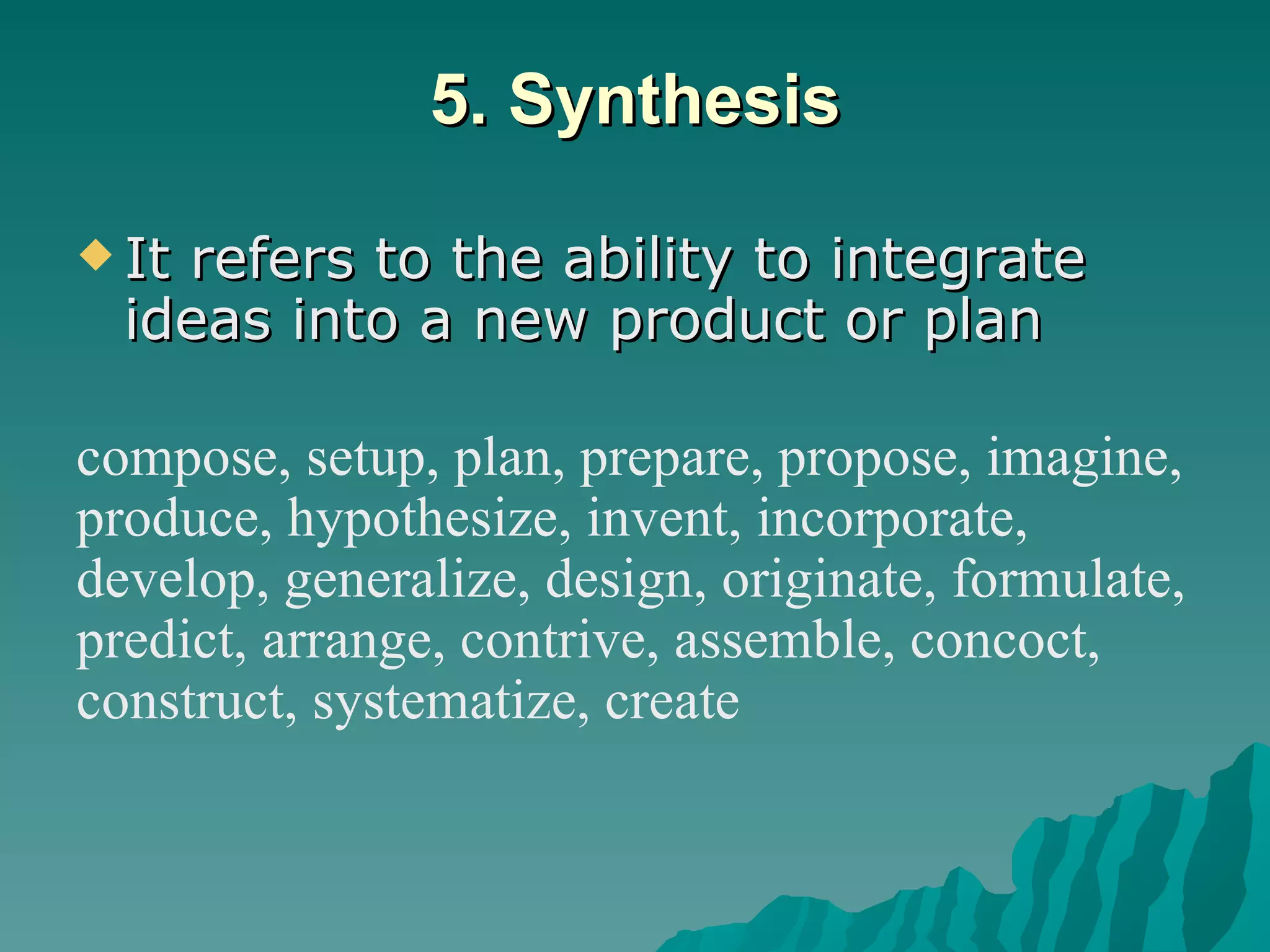
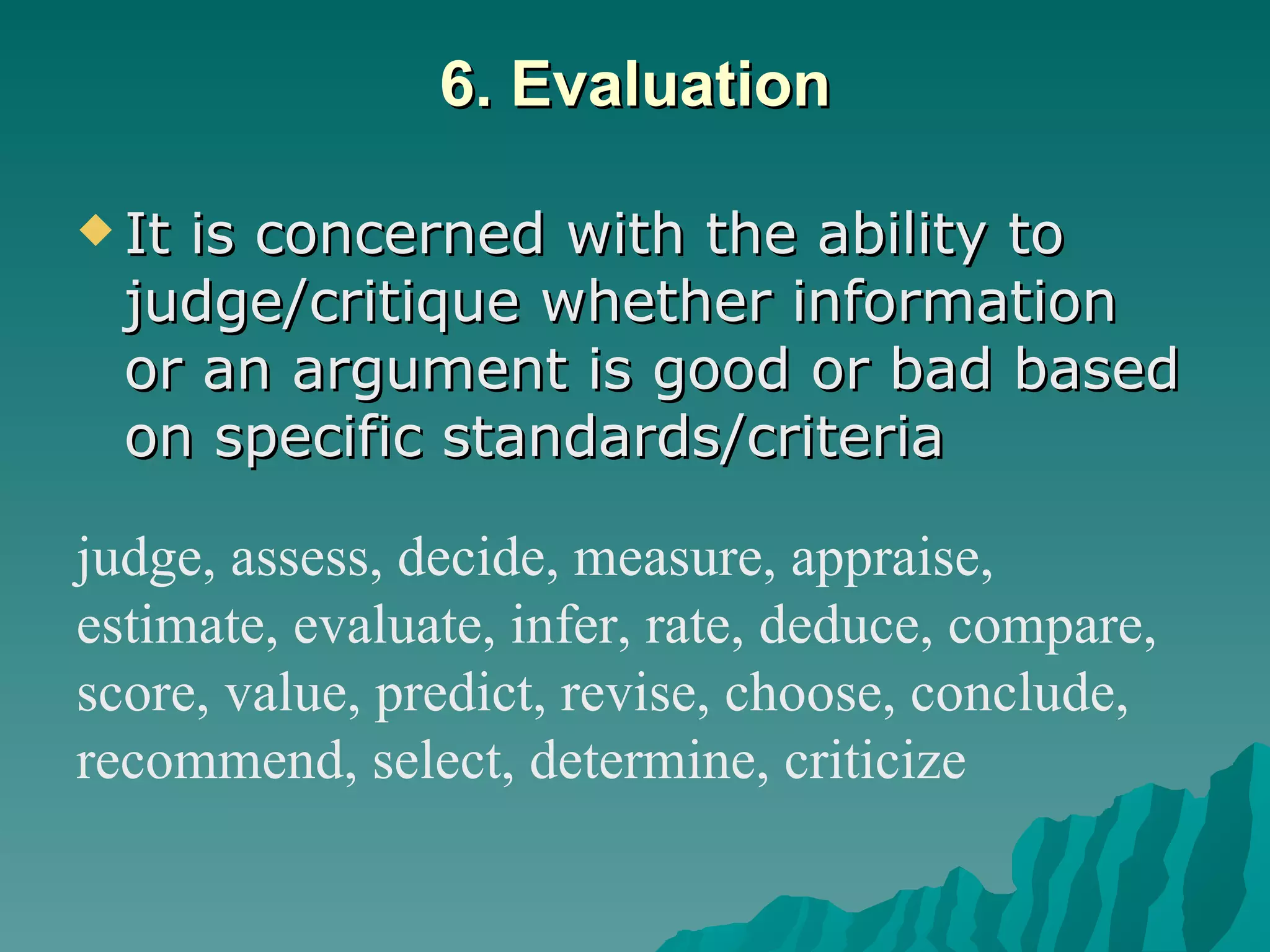
Level Cognitive classification domain  Verbs Used for Objectives Lowest level Knowledge define, memorize, repeat, record, list, recall, name, relate, collect, label, specify, cite, enumerate, tell, recount   Comprehension restate, summarize, discuss, describe, recognize, explain, express, identify, locate, report, retell, review, translate   Application exhibit, solve, interview, simulate, apply, employ, use, demonstrate, dramatize, practice, illustrate, operate, calculate, show, experiment Higher levels Analysis interpret, classify, analyze, arrange, differentiate, group, compare, organize, contrast, examine, scrutinize, survey, categorize, dissect, probe, inventory, investigate, question, discover, text, inquire, distinguish, detect, diagram, inspect   Synthesis compose, setup, plan, prepare, propose, imagine, produce, hypothesize, invent, incorporate, develop, generalize, design, originate, formulate, predict, arrange, contrive, assemble, concoct, construct, systematize, create   Evaluation judge, assess, decide, measure, appraise, estimate, evaluate, infer, rate, deduce, compare, score, value, predict, revise, choose, conclude, recommend, select, determine, criticize
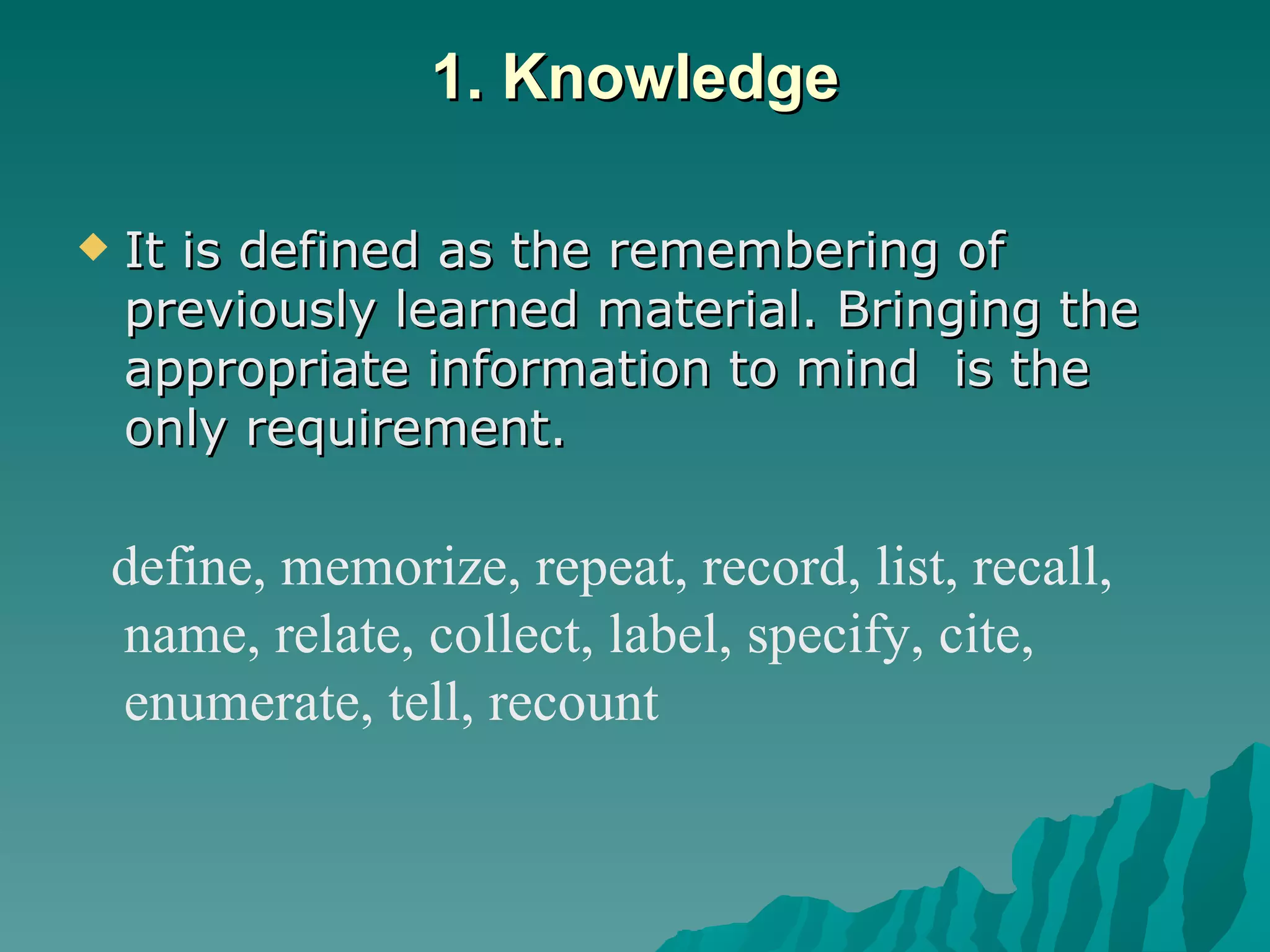
1. Knowledge It is defined as the remembering of previously learned material. Bringing the appropriate information to mind  is the only requirement.  define, memorize, repeat, record, list, recall, name, relate, collect, label, specify, cite, enumerate, tell, recount
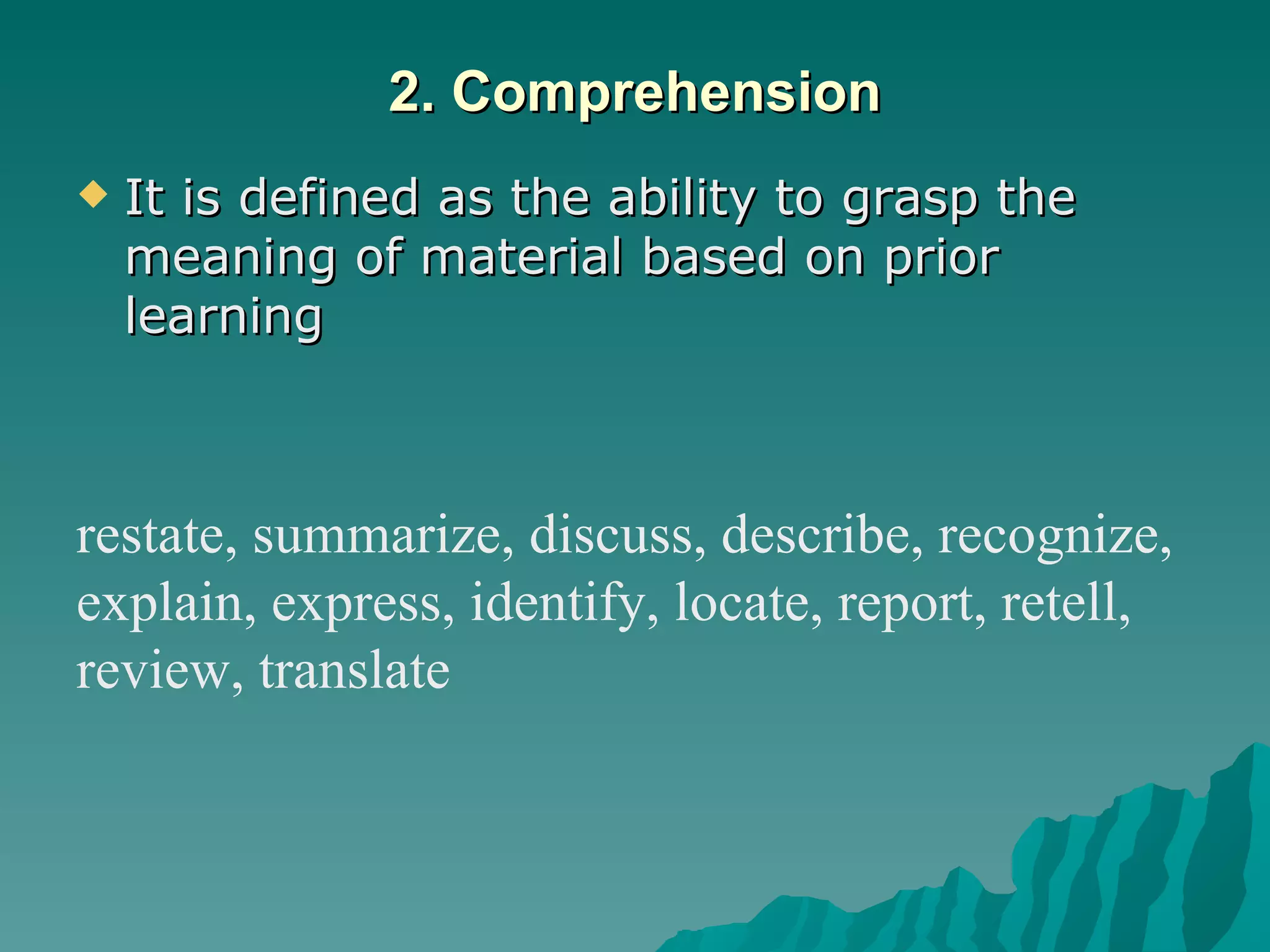
2. Comprehension It is defined as the ability to grasp the meaning of material based on prior learning restate, summarize, discuss, describe, recognize,  explain, express, identify, locate, report, retell,  review, translate
3 .  Application It refers to the ability to use learned material in a new situation, different from the original learning context.  exhibit, solve, interview, simulate, apply, employ, use,  demonstrate, dramatize, practice, illustrate, operate,  calculate, show, experiment  
4. Analysis It refers to the ability to break down material into its component parts so that its organizational structure may be understood.  interpret, classify, analyze, arrange, differentiate, group, compare, organize, contrast, examine,  scrutinize, survey, categorize, dissect, probe,  inventory, investigate, question, discover, text,  inquire, distinguish, detect, diagram, inspect
5. Synthesis It refers to the ability to integrate ideas into a new product or plan  compose, setup, plan, prepare, propose, imagine, produce, hypothesize, invent, incorporate,  develop, generalize, design, originate, formulate, predict, arrange, contrive, assemble, concoct,  construct, systematize, create
6. Evaluation It is concerned with the ability to judge/critique whether information or an argument is good or bad based on specific standards/criteria   judge, assess, decide, measure, appraise,  estimate, evaluate, infer, rate, deduce, compare, score, value, predict, revise, choose, conclude,  recommend, select, determine, criticize
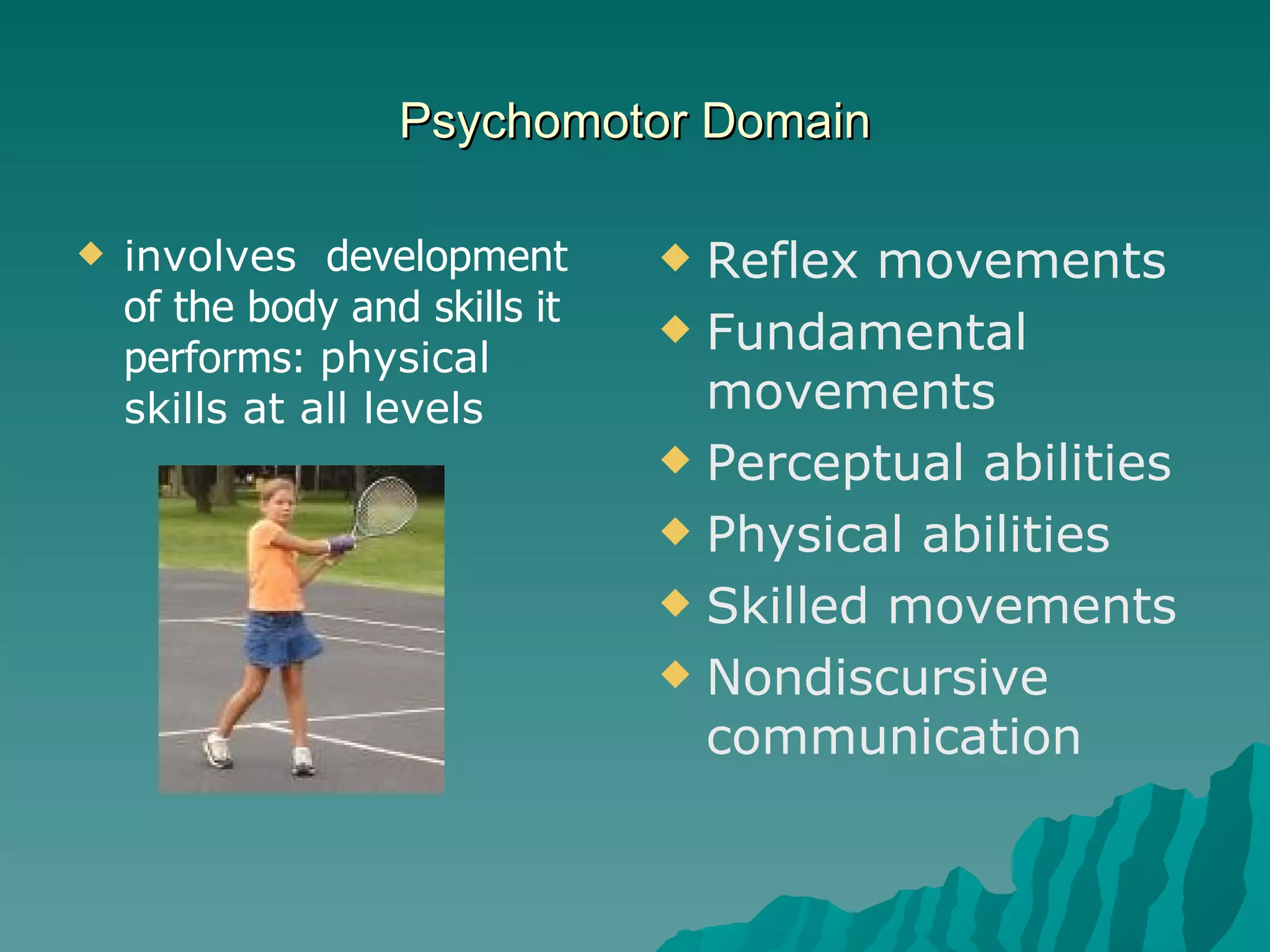
Psychomotor Domain involves  development of the body and skills it performs:  physical  skills at all levels Reflex movements Fundamental movements Perceptual abilities Physical abilities Skilled movements Nondiscursive communication
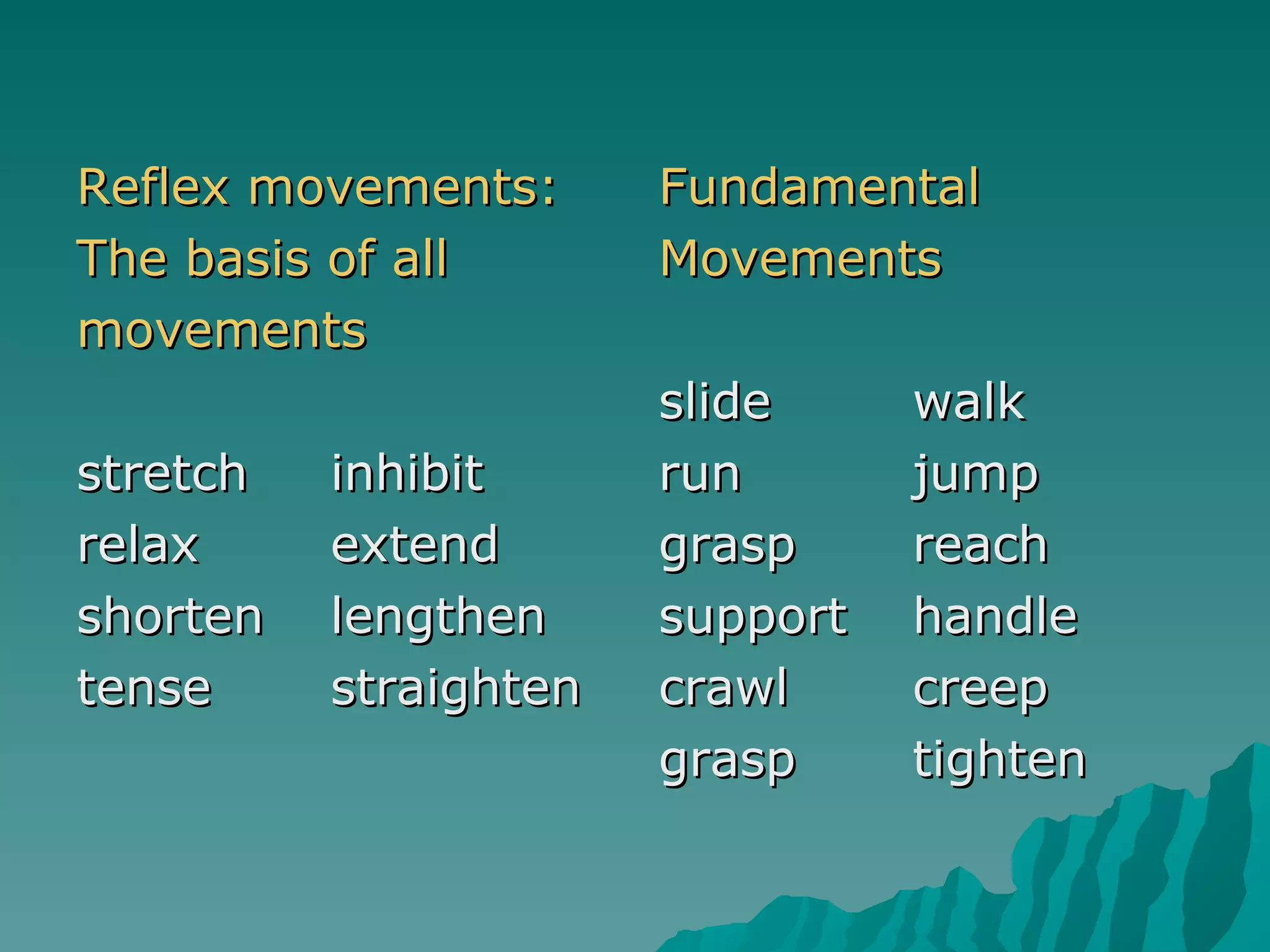
Reflex movements: The basis of all  movements stretch inhibit relax extend shorten lengthen tense straighten  Fundamental Movements slide walk run jump grasp reach support handle crawl creep grasp tighten
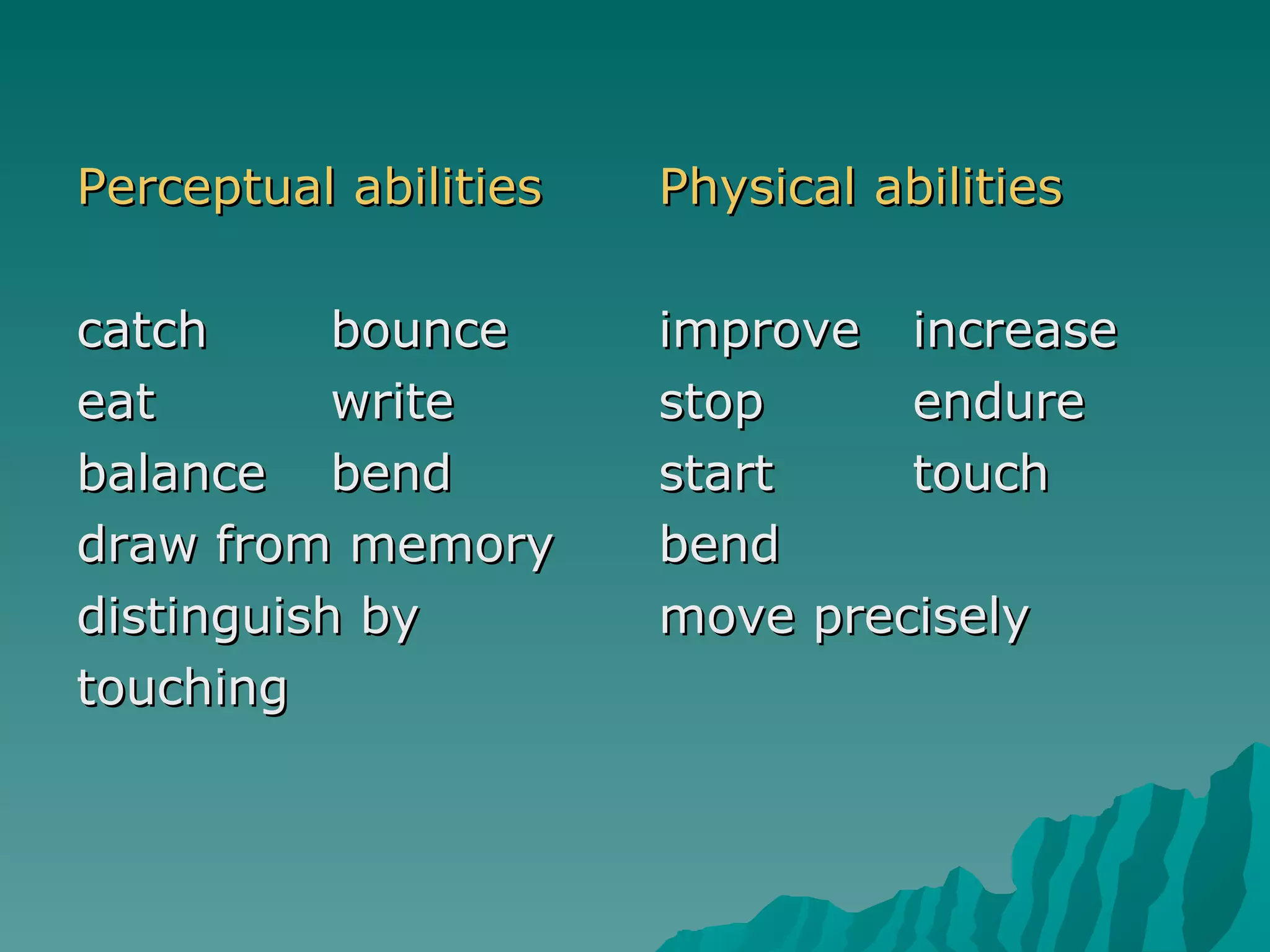
Perceptual abilities catch bounce eat write balance bend draw from memory distinguish by  touching Physical abilities improve increase stop endure start touch bend move precisely
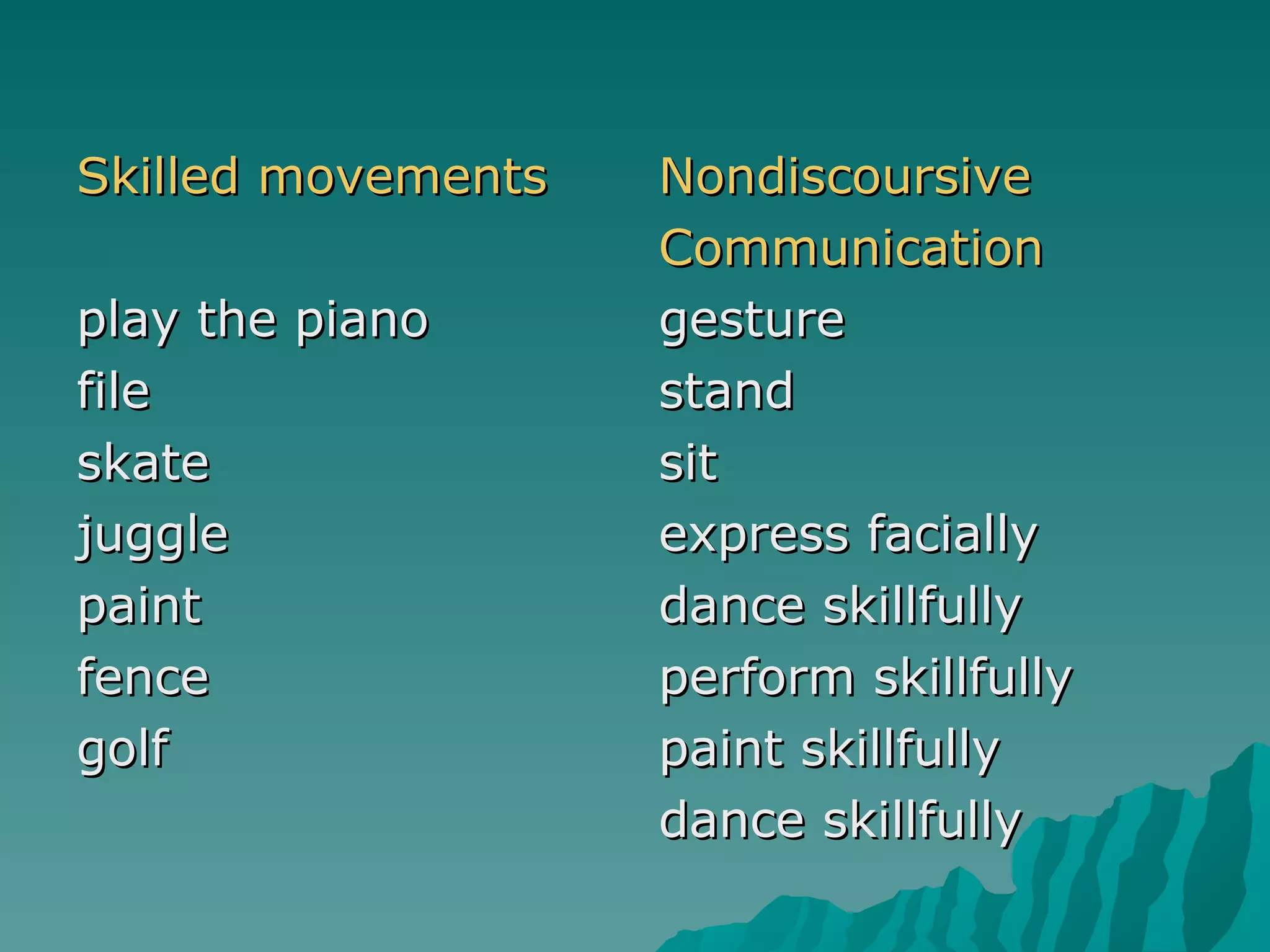
Skilled movements play the piano file skate juggle paint  fence golf  Nondiscoursive Communication gesture stand sit express facially dance skillfully perform skillfully paint skillfully dance skillfully
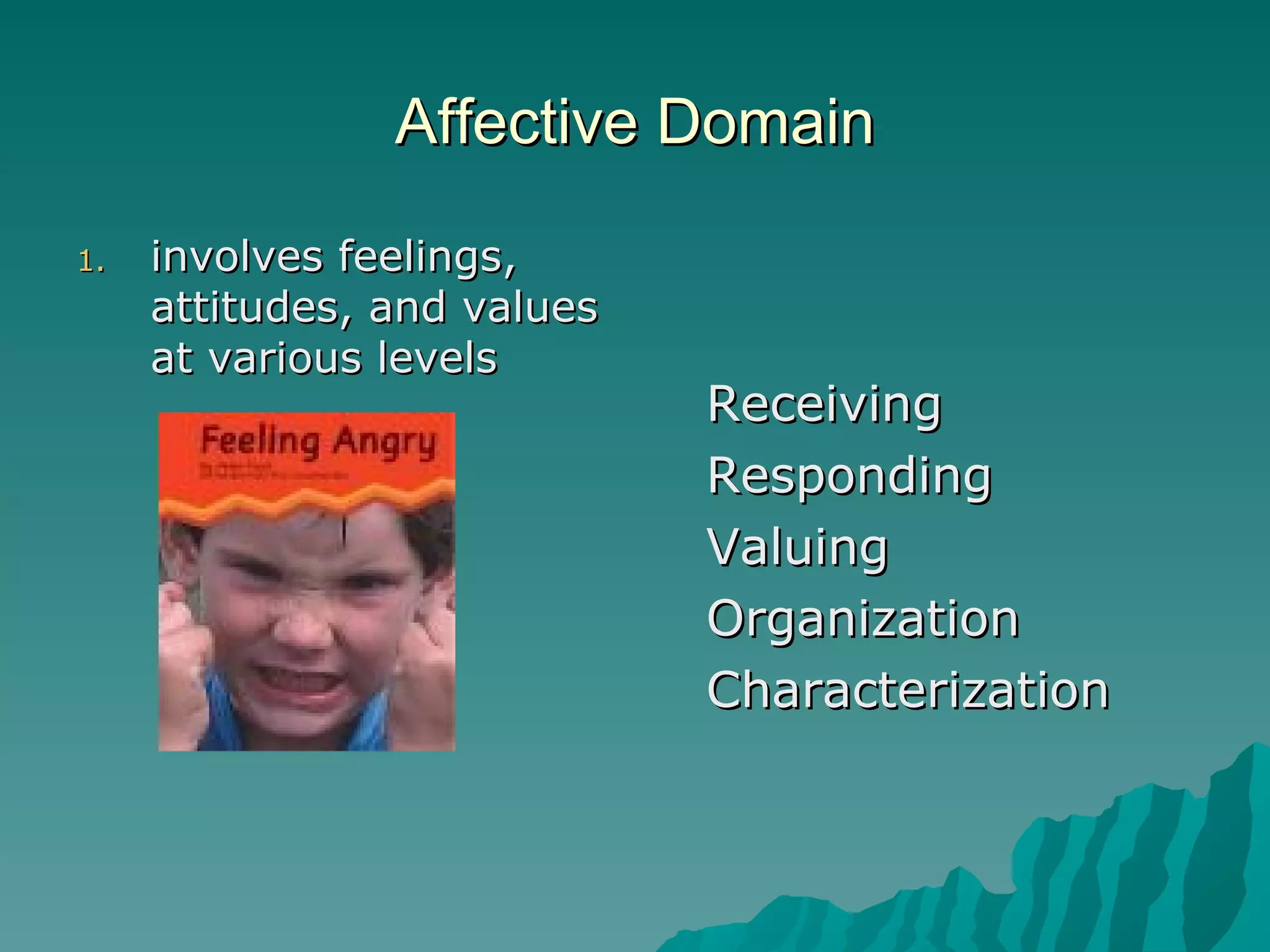
Affective Domain involves feelings, attitudes, and values at various levels Receiving Responding  Valuing Organization Characterization
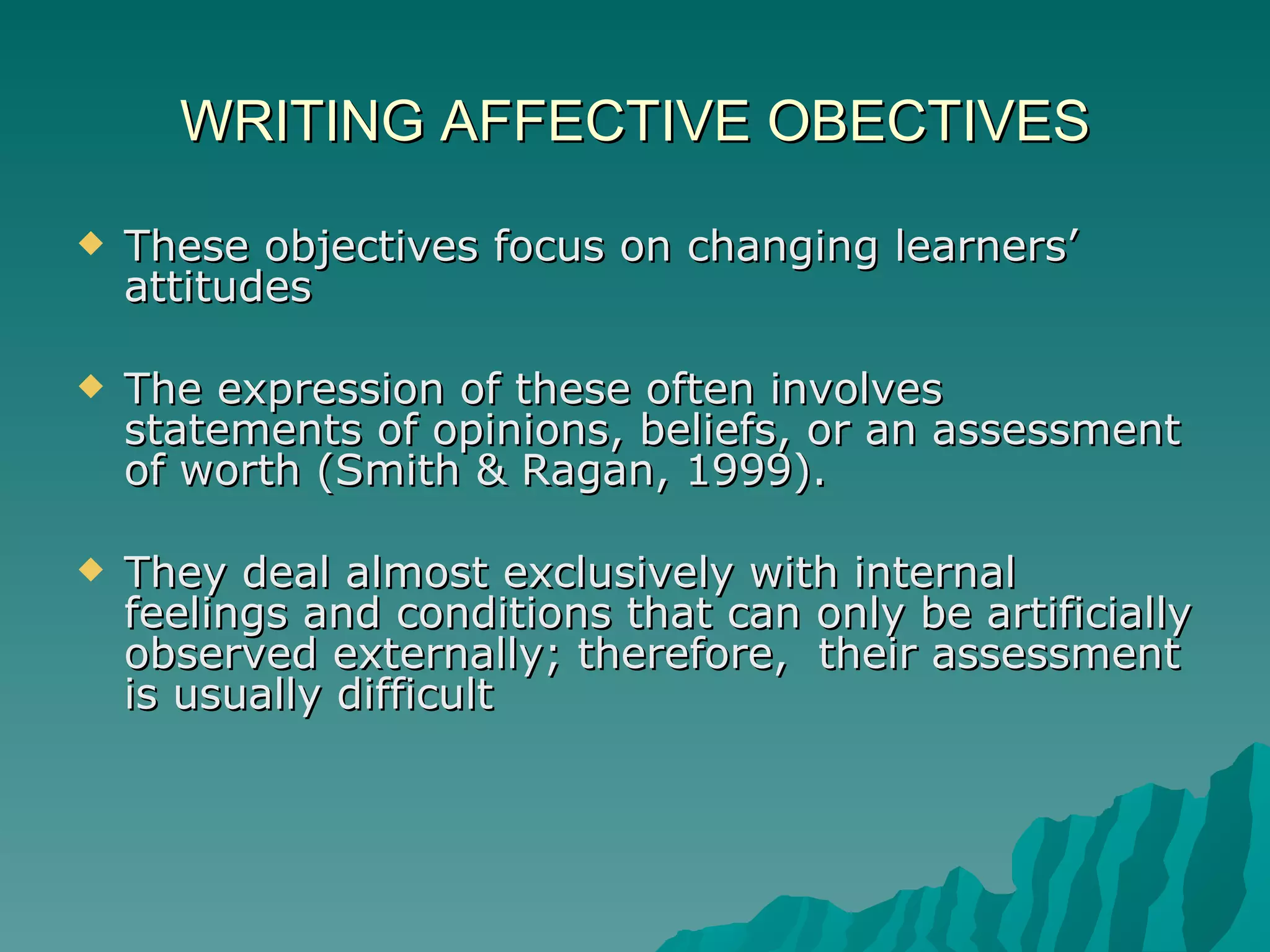
WRITING AFFECTIVE OBECTIVES These objectives focus on changing learners’ attitudes The expression of these often involves statements of opinions, beliefs, or an assessment of worth (Smith & Ragan, 1999).  They deal almost exclusively with internal feelings and conditions that can only be artificially observed externally; therefore,  their assessment is usually difficult
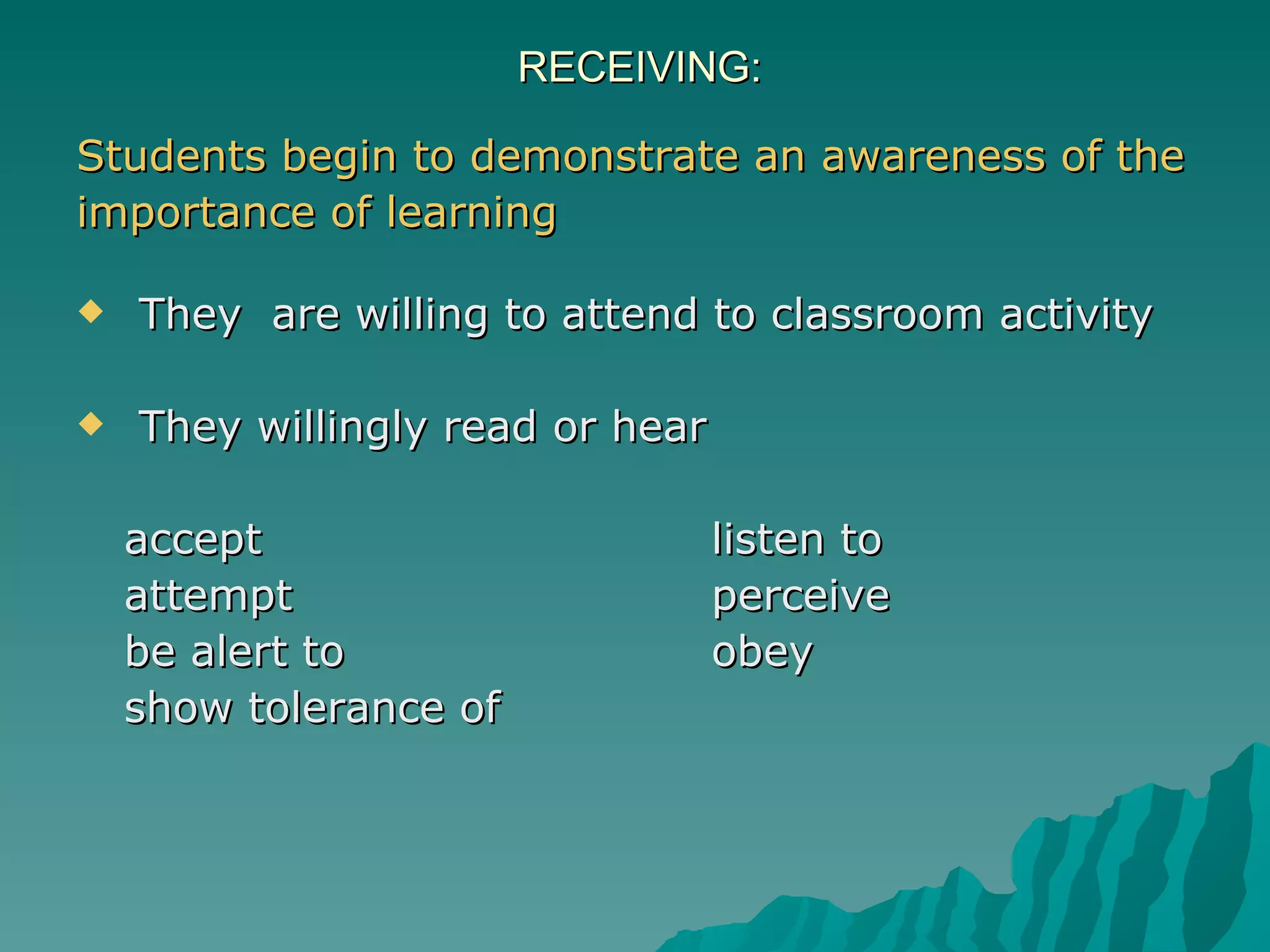
RECEIVING:  Students begin to demonstrate an awareness of the importance of learning They  are willing to attend to classroom activity  They willingly read or hear accept  listen to attempt  perceive be alert to obey show tolerance of
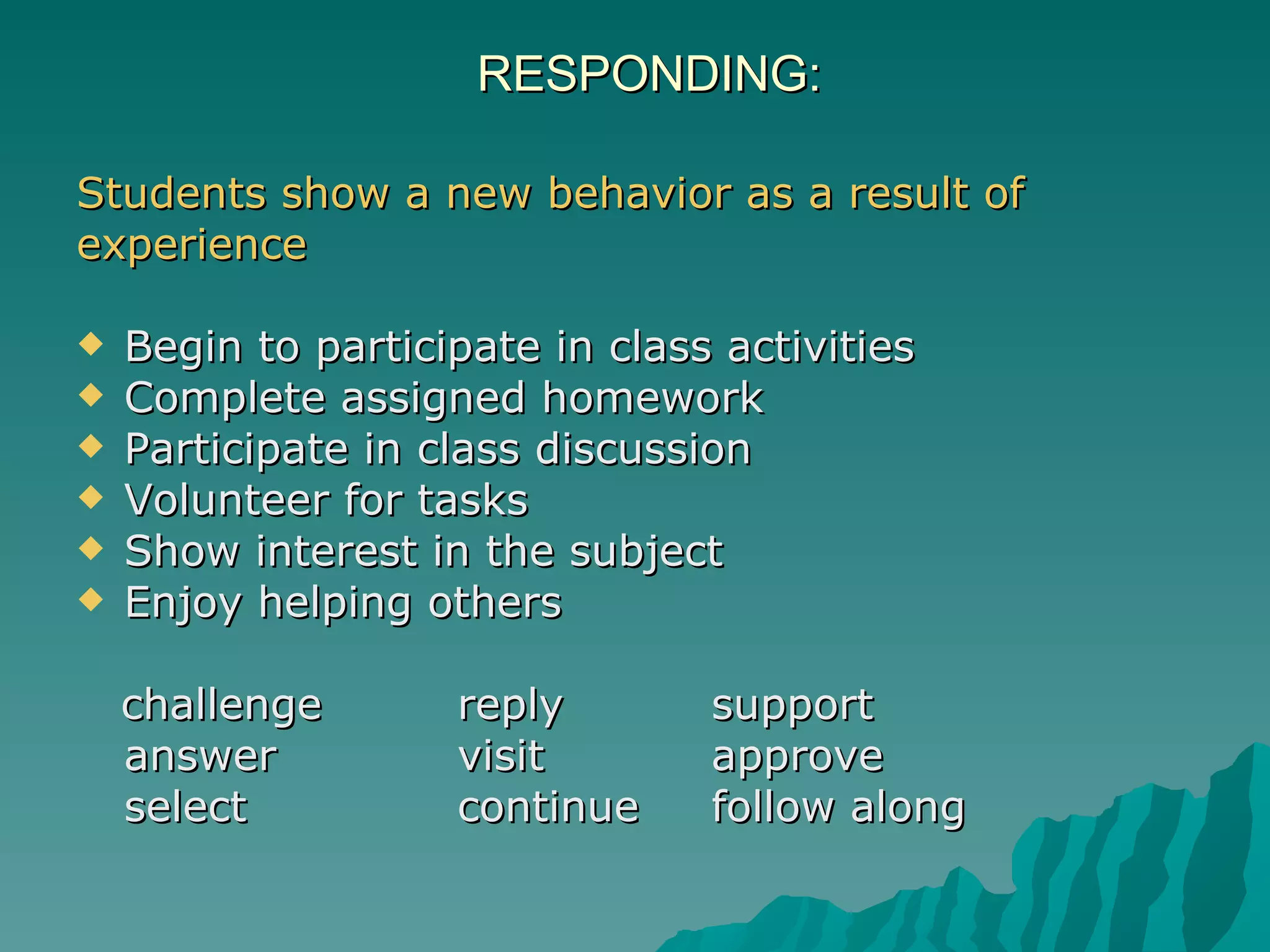
RESPONDING:  Students show a new behavior as a result of  experience Begin to participate in class activities Complete assigned homework  Participate in class discussion  Volunteer for tasks  Show interest in the subject  Enjoy helping others  challenge  reply support answer visit  approve select  continue follow along
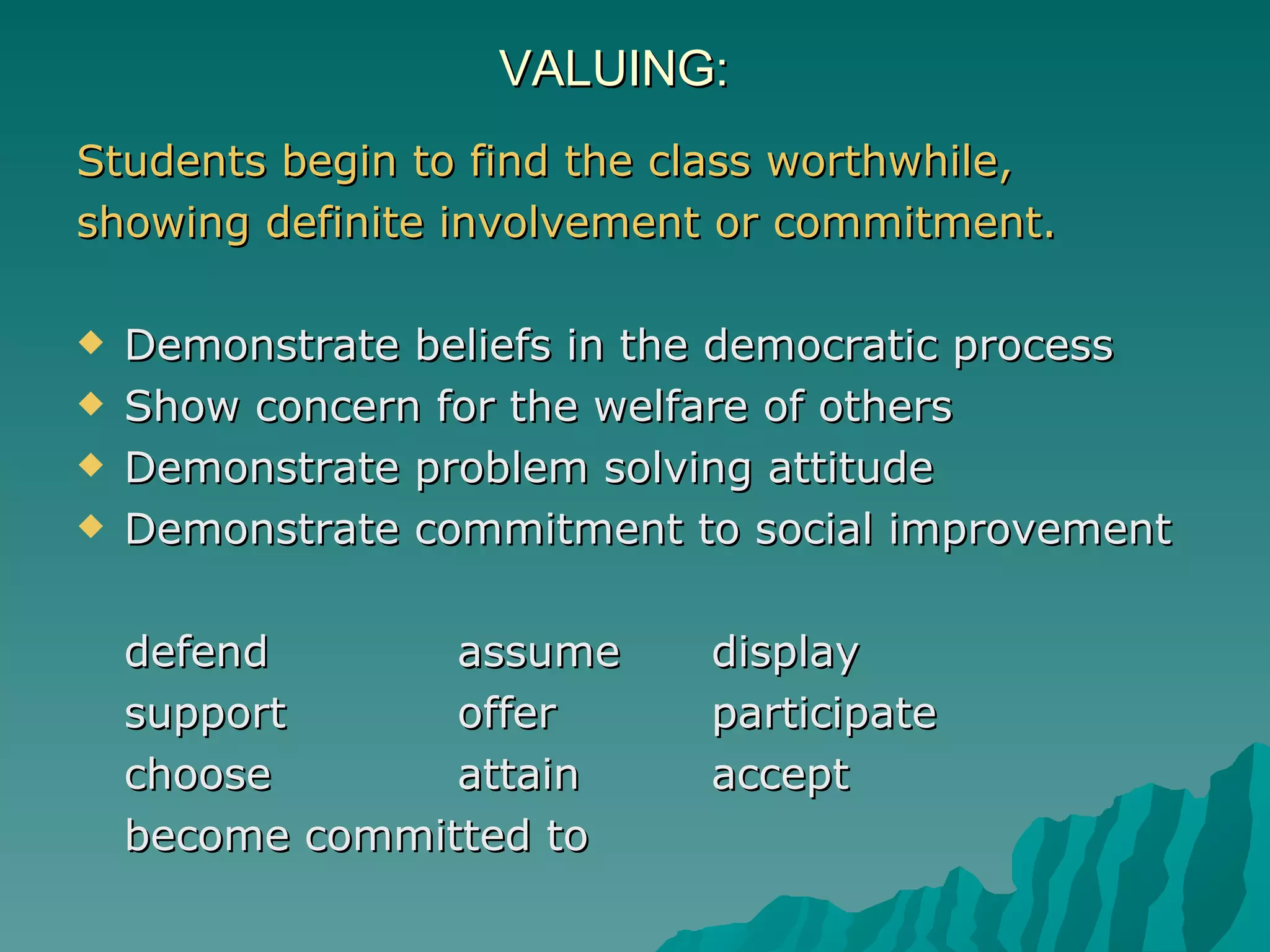
VALUING: Students begin to find the class worthwhile,  showing definite involvement or commitment.  Demonstrate beliefs in the democratic process  Show concern for the welfare of others  Demonstrate problem solving attitude  Demonstrate commitment to social improvement   defend assume display support offer  participate choose attain accept become committed to
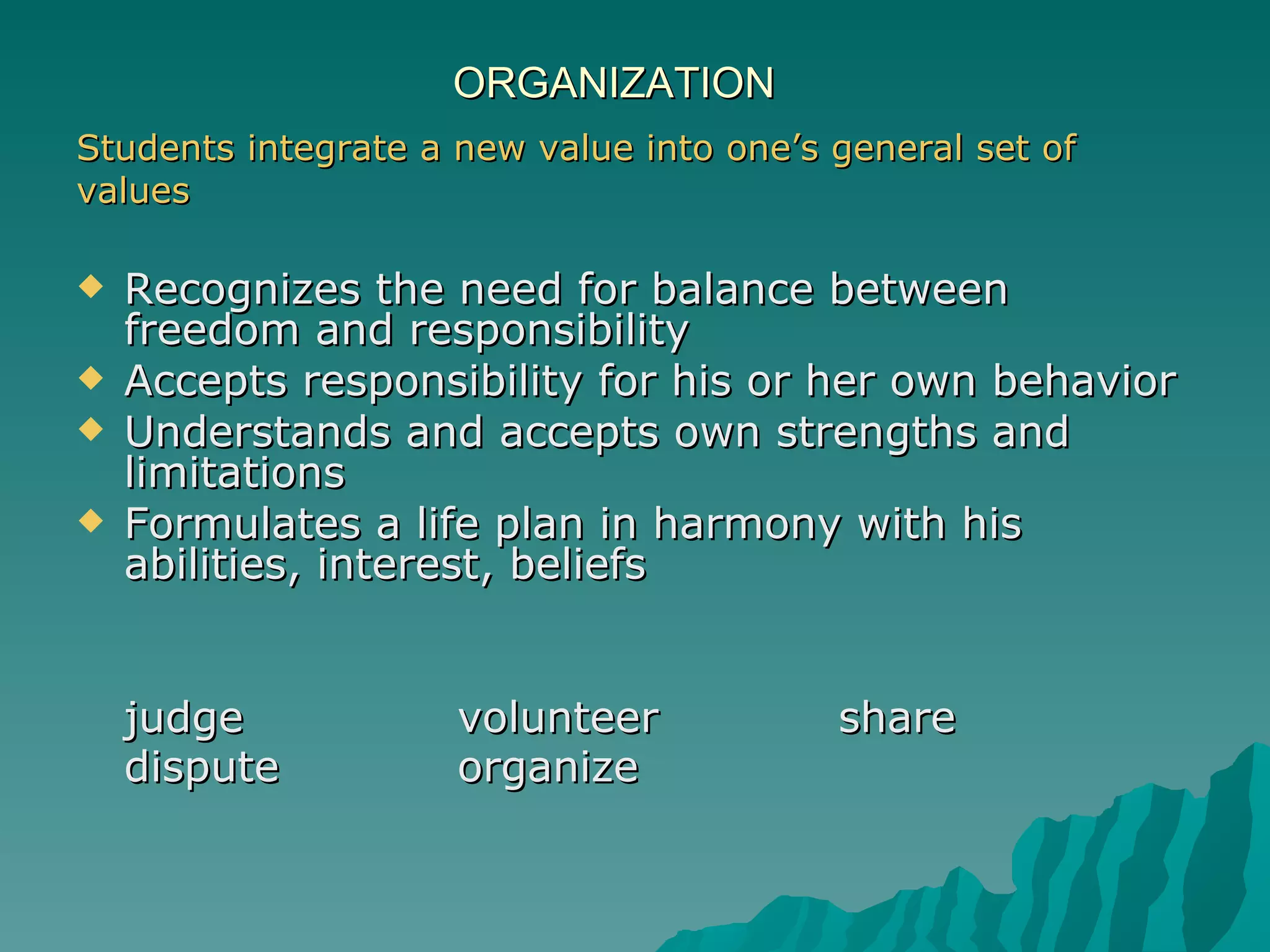
ORGANIZATION Students integrate a new value into one’s general set of  values Recognizes the need for balance between freedom and responsibility  Accepts responsibility for his or her own behavior  Understands and accepts own strengths and limitations  Formulates a life plan in harmony with his abilities, interest, beliefs   judge volunteer share dispute organize
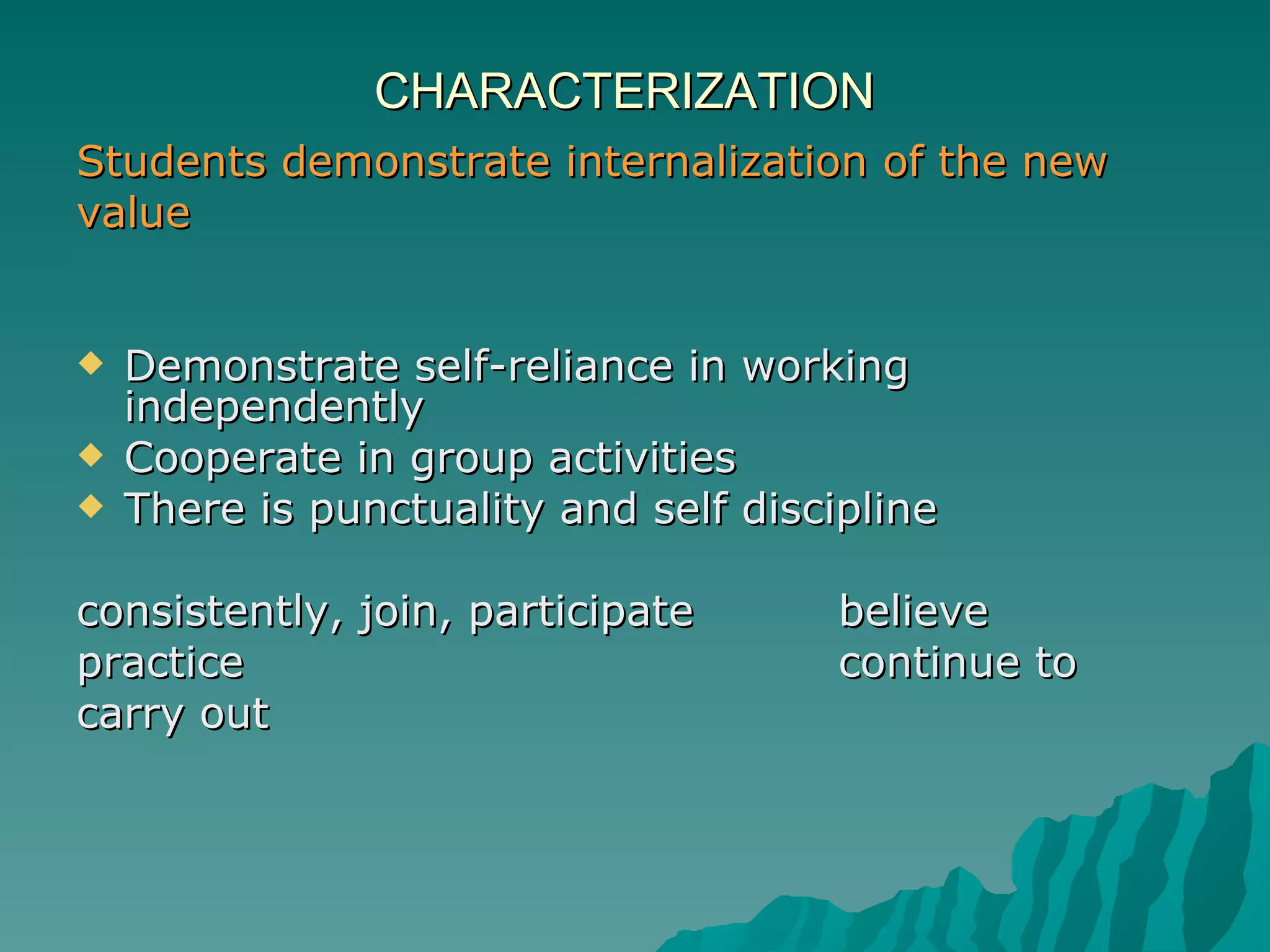
CHARACTERIZATION Students demonstrate internalization of the new value Demonstrate self-reliance in working independently  Cooperate in group activities  There is punctuality and self discipline   consistently, join, participate believe practice continue to carry out
Your turn   Name the corresponding domain for each  of the following objectives
1.Compare cognitive & affective domains. 2.Listen attentively to the presentation about  Bloom’s taxonomy. 3.Design a way to write objectives that combine  two domains. 4.Define levels of cognitive domain. 5.Perform classroom commands given by the  teacher. 6. Attend optional review sessions. 7. Create a floor exercise routine.
8. Judge effectiveness of writing objectives using taxonomy. 9. Elaborate a creative Christmas card. 10. Respect his/her classmates’ personal opinions. 11. Pronounce the alphabet letters correctly. 12. Define orally the terms of planning, instructional goals and learning objectives. 13. Demonstrate the process of preparing a cooking recipe.
14. Appreciate tourist places in our country. 15. Classify countable and uncountable nouns. 16. Contrast quality of life in the city and in the country side. 17. Read a paragraph on daily routines without mispronouncing any word. 18. Write an original composition about their last vacation.
19. Listen while others express their point of view. 20. Evaluate the teachers’ role in the public school 21. Answer a call for volunteers to plan a tree in a public tree 22. Choose nutritious food over junk food 23. Differentiate healthy food from unhealthy food 23. Mime at least ten action verbs
 
The students will……….. 1 . identify on a map the mountain ranges  of eastern United States. 2. volunteer to tidy up the storage room. 3. continue shooting free throws until the student can successfully complete 80% of the attempts. 4. accurately calculate the length of the hypotenuse. 5. perform a piano concert.
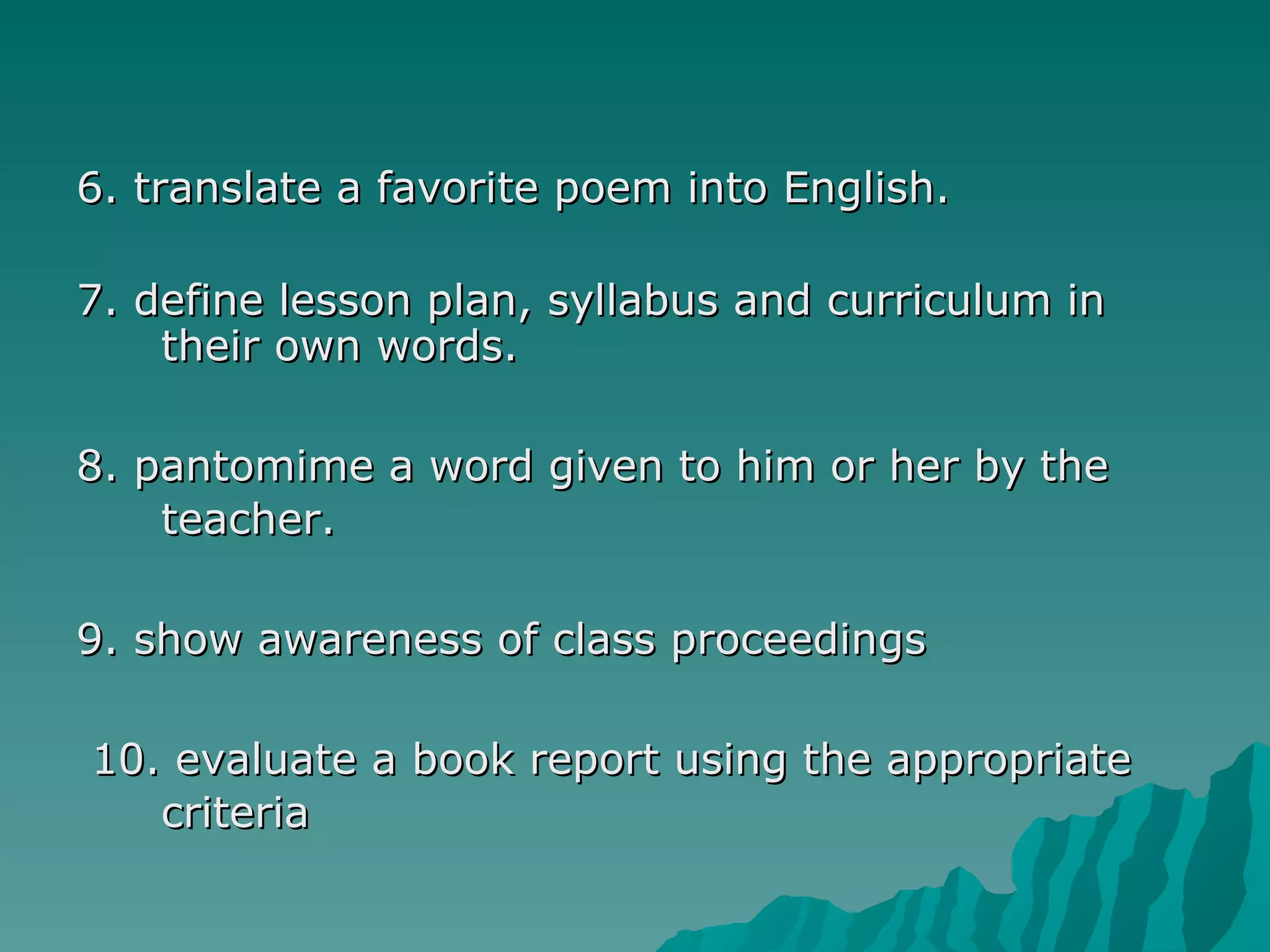
6. translate a favorite poem into English. 7. define lesson plan, syllabus and curriculum in their own words.  8. pantomime a word given to him or her by the teacher.  9. show awareness of class proceedings  10. evaluate a book report using the appropriate criteria
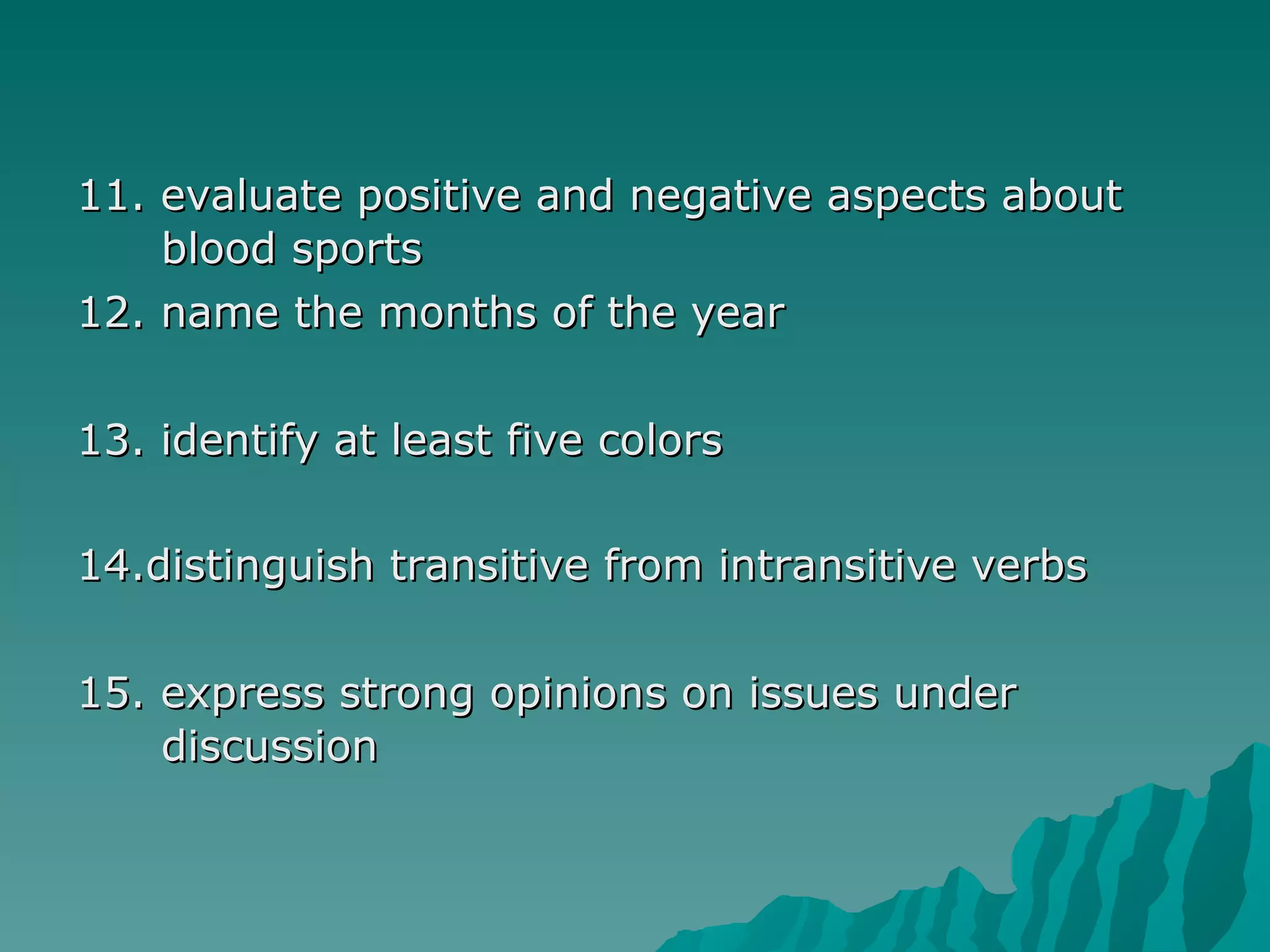
11. evaluate positive and negative aspects about blood sports 12. name the months of the year 13. identify at least five colors 14.distinguish transitive from intransitive verbs 15. express strong opinions on issues under discussion
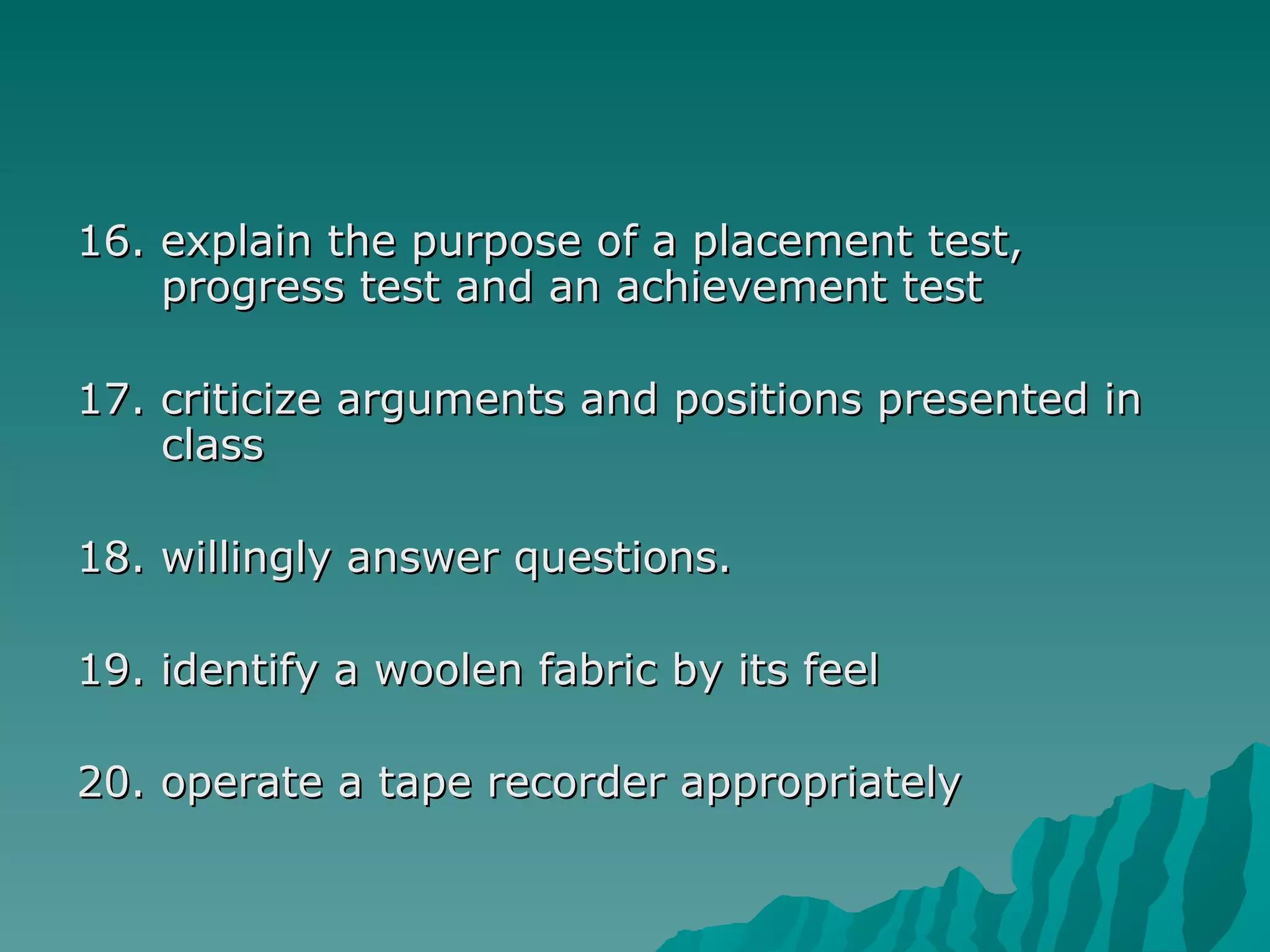
16. explain the purpose of a placement test, progress test and an achievement test 17. criticize arguments and positions presented in class   18.  willingly answer questions.  19. identify a woolen fabric by its feel 20. operate a tape recorder appropriately

C:\fakepath\bloom's taxonomy

  • 1.
    TEFL IIIBloom`s Taxonomy (Classification of learning objectives)
  • 2.
    Presentation objectives Developa better understanding of the three categories of learning objectives Differentiate the three domains of Bloom’s taxonomy
  • 3.
    CLASSIFICATION OF LEARNIGOBJECTIVES Cognitive Domain Affective Domain Psychomotor Domain
  • 4.
    Cognitive domain involves mental operations at all levels Affective domain involves feelings, attitudes, and values at various levels Psychomotor domain involves development of the body and skills it performs, physical skills at all levels BLOOM’S THREE CATEGORIES OF LEARNIG OBJECTIVES
  • 5.
    Cognitive Domain involvesmental operations at all levels Knowledge Comprehension Application Analysis Synthesis Evaluation
  • 6.
    Level Cognitive classificationdomain Verbs Used for Objectives Lowest level Knowledge define, memorize, repeat, record, list, recall, name, relate, collect, label, specify, cite, enumerate, tell, recount   Comprehension restate, summarize, discuss, describe, recognize, explain, express, identify, locate, report, retell, review, translate   Application exhibit, solve, interview, simulate, apply, employ, use, demonstrate, dramatize, practice, illustrate, operate, calculate, show, experiment Higher levels Analysis interpret, classify, analyze, arrange, differentiate, group, compare, organize, contrast, examine, scrutinize, survey, categorize, dissect, probe, inventory, investigate, question, discover, text, inquire, distinguish, detect, diagram, inspect   Synthesis compose, setup, plan, prepare, propose, imagine, produce, hypothesize, invent, incorporate, develop, generalize, design, originate, formulate, predict, arrange, contrive, assemble, concoct, construct, systematize, create   Evaluation judge, assess, decide, measure, appraise, estimate, evaluate, infer, rate, deduce, compare, score, value, predict, revise, choose, conclude, recommend, select, determine, criticize
  • 7.
    1. Knowledge Itis defined as the remembering of previously learned material. Bringing the appropriate information to mind is the only requirement. define, memorize, repeat, record, list, recall, name, relate, collect, label, specify, cite, enumerate, tell, recount
  • 8.
    2. Comprehension Itis defined as the ability to grasp the meaning of material based on prior learning restate, summarize, discuss, describe, recognize, explain, express, identify, locate, report, retell, review, translate
  • 9.
    3 . Application It refers to the ability to use learned material in a new situation, different from the original learning context. exhibit, solve, interview, simulate, apply, employ, use, demonstrate, dramatize, practice, illustrate, operate, calculate, show, experiment  
  • 10.
    4. Analysis Itrefers to the ability to break down material into its component parts so that its organizational structure may be understood. interpret, classify, analyze, arrange, differentiate, group, compare, organize, contrast, examine, scrutinize, survey, categorize, dissect, probe, inventory, investigate, question, discover, text, inquire, distinguish, detect, diagram, inspect
  • 11.
    5. Synthesis Itrefers to the ability to integrate ideas into a new product or plan compose, setup, plan, prepare, propose, imagine, produce, hypothesize, invent, incorporate, develop, generalize, design, originate, formulate, predict, arrange, contrive, assemble, concoct, construct, systematize, create
  • 12.
    6. Evaluation Itis concerned with the ability to judge/critique whether information or an argument is good or bad based on specific standards/criteria judge, assess, decide, measure, appraise, estimate, evaluate, infer, rate, deduce, compare, score, value, predict, revise, choose, conclude, recommend, select, determine, criticize
  • 13.
    Psychomotor Domain involves development of the body and skills it performs: physical skills at all levels Reflex movements Fundamental movements Perceptual abilities Physical abilities Skilled movements Nondiscursive communication
  • 14.
    Reflex movements: Thebasis of all movements stretch inhibit relax extend shorten lengthen tense straighten Fundamental Movements slide walk run jump grasp reach support handle crawl creep grasp tighten
  • 15.
    Perceptual abilities catchbounce eat write balance bend draw from memory distinguish by touching Physical abilities improve increase stop endure start touch bend move precisely
  • 16.
    Skilled movements playthe piano file skate juggle paint fence golf Nondiscoursive Communication gesture stand sit express facially dance skillfully perform skillfully paint skillfully dance skillfully
  • 17.
    Affective Domain involvesfeelings, attitudes, and values at various levels Receiving Responding Valuing Organization Characterization
  • 18.
    WRITING AFFECTIVE OBECTIVESThese objectives focus on changing learners’ attitudes The expression of these often involves statements of opinions, beliefs, or an assessment of worth (Smith & Ragan, 1999). They deal almost exclusively with internal feelings and conditions that can only be artificially observed externally; therefore, their assessment is usually difficult
  • 19.
    RECEIVING: Studentsbegin to demonstrate an awareness of the importance of learning They are willing to attend to classroom activity They willingly read or hear accept listen to attempt perceive be alert to obey show tolerance of
  • 20.
    RESPONDING: Studentsshow a new behavior as a result of experience Begin to participate in class activities Complete assigned homework Participate in class discussion Volunteer for tasks Show interest in the subject Enjoy helping others challenge reply support answer visit approve select continue follow along
  • 21.
    VALUING: Students beginto find the class worthwhile, showing definite involvement or commitment. Demonstrate beliefs in the democratic process Show concern for the welfare of others Demonstrate problem solving attitude Demonstrate commitment to social improvement defend assume display support offer participate choose attain accept become committed to
  • 22.
    ORGANIZATION Students integratea new value into one’s general set of values Recognizes the need for balance between freedom and responsibility Accepts responsibility for his or her own behavior Understands and accepts own strengths and limitations Formulates a life plan in harmony with his abilities, interest, beliefs judge volunteer share dispute organize
  • 23.
    CHARACTERIZATION Students demonstrateinternalization of the new value Demonstrate self-reliance in working independently Cooperate in group activities There is punctuality and self discipline consistently, join, participate believe practice continue to carry out
  • 24.
    Your turn Name the corresponding domain for each of the following objectives
  • 25.
    1.Compare cognitive &affective domains. 2.Listen attentively to the presentation about Bloom’s taxonomy. 3.Design a way to write objectives that combine two domains. 4.Define levels of cognitive domain. 5.Perform classroom commands given by the teacher. 6. Attend optional review sessions. 7. Create a floor exercise routine.
  • 26.
    8. Judge effectivenessof writing objectives using taxonomy. 9. Elaborate a creative Christmas card. 10. Respect his/her classmates’ personal opinions. 11. Pronounce the alphabet letters correctly. 12. Define orally the terms of planning, instructional goals and learning objectives. 13. Demonstrate the process of preparing a cooking recipe.
  • 27.
    14. Appreciate touristplaces in our country. 15. Classify countable and uncountable nouns. 16. Contrast quality of life in the city and in the country side. 17. Read a paragraph on daily routines without mispronouncing any word. 18. Write an original composition about their last vacation.
  • 28.
    19. Listen whileothers express their point of view. 20. Evaluate the teachers’ role in the public school 21. Answer a call for volunteers to plan a tree in a public tree 22. Choose nutritious food over junk food 23. Differentiate healthy food from unhealthy food 23. Mime at least ten action verbs
  • 29.
  • 30.
    The students will………..1 . identify on a map the mountain ranges of eastern United States. 2. volunteer to tidy up the storage room. 3. continue shooting free throws until the student can successfully complete 80% of the attempts. 4. accurately calculate the length of the hypotenuse. 5. perform a piano concert.
  • 31.
    6. translate afavorite poem into English. 7. define lesson plan, syllabus and curriculum in their own words. 8. pantomime a word given to him or her by the teacher. 9. show awareness of class proceedings 10. evaluate a book report using the appropriate criteria
  • 32.
    11. evaluate positiveand negative aspects about blood sports 12. name the months of the year 13. identify at least five colors 14.distinguish transitive from intransitive verbs 15. express strong opinions on issues under discussion
  • 33.
    16. explain thepurpose of a placement test, progress test and an achievement test 17. criticize arguments and positions presented in class 18. willingly answer questions. 19. identify a woolen fabric by its feel 20. operate a tape recorder appropriately