• OBJECTIVE OF EDUCATION
AND ITS GENERAL AIMS
(GOALS)
• LEARNING DOMAINS
• OBJECTIVE OF EDUCATION
AND ITS GENERAL AIMS
(GOALS)
Nurseries and Kindergartens comes first
in Educational Levels, and they are
known for their Gentle Approach and
Guidance in Childhood. Child will not be
able to face following Levels of Life, if
their preparation is not Sound.
FIRST: NURSERY AND KINDERGARTEN
Primary Level is the base of focus to
prepare Young Ones for their Future Life
Phases. It is a General Level includes all
the children of the Nation, and in this
Level they are provided with the basics of
True Belief, Sound Attitudes,
Experiences, Information and Skills.
SECOND: PRIMARY LEVEL
Intermediate Level is a General Cultural
Level, the aim of this Level is to provide
the Young Ones with complete Islamic
Education meant for his Creed, Mind,
Body, and Manners. Taking into
Consideration Students growth, and the
Level he/she is going through, this level
accomplishes the General Goals of
Education.
THIRD: INTERMEDIATE LEVEL
 The Secondary Level by its nature works on Age and
Growth traits of the Students, and needs a lot of
Guidance and Preparation. It includes Different
branches wherein Intermediate Certificate Holders
are taken in as per Systems set by Competent
Authorities. For ex: General Secondary, Academic
Institutes, Dar Al-Tawhid, Islamic University, and
Secondary Teacher Preparation Institutes, and
different Vocational Institutes (Agricultural,
Industrial, and Commercial) Technical and Sports
Institutes, and what is new at this Level.
FOURTH: SECONDARY LEVEL
Amongst all Types and Levels, Higher
Education Level is Practical
Specialization Level. It cares for people
who are talented, and further develops
their talent, to fulfill community needs in
Present and in Future, as per National
Development Goals and its Noble
purpose.
FIFTH: HIGHER EDUCATION LEVEL
LEARNING DOMAINS
THREE (3) DOMAINS OF LEARNING
Cognitive Domain1
Affective domain2
Psychomotor domain3
The cognitive domain involves the
development of our mental skills
and the acquisition of knowledge.
Domain of thought process.
COGNITIVE DOMAIN
COGNITIVE DOMAIN HIERARCHICAL LEVELS OF
LEARNING
 Analysis - the ability to differentiate facts and opinions.
 Knowledge - the ability to recall data and/or
information.
 Comprehension - the ability to understand the
meaning of what is known.
 Application - the ability to utilize an abstraction or
to use knowledge in a new situation.
 Synthesis - the ability to integrate different elements or
concepts in order to form a sound pattern or structure so
a new meaning can be established.
 Evaluation - the ability to come up with judgments
about the importance of concepts.
The affective domain contains learning skills
that are predominantly related to emotional
(affective) processes.
This domain includes the manner in which we
deal with things emotionally, such as feelings,
values, appreciation, enthusiasms,
motivations, and attitudes.
Humanistic theories focus on this domain
AFFECTIVE DOMAIN
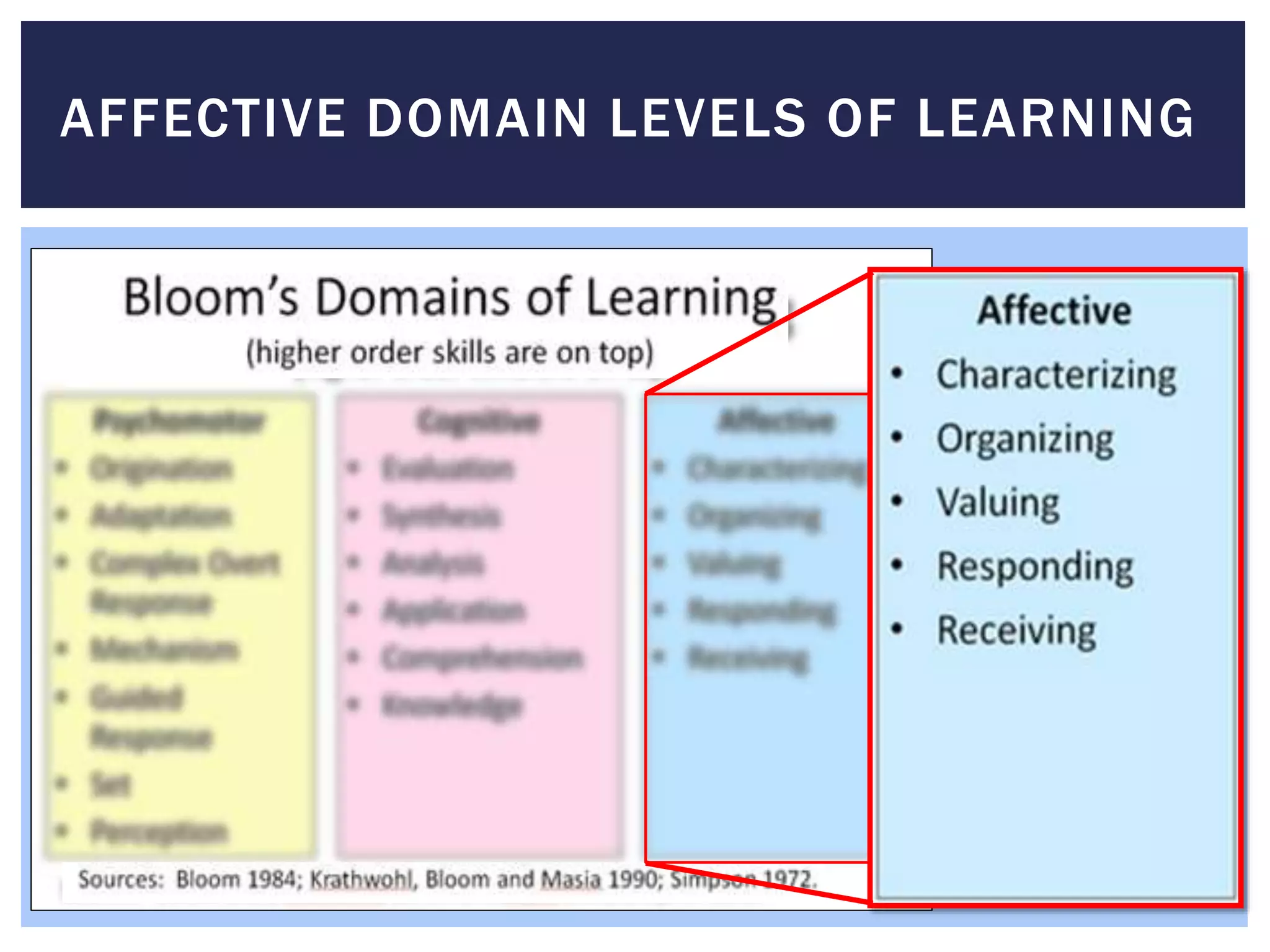
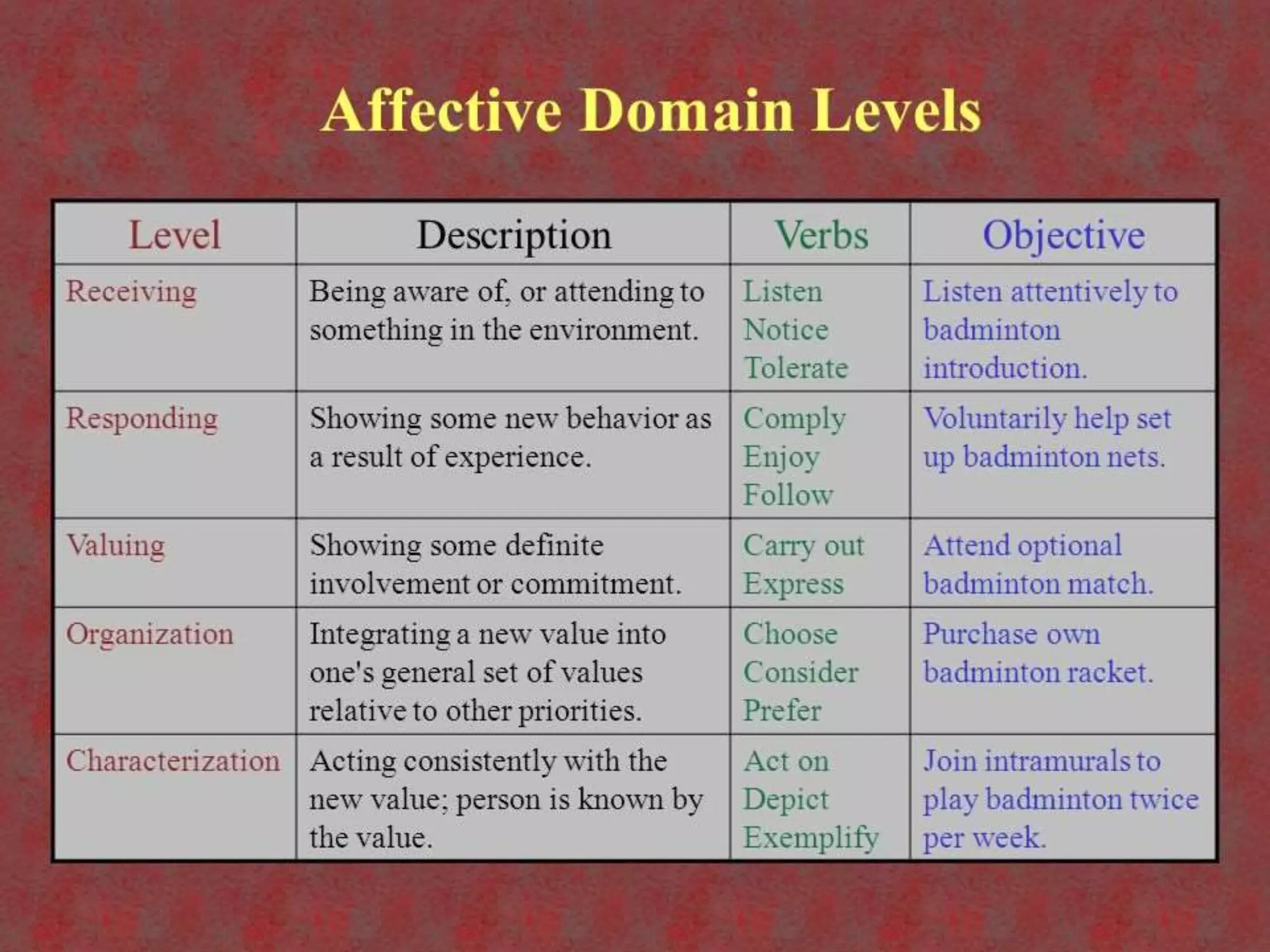
AFFECTIVE DOMAIN LEVELS OF LEARNING
Characterizing
The individual has a value system that has controlled his
or her behavior for a sufficiently long time for him or her to
develop a characteristic “life-style”.
Receiving
It refers to the student’s willingness to attend to particular
phenomena of stimuli (classroom activities, textbook, music,etc).
Responding
Refers to active participation on the part of the student.
Valuing
It is concerned with the worth or value a student attaches
to a particular object, phenomenon, or behavior.
Organization
It is concerned with bringing together different values,
resolving conflicts between them, and beginning the building of an
internally consistent value system.
Psychomotor objectives are those specific to
discreet physical functions, reflex actions and
interpretive movements. Traditionally, these
types of objectives are concerned with the
physically encoding of information, with
movement and/or with activities where the
gross and fine muscles are used for
expressing or interpreting information or
concepts. This area also refers to natural,
autonomic responses or reflexes.
THE PSYCHOMOTOR OR
KINESTHETIC DOMAIN
Reflex movements
Fundamental movements
Perceptual abilities
Physical abilities
Skilled movements
No discursive communication
(TERMS IN THIS AREA BASED ON ANITA
HARROW’S TAXONOMY).

Learning domains

  • 1.
    • OBJECTIVE OFEDUCATION AND ITS GENERAL AIMS (GOALS) • LEARNING DOMAINS
  • 2.
    • OBJECTIVE OFEDUCATION AND ITS GENERAL AIMS (GOALS)
  • 3.
    Nurseries and Kindergartenscomes first in Educational Levels, and they are known for their Gentle Approach and Guidance in Childhood. Child will not be able to face following Levels of Life, if their preparation is not Sound. FIRST: NURSERY AND KINDERGARTEN
  • 4.
    Primary Level isthe base of focus to prepare Young Ones for their Future Life Phases. It is a General Level includes all the children of the Nation, and in this Level they are provided with the basics of True Belief, Sound Attitudes, Experiences, Information and Skills. SECOND: PRIMARY LEVEL
  • 5.
    Intermediate Level isa General Cultural Level, the aim of this Level is to provide the Young Ones with complete Islamic Education meant for his Creed, Mind, Body, and Manners. Taking into Consideration Students growth, and the Level he/she is going through, this level accomplishes the General Goals of Education. THIRD: INTERMEDIATE LEVEL
  • 6.
     The SecondaryLevel by its nature works on Age and Growth traits of the Students, and needs a lot of Guidance and Preparation. It includes Different branches wherein Intermediate Certificate Holders are taken in as per Systems set by Competent Authorities. For ex: General Secondary, Academic Institutes, Dar Al-Tawhid, Islamic University, and Secondary Teacher Preparation Institutes, and different Vocational Institutes (Agricultural, Industrial, and Commercial) Technical and Sports Institutes, and what is new at this Level. FOURTH: SECONDARY LEVEL
  • 7.
    Amongst all Typesand Levels, Higher Education Level is Practical Specialization Level. It cares for people who are talented, and further develops their talent, to fulfill community needs in Present and in Future, as per National Development Goals and its Noble purpose. FIFTH: HIGHER EDUCATION LEVEL
  • 8.
  • 9.
    THREE (3) DOMAINSOF LEARNING Cognitive Domain1 Affective domain2 Psychomotor domain3
  • 10.
    The cognitive domaininvolves the development of our mental skills and the acquisition of knowledge. Domain of thought process. COGNITIVE DOMAIN
  • 11.
  • 12.
     Analysis -the ability to differentiate facts and opinions.  Knowledge - the ability to recall data and/or information.  Comprehension - the ability to understand the meaning of what is known.  Application - the ability to utilize an abstraction or to use knowledge in a new situation.  Synthesis - the ability to integrate different elements or concepts in order to form a sound pattern or structure so a new meaning can be established.  Evaluation - the ability to come up with judgments about the importance of concepts.
  • 13.
    The affective domaincontains learning skills that are predominantly related to emotional (affective) processes. This domain includes the manner in which we deal with things emotionally, such as feelings, values, appreciation, enthusiasms, motivations, and attitudes. Humanistic theories focus on this domain AFFECTIVE DOMAIN
  • 14.
  • 16.
    Characterizing The individual hasa value system that has controlled his or her behavior for a sufficiently long time for him or her to develop a characteristic “life-style”. Receiving It refers to the student’s willingness to attend to particular phenomena of stimuli (classroom activities, textbook, music,etc). Responding Refers to active participation on the part of the student. Valuing It is concerned with the worth or value a student attaches to a particular object, phenomenon, or behavior. Organization It is concerned with bringing together different values, resolving conflicts between them, and beginning the building of an internally consistent value system.
  • 17.
    Psychomotor objectives arethose specific to discreet physical functions, reflex actions and interpretive movements. Traditionally, these types of objectives are concerned with the physically encoding of information, with movement and/or with activities where the gross and fine muscles are used for expressing or interpreting information or concepts. This area also refers to natural, autonomic responses or reflexes. THE PSYCHOMOTOR OR KINESTHETIC DOMAIN
  • 18.
    Reflex movements Fundamental movements Perceptualabilities Physical abilities Skilled movements No discursive communication (TERMS IN THIS AREA BASED ON ANITA HARROW’S TAXONOMY).