FACTORS THAT INFLUENCE TISSUE
REPAIR
& REGENERATION
Dr. Sobia Khalid
• Tissue repair affect quality or adequacy of the
reparative process.
• Variables that modify healing may be extrinsic
(e.g., infection) or intrinsic to the injured
tissue, and systemic or local:
Infection
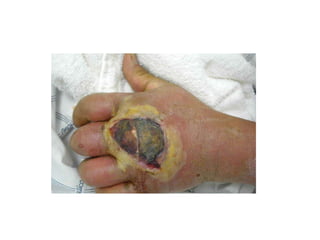
• Infection is clinically one of the most
important causes of delay in healing; it
prolongs inflammation and potentially
increases the local tissue injury.
Diabetes
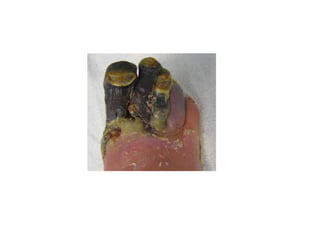
• Diabetes is a metabolic disease that
compromises tissue repair by abnormal
wound healing.
Nutritional status
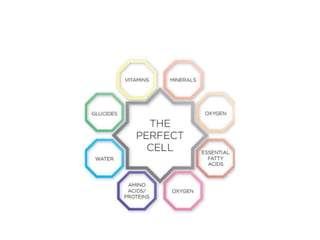
• • Nutritional status has profound effects on
repair; protein deficiency, for example, and
particularly vitamin C deficiency, inhibits
collagen synthesis and retards healing.
Glucocorticoids (steroids)
• Glucocorticoids (steroids) have well-
documented antiinflammatory effects, and
their administration may result in weakness of
the scar due to inhibition of TGFβ production
and diminished fibrosis.
• In some instances, however, the
antiinflammatory effects of glucocorticoids are
desirable.
• For example, in corneal infections,
glucocorticoids are sometimes prescribed
(along with antibiotics) to reduce the
likelihood of opacity that may result from
collagen deposition.
Mechanical factors
• Mechanical factors such as increased local
pressure or torsion may cause wounds to pull
apart, or dehisce.
Poor perfusion
• Poor perfusion, due either to arteriosclerosis
and diabetes or to obstructed venous drainage
(e.g., in varicose veins), also impairs healing.
Foreign bodies
• Foreign bodies such as fragments of steel,
glass, or even bone impede healing.
The type and extent of tissue injury
• Complete restoration can occur only in tissues
composed of stable and labile cells.
• Injury to tissues composed of permanent cells
must inevitably result in scarring by the
remaining viable elements. Such is the case
with healing of a myocardial infarct.
The location of the injury and the
character of the tissue
• For example, inflammation arising in tissue
spaces (e.g., pleural, peritoneal, synovial
cavities) develops extensive exudates.
• Subsequent repair may occur by digestion of
the exudate, initiated by the proteolytic
enzymes of leukocytes and resorption of the
liquefied exudate.
• This is called resolution, and in the absence of
cellular necrosis, normal tissue architecture is
generally restored.
• However, in the setting of larger
accumulations, the exudate undergoes
organization: granulation tissue grows into the
exudate, and a fibrous scar ultimately forms.
LIVER REGENERATION
• After partial hepatectomy, which may be
performed for tumor resection or for living
donor hepatic transplantation.
• Regeneration of the liver occurs by two major
mechanisms:
proliferation of remaining hepatocytes
repopulation from progenitor cells
• Which mechanism plays the dominant role
depends on the nature of the injury.
Proliferation of hepatocytes following
partial hepatectomy
• In humans, resection of up to 90% of the liver
can be corrected by proliferation of the
residual hepatocytes.
• This classic model of tissue regeneration has
been used experimentally to study the
initiation and control of the process.
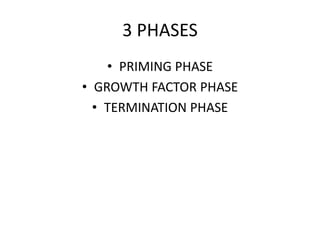
3 PHASES
• PRIMING PHASE
• GROWTH FACTOR PHASE
• TERMINATION PHASE
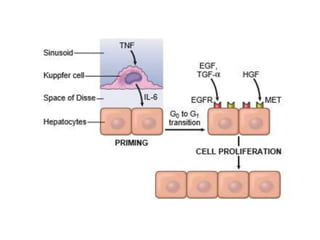
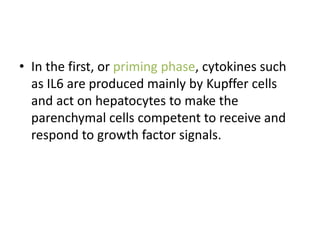
• In the first, or priming phase, cytokines such
as IL6 are produced mainly by Kupffer cells
and act on hepatocytes to make the
parenchymal cells competent to receive and
respond to growth factor signals.
• In the second, or growth factor phase, growth
factors such as HGF and TGFα, produced by
many cell types, act on primed hepatocytes to
stimulate cell metabolism and entry of the
cells into the cell cycle.
• Because hepatocytes are quiescent cells, it
takes them several hours to enter the cell
cycle, progress from G0 to G1, and reach the S
phase of DNA replication.
• Almost all hepatocytes replicate during liver
regeneration after partial hepatectomy.
• The wave of hepatocyte replication is followed
by replication of nonparenchymal cells
(Kupffer cells, endothelial cells, and stellate
cells).
• During the phase of hepatocyte replication, more
than 70 genes are activated; these include genes
encoding transcription factors, cell cycle
regulators, regulators of energy metabolism, and
many others.
• In the final, termination, phase, hepatocytes
return to quiescence. The nature of the stop
signals is poorly understood; anti proliferative
cytokines of the TGFβ family are likely involved.
Liver regeneration from progenitor
cells
Liver regeneration from progenitor cells. In
situations where the proliferative capacity of
hepatocytes is impaired, such as after chronic
liver injury or inflammation, progenitor cells in
the liver contribute to repopulation.
• Some of these progenitor cells reside in
specialized niches called canals of Hering,
where bile canaliculi connect with larger bile
ducts.
• The signals that drive proliferation of
progenitor cells and their differentiation into
mature hepatocytes are topics of active
investigation.
Factors affecting healing

Factors affecting healing

  • 1.
    FACTORS THAT INFLUENCETISSUE REPAIR & REGENERATION Dr. Sobia Khalid
  • 2.
    • Tissue repairaffect quality or adequacy of the reparative process. • Variables that modify healing may be extrinsic (e.g., infection) or intrinsic to the injured tissue, and systemic or local:
  • 3.
    Infection • Infection isclinically one of the most important causes of delay in healing; it prolongs inflammation and potentially increases the local tissue injury.
  • 5.
    Diabetes • Diabetes isa metabolic disease that compromises tissue repair by abnormal wound healing.
  • 7.
    Nutritional status • •Nutritional status has profound effects on repair; protein deficiency, for example, and particularly vitamin C deficiency, inhibits collagen synthesis and retards healing.
  • 9.
    Glucocorticoids (steroids) • Glucocorticoids(steroids) have well- documented antiinflammatory effects, and their administration may result in weakness of the scar due to inhibition of TGFβ production and diminished fibrosis.
  • 10.
    • In someinstances, however, the antiinflammatory effects of glucocorticoids are desirable. • For example, in corneal infections, glucocorticoids are sometimes prescribed (along with antibiotics) to reduce the likelihood of opacity that may result from collagen deposition.
  • 11.
    Mechanical factors • Mechanicalfactors such as increased local pressure or torsion may cause wounds to pull apart, or dehisce.
  • 12.
    Poor perfusion • Poorperfusion, due either to arteriosclerosis and diabetes or to obstructed venous drainage (e.g., in varicose veins), also impairs healing.
  • 13.
    Foreign bodies • Foreignbodies such as fragments of steel, glass, or even bone impede healing.
  • 14.
    The type andextent of tissue injury • Complete restoration can occur only in tissues composed of stable and labile cells. • Injury to tissues composed of permanent cells must inevitably result in scarring by the remaining viable elements. Such is the case with healing of a myocardial infarct.
  • 15.
    The location ofthe injury and the character of the tissue • For example, inflammation arising in tissue spaces (e.g., pleural, peritoneal, synovial cavities) develops extensive exudates. • Subsequent repair may occur by digestion of the exudate, initiated by the proteolytic enzymes of leukocytes and resorption of the liquefied exudate.
  • 16.
    • This iscalled resolution, and in the absence of cellular necrosis, normal tissue architecture is generally restored. • However, in the setting of larger accumulations, the exudate undergoes organization: granulation tissue grows into the exudate, and a fibrous scar ultimately forms.
  • 17.
  • 18.
    • After partialhepatectomy, which may be performed for tumor resection or for living donor hepatic transplantation.
  • 19.
    • Regeneration ofthe liver occurs by two major mechanisms: proliferation of remaining hepatocytes repopulation from progenitor cells • Which mechanism plays the dominant role depends on the nature of the injury.
  • 20.
    Proliferation of hepatocytesfollowing partial hepatectomy
  • 21.
    • In humans,resection of up to 90% of the liver can be corrected by proliferation of the residual hepatocytes. • This classic model of tissue regeneration has been used experimentally to study the initiation and control of the process.
  • 22.
    3 PHASES • PRIMINGPHASE • GROWTH FACTOR PHASE • TERMINATION PHASE
  • 24.
    • In thefirst, or priming phase, cytokines such as IL6 are produced mainly by Kupffer cells and act on hepatocytes to make the parenchymal cells competent to receive and respond to growth factor signals.
  • 25.
    • In thesecond, or growth factor phase, growth factors such as HGF and TGFα, produced by many cell types, act on primed hepatocytes to stimulate cell metabolism and entry of the cells into the cell cycle.
  • 26.
    • Because hepatocytesare quiescent cells, it takes them several hours to enter the cell cycle, progress from G0 to G1, and reach the S phase of DNA replication.
  • 27.
    • Almost allhepatocytes replicate during liver regeneration after partial hepatectomy. • The wave of hepatocyte replication is followed by replication of nonparenchymal cells (Kupffer cells, endothelial cells, and stellate cells).
  • 28.
    • During thephase of hepatocyte replication, more than 70 genes are activated; these include genes encoding transcription factors, cell cycle regulators, regulators of energy metabolism, and many others. • In the final, termination, phase, hepatocytes return to quiescence. The nature of the stop signals is poorly understood; anti proliferative cytokines of the TGFβ family are likely involved.
  • 29.
    Liver regeneration fromprogenitor cells
  • 30.
    Liver regeneration fromprogenitor cells. In situations where the proliferative capacity of hepatocytes is impaired, such as after chronic liver injury or inflammation, progenitor cells in the liver contribute to repopulation.
  • 31.
    • Some ofthese progenitor cells reside in specialized niches called canals of Hering, where bile canaliculi connect with larger bile ducts. • The signals that drive proliferation of progenitor cells and their differentiation into mature hepatocytes are topics of active investigation.