
DR. Sobia Khalid
Infectious Diseases
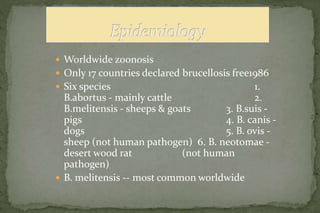
 Worldwide zoonosis
 Only 17 countries declared brucellosis free1986
 Six species 1.
B.abortus - mainly cattle 2.
B.melitensis - sheeps & goats 3. B.suis -
pigs 4. B. canis -
dogs 5. B. ovis -
sheep (not human pathogen) 6. B. neotomae -
desert wood rat (not human
pathogen)
 B. melitensis -- most common worldwide
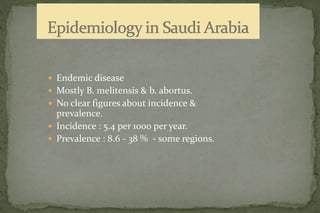
 Endemic disease
 Mostly B. melitensis & b. abortus.
 No clear figures about incidence &
prevalence.
 Incidence : 5.4 per 1000 per year.
 Prevalence : 8.6 - 38 % - some regions.
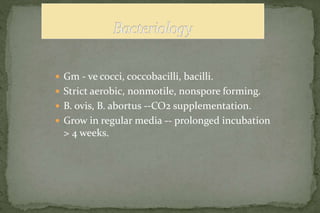
 Gm - ve cocci, coccobacilli, bacilli.
 Strict aerobic, nonmotile, nonspore forming.
 B. ovis, B. abortus --CO2 supplementation.
 Grow in regular media -- prolonged incubation
> 4 weeks.
 Surface lipopolysccharide cell wall
 smooth vs non-smooth.
 determine virulence.
 smooth LPS : B. melitensis,suis,abortus
 Non-smooth LPS B.canis, ovis.
 the basis for agglutination test.
 Zoonosis affecting domestic animals.
 Concentrated in milk, urine, genital organs.
ROUTES OF TRANSMISSION
 Oral : unpasteurised milk & products
raw milk or meet.
 Respiratory: lab workers.
 Skin: accidental penetration or abrasion
 - at risk farmers & veterinarians.
 Other routes:
Conjunctival, Blood transfusion, Transplacental, ?
person to person.
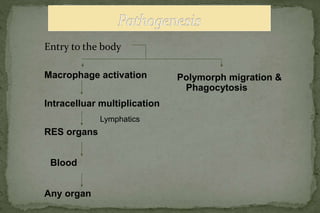
Entry to the body
Macrophage activation Polymorph migration &
Phagocytosis
Intracelluar multiplication
RES organs
Blood
Any organ
Lymphatics
 Cell mediated immunity also activated with granuloma
formation (mainly with B. abortus)
 Humoral antibody response of little importance
 Main way of body control of the infection is through
committed T-lymphocytes producing lymphokines (-
Interferon) which activate macrophage killing
 Pyogenic infection more with B. melitensis and B. suis
 Incubation period: variable 2- 8 wks.
 Presentation: acute 50% & insidious 50%
 Sx & signs not specific.
 Can affect any organ.
 Common nonspecific Sx: - fever with rigors.
- sweats, malaise, anorexia.
- headache, back pain.
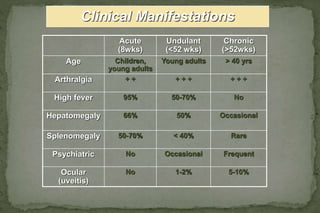
Clinical Manifestations
Acute
(8wks)
Undulant
(<52 wks)
Chronic
(>52wks)
Age Children,
young adults
Young adults > 40 yrs
Arthralgia + + + + + + + +
High fever 95% 50-70% No
Hepatomegaly 66% 50% Occasional
Splenomegaly 50-70% < 40% Rare
Psychiatric No Occasional Frequent
Ocular
(uveitis)
No 1-2% 5-10%
 GIT 70% : anorexia, abd. pain, vomiting,
diarrhea,contipation, hepatosplenomegaly.
 LIVER : Involved in most cases but LFTs normal
or mildly abnormal.
 granulomas (B. abortus).
 hepatitis (B.melitensis).
 abscesses (B.suis).
 Skeletal 20-60% :
 arthritis, spondylitis, osteomyelitis.
 sacroiliitis - most common.
 athritis - oligoarticular : hip, knee & ankles.
Joint asp. - monocytosis, culture +ve in 50 %
 Neurologic
 Meningitis, encephalitis, radiculopathy &
peripheral neuropathy, intracerebral abscesses
 Meningitis
 acute or chronic
 neck rigidity < 50%
 CSF
 lymphocytic pleocytosis
 (N) or low sugar
 increase protein
 culture +ve < 50%
 agglutination +ve in >95%
 Cardiovascular
 Edocarditis 2% (major cause of mortality)
 Rx: valve replacement and antibiotics
 Pericarditis & myocarditis
 Pulmonary
 Inhalation or hematogenous
 Cause any chest syndrome
 Rarely Brucella isolated from sputum
 Genitourinary
 Epidydemoorchitis
 Pyonephrosis (rare)
 Cutaneous
 Nonspecific
 Hematologic
 Anemia
 Leukopenia
 Thrombocytopenia
 History of animal contact is pivotal
 In endemic area, it should be in the
DDx of any nonspecific febrile illness
 Laboratory
 WBC (N) or . monocytosis
 ESR of little help
 Blood cultures
 slow growth = 4 weeks
 new automated system BATEC identifies he organism 4-8 days
 more recent (BACT/ALERT) - 2.8 days
 PCR
 Serology
 Main laboratory method of diagnosis
 Serum agglutination test - most widely used
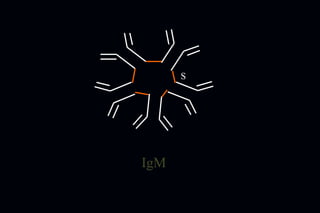
 measures agglutination for IgG, IgM, IgA
 2ME - break sulf-hydrile bonds in IgM polymer - no
agglutination
 which level is diagnostic ??
1 : 160 - non endemic area
1 : 320 - endemic area
 SAT - false negative
 Prozone
 Blocking antibodies
 Other tests: coombs, ELISA, CFT, FTA
IgM
S
 AGG = IgG + IgM
 2ME = IgG
 Preantibiotic era
 Mortality 2% mainly endocarditis
 Morbidity
 High with B. melitensis
 Nerve deafness
 Spinal cord damage
 Control of disease in domestic animals
 immunization using B. abortus strain 19 and B. melitensis strain Rev 1
 Routine pasteurization of milk
 In labs strict biosafety precautions
Drugs against Brucella
 Tetracyclines
 Aminoglycosides
 Streptomycin since 1947
 Gentamicin
 Netilmicin
 Rifampicin
 Quinolones - ciprofloxacin
 ?3rd generation cephalosporins
Drugs against Brucella
 Treatment for uncomplicated Brucellosis
 Stremptomycin + Doxycycline for 6 weeks
 ? TMP/SMX + Doxycycline for 6 weeks
 WHO recommendation 1986
 Rifampicin + Doxycycline for 6 weeks
 Treatment of complicated Brucellosis
 Endocarditis, meningitis
 No uniform agreement
 Usually 3 antibrucella drugs for 3 months
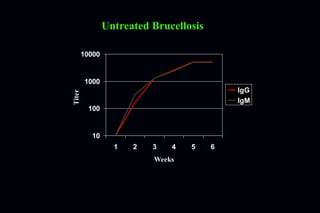
10
100
1000
10000
1 2 3 4 5 6
Weeks
Titer
IgG
IgM
Untreated Brucellosis
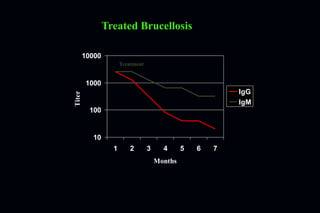
10
100
1000
10000
1 2 3 4 5 6 7
Months
Titer
IgG
IgM
Treated Brucellosis
Treatment
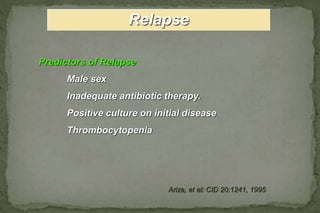
Relapse
Predictors of Relapse
Male sex
Inadequate antibiotic therapy.
Positive culture on initial disease
Thrombocytopenia
Ariza, et al: CID 20:1241, 1995
Brucellosis

Brucellosis

  • 1.
  • 2.
     Worldwide zoonosis Only 17 countries declared brucellosis free1986  Six species 1. B.abortus - mainly cattle 2. B.melitensis - sheeps & goats 3. B.suis - pigs 4. B. canis - dogs 5. B. ovis - sheep (not human pathogen) 6. B. neotomae - desert wood rat (not human pathogen)  B. melitensis -- most common worldwide
  • 3.
     Endemic disease Mostly B. melitensis & b. abortus.  No clear figures about incidence & prevalence.  Incidence : 5.4 per 1000 per year.  Prevalence : 8.6 - 38 % - some regions.
  • 4.
     Gm -ve cocci, coccobacilli, bacilli.  Strict aerobic, nonmotile, nonspore forming.  B. ovis, B. abortus --CO2 supplementation.  Grow in regular media -- prolonged incubation > 4 weeks.
  • 5.
     Surface lipopolysccharidecell wall  smooth vs non-smooth.  determine virulence.  smooth LPS : B. melitensis,suis,abortus  Non-smooth LPS B.canis, ovis.  the basis for agglutination test.
  • 6.
     Zoonosis affectingdomestic animals.  Concentrated in milk, urine, genital organs. ROUTES OF TRANSMISSION  Oral : unpasteurised milk & products raw milk or meet.  Respiratory: lab workers.  Skin: accidental penetration or abrasion  - at risk farmers & veterinarians.  Other routes: Conjunctival, Blood transfusion, Transplacental, ? person to person.
  • 7.
    Entry to thebody Macrophage activation Polymorph migration & Phagocytosis Intracelluar multiplication RES organs Blood Any organ Lymphatics
  • 8.
     Cell mediatedimmunity also activated with granuloma formation (mainly with B. abortus)  Humoral antibody response of little importance  Main way of body control of the infection is through committed T-lymphocytes producing lymphokines (- Interferon) which activate macrophage killing  Pyogenic infection more with B. melitensis and B. suis
  • 9.
     Incubation period:variable 2- 8 wks.  Presentation: acute 50% & insidious 50%  Sx & signs not specific.  Can affect any organ.  Common nonspecific Sx: - fever with rigors. - sweats, malaise, anorexia. - headache, back pain.
  • 10.
    Clinical Manifestations Acute (8wks) Undulant (<52 wks) Chronic (>52wks) AgeChildren, young adults Young adults > 40 yrs Arthralgia + + + + + + + + High fever 95% 50-70% No Hepatomegaly 66% 50% Occasional Splenomegaly 50-70% < 40% Rare Psychiatric No Occasional Frequent Ocular (uveitis) No 1-2% 5-10%
  • 11.
     GIT 70%: anorexia, abd. pain, vomiting, diarrhea,contipation, hepatosplenomegaly.  LIVER : Involved in most cases but LFTs normal or mildly abnormal.  granulomas (B. abortus).  hepatitis (B.melitensis).  abscesses (B.suis).
  • 12.
     Skeletal 20-60%:  arthritis, spondylitis, osteomyelitis.  sacroiliitis - most common.  athritis - oligoarticular : hip, knee & ankles. Joint asp. - monocytosis, culture +ve in 50 %
  • 13.
     Neurologic  Meningitis,encephalitis, radiculopathy & peripheral neuropathy, intracerebral abscesses  Meningitis  acute or chronic  neck rigidity < 50%  CSF  lymphocytic pleocytosis  (N) or low sugar  increase protein  culture +ve < 50%  agglutination +ve in >95%
  • 14.
     Cardiovascular  Edocarditis2% (major cause of mortality)  Rx: valve replacement and antibiotics  Pericarditis & myocarditis  Pulmonary  Inhalation or hematogenous  Cause any chest syndrome  Rarely Brucella isolated from sputum
  • 15.
     Genitourinary  Epidydemoorchitis Pyonephrosis (rare)  Cutaneous  Nonspecific  Hematologic  Anemia  Leukopenia  Thrombocytopenia
  • 16.
     History ofanimal contact is pivotal  In endemic area, it should be in the DDx of any nonspecific febrile illness
  • 17.
     Laboratory  WBC(N) or . monocytosis  ESR of little help  Blood cultures  slow growth = 4 weeks  new automated system BATEC identifies he organism 4-8 days  more recent (BACT/ALERT) - 2.8 days  PCR
  • 18.
     Serology  Mainlaboratory method of diagnosis  Serum agglutination test - most widely used  measures agglutination for IgG, IgM, IgA  2ME - break sulf-hydrile bonds in IgM polymer - no agglutination  which level is diagnostic ?? 1 : 160 - non endemic area 1 : 320 - endemic area  SAT - false negative  Prozone  Blocking antibodies  Other tests: coombs, ELISA, CFT, FTA
  • 19.
  • 20.
     AGG =IgG + IgM  2ME = IgG
  • 21.
     Preantibiotic era Mortality 2% mainly endocarditis  Morbidity  High with B. melitensis  Nerve deafness  Spinal cord damage
  • 22.
     Control ofdisease in domestic animals  immunization using B. abortus strain 19 and B. melitensis strain Rev 1  Routine pasteurization of milk  In labs strict biosafety precautions
  • 23.
    Drugs against Brucella Tetracyclines  Aminoglycosides  Streptomycin since 1947  Gentamicin  Netilmicin  Rifampicin  Quinolones - ciprofloxacin  ?3rd generation cephalosporins
  • 24.
    Drugs against Brucella Treatment for uncomplicated Brucellosis  Stremptomycin + Doxycycline for 6 weeks  ? TMP/SMX + Doxycycline for 6 weeks  WHO recommendation 1986  Rifampicin + Doxycycline for 6 weeks  Treatment of complicated Brucellosis  Endocarditis, meningitis  No uniform agreement  Usually 3 antibrucella drugs for 3 months
  • 25.
    10 100 1000 10000 1 2 34 5 6 Weeks Titer IgG IgM Untreated Brucellosis
  • 26.
    10 100 1000 10000 1 2 34 5 6 7 Months Titer IgG IgM Treated Brucellosis Treatment
  • 27.
    Relapse Predictors of Relapse Malesex Inadequate antibiotic therapy. Positive culture on initial disease Thrombocytopenia Ariza, et al: CID 20:1241, 1995