CCeerrvviiccaall MMyyeellooppaatthhyy 
““AAllwwaayyss IIggnnoorreedd””!!!! 
WWhhaatt ccoouulldd OOrrtthhooppaaeeddiicc ssuurrggeeoonn ddoo??
CCeerrvviiccaall SSppoonnddyylloottiicc 
MMyyeellooppaatthhyy ((CCSSMM)) 
Def: 
Spinal cord dysfunction secondary to:- 
- Extrinsic compression of the cord. 
- Blood supply interferance. 
- Both 
(Parke, Spine. 1988)
CSM Syndrome. 
- Sir Russel Brain : Neurologist. 
- D. North Field : Neuro Surgeon. 
- Marcia Wilkinson : Pathologist. 
(Brain etal. 1952).
This is one more condition which has been 
taken out of the scrap basket into which 
we used to put MS or spinal degenerative 
disease. 
(Gilbert Horrax, 1954).
Cervical Myelopathy : 
A complication of Cervical 
Spondylosis (CSM). 
* (Brain etal. 1952). 
* (Clarke & Robinson 1956).
PPaatthhoopphhyyssiioollooggyy ooff CCSSMM 
* Pre existing cong. or developmental stenosis. 
* Degenerative changes in the disc, producing 
secondary changes on nearby structures 
* Osteophyte of facet Joint. 
* Ligamentum flavum thickening.
CCSSMM 
Most common type of spinal cord 
dysfunction above 55y old. 
(Simeone etal. 1982)
CSM 
* frequently under diagnosed, under 
treated, often leading to increased 
disability. 
Law etal, (JBJS - A, 1994) 
Bernhardt etal. (JBJS-A, 1993) 
* The single most common under 
diagnosed spinal disorder. 
(Dillin etal, 1989).
CClliinniiccaall EEvvaalluuaattiioonn 
A- Common Symptoms : Above 55y. 
* Loss of dexterity of the U.L. 
(Clumsy or weak hands). 
* Neck stiffness, difficulty in walking, 
* Leg weakness or stiffness 
* Pain in shoulders or arms 
* Radicular nerve roots symptoms.
B - Physical Examination. 
1. U.M.N.L. : L.L. ( Hyperreflexia) 
2. U.M.N.L./L.M.N.L. : U.L. (Atrophy of the 
hand musculature) 
3. Hoffmann`s sign + (Neck extension). 
4. Inverted B. Radialis reflex. 
5. Neck flexion  Electric shock – 
sensation down the back &L.L. 
(Lhermitte sign).
6. Changes in deep sensation. 
- Position. 
- Vibration. 
7. Abnormal gait. 
8. Early DisdiadochoKinesia 
(Uncoordinated alternating movement).
DDiiaaggnnoossttiicc SSttuuddiieess 
1. C. spine x-ray - Routine. 
- Instability. 
- Pavlov ratio. 
2. MRI. 
3. Myelogram for dynamic instability. 
4. CT myelogram for OPLL.
DDiiffffeerreennttiiaall DDxx ooff CCSSMM 
1. Multiple sclerosis. 
2. Amyotrophic lateral sclerosis. 
3. Spinal cord tumor. 
4. Subacute combined degeneration. 
5. Cervical disc herniation. 
6. Cerebral lesion. 
7. Syringomyelia
NNaattuurraall HHiissttoorryy ooff CCSSMM 
* Most becomes worse clinically if untreated. 
* > 50% progress to severe disability. 
* Surgery best. 
= 6-12M symptoms. 
= Early myelopathic findings.
DDiissaabbiilliittyy CCllaassssiiffiiccaattiioonn ooff 
CCSSMM 
((NNuurriicckk 11997722)) 
* Grade O : Radicular S & S only. 
* Grade 1 : Signs of cord involvement. 
* Grade 2 : Mild gait involvement. 
* Grade 3 : Gait problem affecting work. 
* Grade 4 : Ambulation with assistance. 
* Grade 5 : Chairbound or bedridden.
DDaannggeerroouuss CCoonnsseerrvvaattiivvee 
ttrreeaattmmeenntt 
1. Cervical traction. 
2. Manipulation of C. Spine will cause: 
* Narrowing of spinal canal. 
* “ “ foramina. 
* Irritation to the facet joints & 
produce further swelling.
WWhheenn ttoo ccoonnssiiddeerr 
ccoonnsseerrvvaattiivvee ttrreeaattmmeenntt??.. 
* Mild symptoms. 
* 13 points or more in JOA score.
CCoonnsseerrvvaattiivvee ttrreeaattmmeenntt 
* How long?. 
* Firm orthosis/NSAIDs. 
* Isometric muscle strengthening. 
* Ice, heat, massage. 
* Monthly follow up.
OOppeerraattiivvee mmaannaaggeemmeenntt 
Absolute indications 
1. Neurological defecit which are 
progressive or have already developed. 
2. Failure of non-operative methods to 
improve the neurological findings. 
3. Severe myelopathy. 
4. 7 points or less in JOA score.
WWhhoo wwiillll bbeenneeffiitt ffrroomm ssuurrggeerryy?? 
1. Severe tingling in the fingers & legs. 
2. Poor handling of knife and fork. 
3. difficulty in buttoning shirts. 
4. Symptoms less than one year. 
5. Patients with 8-12 point in JOA score.
WWhhiicchh aapppprrooaacchh??.. 
* Anterior decompression!. 
* Posterior decompression!. 
* Anterior + Posterior!.
PPrree ooppeerraattiivvee 
ccoonnssiiddeerraattiioonnss 
* Avoid hyper extension of the neck 
during positioning. 
* Left sided approach to avoid inj. to 
RLN. 
* Pre op 120mg prednisolone to be 
repeated after 4hrs.
WWhheenn ttoo ddoo aanntt.. 
aapppprrooaacchh?? 
1. Soft disc herniation 1 to 2 levels. 
2. Spondylosis 1 to 4 levels. 
3. Developmental narrowing of the canal. 
4. Kyphotic deformity. 
5. Localized OPLL.
WWhhaatt yyoouu sshhoouulldd ddoo 
aanntteerriioorrllyy?? 
1. ACDF + plates!!!. 
2. Corpectomy + graft. 
3. Corpectomy + strut graft.
WWhheenn ttoo ddoo ppoosstteerriioorr 
ddeeccoommpprreessssiioonn?? 
1. Compression of > 4 levels. 
2. Calcification of lig. flavum. 
3. Developmental stenosis : (< AP 
13mm). 
4. Extensive OPLL.
PPoosstteerriioorr ddeeccoommpprreessssiioonn 
pprroocceedduurreess 
1. Laminectomy. 
2. Bilat. Open door laminectomy (Kirita’s). 
3. Expanding laminoplasty. 
* Spinous process splitting. 
* Hemilat. open. 
* Z-Plasty.
CCoommbbiinneedd aapppprrooaacchheess!!!!!!!! 
* Cervical instability. 
* Dominant, localized ventral lesion. 
e.g cervical disc, OPLL with canal stenosis. 
* Dominant, localized vental lesion with 
extensive CS or OPLL.
PPoooorr pprrooggnnoossiiss aafftteerr 
ddeeccoommpprreessssiioonn 
1. Atrophy of the spinal cord on MRI 
(Severe cord malacia). 
2. Weakness of peroneal muscles 
(Kozo etal. 1991). 
3. Worse pre op. neurological function 
(Emery etal 1998). 
4. Loss of vibration & propriocepition 
(Montgomery 1992).
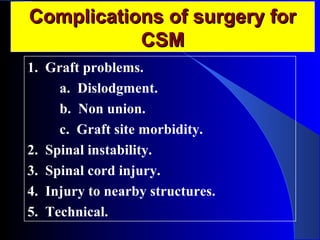
CCoommpplliiccaattiioonnss ooff ssuurrggeerryy ffoorr 
CCSSMM 
1. Graft problems. 
a. Dislodgment. 
b. Non union. 
c. Graft site morbidity. 
2. Spinal instability. 
3. Spinal cord injury. 
4. Injury to nearby structures. 
5. Technical.
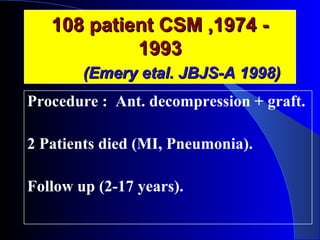
110088 ppaattiieenntt CCSSMM ,,11997744 -- 
11999933 
((EEmmeerryy eettaall.. JJBBJJSS--AA 11999988)) 
Procedure : Ant. decompression + graft. 
2 Patients died (MI, Pneumonia). 
Follow up (2-17 years).
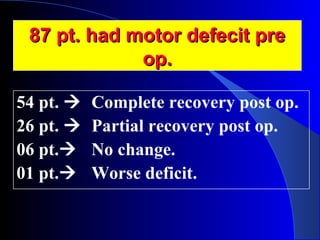
8877 pptt.. hhaadd mmoottoorr ddeeffeecciitt pprree 
oopp.. 
54 pt.  Complete recovery post op. 
26 pt.  Partial recovery post op. 
06 pt. No change. 
01 pt. Worse deficit.
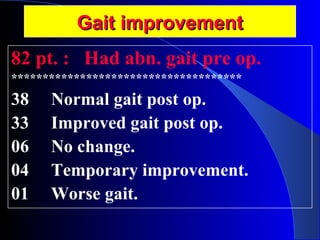
GGaaiitt iimmpprroovveemmeenntt 
82 pt. : Had abn. gait pre op. 
************************************* 
38 Normal gait post op. 
33 Improved gait post op. 
06 No change. 
04 Temporary improvement. 
01 Worse gait.
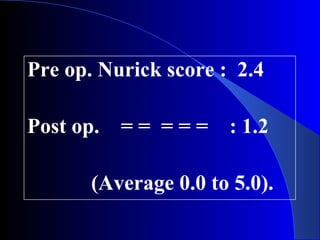
Pre op. Nurick score : 2.4 
Post op. = = = = = : 1.2 
(Average 0.0 to 5.0).
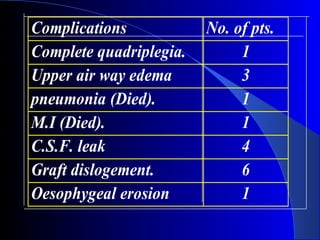
Complications No. of pts. 
Complete quadriplegia. 1 
Upper air way edema 3 
pneumonia (Died). 1 
M.I (Died). 1 
C.S.F. leak 4 
Graft dislogement. 6 
Oesophygeal erosion 1
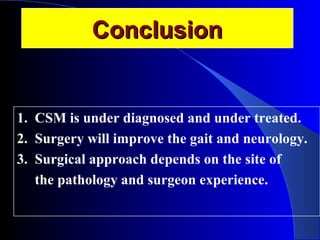
CCoonncclluussiioonn 
1. CSM is under diagnosed and under treated. 
2. Surgery will improve the gait and neurology. 
3. Surgical approach depends on the site of 
the pathology and surgeon experience.
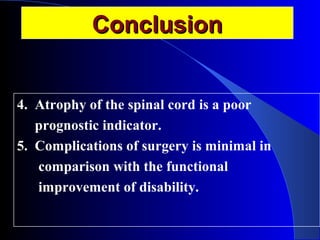
CCoonncclluussiioonn 
4. Atrophy of the spinal cord is a poor 
prognostic indicator. 
5. Complications of surgery is minimal in 
comparison with the functional 
improvement of disability.
SSppiinnaall TTrraaccttss SSyynnddrroommeess iinn 
CCSSMM 
1. Transverse lesion : Most common. 
* AHC. 
* Spino. Th. Tract. 
* Cortico spinal tract. 
* Lately : Post column. 
2. Motor system synd. 
* Cortico spinal tract. 
* Weak U.L. + L.L. 
* Spasticity.
3. Central cord syndrome. 
* U.L. weaker than L.L. 
* Prominant hand weakness. 
* Rarely post column. 
4. Brown-Sequard Syn:Early form of 
CSM.. 
* Cortico spinal tract (Unilat.) 
- Hemi paresis. 
- Pain & Temp. analgesia. 
* Best prognosis for recovery.
5. Brachialgia cord syndrome. 
* U.L. root compression : Radicular 
symptoms with paraesthesia & 
hyporeflexia. 
* Long tract signs, weakness. 
* Gait disturbance.

Basics Cervical myelopathy - البروفيسور فريح ابوحسان - استشاري جراحة العظام والعمود الفقري

  • 1.
    CCeerrvviiccaall MMyyeellooppaatthhyy ““AAllwwaayyssIIggnnoorreedd””!!!! WWhhaatt ccoouulldd OOrrtthhooppaaeeddiicc ssuurrggeeoonn ddoo??
  • 2.
    CCeerrvviiccaall SSppoonnddyylloottiicc MMyyeellooppaatthhyy((CCSSMM)) Def: Spinal cord dysfunction secondary to:- - Extrinsic compression of the cord. - Blood supply interferance. - Both (Parke, Spine. 1988)
  • 3.
    CSM Syndrome. -Sir Russel Brain : Neurologist. - D. North Field : Neuro Surgeon. - Marcia Wilkinson : Pathologist. (Brain etal. 1952).
  • 4.
    This is onemore condition which has been taken out of the scrap basket into which we used to put MS or spinal degenerative disease. (Gilbert Horrax, 1954).
  • 5.
    Cervical Myelopathy : A complication of Cervical Spondylosis (CSM). * (Brain etal. 1952). * (Clarke & Robinson 1956).
  • 6.
    PPaatthhoopphhyyssiioollooggyy ooff CCSSMM * Pre existing cong. or developmental stenosis. * Degenerative changes in the disc, producing secondary changes on nearby structures * Osteophyte of facet Joint. * Ligamentum flavum thickening.
  • 7.
    CCSSMM Most commontype of spinal cord dysfunction above 55y old. (Simeone etal. 1982)
  • 8.
    CSM * frequentlyunder diagnosed, under treated, often leading to increased disability. Law etal, (JBJS - A, 1994) Bernhardt etal. (JBJS-A, 1993) * The single most common under diagnosed spinal disorder. (Dillin etal, 1989).
  • 9.
    CClliinniiccaall EEvvaalluuaattiioonn A-Common Symptoms : Above 55y. * Loss of dexterity of the U.L. (Clumsy or weak hands). * Neck stiffness, difficulty in walking, * Leg weakness or stiffness * Pain in shoulders or arms * Radicular nerve roots symptoms.
  • 10.
    B - PhysicalExamination. 1. U.M.N.L. : L.L. ( Hyperreflexia) 2. U.M.N.L./L.M.N.L. : U.L. (Atrophy of the hand musculature) 3. Hoffmann`s sign + (Neck extension). 4. Inverted B. Radialis reflex. 5. Neck flexion  Electric shock – sensation down the back &L.L. (Lhermitte sign).
  • 11.
    6. Changes indeep sensation. - Position. - Vibration. 7. Abnormal gait. 8. Early DisdiadochoKinesia (Uncoordinated alternating movement).
  • 12.
    DDiiaaggnnoossttiicc SSttuuddiieess 1.C. spine x-ray - Routine. - Instability. - Pavlov ratio. 2. MRI. 3. Myelogram for dynamic instability. 4. CT myelogram for OPLL.
  • 13.
    DDiiffffeerreennttiiaall DDxx ooffCCSSMM 1. Multiple sclerosis. 2. Amyotrophic lateral sclerosis. 3. Spinal cord tumor. 4. Subacute combined degeneration. 5. Cervical disc herniation. 6. Cerebral lesion. 7. Syringomyelia
  • 14.
    NNaattuurraall HHiissttoorryy ooffCCSSMM * Most becomes worse clinically if untreated. * > 50% progress to severe disability. * Surgery best. = 6-12M symptoms. = Early myelopathic findings.
  • 15.
    DDiissaabbiilliittyy CCllaassssiiffiiccaattiioonn ooff CCSSMM ((NNuurriicckk 11997722)) * Grade O : Radicular S & S only. * Grade 1 : Signs of cord involvement. * Grade 2 : Mild gait involvement. * Grade 3 : Gait problem affecting work. * Grade 4 : Ambulation with assistance. * Grade 5 : Chairbound or bedridden.
  • 16.
    DDaannggeerroouuss CCoonnsseerrvvaattiivvee ttrreeaattmmeenntt 1. Cervical traction. 2. Manipulation of C. Spine will cause: * Narrowing of spinal canal. * “ “ foramina. * Irritation to the facet joints & produce further swelling.
  • 17.
    WWhheenn ttoo ccoonnssiiddeerr ccoonnsseerrvvaattiivvee ttrreeaattmmeenntt??.. * Mild symptoms. * 13 points or more in JOA score.
  • 18.
    CCoonnsseerrvvaattiivvee ttrreeaattmmeenntt *How long?. * Firm orthosis/NSAIDs. * Isometric muscle strengthening. * Ice, heat, massage. * Monthly follow up.
  • 19.
    OOppeerraattiivvee mmaannaaggeemmeenntt Absoluteindications 1. Neurological defecit which are progressive or have already developed. 2. Failure of non-operative methods to improve the neurological findings. 3. Severe myelopathy. 4. 7 points or less in JOA score.
  • 20.
    WWhhoo wwiillll bbeenneeffiittffrroomm ssuurrggeerryy?? 1. Severe tingling in the fingers & legs. 2. Poor handling of knife and fork. 3. difficulty in buttoning shirts. 4. Symptoms less than one year. 5. Patients with 8-12 point in JOA score.
  • 21.
    WWhhiicchh aapppprrooaacchh??.. *Anterior decompression!. * Posterior decompression!. * Anterior + Posterior!.
  • 22.
    PPrree ooppeerraattiivvee ccoonnssiiddeerraattiioonnss * Avoid hyper extension of the neck during positioning. * Left sided approach to avoid inj. to RLN. * Pre op 120mg prednisolone to be repeated after 4hrs.
  • 23.
    WWhheenn ttoo ddooaanntt.. aapppprrooaacchh?? 1. Soft disc herniation 1 to 2 levels. 2. Spondylosis 1 to 4 levels. 3. Developmental narrowing of the canal. 4. Kyphotic deformity. 5. Localized OPLL.
  • 24.
    WWhhaatt yyoouu sshhoouullddddoo aanntteerriioorrllyy?? 1. ACDF + plates!!!. 2. Corpectomy + graft. 3. Corpectomy + strut graft.
  • 25.
    WWhheenn ttoo ddooppoosstteerriioorr ddeeccoommpprreessssiioonn?? 1. Compression of > 4 levels. 2. Calcification of lig. flavum. 3. Developmental stenosis : (< AP 13mm). 4. Extensive OPLL.
  • 26.
    PPoosstteerriioorr ddeeccoommpprreessssiioonn pprroocceedduurreess 1. Laminectomy. 2. Bilat. Open door laminectomy (Kirita’s). 3. Expanding laminoplasty. * Spinous process splitting. * Hemilat. open. * Z-Plasty.
  • 27.
    CCoommbbiinneedd aapppprrooaacchheess!!!!!!!! *Cervical instability. * Dominant, localized ventral lesion. e.g cervical disc, OPLL with canal stenosis. * Dominant, localized vental lesion with extensive CS or OPLL.
  • 28.
    PPoooorr pprrooggnnoossiiss aafftteerr ddeeccoommpprreessssiioonn 1. Atrophy of the spinal cord on MRI (Severe cord malacia). 2. Weakness of peroneal muscles (Kozo etal. 1991). 3. Worse pre op. neurological function (Emery etal 1998). 4. Loss of vibration & propriocepition (Montgomery 1992).
  • 29.
    CCoommpplliiccaattiioonnss ooff ssuurrggeerryyffoorr CCSSMM 1. Graft problems. a. Dislodgment. b. Non union. c. Graft site morbidity. 2. Spinal instability. 3. Spinal cord injury. 4. Injury to nearby structures. 5. Technical.
  • 30.
    110088 ppaattiieenntt CCSSMM,,11997744 -- 11999933 ((EEmmeerryy eettaall.. JJBBJJSS--AA 11999988)) Procedure : Ant. decompression + graft. 2 Patients died (MI, Pneumonia). Follow up (2-17 years).
  • 31.
    8877 pptt.. hhaaddmmoottoorr ddeeffeecciitt pprree oopp.. 54 pt.  Complete recovery post op. 26 pt.  Partial recovery post op. 06 pt. No change. 01 pt. Worse deficit.
  • 32.
    GGaaiitt iimmpprroovveemmeenntt 82pt. : Had abn. gait pre op. ************************************* 38 Normal gait post op. 33 Improved gait post op. 06 No change. 04 Temporary improvement. 01 Worse gait.
  • 33.
    Pre op. Nurickscore : 2.4 Post op. = = = = = : 1.2 (Average 0.0 to 5.0).
  • 34.
    Complications No. ofpts. Complete quadriplegia. 1 Upper air way edema 3 pneumonia (Died). 1 M.I (Died). 1 C.S.F. leak 4 Graft dislogement. 6 Oesophygeal erosion 1
  • 35.
    CCoonncclluussiioonn 1. CSMis under diagnosed and under treated. 2. Surgery will improve the gait and neurology. 3. Surgical approach depends on the site of the pathology and surgeon experience.
  • 36.
    CCoonncclluussiioonn 4. Atrophyof the spinal cord is a poor prognostic indicator. 5. Complications of surgery is minimal in comparison with the functional improvement of disability.
  • 37.
    SSppiinnaall TTrraaccttss SSyynnddrroommeessiinn CCSSMM 1. Transverse lesion : Most common. * AHC. * Spino. Th. Tract. * Cortico spinal tract. * Lately : Post column. 2. Motor system synd. * Cortico spinal tract. * Weak U.L. + L.L. * Spasticity.
  • 38.
    3. Central cordsyndrome. * U.L. weaker than L.L. * Prominant hand weakness. * Rarely post column. 4. Brown-Sequard Syn:Early form of CSM.. * Cortico spinal tract (Unilat.) - Hemi paresis. - Pain & Temp. analgesia. * Best prognosis for recovery.
  • 39.
    5. Brachialgia cordsyndrome. * U.L. root compression : Radicular symptoms with paraesthesia & hyporeflexia. * Long tract signs, weakness. * Gait disturbance.