DR.MUMTAZ ALI
NEUROSURGERY DEPARTMENT
JPMC KARACHI
History
 53 year old female , married ,right handed , house wife
,resident of hyderabad with NKCM admitted through
opd with c/o:
 Neck pain for 6months
 Weakness of left arm since 2month
 No hx of urinary incontinence , headache , dec vision ,
seizures ,speech difficulty , dec hearing
 According to my pt she was alright 6 months back then she
developed neck pain which radiates to both shoulder ,left
arm as well as right hand .It is sudden ,gripping , moderate
to severe , intermittent , progressive . It relieves on
extension of neck and aggravates on flexion of neck.It has
no special time of occurrence and no relation with posture
and coughing.she has hx of weight lifting.It is associated
with numbness and tingling in both upper extremities.
 She developed weakness of left arm 2 month back which is
in proximal as well as distal , gradural , mild ,
progressive.she can do routine activities with both
hands.She has loss of sensation in both arms but intact
sensation in perianus.she has no hx of fever , weight loss ,
night sweats , TB contact , trauma , DM & HTN.
 She has no hx of urinary incontinence
 She has no significant lobar , cranial , cerebellar ,
endocrine and systemic symptoms.
 No significant past medical surgical hx , personal hx ,
family hx socioeconomic hx , drug hx, allergic hx
 LEVEL : Cervical spine( myelopathy)
 D/D :
 Disc
 Spondylosis
 tumor
Examination
 An old age pt , well dressed ,good looking ,well oriented
with time place and person with normal built and height
with following vitals and non vitals
 Pulse : 78 bpm , BP : 120/80 mm hg , RR : 16 breaths/min ,
T: A/F
 Pallorness , clubbing , koilynchia dehydration , cynosis ,
jaundice , lymphadenopathy , edema not present.
 No buldge on scalp palpation and scar mark of Vp shunt
presnet on head
 No thydroid swelling is palpated on deglutition
 MME : 30/30
 Primitive reflexs : absent
Upper limbs Lower limbs
 Inspection : SWIFT : absent
 Bulk : symmetrical
 Tone : Inc in L elbow and
wrist while normal on right
 Power : 4/5 below C4 on left
side while normal on right
 Reflexes : +2
 Hoffman : absent
 Inspection : SWIFT : absent
 Bulk : symmetrical
 Tone : normal on both side
 Power : 5/5 in all myotome
 Reflexes : +2
 Plantars : downgoing
 Spine is non-tender , Lhermittes sign positive
 Lobar , cranial , cerebellar and systemic signs are not
present
 LEVEL : Cervical spine( myelopathy)
 D/D :
 Disc
 Spondylosis
 tumor
Investigations
 Specific :
 Xray cervical spine (AP XTSX CC)
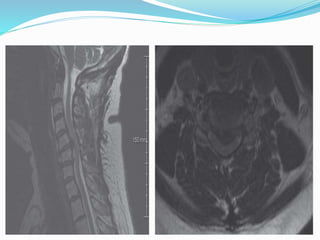
 MRI cervical spine
 CT scan cervical spine
 Routine :
 CBC ,SUCE , PT/APTT/INR . Hep b & c . CXR
 Relevant :
Final diagnosis and management
 Admission
 Counselling
 Optimization
 Preop care
 Surgery : ACDF(three level & two level corpectomy )
 Postop care
 Followup
 Rehabilitation
 Outcome
Surgery
 Shifting : to ot after consent & counselling
 Position : supine , neck extended, pressure points padded
 Equipment : microscope , implant , c.arm , neuromonitoring , bipolar
 Anesthesia : G/A
 Level identification : c.arm
 Incision : Transverse incision from midline to medial border of SCM at Ciricoid cartilage
level
 Dissection: skin , platysma , deep cervical fascia ,muscles
 Retraction : carotid sheath & SCM laterally , tracheoesophageal groove medially
 Prevertebral fascia : dissected
 Microscopic dissection
 Disc identification : with needle of syringe
 Discectomy : C4-5 ,C5-6,C6-7 levels after ALL disection with roungers
 Corpectomy: C5 and C6
 Decompression verification
 Plate fixation
 Wound closure
Complications
 1. exposure injuries
 a) perforation of viscus: ● pharynx● esophagus: ● trachea
 b) vocal cord paresis:
 c) vertebral artery injury:
 d) carotid injury
 e) CSF fistula
 f) Horner’s syndrome
 g) thoracic duct injury
 h) thrombosis of internal jugular vein
 2. spinal cord or nerve root injuries
 a) spinal cord injury:
 b) avoid hyperextension during intubation
 c) bone graft must be shorter than interspace depth
 d) sleep induced apnea
 3. bone fusion problems
 a) failure of fusion
 b) anterior angulation deformity
 c) graft extrusion:
 d) donor site complications: hematoma/seroma, infection, fracture of ilium, injury to
lateral femoral cutaneous nerve, persistent pain due to scar, bowel perforation
 4. miscellaneous
 a) wound infection
 b) post-op hematoma:
 c) dysphagia and hoarseness:
 d) adjacent level degeneration
 e) postoperative discomfort:
 ● globus
 ● nagging discomfort in neck
 f) complex regional pain syndrome (CRPS)
 g) angioedema
 h) pneumothorax / hemothorax
THANKYOU

Cervical disc(Case presentation) dr.mumtaz ali

  • 1.
  • 2.
    History  53 yearold female , married ,right handed , house wife ,resident of hyderabad with NKCM admitted through opd with c/o:  Neck pain for 6months  Weakness of left arm since 2month  No hx of urinary incontinence , headache , dec vision , seizures ,speech difficulty , dec hearing
  • 3.
     According tomy pt she was alright 6 months back then she developed neck pain which radiates to both shoulder ,left arm as well as right hand .It is sudden ,gripping , moderate to severe , intermittent , progressive . It relieves on extension of neck and aggravates on flexion of neck.It has no special time of occurrence and no relation with posture and coughing.she has hx of weight lifting.It is associated with numbness and tingling in both upper extremities.  She developed weakness of left arm 2 month back which is in proximal as well as distal , gradural , mild , progressive.she can do routine activities with both hands.She has loss of sensation in both arms but intact sensation in perianus.she has no hx of fever , weight loss , night sweats , TB contact , trauma , DM & HTN.
  • 4.
     She hasno hx of urinary incontinence  She has no significant lobar , cranial , cerebellar , endocrine and systemic symptoms.  No significant past medical surgical hx , personal hx , family hx socioeconomic hx , drug hx, allergic hx  LEVEL : Cervical spine( myelopathy)  D/D :  Disc  Spondylosis  tumor
  • 5.
    Examination  An oldage pt , well dressed ,good looking ,well oriented with time place and person with normal built and height with following vitals and non vitals  Pulse : 78 bpm , BP : 120/80 mm hg , RR : 16 breaths/min , T: A/F  Pallorness , clubbing , koilynchia dehydration , cynosis , jaundice , lymphadenopathy , edema not present.  No buldge on scalp palpation and scar mark of Vp shunt presnet on head  No thydroid swelling is palpated on deglutition  MME : 30/30  Primitive reflexs : absent
  • 6.
    Upper limbs Lowerlimbs  Inspection : SWIFT : absent  Bulk : symmetrical  Tone : Inc in L elbow and wrist while normal on right  Power : 4/5 below C4 on left side while normal on right  Reflexes : +2  Hoffman : absent  Inspection : SWIFT : absent  Bulk : symmetrical  Tone : normal on both side  Power : 5/5 in all myotome  Reflexes : +2  Plantars : downgoing
  • 7.
     Spine isnon-tender , Lhermittes sign positive  Lobar , cranial , cerebellar and systemic signs are not present  LEVEL : Cervical spine( myelopathy)  D/D :  Disc  Spondylosis  tumor
  • 8.
    Investigations  Specific : Xray cervical spine (AP XTSX CC)  MRI cervical spine  CT scan cervical spine  Routine :  CBC ,SUCE , PT/APTT/INR . Hep b & c . CXR  Relevant :
  • 10.
    Final diagnosis andmanagement  Admission  Counselling  Optimization  Preop care  Surgery : ACDF(three level & two level corpectomy )  Postop care  Followup  Rehabilitation  Outcome
  • 11.
    Surgery  Shifting :to ot after consent & counselling  Position : supine , neck extended, pressure points padded  Equipment : microscope , implant , c.arm , neuromonitoring , bipolar  Anesthesia : G/A  Level identification : c.arm  Incision : Transverse incision from midline to medial border of SCM at Ciricoid cartilage level  Dissection: skin , platysma , deep cervical fascia ,muscles  Retraction : carotid sheath & SCM laterally , tracheoesophageal groove medially  Prevertebral fascia : dissected  Microscopic dissection  Disc identification : with needle of syringe  Discectomy : C4-5 ,C5-6,C6-7 levels after ALL disection with roungers  Corpectomy: C5 and C6  Decompression verification  Plate fixation  Wound closure
  • 12.
    Complications  1. exposureinjuries  a) perforation of viscus: ● pharynx● esophagus: ● trachea  b) vocal cord paresis:  c) vertebral artery injury:  d) carotid injury  e) CSF fistula  f) Horner’s syndrome  g) thoracic duct injury  h) thrombosis of internal jugular vein  2. spinal cord or nerve root injuries  a) spinal cord injury:  b) avoid hyperextension during intubation  c) bone graft must be shorter than interspace depth  d) sleep induced apnea
  • 13.
     3. bonefusion problems  a) failure of fusion  b) anterior angulation deformity  c) graft extrusion:  d) donor site complications: hematoma/seroma, infection, fracture of ilium, injury to lateral femoral cutaneous nerve, persistent pain due to scar, bowel perforation  4. miscellaneous  a) wound infection  b) post-op hematoma:  c) dysphagia and hoarseness:  d) adjacent level degeneration  e) postoperative discomfort:  ● globus  ● nagging discomfort in neck  f) complex regional pain syndrome (CRPS)  g) angioedema  h) pneumothorax / hemothorax
  • 14.