DEFORMITIES OF SPINE
General overview
Dr RAJESH OJHA
Mbbs MS ortho
kgmc Lucknow
Types of deformities
1 Dynamic where it is possible to correct the deformity actively
or passively
This is usually related to joints
2 Rigid or fixed where deformity can not be corrected without
some syrgery,this is
Usually due to change in the shape of bones or joint fused in
deformed and awakword conditions
3 combination where partial correction possible by active or
passive means
(DE-FOR′MĬT-Ē) DEFORMITAS, UGLINESS, DEFORMITY] ALTERATION IN
OR DISTORTION OF THE NATURAL FORM OF A PART, ORGAN, OR THE
ENTIRE BODY. IT MAY BE ACQUIRED OR CONGENITAL. IF PRESENT
AFTER INJURY, DEFORMITY USUALLY IMPLIES THE PRESENCE OF
BONE FRACTURE, BONE DISLOCATION, OR BOTH
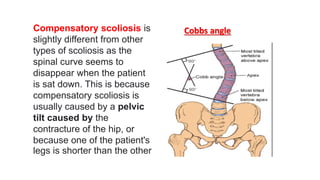
Compensatory scoliosis is
slightly different from other
types of scoliosis as the
spinal curve seems to
disappear when the patient
is sat down. This is because
compensatory scoliosis is
usually caused by a pelvic
tilt caused by the
contracture of the hip, or
because one of the patient's
legs is shorter than the other
Cobbs angle
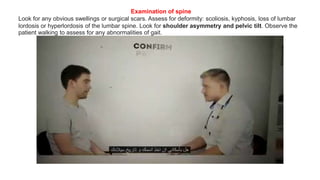
Examination of spine
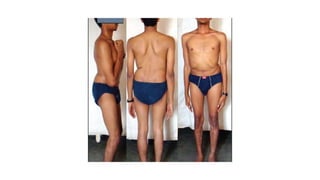
Look for any obvious swellings or surgical scars. Assess for deformity: scoliosis, kyphosis, loss of lumbar
lordosis or hyperlordosis of the lumbar spine. Look for shoulder asymmetry and pelvic tilt. Observe the
patient walking to assess for any abnormalities of gait.
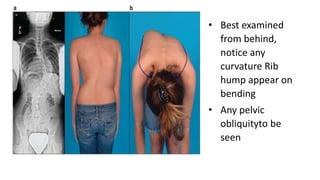
• Best examined
from behind,
notice any
curvature Rib
hump appear on
bending
• Any pelvic
obliquityto be
seen
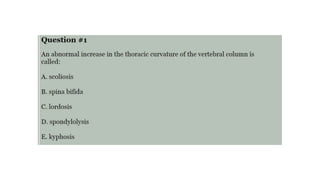
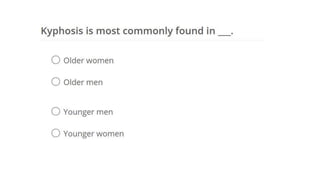
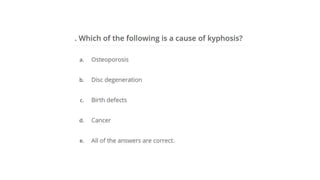
KYPHOSIS
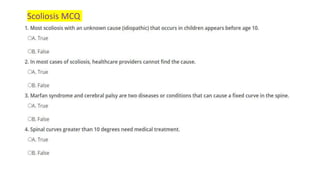
SCOLIOSIS
Kyphoscoliosis
LORDOSIS
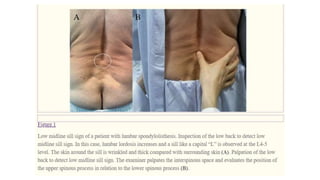
SPODYLOLYSTHESIS
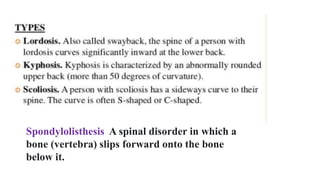
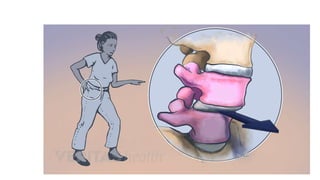
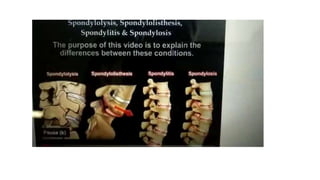
Spondylolisthesis A spinal disorder in which a
bone (vertebra) slips forward onto the bone
below it.
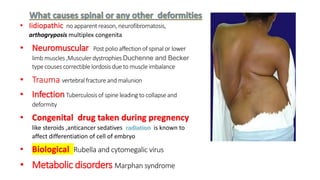
• Iidiopathic no apparent reason, neurofibromatosis,
arthogryposis multiplex congenita
• Neuromuscular Post polio affection of spinal or lower
limb muscles ,Musculer dystrophies Duchenne and Becker
type couses correctible lordosis due to muscle imbalance
• Trauma vertebral fracture and malunion
• InfectionTuberculosis of spine leading to collapse and
deformity
• Congenital drug taken during pregnency
like steroids ,anticancer sedatives is known to
affect differentiation of cell of embryo
• Biological Rubella and cytomegalic virus
• Metabolic disorders Marphan syndrome
Couse of kyphosis varies with age
Commonest Couse in infant is congenital fused
vertebrae,spina bifida
In a child going to school may be caused by poor posture or weight of
school bag
tuberculosis of spine is the cause if angular kyphosis
develops associated with poor health, and xray picture
showing changes suggestive of tb
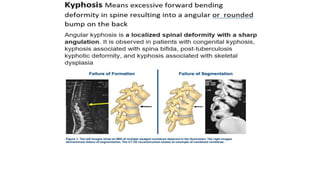
congenital anguler kyphosis is associated with fused
vertebrae or partial agenesis
Some known and recognized disease/syndromes that are associated with
spinal deformities
 Spina bifida
 Arthrogryposis Multiplex Congenita
 Congenital fused vertebrae
 Sprengel shoulder
 Klippel flail syndrome
 Sherman’s adolescent kyphosis
 Marfan syndrome
 Morquio syndrome
 Idiopathic adolescent scoliosis
 Kyphoscoliosis associated with Neurofibromatosis
 Senile kyphosis associated with osteoporosis
 Sequel of spinal trauma
 Sequel of Post polio residual paralysis
 Pott’s spine(tuberculosis)
 Ankylosing spondylitis
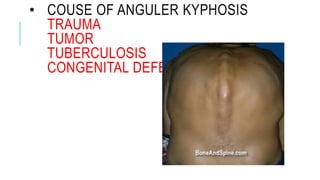
• COUSE OF ANGULER KYPHOSIS
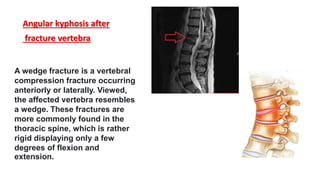
TRAUMA
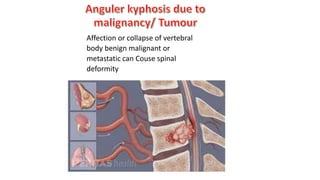
TUMOR
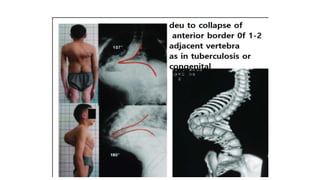
TUBERCULOSIS
CONGENITAL DEFECTS
A wedge fracture is a vertebral
compression fracture occurring
anteriorly or laterally. Viewed,
the affected vertebra resembles
a wedge. These fractures are
more commonly found in the
thoracic spine, which is rather
rigid displaying only a few
degrees of flexion and
extension.
Angular kyphosis after
fracture vertebra
Affection or collapse of vertebral
body benign malignant or
metastatic can Couse spinal
deformity
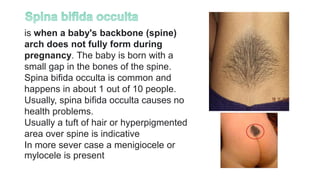
is when a baby's backbone (spine)
arch does not fully form during
pregnancy. The baby is born with a
small gap in the bones of the spine.
Spina bifida occulta is common and
happens in about 1 out of 10 people.
Usually, spina bifida occulta causes no
health problems.
Usually a tuft of hair or hyperpigmented
area over spine is indicative
In more sever case a menigiocele or
mylocele is present
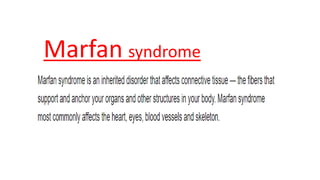
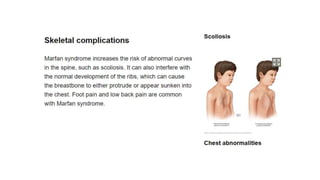
Marfan syndrome
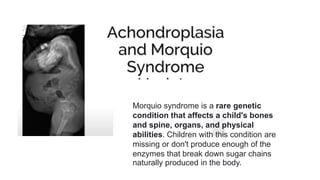
Morquio syndrome is a rare genetic
condition that affects a child's bones
and spine, organs, and physical
abilities. Children with this condition are
missing or don't produce enough of the
enzymes that break down sugar chains
naturally produced in the body.
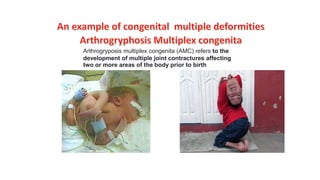
Arthrogryposis multiplex congenita (AMC) refers to the
development of multiple joint contractures affecting
two or more areas of the body prior to birth
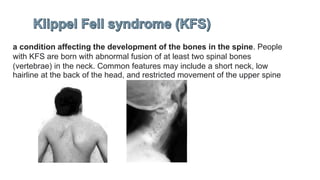
a condition affecting the development of the bones in the spine. People
with KFS are born with abnormal fusion of at least two spinal bones
(vertebrae) in the neck. Common features may include a short neck, low
hairline at the back of the head, and restricted movement of the upper spine
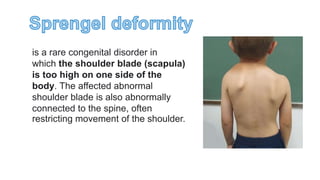
is a rare congenital disorder in
which the shoulder blade (scapula)
is too high on one side of the
body. The affected abnormal
shoulder blade is also abnormally
connected to the spine, often
restricting movement of the shoulder.
Scheuermann's disease adolescent
kyphosis describes a condition where
the vertebrae grow unevenly with
respect to the sagittal plane; that is, the
posterior angle is often greater than the
anterior. This uneven growth results in the
signature "wedging" shape of the
vertebrae, causing kyphosis.
•Scheuermann's Kyphosis is a rigid form of spinal kyphosis caused by
anterior wedging of >5 degrees across three consecutive vertebrae,
osteonecrosis of anterior apophyseal ring
•herniation of disc material leading to loss of anterior disc height
•relative osteoporosis leading to compression deformity
•altered biomechanics leading to anterior wedging and subsequent
growth arrest
•most widely accepted theory suggests that the kyphosis and
vertebral wedging are caused by a developmental error in collagen
aggregation which results in an abnormal end plate
•most commonly in the thoracic spine.
•Diagnosis is made with standard and hyperextension lateral
radiographs of the thoracic spine.
•Treatment can be observation or surgical management depending on
the severity of kyphosis, presence of neurological deficits, and/or
persistent and progressive pain.
Schmorl nodes represent a herniation or an
extrusion of the intervertebral disc nuclear material
through the vertebral body endplate, with
displacement of this material into the adjacent vertebral
body [2]. The herniated tissue may form a defect in the
upper or lower surface of the involved vertebra.
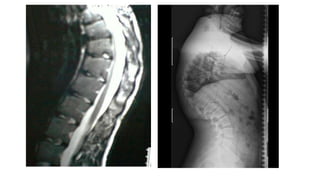
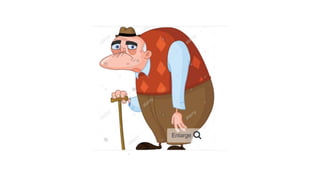
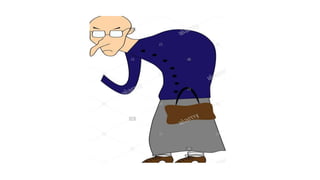
Rounded kyphosis is excessive
forward curve of spine as a result
of collapse or shortening of
anterior part of multiple vertebrae
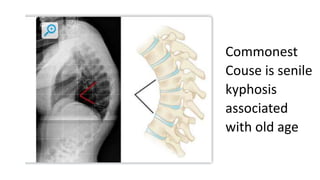
Commonest
Couse is senile
kyphosis
associated
with old age
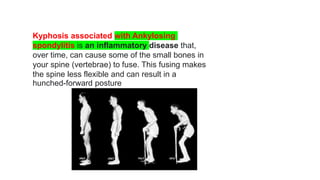
Kyphosis associated with Ankylosing
spondylitis is an inflammatory disease that,
over time, can cause some of the small bones in
your spine (vertebrae) to fuse. This fusing makes
the spine less flexible and can result in a
hunched-forward posture
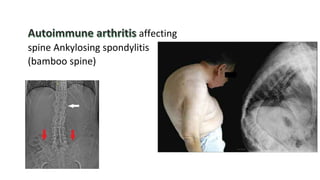
affecting
spine Ankylosing spondylitis
(bamboo spine)
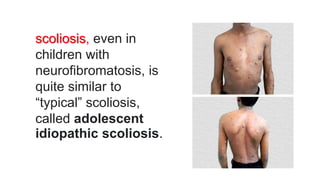
scoliosis, even in
children with
neurofibromatosis, is
quite similar to
“typical” scoliosis,
called adolescent
idiopathic scoliosis.
Lordosis is the term used in
relation to lumber spine and
mostly a compensatory to
excessive dorsal spine
affections
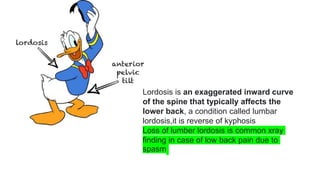
Lordosis is an exaggerated inward curve
of the spine that typically affects the
lower back, a condition called lumbar
lordosis,it is reverse of kyphosis
Loss of lumber lordosis is common xray
finding in case of low back pain due to
spasm
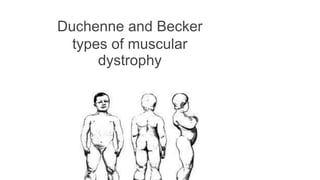
Duchenne and Becker
types of muscular
dystrophy
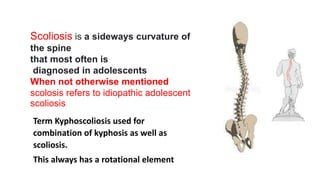
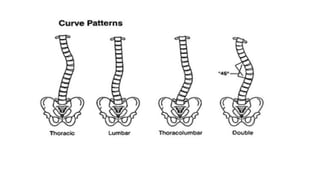
Scoliosis is a sideways curvature of
the spine
that most often is
diagnosed in adolescents
When not otherwise mentioned
scolosis refers to idiopathic adolescent
scoliosis
Term Kyphoscoliosis used for
combination of kyphosis as well as
scoliosis.
This always has a rotational element
Treatment of spinal deformities
Physiotherapy stretching
Permanent Bracing by plaster
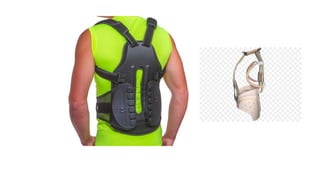
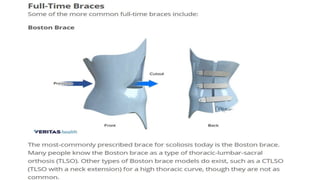
Removable brace
Surgery
In older adults, if osteoporosis is the underlying
cause of the deformity, we may treat it
with calcium, hormone replacement therapy, or
weight-bearing exercises. Bracing is another
nonsurgical option for adults. It will not change the
position of the spine, but it may ease pressure and
pain.
Only kyphosis and scoliosis which are of
significant severity need to be treated,
Specific conditions require specialized
approach
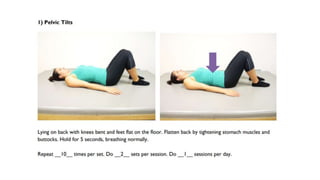
 Exercise and postural correction for mild
 Molded or universal brace
 Surgery
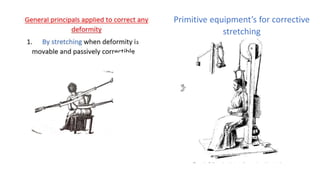
Primitive equipment’s for corrective
stretching
1) Core Strength: Your core muscles include
your abdominal muscles, back muscles and
muscles around the pelvis. These muscles are
designed to protect the spine by creating a sturdy
rod that limits excessive movement in any
direction.
2) Proprioception: Proprioception is the sense
of the body in space regarding position, motion,
and equilibrium
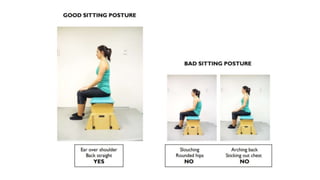
3) Posture: Your spine is strong and stable when
you practice healthy posture. But when you stoop
or slouch, your muscles and ligaments struggle to
keep your body upright and balanced. Poor
posture can stress or pull muscles, which may
Exercise and postural correction
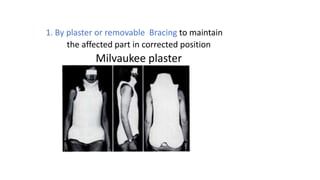
1. By plaster or removable Bracing to maintain
the affected part in corrected position
Milvaukee plaster
Surgery for deformity correction
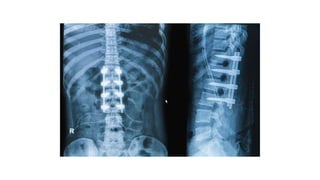
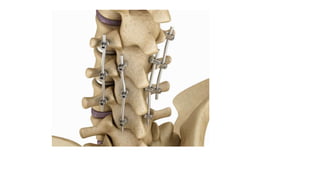
Any deformity anywhere in body need to be corrected
permanently or to great extent by means of
soft tissue release erasing muscles or ligaments to achieve
correction
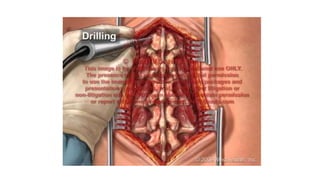
osteotomy cutting the deformed bone to achieve correction
Fusion of joint or orthrodesis to rtain it in corrected position
After achieving desired correction there is usually need to retain it
externally by means of calipers or braces, or internally by
appropriate implants
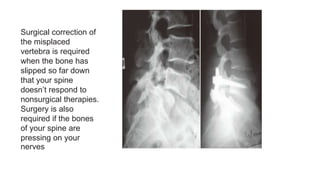
Surgical correction of the misplaced
vertebra is required when the bone
has slipped so far down that your
spine doesn’t respond to nonsurgical
therapies. Surgery is also required if
the bones of your spine are pressing
on your nerves
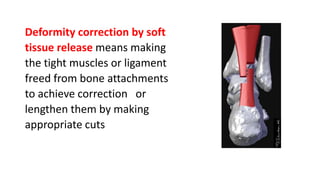
Deformity correction by soft
tissue release means making
the tight muscles or ligament
freed from bone attachments
to achieve correction or
lengthen them by making
appropriate cuts
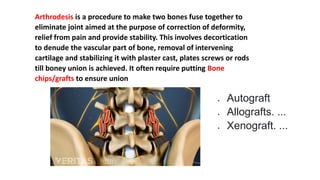
Arthrodesis is a procedure to make two bones fuse together to
eliminate joint aimed at the purpose of correction of deformity,
relief from pain and provide stability. This involves decortication
to denude the vascular part of bone, removal of intervening
cartilage and stabilizing it with plaster cast, plates screws or rods
till boney union is achieved. It often require putting Bone
chips/grafts to ensure union
 Autograft
 Allografts. ...
 Xenograft. ...
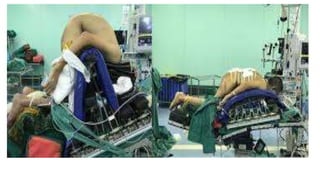
Surgery can usually correct the appearance of the
back and may help to relieve pain but it carries quite a
high risk of complications. Surgery is only
recommended for more severe cases of kyphosis,
where it's felt the potential benefits of surgery outweigh
the risks.
One such is spinal osteotomy for severe
case of ankylosing spondylitis
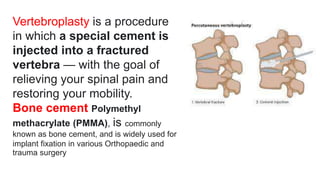
Vertebroplasty is a procedure
in which a special cement is
injected into a fractured
vertebra — with the goal of
relieving your spinal pain and
restoring your mobility.
Bone cement Polymethyl
methacrylate (PMMA), is commonly
known as bone cement, and is widely used for
implant fixation in various Orthopaedic and
trauma surgery
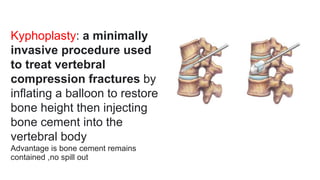
Kyphoplasty: a minimally
invasive procedure used
to treat vertebral
compression fractures by
inflating a balloon to restore
bone height then injecting
bone cement into the
vertebral body
Advantage is bone cement remains
contained ,no spill out
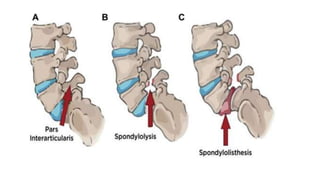
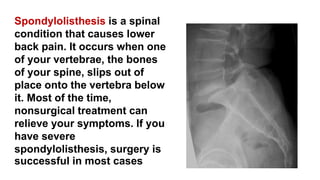
Spondylolisthesis is a spinal
condition that causes lower
back pain. It occurs when one
of your vertebrae, the bones
of your spine, slips out of
place onto the vertebra below
it. Most of the time,
nonsurgical treatment can
relieve your symptoms. If you
have severe
spondylolisthesis, surgery is
successful in most cases
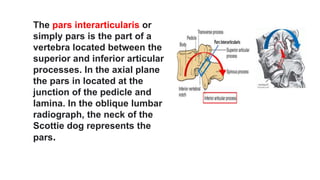
The pars interarticularis or
simply pars is the part of a
vertebra located between the
superior and inferior articular
processes. In the axial plane
the pars in located at the
junction of the pedicle and
lamina. In the oblique lumbar
radiograph, the neck of the
Scottie dog represents the
pars.
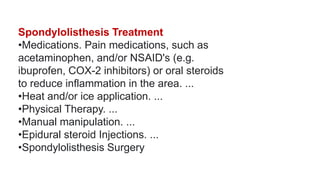
Spondylolisthesis Treatment
•Medications. Pain medications, such as
acetaminophen, and/or NSAID's (e.g.
ibuprofen, COX-2 inhibitors) or oral steroids
to reduce inflammation in the area. ...
•Heat and/or ice application. ...
•Physical Therapy. ...
•Manual manipulation. ...
•Epidural steroid Injections. ...
•Spondylolisthesis Surgery
Surgical correction of
the misplaced
vertebra is required
when the bone has
slipped so far down
that your spine
doesn’t respond to
nonsurgical therapies.
Surgery is also
required if the bones
of your spine are
pressing on your
nerves
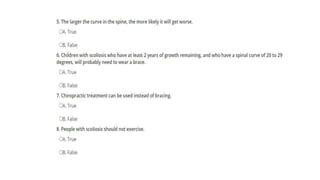
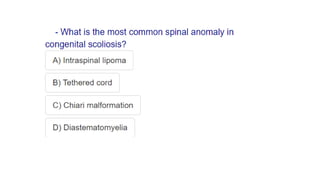
Scoliosis MCQ
Spine
Spine
Spine
Spine
Spine
Spine
Spine

Spine

  • 1.
    DEFORMITIES OF SPINE Generaloverview Dr RAJESH OJHA Mbbs MS ortho kgmc Lucknow
  • 2.
    Types of deformities 1Dynamic where it is possible to correct the deformity actively or passively This is usually related to joints 2 Rigid or fixed where deformity can not be corrected without some syrgery,this is Usually due to change in the shape of bones or joint fused in deformed and awakword conditions 3 combination where partial correction possible by active or passive means (DE-FOR′MĬT-Ē) DEFORMITAS, UGLINESS, DEFORMITY] ALTERATION IN OR DISTORTION OF THE NATURAL FORM OF A PART, ORGAN, OR THE ENTIRE BODY. IT MAY BE ACQUIRED OR CONGENITAL. IF PRESENT AFTER INJURY, DEFORMITY USUALLY IMPLIES THE PRESENCE OF BONE FRACTURE, BONE DISLOCATION, OR BOTH
  • 4.
    Compensatory scoliosis is slightlydifferent from other types of scoliosis as the spinal curve seems to disappear when the patient is sat down. This is because compensatory scoliosis is usually caused by a pelvic tilt caused by the contracture of the hip, or because one of the patient's legs is shorter than the other Cobbs angle
  • 6.
    Examination of spine Lookfor any obvious swellings or surgical scars. Assess for deformity: scoliosis, kyphosis, loss of lumbar lordosis or hyperlordosis of the lumbar spine. Look for shoulder asymmetry and pelvic tilt. Observe the patient walking to assess for any abnormalities of gait.
  • 7.
    • Best examined frombehind, notice any curvature Rib hump appear on bending • Any pelvic obliquityto be seen
  • 8.
  • 9.
    Spondylolisthesis A spinaldisorder in which a bone (vertebra) slips forward onto the bone below it.
  • 10.
    • Iidiopathic noapparent reason, neurofibromatosis, arthogryposis multiplex congenita • Neuromuscular Post polio affection of spinal or lower limb muscles ,Musculer dystrophies Duchenne and Becker type couses correctible lordosis due to muscle imbalance • Trauma vertebral fracture and malunion • InfectionTuberculosis of spine leading to collapse and deformity • Congenital drug taken during pregnency like steroids ,anticancer sedatives is known to affect differentiation of cell of embryo • Biological Rubella and cytomegalic virus • Metabolic disorders Marphan syndrome
  • 11.
    Couse of kyphosisvaries with age Commonest Couse in infant is congenital fused vertebrae,spina bifida In a child going to school may be caused by poor posture or weight of school bag tuberculosis of spine is the cause if angular kyphosis develops associated with poor health, and xray picture showing changes suggestive of tb congenital anguler kyphosis is associated with fused vertebrae or partial agenesis
  • 12.
    Some known andrecognized disease/syndromes that are associated with spinal deformities  Spina bifida  Arthrogryposis Multiplex Congenita  Congenital fused vertebrae  Sprengel shoulder  Klippel flail syndrome  Sherman’s adolescent kyphosis  Marfan syndrome  Morquio syndrome  Idiopathic adolescent scoliosis  Kyphoscoliosis associated with Neurofibromatosis  Senile kyphosis associated with osteoporosis  Sequel of spinal trauma  Sequel of Post polio residual paralysis  Pott’s spine(tuberculosis)  Ankylosing spondylitis
  • 14.
    • COUSE OFANGULER KYPHOSIS TRAUMA TUMOR TUBERCULOSIS CONGENITAL DEFECTS
  • 16.
    A wedge fractureis a vertebral compression fracture occurring anteriorly or laterally. Viewed, the affected vertebra resembles a wedge. These fractures are more commonly found in the thoracic spine, which is rather rigid displaying only a few degrees of flexion and extension. Angular kyphosis after fracture vertebra
  • 17.
    Affection or collapseof vertebral body benign malignant or metastatic can Couse spinal deformity
  • 18.
    is when ababy's backbone (spine) arch does not fully form during pregnancy. The baby is born with a small gap in the bones of the spine. Spina bifida occulta is common and happens in about 1 out of 10 people. Usually, spina bifida occulta causes no health problems. Usually a tuft of hair or hyperpigmented area over spine is indicative In more sever case a menigiocele or mylocele is present
  • 19.
  • 21.
    Morquio syndrome isa rare genetic condition that affects a child's bones and spine, organs, and physical abilities. Children with this condition are missing or don't produce enough of the enzymes that break down sugar chains naturally produced in the body.
  • 22.
    Arthrogryposis multiplex congenita(AMC) refers to the development of multiple joint contractures affecting two or more areas of the body prior to birth
  • 23.
    a condition affectingthe development of the bones in the spine. People with KFS are born with abnormal fusion of at least two spinal bones (vertebrae) in the neck. Common features may include a short neck, low hairline at the back of the head, and restricted movement of the upper spine
  • 24.
    is a rarecongenital disorder in which the shoulder blade (scapula) is too high on one side of the body. The affected abnormal shoulder blade is also abnormally connected to the spine, often restricting movement of the shoulder.
  • 25.
    Scheuermann's disease adolescent kyphosisdescribes a condition where the vertebrae grow unevenly with respect to the sagittal plane; that is, the posterior angle is often greater than the anterior. This uneven growth results in the signature "wedging" shape of the vertebrae, causing kyphosis.
  • 26.
    •Scheuermann's Kyphosis isa rigid form of spinal kyphosis caused by anterior wedging of >5 degrees across three consecutive vertebrae, osteonecrosis of anterior apophyseal ring •herniation of disc material leading to loss of anterior disc height •relative osteoporosis leading to compression deformity •altered biomechanics leading to anterior wedging and subsequent growth arrest •most widely accepted theory suggests that the kyphosis and vertebral wedging are caused by a developmental error in collagen aggregation which results in an abnormal end plate •most commonly in the thoracic spine. •Diagnosis is made with standard and hyperextension lateral radiographs of the thoracic spine. •Treatment can be observation or surgical management depending on the severity of kyphosis, presence of neurological deficits, and/or persistent and progressive pain.
  • 28.
    Schmorl nodes representa herniation or an extrusion of the intervertebral disc nuclear material through the vertebral body endplate, with displacement of this material into the adjacent vertebral body [2]. The herniated tissue may form a defect in the upper or lower surface of the involved vertebra.
  • 29.
    Rounded kyphosis isexcessive forward curve of spine as a result of collapse or shortening of anterior part of multiple vertebrae
  • 31.
  • 33.
    Kyphosis associated withAnkylosing spondylitis is an inflammatory disease that, over time, can cause some of the small bones in your spine (vertebrae) to fuse. This fusing makes the spine less flexible and can result in a hunched-forward posture
  • 34.
  • 35.
    scoliosis, even in childrenwith neurofibromatosis, is quite similar to “typical” scoliosis, called adolescent idiopathic scoliosis.
  • 36.
    Lordosis is theterm used in relation to lumber spine and mostly a compensatory to excessive dorsal spine affections
  • 37.
    Lordosis is anexaggerated inward curve of the spine that typically affects the lower back, a condition called lumbar lordosis,it is reverse of kyphosis Loss of lumber lordosis is common xray finding in case of low back pain due to spasm
  • 38.
    Duchenne and Becker typesof muscular dystrophy
  • 39.
    Scoliosis is asideways curvature of the spine that most often is diagnosed in adolescents When not otherwise mentioned scolosis refers to idiopathic adolescent scoliosis Term Kyphoscoliosis used for combination of kyphosis as well as scoliosis. This always has a rotational element
  • 43.
    Treatment of spinaldeformities Physiotherapy stretching Permanent Bracing by plaster Removable brace Surgery
  • 44.
    In older adults,if osteoporosis is the underlying cause of the deformity, we may treat it with calcium, hormone replacement therapy, or weight-bearing exercises. Bracing is another nonsurgical option for adults. It will not change the position of the spine, but it may ease pressure and pain.
  • 45.
    Only kyphosis andscoliosis which are of significant severity need to be treated, Specific conditions require specialized approach  Exercise and postural correction for mild  Molded or universal brace  Surgery
  • 46.
    Primitive equipment’s forcorrective stretching
  • 48.
    1) Core Strength:Your core muscles include your abdominal muscles, back muscles and muscles around the pelvis. These muscles are designed to protect the spine by creating a sturdy rod that limits excessive movement in any direction. 2) Proprioception: Proprioception is the sense of the body in space regarding position, motion, and equilibrium 3) Posture: Your spine is strong and stable when you practice healthy posture. But when you stoop or slouch, your muscles and ligaments struggle to keep your body upright and balanced. Poor posture can stress or pull muscles, which may Exercise and postural correction
  • 53.
    1. By plasteror removable Bracing to maintain the affected part in corrected position Milvaukee plaster
  • 56.
    Surgery for deformitycorrection Any deformity anywhere in body need to be corrected permanently or to great extent by means of soft tissue release erasing muscles or ligaments to achieve correction osteotomy cutting the deformed bone to achieve correction Fusion of joint or orthrodesis to rtain it in corrected position After achieving desired correction there is usually need to retain it externally by means of calipers or braces, or internally by appropriate implants
  • 57.
    Surgical correction ofthe misplaced vertebra is required when the bone has slipped so far down that your spine doesn’t respond to nonsurgical therapies. Surgery is also required if the bones of your spine are pressing on your nerves
  • 58.
    Deformity correction bysoft tissue release means making the tight muscles or ligament freed from bone attachments to achieve correction or lengthen them by making appropriate cuts
  • 59.
    Arthrodesis is aprocedure to make two bones fuse together to eliminate joint aimed at the purpose of correction of deformity, relief from pain and provide stability. This involves decortication to denude the vascular part of bone, removal of intervening cartilage and stabilizing it with plaster cast, plates screws or rods till boney union is achieved. It often require putting Bone chips/grafts to ensure union  Autograft  Allografts. ...  Xenograft. ...
  • 63.
    Surgery can usuallycorrect the appearance of the back and may help to relieve pain but it carries quite a high risk of complications. Surgery is only recommended for more severe cases of kyphosis, where it's felt the potential benefits of surgery outweigh the risks. One such is spinal osteotomy for severe case of ankylosing spondylitis
  • 64.
    Vertebroplasty is aprocedure in which a special cement is injected into a fractured vertebra — with the goal of relieving your spinal pain and restoring your mobility. Bone cement Polymethyl methacrylate (PMMA), is commonly known as bone cement, and is widely used for implant fixation in various Orthopaedic and trauma surgery
  • 65.
    Kyphoplasty: a minimally invasiveprocedure used to treat vertebral compression fractures by inflating a balloon to restore bone height then injecting bone cement into the vertebral body Advantage is bone cement remains contained ,no spill out
  • 68.
    Spondylolisthesis is aspinal condition that causes lower back pain. It occurs when one of your vertebrae, the bones of your spine, slips out of place onto the vertebra below it. Most of the time, nonsurgical treatment can relieve your symptoms. If you have severe spondylolisthesis, surgery is successful in most cases
  • 71.
    The pars interarticularisor simply pars is the part of a vertebra located between the superior and inferior articular processes. In the axial plane the pars in located at the junction of the pedicle and lamina. In the oblique lumbar radiograph, the neck of the Scottie dog represents the pars.
  • 74.
    Spondylolisthesis Treatment •Medications. Painmedications, such as acetaminophen, and/or NSAID's (e.g. ibuprofen, COX-2 inhibitors) or oral steroids to reduce inflammation in the area. ... •Heat and/or ice application. ... •Physical Therapy. ... •Manual manipulation. ... •Epidural steroid Injections. ... •Spondylolisthesis Surgery
  • 75.
    Surgical correction of themisplaced vertebra is required when the bone has slipped so far down that your spine doesn’t respond to nonsurgical therapies. Surgery is also required if the bones of your spine are pressing on your nerves
  • 84.