Cervical Spondylotic
Myelopathy
Introduction
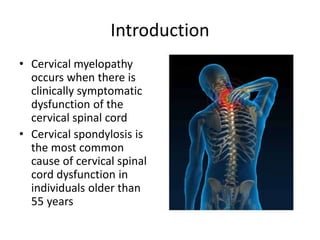
• Cervical myelopathy
occurs when there is
clinically symptomatic
dysfunction of the
cervical spinal cord
• Cervical spondylosis is
the most common
cause of cervical spinal
cord dysfunction in
individuals older than
55 years
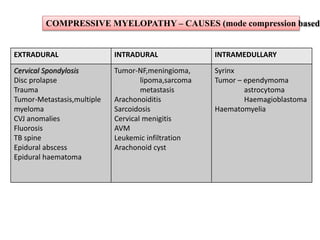
EXTRADURAL INTRADURAL INTRAMEDULLARY
Cervical Spondylosis
Disc prolapse
Trauma
Tumor-Metastasis,multiple
myeloma
CVJ anomalies
Fluorosis
TB spine
Epidural abscess
Epidural haematoma
Tumor-NF,meningioma,
lipoma,sarcoma
metastasis
Arachonoiditis
Sarcoidosis
Cervical menigitis
AVM
Leukemic infiltration
Arachonoid cyst
Syrinx
Tumor – ependymoma
astrocytoma
Haemagioblastoma
Haematomyelia
COMPRESSIVE MYELOPATHY – CAUSES (mode compression based)
• One of the most common causes of cervical
myelopathy is Extradural compression of the
cord, which can occur as a result of
# Spinal trauma
# Mass lesions
# Degenerative changes of the
Spine, or other factors
• When cord compression is caused by
degenerative changes it is cervical spondylotic
myelopathy (CSM), which will be the focus
How spondylosis lead to cord
compression?
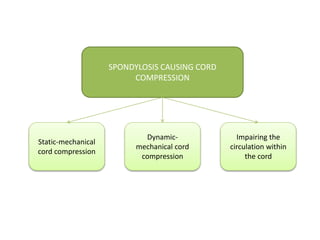
Static-mechanical
cord compression
Dynamic-
mechanical cord
compression
Impairing the
circulation within
the cord
SPONDYLOSIS CAUSING CORD
COMPRESSION
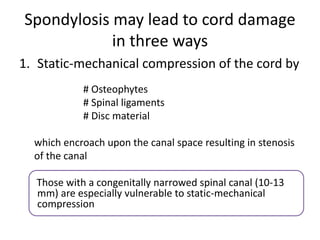
Spondylosis may lead to cord damage
in three ways
1. Static-mechanical compression of the cord by
# Osteophytes
# Spinal ligaments
# Disc material
which encroach upon the canal space resulting in stenosis
of the canal
Those with a congenitally narrowed spinal canal (10-13
mm) are especially vulnerable to static-mechanical
compression
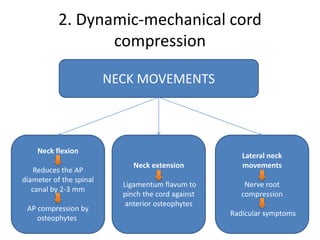
2. Dynamic-mechanical cord
compression
Neck flexion
Reduces the AP
diameter of the spinal
canal by 2-3 mm
AP compression by
osteophytes
Neck extension
Ligamentum flavum to
pinch the cord against
anterior osteophytes
Lateral neck
movements
Nerve root
compression
Radicular symptoms
NECK MOVEMENTS
3.Impairing the circulation within the
cord
• Osteophytes can compress
– the Anterior Spinal Artery or
– a critical medullary feeder, or
– can compress venous drainage
leading to a neuroischemic myelopathy
usually affecting the anterior cord
Clinical presentation
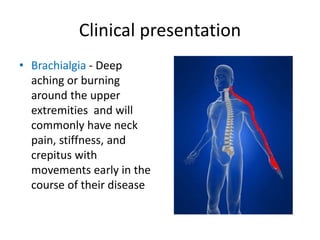
• Brachialgia - Deep
aching or burning
around the upper
extremities and will
commonly have neck
pain, stiffness, and
crepitus with
movements early in the
course of their disease
Clinical presentation
• Most commonly Sensory symptoms including
– Upper extremity numbness
– Pain, and paresthesias initially,
followed by lower extremity sensory changes
• Motor dysfunction may be unilateral or
bilateral depending on the extent and location
of cord damage
Role Of Radiological Investigations
• The correlation between radiographic
evidence of spondylotic cord damage and
clinically significant CSM is not perfect
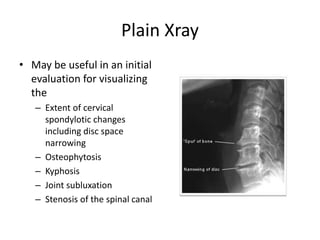
Plain Xray
• May be useful in an initial
evaluation for visualizing
the
– Extent of cervical
spondylotic changes
including disc space
narrowing
– Osteophytosis
– Kyphosis
– Joint subluxation
– Stenosis of the spinal canal
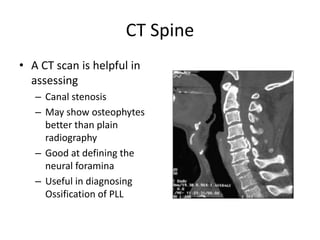
CT Spine
• A CT scan is helpful in
assessing
– Canal stenosis
– May show osteophytes
better than plain
radiography
– Good at defining the
neural foramina
– Useful in diagnosing
Ossification of PLL
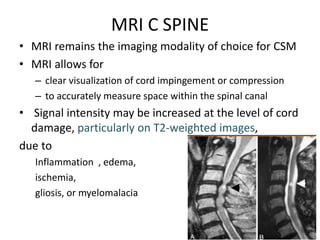
MRI C SPINE
• MRI remains the imaging modality of choice for CSM
• MRI allows for
– clear visualization of cord impingement or compression
– to accurately measure space within the spinal canal
• Signal intensity may be increased at the level of cord
damage, particularly on T2-weighted images,
due to
Inflammation , edema,
ischemia,
gliosis, or myelomalacia
MRI C SPINE
• Signal changes have been shown to be a fairly reliable
indicator of irreversible cord damage
• Diffusion-weighted MR imaging, in particular a
technique known as diffusion tensor imaging(DTI), may
enhance sensitivity for detecting CSM.
• DTI can be able to detect significant cord damage
before the appearance of symptoms it is currently
being evaluated for its potential prognostic value
• MRI can be used to evaluate for non-spondylotic
causes of myelopathy both intrinsic and extrinsic to the
cord.
Can MRI Predict The Prognosis Of
CSM?
• The low-signal intensity changes on T1-
weighted sequences indicated a poor
prognosis
Morio et al., 2001,
Correlation Between Operative Outcomes of Cervical Compression
Myelopathy and MRI of the Spinal Cord
Other Tests
• Electromyography, nerve conduction studies,
and motor and somatosensory evoked
potentials have a role in some cases in
differentiating CSM and nerve root
compression from peripheral neuropathies
and myopathies.
• Conduction studies usually normal in CSM
usually slowed in peripheral neuropathies.
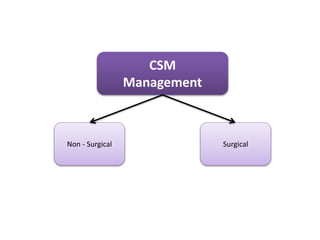
CSM
Management
Non - Surgical Surgical
Non Operative treatment
• Provides symptomatic relief in patients with
CSM
• Should avoid activities that exacerbate
symptoms
• Long term cervical immobilization with a
cervical collar or neck brace is commonly
used, but little evidence for its efficacy
• Role of Physiotherapy
Non Surgical treatment
• Drugs:
– NSAIDs
– Tricyclic antidepressants
– Muscle relaxants
– Opiods can be used for pain relief
Surgical Treatment
• Patients who are operated on early (within a
year of the onset of symptoms) have better
outcomes than those who are operated on
more than a year after the onset of symptoms
• Several studies have shown that many
patients treated surgically have good
outcomes
Ebersold M et al., J Neurosurg 1995;82(5):745-751
Predictors of Surgical outcomes
• Preoperative signal intensity change pattern of
the spinal cord on radiologic evaluations
• Age at the time of surgery
• Chronicity of the disease
Decompression by anterior or
posterior?
Surgical Treatment
• AIM: To decompress the spinal cord
– Decompression can be accomplished by removing
bone, disc, or ligamentous material that is
encroaching on the space within the spinal canal
– Adjacent vertebrae may need to be fused together
to prevent neck instability
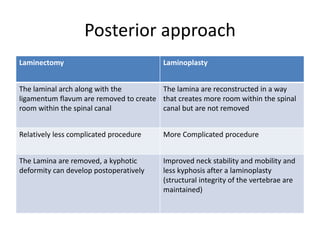
Posterior approach
Laminectomy Laminoplasty
The laminal arch along with the
ligamentum flavum are removed to create
room within the spinal canal
The lamina are reconstructed in a way
that creates more room within the spinal
canal but are not removed
Relatively less complicated procedure More Complicated procedure
The Lamina are removed, a kyphotic
deformity can develop postoperatively
Improved neck stability and mobility and
less kyphosis after a laminoplasty
(structural integrity of the vertebrae are
maintained)
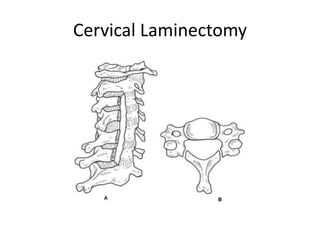
Cervical Laminectomy
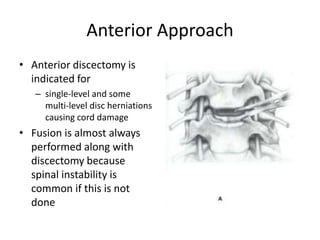
Anterior Approach
• Anterior discectomy is
indicated for
– single-level and some
multi-level disc herniations
causing cord damage
• Fusion is almost always
performed along with
discectomy because
spinal instability is
common if this is not
done
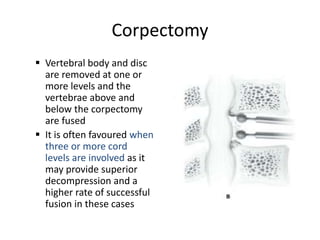
Corpectomy
 Vertebral body and disc
are removed at one or
more levels and the
vertebrae above and
below the corpectomy
are fused
 It is often favoured when
three or more cord
levels are involved as it
may provide superior
decompression and a
higher rate of successful
fusion in these cases
Posterior approach
Favored in cases in which compression is
mainly posterior, for example by
Posterior osteophytes
Thickened ligamentum flavum.
Anterior Approach
Preferred in patients with predominately
anterior compression from
Disc material
Anterior osteophytes, or a
Thick or ossified Posterior longitudinal
ligament
Either approach can create space within the
spinal canal regardless of the anatomical
location of compression
• When not to operate?
• Emerging treatment?
• If cervical collar how long?
• Role of repeat MRI
• Post traumatic old CSM treatment either
conservative or surgery?
• If multilevel lesion ?? How extensive the
surgery can be done?

Cervical Compressive Myelopathy

  • 1.
  • 2.
    Introduction • Cervical myelopathy occurswhen there is clinically symptomatic dysfunction of the cervical spinal cord • Cervical spondylosis is the most common cause of cervical spinal cord dysfunction in individuals older than 55 years
  • 3.
    EXTRADURAL INTRADURAL INTRAMEDULLARY CervicalSpondylosis Disc prolapse Trauma Tumor-Metastasis,multiple myeloma CVJ anomalies Fluorosis TB spine Epidural abscess Epidural haematoma Tumor-NF,meningioma, lipoma,sarcoma metastasis Arachonoiditis Sarcoidosis Cervical menigitis AVM Leukemic infiltration Arachonoid cyst Syrinx Tumor – ependymoma astrocytoma Haemagioblastoma Haematomyelia COMPRESSIVE MYELOPATHY – CAUSES (mode compression based)
  • 4.
    • One ofthe most common causes of cervical myelopathy is Extradural compression of the cord, which can occur as a result of # Spinal trauma # Mass lesions # Degenerative changes of the Spine, or other factors • When cord compression is caused by degenerative changes it is cervical spondylotic myelopathy (CSM), which will be the focus
  • 5.
    How spondylosis leadto cord compression?
  • 6.
    Static-mechanical cord compression Dynamic- mechanical cord compression Impairingthe circulation within the cord SPONDYLOSIS CAUSING CORD COMPRESSION
  • 7.
    Spondylosis may leadto cord damage in three ways 1. Static-mechanical compression of the cord by # Osteophytes # Spinal ligaments # Disc material which encroach upon the canal space resulting in stenosis of the canal Those with a congenitally narrowed spinal canal (10-13 mm) are especially vulnerable to static-mechanical compression
  • 8.
    2. Dynamic-mechanical cord compression Neckflexion Reduces the AP diameter of the spinal canal by 2-3 mm AP compression by osteophytes Neck extension Ligamentum flavum to pinch the cord against anterior osteophytes Lateral neck movements Nerve root compression Radicular symptoms NECK MOVEMENTS
  • 9.
    3.Impairing the circulationwithin the cord • Osteophytes can compress – the Anterior Spinal Artery or – a critical medullary feeder, or – can compress venous drainage leading to a neuroischemic myelopathy usually affecting the anterior cord
  • 10.
    Clinical presentation • Brachialgia- Deep aching or burning around the upper extremities and will commonly have neck pain, stiffness, and crepitus with movements early in the course of their disease
  • 11.
    Clinical presentation • Mostcommonly Sensory symptoms including – Upper extremity numbness – Pain, and paresthesias initially, followed by lower extremity sensory changes • Motor dysfunction may be unilateral or bilateral depending on the extent and location of cord damage
  • 12.
    Role Of RadiologicalInvestigations • The correlation between radiographic evidence of spondylotic cord damage and clinically significant CSM is not perfect
  • 13.
    Plain Xray • Maybe useful in an initial evaluation for visualizing the – Extent of cervical spondylotic changes including disc space narrowing – Osteophytosis – Kyphosis – Joint subluxation – Stenosis of the spinal canal
  • 14.
    CT Spine • ACT scan is helpful in assessing – Canal stenosis – May show osteophytes better than plain radiography – Good at defining the neural foramina – Useful in diagnosing Ossification of PLL
  • 15.
    MRI C SPINE •MRI remains the imaging modality of choice for CSM • MRI allows for – clear visualization of cord impingement or compression – to accurately measure space within the spinal canal • Signal intensity may be increased at the level of cord damage, particularly on T2-weighted images, due to Inflammation , edema, ischemia, gliosis, or myelomalacia
  • 16.
    MRI C SPINE •Signal changes have been shown to be a fairly reliable indicator of irreversible cord damage • Diffusion-weighted MR imaging, in particular a technique known as diffusion tensor imaging(DTI), may enhance sensitivity for detecting CSM. • DTI can be able to detect significant cord damage before the appearance of symptoms it is currently being evaluated for its potential prognostic value • MRI can be used to evaluate for non-spondylotic causes of myelopathy both intrinsic and extrinsic to the cord.
  • 17.
    Can MRI PredictThe Prognosis Of CSM? • The low-signal intensity changes on T1- weighted sequences indicated a poor prognosis Morio et al., 2001, Correlation Between Operative Outcomes of Cervical Compression Myelopathy and MRI of the Spinal Cord
  • 18.
    Other Tests • Electromyography,nerve conduction studies, and motor and somatosensory evoked potentials have a role in some cases in differentiating CSM and nerve root compression from peripheral neuropathies and myopathies. • Conduction studies usually normal in CSM usually slowed in peripheral neuropathies.
  • 19.
  • 20.
    Non Operative treatment •Provides symptomatic relief in patients with CSM • Should avoid activities that exacerbate symptoms • Long term cervical immobilization with a cervical collar or neck brace is commonly used, but little evidence for its efficacy • Role of Physiotherapy
  • 21.
    Non Surgical treatment •Drugs: – NSAIDs – Tricyclic antidepressants – Muscle relaxants – Opiods can be used for pain relief
  • 22.
    Surgical Treatment • Patientswho are operated on early (within a year of the onset of symptoms) have better outcomes than those who are operated on more than a year after the onset of symptoms • Several studies have shown that many patients treated surgically have good outcomes Ebersold M et al., J Neurosurg 1995;82(5):745-751
  • 23.
    Predictors of Surgicaloutcomes • Preoperative signal intensity change pattern of the spinal cord on radiologic evaluations • Age at the time of surgery • Chronicity of the disease
  • 24.
  • 25.
    Surgical Treatment • AIM:To decompress the spinal cord – Decompression can be accomplished by removing bone, disc, or ligamentous material that is encroaching on the space within the spinal canal – Adjacent vertebrae may need to be fused together to prevent neck instability
  • 26.
    Posterior approach Laminectomy Laminoplasty Thelaminal arch along with the ligamentum flavum are removed to create room within the spinal canal The lamina are reconstructed in a way that creates more room within the spinal canal but are not removed Relatively less complicated procedure More Complicated procedure The Lamina are removed, a kyphotic deformity can develop postoperatively Improved neck stability and mobility and less kyphosis after a laminoplasty (structural integrity of the vertebrae are maintained)
  • 27.
  • 28.
    Anterior Approach • Anteriordiscectomy is indicated for – single-level and some multi-level disc herniations causing cord damage • Fusion is almost always performed along with discectomy because spinal instability is common if this is not done
  • 29.
    Corpectomy  Vertebral bodyand disc are removed at one or more levels and the vertebrae above and below the corpectomy are fused  It is often favoured when three or more cord levels are involved as it may provide superior decompression and a higher rate of successful fusion in these cases
  • 30.
    Posterior approach Favored incases in which compression is mainly posterior, for example by Posterior osteophytes Thickened ligamentum flavum.
  • 31.
    Anterior Approach Preferred inpatients with predominately anterior compression from Disc material Anterior osteophytes, or a Thick or ossified Posterior longitudinal ligament Either approach can create space within the spinal canal regardless of the anatomical location of compression
  • 33.
    • When notto operate? • Emerging treatment? • If cervical collar how long? • Role of repeat MRI • Post traumatic old CSM treatment either conservative or surgery? • If multilevel lesion ?? How extensive the surgery can be done?