

Cerebral Edema A Review and Management PJ Papadakos MD FCCP FCCM Professor Anesthesiology, Surgery and Neurosurgery Director Critical Care Medicine University of Rochester
HOW DO PATIENTS PRESENT ? Obvious--motor vehicle accident, car vs pedestrian, fall from height, etc Less obvious--sports injuries (football), delayed deterioration (epidural) Hidden--shaken baby syndrome, older child maltreatment Post Surgical  Post Cardiac Arrest, Hypoxic Injury Electrolyte  Imbalance
CAVEATS IN BRAIN INJURY Neurologic examination - the most important information you have Accurate history is often unavailable or inaccurate Potential for associated injuries or illness (cardiovascular, respiratory,  cervical spine)
CEREBRAL RESUSCITATION Primary survey - airway, breathing, and circulation Neurologic evaluation Secondary survey - “head to toe” Neuroradiologic evaluation Ongoing evaluation and transport
MECHANISMS OF INJURY-PRIMARY Impact: epidural, subdural, contusion, intracerebral hemorrhage, skull fractures Inertial: concussion, diffuse axonal injury Hypoxic\ Ischemic
MECHANISMS OF 2 nd  INJURY Global Hypoxia and ischemia of brain  Decreased cerebral blood flow due to increased intracranial pressure Local  impairment of cerebral blood flow or extra cellular milieu due to the presence of injured brain
PATHOPHYSIOLOGY Primary damage – the only treatment is by  prevention . Secondary damage – multifactorial and time dependent.
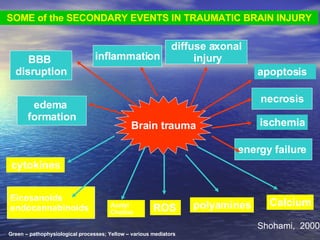
Brain trauma BBB  disruption diffuse axonal injury edema  formation Eicosanoids endocannabinoids necrosis energy failure cytokines SOME of the SECONDARY EVENTS IN TRAUMATIC BRAIN INJURY apoptosis inflammation ROS polyamines Calcium Acetyl Choline ischemia Shohami,  2000 Green – pathophysiological processes; Yellow – various mediators
Time is Important
Hours Dynamic Changes Following Stroke/Trauma Days  Weeks / Months Weeks/Months Ca   ,   Na + Glut, ROS  8 hrs 7 Necrosis  Apoptosis Repair Remodeling Plasticity Functional Recovery I N J U R Y 14 2 Inflammation Barone &Feuerstein  JCBF, 1999
Pathophysiology
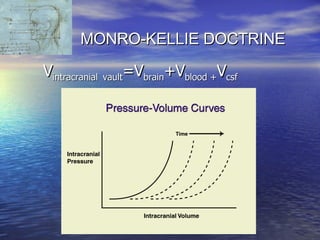
MONRO-KELLIE DOCTRINE V intracranial   vault =V brain +V blood + V csf
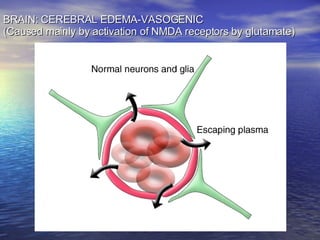
BRAIN: CEREBRAL EDEMA-VASOGENIC (Caused mainly by activation of NMDA receptors by glutamate)
BRAIN: CEREBRAL EDEMA-CYTOTOXIC   (Caused mainly by activation of cytokines, ROS and other  pro-inflammatory mediators)
The brain has the ability to control its blood supply to match its metabolic requirements Chemical or metabolic byproducts of cerebral metabolism can alter blood vessel caliber and behavior BLOOD: CEREBRAL BLOOD FLOW
BLOOD: CEREBRAL BLOOD FLOW (VOLUME) Increases in cerebral metabolic rate Hyperthermia  Seizures Pain, anxiety
CSF: CEREBROSPINAL FLUID 10% of intracranial volume Initial displacement of CSF from ventricles Ventriculostomy to drain CSF
Intracranial Compliance Calvarium is composed of three fluid compartments: Cerebral Blood Volume, CSF, and cerebral parenchyma
 
GUIDELINES – GENERAL ASPECTS   Standards:  accepted principles of patient management that reflect a high degree of clinical certainty Guidelines:   strategies that reflect moderate clinical certainty Options:   unclear clinical certainty
Prehospital
PREHOSPITAL AIRWAY MANAGEMENT   Hypoxia must be avoided, and correct  immediately  . 13%-27%   O 2   Supplemental oxygen should be administered No advantage of ETI (ET intubation) Vs. BVM (Bag / valve / mask) ventilation for the  pre-hospital  airway in pediatric TBI 420 TBI; 115 BVM; 177 ETI  no change ( Gausche, JAMA 2000 ) TBI + ETI    ETCO 2
RESUSCITATION OF BP AND O 2  AND PREHOSPITAL BRAIN-SPECIFIC TX’S FOR SPTBI PATIENTS Hypotension should be identified and corrected as rapidly as possible with fluid resuscitation. (G) Hypotension on arrival to ER  (Pigula, J Ped Surg 1993)  18% ER: mortality 61% Vs. 22%,  ↓ BP+ ↓ O 2  – mortality    85% ! Levine  (Neurosurg 1992) : TBI 0-4y  ↓ BP – 32% poor outcome. Laurssen  (J Neurosurg 1988) : ↑ BP   ↓ EX; White  (CCM 2001) : syst BP > 135    X19 in survival !
PREHOSPITAL TREATMENTS No evidence of efficacy: sedation, NMB, Mannitol, saline 3%, hyperventilation. The prophylactic administration of mannitol is not recommended. Mannitol may be considered for use in euvolemic patients who show signs of cerebral herniation or acute neurological deterioration.
PREHOSPITAL TREATMENTS Mild prophylactic hyperventilation  is not recommended . Hyperventilation may be considered in patients who show signs of  Imminent cerebral herniation or  acute neurological deterioration After correcting hypotension or hypoxemia
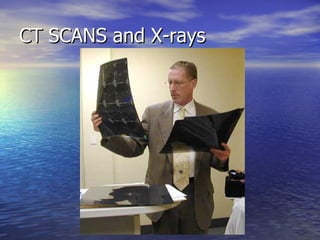
CT SCANS and X-rays
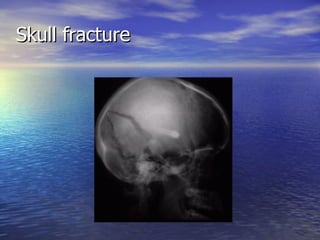
Skull fracture
 
Intracranial Hemorrhage
 
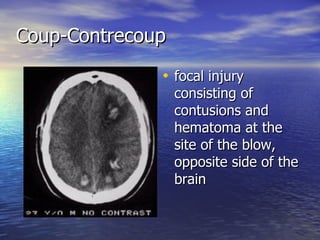
Coup-Contrecoup focal injury consisting of contusions and hematoma at the site of the blow, opposite side of the brain
 
Reversible high T2 signal abnormalities in pre-eclampsia
Monitoring
INDICATIONS FOR ICP MONITORING IN PATIENTS WITH SEVERE TBI ↑ ICP  ≡ ↓ Outcome; Aggressive Tx  ≡ ↑ Outcome Intra-cranial pressure monitoring (ICP) is appropriate in all patients with severe traumatic brain injury (TBI) (Glasgow Coma [GCS] score  ≤ 8)  The presence of open fontanels and/or sutures in an infant with severe TBI does not preclude the development of intracranial hypertension or negate the utility of ICP monitoring.
INTRACRANIAL PRESSURE MONITORING STBI (GCS ≤ 8) + Abnormal CT  ≡  53-63%  ↑ ICP (adult data). Intra-cranial pressure monitoring is not routinely indicated in infants and children with mild or moderate head injury. However, a physician may choose to monitor ICP in certain conscious patients with  traumatic mass lesions or  serial neurological examination is precluded by sedation, neuromuscular blockade, or anesthesia.
THRESHOLD FOR TREATMENT OF INTRA-CRANIAL HYPERTENSION   ICP>20-40mmHg  ≡  Mort. 28%; ICP>40mmHg  ≡  100% Treatment for intracranial hypertension, defined as a pathologic elevation in intracranial pressure (ICP), should begin at an ICP  ≥ 20 mm Hg. (O) Patients may herniate at ICP < 20-25mmHg. Is there a lower ICP threshold for younger children ? Interpretation and treatment of  ↑ ICP based on any ICP threshold should be corroborated by frequent clinical examination monitoring of physiologic variables (CPP, Compliance) cranial imaging.
INTRACRANIAL PRESSURE MONITORING TECHNOLOGY ICP monitoring: a ventricular catheter; external strain gauge transducer (??); catheter tip pressure transducer device    All accurate & reliable (O) Ventricular cath. device most accurate, reliable, low cost +  enables therapeutic (CSF) drainage . No report of meningitis    ICP monitoring.  Jensen: 7% +tip; positive > 7.5 days
CEREBRAL PERFUSION PRESSURE (CPP) A cerebral perfusion pressure (CPP) >40 mm Hg
THE ROLE OF CSF DRAINAGE   Cerebrospinal fluid (CSF) drainage can be considered as an option in the management of elevated ICP Drainage: Ventriculostomy  ±  Lumber puncture.
Mannitol ( 2 X Class III ) Vs. Hypertonic Saline ( 3 X Class II; 1 X Class III ).  Mannitol is effective. Euvolemia + Folly catheter Accepted osmolarity: Mannitol < 320mOsm/L; Hyper NS < 360mOsm/L Mannitol    blood viscosity      arteriolar diameter  and    osmotic effect. Hyper NS    Osmolar grad; membrane pot.; cellular volume;   ANP;   Inflammation;   C.O.  USE OF HYPEROSMOLAR THERAPY
HYPEROSMOLAR THERAPY Hypertonic saline is effective for control of increased ICP after severe head injury Effective doses: cont. infusion of 3% saline 0.1 - 1.0 ml/kg/h, a sliding scale. Goal minimum dose maintain ICP <20 mmHg. Mannitol bolus dose: 0.25g/Kg – 1g/Kg.
USE OF HYPERVENTILATION in the ACUTE MANAGEMENT  Mild or prophylactic hyperventilation (paco 2  <35 mm hg)  should be avoided . Mild hyperventilation (paco 2  30-35 mm hg) may be considered for longer periods for intra-cranial hypertension refractory to Sedation and analgesia Neuromuscular blockade Cerebrospinal fluid drainage hyperosmolar therapy
HYPERVENTILATION Aggressive hyperventilation (Paco 2  < 30 mm Hg) may be considered as a second tier option in the setting of refractory hypertension (O). Cerebral blood flow (CBF), jugular venous oxygen saturation, or brain tissue oxygen monitoring is suggested to help identify cerebral ischemia in this setting. Aggressive hyperventilation therapy titrated to clinical effect may be necessary for BRIEF PERIODS in cases of cerebral herniation or acute neurologic deterioration.
THE USE of BARBITURATES in the CONTROL of INTRA-CRANIAL HYPERTENSION  High-dose barbiturate therapy may be considered in hemodynamically stable patients with salvageable severe head injury  and  refractory intracranial hypertension. If high-dose barbiturate therapy is used, then appropriate hemodynamic monitoring (CVP, Swan-Ganz, repeated ECHOs) and cardiovascular support (Dopamine, Adrenaline) are essential.
THE USE of BARBITURATES in the CONTROL of INTRA-CRANIAL HYPERTENSION  Gold standard – continuous EEG to achieve a state of burst suppression.  Serum barbiturate levels are NOT GOOD for monitoring that therapy.  Prophylactic therapy is not recommended (side effects).
THE ROLE OF TEMPERATURE CONTROL  Extrapolated from the adult data, hyperthermia should be avoided in children with severe traumatic brain injury (TBI) (O). Despite the lack of clinical data in children, hypothermia may be considered in the setting of refractory intracranial hypertension
Calcium Channel Blockers
Ca2+  inf lux Voltag e- Operated Ca2+ specific Receptor- O perated  Ca2+ / Cation Ligand-Operated  Ca2+/Cation  Plasma membrane channels Ca2+ Mitochondrial  Ca Uptake Sarco-/Endo-plasmic reticulum Ca Uptake Ca/Mg pump Na-Ca exchg.
Calcium Channel blockers  May be membrane protective Affect Vasospasm
Coronary/Cerebral Steal The detrimental redistribution of blood flow in patients with atherosclerotic disease from underperfused areas toward better perfused areas Before Vasodilator Stenosis After Vasodilator
Surgical Decompression
 
DECOMPRESSIVE CRANIECTOMY Decompressive craniectomy appears to be  less effective  in patients who have experienced extensive secondary brain insults Patients who experience Secondary deterioration on the Glasgow coma scale (GCS) and/or evolving cerebral herniation syndrome within the first 48 hrs after injury may represent a  favorable group Unimproved GCS of 3 may represent an  unfavorable group
THE USE OF CORTICOSTEROIDS IN THE TREATMENT TBI With the lack of sufficient evidence for beneficial effect and the potential for increased complications and suppression of adrenal production of cortisol, the routine  use of steroids is not recommended  for patients following severe traumatic brain injury.
NUTRITIONAL SUPPORT Replace 130-160% of resting metabolism expenditure after TBI in patients. Weight-specific resting metabolic expenditure guidelines can be found in Talbot's tables. Based on the adult guidelines, nutritional support should begin by 72 hrs  with full replacement by 7 days.
THE ROLE of ANTI-SEIZURE PROPHYLAXIS FOLLOWING STBI Prophylactic anti-seizure therapy may be considered as a treatment option to   prevent increased oxygen utilization
Thank You

Cerebral Edema

  • 1.
    Cerebral Edema AReview and Management PJ Papadakos MD FCCP FCCM Professor Anesthesiology, Surgery and Neurosurgery Director Critical Care Medicine University of Rochester
  • 2.
    HOW DO PATIENTSPRESENT ? Obvious--motor vehicle accident, car vs pedestrian, fall from height, etc Less obvious--sports injuries (football), delayed deterioration (epidural) Hidden--shaken baby syndrome, older child maltreatment Post Surgical Post Cardiac Arrest, Hypoxic Injury Electrolyte Imbalance
  • 3.
    CAVEATS IN BRAININJURY Neurologic examination - the most important information you have Accurate history is often unavailable or inaccurate Potential for associated injuries or illness (cardiovascular, respiratory, cervical spine)
  • 4.
    CEREBRAL RESUSCITATION Primarysurvey - airway, breathing, and circulation Neurologic evaluation Secondary survey - “head to toe” Neuroradiologic evaluation Ongoing evaluation and transport
  • 5.
    MECHANISMS OF INJURY-PRIMARYImpact: epidural, subdural, contusion, intracerebral hemorrhage, skull fractures Inertial: concussion, diffuse axonal injury Hypoxic\ Ischemic
  • 6.
    MECHANISMS OF 2nd INJURY Global Hypoxia and ischemia of brain Decreased cerebral blood flow due to increased intracranial pressure Local impairment of cerebral blood flow or extra cellular milieu due to the presence of injured brain
  • 7.
    PATHOPHYSIOLOGY Primary damage– the only treatment is by prevention . Secondary damage – multifactorial and time dependent.
  • 8.
    Brain trauma BBB disruption diffuse axonal injury edema formation Eicosanoids endocannabinoids necrosis energy failure cytokines SOME of the SECONDARY EVENTS IN TRAUMATIC BRAIN INJURY apoptosis inflammation ROS polyamines Calcium Acetyl Choline ischemia Shohami, 2000 Green – pathophysiological processes; Yellow – various mediators
  • 9.
  • 10.
    Hours Dynamic ChangesFollowing Stroke/Trauma Days Weeks / Months Weeks/Months Ca , Na + Glut, ROS 8 hrs 7 Necrosis Apoptosis Repair Remodeling Plasticity Functional Recovery I N J U R Y 14 2 Inflammation Barone &Feuerstein JCBF, 1999
  • 11.
  • 12.
    MONRO-KELLIE DOCTRINE Vintracranial vault =V brain +V blood + V csf
  • 13.
    BRAIN: CEREBRAL EDEMA-VASOGENIC(Caused mainly by activation of NMDA receptors by glutamate)
  • 14.
    BRAIN: CEREBRAL EDEMA-CYTOTOXIC (Caused mainly by activation of cytokines, ROS and other pro-inflammatory mediators)
  • 15.
    The brain hasthe ability to control its blood supply to match its metabolic requirements Chemical or metabolic byproducts of cerebral metabolism can alter blood vessel caliber and behavior BLOOD: CEREBRAL BLOOD FLOW
  • 16.
    BLOOD: CEREBRAL BLOODFLOW (VOLUME) Increases in cerebral metabolic rate Hyperthermia Seizures Pain, anxiety
  • 17.
    CSF: CEREBROSPINAL FLUID10% of intracranial volume Initial displacement of CSF from ventricles Ventriculostomy to drain CSF
  • 18.
    Intracranial Compliance Calvariumis composed of three fluid compartments: Cerebral Blood Volume, CSF, and cerebral parenchyma
  • 19.
  • 20.
    GUIDELINES – GENERALASPECTS Standards: accepted principles of patient management that reflect a high degree of clinical certainty Guidelines: strategies that reflect moderate clinical certainty Options: unclear clinical certainty
  • 21.
  • 22.
    PREHOSPITAL AIRWAY MANAGEMENT Hypoxia must be avoided, and correct immediately . 13%-27%  O 2 Supplemental oxygen should be administered No advantage of ETI (ET intubation) Vs. BVM (Bag / valve / mask) ventilation for the pre-hospital airway in pediatric TBI 420 TBI; 115 BVM; 177 ETI  no change ( Gausche, JAMA 2000 ) TBI + ETI  ETCO 2
  • 23.
    RESUSCITATION OF BPAND O 2 AND PREHOSPITAL BRAIN-SPECIFIC TX’S FOR SPTBI PATIENTS Hypotension should be identified and corrected as rapidly as possible with fluid resuscitation. (G) Hypotension on arrival to ER (Pigula, J Ped Surg 1993) 18% ER: mortality 61% Vs. 22%, ↓ BP+ ↓ O 2 – mortality  85% ! Levine (Neurosurg 1992) : TBI 0-4y ↓ BP – 32% poor outcome. Laurssen (J Neurosurg 1988) : ↑ BP  ↓ EX; White (CCM 2001) : syst BP > 135  X19 in survival !
  • 24.
    PREHOSPITAL TREATMENTS Noevidence of efficacy: sedation, NMB, Mannitol, saline 3%, hyperventilation. The prophylactic administration of mannitol is not recommended. Mannitol may be considered for use in euvolemic patients who show signs of cerebral herniation or acute neurological deterioration.
  • 25.
    PREHOSPITAL TREATMENTS Mildprophylactic hyperventilation is not recommended . Hyperventilation may be considered in patients who show signs of Imminent cerebral herniation or acute neurological deterioration After correcting hypotension or hypoxemia
  • 26.
  • 27.
  • 28.
  • 29.
  • 30.
  • 31.
    Coup-Contrecoup focal injuryconsisting of contusions and hematoma at the site of the blow, opposite side of the brain
  • 32.
  • 33.
    Reversible high T2signal abnormalities in pre-eclampsia
  • 34.
  • 35.
    INDICATIONS FOR ICPMONITORING IN PATIENTS WITH SEVERE TBI ↑ ICP ≡ ↓ Outcome; Aggressive Tx ≡ ↑ Outcome Intra-cranial pressure monitoring (ICP) is appropriate in all patients with severe traumatic brain injury (TBI) (Glasgow Coma [GCS] score ≤ 8) The presence of open fontanels and/or sutures in an infant with severe TBI does not preclude the development of intracranial hypertension or negate the utility of ICP monitoring.
  • 36.
    INTRACRANIAL PRESSURE MONITORINGSTBI (GCS ≤ 8) + Abnormal CT ≡ 53-63% ↑ ICP (adult data). Intra-cranial pressure monitoring is not routinely indicated in infants and children with mild or moderate head injury. However, a physician may choose to monitor ICP in certain conscious patients with traumatic mass lesions or serial neurological examination is precluded by sedation, neuromuscular blockade, or anesthesia.
  • 37.
    THRESHOLD FOR TREATMENTOF INTRA-CRANIAL HYPERTENSION ICP>20-40mmHg ≡ Mort. 28%; ICP>40mmHg ≡ 100% Treatment for intracranial hypertension, defined as a pathologic elevation in intracranial pressure (ICP), should begin at an ICP ≥ 20 mm Hg. (O) Patients may herniate at ICP < 20-25mmHg. Is there a lower ICP threshold for younger children ? Interpretation and treatment of ↑ ICP based on any ICP threshold should be corroborated by frequent clinical examination monitoring of physiologic variables (CPP, Compliance) cranial imaging.
  • 38.
    INTRACRANIAL PRESSURE MONITORINGTECHNOLOGY ICP monitoring: a ventricular catheter; external strain gauge transducer (??); catheter tip pressure transducer device  All accurate & reliable (O) Ventricular cath. device most accurate, reliable, low cost + enables therapeutic (CSF) drainage . No report of meningitis  ICP monitoring. Jensen: 7% +tip; positive > 7.5 days
  • 39.
    CEREBRAL PERFUSION PRESSURE(CPP) A cerebral perfusion pressure (CPP) >40 mm Hg
  • 40.
    THE ROLE OFCSF DRAINAGE Cerebrospinal fluid (CSF) drainage can be considered as an option in the management of elevated ICP Drainage: Ventriculostomy ± Lumber puncture.
  • 41.
    Mannitol ( 2X Class III ) Vs. Hypertonic Saline ( 3 X Class II; 1 X Class III ). Mannitol is effective. Euvolemia + Folly catheter Accepted osmolarity: Mannitol < 320mOsm/L; Hyper NS < 360mOsm/L Mannitol   blood viscosity   arteriolar diameter and  osmotic effect. Hyper NS  Osmolar grad; membrane pot.; cellular volume;  ANP;  Inflammation;  C.O. USE OF HYPEROSMOLAR THERAPY
  • 42.
    HYPEROSMOLAR THERAPY Hypertonicsaline is effective for control of increased ICP after severe head injury Effective doses: cont. infusion of 3% saline 0.1 - 1.0 ml/kg/h, a sliding scale. Goal minimum dose maintain ICP <20 mmHg. Mannitol bolus dose: 0.25g/Kg – 1g/Kg.
  • 43.
    USE OF HYPERVENTILATIONin the ACUTE MANAGEMENT Mild or prophylactic hyperventilation (paco 2 <35 mm hg) should be avoided . Mild hyperventilation (paco 2 30-35 mm hg) may be considered for longer periods for intra-cranial hypertension refractory to Sedation and analgesia Neuromuscular blockade Cerebrospinal fluid drainage hyperosmolar therapy
  • 44.
    HYPERVENTILATION Aggressive hyperventilation(Paco 2 < 30 mm Hg) may be considered as a second tier option in the setting of refractory hypertension (O). Cerebral blood flow (CBF), jugular venous oxygen saturation, or brain tissue oxygen monitoring is suggested to help identify cerebral ischemia in this setting. Aggressive hyperventilation therapy titrated to clinical effect may be necessary for BRIEF PERIODS in cases of cerebral herniation or acute neurologic deterioration.
  • 45.
    THE USE ofBARBITURATES in the CONTROL of INTRA-CRANIAL HYPERTENSION High-dose barbiturate therapy may be considered in hemodynamically stable patients with salvageable severe head injury and refractory intracranial hypertension. If high-dose barbiturate therapy is used, then appropriate hemodynamic monitoring (CVP, Swan-Ganz, repeated ECHOs) and cardiovascular support (Dopamine, Adrenaline) are essential.
  • 46.
    THE USE ofBARBITURATES in the CONTROL of INTRA-CRANIAL HYPERTENSION Gold standard – continuous EEG to achieve a state of burst suppression. Serum barbiturate levels are NOT GOOD for monitoring that therapy. Prophylactic therapy is not recommended (side effects).
  • 47.
    THE ROLE OFTEMPERATURE CONTROL Extrapolated from the adult data, hyperthermia should be avoided in children with severe traumatic brain injury (TBI) (O). Despite the lack of clinical data in children, hypothermia may be considered in the setting of refractory intracranial hypertension
  • 48.
  • 49.
    Ca2+ influx Voltag e- Operated Ca2+ specific Receptor- O perated Ca2+ / Cation Ligand-Operated Ca2+/Cation Plasma membrane channels Ca2+ Mitochondrial Ca Uptake Sarco-/Endo-plasmic reticulum Ca Uptake Ca/Mg pump Na-Ca exchg.
  • 50.
    Calcium Channel blockers May be membrane protective Affect Vasospasm
  • 51.
    Coronary/Cerebral Steal Thedetrimental redistribution of blood flow in patients with atherosclerotic disease from underperfused areas toward better perfused areas Before Vasodilator Stenosis After Vasodilator
  • 52.
  • 53.
  • 54.
    DECOMPRESSIVE CRANIECTOMY Decompressivecraniectomy appears to be less effective in patients who have experienced extensive secondary brain insults Patients who experience Secondary deterioration on the Glasgow coma scale (GCS) and/or evolving cerebral herniation syndrome within the first 48 hrs after injury may represent a favorable group Unimproved GCS of 3 may represent an unfavorable group
  • 55.
    THE USE OFCORTICOSTEROIDS IN THE TREATMENT TBI With the lack of sufficient evidence for beneficial effect and the potential for increased complications and suppression of adrenal production of cortisol, the routine use of steroids is not recommended for patients following severe traumatic brain injury.
  • 56.
    NUTRITIONAL SUPPORT Replace130-160% of resting metabolism expenditure after TBI in patients. Weight-specific resting metabolic expenditure guidelines can be found in Talbot's tables. Based on the adult guidelines, nutritional support should begin by 72 hrs with full replacement by 7 days.
  • 57.
    THE ROLE ofANTI-SEIZURE PROPHYLAXIS FOLLOWING STBI Prophylactic anti-seizure therapy may be considered as a treatment option to prevent increased oxygen utilization
  • 58.