ICP & Head Trauma
Sophia R. Smith, MD
WRAMC
November 2, 2005
Introduction
• Head injuries are one of the most common
causes of disability and death in children.
• The Centers for Disease Control and
Prevention (CDC) estimates that more
than 10,000 children become disabled
from a brain injury each year.
• Head injuries can be defined as mild as a
bump to severe in nature.
Prevalence of Pediatric Trauma
• Trauma is the leading cause of death in infants
and children
• Trauma is the cause of 50% of deaths in people
between 5 and 34 years of age
• Motor vehicle related accidents account for 50%
of pediatric trauma cases
• $16 billion is spent annually caring for injuries to
children less than 16 years of age
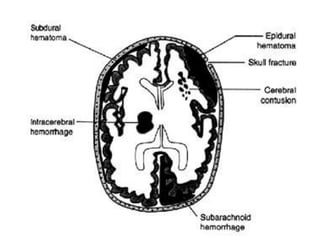
Traumatic Brain Injury
Primary Brain Injury
Results from what has
occurred to the brain
at the time of the
injury
Secondary Brain
Injury
• Physiologic and
biochemical events
which follow the
primary injury
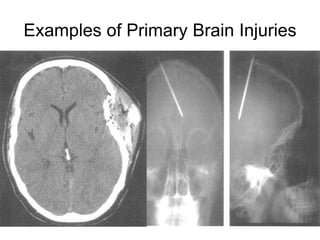
Examples of Primary Brain Injuries
Factors that Effect Secondary
Brain Injuries
• Blood Pressure
• Oxygenation
• Temperature
• Control of Blood Glucose
• Fluid Volume Status
• Increased Intracranial Pressure
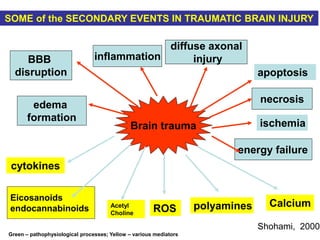
Brain trauma
BBB
disruption
diffuse axonal
injury
edema
formation
Eicosanoids
endocannabinoids
necrosis
energy failure
cytokines
SOME of the SECONDARY EVENTS IN TRAUMATIC BRAIN INJURY
apoptosis
inflammation
ROS polyamines Calcium
Acetyl
Choline
ischemia
Shohami, 2000
Green – pathophysiological processes; Yellow – various mediators
Anatomy of the cranium
• There are various brain contents that are
localized within a rigid structure.
– Cranium
• The cranial vault contents include:
– The brain
– The cerebral spinal fluid
– The cerebral blood
Cerebral Spinal Fluid
• CSF
– 150 cc in adults at all times
•Children slightly less
– Produced by choroid plexus – 20 cc/hr
– CSF is absorbed into venous system at
the subarachnoid villi
Cerebral blood and brain
• Cerebral blood
– Sum of blood in capillaries, veins, and arteries
• Brain
– 80% of the total intracranial volume
• All of these contents are maintained @ a
balanced pressure referred to as intracranial
pressure (ICP)
Monro-Kellie Doctrine
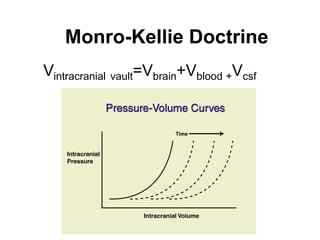
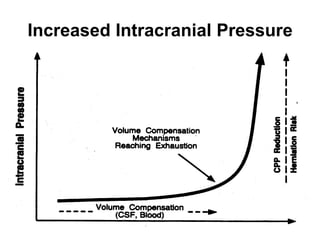
• The ICP within the skull is directly related
to the volume of the contents.
– Defined as the Monro-Kellie Doctrine
– This doctrine states that any increase in
volume of the contents within the brain must
be met with a decrease in the other cranial
contents.
Monro-Kellie Doctrine
Vintracranial vault=Vbrain+Vblood +Vcsf
Increased Intracranial Pressure
Cerebral Blood Flow
• CBF is directly linked to the metabolic
requirements of the brain.
• As the brain metabolic activity increases,
CBF increases
– Vasodilatation of cerebral vessels
– Increase in cerebral blood volume
– Consequent increase in ICP
Cerebral blood flow
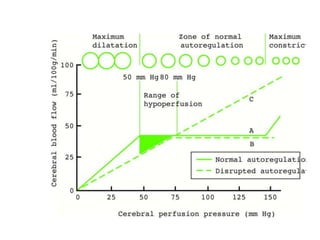
• CBF maintained when MAP range is
50mmHg to 150mmHg
– Cerebral auto regulation
•As BP increase baroreceptors sense event
and cerebral arteries vasoconstrict CBF
maintained with a CBV decrease
•As BP decrease  cerebral arteries dilate to
increase flow  CBV increase
Auto regulation
• This process is lost in pathological states
– Esp. Head trauma
– CBF decreases linearly to MAP below range
• Results is ischemia (strokes) to brain regions
– CBF increases linearly to MAP above auto
regulation range
• HTN encephalopathy as CBV and ICP increase
Mediators of CBF
• Local and global mediators of CBF and
metabolism are important.
– Hypoxia and pH are most important
– As local paO2 decreases, CBF increases
– CBF is affected by pH (and its surrogate
pCO2)
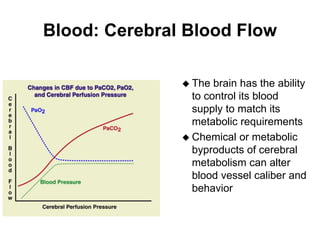
 The brain has the ability
to control its blood
supply to match its
metabolic requirements
 Chemical or metabolic
byproducts of cerebral
metabolism can alter
blood vessel caliber and
behavior
Blood: Cerebral Blood Flow
Studies of hyperventilation &
ICP
• This relationship has been well studied as
a therapeutic option in particular
intentional hyperventilation to lower
cerebral blood flow and thus intracranial
pressure.
• No longer a practice
– Modest hyperventilation
On call
• So, you are in the ER on your first
night of call and the next thing you
know you get your very first trauma
patient.
• How do you evaluate?
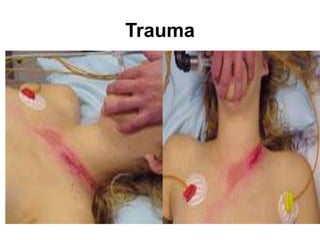
Trauma
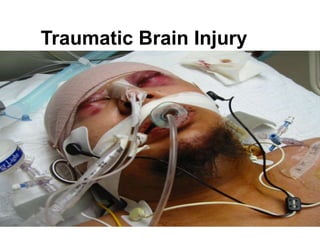
Traumatic Brain Injury
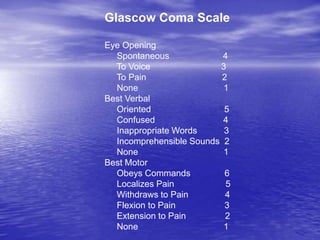
Glascow Coma Scale
Eye Opening
Spontaneous 4
To Voice 3
To Pain 2
None 1
Best Verbal
Oriented 5
Confused 4
Inappropriate Words 3
Incomprehensible Sounds 2
None 1
Best Motor
Obeys Commands 6
Localizes Pain 5
Withdraws to Pain 4
Flexion to Pain 3
Extension to Pain 2
None 1
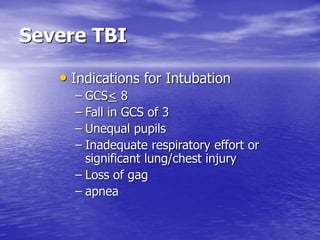
Severe TBI
• Indications for Intubation
– GCS< 8
– Fall in GCS of 3
– Unequal pupils
– Inadequate respiratory effort or
significant lung/chest injury
– Loss of gag
– apnea
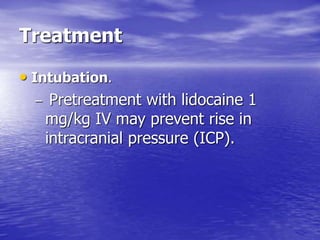
Treatment
• Intubation.
– Pretreatment with lidocaine 1
mg/kg IV may prevent rise in
intracranial pressure (ICP).
Treatment
• Hyperventilation
– to maintain PO2 >90 torrs, PCO2 30 to 32 torrs.
– Hyperventilation may actually increase
ischemia in at risk brain tissue if PCO2 <25 torr
by causing excessive vasoconstriction and has
fallen out of favor. Prophylactic hyperventilation for
those without increased ICP is contraindicated and
worsens outcomes.
• PEEP relatively contraindicated because reduces
cerebral blood flow.
Maintain normal cardiac
output.
• If hypotensive from other cause such as
multi-trauma, treat shock as usual.
• Normal saline is preferred over LR since
LR is slightly hypotonic.
• Hypertonic saline (3% or 7.5%) can be
used. Especially if you see ICP changes.
Maintain normal cardiac
output.
• If markedly hypertensive, consider
labetalol or nitroprusside.
• Avoid lowering the blood pressure unless
diastolic blood pressure is >120 mm Hg.
Diuresis
• Mannitol 1 g/kg IV over 20 minutes
induces osmotic diuresis.
– Avoid if hypotensive or have CHF/renal failure.
• Some suggest furosemide (Lasix and
others).
– Avoid if hypotensive.
ICP Precautions
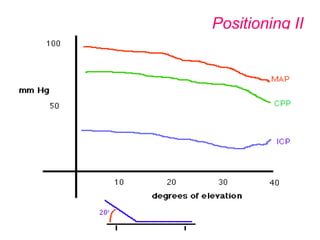
• Elevate head of bed 30 degrees.
• Seizure prophylaxis: Phenytoin will
reduce seizures in the first week after
injury but does not change the overall
outcome.
• Steroids are ineffective in controlling ICP
in the trauma setting.
Positioning II
Manipulation of CPP
• Maintain adequate intravascular volume
– CVP
• Increase MAP
– Utilize alpha agonist--dopamine,
phenylephrine, norepinephrine
• What is appropriate goal for children?
CPP = MAP - ICP
CPP for children
• Aim for a CPP of >60 mmHg
– by maintaining an adequate MAP and control
of ICP
• MAP – ICP = CPP
– Minimizing the morbidity of TBI in
children
Additional therapies
• Prevent hyperglycemia: exacerbates
ischemic cerebral damage
• Attention to electrolyte status. These
patients are prone to electrolyte
abnormalities due to osmotic diuresis,
cerebral salt losing states, SIADH and
diabetes insipidus
Manipulation of ICP
• Decrease cerebral metabolic demand
– sedation, analgesia, barbiturates
– avoid hyperthermia
– avoid seizures
• Hyperventilation
– decreases blood flow to brain
– only acutely for impending herniation
• Mannitol
Blood
Manipulation of ICP
• Mannitol
– dehydrate the brain, not the patient!
– monitor osmolality
• Hypertonic saline
• Decompressive craniectomy
Brain
ICP Monitoring
• ICU patients who have sustained head trauma,
brain hemorrhage, brain surgery, or conditions in
which the brain may swell might require
intracranial pressure monitoring.
• The purpose of ICP monitoring is to continuously
measure the pressure surrounding the brain.
Why Monitor?
• Detect “events”
• Manage intracranial pressure
• Manage cerebral perfusion pressure
How?
• Ventriculostomy
• Intraparenchymal fiberoptic catheter
• Subarachnoid monitor
• Useful adjuncts:
– Arterial line
– Central venous line
– Foley catheter
Manipulation of ICP
• External drainage
– therapeutic as well as diagnostic
– technical issues
– infectious issues
CSF
What to do with the
information...
• Goal: adequate oxygen delivery to maintain
the metabolic needs of the brain.
• Intracranial pressure <20
• Cerebral perfusion pressure >50-70 mm Hg
CPP=MAP-ICP
Indications for ICP monitoring
• Glasgow coma scale <8
• Clinical or radiographic evidence of
increased ICP
• Post-surgical removal of intracranial
hematoma
• Less severe brain injury in the setting
which requires deep sedation or
anesthesia
Other monitoring devices
• CT Scan
• MRI
• PET Scan
• Jugular Venous Oxygen Saturation
Near-infrared Spectroscopy
• Uses absorption characteristics of oxy
Hgb, deoxy Hgb, and [o] cyt aa3
• Uses the ability to penetrate the superficial
brain
• Therefore the state of oxygenation can be
determined.
• Good assessment of cerebral oxygenation
Transcranial Doppler US
• TCD is a noninvasive technique used to
determine cerebral blood velocity in large
intracranial arteries.
• Assessment of
– Brain death
– Reperfusion injury
– Identify regions S/P TBI that are adversely
effected
Cerebral Microdialysis
• Measuring the partial pressure of oxygen
of brain parenchyma and metabolites
using microdialysis
• Electrode in vulnerable brain region
measures O2 concentration
• Measures also local brain metabolism

ICP_Smith.ppt

  • 1.
    ICP & HeadTrauma Sophia R. Smith, MD WRAMC November 2, 2005
  • 2.
    Introduction • Head injuriesare one of the most common causes of disability and death in children. • The Centers for Disease Control and Prevention (CDC) estimates that more than 10,000 children become disabled from a brain injury each year. • Head injuries can be defined as mild as a bump to severe in nature.
  • 3.
    Prevalence of PediatricTrauma • Trauma is the leading cause of death in infants and children • Trauma is the cause of 50% of deaths in people between 5 and 34 years of age • Motor vehicle related accidents account for 50% of pediatric trauma cases • $16 billion is spent annually caring for injuries to children less than 16 years of age
  • 4.
    Traumatic Brain Injury PrimaryBrain Injury Results from what has occurred to the brain at the time of the injury Secondary Brain Injury • Physiologic and biochemical events which follow the primary injury
  • 6.
    Examples of PrimaryBrain Injuries
  • 7.
    Factors that EffectSecondary Brain Injuries • Blood Pressure • Oxygenation • Temperature • Control of Blood Glucose • Fluid Volume Status • Increased Intracranial Pressure
  • 8.
    Brain trauma BBB disruption diffuse axonal injury edema formation Eicosanoids endocannabinoids necrosis energyfailure cytokines SOME of the SECONDARY EVENTS IN TRAUMATIC BRAIN INJURY apoptosis inflammation ROS polyamines Calcium Acetyl Choline ischemia Shohami, 2000 Green – pathophysiological processes; Yellow – various mediators
  • 9.
    Anatomy of thecranium • There are various brain contents that are localized within a rigid structure. – Cranium • The cranial vault contents include: – The brain – The cerebral spinal fluid – The cerebral blood
  • 10.
    Cerebral Spinal Fluid •CSF – 150 cc in adults at all times •Children slightly less – Produced by choroid plexus – 20 cc/hr – CSF is absorbed into venous system at the subarachnoid villi
  • 11.
    Cerebral blood andbrain • Cerebral blood – Sum of blood in capillaries, veins, and arteries • Brain – 80% of the total intracranial volume • All of these contents are maintained @ a balanced pressure referred to as intracranial pressure (ICP)
  • 12.
    Monro-Kellie Doctrine • TheICP within the skull is directly related to the volume of the contents. – Defined as the Monro-Kellie Doctrine – This doctrine states that any increase in volume of the contents within the brain must be met with a decrease in the other cranial contents.
  • 13.
  • 14.
  • 15.
    Cerebral Blood Flow •CBF is directly linked to the metabolic requirements of the brain. • As the brain metabolic activity increases, CBF increases – Vasodilatation of cerebral vessels – Increase in cerebral blood volume – Consequent increase in ICP
  • 16.
    Cerebral blood flow •CBF maintained when MAP range is 50mmHg to 150mmHg – Cerebral auto regulation •As BP increase baroreceptors sense event and cerebral arteries vasoconstrict CBF maintained with a CBV decrease •As BP decrease  cerebral arteries dilate to increase flow  CBV increase
  • 17.
    Auto regulation • Thisprocess is lost in pathological states – Esp. Head trauma – CBF decreases linearly to MAP below range • Results is ischemia (strokes) to brain regions – CBF increases linearly to MAP above auto regulation range • HTN encephalopathy as CBV and ICP increase
  • 19.
    Mediators of CBF •Local and global mediators of CBF and metabolism are important. – Hypoxia and pH are most important – As local paO2 decreases, CBF increases – CBF is affected by pH (and its surrogate pCO2)
  • 20.
     The brainhas the ability to control its blood supply to match its metabolic requirements  Chemical or metabolic byproducts of cerebral metabolism can alter blood vessel caliber and behavior Blood: Cerebral Blood Flow
  • 21.
    Studies of hyperventilation& ICP • This relationship has been well studied as a therapeutic option in particular intentional hyperventilation to lower cerebral blood flow and thus intracranial pressure. • No longer a practice – Modest hyperventilation
  • 22.
    On call • So,you are in the ER on your first night of call and the next thing you know you get your very first trauma patient. • How do you evaluate?
  • 23.
  • 24.
  • 25.
    Glascow Coma Scale EyeOpening Spontaneous 4 To Voice 3 To Pain 2 None 1 Best Verbal Oriented 5 Confused 4 Inappropriate Words 3 Incomprehensible Sounds 2 None 1 Best Motor Obeys Commands 6 Localizes Pain 5 Withdraws to Pain 4 Flexion to Pain 3 Extension to Pain 2 None 1
  • 27.
    Severe TBI • Indicationsfor Intubation – GCS< 8 – Fall in GCS of 3 – Unequal pupils – Inadequate respiratory effort or significant lung/chest injury – Loss of gag – apnea
  • 28.
    Treatment • Intubation. – Pretreatmentwith lidocaine 1 mg/kg IV may prevent rise in intracranial pressure (ICP).
  • 29.
    Treatment • Hyperventilation – tomaintain PO2 >90 torrs, PCO2 30 to 32 torrs. – Hyperventilation may actually increase ischemia in at risk brain tissue if PCO2 <25 torr by causing excessive vasoconstriction and has fallen out of favor. Prophylactic hyperventilation for those without increased ICP is contraindicated and worsens outcomes. • PEEP relatively contraindicated because reduces cerebral blood flow.
  • 30.
    Maintain normal cardiac output. •If hypotensive from other cause such as multi-trauma, treat shock as usual. • Normal saline is preferred over LR since LR is slightly hypotonic. • Hypertonic saline (3% or 7.5%) can be used. Especially if you see ICP changes.
  • 31.
    Maintain normal cardiac output. •If markedly hypertensive, consider labetalol or nitroprusside. • Avoid lowering the blood pressure unless diastolic blood pressure is >120 mm Hg.
  • 32.
    Diuresis • Mannitol 1g/kg IV over 20 minutes induces osmotic diuresis. – Avoid if hypotensive or have CHF/renal failure. • Some suggest furosemide (Lasix and others). – Avoid if hypotensive.
  • 33.
    ICP Precautions • Elevatehead of bed 30 degrees. • Seizure prophylaxis: Phenytoin will reduce seizures in the first week after injury but does not change the overall outcome. • Steroids are ineffective in controlling ICP in the trauma setting.
  • 34.
  • 35.
    Manipulation of CPP •Maintain adequate intravascular volume – CVP • Increase MAP – Utilize alpha agonist--dopamine, phenylephrine, norepinephrine • What is appropriate goal for children? CPP = MAP - ICP
  • 36.
    CPP for children •Aim for a CPP of >60 mmHg – by maintaining an adequate MAP and control of ICP • MAP – ICP = CPP – Minimizing the morbidity of TBI in children
  • 37.
    Additional therapies • Preventhyperglycemia: exacerbates ischemic cerebral damage • Attention to electrolyte status. These patients are prone to electrolyte abnormalities due to osmotic diuresis, cerebral salt losing states, SIADH and diabetes insipidus
  • 38.
    Manipulation of ICP •Decrease cerebral metabolic demand – sedation, analgesia, barbiturates – avoid hyperthermia – avoid seizures • Hyperventilation – decreases blood flow to brain – only acutely for impending herniation • Mannitol Blood
  • 39.
    Manipulation of ICP •Mannitol – dehydrate the brain, not the patient! – monitor osmolality • Hypertonic saline • Decompressive craniectomy Brain
  • 40.
    ICP Monitoring • ICUpatients who have sustained head trauma, brain hemorrhage, brain surgery, or conditions in which the brain may swell might require intracranial pressure monitoring. • The purpose of ICP monitoring is to continuously measure the pressure surrounding the brain.
  • 41.
    Why Monitor? • Detect“events” • Manage intracranial pressure • Manage cerebral perfusion pressure
  • 42.
    How? • Ventriculostomy • Intraparenchymalfiberoptic catheter • Subarachnoid monitor • Useful adjuncts: – Arterial line – Central venous line – Foley catheter
  • 43.
    Manipulation of ICP •External drainage – therapeutic as well as diagnostic – technical issues – infectious issues CSF
  • 44.
    What to dowith the information... • Goal: adequate oxygen delivery to maintain the metabolic needs of the brain. • Intracranial pressure <20 • Cerebral perfusion pressure >50-70 mm Hg CPP=MAP-ICP
  • 45.
    Indications for ICPmonitoring • Glasgow coma scale <8 • Clinical or radiographic evidence of increased ICP • Post-surgical removal of intracranial hematoma • Less severe brain injury in the setting which requires deep sedation or anesthesia
  • 46.
    Other monitoring devices •CT Scan • MRI • PET Scan • Jugular Venous Oxygen Saturation
  • 47.
    Near-infrared Spectroscopy • Usesabsorption characteristics of oxy Hgb, deoxy Hgb, and [o] cyt aa3 • Uses the ability to penetrate the superficial brain • Therefore the state of oxygenation can be determined. • Good assessment of cerebral oxygenation
  • 48.
    Transcranial Doppler US •TCD is a noninvasive technique used to determine cerebral blood velocity in large intracranial arteries. • Assessment of – Brain death – Reperfusion injury – Identify regions S/P TBI that are adversely effected
  • 49.
    Cerebral Microdialysis • Measuringthe partial pressure of oxygen of brain parenchyma and metabolites using microdialysis • Electrode in vulnerable brain region measures O2 concentration • Measures also local brain metabolism