Clipology
Gopal Sedain
Assistant Professor
Department Of Neurosurgery
Institute Of Medicine
Background
 Uses: to stop blood flow to the aneurysm
 Mechanism: crushes the endothelium leading to secondary thrombosis of the
aneurysm
Ideal clip
1. Clamping pressure sufficient to isolate the aneurysm but not so high as to damage the
blood vessel
2. Clamping pressure constant over time to prevent displacement/slipping
3. As small as possible
4. The material nonmagnetic & low density to prevent interference with MRI/ CT
5. Should not obstruct the surgeon's view during implantation
6. Surface smooth and absent jagged edges
7. Surface free from cracks which trap foreign matter & contamination
8. Proper jaw alignment should be maintained at all times to prevent shearing of the
vascular tissue between the jaws.
Types
 Temporary
 Permanent
 Standard, mini, and extra-long sizes
 Straight,
 curved forward, backward and sideward,
 bent forward, backward and sideward, and
 bayoneted.
Evolution
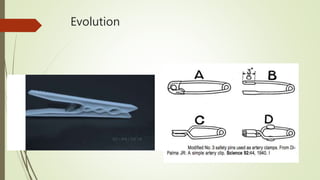
 Cushing's malleable silver clips
 Olivecrona: added winged flanges so that it could be removed if suboptimal
 Dandy (1937) V-shaped malleable silver clip to the neck of an internal carotid artery
(ICA) aneurysm
 Dandy WE: Intracranial aneurysm of internal carotid artery cured by operation. Ann Surg 107:654, 1938
 Mayfield(1952) repositionable spring loaded clips
Evolution
Evolution
 There are four major clip designs that are currently available in the market
 McFadden Vari-Angle
 Sundt Slim-Line
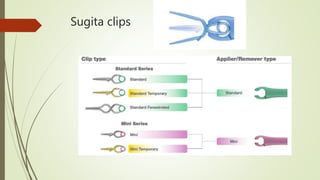
 Sugita
 Yasargil
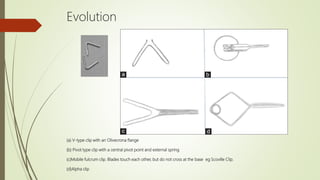
 The mechanism of clip opening and closure is the basis for dividing clips into
 U/V type
 pivot
 mobile fulcrum and
 alpha types
Evolution
(a) V-type clip with an Olivecrona flange
(b) Pivot type clip with a central pivot point and external spring
(c)Mobile fulcrum clip. Blades touch each other, but do not cross at the base eg Scoville Clip.
(d)Alpha clip
Evolution
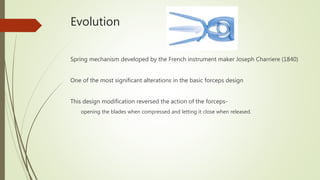
Spring mechanism developed by the French instrument maker Joseph Charriere (1840)
One of the most significant alterations in the basic forceps design
This design modification reversed the action of the forceps-
opening the blades when compressed and letting it close when released.
Evolution
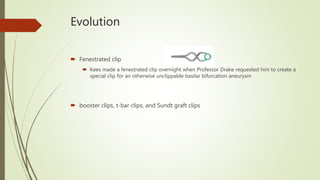
 Fenestrated clip
 Kees made a fenestrated clip overnight when Professor Drake requested him to create a
special clip for an otherwise unclippable basilar bifurcation aneurysm
 booster clips, t-bar clips, and Sundt graft clips
Material Science
 Silver
 Stainless steel alloys such as 301 SS
 Phynox (Yasargil FE) High grade cobalt- chromium
 Eligiloy (Sugita Standard)
 In current practice, both Yasargil and Sugita clips are made of medical grade
titanium.
 Ceramic clips
 316MOSS, Elgiloy, Phynox, and titanium are safe to be implanted.
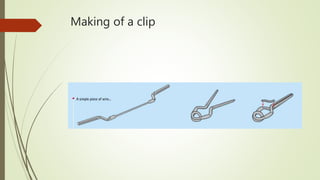
Making of a clip
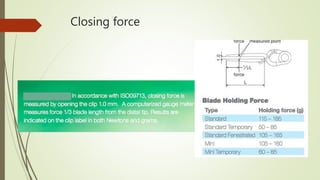
Closing force
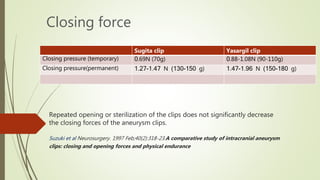
Repeated opening or sterilization of the clips does not significantly decrease
the closing forces of the aneurysm clips.
Suzuki et al Neurosurgery. 1997 Feb;40(2):318-23.A comparative study of intracranial aneurysm
clips: closing and opening forces and physical endurance
Closing force
Sugita clip Yasargil clip
Closing pressure (temporary) 0.69N (70g) 0.88-1.08N (90-110g)
Closing pressure(permanent) 1.27-1.47 N (130-150 g) 1.47-1.96 N (150-180 g)
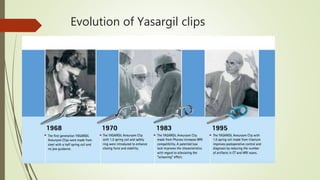
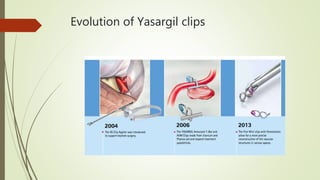
Evolution of Yasargil clips
Sugita clips
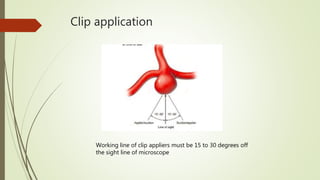
Clip application
Working line of clip appliers must be 15 to 30 degrees off
the sight line of microscope
Direction of clip
 Rhoton's rules of aneurysm formation
(I)aneurysms arise at the branching sites on the parent artery (side branch or bifurcation)
parallel to afferent and efferent
(ii) aneurysms arise at turns or curves in the outer wall of the artery where hemodynamic stress is
the greatest
(iii) aneurysms point in the direction that blood would have gone if the curve at the aneurysm site
was not present
Parallel to parent artery for aneurysms at curves
(iv) each aneurysm is associated with a set of perforating arteries that needs to be preserved
parallel to the line of perforators across an aneurysm base
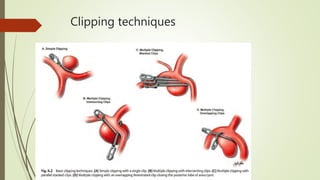
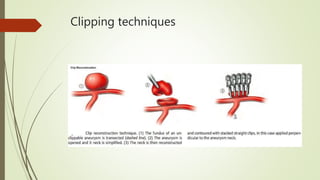
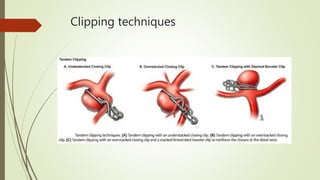
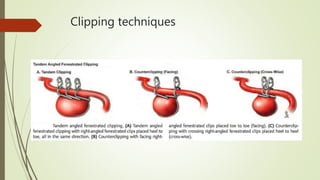
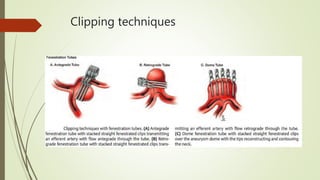
Clipping techniques
Clipping techniques
Clipping techniques
Clipping techniques
Clipping techniques
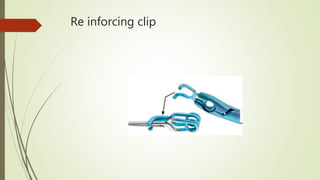
Re inforcing clip
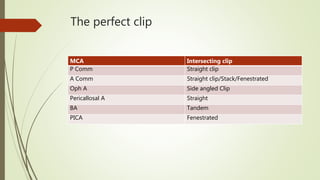
The perfect clip
MCA Intersecting clip
P Comm Straight clip
A Comm Straight clip/Stack/Fenestrated
Oph A Side angled Clip
Pericallosal A Straight
BA Tandem
PICA Fenestrated
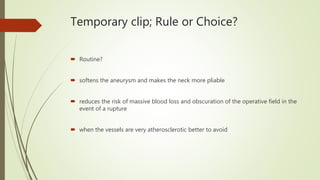
Temporary clip; Rule or Choice?
 Routine?
 softens the aneurysm and makes the neck more pliable
 reduces the risk of massive blood loss and obscuration of the operative field in the
event of a rupture
 when the vessels are very atherosclerotic better to avoid
Aneurysm clips /clipology

Aneurysm clips /clipology

  • 1.
    Clipology Gopal Sedain Assistant Professor DepartmentOf Neurosurgery Institute Of Medicine
  • 2.
    Background  Uses: tostop blood flow to the aneurysm  Mechanism: crushes the endothelium leading to secondary thrombosis of the aneurysm
  • 3.
    Ideal clip 1. Clampingpressure sufficient to isolate the aneurysm but not so high as to damage the blood vessel 2. Clamping pressure constant over time to prevent displacement/slipping 3. As small as possible 4. The material nonmagnetic & low density to prevent interference with MRI/ CT 5. Should not obstruct the surgeon's view during implantation 6. Surface smooth and absent jagged edges 7. Surface free from cracks which trap foreign matter & contamination 8. Proper jaw alignment should be maintained at all times to prevent shearing of the vascular tissue between the jaws.
  • 4.
    Types  Temporary  Permanent Standard, mini, and extra-long sizes  Straight,  curved forward, backward and sideward,  bent forward, backward and sideward, and  bayoneted.
  • 5.
    Evolution  Cushing's malleablesilver clips  Olivecrona: added winged flanges so that it could be removed if suboptimal  Dandy (1937) V-shaped malleable silver clip to the neck of an internal carotid artery (ICA) aneurysm  Dandy WE: Intracranial aneurysm of internal carotid artery cured by operation. Ann Surg 107:654, 1938  Mayfield(1952) repositionable spring loaded clips
  • 6.
  • 7.
    Evolution  There arefour major clip designs that are currently available in the market  McFadden Vari-Angle  Sundt Slim-Line  Sugita  Yasargil  The mechanism of clip opening and closure is the basis for dividing clips into  U/V type  pivot  mobile fulcrum and  alpha types
  • 8.
    Evolution (a) V-type clipwith an Olivecrona flange (b) Pivot type clip with a central pivot point and external spring (c)Mobile fulcrum clip. Blades touch each other, but do not cross at the base eg Scoville Clip. (d)Alpha clip
  • 9.
    Evolution Spring mechanism developedby the French instrument maker Joseph Charriere (1840) One of the most significant alterations in the basic forceps design This design modification reversed the action of the forceps- opening the blades when compressed and letting it close when released.
  • 10.
    Evolution  Fenestrated clip Kees made a fenestrated clip overnight when Professor Drake requested him to create a special clip for an otherwise unclippable basilar bifurcation aneurysm  booster clips, t-bar clips, and Sundt graft clips
  • 11.
    Material Science  Silver Stainless steel alloys such as 301 SS  Phynox (Yasargil FE) High grade cobalt- chromium  Eligiloy (Sugita Standard)  In current practice, both Yasargil and Sugita clips are made of medical grade titanium.  Ceramic clips  316MOSS, Elgiloy, Phynox, and titanium are safe to be implanted.
  • 12.
  • 13.
  • 14.
    Repeated opening orsterilization of the clips does not significantly decrease the closing forces of the aneurysm clips. Suzuki et al Neurosurgery. 1997 Feb;40(2):318-23.A comparative study of intracranial aneurysm clips: closing and opening forces and physical endurance Closing force Sugita clip Yasargil clip Closing pressure (temporary) 0.69N (70g) 0.88-1.08N (90-110g) Closing pressure(permanent) 1.27-1.47 N (130-150 g) 1.47-1.96 N (150-180 g)
  • 15.
  • 16.
  • 17.
  • 18.
    Clip application Working lineof clip appliers must be 15 to 30 degrees off the sight line of microscope
  • 19.
    Direction of clip Rhoton's rules of aneurysm formation (I)aneurysms arise at the branching sites on the parent artery (side branch or bifurcation) parallel to afferent and efferent (ii) aneurysms arise at turns or curves in the outer wall of the artery where hemodynamic stress is the greatest (iii) aneurysms point in the direction that blood would have gone if the curve at the aneurysm site was not present Parallel to parent artery for aneurysms at curves (iv) each aneurysm is associated with a set of perforating arteries that needs to be preserved parallel to the line of perforators across an aneurysm base
  • 20.
  • 21.
  • 22.
  • 23.
  • 24.
  • 25.
  • 26.
    The perfect clip MCAIntersecting clip P Comm Straight clip A Comm Straight clip/Stack/Fenestrated Oph A Side angled Clip Pericallosal A Straight BA Tandem PICA Fenestrated
  • 27.
    Temporary clip; Ruleor Choice?  Routine?  softens the aneurysm and makes the neck more pliable  reduces the risk of massive blood loss and obscuration of the operative field in the event of a rupture  when the vessels are very atherosclerotic better to avoid