History & Landmarks
Of Cephalometrics
By Tony Pious
1St
year Orthodontics
 History prior to the advent of
radiography begins with the attempts of
the scientists to classify the human
physiques.
 Basically it stems from the history of
Anthropometry.
 Sheldon continued the work & refined it.
 He classified physique in to three types.
1.Endomorphy is centered on the
abdomen, and the whole digestive
system.
2.Mesomorphy is focused on the
muscles and the circulatory system.
3.Ectomorphy is related to the brain
and the nervous system.
Early History of measurements
and proportions
 Portrayal of human form demands not
only artistic talent & technical ability but
a disciplined & consistent style.
 The ancient Egyptians developed an
intricate quantitative system that defined
the proportions of the human body. It
became known as the Canon of
proportions.
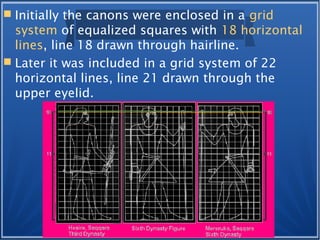
 Initially the canons were enclosed in a grid
system of equalized squares with 18 horizontal
lines, line 18 drawn through hairline.
 Later it was included in a grid system of 22
horizontal lines, line 21 drawn through the
upper eyelid.
Period of Renaissance
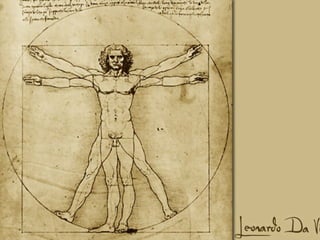
 Leonardo da vinci was probably the
earliest to apply the theory of head
measurement.
 He used lines related to specific structures
in the head in his study of human form.
 His drawings included a study of facial
proportions in natural head position.
The profile was divided in to seven parts
by eight horizontal lines.
 The joining of the lower lip and chin and
the tip of the jaw and the upper tip of
the ear with the temple forms a perfect
square; and each face is half of the
head.
 Albrecht Durer, published a study in
1528 on cranial measurements which
comprised the “Vier Bucher von
menschliche Proportion”.
 Using geometrical methods he provided a
analysis of the leptoprosopic face &
euryprosopic face in coordinate system,
where the horizontal and the vertical lines
were drawn through the same land marks
or facial features.
IN 18TH
CENTURY
The Dutchman Petrus Camper
was credited with the introduction
of facial angle.
He oriented crania in a space on a
horizontal from the middle of the porus
acusticus to a point below the nose.
Camper’s horizontal became the reference
line for angular measurements used to
characterize evolutionary trends in
anthropological studies.
 The facial angle as he described was
formed by the intersection of a facial line
and a horizontal plane.
 The facial line was a line tangential to the
most prominent part of the frontal bone
and to the slight convexity anterior to the
upper teeth.
 The horizontal plane passes through the
lower part of the nasal aperture,
backwards along the line of the
zygomatic arch, and through the centre
of the external auditory meatus.
 Camper’s facial angle was readily
accepted as a standard measurement in
craniology.
 The terms prognathic and orthognathic
introduced by Retzius are tied to
Camper’s illustrations of facial form.
 As a result the facial angle became a time
honored anthropological method to
determine the facial type.
Prognathism refers to the prominence of
jaws, relative to forehead, & a straight
facial profile -- as orthognathous.
 He is also credited with the introduction
of cephalic index, the ratio of breadth to
length of the skull expressed as a
percentage.
History of Cephalometric
Radiography
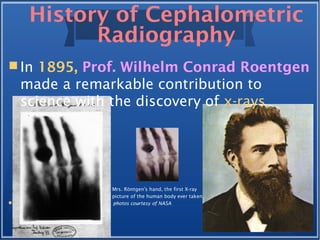
 In 1895, Prof. Wilhelm Conrad Roentgen
made a remarkable contribution to
science with the discovery of x-rays.
Mrs. Röntgen's hand, the first X-ray
picture of the human body ever taken.
 photos courtesy of NASA
 On December 28, 1895 he submitted a paper
“On A New Kind of Rays, A Preliminary
Communication” to the Wurzburg Physical
Medical Society.
Prof. Wilhem Koening & Dr. Otto Walkhoff
simultaneously made the first dental
radiograph in 1896.
It was clear that the use of x-rays provided the
means of obtaining a different perspective on
the arrangement and relation of bones thus
expanding the horizons of craniometry &
cephalometry .
 Van Loon -- first to introduce
cephalometrics to orthodontics. He applied
anthropometric procedures in analyzing
facial growth by making plaster casts of
face in to which he inserted oriented casts
of the dentition.
 Hellman in 1920s used cephalometric
techniques and described their value.
 The first x- ray pictures of skull in the
standard lateral view were taken by
A.J.Pacini & Carrera in 1922.
 Pacini received a research award from the
American Roentgen Ray Society for a
thesis entitled “Roentgen Ray
Anthropometry of the Skull”.
 Pacini introduced a teleroentgenographic
technique for standardized lateral head
radiography which proved to be of
tremendous use in cephalometry, as well
as in measuring growth and devlopment
of face.
 His method, which was rather primitive,
involved a large fixed distance from the x
ray source to the cassette.
He identified the following landmarks :
gonion, pogonion, nasion, and anterior
nasal spine. He also located the sella
turcica & external auditory meatus.
In 1931
Cephalometric radiography came to full
function when B. Holly Broadbent in USA
published methods to obtain standardized
head radiographs in the Angle
Orthodontist (A new X ray tech & its
application to orthodontia).
H. Hofrath simultaneously published the
same in Fortschritte der Orthodontie in
Germany.
Broadbent’s contribution
 Broadbent’s interest in craniofacial
growth began with his orthodontic
education under E.H. Angle in 1920.
 He continued to pursue that intrest along
with his orthodontic practice, working
with a leading anatomist J. Wingate Todd
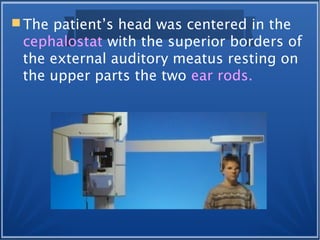
 The patient’s head was centered in the
cephalostat with the superior borders of
the external auditory meatus resting on
the upper parts the two ear rods.
 The lowest point on the inferior bony
border of the left orbit, indicated by the
orbital marker, was at the level of the
upper parts of the ear rods.
 Nose clamp was fixed at the root of the
nose to support the upper face.
 The focus film distance was set at 5 feet
(152.4 cm) and the subject film distance
could be measured to calculate image
magnification.
 With the two X ray tubes at right angles
to each other in the same horizontal
plane, two images (lateral & PA) could be
simultaneously produced.
 Hofrath’s technique differed from
Broadbent’s in that the path of the
central ray was not fixed in relation to
the head and no plan was suggested for
super positioning subsequent x-rays.
Cephalometric
Analysis
 The major use of radiographic
cephalometry is in characterizing the
patient’s dental and skeletal
relationships.
 This led to the development of a number
of cephalometric analyses to compare a
patient to the population standards.
 William. B. Downs in 1948 developed the
first cephalometric analysis.
 Its significance was that it presented an
objective method of portraying many
factors underlying malocclusion.
 Followed by other analyses by
Steiner (1953), Tweed (1953), Ricketts
(1958), Sassouni (1969), Enlow (1969),
Jaraback (1970), Jacobson (1975) etc.
Evolution of
Cephalometrics
 The thoroughness of Broadbent’s design of
the cephalometric method is evident from
the fact that the basic technique has
survived unchanged for over 70 years.
 The instrumentation had evolved to a more
suitable form for the individual practitioner
through the pioneering efforts of Margolis,
Higley & others.
Cephalometric
Landmarks
 -- are readily recognizable points on a
cephalometric radiograph or tracing,
representing certain hard or soft tissue
anatomical structures (anatomical
landmarks) & (constructed
landmarks).
Requirements
 Should be easily seen on the roentgenogram,
 Be uniform in out line, and easily reproducible.
 Should have significant relationship to the
vectors of growth.
 Should permit valid quantitative measurements
of lines and angles projected from them.
 Measurements should be amenable to
statistical analyses.
Hard Tissue
Landmarks
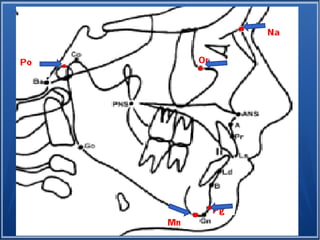
Nasion (N,Na) : the most anterior on the
frontonasal sutures in the midsagittal plane
Orbitale (Or) : the lowest point on the inferior
margin of the orbit.
Porion (Po): the most superior point on the outline
of the external auditory meatus (anatomic). The
superior most point of the ear rods (machine
porion) sometimes is used.
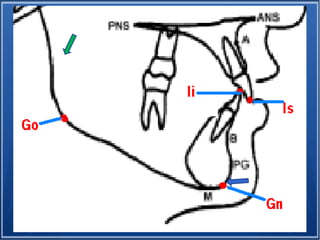
Gonion (Go): the most posterior inferior
point on the outline of the angle of the
mandible.
Pogonion(pog): its is the most anterior
point of the boney cin in the median plane.
 Gnathion (Gn) : the most anterior inferior
point on the bony chin in the midsagittal
plane.
Menton (Me) : the most inferior point of the
mandibular symphysis in the midsagittal
plane.
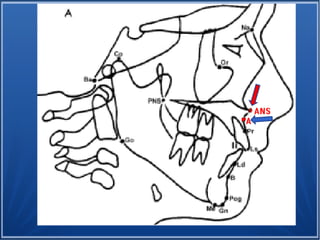
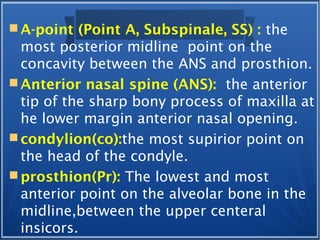
 A-point (Point A, Subspinale, SS) : the
most posterior midline point on the
concavity between the ANS and prosthion.
 Anterior nasal spine (ANS): the anterior
tip of the sharp bony process of maxilla at
he lower margin anterior nasal opening.
 condylion(co):the most supirior point on
the head of the condyle.
 prosthion(Pr): The lowest and most
anterior point on the alveolar bone in the
midline,between the upper centeral
insicors.
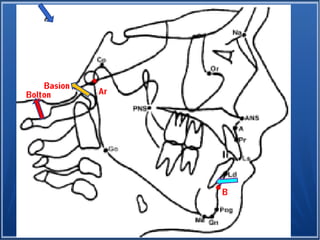
 Articulare (Ar) a point at the junction of
the posterior border of ramus of mandible
and inferior border of posterior cranial
base (occipital bone).
 B-point (Point B, Supramentale, sm): the
most posterior midline point in the
concavity of the mandible between the
most superior point on the alveolar bone
overlying the mandibular incisors
(infradentale) and Pog.
 Basion (Ba): the lowest point on the
anterior rim of the foramen magnum.
 Bolton (Bo) : the intersection of the
outline of the occipital condyle and the
foramen magnum at the highest point on
the notch posterior to the occipital
condyle.
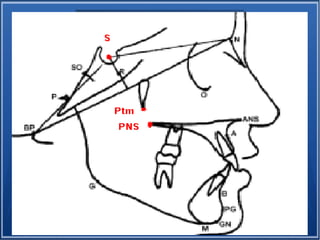
 Pterygomaxillary fissure (PTM,) :
bilateral inverted tear drop shaped
radiolucency whose anterior border
represents the posterior surfaces of the
tuberosities of the maxilla.
 Sella (S) : the geometric centre of the
pituitary fossa (sella turcica), determined
by inspection – a constructed point in the
midsagittal plane.
 Broadband registration point:it is the
 Posterior nasal spine (PNS) : the most
posterior point on the bony hard palate in
the midsagittal plane, the meeting point
between inferior & superior surfaces of
the hard palate at its posterior aspect.
SOFT TISSUE LANDMARKS
●
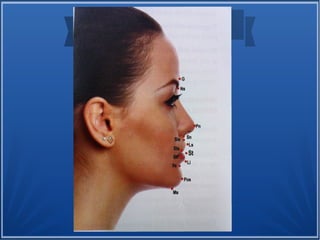
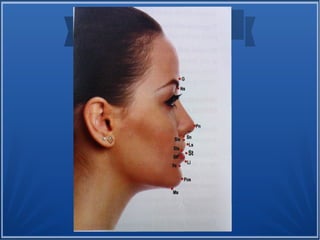
Glabella(G): it is the most prominent
point in the midsagittal plane of the
forehead.
●
Nasion soft tissue(Ns):it is the
deepest point in the concavity of the
soft tissue contour of the root of the
nose.
●
Pronasale(Pn):the most prominent
point of the nose.
●
Labrale superius(Ls):the median point int he
upper margin of the upper membranous lip.
●
Superious labial sulcus(Sls):it is a point of
great concavity in the midline of upper lip.
●
Stomion superius(Sts): it is the lowest point of
the upper lip.
●
Stomion inferius(sti):it is the highest point of
the lower lip.
●
Stomion(St): it is the midpoint between the
stomion superius and stomion inferius.
●
Labrale inferius(Li):the median point in the
lower margin of the lower membranous lip.
●
Pogonion soft tissue(Pos): it is the most
prominent point on the soft tissue contour of
the chin.
●
Menton soft tissue(Ms):it is a constructed
point at the intersection of a vertical co-ordinate
from menton and the inferior soft tissue contour
of the chin.
Conclusion
 Broadbent’s gave us a three dimensional
analysis, but orthodontics has remained
preoccupied with the lateral view. The
lateral view is easy to work with and the
patient is also much more recognizable
than in the frontal (P-A) view, especially
with soft tissue enhancement.
 Clinical orthodontics is yet to fully utilize
Broadbent’s contribution.
 We treat in three dimensions and the width
dimension that are visualized on the
frontal view are crucial in many cases.
Cephalometric history, evolotion & landmarks1

Cephalometric history, evolotion & landmarks1

  • 1.
    History & Landmarks OfCephalometrics By Tony Pious 1St year Orthodontics
  • 2.
     History priorto the advent of radiography begins with the attempts of the scientists to classify the human physiques.  Basically it stems from the history of Anthropometry.
  • 3.
     Sheldon continuedthe work & refined it.  He classified physique in to three types. 1.Endomorphy is centered on the abdomen, and the whole digestive system. 2.Mesomorphy is focused on the muscles and the circulatory system. 3.Ectomorphy is related to the brain and the nervous system.
  • 4.
    Early History ofmeasurements and proportions  Portrayal of human form demands not only artistic talent & technical ability but a disciplined & consistent style.  The ancient Egyptians developed an intricate quantitative system that defined the proportions of the human body. It became known as the Canon of proportions.
  • 5.
     Initially thecanons were enclosed in a grid system of equalized squares with 18 horizontal lines, line 18 drawn through hairline.  Later it was included in a grid system of 22 horizontal lines, line 21 drawn through the upper eyelid.
  • 6.
    Period of Renaissance Leonardo da vinci was probably the earliest to apply the theory of head measurement.  He used lines related to specific structures in the head in his study of human form.
  • 8.
     His drawingsincluded a study of facial proportions in natural head position. The profile was divided in to seven parts by eight horizontal lines.  The joining of the lower lip and chin and the tip of the jaw and the upper tip of the ear with the temple forms a perfect square; and each face is half of the head.
  • 9.
     Albrecht Durer,published a study in 1528 on cranial measurements which comprised the “Vier Bucher von menschliche Proportion”.  Using geometrical methods he provided a analysis of the leptoprosopic face & euryprosopic face in coordinate system, where the horizontal and the vertical lines were drawn through the same land marks or facial features.
  • 10.
    IN 18TH CENTURY The DutchmanPetrus Camper was credited with the introduction of facial angle. He oriented crania in a space on a horizontal from the middle of the porus acusticus to a point below the nose. Camper’s horizontal became the reference line for angular measurements used to characterize evolutionary trends in anthropological studies.
  • 11.
     The facialangle as he described was formed by the intersection of a facial line and a horizontal plane.  The facial line was a line tangential to the most prominent part of the frontal bone and to the slight convexity anterior to the upper teeth.
  • 12.
     The horizontalplane passes through the lower part of the nasal aperture, backwards along the line of the zygomatic arch, and through the centre of the external auditory meatus.  Camper’s facial angle was readily accepted as a standard measurement in craniology.
  • 13.
     The termsprognathic and orthognathic introduced by Retzius are tied to Camper’s illustrations of facial form.  As a result the facial angle became a time honored anthropological method to determine the facial type. Prognathism refers to the prominence of jaws, relative to forehead, & a straight facial profile -- as orthognathous.
  • 14.
     He isalso credited with the introduction of cephalic index, the ratio of breadth to length of the skull expressed as a percentage.
  • 15.
    History of Cephalometric Radiography In 1895, Prof. Wilhelm Conrad Roentgen made a remarkable contribution to science with the discovery of x-rays. Mrs. Röntgen's hand, the first X-ray picture of the human body ever taken.  photos courtesy of NASA
  • 16.
     On December28, 1895 he submitted a paper “On A New Kind of Rays, A Preliminary Communication” to the Wurzburg Physical Medical Society. Prof. Wilhem Koening & Dr. Otto Walkhoff simultaneously made the first dental radiograph in 1896. It was clear that the use of x-rays provided the means of obtaining a different perspective on the arrangement and relation of bones thus expanding the horizons of craniometry & cephalometry .
  • 17.
     Van Loon-- first to introduce cephalometrics to orthodontics. He applied anthropometric procedures in analyzing facial growth by making plaster casts of face in to which he inserted oriented casts of the dentition.  Hellman in 1920s used cephalometric techniques and described their value.
  • 18.
     The firstx- ray pictures of skull in the standard lateral view were taken by A.J.Pacini & Carrera in 1922.  Pacini received a research award from the American Roentgen Ray Society for a thesis entitled “Roentgen Ray Anthropometry of the Skull”.
  • 19.
     Pacini introduceda teleroentgenographic technique for standardized lateral head radiography which proved to be of tremendous use in cephalometry, as well as in measuring growth and devlopment of face.  His method, which was rather primitive, involved a large fixed distance from the x ray source to the cassette.
  • 20.
    He identified thefollowing landmarks : gonion, pogonion, nasion, and anterior nasal spine. He also located the sella turcica & external auditory meatus.
  • 21.
    In 1931 Cephalometric radiographycame to full function when B. Holly Broadbent in USA published methods to obtain standardized head radiographs in the Angle Orthodontist (A new X ray tech & its application to orthodontia). H. Hofrath simultaneously published the same in Fortschritte der Orthodontie in Germany.
  • 22.
    Broadbent’s contribution  Broadbent’sinterest in craniofacial growth began with his orthodontic education under E.H. Angle in 1920.  He continued to pursue that intrest along with his orthodontic practice, working with a leading anatomist J. Wingate Todd
  • 23.
     The patient’shead was centered in the cephalostat with the superior borders of the external auditory meatus resting on the upper parts the two ear rods.
  • 24.
     The lowestpoint on the inferior bony border of the left orbit, indicated by the orbital marker, was at the level of the upper parts of the ear rods.  Nose clamp was fixed at the root of the nose to support the upper face.
  • 25.
     The focusfilm distance was set at 5 feet (152.4 cm) and the subject film distance could be measured to calculate image magnification.  With the two X ray tubes at right angles to each other in the same horizontal plane, two images (lateral & PA) could be simultaneously produced.
  • 26.
     Hofrath’s techniquediffered from Broadbent’s in that the path of the central ray was not fixed in relation to the head and no plan was suggested for super positioning subsequent x-rays.
  • 27.
  • 28.
     The majoruse of radiographic cephalometry is in characterizing the patient’s dental and skeletal relationships.  This led to the development of a number of cephalometric analyses to compare a patient to the population standards.
  • 29.
     William. B.Downs in 1948 developed the first cephalometric analysis.  Its significance was that it presented an objective method of portraying many factors underlying malocclusion.  Followed by other analyses by Steiner (1953), Tweed (1953), Ricketts (1958), Sassouni (1969), Enlow (1969), Jaraback (1970), Jacobson (1975) etc.
  • 30.
    Evolution of Cephalometrics  Thethoroughness of Broadbent’s design of the cephalometric method is evident from the fact that the basic technique has survived unchanged for over 70 years.  The instrumentation had evolved to a more suitable form for the individual practitioner through the pioneering efforts of Margolis, Higley & others.
  • 31.
    Cephalometric Landmarks  -- arereadily recognizable points on a cephalometric radiograph or tracing, representing certain hard or soft tissue anatomical structures (anatomical landmarks) & (constructed landmarks).
  • 32.
    Requirements  Should beeasily seen on the roentgenogram,  Be uniform in out line, and easily reproducible.  Should have significant relationship to the vectors of growth.  Should permit valid quantitative measurements of lines and angles projected from them.  Measurements should be amenable to statistical analyses.
  • 33.
  • 34.
    Nasion (N,Na) :the most anterior on the frontonasal sutures in the midsagittal plane Orbitale (Or) : the lowest point on the inferior margin of the orbit. Porion (Po): the most superior point on the outline of the external auditory meatus (anatomic). The superior most point of the ear rods (machine porion) sometimes is used.
  • 36.
    Gonion (Go): themost posterior inferior point on the outline of the angle of the mandible. Pogonion(pog): its is the most anterior point of the boney cin in the median plane.  Gnathion (Gn) : the most anterior inferior point on the bony chin in the midsagittal plane. Menton (Me) : the most inferior point of the mandibular symphysis in the midsagittal plane.
  • 38.
     A-point (PointA, Subspinale, SS) : the most posterior midline point on the concavity between the ANS and prosthion.  Anterior nasal spine (ANS): the anterior tip of the sharp bony process of maxilla at he lower margin anterior nasal opening.  condylion(co):the most supirior point on the head of the condyle.  prosthion(Pr): The lowest and most anterior point on the alveolar bone in the midline,between the upper centeral insicors.
  • 40.
     Articulare (Ar)a point at the junction of the posterior border of ramus of mandible and inferior border of posterior cranial base (occipital bone).  B-point (Point B, Supramentale, sm): the most posterior midline point in the concavity of the mandible between the most superior point on the alveolar bone overlying the mandibular incisors (infradentale) and Pog.
  • 42.
     Basion (Ba):the lowest point on the anterior rim of the foramen magnum.  Bolton (Bo) : the intersection of the outline of the occipital condyle and the foramen magnum at the highest point on the notch posterior to the occipital condyle.
  • 43.
     Pterygomaxillary fissure(PTM,) : bilateral inverted tear drop shaped radiolucency whose anterior border represents the posterior surfaces of the tuberosities of the maxilla.  Sella (S) : the geometric centre of the pituitary fossa (sella turcica), determined by inspection – a constructed point in the midsagittal plane.  Broadband registration point:it is the
  • 45.
     Posterior nasalspine (PNS) : the most posterior point on the bony hard palate in the midsagittal plane, the meeting point between inferior & superior surfaces of the hard palate at its posterior aspect.
  • 46.
  • 47.
    ● Glabella(G): it isthe most prominent point in the midsagittal plane of the forehead. ● Nasion soft tissue(Ns):it is the deepest point in the concavity of the soft tissue contour of the root of the nose. ● Pronasale(Pn):the most prominent point of the nose.
  • 49.
    ● Labrale superius(Ls):the medianpoint int he upper margin of the upper membranous lip. ● Superious labial sulcus(Sls):it is a point of great concavity in the midline of upper lip. ● Stomion superius(Sts): it is the lowest point of the upper lip. ● Stomion inferius(sti):it is the highest point of the lower lip.
  • 50.
    ● Stomion(St): it isthe midpoint between the stomion superius and stomion inferius. ● Labrale inferius(Li):the median point in the lower margin of the lower membranous lip. ● Pogonion soft tissue(Pos): it is the most prominent point on the soft tissue contour of the chin. ● Menton soft tissue(Ms):it is a constructed point at the intersection of a vertical co-ordinate from menton and the inferior soft tissue contour of the chin.
  • 52.
    Conclusion  Broadbent’s gaveus a three dimensional analysis, but orthodontics has remained preoccupied with the lateral view. The lateral view is easy to work with and the patient is also much more recognizable than in the frontal (P-A) view, especially with soft tissue enhancement.
  • 53.
     Clinical orthodonticsis yet to fully utilize Broadbent’s contribution.  We treat in three dimensions and the width dimension that are visualized on the frontal view are crucial in many cases.