Cytokines
Prof. Dr. Zahid Shakoor
M.B.B.S, Ph D (London)
King Saud Univeristy
Cytokines
 Facts
 They are low molecular weight proteins
 They are involved in immunity and
inflammation where they regulate the
amplitude and duration of inflammation
 They are extremely potent
 They are produced transiently
Cytokines
 They act with cell
surface receptors
specific for each
cytokine group
 Their cell surface
binding leads to protein
synthesis and altered
cell behavior
Pleiotropic
Redundant
Synergistic
Antagonistic
-
Cytokines : Mode of Action
Cytokines
 The messenger molecules of the immune system
 These are short acting soluble mediators
 Previously designated as lymphokines (lymphocyte
derived), monokines (monocyte derived),
chemokines, interleukins, interferon
 They have wide spectrum of effects and are
produced by several different cell types
2
1
3
4
5
6
Working Classification of Cytokines
 Cytokines that mediate natural immunity
 Interleukin-1 (IL-1), tumor necrosis factor alpha
(TNF), interferons and IL-6
 Cytokines that regulate lymphocyte growth,
activation and differentiation
 IL-2, IL-4, IL-5, IL-12, IL-15 and transforming
growth factor- (TGF- )
Cytokines
 Cytokines that activate inflammatory cells
 IFN-, TNF, lymphotoxin (TNF-) and migratory inhibitory
factor
 Cytokines that affect leukocyte movements also called
“chemokines”
 C-C and C-X-C chemokines on the bases of cysteine
residues
 C-X-C are produced by macrophage – IL-8
 C-C are produced by T cells – MIP, MCP
Cytokines
 Cytokines that stimulate hematopoiesis
 Derived from lymphocytes or stromal cells
stimulate the production of blood cells by acting on
hematopoietic progenitor cells.
 The members of this family are called “colony-
stimulating factors” (CSFs) eg, granulocyte-
monocyte colony stimulating factor (GM-CSF),
granulocyte-colony stimulating factor (G-CSF)
General Properties of
Cytokines
 Cytokines induce their effects in three ways
 Autocrine effect: ie, they act on the same cell that
produces the cytokine eg, IL-2
 Paracrine effect: that effect other cells in the
vicinity eg, IL-7 in the bone marrow act on B cells
progenitors
 Endocrine effect: they affect many cells
systemically eg, IL-1 and TNF- which produce
acute-phase response during inflammation
Autocrine
Paracrine
Endocrine
General Properties of Cytokines
Mode of Action I
Close proximity
Distant cells
General Properties of
Cytokines
 Cytokines mediate their effect by binding
to specific receptors on the cell surface
 For example, IL-2 activates T cells by
binding to its specific high-affinity receptor
on the target cells
Mediators Affecting Lymphocytes
 IL-1
 Protein produced by macrophages
 Activates T & B cells, neutrophils, epithelial cells
and fibroblasts
 Activates T cells to produce IL-2
 It is an endogenous pyrogen
Interleukin-2 (IL-2)
 It is a protein produced by helper T cells
 Stimulates both helper and cytotoxic T cells
 IL-2 acts through the induction of a specific
receptor (IL-2 receptor) on the cell surface
 IL-2 reacts in combination with IL-4 to
stimulate growth of B cells
Interleukins- 4 & 5
 Are proteins produced by helper T cells
 They promote growth and differentiation of B cells
respectively
 IL-4 enhances humoral immunity by increasing number
of Th-2 cells
 IL-4 is required for class switching of Igs and enhances
IgE production
 IL-5 increases IgA production and helps in activation of
eosinophils – defense against helminths
Other Cytokines
IL-6, IL-10, IL-12 & IL-13
 IL-6 produced by helper T cells and
macrophages
 Stimulates B cells to differentiate
 Induces fever by acting on hypothalamus
 Induces the production of acute phase
proteins by liver
IL-10 & IL-12
 These cytokines regulate the production of Th-1 cells
 IL-12 is produced by macrophages and promotes the
development of Th-1 cells
 IL-10 is produced by Th2 cells and inhibits the
development of Th-1 by limiting the production of IF
The relative amounts of IL-4, IL-10 & IL-12 drive the
differentiation of Th-1 & Th-2 cells and enhance
either cell mediated or humoral immunity
respectively
IL-13
 It is produced by Th-2 cells
 It is one of the main mediators of allergic
airway disease (asthma)
 IL-13 is associated with airway hyper-
responsiveness in asthma
 It has no effect on IgE production
Transforming Growth Factor- (TGF- )
 TGF-  inhibits the growth and activities of T cells
 It is also called anti-cytokine as it also inhibits many
functions of macrophages, B cells, neutrophils and
natural killer cells
 These effects are brought about by counteracting the
actions of other activating factors
 It enhances synthesis of collagen (wound healing)
 Produced by many cell types including macrophages,
T and B cells
Mediators Effecting Macrophages and
Monocytes
 Chemokines attract neutrophils and macrophages to
the site of inflammation
 They are produced by endothelial cells and
macrophages
 They activate “integrins” on the surface of
macorphages and neutrophils that bind to intercellular
adhesion molecule-1 (ICAM-1) on the surface of
endothelium
 This interaction leads to migration of cells into the
infected or inflamed area
Chemokines
 Approximately 50 chemokines have been identified
 They are polypeptides of size from 68 to 120 amino
acids
 Alpha chemokines have two cysteines separated by
an amino acid (C-X-C group)
 Attract neutrophils
 Beta chemokines have two adjacent cysteines
 (C-C group)
 Attract macrophages
Mediators Affecting
Polymorphonuclear Leukocytes
1. Tumor Necrosis Factor (TNF)
 Activates phagocytic and killing activities of
neutrophils
 Increases synthesis of adhesion molecules by
endothelial cells
 Thus mediating extra-vascular migration of
neutrophils
Mediators Affecting
Polymorphonuclear Leukocytes
2. Interleukin-8 and complement component
C5a are important attractants for neutrophils
3. Leukocyte-inhibitory factor inhibits migration
of neutrophils from the site of inflammation
Mediators Affecting Stem Cells
 IL-3 produced by activated helper T cells supports the
growth and differentiation of stem cells in the bone
marrow
 Granulocyte-Macrophage Colony Stimulating Factor
(GM-CSF)
 Used in bone marrow transplantation
 Granulocyte Colony Stimulating Factor (G-CSF)
 Used in cancer chemotherapy
Mediators Produced by Macrophages
That Affect Other Cells
1. TNF-
 Extra-vascular migration of inflammatory cells
through induction of adhesion molecules
 Activates respiratory burst within neutrophils
 Enhances lymphokine production by Th cells
 Stimulates growth of B cells
 High concentrations mediate endotoxin-induced
septic shock
Mediators Produced by Macrophages
That Affect Other Cells
 Anti TNF- antibodies prevents the action of
endotoxin
 TNF- is also known as “chacectin” because it
causes “cachexia”
 It causes death and necrosis of certain tumors in
experimental animals
Mediators Produced by Macrophages
That Affect Other Cells
2. Nitric Oxide (NO)
 Produced mainly by macorphages in response
lipopolysaccharide (LPS) found in cell wall of
gram-negative bacteria
 NO cause vasodilatation which contributes to
hypotension associated with septic shock
 Inhibitors of NO synthtase inhibits NO production
thus preventing hypotension
Mediators Produced by Macrophages
That Affect Other Cells
3. Macrophage migration inhibition factor
(MIF)
 Produced by macorphages in response to
endotoxin
 Plays a major role in the induction of septic
shock
 Anti-MIF antibodies can prevent septic shock
Mediators with Other Effects
 Interferons
 These are glycoproteins that block viral replication
 Alpha interferon from leukocytes and beta
interferon from fibroblasts have anti-viral activity
 Gamma interferon produced by Th-1 lymphocytes
activates macrophages (phagocytosis), NK cells
(tumor cells) and neutrophils
 Enhances the expression of Class I & II MHC
Cytokines and Disease
 Bacterial Septic Shock
 Cell wall endotoxin stimulate macrophages to
overproduce IL-1 and TNF alpha
 Treatment is with antibodies against TNF alpha
and use of recombinant IL-1 receptor antagonists
Cytokines and Disease
 Lymphoid and Myeloid Cancers
 High levels of IL-6 are produced by
 Cardiac myxoma cells, myeloma, plasmacytoma
cells, cervical and bladder cancer cells
IL-6 works in an autocrine manner to
stimulate cell proliferation
Cytokines and Disease
 T cell leukemia is associated with HTLV-1
retrovirus
 HTLV-1 protein called “Tax” induces factors that
bind to the promotor regions of genes encoding IL2
and IL2 receptors and activating them
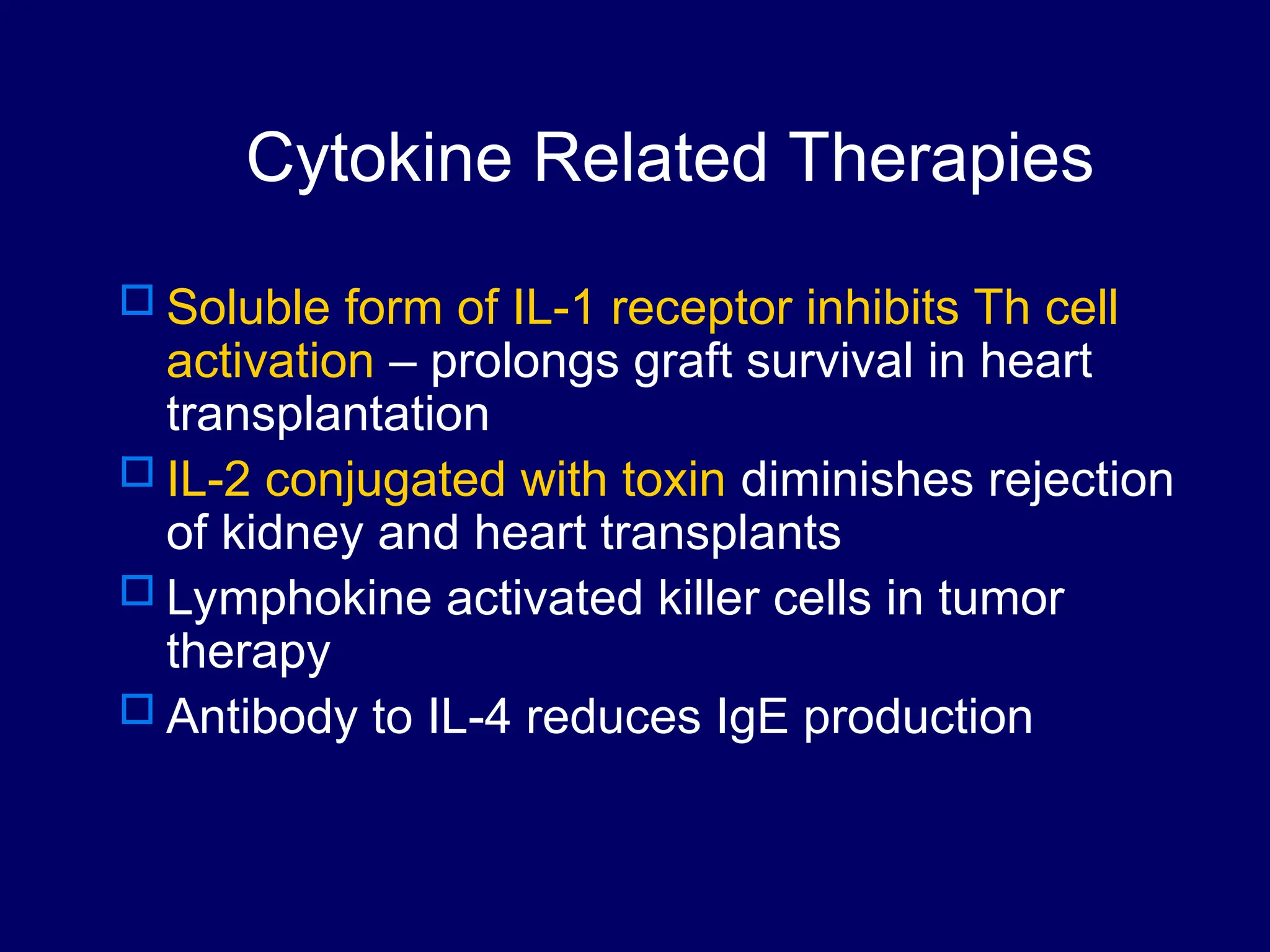
Cytokine Related Therapies
 Soluble form of IL-1 receptor inhibits Th cell
activation – prolongs graft survival in heart
transplantation
 IL-2 conjugated with toxin diminishes rejection
of kidney and heart transplants
 Lymphokine activated killer cells in tumor
therapy
 Antibody to IL-4 reduces IgE production
Cytokine
Functions
IL-5 & TGF-
Induces class switch to IgA
IL-4
Up-regulates MHC II expression, class switch to IgE
IL-10
Down-regulates MHC II expression
IL-2 & IL-12
Synergistically induce differentiation into CTL
Interferon 
Inhibition of viral replication
Interferon 
Class switching to certain IgGs
Examples of some cytokines functions
Cytokine Network

Targets
Thank you

4-Cytokines lecture.pptdfdfdfdfdban dididit

  • 1.
    Cytokines Prof. Dr. ZahidShakoor M.B.B.S, Ph D (London) King Saud Univeristy
  • 2.
    Cytokines  Facts  Theyare low molecular weight proteins  They are involved in immunity and inflammation where they regulate the amplitude and duration of inflammation  They are extremely potent  They are produced transiently
  • 3.
    Cytokines  They actwith cell surface receptors specific for each cytokine group  Their cell surface binding leads to protein synthesis and altered cell behavior
  • 4.
  • 5.
    Cytokines  The messengermolecules of the immune system  These are short acting soluble mediators  Previously designated as lymphokines (lymphocyte derived), monokines (monocyte derived), chemokines, interleukins, interferon  They have wide spectrum of effects and are produced by several different cell types
  • 6.
  • 7.
    Working Classification ofCytokines  Cytokines that mediate natural immunity  Interleukin-1 (IL-1), tumor necrosis factor alpha (TNF), interferons and IL-6  Cytokines that regulate lymphocyte growth, activation and differentiation  IL-2, IL-4, IL-5, IL-12, IL-15 and transforming growth factor- (TGF- )
  • 8.
    Cytokines  Cytokines thatactivate inflammatory cells  IFN-, TNF, lymphotoxin (TNF-) and migratory inhibitory factor  Cytokines that affect leukocyte movements also called “chemokines”  C-C and C-X-C chemokines on the bases of cysteine residues  C-X-C are produced by macrophage – IL-8  C-C are produced by T cells – MIP, MCP
  • 9.
    Cytokines  Cytokines thatstimulate hematopoiesis  Derived from lymphocytes or stromal cells stimulate the production of blood cells by acting on hematopoietic progenitor cells.  The members of this family are called “colony- stimulating factors” (CSFs) eg, granulocyte- monocyte colony stimulating factor (GM-CSF), granulocyte-colony stimulating factor (G-CSF)
  • 10.
    General Properties of Cytokines Cytokines induce their effects in three ways  Autocrine effect: ie, they act on the same cell that produces the cytokine eg, IL-2  Paracrine effect: that effect other cells in the vicinity eg, IL-7 in the bone marrow act on B cells progenitors  Endocrine effect: they affect many cells systemically eg, IL-1 and TNF- which produce acute-phase response during inflammation
  • 11.
    Autocrine Paracrine Endocrine General Properties ofCytokines Mode of Action I Close proximity Distant cells
  • 12.
    General Properties of Cytokines Cytokines mediate their effect by binding to specific receptors on the cell surface  For example, IL-2 activates T cells by binding to its specific high-affinity receptor on the target cells
  • 13.
    Mediators Affecting Lymphocytes IL-1  Protein produced by macrophages  Activates T & B cells, neutrophils, epithelial cells and fibroblasts  Activates T cells to produce IL-2  It is an endogenous pyrogen
  • 14.
    Interleukin-2 (IL-2)  Itis a protein produced by helper T cells  Stimulates both helper and cytotoxic T cells  IL-2 acts through the induction of a specific receptor (IL-2 receptor) on the cell surface  IL-2 reacts in combination with IL-4 to stimulate growth of B cells
  • 15.
    Interleukins- 4 &5  Are proteins produced by helper T cells  They promote growth and differentiation of B cells respectively  IL-4 enhances humoral immunity by increasing number of Th-2 cells  IL-4 is required for class switching of Igs and enhances IgE production  IL-5 increases IgA production and helps in activation of eosinophils – defense against helminths
  • 16.
    Other Cytokines IL-6, IL-10,IL-12 & IL-13  IL-6 produced by helper T cells and macrophages  Stimulates B cells to differentiate  Induces fever by acting on hypothalamus  Induces the production of acute phase proteins by liver
  • 17.
    IL-10 & IL-12 These cytokines regulate the production of Th-1 cells  IL-12 is produced by macrophages and promotes the development of Th-1 cells  IL-10 is produced by Th2 cells and inhibits the development of Th-1 by limiting the production of IF The relative amounts of IL-4, IL-10 & IL-12 drive the differentiation of Th-1 & Th-2 cells and enhance either cell mediated or humoral immunity respectively
  • 19.
    IL-13  It isproduced by Th-2 cells  It is one of the main mediators of allergic airway disease (asthma)  IL-13 is associated with airway hyper- responsiveness in asthma  It has no effect on IgE production
  • 20.
    Transforming Growth Factor-(TGF- )  TGF-  inhibits the growth and activities of T cells  It is also called anti-cytokine as it also inhibits many functions of macrophages, B cells, neutrophils and natural killer cells  These effects are brought about by counteracting the actions of other activating factors  It enhances synthesis of collagen (wound healing)  Produced by many cell types including macrophages, T and B cells
  • 21.
    Mediators Effecting Macrophagesand Monocytes  Chemokines attract neutrophils and macrophages to the site of inflammation  They are produced by endothelial cells and macrophages  They activate “integrins” on the surface of macorphages and neutrophils that bind to intercellular adhesion molecule-1 (ICAM-1) on the surface of endothelium  This interaction leads to migration of cells into the infected or inflamed area
  • 22.
    Chemokines  Approximately 50chemokines have been identified  They are polypeptides of size from 68 to 120 amino acids  Alpha chemokines have two cysteines separated by an amino acid (C-X-C group)  Attract neutrophils  Beta chemokines have two adjacent cysteines  (C-C group)  Attract macrophages
  • 23.
    Mediators Affecting Polymorphonuclear Leukocytes 1.Tumor Necrosis Factor (TNF)  Activates phagocytic and killing activities of neutrophils  Increases synthesis of adhesion molecules by endothelial cells  Thus mediating extra-vascular migration of neutrophils
  • 24.
    Mediators Affecting Polymorphonuclear Leukocytes 2.Interleukin-8 and complement component C5a are important attractants for neutrophils 3. Leukocyte-inhibitory factor inhibits migration of neutrophils from the site of inflammation
  • 25.
    Mediators Affecting StemCells  IL-3 produced by activated helper T cells supports the growth and differentiation of stem cells in the bone marrow  Granulocyte-Macrophage Colony Stimulating Factor (GM-CSF)  Used in bone marrow transplantation  Granulocyte Colony Stimulating Factor (G-CSF)  Used in cancer chemotherapy
  • 26.
    Mediators Produced byMacrophages That Affect Other Cells 1. TNF-  Extra-vascular migration of inflammatory cells through induction of adhesion molecules  Activates respiratory burst within neutrophils  Enhances lymphokine production by Th cells  Stimulates growth of B cells  High concentrations mediate endotoxin-induced septic shock
  • 27.
    Mediators Produced byMacrophages That Affect Other Cells  Anti TNF- antibodies prevents the action of endotoxin  TNF- is also known as “chacectin” because it causes “cachexia”  It causes death and necrosis of certain tumors in experimental animals
  • 28.
    Mediators Produced byMacrophages That Affect Other Cells 2. Nitric Oxide (NO)  Produced mainly by macorphages in response lipopolysaccharide (LPS) found in cell wall of gram-negative bacteria  NO cause vasodilatation which contributes to hypotension associated with septic shock  Inhibitors of NO synthtase inhibits NO production thus preventing hypotension
  • 29.
    Mediators Produced byMacrophages That Affect Other Cells 3. Macrophage migration inhibition factor (MIF)  Produced by macorphages in response to endotoxin  Plays a major role in the induction of septic shock  Anti-MIF antibodies can prevent septic shock
  • 30.
    Mediators with OtherEffects  Interferons  These are glycoproteins that block viral replication  Alpha interferon from leukocytes and beta interferon from fibroblasts have anti-viral activity  Gamma interferon produced by Th-1 lymphocytes activates macrophages (phagocytosis), NK cells (tumor cells) and neutrophils  Enhances the expression of Class I & II MHC
  • 31.
    Cytokines and Disease Bacterial Septic Shock  Cell wall endotoxin stimulate macrophages to overproduce IL-1 and TNF alpha  Treatment is with antibodies against TNF alpha and use of recombinant IL-1 receptor antagonists
  • 32.
    Cytokines and Disease Lymphoid and Myeloid Cancers  High levels of IL-6 are produced by  Cardiac myxoma cells, myeloma, plasmacytoma cells, cervical and bladder cancer cells IL-6 works in an autocrine manner to stimulate cell proliferation
  • 33.
    Cytokines and Disease T cell leukemia is associated with HTLV-1 retrovirus  HTLV-1 protein called “Tax” induces factors that bind to the promotor regions of genes encoding IL2 and IL2 receptors and activating them
  • 34.
    Cytokine Related Therapies Soluble form of IL-1 receptor inhibits Th cell activation – prolongs graft survival in heart transplantation  IL-2 conjugated with toxin diminishes rejection of kidney and heart transplants  Lymphokine activated killer cells in tumor therapy  Antibody to IL-4 reduces IgE production
  • 35.
    Cytokine Functions IL-5 & TGF- Inducesclass switch to IgA IL-4 Up-regulates MHC II expression, class switch to IgE IL-10 Down-regulates MHC II expression IL-2 & IL-12 Synergistically induce differentiation into CTL Interferon  Inhibition of viral replication Interferon  Class switching to certain IgGs Examples of some cytokines functions
  • 36.
  • 37.