TOPIC- PRIMARY IMMUNE
RESPONSE
INTRODUCTION TO MICROBIAL
WORLD.
RASHIKA SOOD
RUPALI CHAUHAN
Primary and
secondary immune
responses are like a
soccer game…
The first time you play another team, you don’t
know how they play…
They could be great players…
…or they could be horrible players.
So it takes you a good half of the game to
understand and get settled….
But if you play again with them for the second time…
You can quickly start playing hard because you
remember how they played before.
•Primary response is the immune response of the
body to new antigens.
•When a new pathogen enters in to the body,
immune system takes little time to respond.
•During this period immune system learns about the
pathogen and gets ready to eliminate it from the
body.
The preparation period that is the period between entry of
pathogen and expression of immune response is known as
"latent period".
Latent period in humoral immunity indicates activation
and proliferation of naive B cells to produce plasma
cells and memory cells.
Plasma cells secrete antibodies and memory cells store
information of the pathogen.
.
Generally IgM type antibodies with
a half life of 5 days are produced in
primary response.
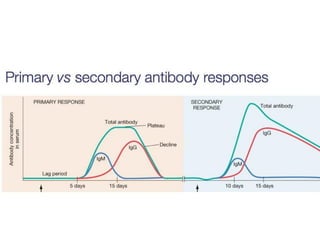
Concentration of secreted antibodies is different at
different stages of latent period:-
•In the initial, stage antibodies against the new
antigens are almost absent, and this period is known
as "Lag phase".
•Antibodies gradually rise from zero stage to a
maximum and this raising period is referred as "Log
phase".
•After attaining maximum, antibody levels remain
constant for some time and the period with constant
antibody levels is referred as "plateau phase".
•Plateau phase is accompanied by a decline phase,
indicating reduction of Antibodies.
•Presence of antigen is necessary for the production of
plasma cells. Since the antigens are removed by the action
of antibodies, B cells fail to get stimulation from antigens
and stops producing plasma cells.
•The number of plasma cells producing Abs gradually
decreases due to their short life. Death of plasma cells
producing antibodies and drop in the formation of plasma
cells leads to a reduced Abs level in the decline phase. If a
graph is plotted for the Abs titer against time in an immune
response, it gives a typical sigmoid curve with an extended
decline phase
Comparison on amount of antibody production
in primary and secondary immune response.
Dynamics of Antibody Production
• Antibody production
– Initial antibody produced in IgM
– Lasts 10-12 days
– Followed by production of IgG
– Lasts 4-5 days
– Without continued antigenic challenge antibody
levels drop off, although IgG may continue to be
produced.
Duration of latent period in
primary immune response
varies from several hours to
days. It depends on many
factors such as type of
antigen, amount of antigen
entered, rout of entry, health
status of the individual etc.
For instance latent period is
few hours for pneumococcal
antigen but 2- 3 weeks for
diphtheria.

Primary immune response Educational Learning Presentation with Analogy

  • 1.
    TOPIC- PRIMARY IMMUNE RESPONSE INTRODUCTIONTO MICROBIAL WORLD. RASHIKA SOOD RUPALI CHAUHAN
  • 2.
    Primary and secondary immune responsesare like a soccer game…
  • 4.
    The first timeyou play another team, you don’t know how they play…
  • 5.
    They could begreat players…
  • 6.
    …or they couldbe horrible players.
  • 7.
    So it takesyou a good half of the game to understand and get settled….
  • 8.
    But if youplay again with them for the second time… You can quickly start playing hard because you remember how they played before.
  • 9.
    •Primary response isthe immune response of the body to new antigens. •When a new pathogen enters in to the body, immune system takes little time to respond. •During this period immune system learns about the pathogen and gets ready to eliminate it from the body.
  • 10.
    The preparation periodthat is the period between entry of pathogen and expression of immune response is known as "latent period".
  • 11.
    Latent period inhumoral immunity indicates activation and proliferation of naive B cells to produce plasma cells and memory cells. Plasma cells secrete antibodies and memory cells store information of the pathogen. .
  • 13.
    Generally IgM typeantibodies with a half life of 5 days are produced in primary response.
  • 14.
    Concentration of secretedantibodies is different at different stages of latent period:- •In the initial, stage antibodies against the new antigens are almost absent, and this period is known as "Lag phase". •Antibodies gradually rise from zero stage to a maximum and this raising period is referred as "Log phase". •After attaining maximum, antibody levels remain constant for some time and the period with constant antibody levels is referred as "plateau phase".
  • 15.
    •Plateau phase isaccompanied by a decline phase, indicating reduction of Antibodies. •Presence of antigen is necessary for the production of plasma cells. Since the antigens are removed by the action of antibodies, B cells fail to get stimulation from antigens and stops producing plasma cells. •The number of plasma cells producing Abs gradually decreases due to their short life. Death of plasma cells producing antibodies and drop in the formation of plasma cells leads to a reduced Abs level in the decline phase. If a graph is plotted for the Abs titer against time in an immune response, it gives a typical sigmoid curve with an extended decline phase
  • 16.
    Comparison on amountof antibody production in primary and secondary immune response.
  • 17.
    Dynamics of AntibodyProduction • Antibody production – Initial antibody produced in IgM – Lasts 10-12 days – Followed by production of IgG – Lasts 4-5 days – Without continued antigenic challenge antibody levels drop off, although IgG may continue to be produced.
  • 19.
    Duration of latentperiod in primary immune response varies from several hours to days. It depends on many factors such as type of antigen, amount of antigen entered, rout of entry, health status of the individual etc. For instance latent period is few hours for pneumococcal antigen but 2- 3 weeks for diphtheria.