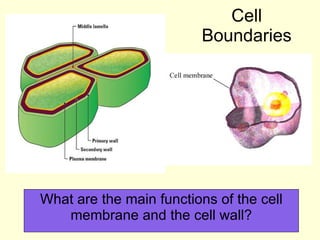
Cell Boundaries What are the main functions of the cell membrane and the cell wall?
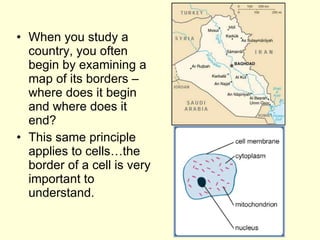
When you study a country, you often begin by examining a map of its borders – where does it begin and where does it end? This same principle applies to cells…the border of a cell is very important to understand.
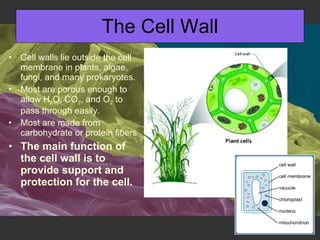
The Cell Wall Cell walls lie outside the cell membrane in plants, algae, fungi, and many prokaryotes. Most are porous enough to allow H 2 O, CO 2 , and O 2  to pass through easily. Most are made from carbohydrate or protein fibers The main function of the cell wall is to provide support and protection for the cell.
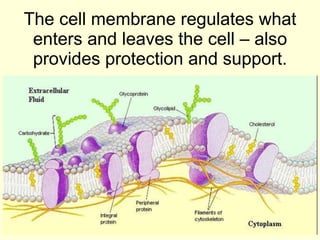
The cell membrane regulates what enters and leaves the cell – also provides protection and support.
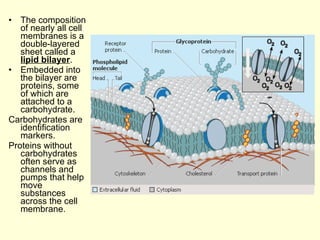
The composition of nearly all cell membranes is a double-layered sheet called a  lipid bilayer . Embedded into the bilayer are proteins, some of which are attached to a carbohydrate. Carbohydrates are identification markers. Proteins without carbohydrates often serve as channels and pumps that help move substances across the cell membrane.
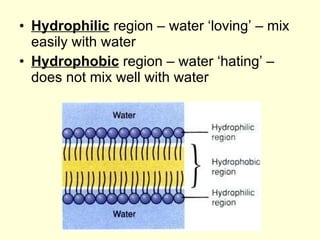
Hydrophilic  region – water ‘loving’ – mix easily with water Hydrophobic  region – water ‘hating’ – does not mix well with water
[What moves into and out of cells?] In     food, carbohydrates (sugars), proteins, lipids, O 2 , H 2 O Out     wastes (ammonia), CO 2 , H 2 O… [What determines the rate and the direction of this movement across the membrane?] Concentration gradient  – the difference in concentration across a space…  ( solvent / solute ) Often the movement will continue until  equilibrium  is reached – equal concentrations on both sides of the membrane (equal movement in both directions)
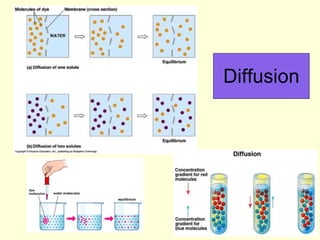
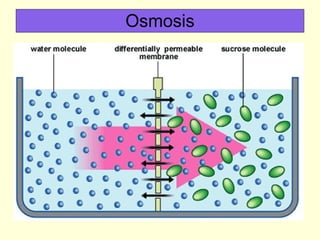
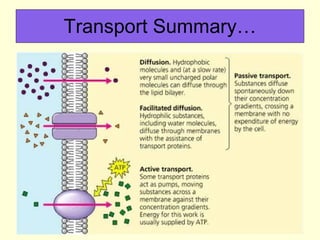
There are two main types of transport Passive Transport  – movement that does not require energy.  The cell does not have to generate any energy to accomplish this type of movement. The most well known example of passive transport is… DIFFUSION  – the movement of a substance from an area of high(er) concentration to an area of low(er) concentration. When water moves, we call it… OSMOSIS  – the diffusion of water through a semi-permeable membrane
Diffusion
Osmosis
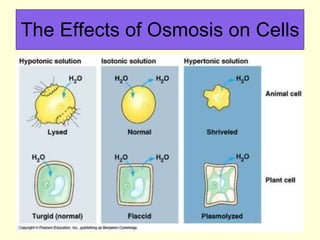
How does  OSMOSIS  work? Water will move into the cell . [When the surrounding fluid contains a lower concentration of dissolved materials than the cell does…] … Water moves into the cell…Why?... … The solution outside of the cell has a lower solute concentration than the cell itself. The cell is in a  hypotonic  solution.
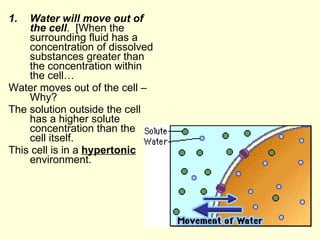
Water will move out of the cell .  [When the surrounding fluid has a concentration of dissolved substances greater than the concentration within the cell… Water moves out of the cell – Why? The solution outside the cell has a higher solute concentration than the cell itself.  This cell is in a  hypertonic  environment.
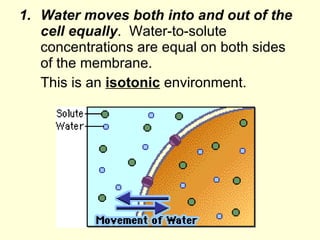
Water moves both into and out of the cell   equally .  Water-to-solute concentrations are equal on both sides of the membrane. This is an  isotonic  environment.
The Effects of Osmosis on Cells
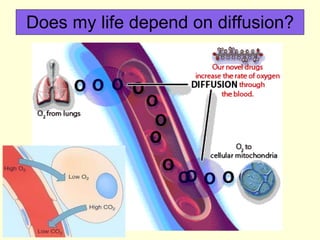
Does my life depend on diffusion?
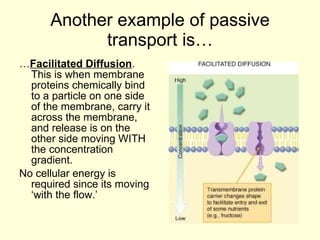
Another example of passive transport is… … Facilitated Diffusion .  This is when membrane proteins chemically bind to a particle on one side of the membrane, carry it across the membrane, and release is on the other side moving WITH the concentration gradient. No cellular energy is required since its moving ‘with the flow.’
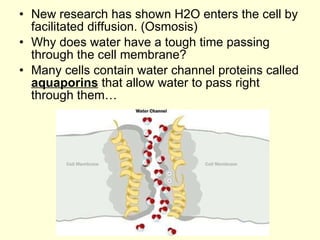
New research has shown H2O enters the cell by facilitated diffusion. (Osmosis) Why does water have a tough time passing through the cell membrane? Many cells contain water channel proteins called  aquaporins  that allow water to pass right through them…
Another application… What disease does these people suffer from?
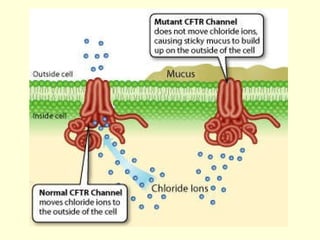
Cystic Fibrosis CF is an incurable genetic disease that affects 1 in every 3,000 Caucasian births. It involves a chronic cough, lung infections, and digestion problems. 25% of patients survive in their 30’s. What causes it? CF is caused by a mutation in the gene of a membrane protein (CFTR protein) – this protein is a part of the cell membrane and helps regulate the movement of chlorine ions (Cl - ) across the cell membrane.
 
The inability to regulate the movement of Cl -  ions results in an imbalance of water – a thick mucus builds up… … on the cells of the lungs (this makes one vulnerable to lung infections) … on cells in the digestive system (this blocks the release of digestive enzymes) … on reproductive organs (infertility may be a problem – sperm can’t get to egg) The POINT     Serious issues may arise when your cell losses its ability to regulate what substances can and can’t move across its membrane…
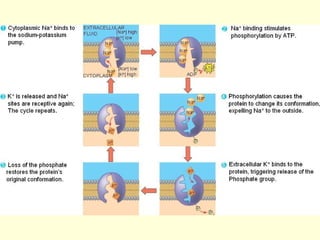
Active Transport  - movement that does require energy.  The cell plays an active role in accomplishing these particle movements. Examples – All animal cells use the  sodium-potassium  pump to move Na +  and K +  across a membrane. [see next slide]
 
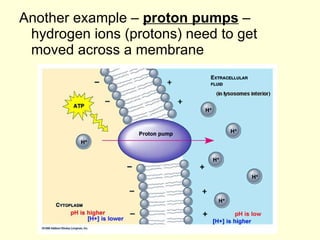
Another example –  proton pumps  – hydrogen ions (protons) need to get moved across a membrane
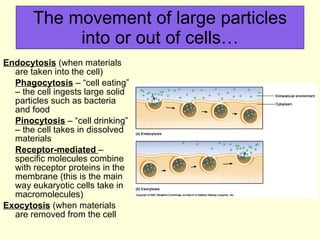
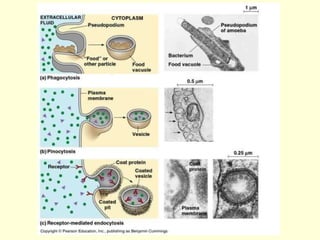
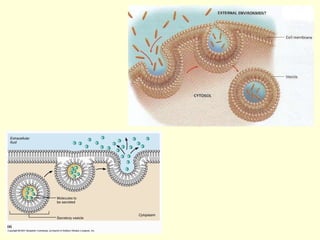
The movement of large particles into or out of cells… Endocytosis  (when materials are taken into the cell) Phagocytosis  – “cell eating” – the cell ingests large solid particles such as bacteria and food Pinocytosis  – “cell drinking” – the cell takes in dissolved materials Receptor-mediated  – specific molecules combine with receptor proteins in the membrane (this is the main way eukaryotic cells take in  macromolecules) Exocytosis  (when materials are removed from the cell
 
 
Transport Summary…

Cells

  • 1.
    Cell Boundaries Whatare the main functions of the cell membrane and the cell wall?
  • 2.
    When you studya country, you often begin by examining a map of its borders – where does it begin and where does it end? This same principle applies to cells…the border of a cell is very important to understand.
  • 3.
    The Cell WallCell walls lie outside the cell membrane in plants, algae, fungi, and many prokaryotes. Most are porous enough to allow H 2 O, CO 2 , and O 2 to pass through easily. Most are made from carbohydrate or protein fibers The main function of the cell wall is to provide support and protection for the cell.
  • 4.
    The cell membraneregulates what enters and leaves the cell – also provides protection and support.
  • 5.
    The composition ofnearly all cell membranes is a double-layered sheet called a lipid bilayer . Embedded into the bilayer are proteins, some of which are attached to a carbohydrate. Carbohydrates are identification markers. Proteins without carbohydrates often serve as channels and pumps that help move substances across the cell membrane.
  • 6.
    Hydrophilic region– water ‘loving’ – mix easily with water Hydrophobic region – water ‘hating’ – does not mix well with water
  • 7.
    [What moves intoand out of cells?] In  food, carbohydrates (sugars), proteins, lipids, O 2 , H 2 O Out  wastes (ammonia), CO 2 , H 2 O… [What determines the rate and the direction of this movement across the membrane?] Concentration gradient – the difference in concentration across a space… ( solvent / solute ) Often the movement will continue until equilibrium is reached – equal concentrations on both sides of the membrane (equal movement in both directions)
  • 8.
    There are twomain types of transport Passive Transport – movement that does not require energy. The cell does not have to generate any energy to accomplish this type of movement. The most well known example of passive transport is… DIFFUSION – the movement of a substance from an area of high(er) concentration to an area of low(er) concentration. When water moves, we call it… OSMOSIS – the diffusion of water through a semi-permeable membrane
  • 9.
  • 10.
  • 11.
    How does OSMOSIS work? Water will move into the cell . [When the surrounding fluid contains a lower concentration of dissolved materials than the cell does…] … Water moves into the cell…Why?... … The solution outside of the cell has a lower solute concentration than the cell itself. The cell is in a hypotonic solution.
  • 12.
    Water will moveout of the cell . [When the surrounding fluid has a concentration of dissolved substances greater than the concentration within the cell… Water moves out of the cell – Why? The solution outside the cell has a higher solute concentration than the cell itself. This cell is in a hypertonic environment.
  • 13.
    Water moves bothinto and out of the cell equally . Water-to-solute concentrations are equal on both sides of the membrane. This is an isotonic environment.
  • 14.
    The Effects ofOsmosis on Cells
  • 15.
    Does my lifedepend on diffusion?
  • 16.
    Another example ofpassive transport is… … Facilitated Diffusion . This is when membrane proteins chemically bind to a particle on one side of the membrane, carry it across the membrane, and release is on the other side moving WITH the concentration gradient. No cellular energy is required since its moving ‘with the flow.’
  • 17.
    New research hasshown H2O enters the cell by facilitated diffusion. (Osmosis) Why does water have a tough time passing through the cell membrane? Many cells contain water channel proteins called aquaporins that allow water to pass right through them…
  • 18.
    Another application… Whatdisease does these people suffer from?
  • 19.
    Cystic Fibrosis CFis an incurable genetic disease that affects 1 in every 3,000 Caucasian births. It involves a chronic cough, lung infections, and digestion problems. 25% of patients survive in their 30’s. What causes it? CF is caused by a mutation in the gene of a membrane protein (CFTR protein) – this protein is a part of the cell membrane and helps regulate the movement of chlorine ions (Cl - ) across the cell membrane.
  • 20.
  • 21.
    The inability toregulate the movement of Cl - ions results in an imbalance of water – a thick mucus builds up… … on the cells of the lungs (this makes one vulnerable to lung infections) … on cells in the digestive system (this blocks the release of digestive enzymes) … on reproductive organs (infertility may be a problem – sperm can’t get to egg) The POINT  Serious issues may arise when your cell losses its ability to regulate what substances can and can’t move across its membrane…
  • 22.
    Active Transport - movement that does require energy. The cell plays an active role in accomplishing these particle movements. Examples – All animal cells use the sodium-potassium pump to move Na + and K + across a membrane. [see next slide]
  • 23.
  • 24.
    Another example – proton pumps – hydrogen ions (protons) need to get moved across a membrane
  • 25.
    The movement oflarge particles into or out of cells… Endocytosis (when materials are taken into the cell) Phagocytosis – “cell eating” – the cell ingests large solid particles such as bacteria and food Pinocytosis – “cell drinking” – the cell takes in dissolved materials Receptor-mediated – specific molecules combine with receptor proteins in the membrane (this is the main way eukaryotic cells take in macromolecules) Exocytosis (when materials are removed from the cell
  • 26.
  • 27.
  • 28.