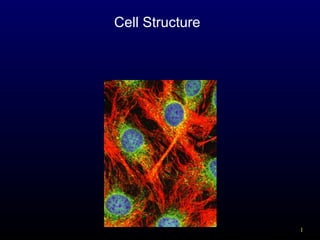
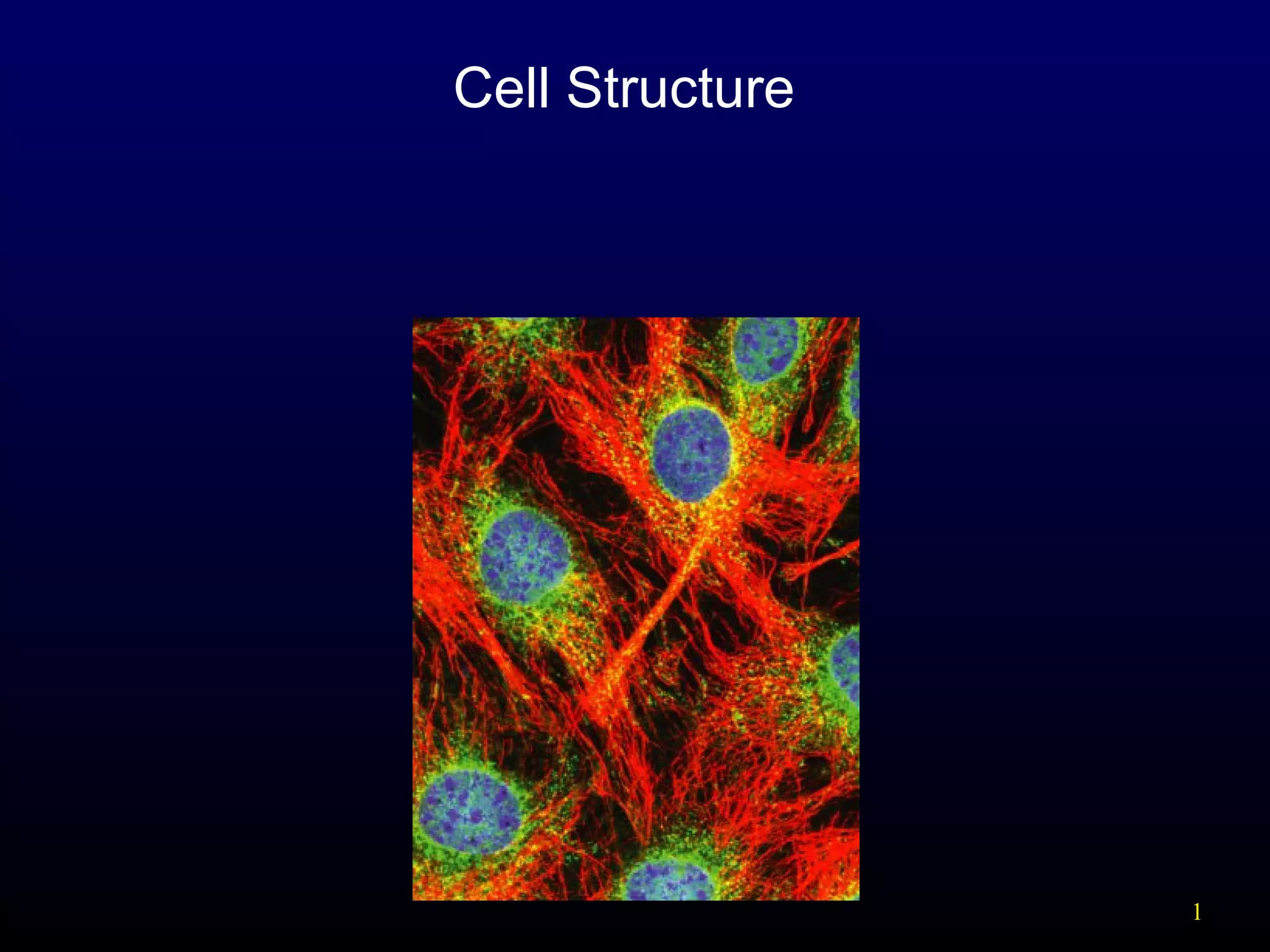
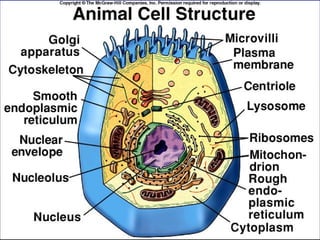
Cell Structure

1
Cell Theory
•

•

•

All organisms are composed of one or more
cells.
Cells are the smallest living units of all living
organisms.
Cells arise only by division of a previously
existing cell.

2
•

•

•

Cell Characteristics
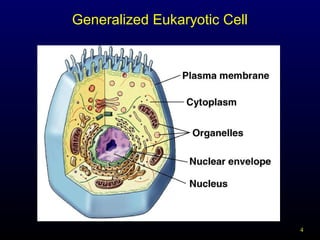
Genetic material
– single circular molecule of DNA in
prokaryotes
– double helix located in nucleus in
eukaryotes – nuclear envelope (double
membrane
Cytoplasm fills cell interior –
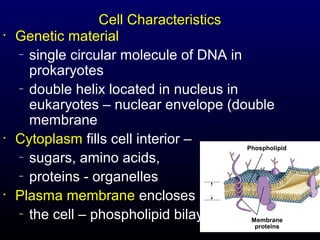
Phospholipid
– sugars, amino acids,
– proteins - organelles
Plasma membrane encloses
– the cell – phospholipid bilayer
Membrane
proteins

3
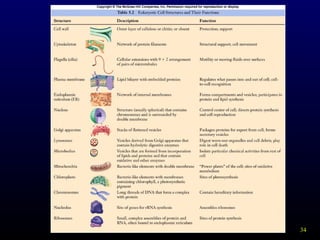
Generalized Eukaryotic Cell

4
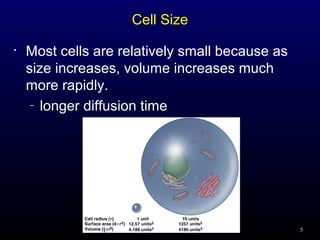
Cell Size
•

Most cells are relatively small because as
size increases, volume increases much
more rapidly.
– longer diffusion time

5
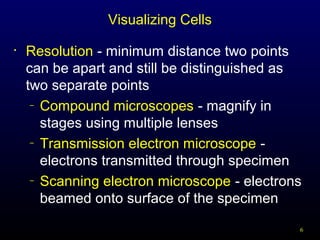
Visualizing Cells
•

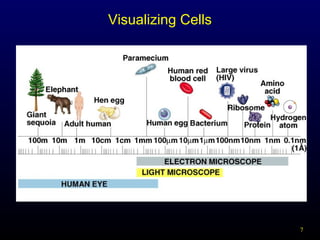
Resolution - minimum distance two points
can be apart and still be distinguished as
two separate points
– Compound microscopes - magnify in
stages using multiple lenses
– Transmission electron microscope electrons transmitted through specimen
– Scanning electron microscope - electrons
beamed onto surface of the specimen
6
Visualizing Cells

7
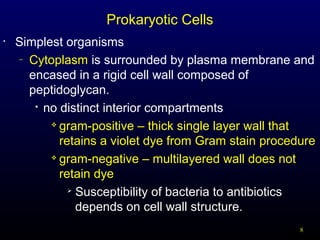
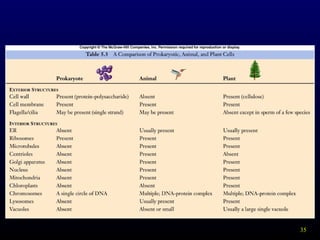
Prokaryotic Cells
•

Simplest organisms
– Cytoplasm is surrounded by plasma membrane and
encased in a rigid cell wall composed of
peptidoglycan.
 no distinct interior compartments

gram-positive – thick single layer wall that
retains a violet dye from Gram stain procedure
 gram-negative – multilayered wall does not
retain dye

Susceptibility of bacteria to antibiotics
depends on cell wall structure.
8
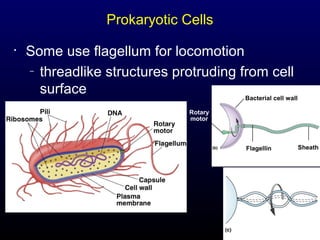
Prokaryotic Cells
•

Some use flagellum for locomotion
– threadlike structures protruding from cell
surface
Bacterial cell wall
Rotary
motor

Flagellin

Sheath

9
Eukaryotic Cells
•

Characterized by compartmentalization by
an endomembrane system, and the
presence of membrane-bound organelles.
– Central vacuole – plants, storage
– Vesicles (smaller)
– Chromosomes - DNA and protein
– Cytoskeleton (internal protein scaffolding)
– Cell walls – plants and fungi
10
11
12
•
•
•

•

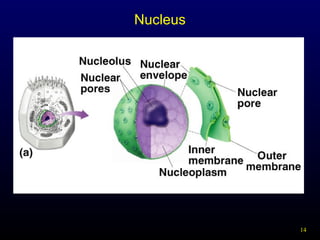
Nucleus
Repository for genetic material
Directs activities of the cell
Usually single, some cells several, RBC none
– Nucleolus - region of intensive ribosomal
RNA synthesis
Surface of nucleus bound by two
phospholipid bilayer membranes
– nuclear membrane
– Nuclear pores – protein gatekeepers

Usually proteins going in and RNA going
out
13
Nucleus

14
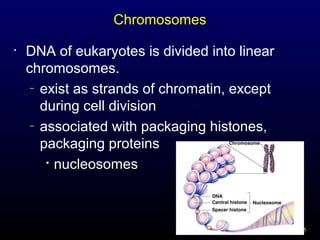
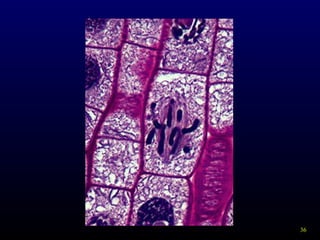
Chromosomes
•

DNA of eukaryotes is divided into linear
chromosomes.
– exist as strands of chromatin, except
during cell division
– associated with packaging histones,
packaging proteins
 nucleosomes

15
•

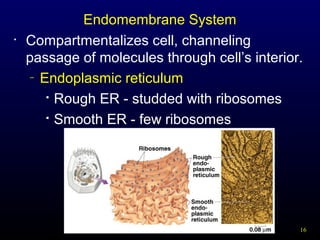
Endomembrane System
Compartmentalizes cell, channeling
passage of molecules through cell’s interior.
– Endoplasmic reticulum
 Rough ER - studded with ribosomes

Smooth ER - few ribosomes

16
Endoplasmic reticulum
•
•
•

•
•

•

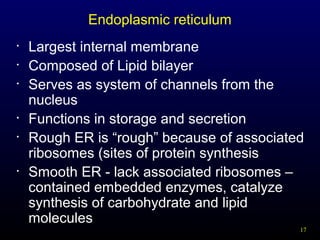
Largest internal membrane
Composed of Lipid bilayer
Serves as system of channels from the
nucleus
Functions in storage and secretion
Rough ER is “rough” because of associated
ribosomes (sites of protein synthesis
Smooth ER - lack associated ribosomes –
contained embedded enzymes, catalyze
synthesis of carbohydrate and lipid
molecules
17
•

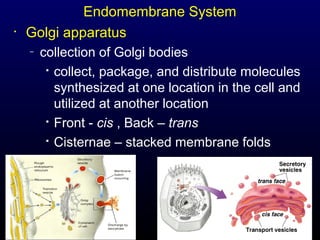
Endomembrane System
Golgi apparatus
–

collection of Golgi bodies
 collect, package, and distribute molecules
synthesized at one location in the cell and
utilized at another location
 Front - cis , Back – trans

Cisternae – stacked membrane folds

18
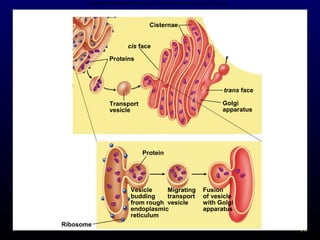
Copyright © The McGraw-Hill Companies, Inc. Permission required for reproduction or display.

Cisternae
cis face
Proteins

trans face
Golgi
apparatus

Transport
vesicle

Protein

Vesicle
Migrating
budding
transport
from rough vesicle
endoplasmic
reticulum
Ribosome

Fusion
of vesicle
with Golgi
apparatus
19
Endomembrane System
•

Vesicles
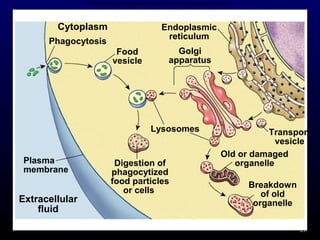
– Lysosomes - membrane-bound vesicles
containing digestive enzymes – from Golgi
– Microbodies - enzyme-bearing,
membrane-enclosed vesicles.

Peroxisomes - contain enzymes that
catalyze the removal of electrons and
associated hydrogen atoms
 Peroxisome – named for hydrogen
peroxide produced as a by-product

Enzyme breaks down to water and
oxygen
20
Copyright © The McGraw-Hill Companies, Inc. Permission required for reproduction or display.

Cytoplasm

Endoplasmic
reticulum

Phagocytosis
Food
vesicle

Golgi
apparatus

Lysosomes
Plasma
membrane

Extracellular
fluid

Digestion of
phagocytized
food particles
or cells

Transport
vesicle
Old or damaged
organelle
Breakdown
of old
organelle
21
Ribosomes
•

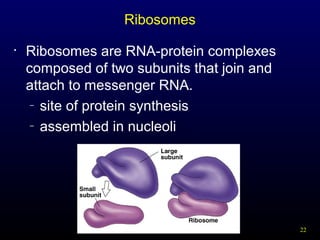
Ribosomes are RNA-protein complexes
composed of two subunits that join and
attach to messenger RNA.
– site of protein synthesis
– assembled in nucleoli

22
Organelles With DNA
•

•

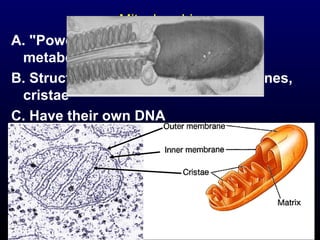
Mitochondria
– bounded by exterior and interior
membranes
– interior partitioned by cristae
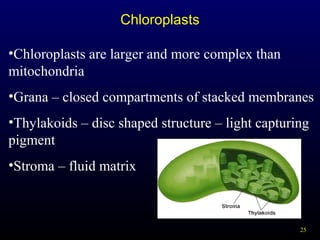
Chloroplasts
– have enclosed internal compartments of
stacked grana, containing thylakoids
– found in photosynthetic organisms
23
Mitochondria
A. "Powerhouse of the cell" - cellular
metabolism
B. Structure- outer and inner membranes,
cristae
C. Have their own DNA

24
Chloroplasts
•Chloroplasts are larger and more complex than
mitochondria
•Grana – closed compartments of stacked membranes
•Thylakoids – disc shaped structure – light capturing
pigment
•Stroma – fluid matrix

25
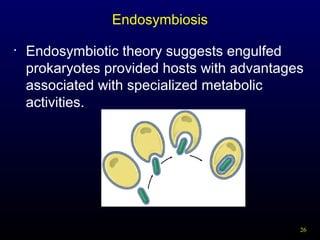
Endosymbiosis
•

Endosymbiotic theory suggests engulfed
prokaryotes provided hosts with advantages
associated with specialized metabolic
activities.

26
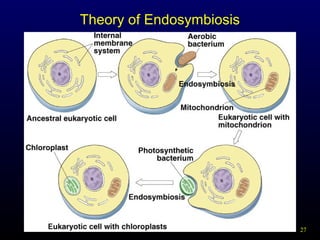
Theory of Endosymbiosis

27
Evidence for the endosymbiont theory is that
mitochondria and chloroplasts:
- Are appropriate size to be descendants of eubacteria.
- Have inner membranes similar to those on prokaryotic
plasma membranes.
- Replicate by splitting, as in prokaryotes.
- DNA is circular and different from the DNA of the cell's
nucleus.
- Contain their own components for DNA transcription and
translation into proteins .
- Have ribosomes similar to prokaryotic ribosomes.
- Molecular systematics lend evidence to support this
theory.
- Many extant organisms are involved in endosymbiotic
relationships.
28
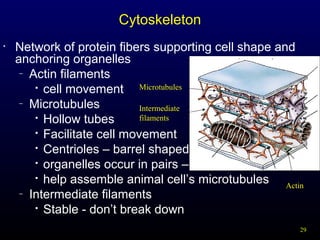
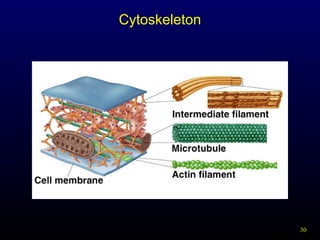
Cytoskeleton
•

Network of protein fibers supporting cell shape and
anchoring organelles
– Actin filaments
Microtubules
 cell movement
– Microtubules
Intermediate
 Hollow tubes
filaments

Facilitate cell movement
 Centrioles – barrel shaped

organelles occur in pairs –
 help assemble animal cell’s microtubules
Actin
– Intermediate filaments
 Stable - don’t break down
29
Cytoskeleton

30
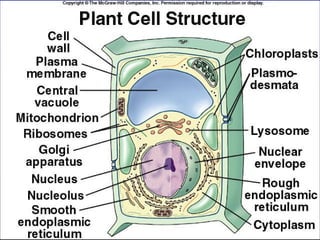
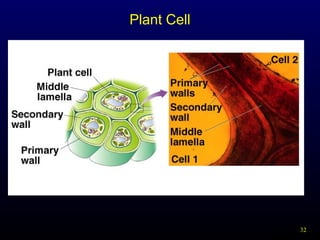
Plant Cells
•

•

Central vacuole
– often found in the center of a plant, and
serves as a storage facility for water and
other materials
Cell wall
– primary walls – laid down while cell is
growing
– middle lamella – glues cells together
– secondary walls – inside the primary cell
walls after growth
31
Plant Cell

32
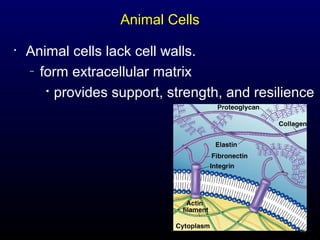
Animal Cells
•

Animal cells lack cell walls.
– form extracellular matrix
 provides support, strength, and resilience

33
34
35
36

Cell structure

  • 1.
  • 2.
    Cell Theory • • • All organismsare composed of one or more cells. Cells are the smallest living units of all living organisms. Cells arise only by division of a previously existing cell. 2
  • 3.
    • • • Cell Characteristics Genetic material –single circular molecule of DNA in prokaryotes – double helix located in nucleus in eukaryotes – nuclear envelope (double membrane Cytoplasm fills cell interior – Phospholipid – sugars, amino acids, – proteins - organelles Plasma membrane encloses – the cell – phospholipid bilayer Membrane proteins 3
  • 4.
  • 5.
    Cell Size • Most cellsare relatively small because as size increases, volume increases much more rapidly. – longer diffusion time 5
  • 6.
    Visualizing Cells • Resolution -minimum distance two points can be apart and still be distinguished as two separate points – Compound microscopes - magnify in stages using multiple lenses – Transmission electron microscope electrons transmitted through specimen – Scanning electron microscope - electrons beamed onto surface of the specimen 6
  • 7.
  • 8.
    Prokaryotic Cells • Simplest organisms –Cytoplasm is surrounded by plasma membrane and encased in a rigid cell wall composed of peptidoglycan.  no distinct interior compartments  gram-positive – thick single layer wall that retains a violet dye from Gram stain procedure  gram-negative – multilayered wall does not retain dye  Susceptibility of bacteria to antibiotics depends on cell wall structure. 8
  • 9.
    Prokaryotic Cells • Some useflagellum for locomotion – threadlike structures protruding from cell surface Bacterial cell wall Rotary motor Flagellin Sheath 9
  • 10.
    Eukaryotic Cells • Characterized bycompartmentalization by an endomembrane system, and the presence of membrane-bound organelles. – Central vacuole – plants, storage – Vesicles (smaller) – Chromosomes - DNA and protein – Cytoskeleton (internal protein scaffolding) – Cell walls – plants and fungi 10
  • 11.
  • 12.
  • 13.
    • • • • Nucleus Repository for geneticmaterial Directs activities of the cell Usually single, some cells several, RBC none – Nucleolus - region of intensive ribosomal RNA synthesis Surface of nucleus bound by two phospholipid bilayer membranes – nuclear membrane – Nuclear pores – protein gatekeepers  Usually proteins going in and RNA going out 13
  • 14.
  • 15.
    Chromosomes • DNA of eukaryotesis divided into linear chromosomes. – exist as strands of chromatin, except during cell division – associated with packaging histones, packaging proteins  nucleosomes 15
  • 16.
    • Endomembrane System Compartmentalizes cell,channeling passage of molecules through cell’s interior. – Endoplasmic reticulum  Rough ER - studded with ribosomes  Smooth ER - few ribosomes 16
  • 17.
    Endoplasmic reticulum • • • • • • Largest internalmembrane Composed of Lipid bilayer Serves as system of channels from the nucleus Functions in storage and secretion Rough ER is “rough” because of associated ribosomes (sites of protein synthesis Smooth ER - lack associated ribosomes – contained embedded enzymes, catalyze synthesis of carbohydrate and lipid molecules 17
  • 18.
    • Endomembrane System Golgi apparatus – collectionof Golgi bodies  collect, package, and distribute molecules synthesized at one location in the cell and utilized at another location  Front - cis , Back – trans  Cisternae – stacked membrane folds 18
  • 19.
    Copyright © TheMcGraw-Hill Companies, Inc. Permission required for reproduction or display. Cisternae cis face Proteins trans face Golgi apparatus Transport vesicle Protein Vesicle Migrating budding transport from rough vesicle endoplasmic reticulum Ribosome Fusion of vesicle with Golgi apparatus 19
  • 20.
    Endomembrane System • Vesicles – Lysosomes- membrane-bound vesicles containing digestive enzymes – from Golgi – Microbodies - enzyme-bearing, membrane-enclosed vesicles.  Peroxisomes - contain enzymes that catalyze the removal of electrons and associated hydrogen atoms  Peroxisome – named for hydrogen peroxide produced as a by-product  Enzyme breaks down to water and oxygen 20
  • 21.
    Copyright © TheMcGraw-Hill Companies, Inc. Permission required for reproduction or display. Cytoplasm Endoplasmic reticulum Phagocytosis Food vesicle Golgi apparatus Lysosomes Plasma membrane Extracellular fluid Digestion of phagocytized food particles or cells Transport vesicle Old or damaged organelle Breakdown of old organelle 21
  • 22.
    Ribosomes • Ribosomes are RNA-proteincomplexes composed of two subunits that join and attach to messenger RNA. – site of protein synthesis – assembled in nucleoli 22
  • 23.
    Organelles With DNA • • Mitochondria –bounded by exterior and interior membranes – interior partitioned by cristae Chloroplasts – have enclosed internal compartments of stacked grana, containing thylakoids – found in photosynthetic organisms 23
  • 24.
    Mitochondria A. "Powerhouse ofthe cell" - cellular metabolism B. Structure- outer and inner membranes, cristae C. Have their own DNA 24
  • 25.
    Chloroplasts •Chloroplasts are largerand more complex than mitochondria •Grana – closed compartments of stacked membranes •Thylakoids – disc shaped structure – light capturing pigment •Stroma – fluid matrix 25
  • 26.
    Endosymbiosis • Endosymbiotic theory suggestsengulfed prokaryotes provided hosts with advantages associated with specialized metabolic activities. 26
  • 27.
  • 28.
    Evidence for theendosymbiont theory is that mitochondria and chloroplasts: - Are appropriate size to be descendants of eubacteria. - Have inner membranes similar to those on prokaryotic plasma membranes. - Replicate by splitting, as in prokaryotes. - DNA is circular and different from the DNA of the cell's nucleus. - Contain their own components for DNA transcription and translation into proteins . - Have ribosomes similar to prokaryotic ribosomes. - Molecular systematics lend evidence to support this theory. - Many extant organisms are involved in endosymbiotic relationships. 28
  • 29.
    Cytoskeleton • Network of proteinfibers supporting cell shape and anchoring organelles – Actin filaments Microtubules  cell movement – Microtubules Intermediate  Hollow tubes filaments  Facilitate cell movement  Centrioles – barrel shaped  organelles occur in pairs –  help assemble animal cell’s microtubules Actin – Intermediate filaments  Stable - don’t break down 29
  • 30.
  • 31.
    Plant Cells • • Central vacuole –often found in the center of a plant, and serves as a storage facility for water and other materials Cell wall – primary walls – laid down while cell is growing – middle lamella – glues cells together – secondary walls – inside the primary cell walls after growth 31
  • 32.
  • 33.
    Animal Cells • Animal cellslack cell walls. – form extracellular matrix  provides support, strength, and resilience 33
  • 34.
  • 35.
  • 36.