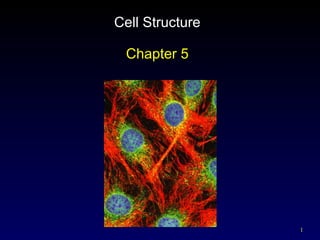
Cell Structure Chapter 5
Outline Cell Theory Cell Size Prokaryotic Cells Eukaryotic Cells Organelles Containing DNA Endosymbiosis Plant Cells  Animal Cells
Cell Characteristics Genetic material single circular molecule in prokaryotes double helix located in nucleus in eukaryotes Cytoplasm  fills cell interior Plasma membrane  encloses the cell
Generalized Eukaryotic Cell
Cell Theory All organisms are composed of one or more cells. Cells are the smallest living units of all living organisms. Cells arise only by division of a previously existing cell.
Cell Size Most cells are relatively small because as size increases, volume increases much more rapidly. longer diffusion time
Visualizing Cells Resolution  - minimum distance two points can be apart and still be distinguished as two separate points Compound microscopes  - magnify in stages using multiple lenses Transmission electron microscope  - electrons transmitted through specimen Scanning electron microscope  - electrons beamed onto surface of the specimen
Visualizing Cells
Prokaryotic Cells Simplest organisms Cytoplasm  is surrounded by plasma membrane and encased in a rigid cell wall composed of peptidoglycan. no distinct interior compartments gram-positive gram-negative Susceptibility of bacteria to antibiotics depends on cell wall structure.
Prokaryotic Cells Some use flagellum for locomotion threadlike structures protruding from cell surface
Eukaryotic Cells Characterized by compartmentalization by an endomembrane system, and the presence of membrane-bound organelles. central vacuole vesicles chromosomes cytoskeleton cell walls
Nucleus Repository for genetic material Nucleolus  - region of intensive ribosomal RNA synthesis Surface of nucleus bound by two phospholipid bilayer membranes nuclear membrane
Nucleus
Chromosomes DNA of eukaryotes is divided into linear chromosomes. exist as strands of chromatin, except during cell division associated with packaging histones, packaging proteins nucleosomes
Endomembrane System Compartmentalizes cell, channeling passage of molecules through cell’s interior. Endoplasmic reticulum Rough ER - studded with ribosomes Smooth ER - few ribosomes
Endomembrane System Golgi apparatus collection of Golgi bodies collect, package, and distribute molecules synthesized at one location in the cell and utilized at another location
Endomembrane System Vesicles Lysosomes  - membrane-bound digestive vesicles Microbodies  - enzyme-bearing, membrane-enclosed vesicles. Peroxisomes - contain enzymes that catalyze the removal of electrons and associated hydrogen atoms
Ribosomes Ribosomes are RNA-protein complexes composed of two subunits that join and attach to messenger RNA. site of protein synthesis assembled in nucleoli
Organelles With DNA Mitochondria   bounded by exterior and interior membranes interior partitioned by cristae Chloroplasts have enclosed internal compartments of stacked grana, containing thylakoids found in photosynthetic organisms
Endosymbiosis Endosymbiotic theory suggests engulfed prokaryotes provided hosts with advantages associated with specialized metabolic activities.
Cytoskeleton Network of protein fibers supporting cell shape and anchoring organelles Actin filaments cell movement Microtubules centrioles Intermediate filaments
Cytoskeleton
Plant Cells  Central vacuole   often found in the center of a plant, and serves as a storage facility for water and other materials Cell wall primary walls middle lamella secondary walls
Plant Cell
Animal Cells Animal cells lack cell walls. form extracellular matrix provides support, strength, and resilience
Summary Cell Theory Cell Size Prokaryotic Cells Eukaryotic Cells Organelles Containing DNA Endosymbiosis Plant Cells  Animal Cells
 

Cells

  • 1.
  • 2.
    Outline Cell TheoryCell Size Prokaryotic Cells Eukaryotic Cells Organelles Containing DNA Endosymbiosis Plant Cells Animal Cells
  • 3.
    Cell Characteristics Geneticmaterial single circular molecule in prokaryotes double helix located in nucleus in eukaryotes Cytoplasm fills cell interior Plasma membrane encloses the cell
  • 4.
  • 5.
    Cell Theory Allorganisms are composed of one or more cells. Cells are the smallest living units of all living organisms. Cells arise only by division of a previously existing cell.
  • 6.
    Cell Size Mostcells are relatively small because as size increases, volume increases much more rapidly. longer diffusion time
  • 7.
    Visualizing Cells Resolution - minimum distance two points can be apart and still be distinguished as two separate points Compound microscopes - magnify in stages using multiple lenses Transmission electron microscope - electrons transmitted through specimen Scanning electron microscope - electrons beamed onto surface of the specimen
  • 8.
  • 9.
    Prokaryotic Cells Simplestorganisms Cytoplasm is surrounded by plasma membrane and encased in a rigid cell wall composed of peptidoglycan. no distinct interior compartments gram-positive gram-negative Susceptibility of bacteria to antibiotics depends on cell wall structure.
  • 10.
    Prokaryotic Cells Someuse flagellum for locomotion threadlike structures protruding from cell surface
  • 11.
    Eukaryotic Cells Characterizedby compartmentalization by an endomembrane system, and the presence of membrane-bound organelles. central vacuole vesicles chromosomes cytoskeleton cell walls
  • 12.
    Nucleus Repository forgenetic material Nucleolus - region of intensive ribosomal RNA synthesis Surface of nucleus bound by two phospholipid bilayer membranes nuclear membrane
  • 13.
  • 14.
    Chromosomes DNA ofeukaryotes is divided into linear chromosomes. exist as strands of chromatin, except during cell division associated with packaging histones, packaging proteins nucleosomes
  • 15.
    Endomembrane System Compartmentalizescell, channeling passage of molecules through cell’s interior. Endoplasmic reticulum Rough ER - studded with ribosomes Smooth ER - few ribosomes
  • 16.
    Endomembrane System Golgiapparatus collection of Golgi bodies collect, package, and distribute molecules synthesized at one location in the cell and utilized at another location
  • 17.
    Endomembrane System VesiclesLysosomes - membrane-bound digestive vesicles Microbodies - enzyme-bearing, membrane-enclosed vesicles. Peroxisomes - contain enzymes that catalyze the removal of electrons and associated hydrogen atoms
  • 18.
    Ribosomes Ribosomes areRNA-protein complexes composed of two subunits that join and attach to messenger RNA. site of protein synthesis assembled in nucleoli
  • 19.
    Organelles With DNAMitochondria bounded by exterior and interior membranes interior partitioned by cristae Chloroplasts have enclosed internal compartments of stacked grana, containing thylakoids found in photosynthetic organisms
  • 20.
    Endosymbiosis Endosymbiotic theorysuggests engulfed prokaryotes provided hosts with advantages associated with specialized metabolic activities.
  • 21.
    Cytoskeleton Network ofprotein fibers supporting cell shape and anchoring organelles Actin filaments cell movement Microtubules centrioles Intermediate filaments
  • 22.
  • 23.
    Plant Cells Central vacuole often found in the center of a plant, and serves as a storage facility for water and other materials Cell wall primary walls middle lamella secondary walls
  • 24.
  • 25.
    Animal Cells Animalcells lack cell walls. form extracellular matrix provides support, strength, and resilience
  • 26.
    Summary Cell TheoryCell Size Prokaryotic Cells Eukaryotic Cells Organelles Containing DNA Endosymbiosis Plant Cells Animal Cells
  • 27.