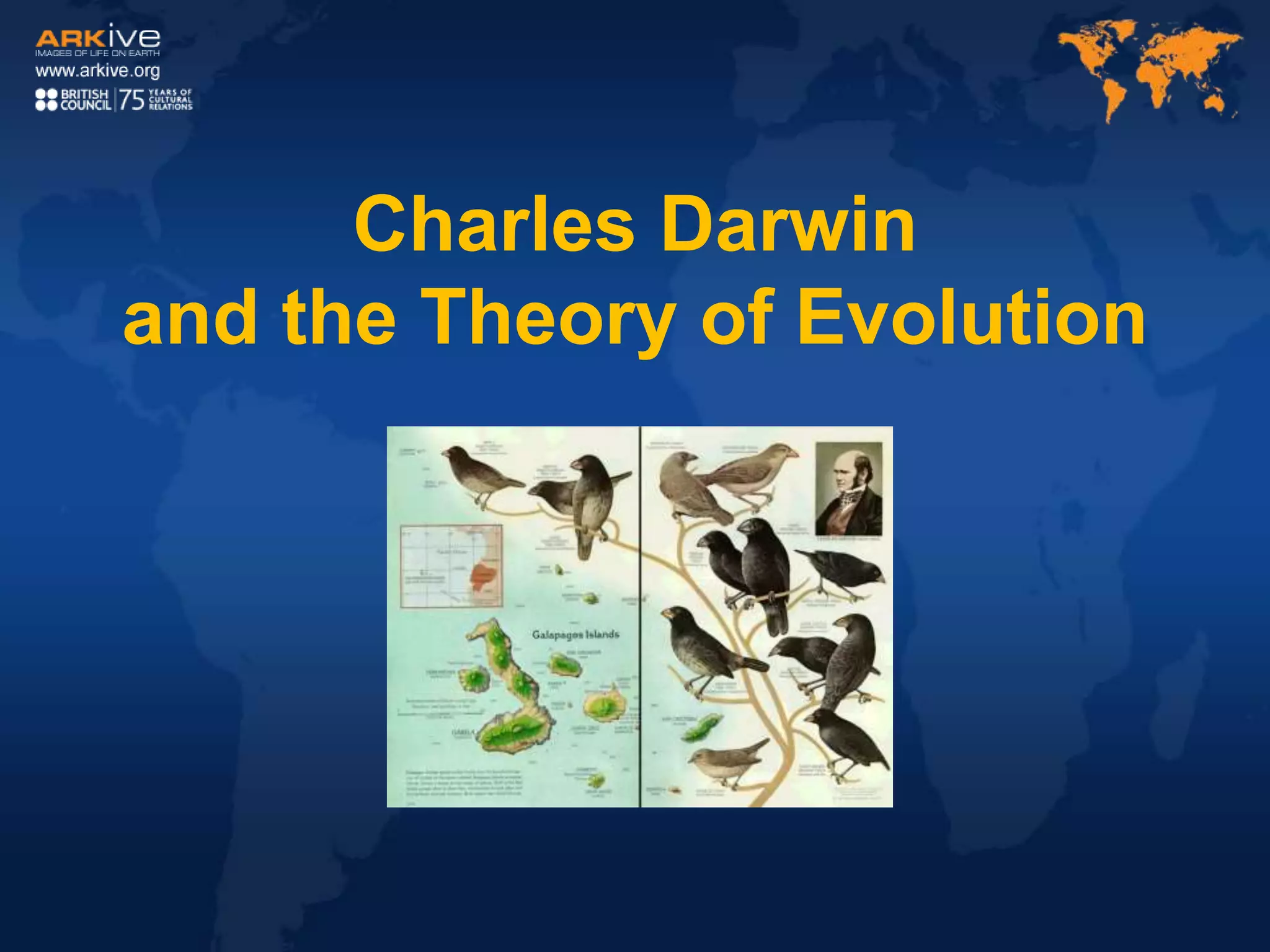
Charles Darwin
and the Theory of Evolution
Charles Darwin developed his
theory of evolution using four
observations and two
deductions.
Observation #1:
All organisms produce more
offspring than survive to
adulthood.
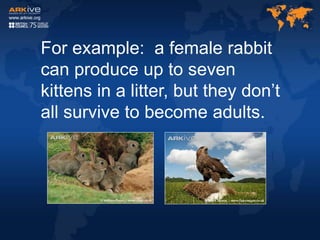
For example: a female rabbit
can produce up to seven
kittens in a litter, but they don’t
all survive to become adults.
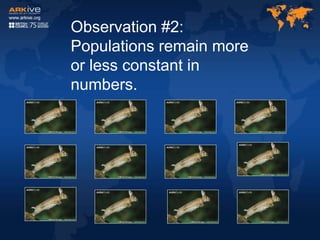
Observation #2:
Populations remain more
or less constant in
numbers.
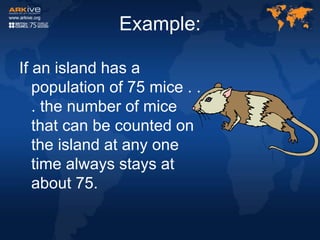
Example:
If an island has a
population of 75 mice . .
. the number of mice
that can be counted on
the island at any one
time always stays at
about 75.
Observation #3:
Members of the same
species show variation
in characteristics.
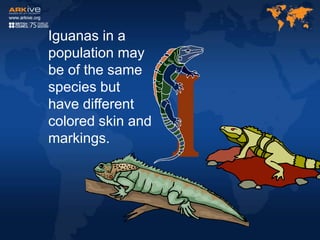
Iguanas in a
population may
be of the same
species but
have different
colored skin and
markings.
Observation #4: Some
characteristics are inherited
and are passed on to the
next generation.
Example: finches with a
beaks of a certain shape
pass on that characteristic to
their offspring.
Darwin came to 2 deductions as a
result of his observations.
Deduction #1: All organisms are
involved in a struggle for survival
and only the best adapted
survive. This is also know as
“Survival of the Fittest”.
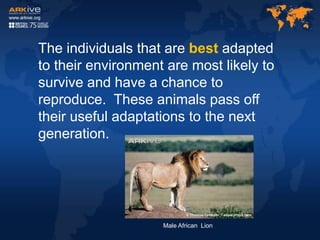
The individuals that are best adapted
to their environment are most likely to
survive and have a chance to
reproduce. These animals pass off
their useful adaptations to the next
generation.
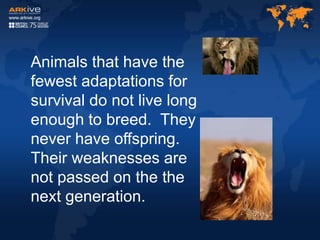
Male African Lion
Animals that have the
fewest adaptations for
survival do not live long
enough to breed. They
never have offspring.
Their weaknesses are
not passed on the the
next generation.
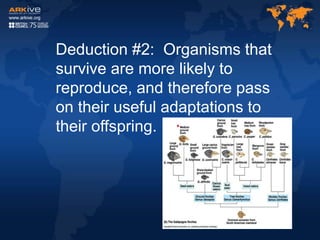
Deduction #2: Organisms that
survive are more likely to
reproduce, and therefore pass
on their useful adaptations to
their offspring.
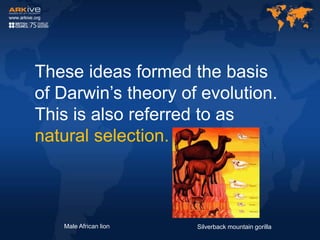
These ideas formed the basis
of Darwin’s theory of evolution.
This is also referred to as
natural selection.
Male African lion Silverback mountain gorilla
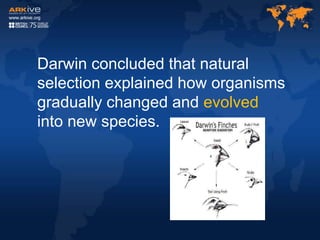
Darwin concluded that natural
selection explained how organisms
gradually changed and evolved
into new species.
At the time of
publishing Darwin
found it difficult to get
his theory accepted,
as it was difficult to
prove.
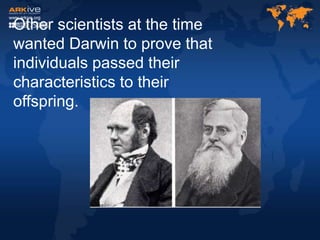
Other scientists at the time
wanted Darwin to prove that
individuals passed their
characteristics to their
offspring.
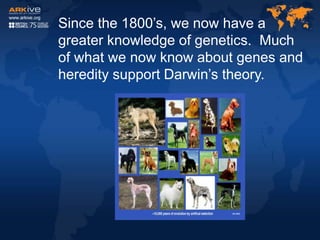
Since the 1800’s, we now have a
greater knowledge of genetics. Much
of what we now know about genes and
heredity support Darwin’s theory.

Evolution Power Point

  • 1.
    Charles Darwin and theTheory of Evolution
  • 2.
    Charles Darwin developedhis theory of evolution using four observations and two deductions.
  • 3.
    Observation #1: All organismsproduce more offspring than survive to adulthood.
  • 4.
    For example: afemale rabbit can produce up to seven kittens in a litter, but they don’t all survive to become adults.
  • 5.
    Observation #2: Populations remainmore or less constant in numbers.
  • 6.
    Example: If an islandhas a population of 75 mice . . . the number of mice that can be counted on the island at any one time always stays at about 75.
  • 7.
    Observation #3: Members ofthe same species show variation in characteristics.
  • 8.
    Iguanas in a populationmay be of the same species but have different colored skin and markings.
  • 9.
    Observation #4: Some characteristicsare inherited and are passed on to the next generation.
  • 10.
    Example: finches witha beaks of a certain shape pass on that characteristic to their offspring.
  • 11.
    Darwin came to2 deductions as a result of his observations.
  • 12.
    Deduction #1: Allorganisms are involved in a struggle for survival and only the best adapted survive. This is also know as “Survival of the Fittest”.
  • 13.
    The individuals thatare best adapted to their environment are most likely to survive and have a chance to reproduce. These animals pass off their useful adaptations to the next generation. Male African Lion
  • 14.
    Animals that havethe fewest adaptations for survival do not live long enough to breed. They never have offspring. Their weaknesses are not passed on the the next generation.
  • 15.
    Deduction #2: Organismsthat survive are more likely to reproduce, and therefore pass on their useful adaptations to their offspring.
  • 16.
    These ideas formedthe basis of Darwin’s theory of evolution. This is also referred to as natural selection. Male African lion Silverback mountain gorilla
  • 17.
    Darwin concluded thatnatural selection explained how organisms gradually changed and evolved into new species.
  • 18.
    At the timeof publishing Darwin found it difficult to get his theory accepted, as it was difficult to prove.
  • 19.
    Other scientists atthe time wanted Darwin to prove that individuals passed their characteristics to their offspring.
  • 20.
    Since the 1800’s,we now have a greater knowledge of genetics. Much of what we now know about genes and heredity support Darwin’s theory.