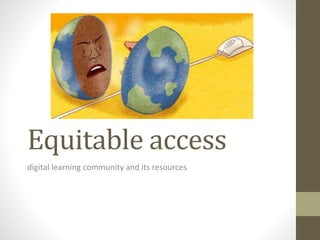
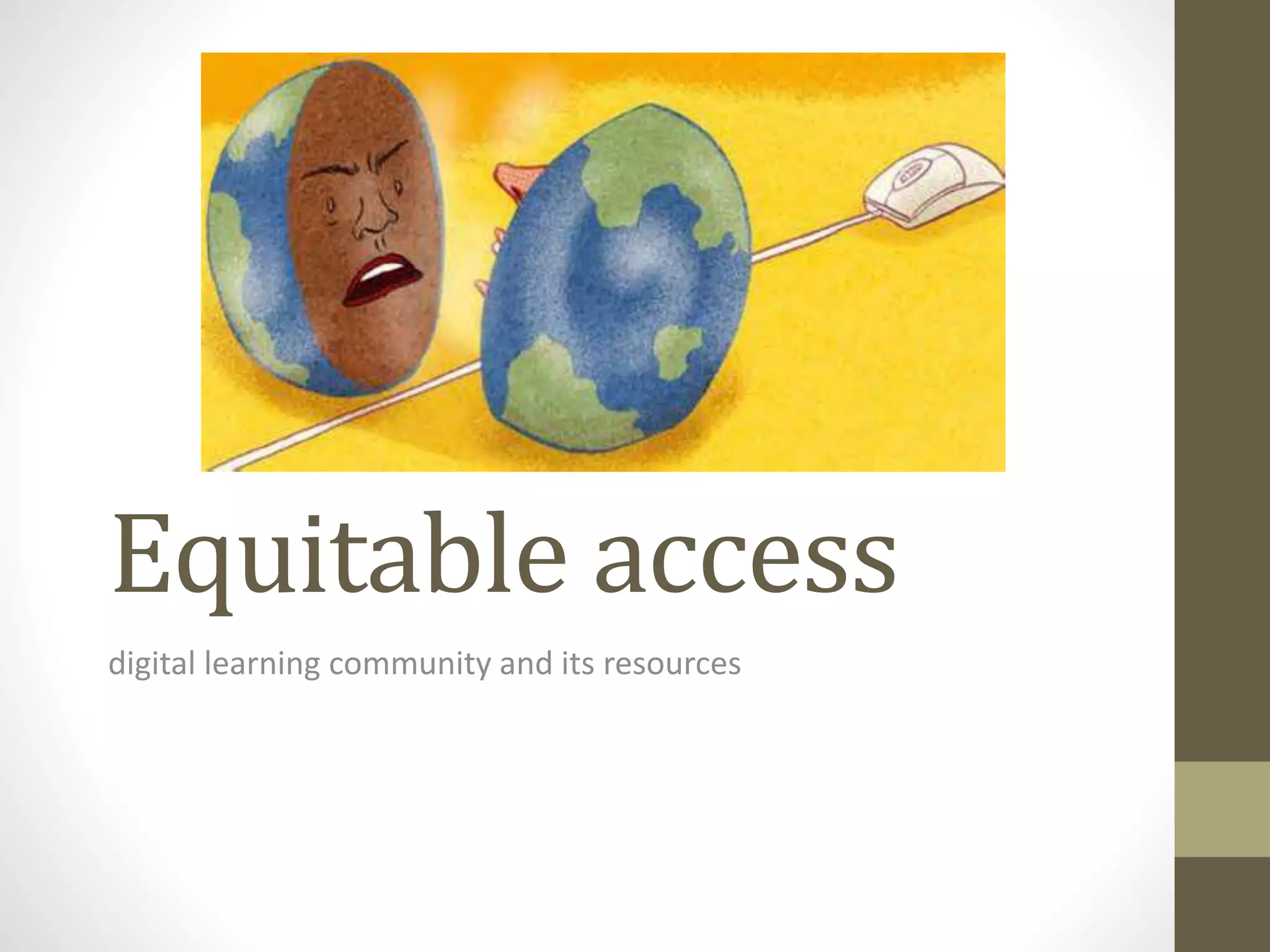
Equitable access
digital learning community and its resources
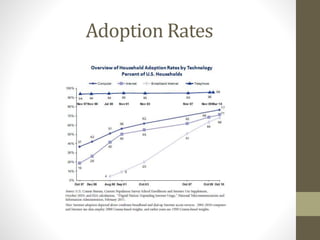
As of October 2010…
• More than 68% of households used broadband Internet access
service
• Approximately 80% of households had at least one Internet user,
either at home or elsewhere
• Cable modem (32%) and DSL (23%) ranked as the most commonly
used broadband technologies.
• Over three-fourths (77%) of households had a computer – the
principal means by which households access the Internet.
Low computer use correlates with low broadband adoption rates.
• Broadband Internet adoption, as well as computer use, varied across
demographic and geographic groups. Lower income families, people
with less education, those with disabilities, Blacks, Hispanics, and
rural residents generally lagged the national average in both
broadband adoption and computer use.
Lack of Connection/Adoption
• The differences in socio-economic attributes do not entirely explain why
some groups lagged in adoption. Broadband Internet adoption
disparities decrease when regression analysis holds constant certain
household characteristics, such as income, education, race, ethnicity,
foreign-born status, household composition, disability status, or
geographic location.
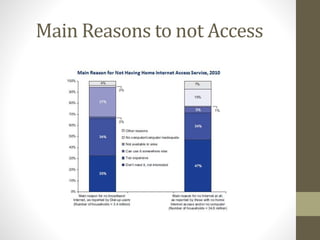
• The most important reasons households without broadband Internet or
dial-up service gave for not subscribing were:
(1) lack of need or interest (47%)
(2) lack of affordability (24%)
(3) inadequate computer (15%)
• Households reporting affordability as the major barrier to subscribing to
broadband service cited both the fixed cost of purchasing a computer
and the recurring monthly subscription costs as important factors
• Analysis of the expanded CPS data suggests that work, school, public
libraries, and someone else’s house were all popular alternatives for
Internet access among those with no home broadband Internet access
service
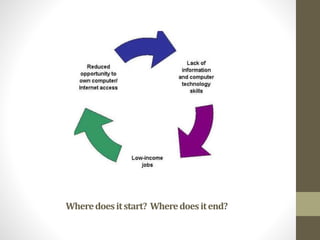
Wheredoesitstart? Wheredoesitend?
Adoption Rates
Main Reasons to not Access
Digital Divide
A digitally connected population, which
helps fosters innovation, economic growth
and social communication, is critical for U.S.
competitiveness in a global economy. The
better we understand the reasons for the
digital divide, the more effective we will be
in solving it.
~Mark Doms, Chief Economist, U.S. Department of Commerce

Equitable access

  • 1.
    Equitable access digital learningcommunity and its resources
  • 2.
    As of October2010… • More than 68% of households used broadband Internet access service • Approximately 80% of households had at least one Internet user, either at home or elsewhere • Cable modem (32%) and DSL (23%) ranked as the most commonly used broadband technologies. • Over three-fourths (77%) of households had a computer – the principal means by which households access the Internet. Low computer use correlates with low broadband adoption rates. • Broadband Internet adoption, as well as computer use, varied across demographic and geographic groups. Lower income families, people with less education, those with disabilities, Blacks, Hispanics, and rural residents generally lagged the national average in both broadband adoption and computer use.
  • 3.
    Lack of Connection/Adoption •The differences in socio-economic attributes do not entirely explain why some groups lagged in adoption. Broadband Internet adoption disparities decrease when regression analysis holds constant certain household characteristics, such as income, education, race, ethnicity, foreign-born status, household composition, disability status, or geographic location. • The most important reasons households without broadband Internet or dial-up service gave for not subscribing were: (1) lack of need or interest (47%) (2) lack of affordability (24%) (3) inadequate computer (15%) • Households reporting affordability as the major barrier to subscribing to broadband service cited both the fixed cost of purchasing a computer and the recurring monthly subscription costs as important factors • Analysis of the expanded CPS data suggests that work, school, public libraries, and someone else’s house were all popular alternatives for Internet access among those with no home broadband Internet access service
  • 4.
  • 5.
  • 6.
    Main Reasons tonot Access
  • 7.
    Digital Divide A digitallyconnected population, which helps fosters innovation, economic growth and social communication, is critical for U.S. competitiveness in a global economy. The better we understand the reasons for the digital divide, the more effective we will be in solving it. ~Mark Doms, Chief Economist, U.S. Department of Commerce