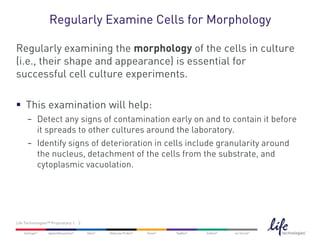
Cell Morphology
                                        8/27/2012


Life Technologies™ Proprietary | 1
Regularly Examine Cells for Morphology

Regularly examining the morphology of the cells in culture
(i.e., their shape and appearance) is essential for
successful cell culture experiments.

 This examination will help:
      −    Detect any signs of contamination early on and to contain it before
           it spreads to other cultures around the laboratory.
      −    Identify signs of deterioration in cells include granularity around
           the nucleus, detachment of the cells from the substrate, and
           cytoplasmic vacuolation.


Life Technologies™ Proprietary | 2
Cell Deterioration

 Deterioration may be caused by:
      −    Contamination of the culture
      −    Senescence of the cell line
      −    Presence of toxic substances in the medium
      −    Culture needs a medium change


 Allowing the deterioration to progress too far will make it
  irreversible.


Life Technologies™ Proprietary | 3
Cell Morphology Categories
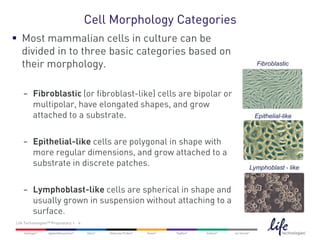
 Most mammalian cells in culture can be
  divided in to three basic categories based on
  their morphology.                                                 Fibroblastic


    −    Fibroblastic (or fibroblast-like) cells are bipolar or
         multipolar, have elongated shapes, and grow
         attached to a substrate.                                  Epithelial-like


    −    Epithelial-like cells are polygonal in shape with
         more regular dimensions, and grow attached to a
         substrate in discrete patches.                           Lymphoblast - like


    −    Lymphoblast-like cells are spherical in shape and
         usually grown in suspension without attaching to a
         surface.
Life Technologies™ Proprietary | 4
Cell Morphology: Example A

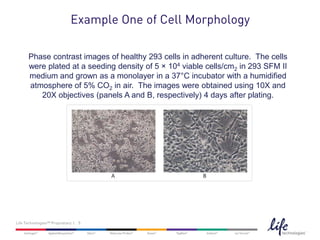
      Phase contrast images of healthy 293 cells in adherent culture. The cells
      were plated at a seeding density of 5 × 10⁴ viable cells/cm2 in 293 SFM II
      medium and grown as a monolayer in a 37°C incubator with a humidified
      atmosphere of 5% CO2 in air. The images were obtained using 10X and
         20X objectives (panels A and B, respectively) 4 days after plating.


Life Technologies™ Proprietary | 5
Cell Morphology: Example B

      Phase contrast images of healthy 293 cells in adherent culture. The cells
      were plated at a seeding density of 5 × 10⁴ viable cells/cm2 in 293 SFM II
      medium and grown as a monolayer in a 37°C incubator with a humidified
    atmosphere of 5% CO2 in air. The images were obtained using 10X and 20X
           objectives (panels A and B, respectively) 4 days after plating.


Life Technologies™ Proprietary | 6
More Cell Culture Information

 Visit the Life Technologies website to learn more about
  the basics of cell culture http://owl.li/dgWEh

 Watch a webinar about the basics of cell culture.
  http://owl.li/dgWPe


Life Technologies™ Proprietary | 7

What is Cell Morphology in a Cell Culture?

  • 1.
    Cell Morphology 8/27/2012 Life Technologies™ Proprietary | 1
  • 2.
    Regularly Examine Cellsfor Morphology Regularly examining the morphology of the cells in culture (i.e., their shape and appearance) is essential for successful cell culture experiments.  This examination will help: − Detect any signs of contamination early on and to contain it before it spreads to other cultures around the laboratory. − Identify signs of deterioration in cells include granularity around the nucleus, detachment of the cells from the substrate, and cytoplasmic vacuolation. Life Technologies™ Proprietary | 2
  • 3.
    Cell Deterioration  Deteriorationmay be caused by: − Contamination of the culture − Senescence of the cell line − Presence of toxic substances in the medium − Culture needs a medium change  Allowing the deterioration to progress too far will make it irreversible. Life Technologies™ Proprietary | 3
  • 4.
    Cell Morphology Categories Most mammalian cells in culture can be divided in to three basic categories based on their morphology. Fibroblastic − Fibroblastic (or fibroblast-like) cells are bipolar or multipolar, have elongated shapes, and grow attached to a substrate. Epithelial-like − Epithelial-like cells are polygonal in shape with more regular dimensions, and grow attached to a substrate in discrete patches. Lymphoblast - like − Lymphoblast-like cells are spherical in shape and usually grown in suspension without attaching to a surface. Life Technologies™ Proprietary | 4
  • 5.
    Cell Morphology: ExampleA Phase contrast images of healthy 293 cells in adherent culture. The cells were plated at a seeding density of 5 × 10⁴ viable cells/cm2 in 293 SFM II medium and grown as a monolayer in a 37°C incubator with a humidified atmosphere of 5% CO2 in air. The images were obtained using 10X and 20X objectives (panels A and B, respectively) 4 days after plating. Life Technologies™ Proprietary | 5
  • 6.
    Cell Morphology: ExampleB Phase contrast images of healthy 293 cells in adherent culture. The cells were plated at a seeding density of 5 × 10⁴ viable cells/cm2 in 293 SFM II medium and grown as a monolayer in a 37°C incubator with a humidified atmosphere of 5% CO2 in air. The images were obtained using 10X and 20X objectives (panels A and B, respectively) 4 days after plating. Life Technologies™ Proprietary | 6
  • 7.
    More Cell CultureInformation  Visit the Life Technologies website to learn more about the basics of cell culture http://owl.li/dgWEh  Watch a webinar about the basics of cell culture. http://owl.li/dgWPe Life Technologies™ Proprietary | 7