CellCycle
OmarNabel
Introduction
Cell Cycle: It is the series of growth and development steps a cell
undergoes between its “birth”—formation by the division of a
mother cell—and reproduction—division to make two new daughter
cells.
To divide, a cell must complete several important tasks, it must:
- Grow
Copy its genetic material (DNA).
-Physically split into two daughter cells.
Cells perform these tasks in an organized, predictable series of steps
that make up the cell cycle.
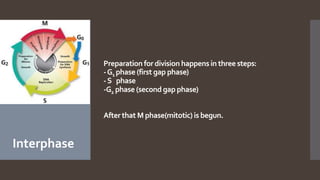
Preparation fordivision happens in threesteps:
-G1 phase (first gap phase)
-S phase
-G2 phase (second gap phase)
Afterthat M phase(mitotic) is begun.
Interphase
G1 phase
During G1 phase:
- the cell grows physically larger (*1.5).
- copies organelles.
- makes the molecular building blocks it will need in later steps.
S phase
In S phase:
-The cell synthesizes a complete copy of the DNA in its nucleus.
-Duplicates the centrosome (a microtubule-organizing structure
which help in separating DNA during M phase).
G2 phase
During G2 phase:
-The cell grows more. (*2)
-Makes proteins and organelles.
-Begins to reorganize its contents in preparation for Mitosis.
G2 phase ends when mitosis begins.
M phase
(mitotic)
During the mitotic (M) phase : the cell divides its copied DNA and
cytoplasm to make two new cells.
M phase involves two distinct division-related processes: mitosis
and cytokinesis.
Mitosis
Mitosis is divided into 4 stages:
Prophase  Metaphase  Anaphase Telophase
In mitosis:
-The nuclear DNA of the cell condenses into visible chromosomes
and is pulled apart by the mitotic spindle
-A specialized structure made out of microtubules.
-The nucleus is turned to 2 nuclei.
Prophase
During the Prophase:
-Nuclear membrane starts to disappear.
-The centrosomes migrate to the opposite sides of the cell.
These all happens because of chemical and thermodynamic
reactions.
Metaphase
In Metaphase :
-The nuclear membrane had disappeared.
-The chromosomes start lining up in the middle of the cell
-The centrioles inside the centrosomes produce microtubules that
attach to the chromosomes in the centromere (where the two
chromatins are attached together).
Anaphase
In Metaphase:
-Each of two chromatins(in each chromosomes) are separated
from each other when they are pulled by the microtubules from
the centrioles.
-Each chromatin is called a chromosome.
-The chromosome are migrated to the opposite sides of the cell.
-The cell membrane is getting narrower in the middle preparing for
the cytokinesis.
Telophase
InTelophase:
-This stage is nearly opposite to the prophase.
-Nuclear membrane start to form around the DNA
Cytokinesis
It can be called the separation phase.
Cytokinesis is a phase after telophase in which the mother cell
separates to 2 daughter cells.
Cytokinesis isn’t the same in animal and plant cells but it get the
same result.
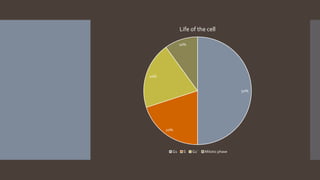
50%
20%
20%
10%
Life of the cell
G1 S G2` Mitotic phase
Thanks for Reading
☺

Cell cycle - Stem Schools - Omar Nabel

  • 1.
  • 2.
    Introduction Cell Cycle: Itis the series of growth and development steps a cell undergoes between its “birth”—formation by the division of a mother cell—and reproduction—division to make two new daughter cells. To divide, a cell must complete several important tasks, it must: - Grow Copy its genetic material (DNA). -Physically split into two daughter cells. Cells perform these tasks in an organized, predictable series of steps that make up the cell cycle.
  • 3.
    Preparation fordivision happensin threesteps: -G1 phase (first gap phase) -S phase -G2 phase (second gap phase) Afterthat M phase(mitotic) is begun. Interphase
  • 4.
    G1 phase During G1phase: - the cell grows physically larger (*1.5). - copies organelles. - makes the molecular building blocks it will need in later steps.
  • 5.
    S phase In Sphase: -The cell synthesizes a complete copy of the DNA in its nucleus. -Duplicates the centrosome (a microtubule-organizing structure which help in separating DNA during M phase).
  • 6.
    G2 phase During G2phase: -The cell grows more. (*2) -Makes proteins and organelles. -Begins to reorganize its contents in preparation for Mitosis. G2 phase ends when mitosis begins.
  • 7.
    M phase (mitotic) During themitotic (M) phase : the cell divides its copied DNA and cytoplasm to make two new cells. M phase involves two distinct division-related processes: mitosis and cytokinesis.
  • 8.
    Mitosis Mitosis is dividedinto 4 stages: Prophase  Metaphase  Anaphase Telophase In mitosis: -The nuclear DNA of the cell condenses into visible chromosomes and is pulled apart by the mitotic spindle -A specialized structure made out of microtubules. -The nucleus is turned to 2 nuclei.
  • 9.
    Prophase During the Prophase: -Nuclearmembrane starts to disappear. -The centrosomes migrate to the opposite sides of the cell. These all happens because of chemical and thermodynamic reactions.
  • 10.
    Metaphase In Metaphase : -Thenuclear membrane had disappeared. -The chromosomes start lining up in the middle of the cell -The centrioles inside the centrosomes produce microtubules that attach to the chromosomes in the centromere (where the two chromatins are attached together).
  • 11.
    Anaphase In Metaphase: -Each oftwo chromatins(in each chromosomes) are separated from each other when they are pulled by the microtubules from the centrioles. -Each chromatin is called a chromosome. -The chromosome are migrated to the opposite sides of the cell. -The cell membrane is getting narrower in the middle preparing for the cytokinesis.
  • 12.
    Telophase InTelophase: -This stage isnearly opposite to the prophase. -Nuclear membrane start to form around the DNA
  • 13.
    Cytokinesis It can becalled the separation phase. Cytokinesis is a phase after telophase in which the mother cell separates to 2 daughter cells. Cytokinesis isn’t the same in animal and plant cells but it get the same result.
  • 14.
    50% 20% 20% 10% Life of thecell G1 S G2` Mitotic phase
  • 15.