PRESENTATION ON
CELL CYCLE
BY KRITIK
CHOUDHAR
CONTENT:-
What is cell cycle ?
Phases of cell cycle
Stages of cell cycle
WHAT IS CELL CYCLE?
 The cell cycle is a process in which a cell grows and
divides to create a copy of itself. Some organisms
reproduce through the cell cycle, and in complex
multicellular organisms, the cell cycle is used to
allow the organism to grow, and to replace cells as
they grow worn out. In animals, the whole cell cycle
takes around 24 hours from start to finish. Some
cells, such as skin cells, are constantly going
through the cell cycle, while other cells may divide
rarely, if at all; neurons, for example, don't grow and
divide once they are mature.
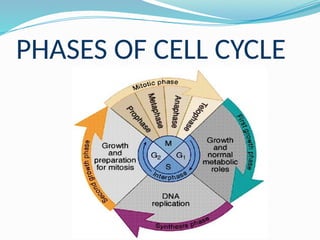
PHASES OF CELL CYCLE
Cell cycle consist three phases;-
 G1 phase-growth and synthesis
 S phase- DNA synthesis phase
 G2 phase-Preparation for division
 M phase-M phase includes the overlapping
processes of mitosis and cytokinesis
G1 PHASE
 Gap phase 1 begins at the completion of
mitosis and cytokinesis and lasts until the
beginning of S phase. This phase is
generally the longest of the four cell cycle
phases and is quite variable in length.
During this phase, the cell chooses either
to replicate its deoxyribonucleic acid
(DNA) or to exit the cell cycle and enter a
quiescent state (the G0 phase).
S PHASE
 Replication of the chromosomes is restricted to
one specific portion of interphase, called S
phase (DNA synthesis phase), which typically
lasts about 6 h. In mammalian cells, the start of
S phase—the actual initiation of DNA synthesis
—takes place several hours after the cell has
committed to carrying out DNA synthesis.
During S phase, each chromosome replicates
exactly once to form a pair of physically linked
sister chromatids. In animal cells, a pair of
centrioles is also duplicated during S phase.
G2 PHASE
 The portion of interphase that
follows S phase is called gap
phase 2. Some cells can exit the
cell cycle from G2 phase, just as
they can from G1 phase.
Combination of these three phases is
known as interphase.
M PHASE
M phase includes the
overlapping processes of
mitosis and cytokinesis
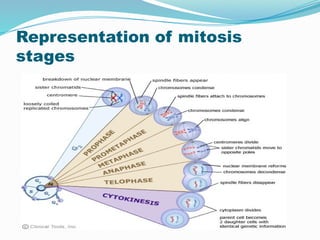
Mitosis is divided into five
stages;-
Prophase
Prometaphase
Metaphase
Anaphase
telophase
Representation of mitosis
stages
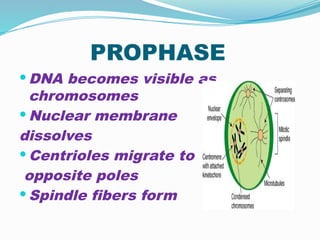
PROPHASE
 DNA becomes visible as
chromosomes
 Nuclear membrane
dissolves
 Centrioles migrate to
opposite poles
 Spindle fibers form
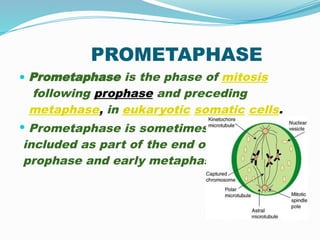
PROMETAPHASE
 Prometaphase is the phase of mitosis
following prophase and preceding
metaphase, in eukaryotic somatic cells.
 Prometaphase is sometimes simply
included as part of the end of
prophase and early metaphase.
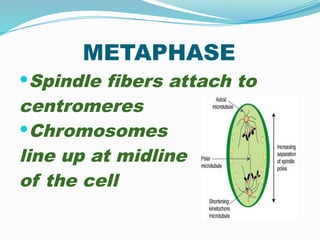
METAPHASE
Spindle fibers attach to
centromeres
Chromosomes
line up at midline
of the cell
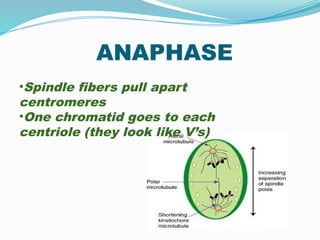
ANAPHASE
•Spindle fibers pull apart
centromeres
•One chromatid goes to each
centriole (they look like V’s)
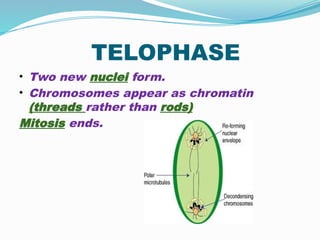
TELOPHASE
• Two new nuclei form.
• Chromosomes appear as chromatin
(threads rather than rods).
Mitosis ends.
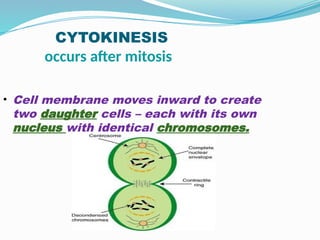
CYTOKINESIS
occurs after mitosis
• Cell membrane moves inward to create
two daughter cells – each with its own
nucleus with identical chromosomes.
THANKYO
U

presentationoncellcycle-121117091705-phpapp01.pptx

  • 1.
  • 2.
    CONTENT:- What is cellcycle ? Phases of cell cycle Stages of cell cycle
  • 3.
    WHAT IS CELLCYCLE?  The cell cycle is a process in which a cell grows and divides to create a copy of itself. Some organisms reproduce through the cell cycle, and in complex multicellular organisms, the cell cycle is used to allow the organism to grow, and to replace cells as they grow worn out. In animals, the whole cell cycle takes around 24 hours from start to finish. Some cells, such as skin cells, are constantly going through the cell cycle, while other cells may divide rarely, if at all; neurons, for example, don't grow and divide once they are mature.
  • 4.
  • 5.
    Cell cycle consistthree phases;-  G1 phase-growth and synthesis  S phase- DNA synthesis phase  G2 phase-Preparation for division  M phase-M phase includes the overlapping processes of mitosis and cytokinesis
  • 6.
    G1 PHASE  Gapphase 1 begins at the completion of mitosis and cytokinesis and lasts until the beginning of S phase. This phase is generally the longest of the four cell cycle phases and is quite variable in length. During this phase, the cell chooses either to replicate its deoxyribonucleic acid (DNA) or to exit the cell cycle and enter a quiescent state (the G0 phase).
  • 7.
    S PHASE  Replicationof the chromosomes is restricted to one specific portion of interphase, called S phase (DNA synthesis phase), which typically lasts about 6 h. In mammalian cells, the start of S phase—the actual initiation of DNA synthesis —takes place several hours after the cell has committed to carrying out DNA synthesis. During S phase, each chromosome replicates exactly once to form a pair of physically linked sister chromatids. In animal cells, a pair of centrioles is also duplicated during S phase.
  • 8.
    G2 PHASE  Theportion of interphase that follows S phase is called gap phase 2. Some cells can exit the cell cycle from G2 phase, just as they can from G1 phase. Combination of these three phases is known as interphase.
  • 9.
    M PHASE M phaseincludes the overlapping processes of mitosis and cytokinesis
  • 10.
    Mitosis is dividedinto five stages;- Prophase Prometaphase Metaphase Anaphase telophase
  • 11.
  • 12.
    PROPHASE  DNA becomesvisible as chromosomes  Nuclear membrane dissolves  Centrioles migrate to opposite poles  Spindle fibers form
  • 13.
    PROMETAPHASE  Prometaphase isthe phase of mitosis following prophase and preceding metaphase, in eukaryotic somatic cells.  Prometaphase is sometimes simply included as part of the end of prophase and early metaphase.
  • 14.
    METAPHASE Spindle fibers attachto centromeres Chromosomes line up at midline of the cell
  • 15.
    ANAPHASE •Spindle fibers pullapart centromeres •One chromatid goes to each centriole (they look like V’s)
  • 16.
    TELOPHASE • Two newnuclei form. • Chromosomes appear as chromatin (threads rather than rods). Mitosis ends.
  • 17.
    CYTOKINESIS occurs after mitosis •Cell membrane moves inward to create two daughter cells – each with its own nucleus with identical chromosomes.
  • 18.