“ Cell Division”
…what is cell division? Cell division  is the process by which a  parent  cell  divides into two or more  daughter cells . Cell division is usually a small segment of a larger  cell cycle Cell division is the process that cells go through in order to divide.
“Two Types Of  Cell Division” …depending on the purpose: MITOSIS - The cell division associated with  growth and cell replacement or repair. MEIOSIS - The cell division associated with sexual reproduction.
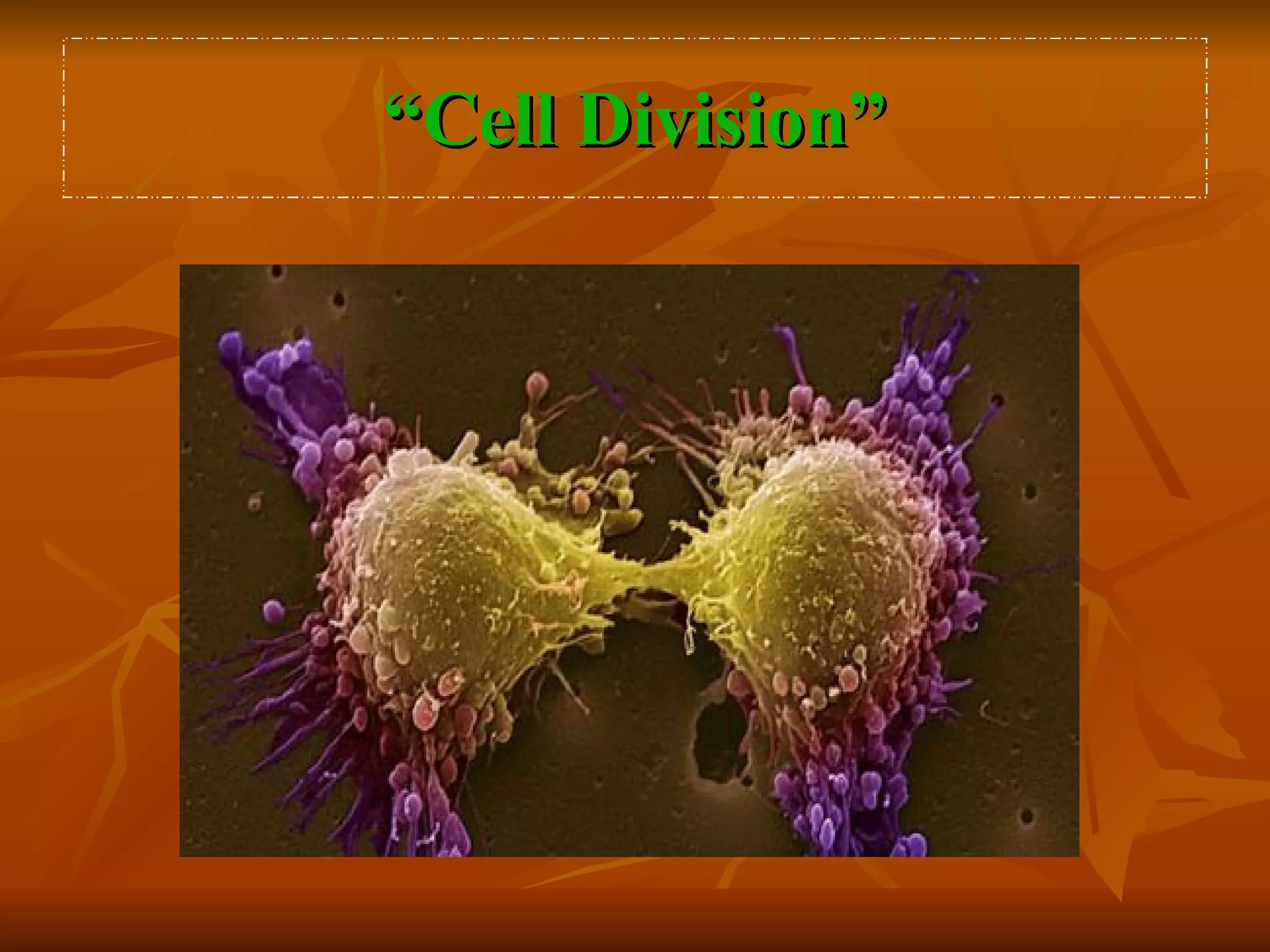
Mitosis - Process of Cell Division Mitosis is the cell division process wherein the eukaryotic cell splits the  chromosomes  (thread like strands of DNA) in its cell nucleus in to two identical sets in two separated nuclei. The process is instantly followed by cytokinesis, in which the nuclei, cytoplasm, organelles and cell membrane get divided into two separate cells having equal proportions of these cellular components.
Cytokinesis  is the process of dividing the cytoplasm and the cellmembrane, and this process  may follow immediately after mitosis or occur separately, depending on the organism involved.
Meiosis, on the other hand, reduces the number of chromosomes by half, so that, for example, human egg and  sperm  cells, called gametes, each have 23 chromosomes and can join to produce a  zygote  with 46. It has two division phases, whereas mitosis has only one.
“Stages Of Cell Division”
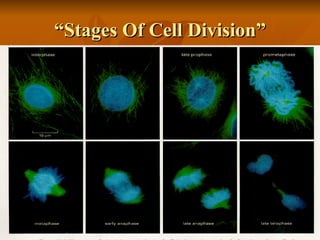
Interphase:  This is the first stage of cell division wherein the cell is engaged in metabolic activity and prepares itself for cell division process. Interphase comprises of three phases, including G1, S and G2 in which the cell matures by producing proteins and cytoplasmic organelles. In this phase, the DNA replicates but has not yet formed a condensed clear structure of chromosome.
Prophase:  In this stage, the chromatin begins to shorten and condense due to coiling, to form chromosomes. Centrioles start moving to the opposite ends of the cell and the spindle fibers extend from the centromeres (condensed region of each chromosome). The nuclear membrane and nucleolus can no longer be seen now. Prometaphase:  In prometaphase, each chromosome forms two kinetochores (protein structure on chromosomes) at the centromere, one attached at each chromatid. Microtubules (structural components of the cell) attach at the kinetochores and the chromosomes start moving.
Metaphase:  The spindle fibers attach themselves to the centromere of the chromosomes and align them along the middle of the cell nucleus. The line is referred as the equatorial plate or metaphase plate. This alignment will ensure that in the next phase, when the chromosomes will separate, each newly formed nucleus will get one copy of each chromosome. Anaphase:  In this phase, as the spindle fiber shorten and the centromere splits, the paired chromosomes will separate and start moving to the opposite sides of the cell. Though the reason for this motion is still unknown, according to some studies, it is the rapid assembly and breakdown of microtubules that may cause this movement. Hence, at the end of anaphase, we get two separate identical copies of sister chromosomes.
Telophase:  In telophase, the sister chromosomes attach at the opposite ends of the pole and a new nuclear membrane is formed around each set of sister chromosomes. The spindle fibers also disintegrate. Cytokinesis:  Though not a phase of mitosis, cytokinesis is a separate process that completes the entire process of cell division. It is a process of splitting the daughter cells apart by forming a furrow wherein the cell is pinched in to two. By the end of this process, each daughter cell has a complete copy of the genome of its parent cell, i.e. same number and quality of chromosomes.
Thank You!!! … by perezjohnv

John celldivision

  • 1.
  • 2.
    …what is celldivision? Cell division is the process by which a parent cell divides into two or more daughter cells . Cell division is usually a small segment of a larger cell cycle Cell division is the process that cells go through in order to divide.
  • 3.
    “Two Types Of Cell Division” …depending on the purpose: MITOSIS - The cell division associated with growth and cell replacement or repair. MEIOSIS - The cell division associated with sexual reproduction.
  • 4.
    Mitosis - Processof Cell Division Mitosis is the cell division process wherein the eukaryotic cell splits the chromosomes (thread like strands of DNA) in its cell nucleus in to two identical sets in two separated nuclei. The process is instantly followed by cytokinesis, in which the nuclei, cytoplasm, organelles and cell membrane get divided into two separate cells having equal proportions of these cellular components.
  • 5.
    Cytokinesis isthe process of dividing the cytoplasm and the cellmembrane, and this process may follow immediately after mitosis or occur separately, depending on the organism involved.
  • 6.
    Meiosis, on theother hand, reduces the number of chromosomes by half, so that, for example, human egg and sperm cells, called gametes, each have 23 chromosomes and can join to produce a zygote with 46. It has two division phases, whereas mitosis has only one.
  • 7.
    “Stages Of CellDivision”
  • 8.
    Interphase: Thisis the first stage of cell division wherein the cell is engaged in metabolic activity and prepares itself for cell division process. Interphase comprises of three phases, including G1, S and G2 in which the cell matures by producing proteins and cytoplasmic organelles. In this phase, the DNA replicates but has not yet formed a condensed clear structure of chromosome.
  • 9.
    Prophase: Inthis stage, the chromatin begins to shorten and condense due to coiling, to form chromosomes. Centrioles start moving to the opposite ends of the cell and the spindle fibers extend from the centromeres (condensed region of each chromosome). The nuclear membrane and nucleolus can no longer be seen now. Prometaphase: In prometaphase, each chromosome forms two kinetochores (protein structure on chromosomes) at the centromere, one attached at each chromatid. Microtubules (structural components of the cell) attach at the kinetochores and the chromosomes start moving.
  • 10.
    Metaphase: Thespindle fibers attach themselves to the centromere of the chromosomes and align them along the middle of the cell nucleus. The line is referred as the equatorial plate or metaphase plate. This alignment will ensure that in the next phase, when the chromosomes will separate, each newly formed nucleus will get one copy of each chromosome. Anaphase: In this phase, as the spindle fiber shorten and the centromere splits, the paired chromosomes will separate and start moving to the opposite sides of the cell. Though the reason for this motion is still unknown, according to some studies, it is the rapid assembly and breakdown of microtubules that may cause this movement. Hence, at the end of anaphase, we get two separate identical copies of sister chromosomes.
  • 11.
    Telophase: Intelophase, the sister chromosomes attach at the opposite ends of the pole and a new nuclear membrane is formed around each set of sister chromosomes. The spindle fibers also disintegrate. Cytokinesis: Though not a phase of mitosis, cytokinesis is a separate process that completes the entire process of cell division. It is a process of splitting the daughter cells apart by forming a furrow wherein the cell is pinched in to two. By the end of this process, each daughter cell has a complete copy of the genome of its parent cell, i.e. same number and quality of chromosomes.
  • 12.
    Thank You!!! …by perezjohnv