1
Cell fusion experiments
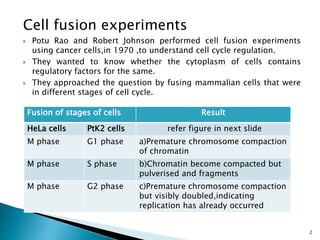
 Potu Rao and Robert Johnson performed cell fusion experiments
using cancer cells,in 1970 ,to understand cell cycle regulation.
 They wanted to know whether the cytoplasm of cells contains
regulatory factors for the same.
 They approached the question by fusing mammalian cells that were
in different stages of cell cycle.
2
Fusion of stages of cells Result
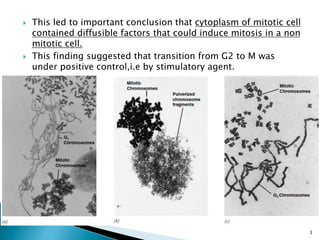
HeLa cells PtK2 cells refer figure in next slide
M phase G1 phase a)Premature chromosome compaction
of chromatin
M phase S phase b)Chromatin become compacted but
pulverised and fragments
M phase G2 phase c)Premature chromosome compaction
but visibly doubled,indicating
replication has already occurred
 This led to important conclusion that cytoplasm of mitotic cell
contained diffusible factors that could induce mitosis in a non
mitotic cell.
 This finding suggested that transition from G2 to M was
under positive control,i.e by stimulatory agent.
3
Cell cycle molecules
 Cyclin dependent kinases(cdk)-phosphorylates specific serine and
threonine residues of specific protein substrates.Their level remains
constant during the cell cycle,but activity varies as per the cyclins.
 Cyclins- are the positive regulatory partners for the cdks and
activates them by binding to them. Name is given such,because they
undergo cycle of synthesis and degradation in a regulated manner at
points in a cell cycle.
 Other regulatory enzymes,like temperature sensitive(ts) cell division
cycle mutants(cdc) present in Yeasts.(lower eukaryotes)
Control mechanism in fission yeast
 In S. pombe ,only one cyclin and one cdk drive all the stages of cell
cycle.
Steps:
 Cyclin binding-When cyclins reaches sufficient concentration in
cell,it binds to cdk and activates it.
4
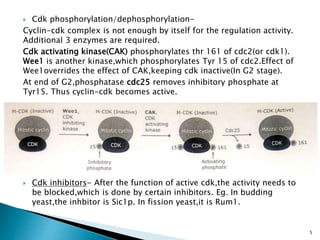
 Cdk phosphorylation/dephosphorylation-
Cyclin-cdk complex is not enough by itself for the regulation activity.
Additional 3 enzymes are required.
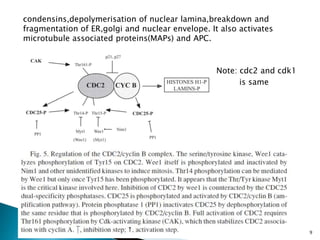
Cdk activating kinase(CAK) phosphorylates thr 161 of cdc2(or cdk1).
Wee1 is another kinase,which phosphorylates Tyr 15 of cdc2.Effect of
Wee1overrides the effect of CAK,keeping cdk inactive(In G2 stage).
At end of G2,phosphatase cdc25 removes inhibitory phosphate at
Tyr15. Thus cyclin-cdk becomes active.
 Cdk inhibitors- After the function of active cdk,the activity needs to
be blocked,which is done by certain inhibitors. Eg. In budding
yeast,the inhbitor is Sic1p. In fission yeast,it is Rum1.
5
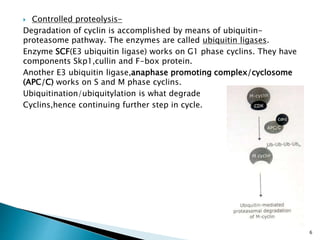
 Controlled proteolysis-
Degradation of cyclin is accomplished by means of ubiquitin-
proteasome pathway. The enzymes are called ubiquitin ligases.
Enzyme SCF(E3 ubiquitin ligase) works on G1 phase cyclins. They have
components Skp1,cullin and F-box protein.
Another E3 ubiquitin ligase,anaphase promoting complex/cyclosome
(APC/C) works on S and M phase cyclins.
Ubiquitination/ubiquitylation is what degrade
Cyclins,hence continuing further step in cycle.
6
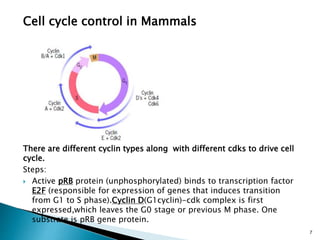
Cell cycle control in Mammals
There are different cyclin types along with different cdks to drive cell
cycle.
Steps:
 Active pRB protein (unphosphorylated) binds to transcription factor
E2F (responsible for expression of genes that induces transition
from G1 to S phase).Cyclin D(G1cyclin)-cdk complex is first
expressed,which leaves the G0 stage or previous M phase. One
substrate is pRB gene protein.
7
 The phosphorylated pRB has reduced affinity to E2F, which then
releases and starts transcription of cyclin E(G1/S cyclins) required
for transition to S phase.
 Further phosphorylation of pRB by E-cdk2 increases level of E2F
factor members required for expression of cyclin A for promoting to
next phase.
 Cyclin E-cdk2 also activates the cdk inhibitors for precise negative
regulation of the above cdks.
There are 2 family of inhibitors- CIP/KIP family(cdk interacting
protein/kinase inhibiting protein) ,eg p21,p27,p57 inhibits A-cdk2
and
INK4 family(inhibitors of kinase 4),eg p15,p16,p18 etc,inhibits D-cdk4
or D-cdk6 activity.
 Cyclin A(S cyclin) cdk2 complex regulates multiple cell cycle steps.
First there is association with cdk-2 and then with cdk-1 in late S-
phase with stabilization and activation of MPF(cyclin B-cdk 1)
 Cyclin B-cdk1 (also called MPF-maturation promoting factor/mitosis
promoting factor) is synthesised in late S phase and levels in G2
phase and is very important. It triggers formation of mitotic
spindle,chromatin condensation by phosphorylating
8
condensins,depolymerisation of nuclear lamina,breakdown and
fragmentation of ER,golgi and nuclear envelope. It also activates
microtubule associated proteins(MAPs) and APC.
Note: cdc2 and cdk1
is same
9
Cell cycle checkpoints:
 It ensures fidelity of cell division and verify that processes of
each phase of cell cycle is accurately completed before
progression into next phase.
 It will arrest the cell cycle in that stage until all signals are
positive.
1)G1/S checkpoint:
 +ve signals->nutrients are sufficient,growth factors present,cell size
adequate,DNA is not damaged.
 Once the signal to pass to S phase(after G1), it is commited to cell
division compulsory(no exiting),or else apoptosis.
2)G2/M checkpoint:
 Also known as DNA damage checkpoint.
 +ve signal->replication is complete,no DNA damage,repair
completed
 -ve signal->ss or dsDNA break or damage(even at time of G1/S).
 It will pause and repair,or kill the cell.
10
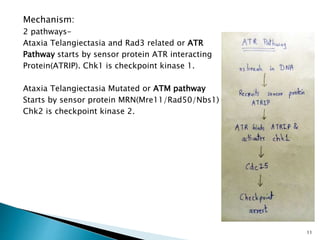
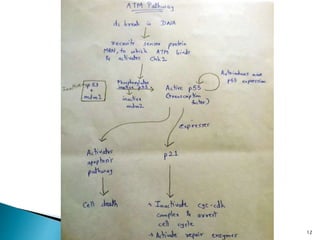
Mechanism:
2 pathways-
Ataxia Telangiectasia and Rad3 related or ATR
Pathway starts by sensor protein ATR interacting
Protein(ATRIP). Chk1 is checkpoint kinase 1.
Ataxia Telangiectasia Mutated or ATM pathway
Starts by sensor protein MRN(Mre11/Rad50/Nbs1)
Chk2 is checkpoint kinase 2.
11
12
3)M-phase checkpoint:
 Also known as spindle assembly checkpoint.
 Occurs in metaphase,and required for anaphase transition.
 +ve signal->All chromosomes aligned properly at equatorial plate
and spindle fibers attached properly to the centromere
Mechanism:
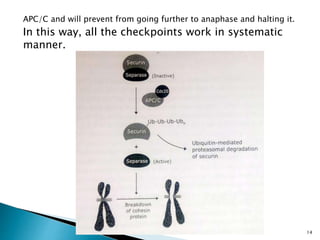
 Securin protein present in cytoplasm binds to cysteine protease
separase and keeps it inactive.
 Function of separase is to degrade cohesin subunit,Scc1,which binds
two sister chromatids and prevents its separation.
 Mitotic arrest deficient 2(MAD2) and Budding Uninhibited by
benzimidazole (BUB1) are spindle checkpoint proteins along with
regulator of APC,i.e. cdc20.
 When spindle fiber attaches to centromeres,MAD2 and APC-cdc20
dissociates and the latter ubiquinates securin. The cleaved securin
activates separase, which cleaves cohesin,so sister chromatids can
separate and cell goes into anaphase.
 But when spindle fibers not attached properly from both poles, the
MAD2 and BUB proteins bind to cdc20 and inhibits the activation of
13
APC/C and will prevent from going further to anaphase and halting it.
In this way, all the checkpoints work in systematic
manner.
14
15

Cell cycle regulation and checkpoints

  • 1.
  • 2.
    Cell fusion experiments Potu Rao and Robert Johnson performed cell fusion experiments using cancer cells,in 1970 ,to understand cell cycle regulation.  They wanted to know whether the cytoplasm of cells contains regulatory factors for the same.  They approached the question by fusing mammalian cells that were in different stages of cell cycle. 2 Fusion of stages of cells Result HeLa cells PtK2 cells refer figure in next slide M phase G1 phase a)Premature chromosome compaction of chromatin M phase S phase b)Chromatin become compacted but pulverised and fragments M phase G2 phase c)Premature chromosome compaction but visibly doubled,indicating replication has already occurred
  • 3.
     This ledto important conclusion that cytoplasm of mitotic cell contained diffusible factors that could induce mitosis in a non mitotic cell.  This finding suggested that transition from G2 to M was under positive control,i.e by stimulatory agent. 3
  • 4.
    Cell cycle molecules Cyclin dependent kinases(cdk)-phosphorylates specific serine and threonine residues of specific protein substrates.Their level remains constant during the cell cycle,but activity varies as per the cyclins.  Cyclins- are the positive regulatory partners for the cdks and activates them by binding to them. Name is given such,because they undergo cycle of synthesis and degradation in a regulated manner at points in a cell cycle.  Other regulatory enzymes,like temperature sensitive(ts) cell division cycle mutants(cdc) present in Yeasts.(lower eukaryotes) Control mechanism in fission yeast  In S. pombe ,only one cyclin and one cdk drive all the stages of cell cycle. Steps:  Cyclin binding-When cyclins reaches sufficient concentration in cell,it binds to cdk and activates it. 4
  • 5.
     Cdk phosphorylation/dephosphorylation- Cyclin-cdkcomplex is not enough by itself for the regulation activity. Additional 3 enzymes are required. Cdk activating kinase(CAK) phosphorylates thr 161 of cdc2(or cdk1). Wee1 is another kinase,which phosphorylates Tyr 15 of cdc2.Effect of Wee1overrides the effect of CAK,keeping cdk inactive(In G2 stage). At end of G2,phosphatase cdc25 removes inhibitory phosphate at Tyr15. Thus cyclin-cdk becomes active.  Cdk inhibitors- After the function of active cdk,the activity needs to be blocked,which is done by certain inhibitors. Eg. In budding yeast,the inhbitor is Sic1p. In fission yeast,it is Rum1. 5
  • 6.
     Controlled proteolysis- Degradationof cyclin is accomplished by means of ubiquitin- proteasome pathway. The enzymes are called ubiquitin ligases. Enzyme SCF(E3 ubiquitin ligase) works on G1 phase cyclins. They have components Skp1,cullin and F-box protein. Another E3 ubiquitin ligase,anaphase promoting complex/cyclosome (APC/C) works on S and M phase cyclins. Ubiquitination/ubiquitylation is what degrade Cyclins,hence continuing further step in cycle. 6
  • 7.
    Cell cycle controlin Mammals There are different cyclin types along with different cdks to drive cell cycle. Steps:  Active pRB protein (unphosphorylated) binds to transcription factor E2F (responsible for expression of genes that induces transition from G1 to S phase).Cyclin D(G1cyclin)-cdk complex is first expressed,which leaves the G0 stage or previous M phase. One substrate is pRB gene protein. 7
  • 8.
     The phosphorylatedpRB has reduced affinity to E2F, which then releases and starts transcription of cyclin E(G1/S cyclins) required for transition to S phase.  Further phosphorylation of pRB by E-cdk2 increases level of E2F factor members required for expression of cyclin A for promoting to next phase.  Cyclin E-cdk2 also activates the cdk inhibitors for precise negative regulation of the above cdks. There are 2 family of inhibitors- CIP/KIP family(cdk interacting protein/kinase inhibiting protein) ,eg p21,p27,p57 inhibits A-cdk2 and INK4 family(inhibitors of kinase 4),eg p15,p16,p18 etc,inhibits D-cdk4 or D-cdk6 activity.  Cyclin A(S cyclin) cdk2 complex regulates multiple cell cycle steps. First there is association with cdk-2 and then with cdk-1 in late S- phase with stabilization and activation of MPF(cyclin B-cdk 1)  Cyclin B-cdk1 (also called MPF-maturation promoting factor/mitosis promoting factor) is synthesised in late S phase and levels in G2 phase and is very important. It triggers formation of mitotic spindle,chromatin condensation by phosphorylating 8
  • 9.
    condensins,depolymerisation of nuclearlamina,breakdown and fragmentation of ER,golgi and nuclear envelope. It also activates microtubule associated proteins(MAPs) and APC. Note: cdc2 and cdk1 is same 9
  • 10.
    Cell cycle checkpoints: It ensures fidelity of cell division and verify that processes of each phase of cell cycle is accurately completed before progression into next phase.  It will arrest the cell cycle in that stage until all signals are positive. 1)G1/S checkpoint:  +ve signals->nutrients are sufficient,growth factors present,cell size adequate,DNA is not damaged.  Once the signal to pass to S phase(after G1), it is commited to cell division compulsory(no exiting),or else apoptosis. 2)G2/M checkpoint:  Also known as DNA damage checkpoint.  +ve signal->replication is complete,no DNA damage,repair completed  -ve signal->ss or dsDNA break or damage(even at time of G1/S).  It will pause and repair,or kill the cell. 10
  • 11.
    Mechanism: 2 pathways- Ataxia Telangiectasiaand Rad3 related or ATR Pathway starts by sensor protein ATR interacting Protein(ATRIP). Chk1 is checkpoint kinase 1. Ataxia Telangiectasia Mutated or ATM pathway Starts by sensor protein MRN(Mre11/Rad50/Nbs1) Chk2 is checkpoint kinase 2. 11
  • 12.
  • 13.
    3)M-phase checkpoint:  Alsoknown as spindle assembly checkpoint.  Occurs in metaphase,and required for anaphase transition.  +ve signal->All chromosomes aligned properly at equatorial plate and spindle fibers attached properly to the centromere Mechanism:  Securin protein present in cytoplasm binds to cysteine protease separase and keeps it inactive.  Function of separase is to degrade cohesin subunit,Scc1,which binds two sister chromatids and prevents its separation.  Mitotic arrest deficient 2(MAD2) and Budding Uninhibited by benzimidazole (BUB1) are spindle checkpoint proteins along with regulator of APC,i.e. cdc20.  When spindle fiber attaches to centromeres,MAD2 and APC-cdc20 dissociates and the latter ubiquinates securin. The cleaved securin activates separase, which cleaves cohesin,so sister chromatids can separate and cell goes into anaphase.  But when spindle fibers not attached properly from both poles, the MAD2 and BUB proteins bind to cdc20 and inhibits the activation of 13
  • 14.
    APC/C and willprevent from going further to anaphase and halting it. In this way, all the checkpoints work in systematic manner. 14
  • 15.