

Regulation
of
Cell
Cycle
 The study of cell cycle have practical
implications in combating cancer ,a
disease that results from the breakdown
in a cell ability to regulate its own
division .
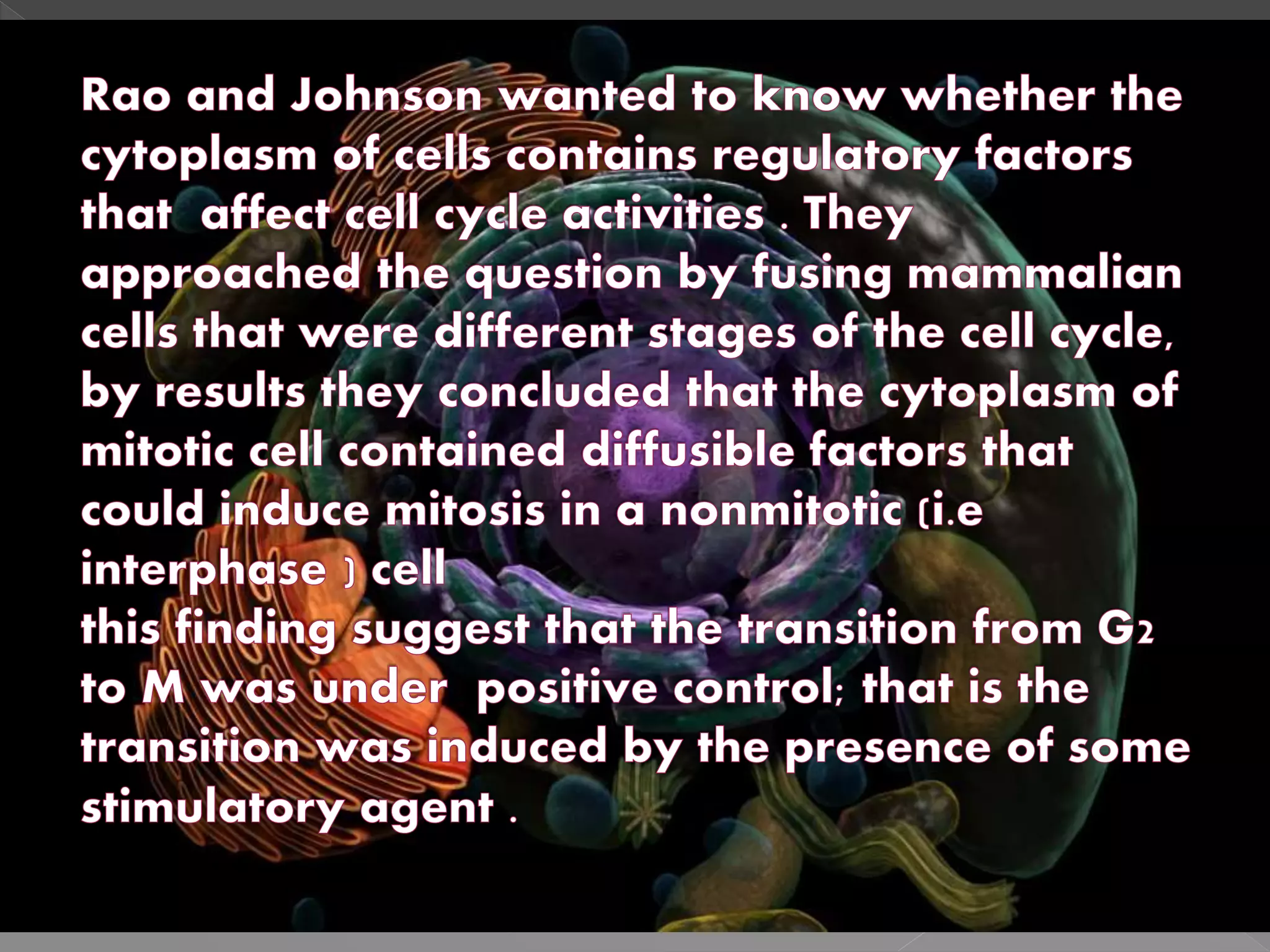
 In 1970 ,a series of cell fusion experiments
carried out by Potu Rao Robert Johnson
of university of Colorado helped open the
door to understanding how the cell cycle
is regulated.
Cell Division is expensive process
Maintain the integrity of Genome
cell
Proper cytoplasmic growth of
the cell division is required
Proper Cellular homeostatis
Prevent onset of Mutations
Cdk(Cyclin dependant kinases,catalytic protein)
Cyclin(Key regulator Protein
Rb protein
P53 protein
Tumor
Suppress
Protein
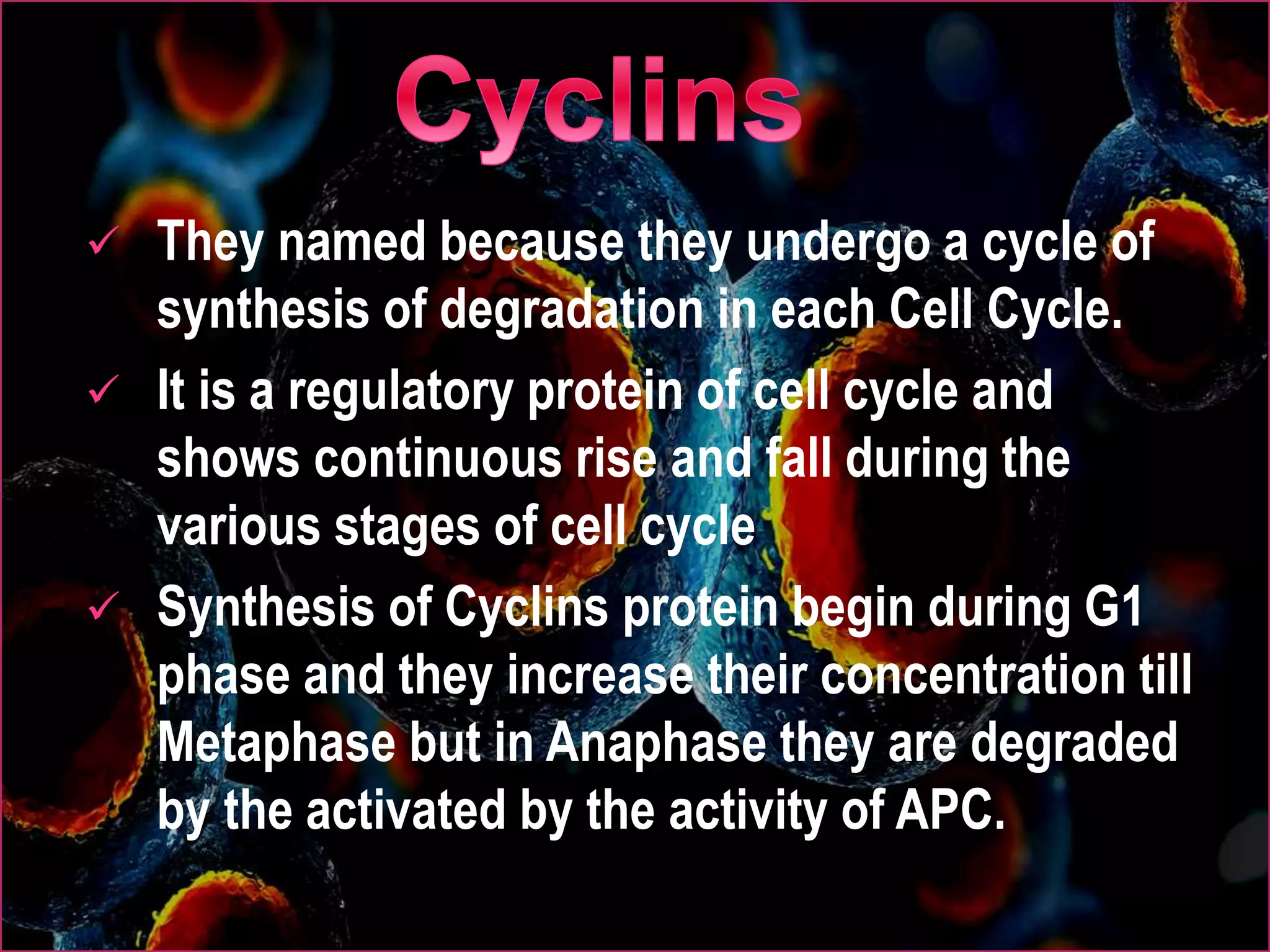
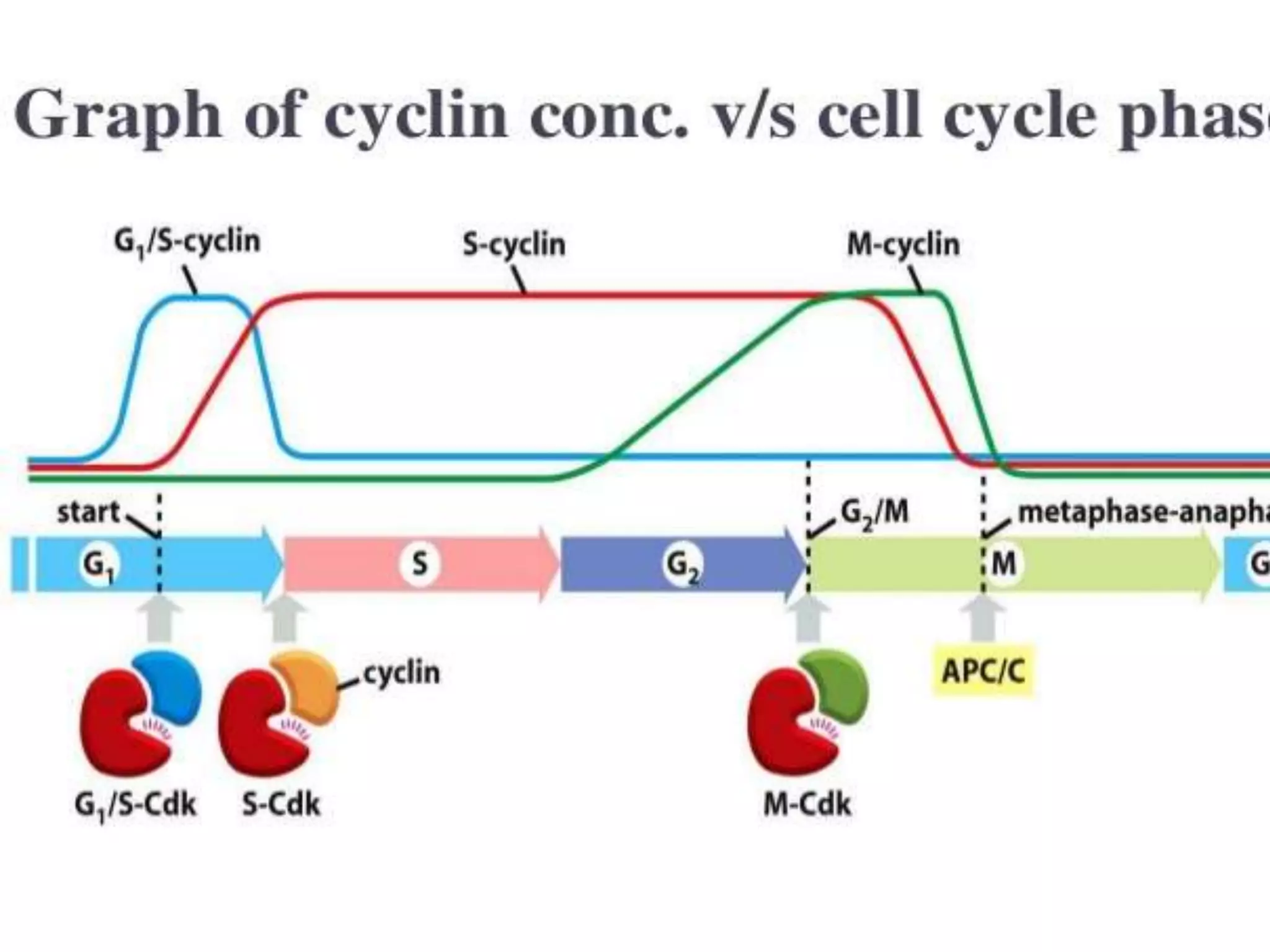
 They named because they undergo a cycle of
synthesis of degradation in each Cell Cycle.
 It is a regulatory protein of cell cycle and
shows continuous rise and fall during the
various stages of cell cycle
 Synthesis of Cyclins protein begin during G1
phase and they increase their concentration till
Metaphase but in Anaphase they are degraded
by the activated by the activity of APC.
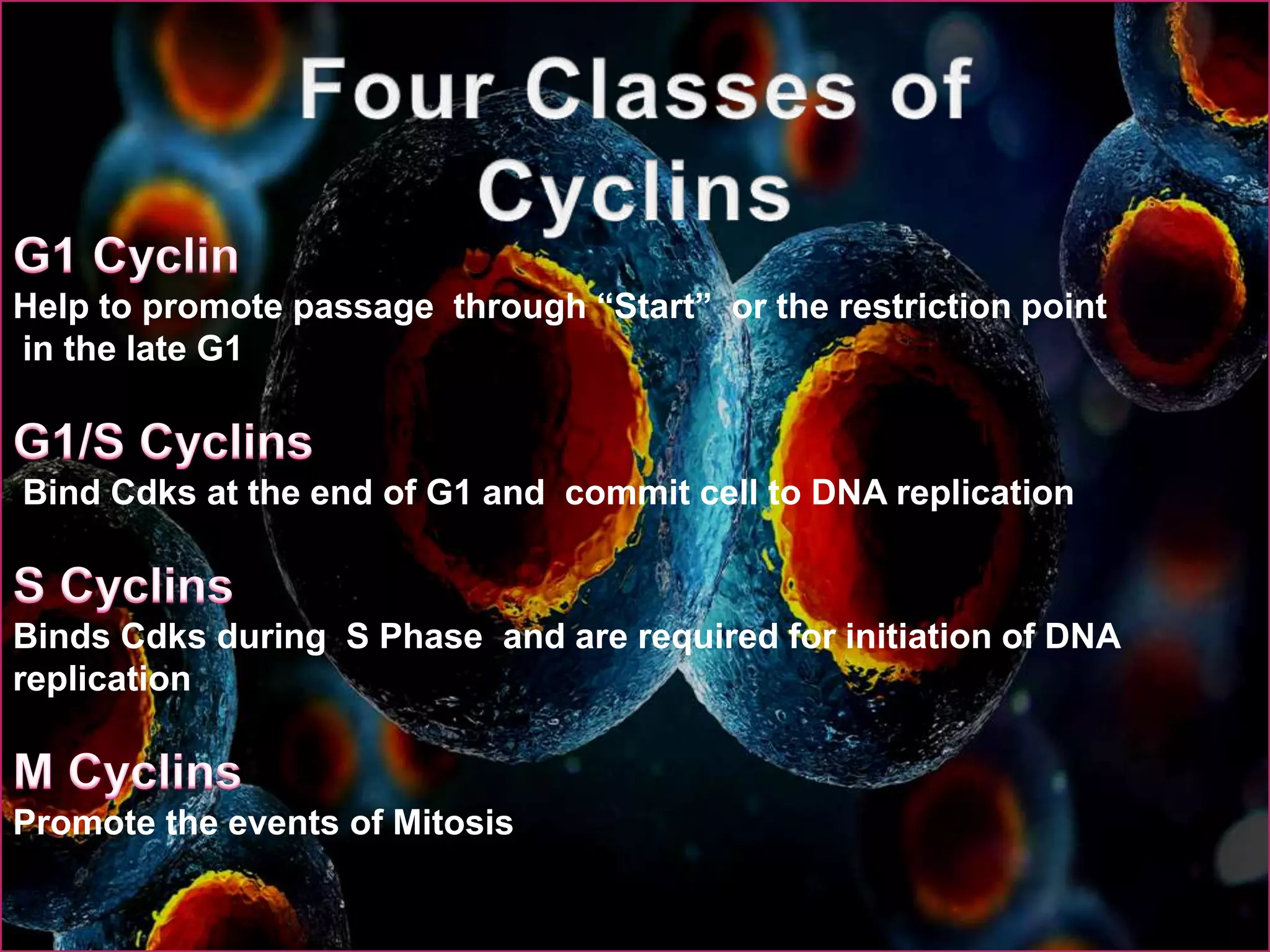
Help to promote passage through “Start” or the restriction point
in the late G1
Bind Cdks at the end of G1 and commit cell to DNA replication
Binds Cdks during S Phase and are required for initiation of DNA
replication
Promote the events of Mitosis
Cyclin is most
important key
regulator of
cell cycle and
it regulate the
activity of
Cdk
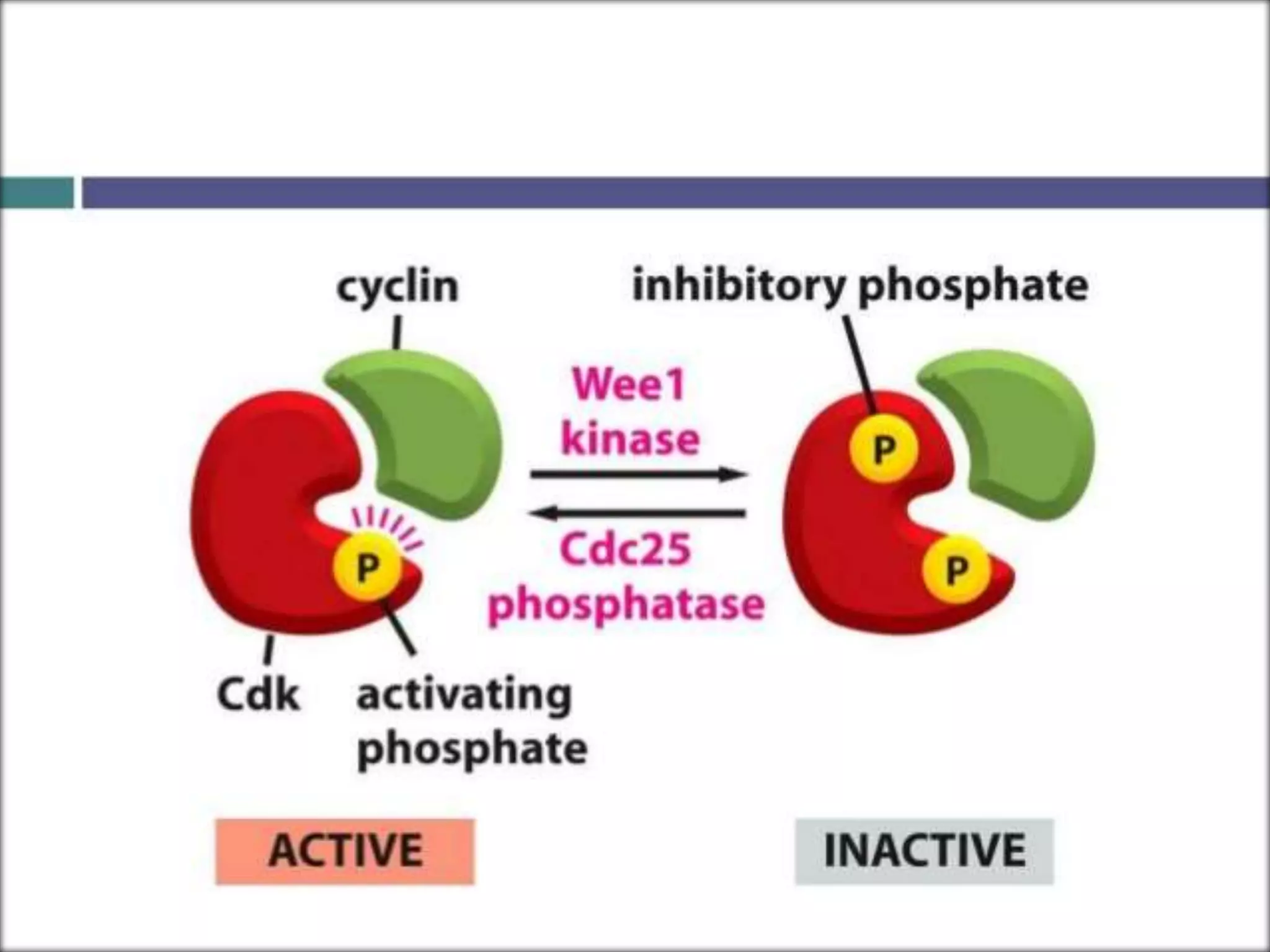
During G2,the cdc2 kinase interacts with a mitotic cyclin but
remain inactive as the result of phosphorylation of a key
tyrosine residue
Remain
inactive and
activated only
upon cycle
binding
Concentration
remains constant
throughout the
cell cycle
Ser- Thr
Kinases which
act as catalytic
protein for cell
cycle
 Progression of cell cycle is controlled by a
conserved set of proteins called kinases.
 Regulate the progression of cell cycle in
association with another group of proteins
called as cyclins.
 The concentration of cyclins fluctuates
throughout the cell cycle while that of Cdk
CdK1
• G2 to M
CdK2
• G1 to S
CdK 4
• G1 to S
CdK20
• Metaphase to Anaphase
Different Types of
CdK:-
FLUCTUATION OF CYCLING DURING CELL CYCLE
Formulated by
Leland Hartwell
and Ted
Weinert in 1988
Halt the cell cycle
processes if
1)Any chromosomal
DNA damaged
2)Critical processes
Activated by system
of sensors that
recognise DNA
damage or cellular
abnormalities
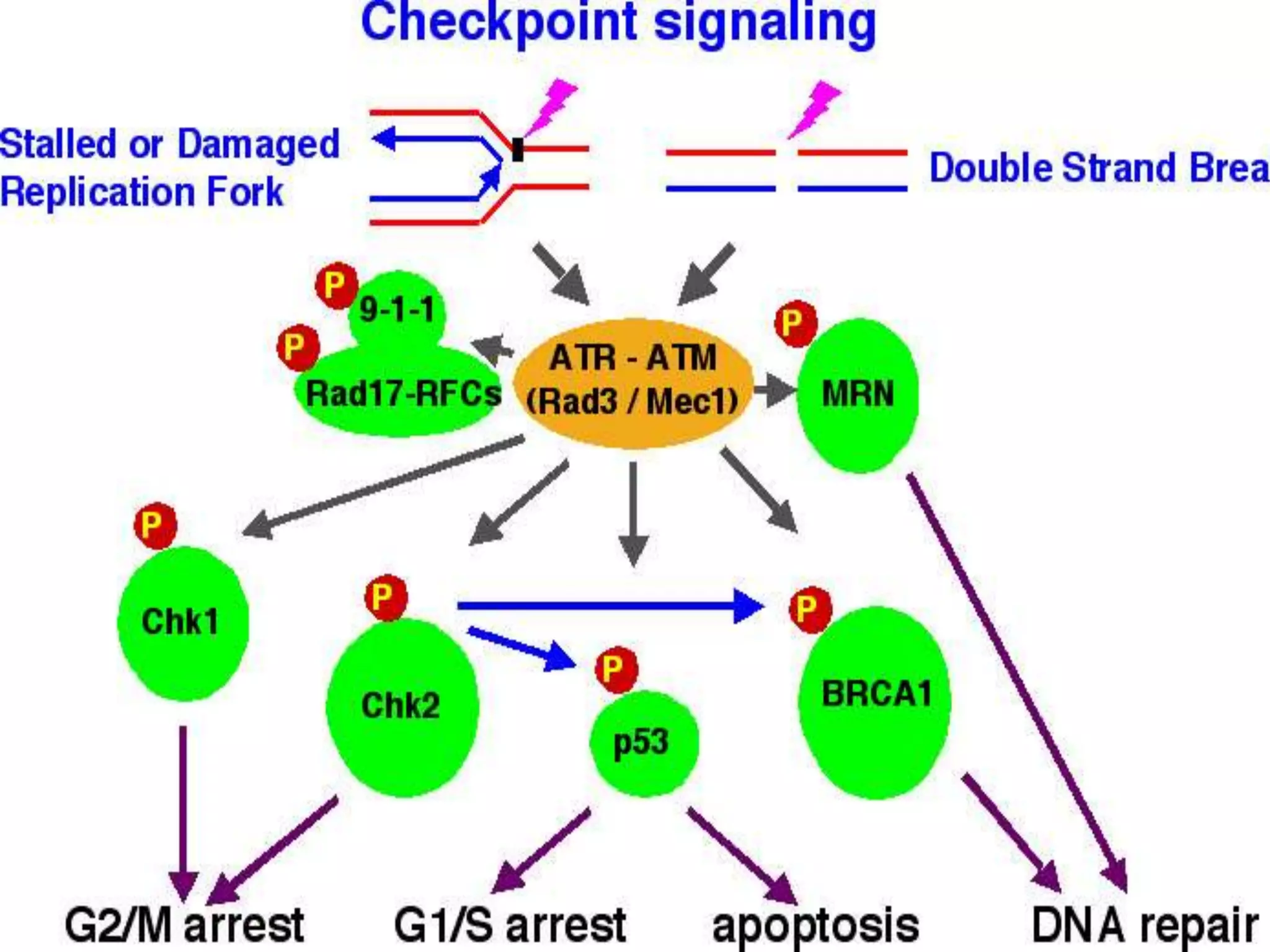
If DNA damaged
beyond the
repair,
1)death of the
cell
2)senescence
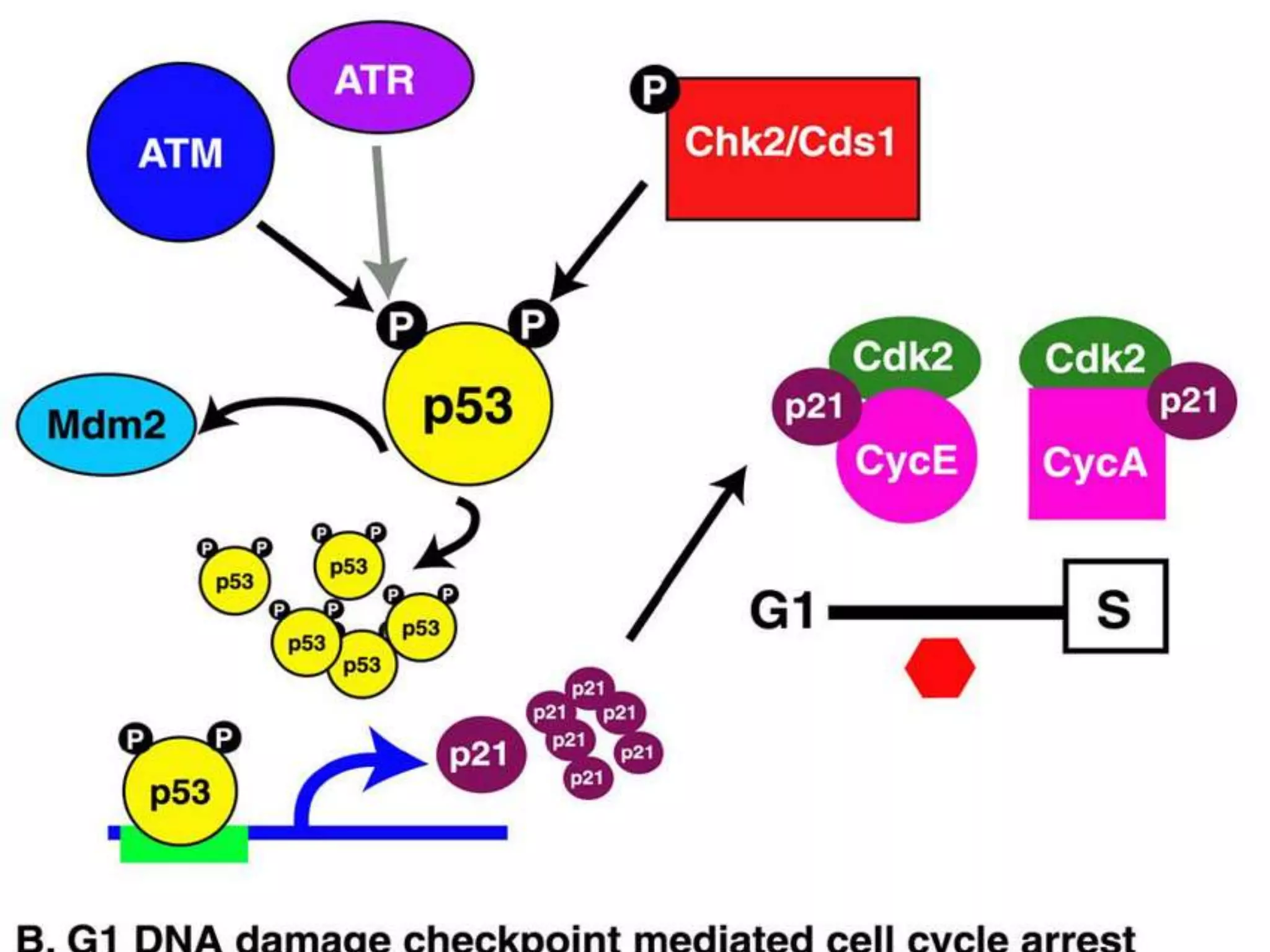
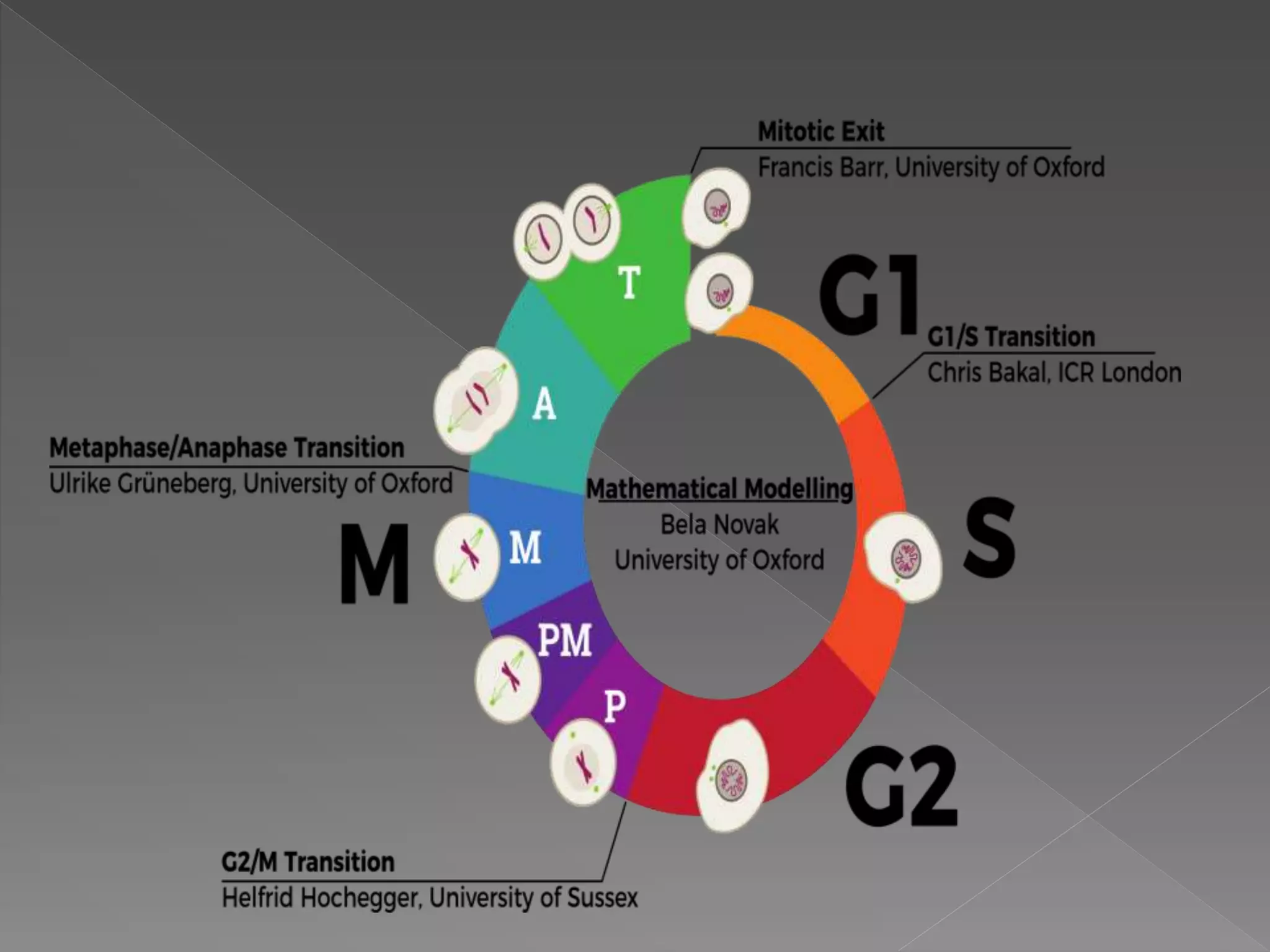
G1 Checkpoint
Check For:
Nutrients
Growth factors
DNA damage
Check for:
Cell size
DNA
replication
Check for:
Chromosome
spindle
Attachment
G2
Checkpoint
Metaphase
Checkpoint
G1
Checkpoint
G1
M
G2
S
DNA
Synthesis
G0
(Resting
Phase)
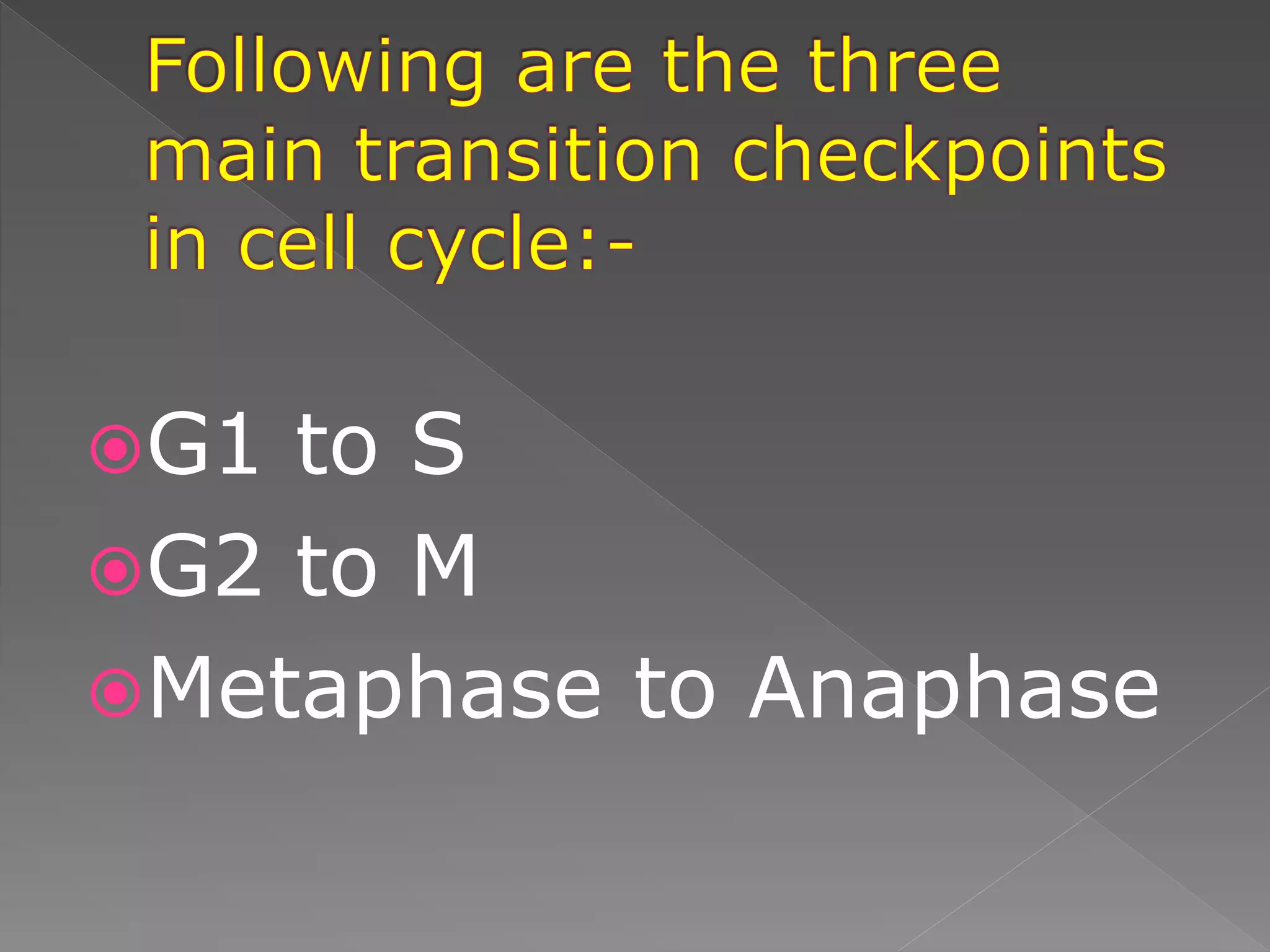
G1 to S
G2 to M
Metaphase to Anaphase
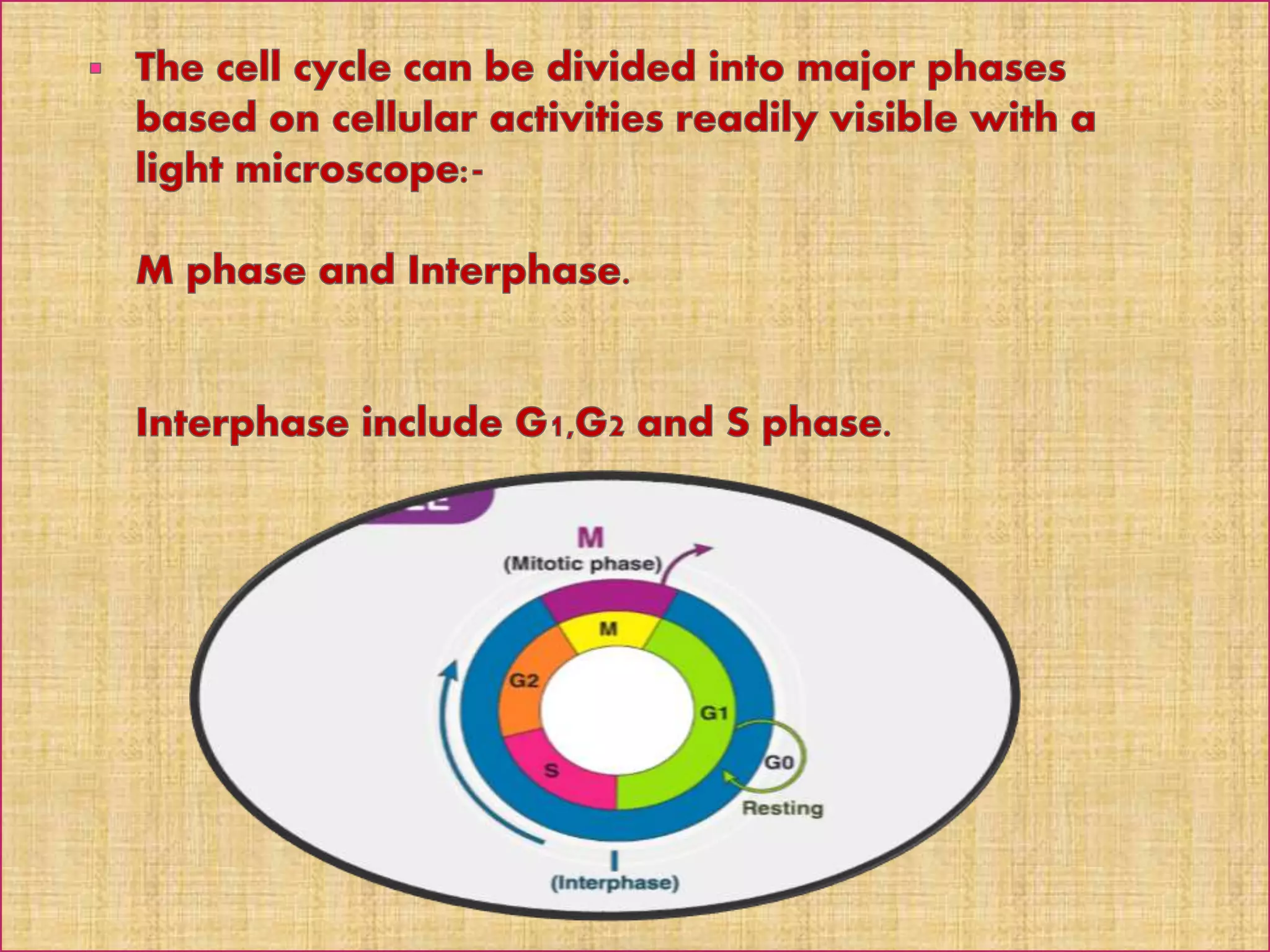
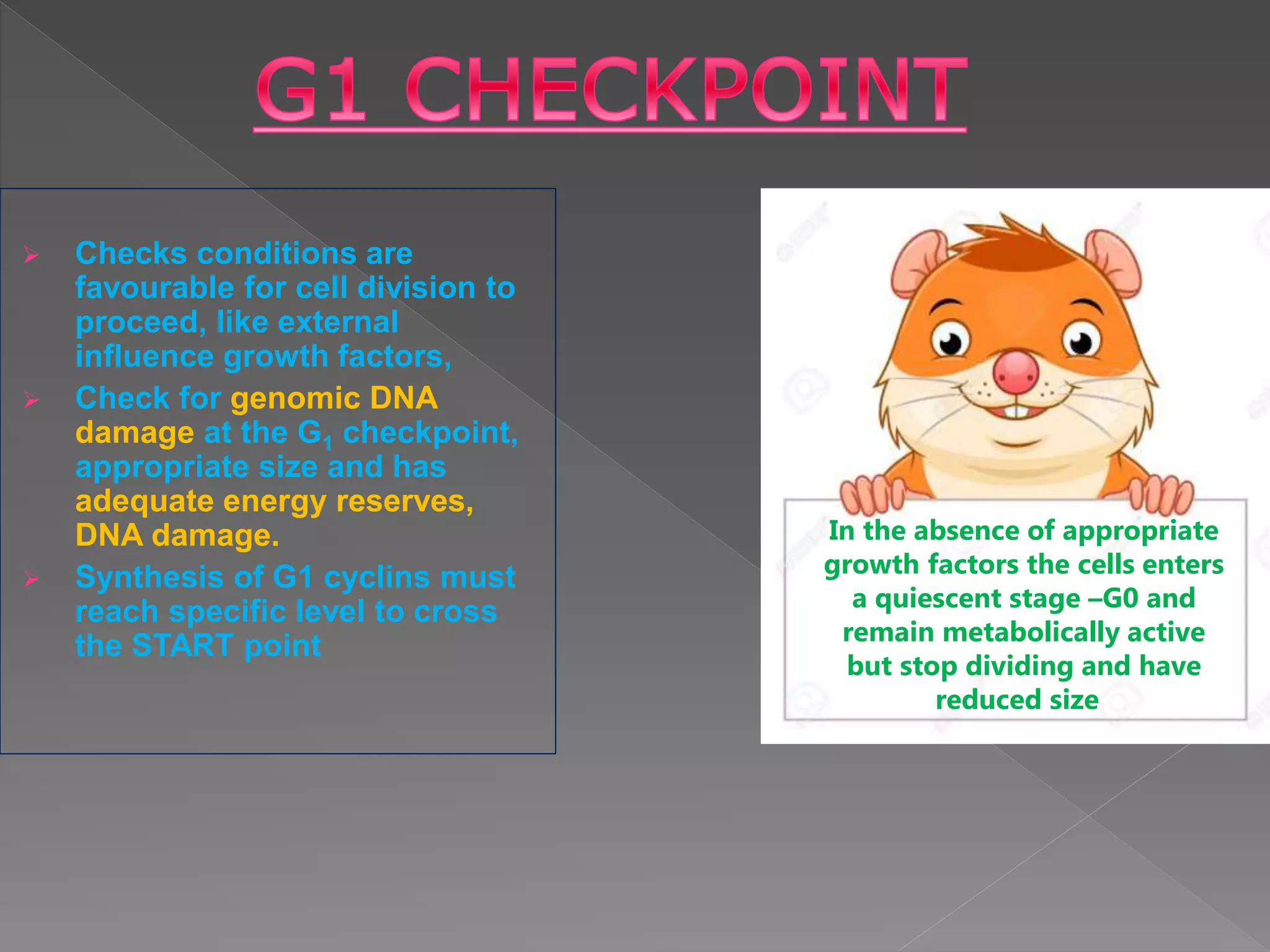
 Checks conditions are
favourable for cell division to
proceed, like external
influence growth factors,
 Check for genomic DNA
damage at the G1 checkpoint,
appropriate size and has
adequate energy reserves,
DNA damage.
 Synthesis of G1 cyclins must
reach specific level to cross
the START point
In the absence of appropriate
growth factors the cells enters
a quiescent stage –G0 and
remain metabolically active
but stop dividing and have
reduced size .
 The restriction point is located at the end of the G2 phase .
 This checks the number of factors which are essential for the cell
division.
 Maturation-promoting factor or mitosis promoting factor or M-
phase promoting factor-(MPF) is a protein composed of cyclin-B
and CDK-I. This protein promotes the G2 phase into the entrance
of M-phase .
 The main function of MPF in this restriction point are
a. Triggers the formation of Mitotic spindle.
b. Promotes chromosome condensation
c. Causes nuclear envelop breakdown .
 If there are any damages are noticed in this restriction point ,then
the phasphatase not activate the MPF, resulting in the arrest of
cell cycle in G2 phase till the repair of the damaged DNA .This
prevents the transfer of defected DNA into the daughter cells.
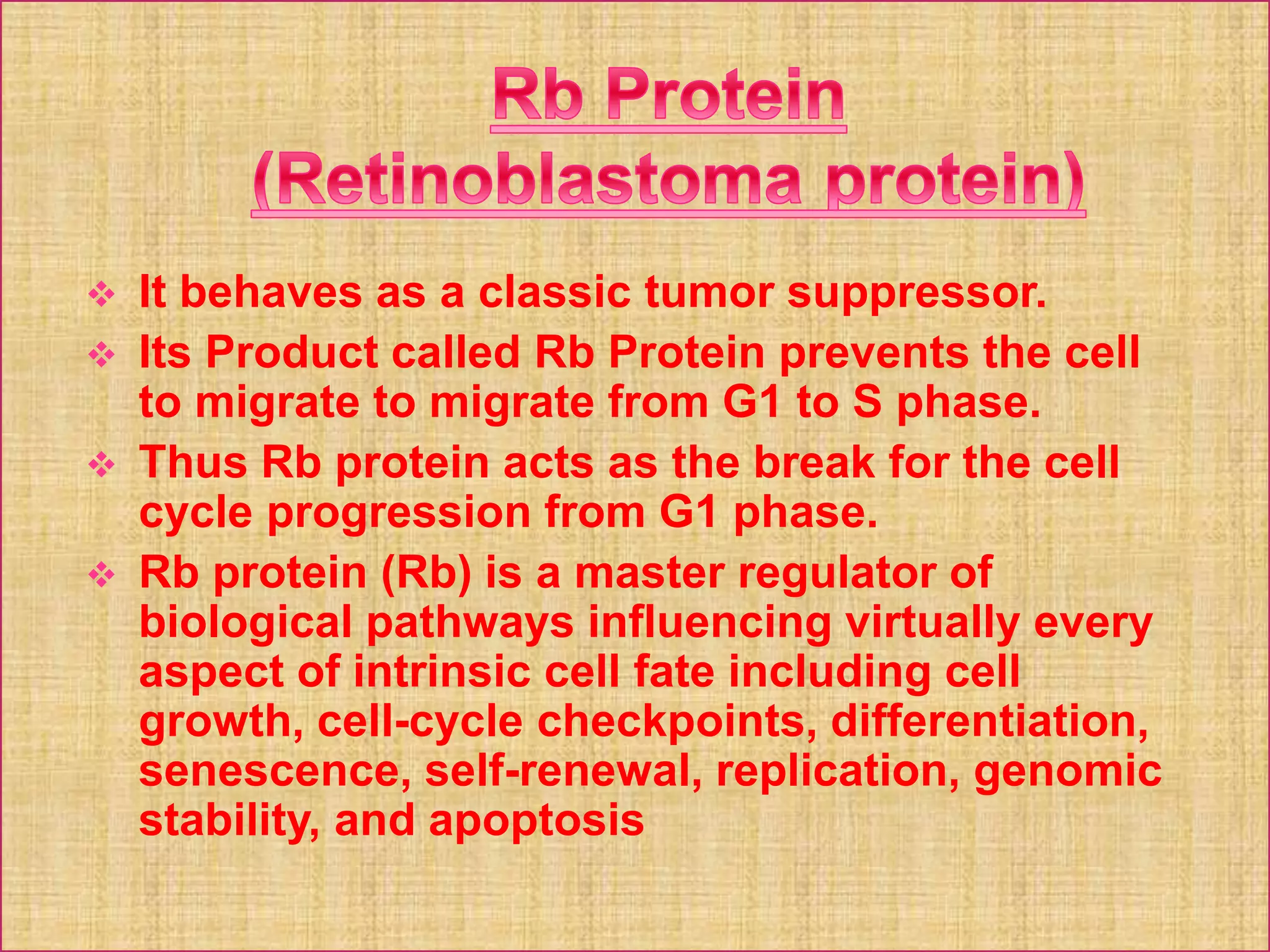
 It behaves as a classic tumor suppressor.
 Its Product called Rb Protein prevents the cell
to migrate to migrate from G1 to S phase.
 Thus Rb protein acts as the break for the cell
cycle progression from G1 phase.
 Rb protein (Rb) is a master regulator of
biological pathways influencing virtually every
aspect of intrinsic cell fate including cell
growth, cell-cycle checkpoints, differentiation,
senescence, self-renewal, replication, genomic
stability, and apoptosis
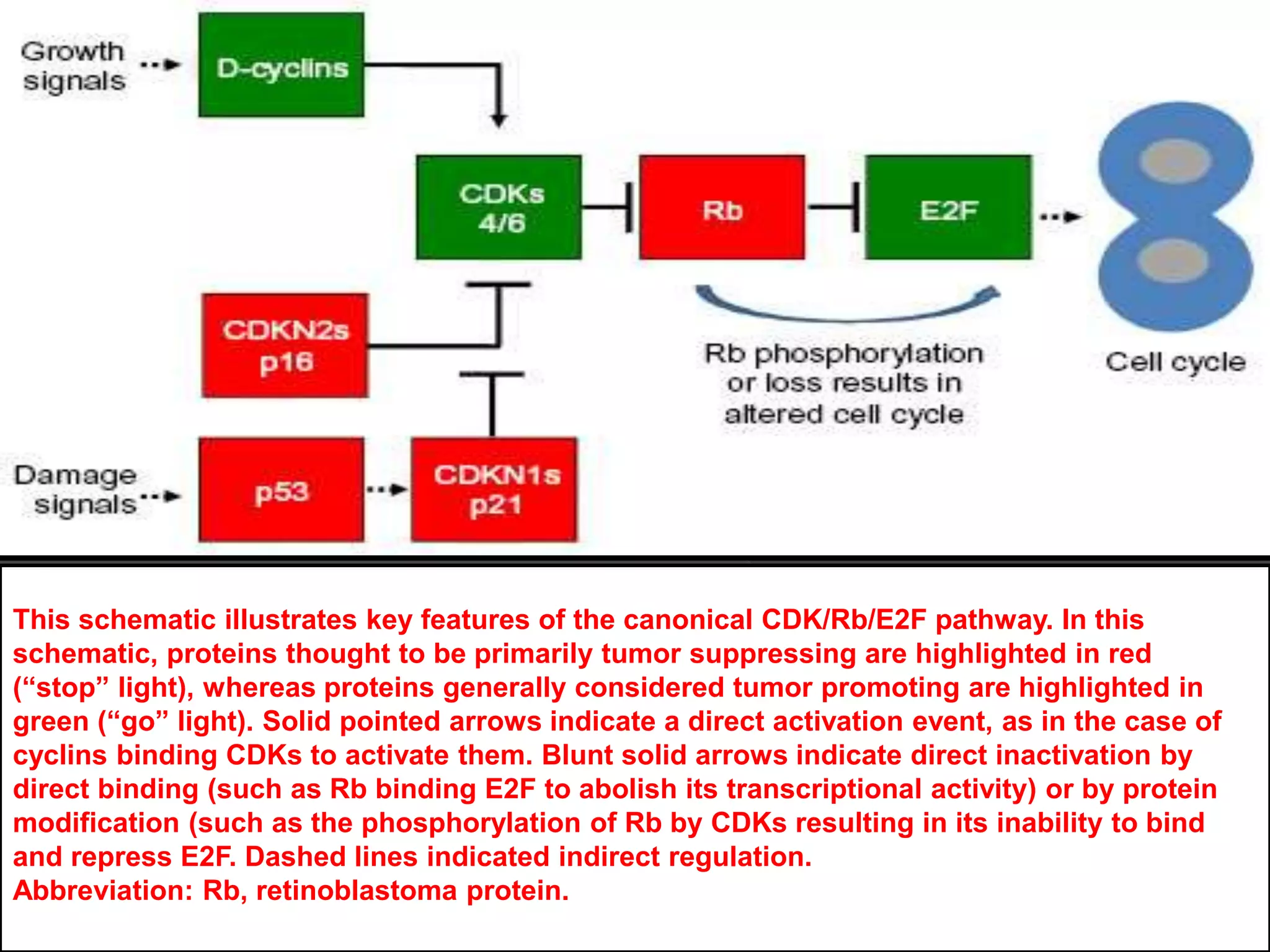
This schematic illustrates key features of the canonical CDK/Rb/E2F pathway. In this
schematic, proteins thought to be primarily tumor suppressing are highlighted in red
(“stop” light), whereas proteins generally considered tumor promoting are highlighted in
green (“go” light). Solid pointed arrows indicate a direct activation event, as in the case of
cyclins binding CDKs to activate them. Blunt solid arrows indicate direct inactivation by
direct binding (such as Rb binding E2F to abolish its transcriptional activity) or by protein
modification (such as the phosphorylation of Rb by CDKs resulting in its inability to bind
and repress E2F. Dashed lines indicated indirect regulation.
Abbreviation: Rb, retinoblastoma protein.
 Tumor suppresser protein
 Revealed character as a tumor
suppresser gene in 1989
 Preventing Tumor development
 Inhibit Over expression Of Cell
 Regulate to cell cycle
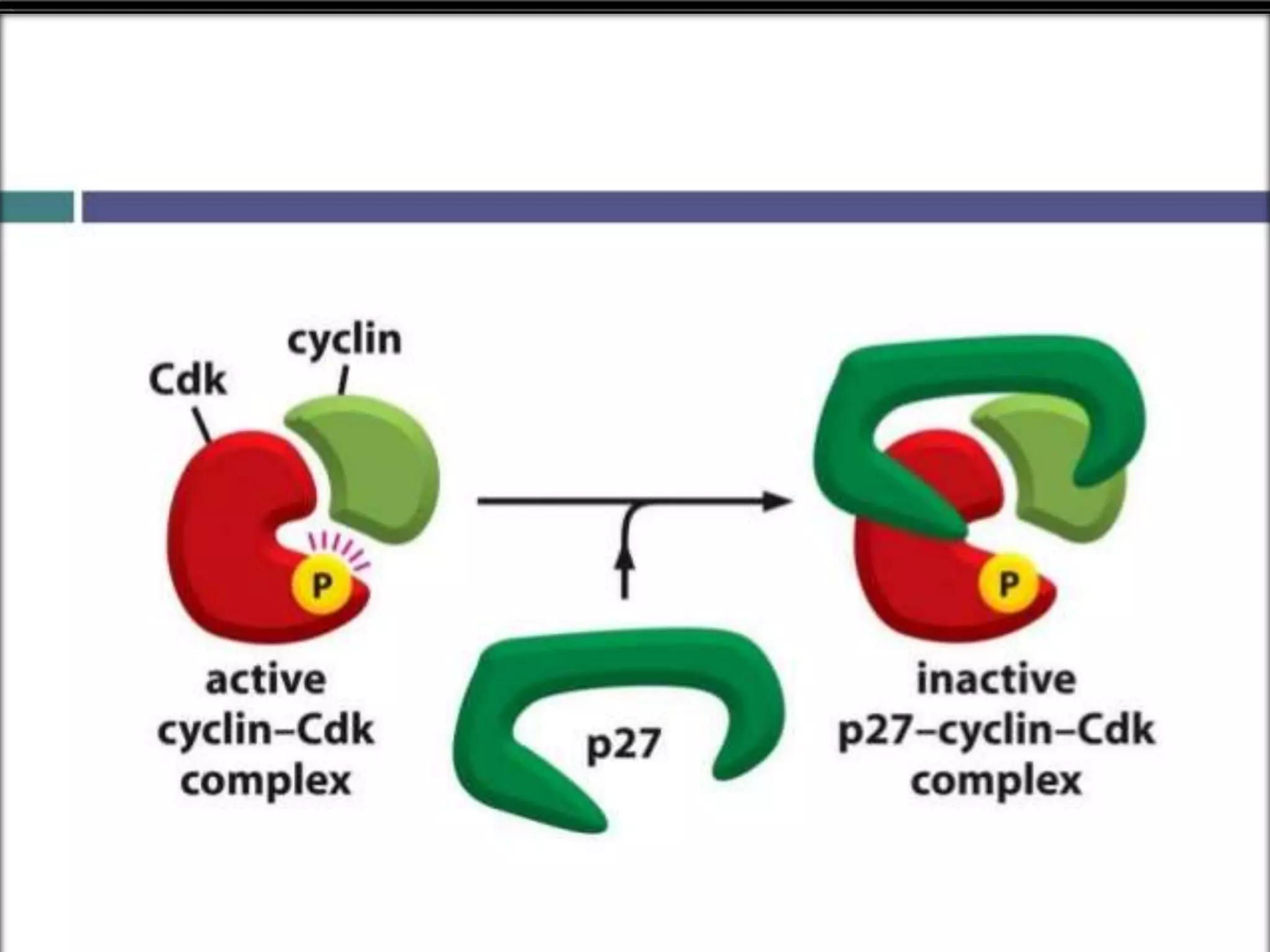
Cdk inhibitors , such as p21 and
p27,are also active in cell
differentiation . Just before cells
begin to differentiate---whether
into muscle cells ,liver cells ,
blood cells , or some other
type—they typically withdraw
from the cell cycle and stop
dividing , Cdk inhibitors are
thought to either allow or
directly induce cell cycle
withdrawl.
 The retinoblastoma protein: a master
tumor suppressor acts as a link between
cell cycle and cell
adhesion
Authors Engel B, Cress W D, Santiago-
Cardona P
 Cell Biology-Gerald Karp
 Wikipedia
Regulation of cell cycle (1)

Regulation of cell cycle (1)

  • 3.
  • 6.
     The studyof cell cycle have practical implications in combating cancer ,a disease that results from the breakdown in a cell ability to regulate its own division .  In 1970 ,a series of cell fusion experiments carried out by Potu Rao Robert Johnson of university of Colorado helped open the door to understanding how the cell cycle is regulated.
  • 9.
    Cell Division isexpensive process Maintain the integrity of Genome cell Proper cytoplasmic growth of the cell division is required Proper Cellular homeostatis Prevent onset of Mutations
  • 10.
    Cdk(Cyclin dependant kinases,catalyticprotein) Cyclin(Key regulator Protein Rb protein P53 protein Tumor Suppress Protein
  • 11.
     They namedbecause they undergo a cycle of synthesis of degradation in each Cell Cycle.  It is a regulatory protein of cell cycle and shows continuous rise and fall during the various stages of cell cycle  Synthesis of Cyclins protein begin during G1 phase and they increase their concentration till Metaphase but in Anaphase they are degraded by the activated by the activity of APC.
  • 12.
    Help to promotepassage through “Start” or the restriction point in the late G1 Bind Cdks at the end of G1 and commit cell to DNA replication Binds Cdks during S Phase and are required for initiation of DNA replication Promote the events of Mitosis
  • 13.
    Cyclin is most importantkey regulator of cell cycle and it regulate the activity of Cdk
  • 17.
    During G2,the cdc2kinase interacts with a mitotic cyclin but remain inactive as the result of phosphorylation of a key tyrosine residue
  • 18.
    Remain inactive and activated only uponcycle binding Concentration remains constant throughout the cell cycle Ser- Thr Kinases which act as catalytic protein for cell cycle
  • 19.
     Progression ofcell cycle is controlled by a conserved set of proteins called kinases.  Regulate the progression of cell cycle in association with another group of proteins called as cyclins.  The concentration of cyclins fluctuates throughout the cell cycle while that of Cdk
  • 20.
    CdK1 • G2 toM CdK2 • G1 to S CdK 4 • G1 to S CdK20 • Metaphase to Anaphase Different Types of CdK:-
  • 22.
    FLUCTUATION OF CYCLINGDURING CELL CYCLE
  • 23.
    Formulated by Leland Hartwell andTed Weinert in 1988 Halt the cell cycle processes if 1)Any chromosomal DNA damaged 2)Critical processes Activated by system of sensors that recognise DNA damage or cellular abnormalities If DNA damaged beyond the repair, 1)death of the cell 2)senescence
  • 24.
    G1 Checkpoint Check For: Nutrients Growthfactors DNA damage Check for: Cell size DNA replication Check for: Chromosome spindle Attachment G2 Checkpoint Metaphase Checkpoint G1 Checkpoint G1 M G2 S DNA Synthesis G0 (Resting Phase)
  • 26.
    G1 to S G2to M Metaphase to Anaphase
  • 27.
     Checks conditionsare favourable for cell division to proceed, like external influence growth factors,  Check for genomic DNA damage at the G1 checkpoint, appropriate size and has adequate energy reserves, DNA damage.  Synthesis of G1 cyclins must reach specific level to cross the START point In the absence of appropriate growth factors the cells enters a quiescent stage –G0 and remain metabolically active but stop dividing and have reduced size .
  • 28.
     The restrictionpoint is located at the end of the G2 phase .  This checks the number of factors which are essential for the cell division.  Maturation-promoting factor or mitosis promoting factor or M- phase promoting factor-(MPF) is a protein composed of cyclin-B and CDK-I. This protein promotes the G2 phase into the entrance of M-phase .  The main function of MPF in this restriction point are a. Triggers the formation of Mitotic spindle. b. Promotes chromosome condensation c. Causes nuclear envelop breakdown .  If there are any damages are noticed in this restriction point ,then the phasphatase not activate the MPF, resulting in the arrest of cell cycle in G2 phase till the repair of the damaged DNA .This prevents the transfer of defected DNA into the daughter cells.
  • 32.
     It behavesas a classic tumor suppressor.  Its Product called Rb Protein prevents the cell to migrate to migrate from G1 to S phase.  Thus Rb protein acts as the break for the cell cycle progression from G1 phase.  Rb protein (Rb) is a master regulator of biological pathways influencing virtually every aspect of intrinsic cell fate including cell growth, cell-cycle checkpoints, differentiation, senescence, self-renewal, replication, genomic stability, and apoptosis
  • 33.
    This schematic illustrateskey features of the canonical CDK/Rb/E2F pathway. In this schematic, proteins thought to be primarily tumor suppressing are highlighted in red (“stop” light), whereas proteins generally considered tumor promoting are highlighted in green (“go” light). Solid pointed arrows indicate a direct activation event, as in the case of cyclins binding CDKs to activate them. Blunt solid arrows indicate direct inactivation by direct binding (such as Rb binding E2F to abolish its transcriptional activity) or by protein modification (such as the phosphorylation of Rb by CDKs resulting in its inability to bind and repress E2F. Dashed lines indicated indirect regulation. Abbreviation: Rb, retinoblastoma protein.
  • 34.
     Tumor suppresserprotein  Revealed character as a tumor suppresser gene in 1989  Preventing Tumor development  Inhibit Over expression Of Cell  Regulate to cell cycle
  • 36.
    Cdk inhibitors ,such as p21 and p27,are also active in cell differentiation . Just before cells begin to differentiate---whether into muscle cells ,liver cells , blood cells , or some other type—they typically withdraw from the cell cycle and stop dividing , Cdk inhibitors are thought to either allow or directly induce cell cycle withdrawl.
  • 37.
     The retinoblastomaprotein: a master tumor suppressor acts as a link between cell cycle and cell adhesion Authors Engel B, Cress W D, Santiago- Cardona P  Cell Biology-Gerald Karp  Wikipedia