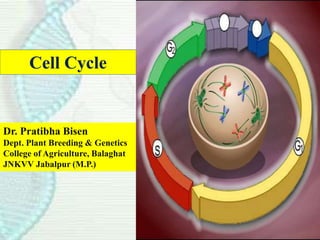
Cell Cycle
Dr. Pratibha Bisen
Dept. Plant Breeding & Genetics
College of Agriculture, Balaghat
JNKVV Jabalpur (M.P.)
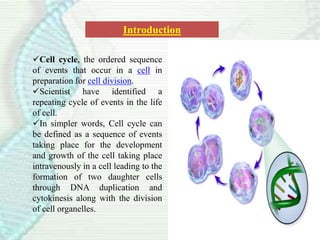
Cell cycle, the ordered sequence
of events that occur in a cell in
preparation for cell division.
Scientist have identified a
repeating cycle of events in the life
of cell.
In simpler words, Cell cycle can
be defined as a sequence of events
taking place for the development
and growth of the cell taking place
intravenously in a cell leading to the
formation of two daughter cells
through DNA duplication and
cytokinesis along with the division
of cell organelles.
Introduction
Cell cycle
Phases of Cell cycle
Cell cycle
Interphase
Phases of Cell cycle
Cell cycle
Interphase Mitosis
Phases of Cell cycle
G1
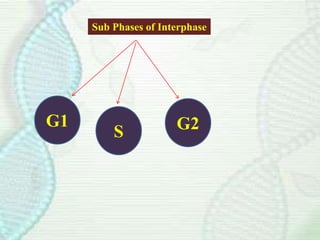
Sub Phases of Interphase
G1
S
Sub Phases of Interphase
G1
S G2
G1
This is the primary stage of the interphase, known as the G1 or first gap
phase.
This phase is characterized by changes in the chromosomes from the
condensed to the extended state in addition to a range of metabolic
activities leading to the initiation of replication of DNA.
Characteristics of the chromatin fibres in this phase are – less coiled and
slender, extended fully and ready for transcription.
The process of transcription results in the production of RNAs and also
a sequence of protein molecules vital for DNA replication to be initiated
G1 phase is lengthier than the other three phases and varies from cell to
cell
DNA synthesis in this phase is initiated at a distinct checkpoint. The cell
progresses towards division once all the biochemical events at this
particular point have concluded.
S
It is an active DNA synthesis and histone synthesis phase of the interphase
Here the chromosome number duplicates enabled by linked proteins and
DNA replication. Most of the histone protein synthesis occurs in this phase
though some of it occurs in G1 phase
Identical pair of DNA molecules are formed as the process of DNA
replication is discontinuous and semi-conservative
Even after the chromosomes have doubled, the sister chromatids are
securely attached to the centromeric region
G2
This phase is succeeded by the S phase. Here the chromosomes comprise of
two chromatids thus cell has double the quantity of DNA.
Here, the cell restores its energy, producing proteins essential for
chromosomes to manipulate
Few of the cell organelles are replicated. Cytoskeleton dismantles to render
resources for mitosis
Additional growth of cell may be observed. Before the cell enters the first
phase of mitosis, the concluding preparations of the mitotic phase must be
done.
G2
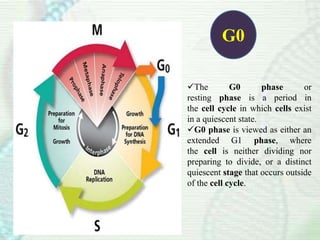
The G0 phase or
resting phase is a period in
the cell cycle in which cells exist
in a quiescent state.
G0 phase is viewed as either an
extended G1 phase, where
the cell is neither dividing nor
preparing to divide, or a distinct
quiescent stage that occurs outside
of the cell cycle.
G0
M
This phase is succeeded by the G2 phase. Here the cell divides into two
daughter cells along with equal distribution of chromosomes between the
daughter cells. Once the M phase steps into the G1 phase, the next cell cycle
is initiated to be repeated.
During the mitotic (M) phase, the cell divides its copied DNA and
cytoplasm to make two new cells.
M phase involves two distinct division-related processes: mitosis and
cytokinesis.
The progression of cells through the cell cycle is controlled by checkpoints
at different stages.
These detect if a cell contains damaged DNA and ensure those cells do not
replicate.
The Restriction point (R) is located at G1 and is a key checkpoint. The
vast majority of cells that pass through the R point will end up completing the
entire cell cycle. Other checkpoints are located at the transitions between G1
and S, and G2 and M.
If damaged DNA is detected at any checkpoint, activation of the checkpoint
results in increased protein p53 production. p53 is a tumour suppressor gene
that stops the progression of the cell cycle and starts repair mechanisms for
the damaged DNA. If this DNA cannot be repaired, then it ensures the cell
undergoes apoptosis and can no longer replicate.
This cell cycle is also closely regulated by cyclins which control cell
progression by activating cyclin-dependent kinase (CDK) enzymes.
Regulation
Cell cycle
Cell cycle
Cell cycle

Cell cycle

  • 1.
    Cell Cycle Dr. PratibhaBisen Dept. Plant Breeding & Genetics College of Agriculture, Balaghat JNKVV Jabalpur (M.P.)
  • 2.
    Cell cycle, theordered sequence of events that occur in a cell in preparation for cell division. Scientist have identified a repeating cycle of events in the life of cell. In simpler words, Cell cycle can be defined as a sequence of events taking place for the development and growth of the cell taking place intravenously in a cell leading to the formation of two daughter cells through DNA duplication and cytokinesis along with the division of cell organelles. Introduction
  • 3.
  • 4.
  • 5.
  • 7.
    G1 Sub Phases ofInterphase
  • 8.
  • 9.
    Sub Phases ofInterphase G1 S G2
  • 10.
    G1 This is theprimary stage of the interphase, known as the G1 or first gap phase. This phase is characterized by changes in the chromosomes from the condensed to the extended state in addition to a range of metabolic activities leading to the initiation of replication of DNA. Characteristics of the chromatin fibres in this phase are – less coiled and slender, extended fully and ready for transcription. The process of transcription results in the production of RNAs and also a sequence of protein molecules vital for DNA replication to be initiated G1 phase is lengthier than the other three phases and varies from cell to cell DNA synthesis in this phase is initiated at a distinct checkpoint. The cell progresses towards division once all the biochemical events at this particular point have concluded.
  • 11.
    S It is anactive DNA synthesis and histone synthesis phase of the interphase Here the chromosome number duplicates enabled by linked proteins and DNA replication. Most of the histone protein synthesis occurs in this phase though some of it occurs in G1 phase Identical pair of DNA molecules are formed as the process of DNA replication is discontinuous and semi-conservative Even after the chromosomes have doubled, the sister chromatids are securely attached to the centromeric region
  • 12.
    G2 This phase issucceeded by the S phase. Here the chromosomes comprise of two chromatids thus cell has double the quantity of DNA. Here, the cell restores its energy, producing proteins essential for chromosomes to manipulate Few of the cell organelles are replicated. Cytoskeleton dismantles to render resources for mitosis Additional growth of cell may be observed. Before the cell enters the first phase of mitosis, the concluding preparations of the mitotic phase must be done.
  • 13.
  • 15.
    The G0 phaseor resting phase is a period in the cell cycle in which cells exist in a quiescent state. G0 phase is viewed as either an extended G1 phase, where the cell is neither dividing nor preparing to divide, or a distinct quiescent stage that occurs outside of the cell cycle. G0
  • 16.
    M This phase issucceeded by the G2 phase. Here the cell divides into two daughter cells along with equal distribution of chromosomes between the daughter cells. Once the M phase steps into the G1 phase, the next cell cycle is initiated to be repeated. During the mitotic (M) phase, the cell divides its copied DNA and cytoplasm to make two new cells. M phase involves two distinct division-related processes: mitosis and cytokinesis.
  • 19.
    The progression ofcells through the cell cycle is controlled by checkpoints at different stages. These detect if a cell contains damaged DNA and ensure those cells do not replicate. The Restriction point (R) is located at G1 and is a key checkpoint. The vast majority of cells that pass through the R point will end up completing the entire cell cycle. Other checkpoints are located at the transitions between G1 and S, and G2 and M. If damaged DNA is detected at any checkpoint, activation of the checkpoint results in increased protein p53 production. p53 is a tumour suppressor gene that stops the progression of the cell cycle and starts repair mechanisms for the damaged DNA. If this DNA cannot be repaired, then it ensures the cell undergoes apoptosis and can no longer replicate. This cell cycle is also closely regulated by cyclins which control cell progression by activating cyclin-dependent kinase (CDK) enzymes. Regulation