CELL ADHESION
MOLECULES
Dr.N.Manjula
INTRODUCTION
 Cells in vivo must form contacts with their neighbour
cell or with ECM in order to form tissues.
 The tissues of our body are held together by
molecular interaction between the cells.
 CAM are glycoproteins located on the cell surface.
 These proteins are typically trans membrane
receptors but are sometimes stored in cytoplasm.
 CAM are also important for recruitment of leukocytes
to site of inflammation by promoting cell – cell and cell
– matrix interactions.
 CAM bind with other cells by Cell Adhesion
Receptor.
 These receptors enable cells to recognize and
bind molecules on other cells or ECM.
 They form two type of adhesion:-
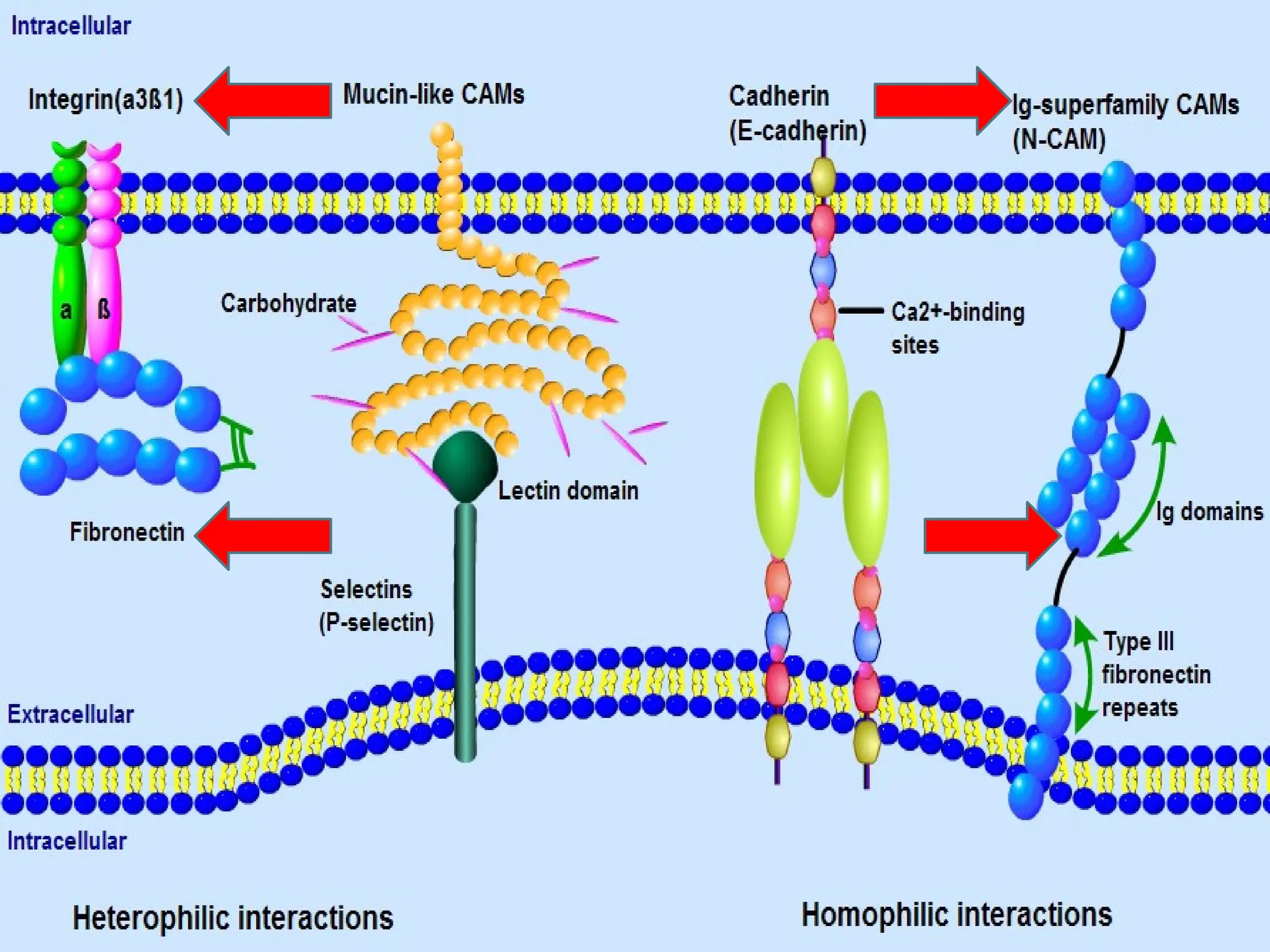
 HOMOPHILIC: between same type of molecules.
 Eg: cadherin – cadherin.
 HETEROPHILIC:- between different type of
molecules.
 Eg: selectin – mucin.
CLASSIFICATION
 Most of CAM belong to four protein family:
 Cadherin
 Integrin
 Selectin
 Ig Super Family [IgS]
CADHERIN
 They are calcium dependent adhesion molecules.
 This family has almost 90 members which participate
in interaction between cells of same type.
 Subclasses:-
 N – cadherin – neural.
 P – cadherin – placental.
 E – cadherin – epithelial.
 They exhibit homophilic adhesion.
 Failure of cadherin mediated cell – cell adhesion
is seen in breast cancer.
 Interactions between cadherin connect plasma
membrane of adjacent cells forming two types of
cell junction:
 1.ZONULA ADHERENS: small, spotlike, junction
located near apical surface of epithelial cells.
 2.DESMOSOMES: stronger and more extensive
junctions present in epithelial and muscle cells.
 Migration of keratinocytes in re-epithelialization of
skin wound healing is depend on desmosomal
junction.
 Linkage of cadherin with cytoskeleton occurs via
two classes of catenin.
 Beta and Alpha.
 Cell to cell interaction mediated by cadherin and
catenins play major role in regulating cell motility,
proliferation and differentiation.
 Dimnished function of E cadherin contributes to
certain cancer that includes breast and gastric
cancers.
 Free beta catenin acts independently of cadherin
in Wnt signaling pathway which participates in
stem cell homeostasis and regeneration.
 Mutation and altered expression of Wnt/beta
catenin pathway is implicated in cancer
development particularliy in GIT and Liver.
Ig Super Family [IgS]
 They are calcium independent CAM.
 They exhibit both homophilic and heterophilic
adhesion.
 Involved in recognition, binding, adhesion process.
 They possess an extracellular region known as
immunoglobulin domain.
 Adhesion molecules that contain variable number
of immunoglobulin like domain are member of this
family.
 Few of them are: - ICAM – 1 (CD54), ICAM – 2
(CD102), ICAM – 3 (CD50), and VCAM (CD106)
expressed on vascular endothelial cells bind to
integrin molecules.
 MAdCAM – 1 has both Ig like domain and mucin
like domain.
 It is expressed on mucosal endothelium and
directs lymphocyte entry into mucosa.
 It binds to integrin alpha4beta7 (LPAM) via Ig like
domain and to L – selectin (CD62L) via mucin like
domain.
 Platelet endothelial cell adhesion molecule
{PECAM – 1, CD31}is found on surface of
leukocytes.
 It exhibits homotypic binding { PECAM – PECAM}.
 Junctional cell adhesion molecule (JAM – 1,CD
321) is located within endothelial junctional
complex.
 Take part in transendothelial migration.
ICAM 1
 Intercellular adhesion molecule 1 is expressed on
endothelial cells.
 When there is an invading pathogen, the
endothelial cells become activated and will
express ICAM 1 on their surfaces.
 ICAM 1 will bind to cell adhesion molecule LFA 1
(lymphocyte function associated 1 - integrin)
molecule expressed on monocytes.
 Monocytes will move across the endothelial cells
to the interstitial space to differentiate to
macrophage.
VCAM 1
 It is expressed on endothelial cells.
 When there is an invading pathogen, the
endothelial cells become activated and will
express VCAM 1 on their surfaces.
 VCAM 1 will bind to CAM - VLA 4 (very late
antigen 4 – integrin ) expressed on monocytes.
 Monocytes will move across endothelial cells to
the interstitial space to differentiate to
macrophage.
 It is a family of membrane glycoprotein which has
an extracellular lectin like domain that enable
these molecules to bind to specific carbohydrate
groups.
 Selectin primarily interact with sialylated
carbohydrate moiety called sialyl – Lewis which is
often linked to mucin like molecules.
 P – selectin is stored within Weibel – Palade
bodies, atype of granule within endothelial cell.
SELECTIN
 They are divalent cation dependent CAM
 They are carbohydrate binding proteins.
 Eg: E – selectin [endothelial].
 L – selectin [leukocyte].
 P – selectin [platelet].
 Play major role in many host defense mechanism.
 On activation of endothelial cell, the granule fuses
with plasma membrane, resulting in expression of
P – selectin on the cell surface.
 Expression of E – selectin requires synthesis of
new protein and occur after endothelium has been
stimulated by pro inflammatory cytokines.
 These are responsible for initial stickiness of
leukocytes to vascular endothelium.
 P - selectin
 Recruitment of neutrophils.
 Type 1 activation.
 Induced by histamine in minutes.
 E – selectin
 Type 2 activation.
 Takes hours.
 L – selectin
 Allows naïve T lymphocytes to move from blood
into lymph node.
Increased levels of E selectin
 Scleroderma
 polyarteritis nodosa
 SLE
 Psoriasis
 Atopic dermatitis
INTEGRIN
 They are large group of heterodimeric glycoprotein
 Alpha and Beta both group participate in binding.
 They take part in cell – cell adhesion, binding,
interaction of cell with ECM.
 These are heterodimeric proteins consisting of
alpha and beta chain that are noncovalently
associated at the cell surface.
 Most integrins bind to ECM and provide cell matrix
interactions throughout the body.
 Some subfamilies are involved in cell to cell
interactions.
 Integrin bind to ECM proteins such as fibronectin,
laminin, osteopontin providing connection
between cells and ECM and also to adhesive
proteins in other cells establishing cell to cell
contact.
 FIBRONECTIN is a large protein that bind to
many molecules such as collagen, fibrin,
proteoglycan, and cell surface receptors.
 The plasma form binds to fibrin, helping to
stabilize blood clot that fills gap created by wound.
 Thus helps in formation of provisional matrix in
wound healing.
 LAMININ is the most abundant glycoprotein in
basement membrane.
 It has binding domain for both ECM and cell
surface receptors.
 It also mediates attachment of cells to connective
tissue substrates.
 Cadherin and Integrin link the cell surface with
cytoskeleton through binding to actin and
intermediate filaments.
 Ligand binding to integrin causes clustering of
receptors in cell membrane and formation of
focal adhesion complexes.
 Integrin - cytoskeleton complex function as
activated receptors and trigger number of signal
transduction pathway including MAP kinase, PKC,
PI3K pathway which are also activated by growth
factors.
 Integrin and growth factor receptor ineract [cross –
talk] to transmit environmental signals to the cell
that regulate proliferation, apoptosis,
differentiation.
 Leukocytes express special type of integrin
known as beta2 integrin or CD 18.
 Integrin with beta 2 subunit bind to members
of Ig superfamily.
 Some integrins must be activated before they
can bind with high affinity to their ligands.
 Clustering of integrin on the cell surface also
increases the likelihood of effective binding and
plays a role in leukocyte migration.
 Lack of this role of integrin leads to LEUKOCYTE
ADHESION DEFICIENCY [LAD type 1] AR.
 Characterized by recurrent bacterial infection and
impaired wound healing.
 Similar deficiency with impaired expression of
selection is termed as [LAD type 2].
DISEASES RELATED TO INTEGRIN DEFICIENCY
 There are three inherited autosomal recessive
disorders associated with integrin.
 1.mutation in alpha 2 b and beta 3 subunit =
GLANZMANN’S THROMBASTHENIA [ platelet
dysfunction and bleeding disorder]
 2.point mutation and gene deletion in beta 2 =
LAD.
 3.mutation in alpha 6 and beta 4 = JUNCTIONAL
EPIDERMOLYSIS BULLOSA skin blistering.
ROLE OF CELL ADHESION MOLECULE IN:
 Cell to cell interactions.
 Embryogenesis.
 Immunity – migration of cells to
inflammation site.
 Cell – tissue – organ development.
 Wound healing.
 Cancer metastasis.
EMBRYOGENESIS
IN CANCER
 E cadherin has been shown to be a potent
invasion suppressor as well as tumor suppressor.
 Disturbed expression profiles of
E-cadherin/catenin complex have been
demonstrated in histological section of many
human tumor types.
 Majority of carcinoma seems to show deregulated
E-cadherin expression by various mechanism.
 The predominant mechanism emerging in
most carcinoma or hypermethylation of E-
cadherin promoter and expression of
transrepressor molecules such as SIP1, Snail
, Slug that bind sequence elements in the
proximal E-cadherin promoter.
 Loss of E cadherin function elicit active signal
that supports migration, invasion, metastasis
of tumor cells.
 Loss E cadherin correlates poor prognosis.
THERAPEUTIC USES
 In osteoporosis E selectin tagged stem cells
help migrate osteoblast developed from bone
marrow to site needed.
Tensin in health and disease
 Tensin is a cytoplasmic phosphoprotein that is
localised to integrin mediated focal adhesion.
 It binds to actin filaments at ABD domain and
contains phosphotyrosine binding PTB domain
which interacts with the cytoplasmic tail of
integrin.
 In addition tensin has Src Homology 2(SH2)
domain capable of interacting with tyrosine
phosphorylated proteins
Role of tensin in carcinogenesis
 Tensins are deregulated in cancer although their
function is tissue dependent.
 Cten Tensin 4 acts as tumour suppressor in
prostate and as oncogene in colon, breast and
lung neoplasia.
 Tensin 1 and 3 found to downregulate in prostate,
breast,kidney and skin cancer.
 Tensin 2 is down regulated in kidney and lung
cancer but over expressed in hepatocellular
carcinoma
 Thus tensin function as a platform for assembly of
signalling complexes at focal adhesions by
recruiting tyrosine phosphorylation signalling
molecules through the SH 2 domain and also by
providing interaction sites for other SH2
containing proteins.
 Therefore, tensin and its downstream signalling
molecules may be targets for therapeutic
intervention in renal disease , wound healing and
cancer.
 The processes of organogenesis, organ
homeostasis and repair require modulation of
cell adhesion to enable cell motility and maintain
cell stasis.
 Cell adhesion can be viewed as intercellular
adhesion (i.e. adhesions between cells) or cell-
to-matrix adhesion.
 The former is maintained through intercellular
junctions, while the latter is maintained
predominantly through focal adhesions.
Summary
 Special interaction between molecules expressed
on the surface of leukocytes (receptor) and
molecule on the surface of potential target cells
(ligands) are important mechanism in cell - cell
communication.
 These surface molecules are collectively called as
cell adhesion molecules
 Despite of their various role, malfunctioning of
CAM leads to breast cancer, leukocyte adhesion
deficiency syndrome, epithelial cell cancer.
References
 Kuby book of immunology 6 th edition.
 Robbins pathologic basis of disease.
 Recent advances in histopathology no 23.
CELL ADHESION MOLECULES-1            .pptx

CELL ADHESION MOLECULES-1 .pptx

  • 1.
  • 2.
    INTRODUCTION  Cells invivo must form contacts with their neighbour cell or with ECM in order to form tissues.  The tissues of our body are held together by molecular interaction between the cells.  CAM are glycoproteins located on the cell surface.  These proteins are typically trans membrane receptors but are sometimes stored in cytoplasm.  CAM are also important for recruitment of leukocytes to site of inflammation by promoting cell – cell and cell – matrix interactions.
  • 3.
     CAM bindwith other cells by Cell Adhesion Receptor.  These receptors enable cells to recognize and bind molecules on other cells or ECM.  They form two type of adhesion:-  HOMOPHILIC: between same type of molecules.  Eg: cadherin – cadherin.  HETEROPHILIC:- between different type of molecules.  Eg: selectin – mucin.
  • 5.
    CLASSIFICATION  Most ofCAM belong to four protein family:  Cadherin  Integrin  Selectin  Ig Super Family [IgS]
  • 7.
    CADHERIN  They arecalcium dependent adhesion molecules.  This family has almost 90 members which participate in interaction between cells of same type.  Subclasses:-  N – cadherin – neural.  P – cadherin – placental.  E – cadherin – epithelial.  They exhibit homophilic adhesion.  Failure of cadherin mediated cell – cell adhesion is seen in breast cancer.
  • 8.
     Interactions betweencadherin connect plasma membrane of adjacent cells forming two types of cell junction:  1.ZONULA ADHERENS: small, spotlike, junction located near apical surface of epithelial cells.  2.DESMOSOMES: stronger and more extensive junctions present in epithelial and muscle cells.  Migration of keratinocytes in re-epithelialization of skin wound healing is depend on desmosomal junction.
  • 9.
     Linkage ofcadherin with cytoskeleton occurs via two classes of catenin.  Beta and Alpha.  Cell to cell interaction mediated by cadherin and catenins play major role in regulating cell motility, proliferation and differentiation.
  • 10.
     Dimnished functionof E cadherin contributes to certain cancer that includes breast and gastric cancers.  Free beta catenin acts independently of cadherin in Wnt signaling pathway which participates in stem cell homeostasis and regeneration.  Mutation and altered expression of Wnt/beta catenin pathway is implicated in cancer development particularliy in GIT and Liver.
  • 12.
    Ig Super Family[IgS]  They are calcium independent CAM.  They exhibit both homophilic and heterophilic adhesion.  Involved in recognition, binding, adhesion process.  They possess an extracellular region known as immunoglobulin domain.
  • 13.
     Adhesion moleculesthat contain variable number of immunoglobulin like domain are member of this family.  Few of them are: - ICAM – 1 (CD54), ICAM – 2 (CD102), ICAM – 3 (CD50), and VCAM (CD106) expressed on vascular endothelial cells bind to integrin molecules.
  • 14.
     MAdCAM –1 has both Ig like domain and mucin like domain.  It is expressed on mucosal endothelium and directs lymphocyte entry into mucosa.  It binds to integrin alpha4beta7 (LPAM) via Ig like domain and to L – selectin (CD62L) via mucin like domain.
  • 15.
     Platelet endothelialcell adhesion molecule {PECAM – 1, CD31}is found on surface of leukocytes.  It exhibits homotypic binding { PECAM – PECAM}.  Junctional cell adhesion molecule (JAM – 1,CD 321) is located within endothelial junctional complex.  Take part in transendothelial migration.
  • 16.
    ICAM 1  Intercellularadhesion molecule 1 is expressed on endothelial cells.  When there is an invading pathogen, the endothelial cells become activated and will express ICAM 1 on their surfaces.  ICAM 1 will bind to cell adhesion molecule LFA 1 (lymphocyte function associated 1 - integrin) molecule expressed on monocytes.  Monocytes will move across the endothelial cells to the interstitial space to differentiate to macrophage.
  • 17.
    VCAM 1  Itis expressed on endothelial cells.  When there is an invading pathogen, the endothelial cells become activated and will express VCAM 1 on their surfaces.  VCAM 1 will bind to CAM - VLA 4 (very late antigen 4 – integrin ) expressed on monocytes.  Monocytes will move across endothelial cells to the interstitial space to differentiate to macrophage.
  • 19.
     It isa family of membrane glycoprotein which has an extracellular lectin like domain that enable these molecules to bind to specific carbohydrate groups.  Selectin primarily interact with sialylated carbohydrate moiety called sialyl – Lewis which is often linked to mucin like molecules.  P – selectin is stored within Weibel – Palade bodies, atype of granule within endothelial cell.
  • 20.
    SELECTIN  They aredivalent cation dependent CAM  They are carbohydrate binding proteins.  Eg: E – selectin [endothelial].  L – selectin [leukocyte].  P – selectin [platelet].  Play major role in many host defense mechanism.
  • 21.
     On activationof endothelial cell, the granule fuses with plasma membrane, resulting in expression of P – selectin on the cell surface.  Expression of E – selectin requires synthesis of new protein and occur after endothelium has been stimulated by pro inflammatory cytokines.  These are responsible for initial stickiness of leukocytes to vascular endothelium.
  • 22.
     P -selectin  Recruitment of neutrophils.  Type 1 activation.  Induced by histamine in minutes.  E – selectin  Type 2 activation.  Takes hours.  L – selectin  Allows naïve T lymphocytes to move from blood into lymph node.
  • 23.
    Increased levels ofE selectin  Scleroderma  polyarteritis nodosa  SLE  Psoriasis  Atopic dermatitis
  • 24.
    INTEGRIN  They arelarge group of heterodimeric glycoprotein  Alpha and Beta both group participate in binding.  They take part in cell – cell adhesion, binding, interaction of cell with ECM.  These are heterodimeric proteins consisting of alpha and beta chain that are noncovalently associated at the cell surface.
  • 25.
     Most integrinsbind to ECM and provide cell matrix interactions throughout the body.  Some subfamilies are involved in cell to cell interactions.  Integrin bind to ECM proteins such as fibronectin, laminin, osteopontin providing connection between cells and ECM and also to adhesive proteins in other cells establishing cell to cell contact.
  • 26.
     FIBRONECTIN isa large protein that bind to many molecules such as collagen, fibrin, proteoglycan, and cell surface receptors.  The plasma form binds to fibrin, helping to stabilize blood clot that fills gap created by wound.  Thus helps in formation of provisional matrix in wound healing.
  • 27.
     LAMININ isthe most abundant glycoprotein in basement membrane.  It has binding domain for both ECM and cell surface receptors.  It also mediates attachment of cells to connective tissue substrates.
  • 28.
     Cadherin andIntegrin link the cell surface with cytoskeleton through binding to actin and intermediate filaments.  Ligand binding to integrin causes clustering of receptors in cell membrane and formation of focal adhesion complexes.
  • 29.
     Integrin -cytoskeleton complex function as activated receptors and trigger number of signal transduction pathway including MAP kinase, PKC, PI3K pathway which are also activated by growth factors.  Integrin and growth factor receptor ineract [cross – talk] to transmit environmental signals to the cell that regulate proliferation, apoptosis, differentiation.
  • 30.
     Leukocytes expressspecial type of integrin known as beta2 integrin or CD 18.  Integrin with beta 2 subunit bind to members of Ig superfamily.  Some integrins must be activated before they can bind with high affinity to their ligands.
  • 31.
     Clustering ofintegrin on the cell surface also increases the likelihood of effective binding and plays a role in leukocyte migration.  Lack of this role of integrin leads to LEUKOCYTE ADHESION DEFICIENCY [LAD type 1] AR.  Characterized by recurrent bacterial infection and impaired wound healing.  Similar deficiency with impaired expression of selection is termed as [LAD type 2].
  • 32.
    DISEASES RELATED TOINTEGRIN DEFICIENCY  There are three inherited autosomal recessive disorders associated with integrin.  1.mutation in alpha 2 b and beta 3 subunit = GLANZMANN’S THROMBASTHENIA [ platelet dysfunction and bleeding disorder]  2.point mutation and gene deletion in beta 2 = LAD.  3.mutation in alpha 6 and beta 4 = JUNCTIONAL EPIDERMOLYSIS BULLOSA skin blistering.
  • 34.
    ROLE OF CELLADHESION MOLECULE IN:  Cell to cell interactions.  Embryogenesis.  Immunity – migration of cells to inflammation site.  Cell – tissue – organ development.  Wound healing.  Cancer metastasis.
  • 39.
  • 40.
    IN CANCER  Ecadherin has been shown to be a potent invasion suppressor as well as tumor suppressor.  Disturbed expression profiles of E-cadherin/catenin complex have been demonstrated in histological section of many human tumor types.  Majority of carcinoma seems to show deregulated E-cadherin expression by various mechanism.
  • 41.
     The predominantmechanism emerging in most carcinoma or hypermethylation of E- cadherin promoter and expression of transrepressor molecules such as SIP1, Snail , Slug that bind sequence elements in the proximal E-cadherin promoter.  Loss of E cadherin function elicit active signal that supports migration, invasion, metastasis of tumor cells.  Loss E cadherin correlates poor prognosis.
  • 43.
    THERAPEUTIC USES  Inosteoporosis E selectin tagged stem cells help migrate osteoblast developed from bone marrow to site needed.
  • 44.
    Tensin in healthand disease  Tensin is a cytoplasmic phosphoprotein that is localised to integrin mediated focal adhesion.  It binds to actin filaments at ABD domain and contains phosphotyrosine binding PTB domain which interacts with the cytoplasmic tail of integrin.  In addition tensin has Src Homology 2(SH2) domain capable of interacting with tyrosine phosphorylated proteins
  • 45.
    Role of tensinin carcinogenesis  Tensins are deregulated in cancer although their function is tissue dependent.  Cten Tensin 4 acts as tumour suppressor in prostate and as oncogene in colon, breast and lung neoplasia.  Tensin 1 and 3 found to downregulate in prostate, breast,kidney and skin cancer.  Tensin 2 is down regulated in kidney and lung cancer but over expressed in hepatocellular carcinoma
  • 46.
     Thus tensinfunction as a platform for assembly of signalling complexes at focal adhesions by recruiting tyrosine phosphorylation signalling molecules through the SH 2 domain and also by providing interaction sites for other SH2 containing proteins.  Therefore, tensin and its downstream signalling molecules may be targets for therapeutic intervention in renal disease , wound healing and cancer.
  • 47.
     The processesof organogenesis, organ homeostasis and repair require modulation of cell adhesion to enable cell motility and maintain cell stasis.  Cell adhesion can be viewed as intercellular adhesion (i.e. adhesions between cells) or cell- to-matrix adhesion.  The former is maintained through intercellular junctions, while the latter is maintained predominantly through focal adhesions.
  • 48.
    Summary  Special interactionbetween molecules expressed on the surface of leukocytes (receptor) and molecule on the surface of potential target cells (ligands) are important mechanism in cell - cell communication.  These surface molecules are collectively called as cell adhesion molecules  Despite of their various role, malfunctioning of CAM leads to breast cancer, leukocyte adhesion deficiency syndrome, epithelial cell cancer.
  • 49.
    References  Kuby bookof immunology 6 th edition.  Robbins pathologic basis of disease.  Recent advances in histopathology no 23.