Female GametophyteDevelopment & Types
The Female Gametophyte			03Development of Female Gametophyte	04Types of Female Gametophytes		14Monosporic					16Polygonum					17Oenothera					19Bisporic						21Allium						22Endymion					24Tetrasporic					26Fritillaria					27INDEX12/9/20082The Female Gametophyte
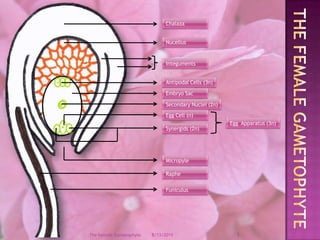
ChalazaNucellusIntegumentsAntipodal Cells (3n)Embryo SacThe Female gametophyteSecondary Nuclei (2n)Egg Cell (n)Egg  Apparatus (3n)Synergids (2n)MicropyleRapheFuniculus12/9/20083The Female Gametophyte
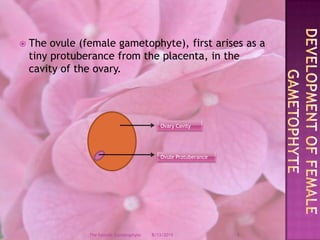
The ovule (female gametophyte), first arises as a tiny protuberance from the placenta, in the cavity of the ovary. Development of female GametophyteOvary CavityOvule Protuberance12/9/20084The Female Gametophyte
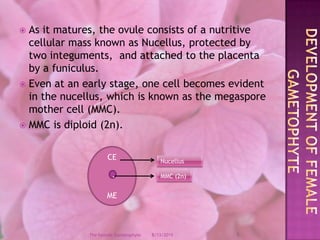
As it matures, the ovule consists of a nutritive cellular mass known as Nucellus, protected by two integuments,  and attached to the placenta by a funiculus.Even at an early stage, one cell becomes evident in the nucellus, which is known as the megaspore mother cell (MMC).MMC is diploid (2n).Development of female GametophyteCE MENucellus.MMC (2n)12/9/20085The Female Gametophyte
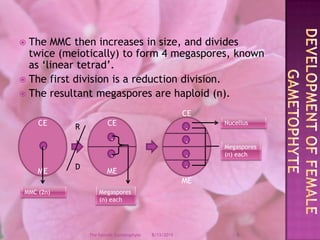
The MMC then increases in size, and divides twice (meiotically) to form 4 megaspores, known as ‘linear tetrad’.The first division is a reduction division.The resultant megaspores are haploid (n).Development of female GametophyteCEMENucellusCEMECEME...Megaspores(n) each...R.MMC (2n)Megaspores (n) eachD12/9/20086The Female Gametophyte
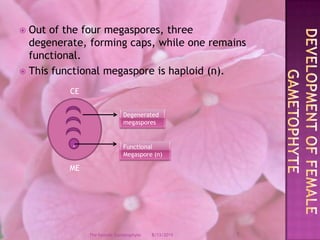
Out of the four megaspores, three degenerate, forming caps, while one remains functional.This functional megaspore is haploid (n).CEMEDevelopment of female GametophyteDegenerated megaspores.Functional Megaspore (n)12/9/20087The Female Gametophyte
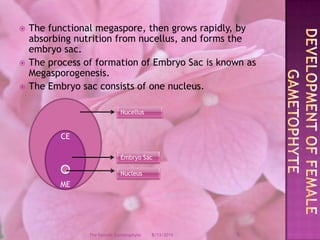
The functional megaspore, then grows rapidly, by absorbing nutrition from nucellus, and forms the embryo sac.The process of formation of Embryo Sac is known as Megasporogenesis.The Embryo sac consists of one nucleus.Development of female GametophyteNucellusCEMEEmbryo Sac .Nucleus12/9/20088The Female Gametophyte
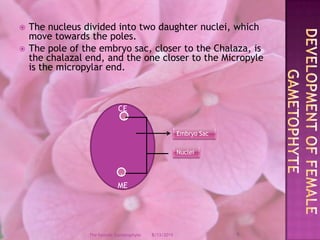
The nucleus divided into two daughter nuclei, which move towards the poles.The pole of the embryo sac, closer to the Chalaza, is the chalazal end, and the one closer to the Micropyle is the micropylar end.Development of female GametophyteCEME.Embryo Sac Nuclei.12/9/20089The Female Gametophyte
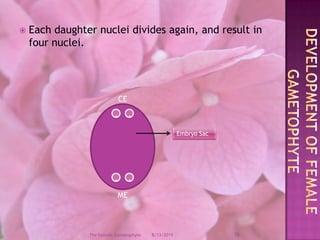
Each daughter nuclei divides again, and result in four nuclei.Development of female GametophyteCEME..Embryo Sac ..12/9/200810The Female Gametophyte
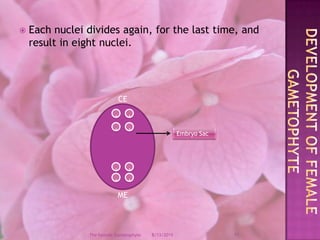
Each nuclei divides again, for the last time, and result in eight nuclei.Development of female GametophyteCEME....Embryo Sac ....12/9/200811The Female Gametophyte
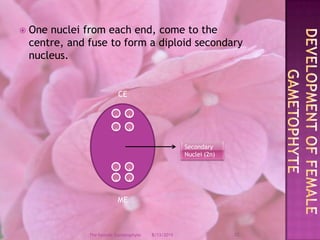
One nuclei from each end, come to the centre, and fuse to form a diploid secondary nucleus.Development of female GametophyteCEME....Secondary Nuclei (2n)....12/9/200812The Female Gametophyte
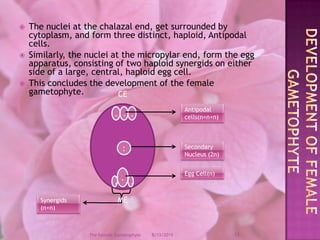
The nuclei at the chalazal end, get surrounded by cytoplasm, and form three distinct, haploid, Antipodal cells.Similarly, the nuclei at the micropylar end, form the egg apparatus, consisting of two haploid synergids on either side of a large, central, haploid egg cell.This concludes the development of the female gametophyte. Development of female GametophyteCEMEAntipodal cells(n+n+n)...:Secondary Nucleus (2n).Egg Cell(n)..Synergids (n+n)12/9/200813The Female Gametophyte
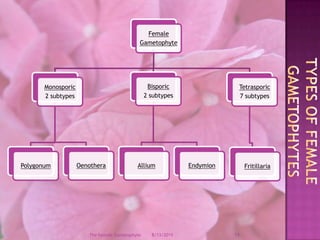
Types of Female Gametophytes12/9/200814The Female Gametophyte
The types of female gametophytes are distinguished by the number of megaspores involved in the formation of the embryo sac.Based on this criteria, there are three types of female gametophytes:MONOSPORICBISPORICTETRASPORICEach type has more than one subtype.Some of the common ones are discussed further.types of female Gametophyte12/9/200815The Female Gametophyte
A Monosporic Embryo Sac (ES) is derived from a single haploid megaspore.All the nuclei in the Embryo Sac are genetically identical, as they develop from the same megaspore.There are two subtypes of Monosporic female gametophytes.They are the Polygonum TypeOenothera TypeMonosporic12/9/200816The Female Gametophyte
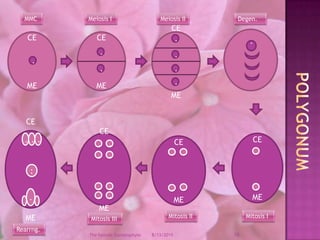
It was first described by Stresberger in 1879.Here, ES is formed by the megaspore at the chalazal end, and the rest of the tetrad degenerates.The Embryo Sac is 8 nucleated, three antipodal cells are located at the chalazal end, a central diploid secondary nucleus exists, along with a micropylar egg apparatus, consisting of two synergids, and an egg cell.This type of ES is most common in Angiosperms.It was observed in the flowers of Polygonumsp., thus it is referred to as the Polygonum type of Embryo sac development.Polygonum12/9/200817The Female Gametophyte
12/9/200818The Female GametophyteMMCMeiosis IMeiosis IIDegen.CEMECEMECEME........PolygonumCEMECEMECEMECEME..........:..........Mitosis IMitosis IIMitosis IIIRearrng.
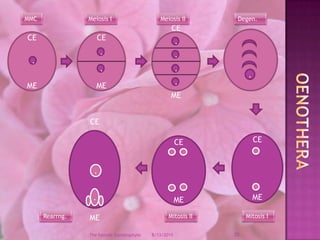
This type of ES was derived from the megaspore of the micropylar end of the spore tetrad.The ES comprises of and egg apparatus and a uninucleate central cell.This type of ES is a characteristic of Onagraceae family.Oenothera12/9/200819The Female Gametophyte
12/9/200820The Female GametophyteMMCMeiosis IMeiosis IIDegen.CEMECEMECEME........OenotheraCEMECEME...CEME.......Mitosis IMitosis IIRearrng.
In the plant bearing Bisporic ES the first division is accomplished by wall formation so that a dyad is formed.One of the dyad cell undergoes the sec. division, whereas the other one degenerates.Both the megaspores contribute in the formation of mature Bisporic ES.Each megaspore nucleus undergoes two mitotic division , forming 8 nuclei.The final organization of the embryo sac is similar to the Polygonum type.In Bisporic type, the ES is derived from 2 meiotic products, so the nuclei belongs to two different genetic constitutions.Four nuclei are different from the other four.Bisporic ES is of 2 types:AlliumEndymionBisporic12/9/200821The Female Gametophyte
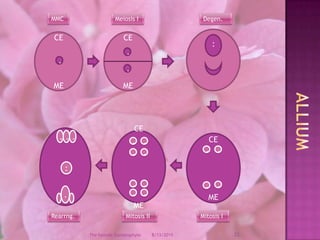
The ES is derived from the Chalazal Dyad, and is similar to that of Polygonum type.The mature ES consists of one binucleate central cell, three antipodal cells at the Chalazal end, and an egg apparatus at the micropylar end.Allium12/9/200822The Female Gametophyte
12/9/200823The Female GametophyteMMCMeiosis IDegen.CEMECEME..:.AlliumCEMECEME.........:.........Mitosis IMitosis IIRearrng.
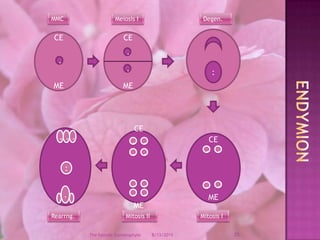
The ES is derived from the Micropylar Dyad, and is similar to that of Polygonum type.The mature ES consists of one binucleate central cell, three antipodal cells at the Chalazal end, and an egg apparatus at the Micropylar end.Endymion12/9/200824The Female Gametophyte
12/9/200825The Female GametophyteMMCMeiosis IDegen.CEMECEME..:.EndymionCEMECEME.........:.........Mitosis IMitosis IIRearrng.
In this group neither of the meiotic division is accompanied by wall formation , so that, at the end of Meiosis, all the four haploid nuclei remain in the common cytoplasm, forming a coenomegaspore, which takes part in the formation of mature ES.A Tetrasporic ES, is more heterogeneous, than a Bisporic ES because, all the four megaspores are involved in the formation of ES and are genetically different.There are 7 types of Tetrasporic ES.Tetrasporic12/9/200826The Female Gametophyte
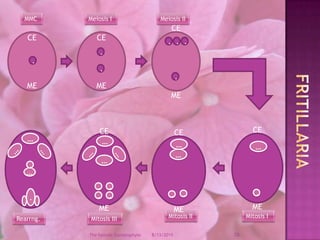
After the nuclear fusion, both the nuclei of the coenomegaspore(1 haploid + 1 triploid) , divide twice, forming four nuclei at each pore.The mature ES, comprises of an egg apparatus of three haploid cells, three triploid antipodal cells, and a central cell with two polar nuclei, one haploid and one triploid.Fritillaria12/9/200827The Female Gametophyte
12/9/200828The Female GametophyteMMCMeiosis IMeiosis IICEMECEMECEME.......FritillariaCEMECEME……CEME……………………...…........Mitosis IMitosis IIMitosis IIIRearrng.
12/9/2008The Female Gametophyte29Rutwik

Female Gametophyte

  • 1.
  • 2.
    The Female Gametophyte 03Developmentof Female Gametophyte 04Types of Female Gametophytes 14Monosporic 16Polygonum 17Oenothera 19Bisporic 21Allium 22Endymion 24Tetrasporic 26Fritillaria 27INDEX12/9/20082The Female Gametophyte
  • 3.
    ChalazaNucellusIntegumentsAntipodal Cells (3n)EmbryoSacThe Female gametophyteSecondary Nuclei (2n)Egg Cell (n)Egg Apparatus (3n)Synergids (2n)MicropyleRapheFuniculus12/9/20083The Female Gametophyte
  • 4.
    The ovule (femalegametophyte), first arises as a tiny protuberance from the placenta, in the cavity of the ovary. Development of female GametophyteOvary CavityOvule Protuberance12/9/20084The Female Gametophyte
  • 5.
    As it matures,the ovule consists of a nutritive cellular mass known as Nucellus, protected by two integuments, and attached to the placenta by a funiculus.Even at an early stage, one cell becomes evident in the nucellus, which is known as the megaspore mother cell (MMC).MMC is diploid (2n).Development of female GametophyteCE MENucellus.MMC (2n)12/9/20085The Female Gametophyte
  • 6.
    The MMC thenincreases in size, and divides twice (meiotically) to form 4 megaspores, known as ‘linear tetrad’.The first division is a reduction division.The resultant megaspores are haploid (n).Development of female GametophyteCEMENucellusCEMECEME...Megaspores(n) each...R.MMC (2n)Megaspores (n) eachD12/9/20086The Female Gametophyte
  • 7.
    Out of thefour megaspores, three degenerate, forming caps, while one remains functional.This functional megaspore is haploid (n).CEMEDevelopment of female GametophyteDegenerated megaspores.Functional Megaspore (n)12/9/20087The Female Gametophyte
  • 8.
    The functional megaspore,then grows rapidly, by absorbing nutrition from nucellus, and forms the embryo sac.The process of formation of Embryo Sac is known as Megasporogenesis.The Embryo sac consists of one nucleus.Development of female GametophyteNucellusCEMEEmbryo Sac .Nucleus12/9/20088The Female Gametophyte
  • 9.
    The nucleus dividedinto two daughter nuclei, which move towards the poles.The pole of the embryo sac, closer to the Chalaza, is the chalazal end, and the one closer to the Micropyle is the micropylar end.Development of female GametophyteCEME.Embryo Sac Nuclei.12/9/20089The Female Gametophyte
  • 10.
    Each daughter nucleidivides again, and result in four nuclei.Development of female GametophyteCEME..Embryo Sac ..12/9/200810The Female Gametophyte
  • 11.
    Each nuclei dividesagain, for the last time, and result in eight nuclei.Development of female GametophyteCEME....Embryo Sac ....12/9/200811The Female Gametophyte
  • 12.
    One nuclei fromeach end, come to the centre, and fuse to form a diploid secondary nucleus.Development of female GametophyteCEME....Secondary Nuclei (2n)....12/9/200812The Female Gametophyte
  • 13.
    The nuclei atthe chalazal end, get surrounded by cytoplasm, and form three distinct, haploid, Antipodal cells.Similarly, the nuclei at the micropylar end, form the egg apparatus, consisting of two haploid synergids on either side of a large, central, haploid egg cell.This concludes the development of the female gametophyte. Development of female GametophyteCEMEAntipodal cells(n+n+n)...:Secondary Nucleus (2n).Egg Cell(n)..Synergids (n+n)12/9/200813The Female Gametophyte
  • 14.
    Types of FemaleGametophytes12/9/200814The Female Gametophyte
  • 15.
    The types offemale gametophytes are distinguished by the number of megaspores involved in the formation of the embryo sac.Based on this criteria, there are three types of female gametophytes:MONOSPORICBISPORICTETRASPORICEach type has more than one subtype.Some of the common ones are discussed further.types of female Gametophyte12/9/200815The Female Gametophyte
  • 16.
    A Monosporic EmbryoSac (ES) is derived from a single haploid megaspore.All the nuclei in the Embryo Sac are genetically identical, as they develop from the same megaspore.There are two subtypes of Monosporic female gametophytes.They are the Polygonum TypeOenothera TypeMonosporic12/9/200816The Female Gametophyte
  • 17.
    It was firstdescribed by Stresberger in 1879.Here, ES is formed by the megaspore at the chalazal end, and the rest of the tetrad degenerates.The Embryo Sac is 8 nucleated, three antipodal cells are located at the chalazal end, a central diploid secondary nucleus exists, along with a micropylar egg apparatus, consisting of two synergids, and an egg cell.This type of ES is most common in Angiosperms.It was observed in the flowers of Polygonumsp., thus it is referred to as the Polygonum type of Embryo sac development.Polygonum12/9/200817The Female Gametophyte
  • 18.
    12/9/200818The Female GametophyteMMCMeiosisIMeiosis IIDegen.CEMECEMECEME........PolygonumCEMECEMECEMECEME..........:..........Mitosis IMitosis IIMitosis IIIRearrng.
  • 19.
    This type ofES was derived from the megaspore of the micropylar end of the spore tetrad.The ES comprises of and egg apparatus and a uninucleate central cell.This type of ES is a characteristic of Onagraceae family.Oenothera12/9/200819The Female Gametophyte
  • 20.
    12/9/200820The Female GametophyteMMCMeiosisIMeiosis IIDegen.CEMECEMECEME........OenotheraCEMECEME...CEME.......Mitosis IMitosis IIRearrng.
  • 21.
    In the plantbearing Bisporic ES the first division is accomplished by wall formation so that a dyad is formed.One of the dyad cell undergoes the sec. division, whereas the other one degenerates.Both the megaspores contribute in the formation of mature Bisporic ES.Each megaspore nucleus undergoes two mitotic division , forming 8 nuclei.The final organization of the embryo sac is similar to the Polygonum type.In Bisporic type, the ES is derived from 2 meiotic products, so the nuclei belongs to two different genetic constitutions.Four nuclei are different from the other four.Bisporic ES is of 2 types:AlliumEndymionBisporic12/9/200821The Female Gametophyte
  • 22.
    The ES isderived from the Chalazal Dyad, and is similar to that of Polygonum type.The mature ES consists of one binucleate central cell, three antipodal cells at the Chalazal end, and an egg apparatus at the micropylar end.Allium12/9/200822The Female Gametophyte
  • 23.
    12/9/200823The Female GametophyteMMCMeiosisIDegen.CEMECEME..:.AlliumCEMECEME.........:.........Mitosis IMitosis IIRearrng.
  • 24.
    The ES isderived from the Micropylar Dyad, and is similar to that of Polygonum type.The mature ES consists of one binucleate central cell, three antipodal cells at the Chalazal end, and an egg apparatus at the Micropylar end.Endymion12/9/200824The Female Gametophyte
  • 25.
    12/9/200825The Female GametophyteMMCMeiosisIDegen.CEMECEME..:.EndymionCEMECEME.........:.........Mitosis IMitosis IIRearrng.
  • 26.
    In this groupneither of the meiotic division is accompanied by wall formation , so that, at the end of Meiosis, all the four haploid nuclei remain in the common cytoplasm, forming a coenomegaspore, which takes part in the formation of mature ES.A Tetrasporic ES, is more heterogeneous, than a Bisporic ES because, all the four megaspores are involved in the formation of ES and are genetically different.There are 7 types of Tetrasporic ES.Tetrasporic12/9/200826The Female Gametophyte
  • 27.
    After the nuclearfusion, both the nuclei of the coenomegaspore(1 haploid + 1 triploid) , divide twice, forming four nuclei at each pore.The mature ES, comprises of an egg apparatus of three haploid cells, three triploid antipodal cells, and a central cell with two polar nuclei, one haploid and one triploid.Fritillaria12/9/200827The Female Gametophyte
  • 28.
    12/9/200828The Female GametophyteMMCMeiosisIMeiosis IICEMECEMECEME.......FritillariaCEMECEME……CEME……………………...…........Mitosis IMitosis IIMitosis IIIRearrng.
  • 29.