WELCOME
ANALYSIS OF DIFFERENT PSEUDORANDOM AND ORTHOGONAL
SPREADING SEQUENCES IN DS-CDMA

Mr.Praveen PN
Lecturer
ECE Department

Safareena KK
CEAKEEC101
S8 EC2
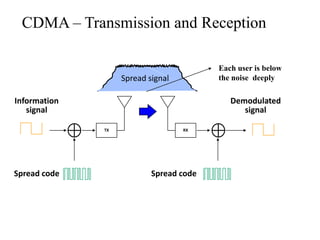
CDMA – Transmission and Reception
Each user is below
the noise deeply

Spread signal
Information
signal

Demodulated
signal
TX

Spread code

RX

Spread code
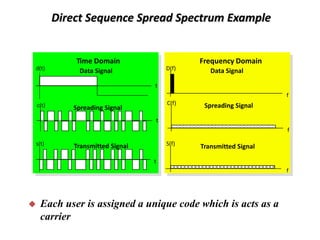
Direct Sequence Spread Spectrum Example

Time Domain
d(t)

Frequency Domain
D(f)

Data Signal

Data Signal

t
f
c(t)

C(f)

Spreading Signal

Spreading Signal

t
f
s(t)

S(f)

Transmitted Signal

Transmitted Signal

t
f



Each user is assigned a unique code which is acts as a
carrier
INTRODUCTION
• A device in WCDMA system can access several
services simultaneously
• Spread spectrum is a radio communications
system in which the baseband signal bandwidth is
spread over a larger bandwidth by a higherfrequency signal.
• CDMA (DS-CDMA) uses direct sequence spread
spectrum (DSSS) technology to spread the
spectrum
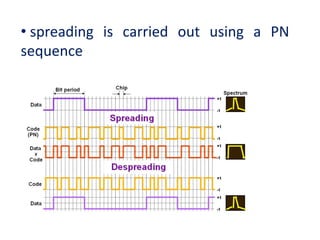
• spreading is carried out using a PN
sequence
PSEUDO-NOISE SEQUENCE
• A pseudo-noise (PN) sequence is a sequence
of 1’s and 0’s and it is periodic.
• The PN sequences have the following three
properties; Balance, run and auto-Correlation
Properties.
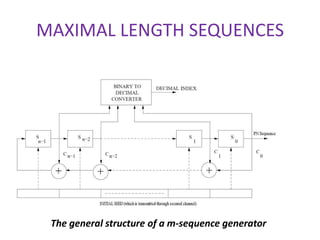
MAXIMAL LENGTH SEQUENCES

The general structure of a m-sequence generator
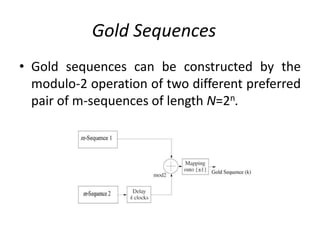
Gold Sequences
• Gold sequences can be constructed by the
modulo-2 operation of two different preferred
pair of m-sequences of length N=2n.
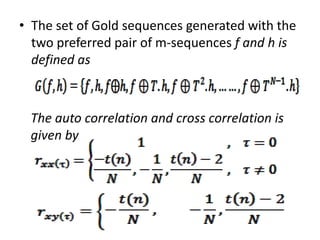
• The set of Gold sequences generated with the
two preferred pair of m-sequences f and h is
defined as

The auto correlation and cross correlation is
given by
GOLD-LIKE SEQUENCES
• These are similar to Gold sequence and have
good correlation properties.
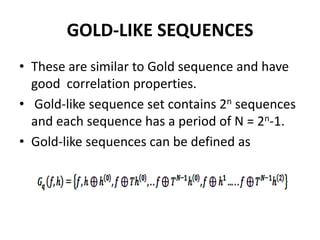
• Gold-like sequence set contains 2n sequences
and each sequence has a period of N = 2n-1.
• Gold-like sequences can be defined as
BARKER SEQUENCES
• Barker sequences are short length codes that
offer good correlation properties.
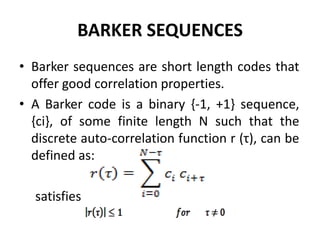
• A Barker code is a binary {-1, +1} sequence,
{ci}, of some finite length N such that the
discrete auto-correlation function r (τ), can be
defined as:

satisfies
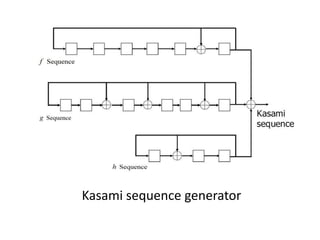
KASAMI SEQUENCES
• It has very low cross correlation
• The degree n of the primitive polynomial used
to generate Kasami sequences.
• These sequences are defined for even values
of n .
• There are two types of kasami sequences
a) small set of kasami sequences
b) large set of kasami sequences
Kasami sequence generator
ORTHOGONAL SEQUENCE
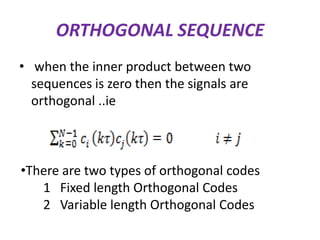
• when the inner product between two
sequences is zero then the signals are
orthogonal ..ie

•There are two types of orthogonal codes
1 Fixed length Orthogonal Codes
2 Variable length Orthogonal Codes
Fixed length orthogonal code
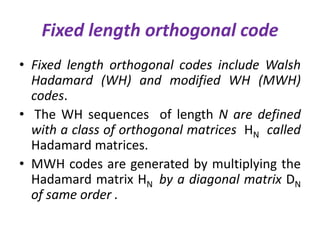
• Fixed length orthogonal codes include Walsh
Hadamard (WH) and modified WH (MWH)
codes.
• The WH sequences of length N are defined
with a class of orthogonal matrices HN called
Hadamard matrices.
• MWH codes are generated by multiplying the
Hadamard matrix HN by a diagonal matrix DN
of same order .
Variable length orthogonal codes
• Orthogonal codes with different length are
called variable orthogonal code.
• It also known as Orthogonal
Spreading Factor (OVSF).

Variable

• The codes can be generated using the tree
structure instead of Hadmard matrix.
ORTHOGONAL GOLD CODES
• Orthogonal gold code can be constructed
simply padding zero to the gold codes.

by

• Cross correlation value is zero
• Length of orthogonal gold code is 2n

• Auto

correlation value is similar to that of gold
sequence
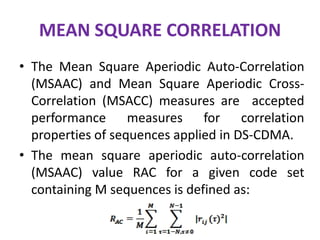
MEAN SQUARE CORRELATION
• The Mean Square Aperiodic Auto-Correlation
(MSAAC) and Mean Square Aperiodic CrossCorrelation (MSACC) measures are accepted
performance measures for correlation
properties of sequences applied in DS-CDMA.
• The mean square aperiodic auto-correlation
(MSAAC) value RAC for a given code set
containing M sequences is defined as:
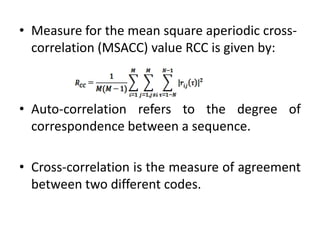
• Measure for the mean square aperiodic crosscorrelation (MSACC) value RCC is given by:

• Auto-correlation refers to the degree of
correspondence between a sequence.
• Cross-correlation is the measure of agreement
between two different codes.
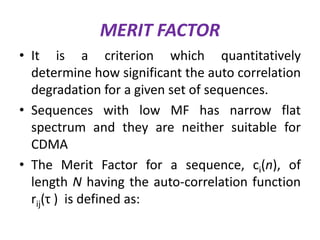
MERIT FACTOR
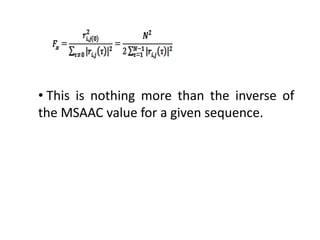
• It is a criterion which quantitatively
determine how significant the auto correlation
degradation for a given set of sequences.
• Sequences with low MF has narrow flat
spectrum and they are neither suitable for
CDMA
• The Merit Factor for a sequence, ci(n), of
length N having the auto-correlation function
rij(τ ) is defined as:
• This is nothing more than the inverse of
the MSAAC value for a given sequence.
RESULTS AND DISCUSSION
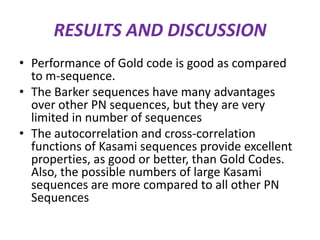
• Performance of Gold code is good as compared
to m-sequence.
• The Barker sequences have many advantages
over other PN sequences, but they are very
limited in number of sequences
• The autocorrelation and cross-correlation
functions of Kasami sequences provide excellent
properties, as good or better, than Gold Codes.
Also, the possible numbers of large Kasami
sequences are more compared to all other PN
Sequences
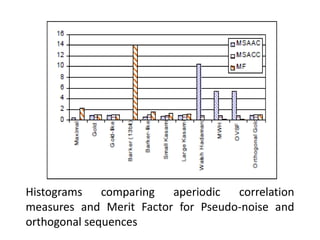
Histograms
comparing
aperiodic
correlation
measures and Merit Factor for Pseudo-noise and
orthogonal sequences
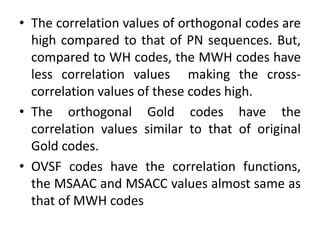
• The correlation values of orthogonal codes are
high compared to that of PN sequences. But,
compared to WH codes, the MWH codes have
less correlation values making the crosscorrelation values of these codes high.
• The orthogonal Gold codes have the
correlation values similar to that of original
Gold codes.
• OVSF codes have the correlation functions,
the MSAAC and MSACC values almost same as
that of MWH codes
CONCLUSION
• Large Kasami sequence has both good correlation
values and high MF, which make these sequences to
have wide flat spectrum that is better suited to be
used in the WCDMA uplink transmission.
• In the downlink of WCDMA, variable data rate is
supported by using orthogonal variable spreading
factor (OVSF) codes.
• We have reviewed different PN as well as fixed- and
variable-length orthogonal sequences that can be
used in many applications including spreading codes
for CDMA cellular networks.

REFERENCES
• D.Torrieri, “Principles Of Spread-Spectrum
Communication Systems“, Springer, 2nd
edition, 2011
•Valery P. Ipatov, “Spread Spectrum and
CDMA Principles and Applications” Jhon
Wiley & Sons Ltd, 2005.

• K. Fazel and S. Kaiser, “Multi-carrier spreadspectrum: for future generation wireless
systems”
Couch.
L.W,“Digital
and
Analog
Communication Systems”, 7th Ed, Prentice Hall,
Inc., 2007,
T.S. Rappaport, “Wireless Communication,
principles & practice”, PHI, 2001.
E. STRO¨M, T. OTTOSSON, A.SVENSSON, “An
Introduction to Spread Spectrum Systems”,
Department of Signals and systems chalmers
university of technology G¨oteborg, Sweden, 2002
.
THANKS

Cdma 101

  • 1.
  • 2.
    ANALYSIS OF DIFFERENTPSEUDORANDOM AND ORTHOGONAL SPREADING SEQUENCES IN DS-CDMA Mr.Praveen PN Lecturer ECE Department Safareena KK CEAKEEC101 S8 EC2
  • 3.
    CDMA – Transmissionand Reception Each user is below the noise deeply Spread signal Information signal Demodulated signal TX Spread code RX Spread code
  • 4.
    Direct Sequence SpreadSpectrum Example Time Domain d(t) Frequency Domain D(f) Data Signal Data Signal t f c(t) C(f) Spreading Signal Spreading Signal t f s(t) S(f) Transmitted Signal Transmitted Signal t f  Each user is assigned a unique code which is acts as a carrier
  • 5.
    INTRODUCTION • A devicein WCDMA system can access several services simultaneously • Spread spectrum is a radio communications system in which the baseband signal bandwidth is spread over a larger bandwidth by a higherfrequency signal. • CDMA (DS-CDMA) uses direct sequence spread spectrum (DSSS) technology to spread the spectrum
  • 6.
    • spreading iscarried out using a PN sequence
  • 7.
    PSEUDO-NOISE SEQUENCE • Apseudo-noise (PN) sequence is a sequence of 1’s and 0’s and it is periodic. • The PN sequences have the following three properties; Balance, run and auto-Correlation Properties.
  • 8.
    MAXIMAL LENGTH SEQUENCES Thegeneral structure of a m-sequence generator
  • 9.
    Gold Sequences • Goldsequences can be constructed by the modulo-2 operation of two different preferred pair of m-sequences of length N=2n.
  • 10.
    • The setof Gold sequences generated with the two preferred pair of m-sequences f and h is defined as The auto correlation and cross correlation is given by
  • 11.
    GOLD-LIKE SEQUENCES • Theseare similar to Gold sequence and have good correlation properties. • Gold-like sequence set contains 2n sequences and each sequence has a period of N = 2n-1. • Gold-like sequences can be defined as
  • 12.
    BARKER SEQUENCES • Barkersequences are short length codes that offer good correlation properties. • A Barker code is a binary {-1, +1} sequence, {ci}, of some finite length N such that the discrete auto-correlation function r (τ), can be defined as: satisfies
  • 13.
    KASAMI SEQUENCES • Ithas very low cross correlation • The degree n of the primitive polynomial used to generate Kasami sequences. • These sequences are defined for even values of n . • There are two types of kasami sequences a) small set of kasami sequences b) large set of kasami sequences
  • 14.
  • 15.
    ORTHOGONAL SEQUENCE • whenthe inner product between two sequences is zero then the signals are orthogonal ..ie •There are two types of orthogonal codes 1 Fixed length Orthogonal Codes 2 Variable length Orthogonal Codes
  • 16.
    Fixed length orthogonalcode • Fixed length orthogonal codes include Walsh Hadamard (WH) and modified WH (MWH) codes. • The WH sequences of length N are defined with a class of orthogonal matrices HN called Hadamard matrices. • MWH codes are generated by multiplying the Hadamard matrix HN by a diagonal matrix DN of same order .
  • 17.
    Variable length orthogonalcodes • Orthogonal codes with different length are called variable orthogonal code. • It also known as Orthogonal Spreading Factor (OVSF). Variable • The codes can be generated using the tree structure instead of Hadmard matrix.
  • 18.
    ORTHOGONAL GOLD CODES •Orthogonal gold code can be constructed simply padding zero to the gold codes. by • Cross correlation value is zero • Length of orthogonal gold code is 2n • Auto correlation value is similar to that of gold sequence
  • 19.
    MEAN SQUARE CORRELATION •The Mean Square Aperiodic Auto-Correlation (MSAAC) and Mean Square Aperiodic CrossCorrelation (MSACC) measures are accepted performance measures for correlation properties of sequences applied in DS-CDMA. • The mean square aperiodic auto-correlation (MSAAC) value RAC for a given code set containing M sequences is defined as:
  • 20.
    • Measure forthe mean square aperiodic crosscorrelation (MSACC) value RCC is given by: • Auto-correlation refers to the degree of correspondence between a sequence. • Cross-correlation is the measure of agreement between two different codes.
  • 21.
    MERIT FACTOR • Itis a criterion which quantitatively determine how significant the auto correlation degradation for a given set of sequences. • Sequences with low MF has narrow flat spectrum and they are neither suitable for CDMA • The Merit Factor for a sequence, ci(n), of length N having the auto-correlation function rij(τ ) is defined as:
  • 22.
    • This isnothing more than the inverse of the MSAAC value for a given sequence.
  • 23.
    RESULTS AND DISCUSSION •Performance of Gold code is good as compared to m-sequence. • The Barker sequences have many advantages over other PN sequences, but they are very limited in number of sequences • The autocorrelation and cross-correlation functions of Kasami sequences provide excellent properties, as good or better, than Gold Codes. Also, the possible numbers of large Kasami sequences are more compared to all other PN Sequences
  • 24.
    Histograms comparing aperiodic correlation measures and MeritFactor for Pseudo-noise and orthogonal sequences
  • 25.
    • The correlationvalues of orthogonal codes are high compared to that of PN sequences. But, compared to WH codes, the MWH codes have less correlation values making the crosscorrelation values of these codes high. • The orthogonal Gold codes have the correlation values similar to that of original Gold codes. • OVSF codes have the correlation functions, the MSAAC and MSACC values almost same as that of MWH codes
  • 26.
    CONCLUSION • Large Kasamisequence has both good correlation values and high MF, which make these sequences to have wide flat spectrum that is better suited to be used in the WCDMA uplink transmission. • In the downlink of WCDMA, variable data rate is supported by using orthogonal variable spreading factor (OVSF) codes. • We have reviewed different PN as well as fixed- and variable-length orthogonal sequences that can be used in many applications including spreading codes for CDMA cellular networks.
  • 27.
    REFERENCES • D.Torrieri, “PrinciplesOf Spread-Spectrum Communication Systems“, Springer, 2nd edition, 2011 •Valery P. Ipatov, “Spread Spectrum and CDMA Principles and Applications” Jhon Wiley & Sons Ltd, 2005. • K. Fazel and S. Kaiser, “Multi-carrier spreadspectrum: for future generation wireless systems”
  • 28.
    Couch. L.W,“Digital and Analog Communication Systems”, 7thEd, Prentice Hall, Inc., 2007, T.S. Rappaport, “Wireless Communication, principles & practice”, PHI, 2001. E. STRO¨M, T. OTTOSSON, A.SVENSSON, “An Introduction to Spread Spectrum Systems”, Department of Signals and systems chalmers university of technology G¨oteborg, Sweden, 2002 .
  • 29.