11/30/2004 Tommi Heikkilä
S-72.333 Postgraduate Course in Radio Communications
1
C D M A
Code Division Multiple Access
11/30/2004 Tommi Heikkilä
S-72.333 Postgraduate Course in Radio Communications
2
Agenda
• Introduction
• History of Spread-Spectrum and CDMA
• Introduction to DS-CDMA
• Cellular CDMA
• CDMA Capacity
• CDMA Cellular Applications
• Conclusions
• References
• Homework
11/30/2004 Tommi Heikkilä
S-72.333 Postgraduate Course in Radio Communications
3
Introduction
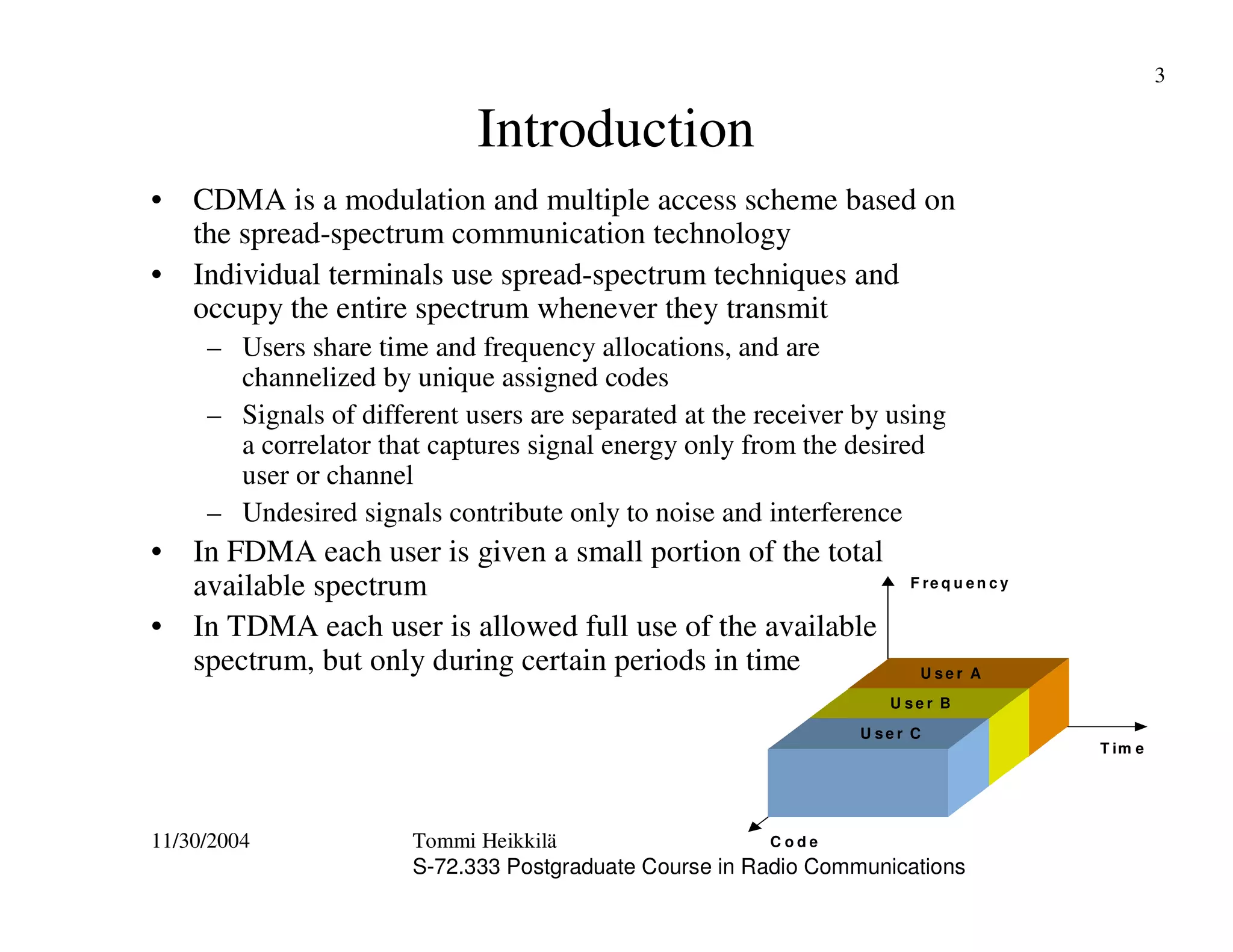
• CDMA is a modulation and multiple access scheme based on
the spread-spectrum communication technology
• Individual terminals use spread-spectrum techniques and
occupy the entire spectrum whenever they transmit
– Users share time and frequency allocations, and are
channelized by unique assigned codes
– Signals of different users are separated at the receiver by using
a correlator that captures signal energy only from the desired
user or channel
– Undesired signals contribute only to noise and interference
• In FDMA each user is given a small portion of the total
available spectrum
• In TDMA each user is allowed full use of the available
spectrum, but only during certain periods in time
F re q u e n c y
T im e
C o d e
H ig h d a ta ra te u s e r
U s e r C
U s e r A
U s e r B
11/30/2004 Tommi Heikkilä
S-72.333 Postgraduate Course in Radio Communications
4
History of Spread-Spectrum and CDMA
• Development of the CDMA technique dates back to the early 1950s when
different studies of the spread-spectrum technologies were started
• Basic by Claude Shannon and Robert Pierce in 1949
• In 1950 De-Rosa-Rogoff defined the direct-sequence spread-spectrum
method, the processing gain equation, and a noise multiplexing idea
• Price and Green filed the RAKE receiver patent in 1956
• In 1961 Manuski defined the near-far problem crucial for CDMA systems
• In 1970s several military and navigation applications were developed.
– Military with very low C/I, Anti-jamming applications
• Cellular applications proposed late 70s focused on narrowband systems
– In 1978 Cooper and Nettleton suggested a cellular spread-spectrum application
• During 80s Qualcomm investigated CDMA for cellular applications
– IS-95 standard 1993 and commercial networks introduced in 1995
• 3G wideband CDMA systems, such as CDMA IS-2000 and European
WCDMA developed from 1990s and still going on
– Commercial networks are opened at the moment
11/30/2004 Tommi Heikkilä
S-72.333 Postgraduate Course in Radio Communications
5
Spread-Spectrum Technology (1)
• Originally developed for military and navigation purposes
– secure means of communication in hostile environments
– Low Probability of Interception
• Cannot be easily detected by enemy communication equipment due to low
power spectral density, even lower than background noise
– Anti-Jamming
• Properties to combat intentional interference trying to sabotage
communication systems
• Nowadays feasible for commercial applications especially for mobile
communication systems
– It provides an efficient multiple access method for a number of
independent users sharing a common communication channel without
external synchronization methods
– DS-CDMA is probably the most interesting multiple access method
provided by spread-spectrum technology
11/30/2004 Tommi Heikkilä
S-72.333 Postgraduate Course in Radio Communications
6
Spread-Spectrum Technology (2)
• Transmission bandwidth is much larger than information bandwidth
• Bandwidth does not depend on the informational signal
• Processing gain = Transmitted bandwidth/ Information bandwidth
– Gp is also called the spreading factor and determines the maximum number of
simultaneous users or connections allowed in a communication system
– Determines the level of protection against multipath interference signals and
signal detection capabilities of a spread spectrum communication system
– In multipath situations the receiver observes spread-spectrum signals summed
with narrowband interference
– Determines the power ratio of the desired signal and interference after de-
spreading
– Low data rates such as speech have high processing gain compared to high
data rates
– High data rate means less processing gain and higher transmit power or
smaller coverage
i
t
p
B
B
G
11/30/2004 Tommi Heikkilä
S-72.333 Postgraduate Course in Radio Communications
7
Spread-Spectrum Technology (3)
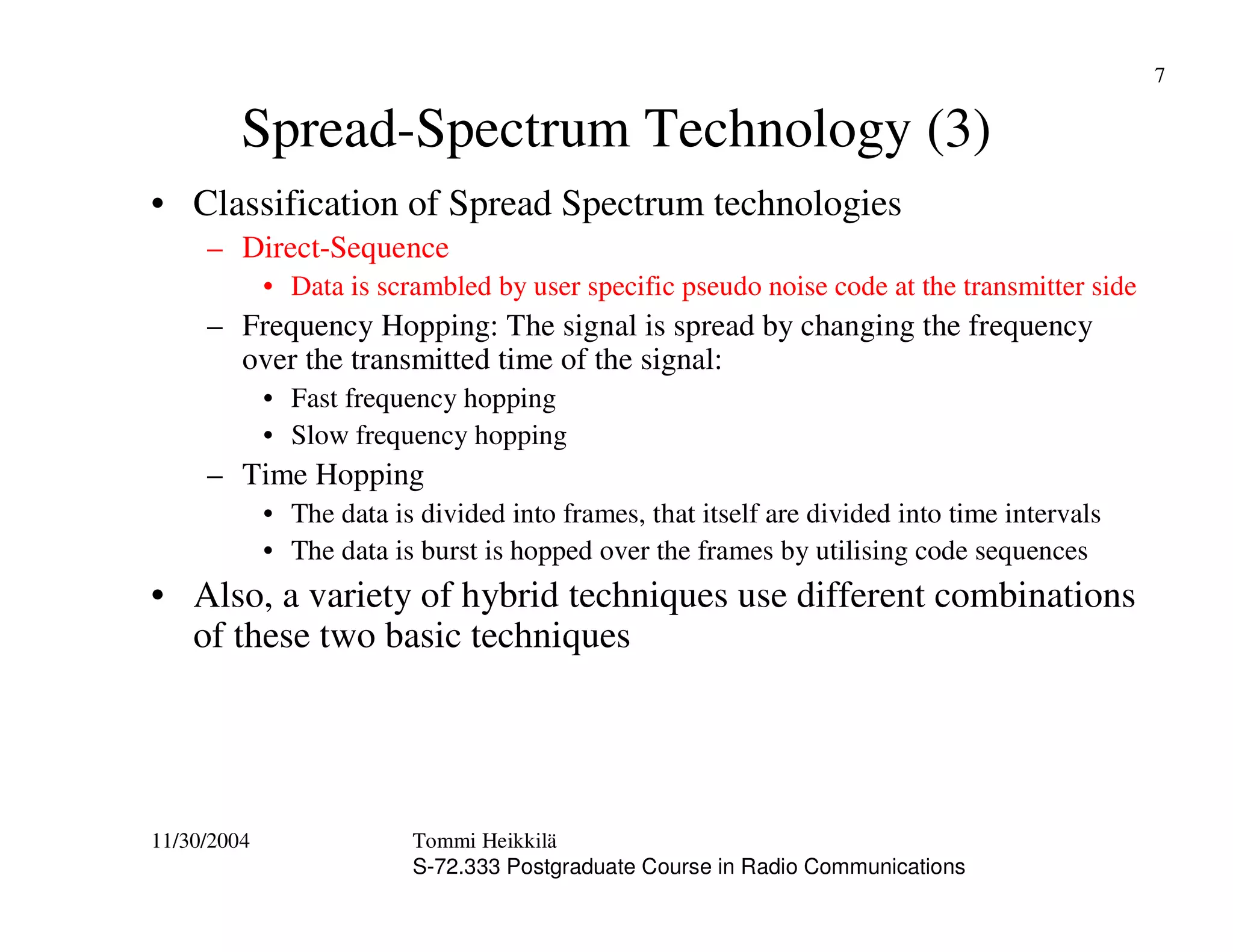
• Classification of Spread Spectrum technologies
– Direct-Sequence
• Data is scrambled by user specific pseudo noise code at the transmitter side
– Frequency Hopping: The signal is spread by changing the frequency
over the transmitted time of the signal:
• Fast frequency hopping
• Slow frequency hopping
– Time Hopping
• The data is divided into frames, that itself are divided into time intervals
• The data is burst is hopped over the frames by utilising code sequences
• Also, a variety of hybrid techniques use different combinations
of these two basic techniques
11/30/2004 Tommi Heikkilä
S-72.333 Postgraduate Course in Radio Communications
8
Introduction to DS-CDMA (1)
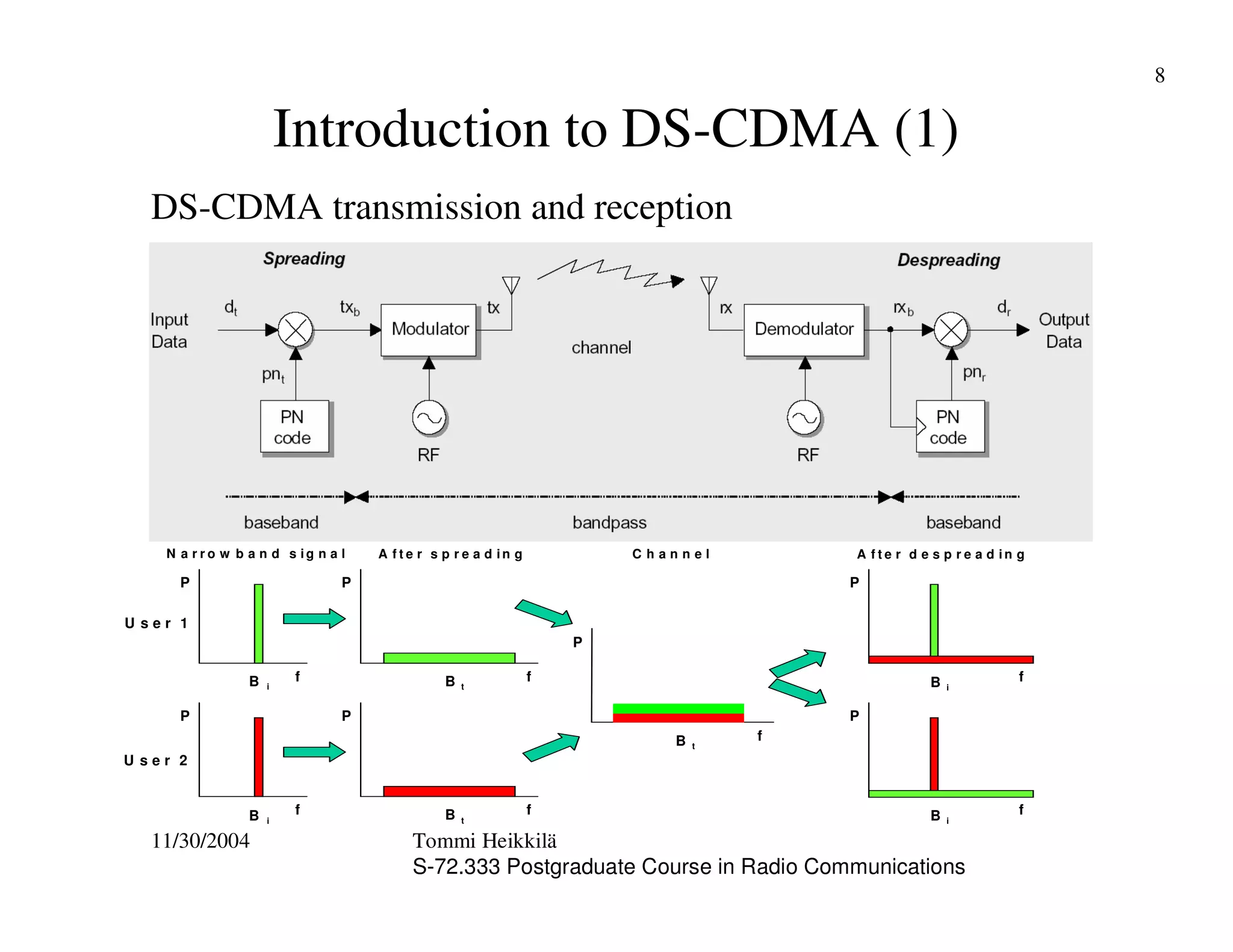
DS-CDMA transmission and reception
B i
B i
B t
U s e r 1
U s e r 2
A f t e r s p r e a d i n g
N a r r o w b a n d s i g n a l
B t
C h a n n e l
B t
A f t e r d e s p r e a d i n g
B i
B i
P
P P
P
P
P
P
f
f f
f f f
f
11/30/2004 Tommi Heikkilä
S-72.333 Postgraduate Course in Radio Communications
9
Introduction to DS-CDMA (2)
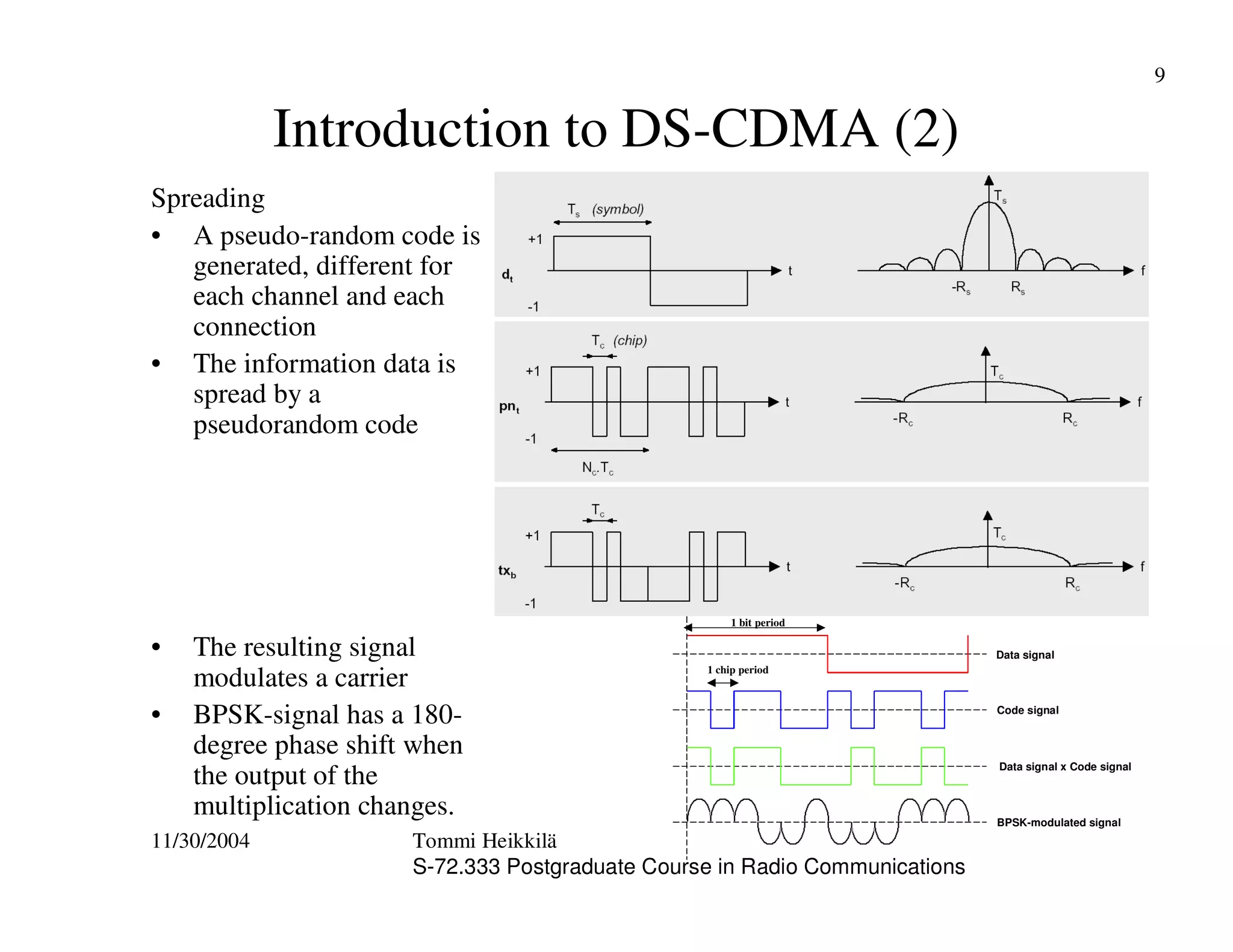
Spreading
• A pseudo-random code is
generated, different for
each channel and each
connection
• The information data is
spread by a
pseudorandom code
• The resulting signal
modulates a carrier
• BPSK-signal has a 180-
degree phase shift when
the output of the
multiplication changes.
Data signal
Code signal
Data signal x Code signal
BPSK-modulated signal
1 chip period
1 bit period
11/30/2004 Tommi Heikkilä
S-72.333 Postgraduate Course in Radio Communications
10
Introduction to DS-CDMA (3)
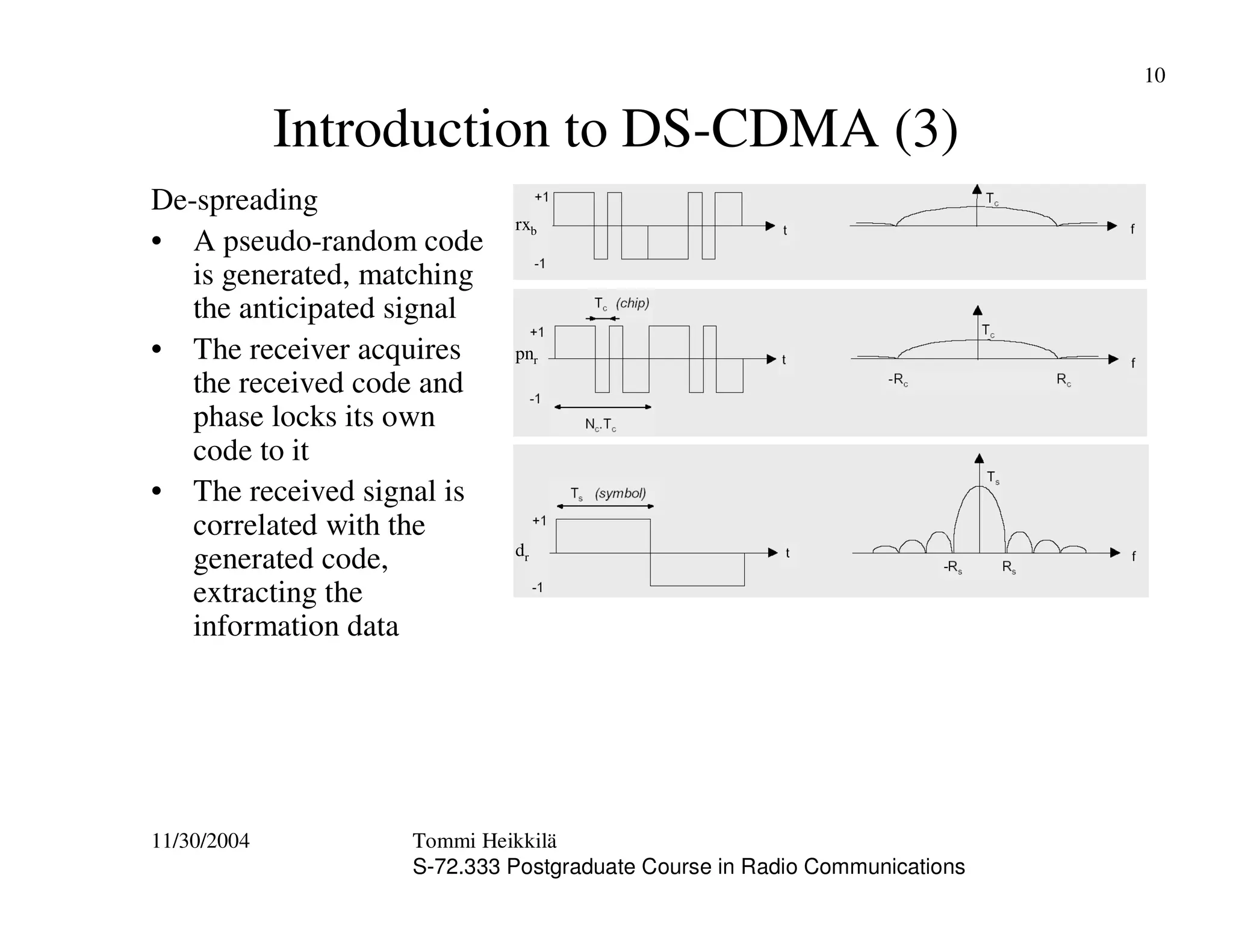
De-spreading
• A pseudo-random code
is generated, matching
the anticipated signal
• The receiver acquires
the received code and
phase locks its own
code to it
• The received signal is
correlated with the
generated code,
extracting the
information data
rxb
pnr
dr
11/30/2004 Tommi Heikkilä
S-72.333 Postgraduate Course in Radio Communications
11
Introduction to DS-CDMA (4)
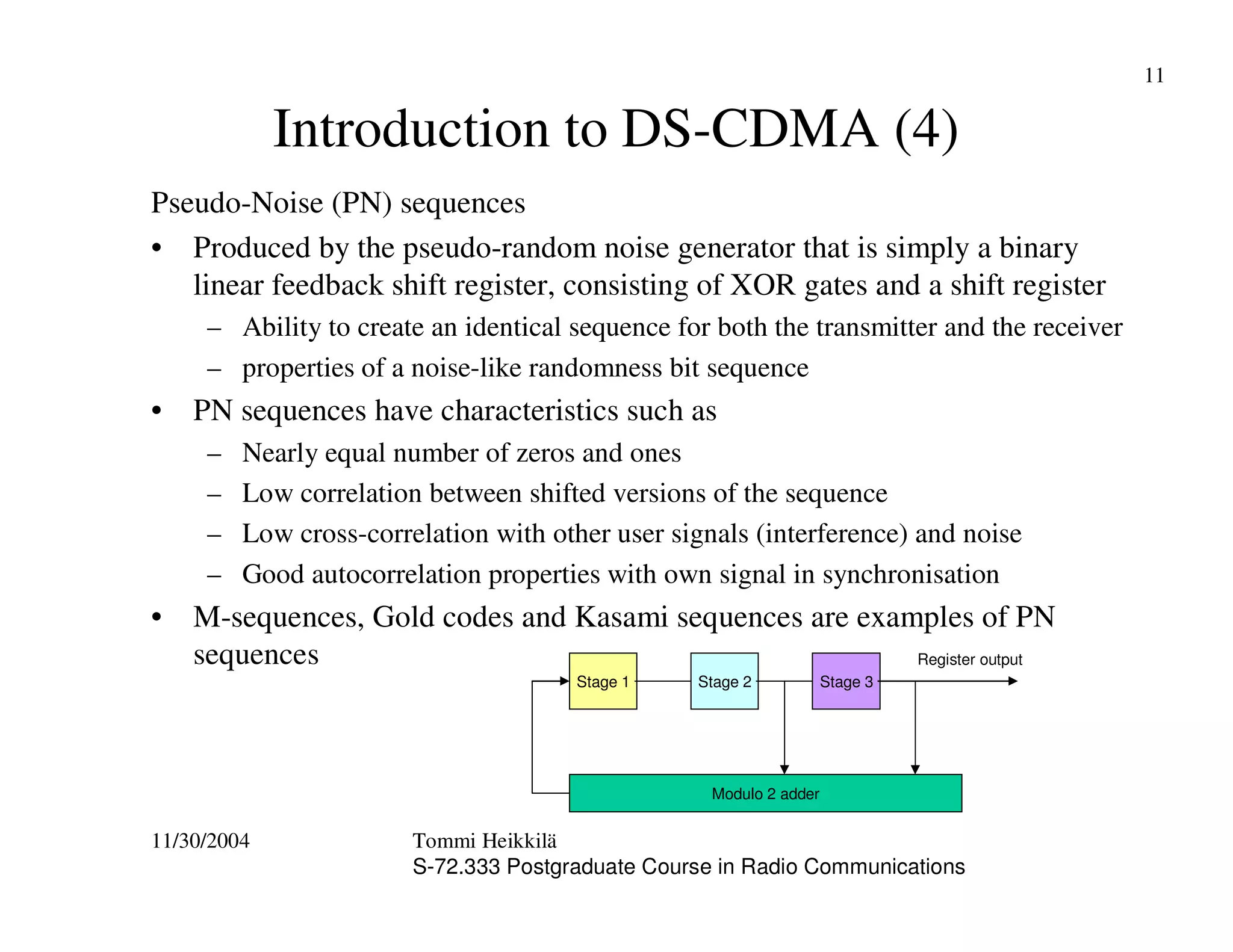
Pseudo-Noise (PN) sequences
• Produced by the pseudo-random noise generator that is simply a binary
linear feedback shift register, consisting of XOR gates and a shift register
– Ability to create an identical sequence for both the transmitter and the receiver
– properties of a noise-like randomness bit sequence
• PN sequences have characteristics such as
– Nearly equal number of zeros and ones
– Low correlation between shifted versions of the sequence
– Low cross-correlation with other user signals (interference) and noise
– Good autocorrelation properties with own signal in synchronisation
• M-sequences, Gold codes and Kasami sequences are examples of PN
sequences
Stage 1 Stage 2 Stage 3
Modulo 2 adder
Register output
11/30/2004 Tommi Heikkilä
S-72.333 Postgraduate Course in Radio Communications
12
Introduction to DS-CDMA (5)
Walsh Codes
• Walsh codes are the most common orthogonal codes used in CDMA
• Correspond to the rows of matrix known as the Hadamard matrix
• Walsh-Hadamard sequences can be used as spreading codes when users
are time synchronous
– The IS-95 system uses a 64 by 64 Walsh function matrix
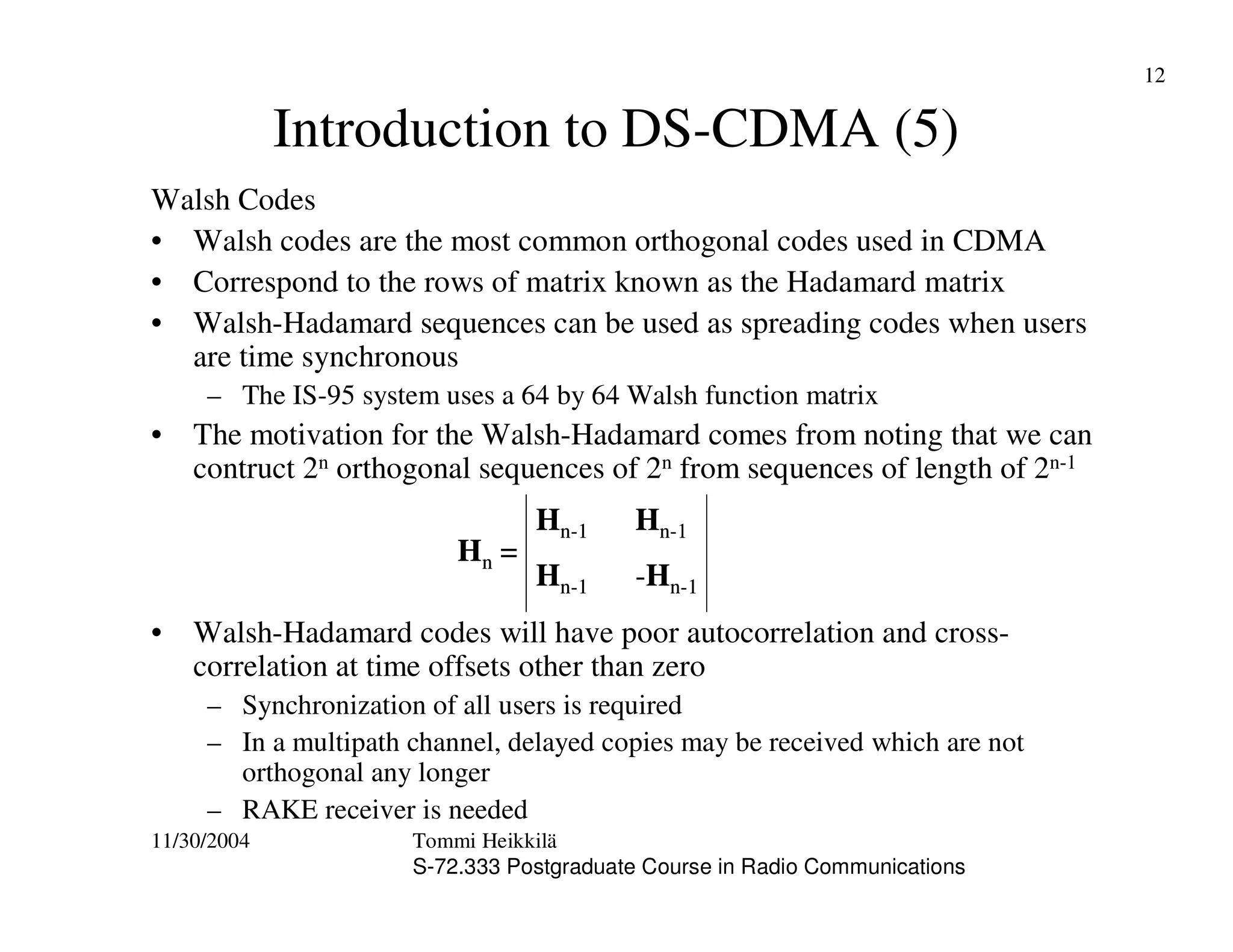
• The motivation for the Walsh-Hadamard comes from noting that we can
contruct 2n orthogonal sequences of 2n from sequences of length of 2n-1
• Walsh-Hadamard codes will have poor autocorrelation and cross-
correlation at time offsets other than zero
– Synchronization of all users is required
– In a multipath channel, delayed copies may be received which are not
orthogonal any longer
– RAKE receiver is needed
Hn =
Hn-1 Hn-1
Hn-1 -Hn-1
Hn =
Hn-1 Hn-1
Hn-1 -Hn-1
11/30/2004 Tommi Heikkilä
S-72.333 Postgraduate Course in Radio Communications
13
Cellular CDMA (1)
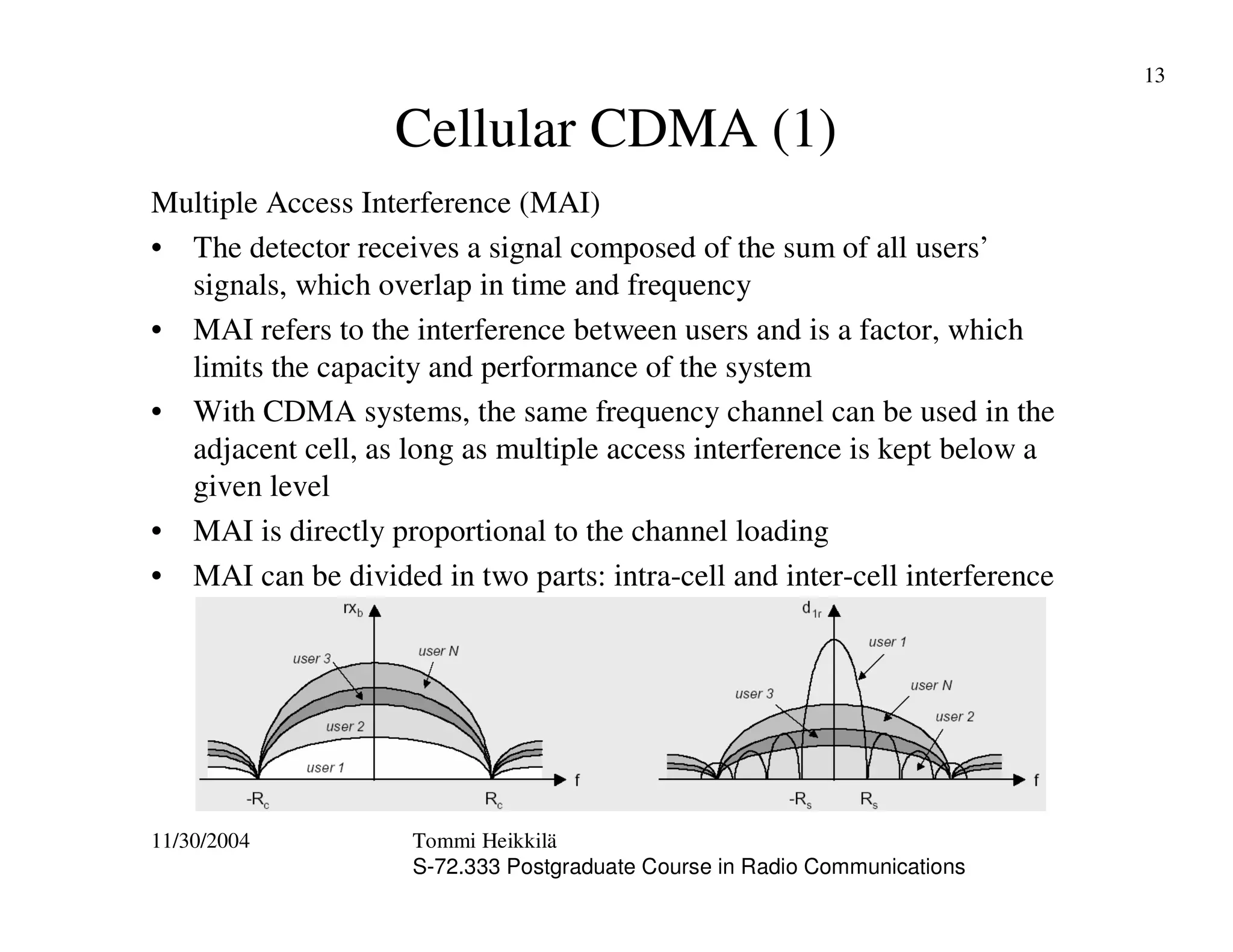
Multiple Access Interference (MAI)
• The detector receives a signal composed of the sum of all users’
signals, which overlap in time and frequency
• MAI refers to the interference between users and is a factor, which
limits the capacity and performance of the system
• With CDMA systems, the same frequency channel can be used in the
adjacent cell, as long as multiple access interference is kept below a
given level
• MAI is directly proportional to the channel loading
• MAI can be divided in two parts: intra-cell and inter-cell interference
11/30/2004 Tommi Heikkilä
S-72.333 Postgraduate Course in Radio Communications
14
Cellular CDMA (2)
Multipath
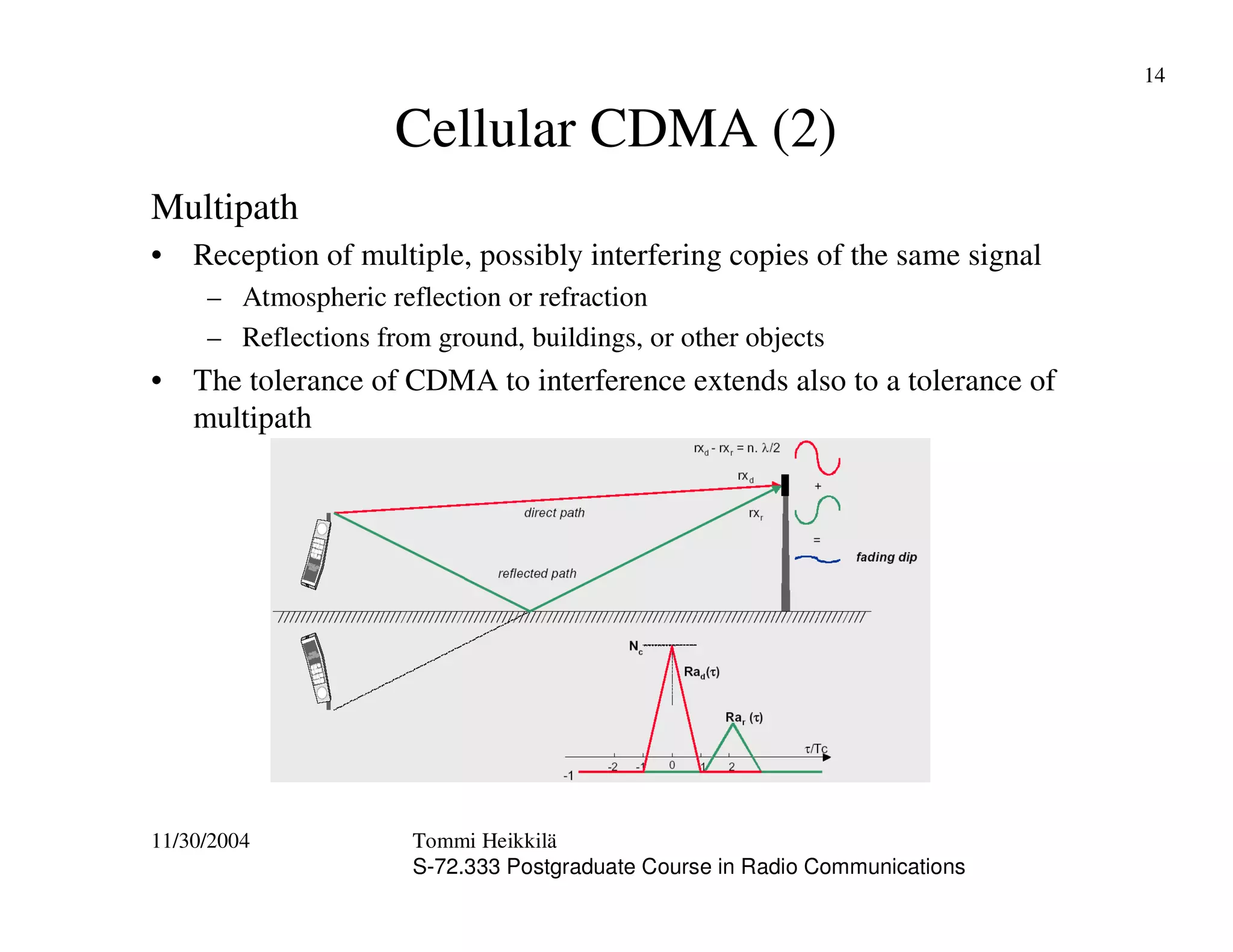
• Reception of multiple, possibly interfering copies of the same signal
– Atmospheric reflection or refraction
– Reflections from ground, buildings, or other objects
• The tolerance of CDMA to interference extends also to a tolerance of
multipath
11/30/2004 Tommi Heikkilä
S-72.333 Postgraduate Course in Radio Communications
15
Cellular CDMA (3)
RAKE receiver
• Uses a multipath diversity principle
– Uses several baseband correlators to individually process several signal multipath components
– Correlator outputs are combined to achieve improved communications reliability and
performance
• Impulse response measurements of the multipath channel profile are executed through a
matched filter to make a successful de-spreading
– It reveals multipath channel peaks and gives timing and RAKE finger allocations to different
receiver blocks
– Tracks and monitors these peaks with a measurement rate depending on speeds of mobile
station and on propagation environment
• Number of available fingers depends on the channel profile and the chip rate
– The higher the chip rate, the more resolvable paths there are
– A very large number of fingers lead to combining losses and practical implementation problems
Correlator
Phase
rotator
Delay
equalizer
Code
generators
Channel
estimators
I
Q
I
Q
Combiner
Finger 1
Finger 3
Finger 2
Matched
filter
Input
RF signal
Timing and finger allocation
Output
Correlator
Phase
rotator
Delay
equalizer
Code
generators
Channel
estimators
I
Q
I
Q
Combiner
Finger 1
Finger 3
Finger 2
Matched
filter
Input
RF signal
Timing and finger allocation
Output
11/30/2004 Tommi Heikkilä
S-72.333 Postgraduate Course in Radio Communications
16
Cellular CDMA (4)
Near-Far Problem
• The problem arises when MS A and MS B are located in a same cell
with different distances from a BS
• If no power control were applied in uplink, the MS A would transmit
so high power that MS B would have no connection to the BS due to
too low SIR-values
• The MS A would be reserving a great amount of the capacity of the
cell
11/30/2004 Tommi Heikkilä
S-72.333 Postgraduate Course in Radio Communications
17
Cellular CDMA (5)
Power Control
• Power control is an extremely essential function when considering the
smooth operation and the capacity of CDMA-based systems
• The power control problem arises due to multiple access interference
• Each user looks like random noise to other users and causes
unnecessary interference to the system
• Power control is implemented to overcome the near-far problem and to
maximize the capacity of the system
– It tries to control the powers of the mobile stations in the system so that
the received powers at the base station stay equal
– It tries also to compensate the effects of slow fading and fast fading
– There is no near-far problem in downlink due to a one-to-many situation
• Power control forces all users to transmit the minimum amount of
power needed to achieve acceptable signal quality at the base station
11/30/2004 Tommi Heikkilä
S-72.333 Postgraduate Course in Radio Communications
18
Cellular CDMA (6)
Soft and Softer Handover
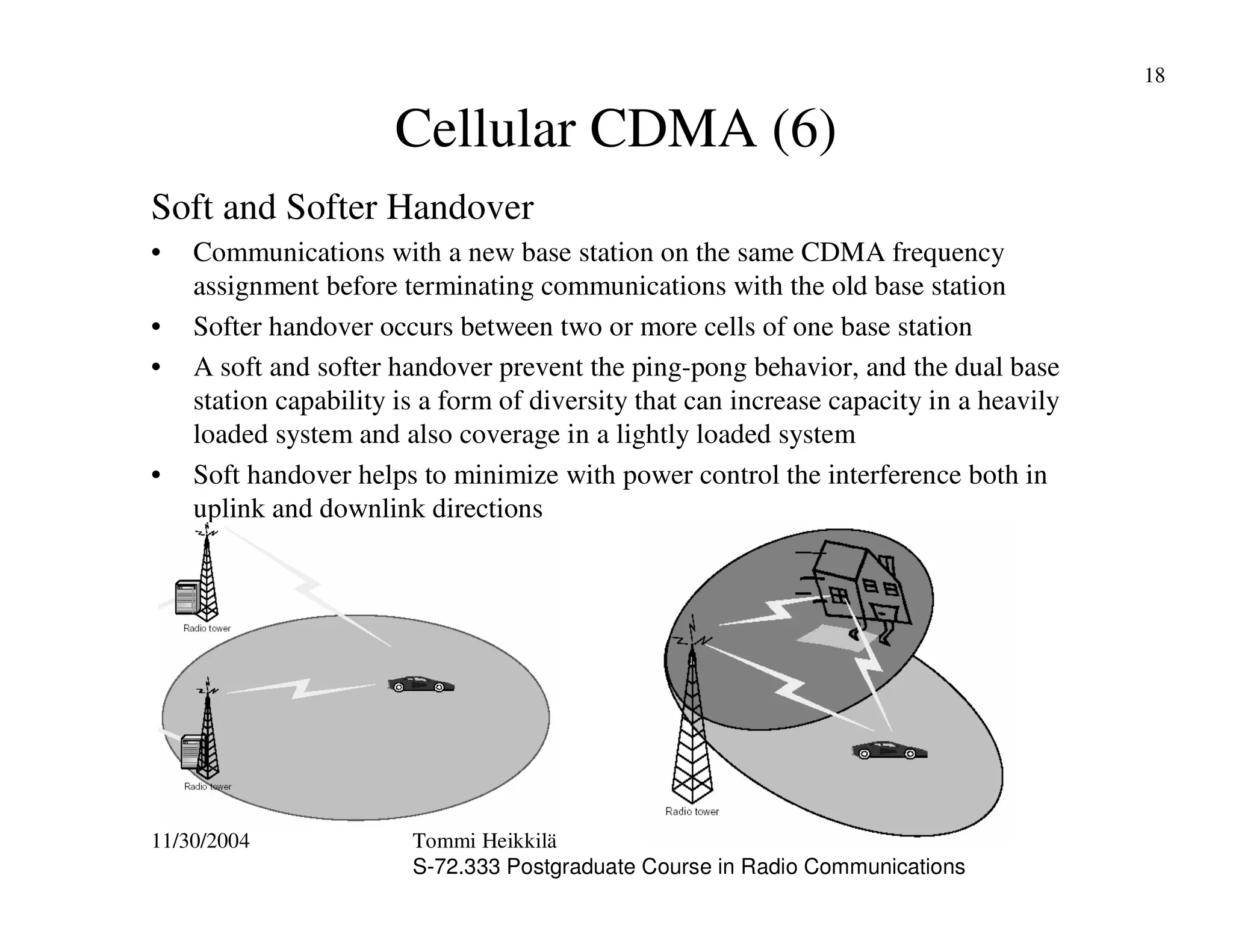
• Communications with a new base station on the same CDMA frequency
assignment before terminating communications with the old base station
• Softer handover occurs between two or more cells of one base station
• A soft and softer handover prevent the ping-pong behavior, and the dual base
station capability is a form of diversity that can increase capacity in a heavily
loaded system and also coverage in a lightly loaded system
• Soft handover helps to minimize with power control the interference both in
uplink and downlink directions
11/30/2004 Tommi Heikkilä
S-72.333 Postgraduate Course in Radio Communications
19
CDMA Capacity (1)
• Can be defined as throughput of bits or as the amount of simultaneous users in
the network receiving voice and data services with certain predefined quality
targets
• Interfering signals caused by users to each other rise, as the amount of users
gets higher in the network
• A balance between maintaining connection integrity and restricting
interference level is maintained by controlling the power of each user so that
signals arrive at their intended receiver with minimum required SIR-level
• Interference, coverage, and capacity are coupled tightly to together
• Capacity can be restricted by either transmission power constraints or by the
self-generated interference
– In the uplink, the system reaches its capacity when a mobile station does not have
enough power to overcome interference from the network, or a predefined loading
target of the network is met
– In the downlink, capacity is reached when no additional power is available to add
new users
– The power needed for either link is fundamentally related to Eb/No requirements
for different services
11/30/2004 Tommi Heikkilä
S-72.333 Postgraduate Course in Radio Communications
20
CDMA Capacity (2)
• Eb/No can be defined as in the following equation
• Where W is the chip rate, j is service activity factor, Rj is the baseband bit rate of a connection j, Pj
is received signal power from the connection j, and Itotal is the total received wideband power
including thermal noise power in the base station. Solving for P from previous equation leads to the
following equation
– where Lj
can be defined as the load factor of the jth mobile user’s connection in the uplink direction. For all
users in a CDMA network the uplink load factor can be defined as in the following equation
– where N is the number of uplink connections in the network
• The system has reached its pole capacity when the uplink load factor, UL, approaches 1. In reality,
there are two kinds of interference occurring. The effect of inter-cell loading can be taken into
account by the ratio of other cell to own cell interference, i. The uplink load factor then becomes to a
formula presented in the following equation
j
total
j
j
j
j
b
P
I
P
R
W
N
E
0
total
j
totql
j
j
j
o
b
j I
L
I
R
N
E
W
P
1
1
N
j
j
UL L
1
N
j
j
j
j
o
b
N
j
j
UL
R
N
E
W
i
L
i
1
1
1
1
)
1
(
)
1
(
11/30/2004 Tommi Heikkilä
S-72.333 Postgraduate Course in Radio Communications
21
CDMA Capacity (3)
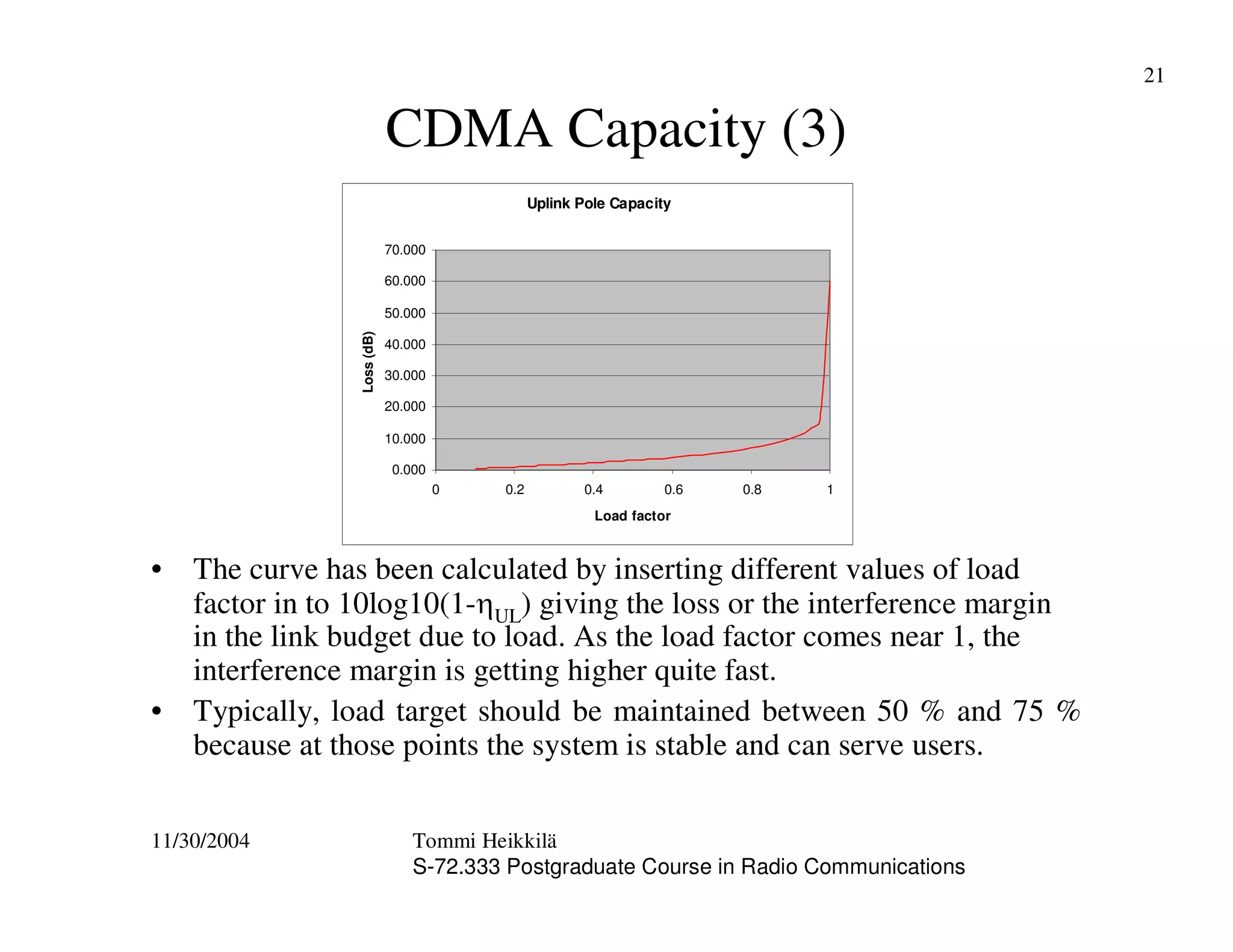
• The curve has been calculated by inserting different values of load
factor in to 10log10(1- UL) giving the loss or the interference margin
in the link budget due to load. As the load factor comes near 1, the
interference margin is getting higher quite fast.
• Typically, load target should be maintained between 50 % and 75 %
because at those points the system is stable and can serve users.
Uplink Pole Capacity
0.000
10.000
20.000
30.000
40.000
50.000
60.000
70.000
0 0.2 0.4 0.6 0.8 1
Load factor
Loss
(dB)
11/30/2004 Tommi Heikkilä
S-72.333 Postgraduate Course in Radio Communications
22
CDMA Capacity (4)
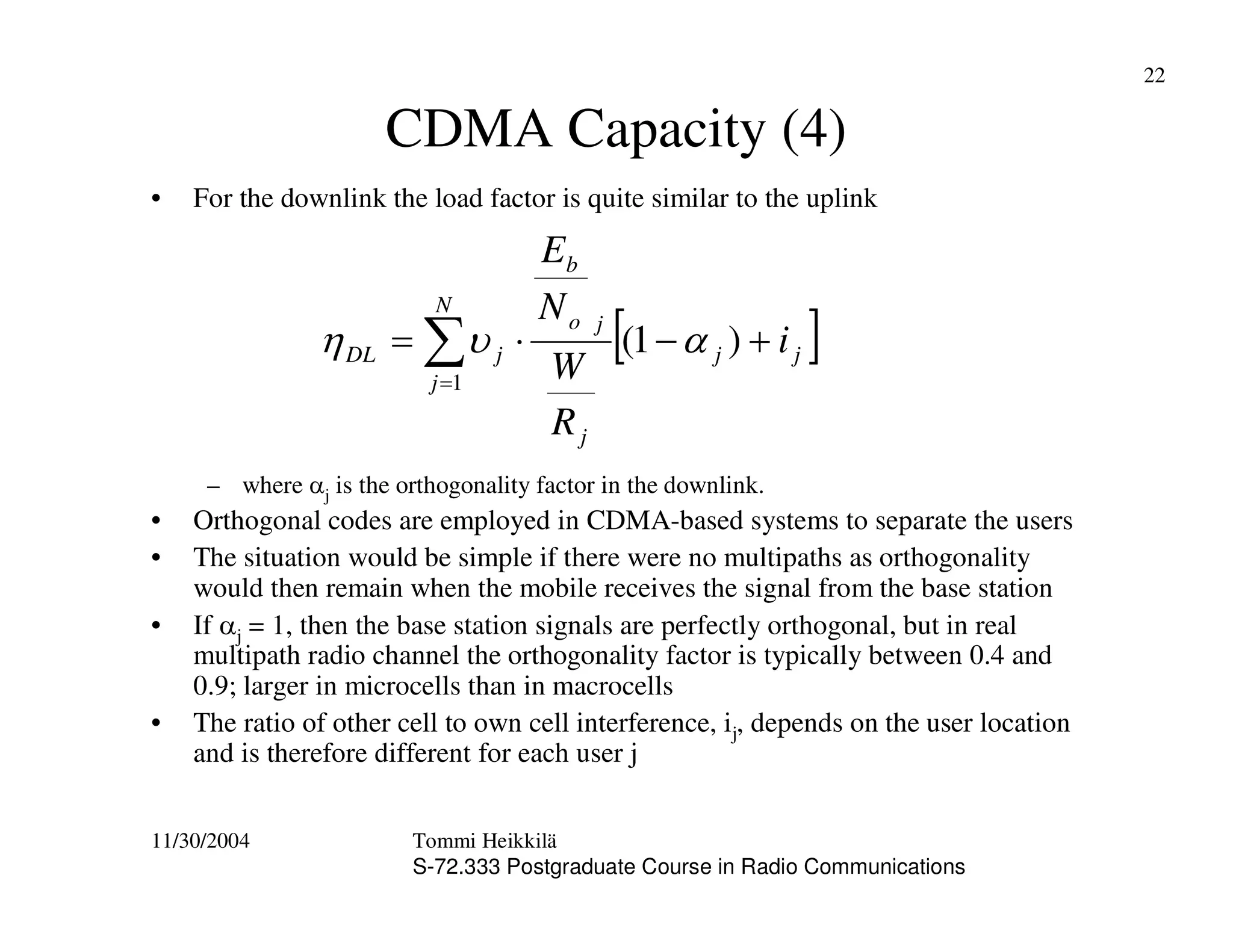
• For the downlink the load factor is quite similar to the uplink
– where j is the orthogonality factor in the downlink.
• Orthogonal codes are employed in CDMA-based systems to separate the users
• The situation would be simple if there were no multipaths as orthogonality
would then remain when the mobile receives the signal from the base station
• If j = 1, then the base station signals are perfectly orthogonal, but in real
multipath radio channel the orthogonality factor is typically between 0.4 and
0.9; larger in microcells than in macrocells
• The ratio of other cell to own cell interference, ij, depends on the user location
and is therefore different for each user j
j
j
N
j
j
j
o
b
j
DL i
R
W
N
E
)
1
(
1
11/30/2004 Tommi Heikkilä
S-72.333 Postgraduate Course in Radio Communications
23
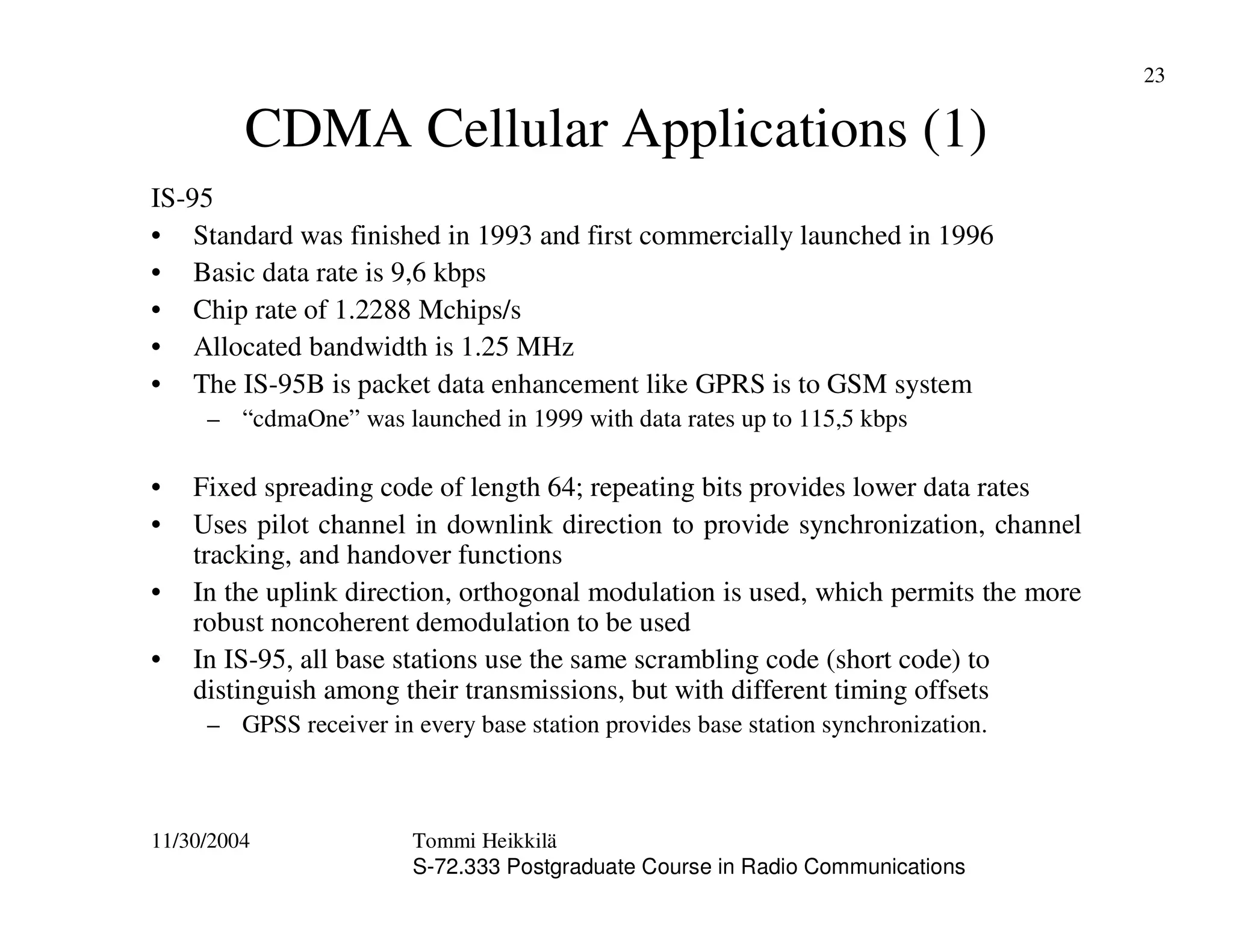
CDMA Cellular Applications (1)
IS-95
• Standard was finished in 1993 and first commercially launched in 1996
• Basic data rate is 9,6 kbps
• Chip rate of 1.2288 Mchips/s
• Allocated bandwidth is 1.25 MHz
• The IS-95B is packet data enhancement like GPRS is to GSM system
– “cdmaOne” was launched in 1999 with data rates up to 115,5 kbps
• Fixed spreading code of length 64; repeating bits provides lower data rates
• Uses pilot channel in downlink direction to provide synchronization, channel
tracking, and handover functions
• In the uplink direction, orthogonal modulation is used, which permits the more
robust noncoherent demodulation to be used
• In IS-95, all base stations use the same scrambling code (short code) to
distinguish among their transmissions, but with different timing offsets
– GPSS receiver in every base station provides base station synchronization.
11/30/2004 Tommi Heikkilä
S-72.333 Postgraduate Course in Radio Communications
24
CDMA Cellular Applications (2)
CDMA2000
• The third generation evolution phase of IS-95A/B
• It can offer up to 307 kbps data rates (compare to EDGE)
• CDMA2000 can use same 1.25 MHz as IS-95/cdmaOne
1xEV-DO/DV
• 1xEVDO (Data Only) and 1xEVDV (Data&Voice)
• Can offer high-speed data rates from 2,4 Mbps to 3,09 Mbps
WCDMA
• The faster chip rate of 3,84 Mchips/s implies that WCDMA receiver can provide greater
multipath resolution and with a RAKE receiver, this implies greater frequency diversity
due to wider bandwidth, 5 MHz
• Data rates up to 384 kbps for circuit switched and up to 2 Mbps for packet switched data
• Downlink spreading factor = 4 - 512 and uplink spreading factor = 4 - 256.
• Coherent detection on both uplink and downlink direction by using pilot bits in
transmission
• HSDPA 3GPP R5 using new modulation (QPSK+16QAM) and coding schemes to give
higher data rates for packet switched data in WCDMA
11/30/2004 Tommi Heikkilä
S-72.333 Postgraduate Course in Radio Communications
25
Conclusions
• DS-CDMA is probably the most interesting multiple access method
provided by spread-spectrum technology
• Data is scrambled by user specific pseudo noise code at the transmitter
• Through RAKE receiver multipaths can be used in advantage to
improve receiver performance by capturing the energy in paths having
different transmission delays
• Power control and soft handover must work or there is no cellular
CDMA as we know
• Interference, coverage, and capacity are coupled tightly to together in
CDMA systems
• Nowadays systems such as CDMA2000, its evolution versions, and
European WCDMA are becoming more and more popular as the
networks are opening commercially around the world
11/30/2004 Tommi Heikkilä
S-72.333 Postgraduate Course in Radio Communications
26
References
• [1] Simon Haykin, Michael Moher: Modern Wireless
Communications, Prentice Hall 2005, pp. 258-338.
• [2] Samuel C. Yang, CDMA RF System Engineering, Norwood MA,
USA, Artech House Inc., 1998, 280 pp.
• [3] Tero Ojanperä, Ramjee Prasad, Wideband CDMA for Third
Generation Mobile Communications, Norwood MA, USA,
Artect House Inc., 1998, 439 pp.
• [4] Jerry D. Gibson, Elaine M. Gibson, The Mobile Communications
Handbook, 2nd Edition, Boca Raton, Florida, USA, CRC Press
LLC, 1999, 600 pp.
• [5] John G. Proakis, Digital communications, 3rd Edition., New
York, USA, McGraw-Hill, 1995, 928 pp.
• [6] Harri Holma, Antti Toskala, WCDMA for UMTS, Radio Access
For Third Generation Mobile Communications, Chichester,
England, John Wiley & Sons, Ltd., 2000, 322 pp.
11/30/2004 Tommi Heikkilä
S-72.333 Postgraduate Course in Radio Communications
27
Homework
1. a) Construct Walsh-Hadamard sequences of length of 8 if
1. b) Spread following data signal, S, with 3rd row sequence of the
Walsh-Hadamard matrix constructed in phase a)
S = [1 –1 –1 1]
2. Why are power control and soft handover so important features in
CDMA cellular systems?
H1 =
1 1
1 -1

CDMA.pdf

  • 1.
    11/30/2004 Tommi Heikkilä S-72.333Postgraduate Course in Radio Communications 1 C D M A Code Division Multiple Access
  • 2.
    11/30/2004 Tommi Heikkilä S-72.333Postgraduate Course in Radio Communications 2 Agenda • Introduction • History of Spread-Spectrum and CDMA • Introduction to DS-CDMA • Cellular CDMA • CDMA Capacity • CDMA Cellular Applications • Conclusions • References • Homework
  • 3.
    11/30/2004 Tommi Heikkilä S-72.333Postgraduate Course in Radio Communications 3 Introduction • CDMA is a modulation and multiple access scheme based on the spread-spectrum communication technology • Individual terminals use spread-spectrum techniques and occupy the entire spectrum whenever they transmit – Users share time and frequency allocations, and are channelized by unique assigned codes – Signals of different users are separated at the receiver by using a correlator that captures signal energy only from the desired user or channel – Undesired signals contribute only to noise and interference • In FDMA each user is given a small portion of the total available spectrum • In TDMA each user is allowed full use of the available spectrum, but only during certain periods in time F re q u e n c y T im e C o d e H ig h d a ta ra te u s e r U s e r C U s e r A U s e r B
  • 4.
    11/30/2004 Tommi Heikkilä S-72.333Postgraduate Course in Radio Communications 4 History of Spread-Spectrum and CDMA • Development of the CDMA technique dates back to the early 1950s when different studies of the spread-spectrum technologies were started • Basic by Claude Shannon and Robert Pierce in 1949 • In 1950 De-Rosa-Rogoff defined the direct-sequence spread-spectrum method, the processing gain equation, and a noise multiplexing idea • Price and Green filed the RAKE receiver patent in 1956 • In 1961 Manuski defined the near-far problem crucial for CDMA systems • In 1970s several military and navigation applications were developed. – Military with very low C/I, Anti-jamming applications • Cellular applications proposed late 70s focused on narrowband systems – In 1978 Cooper and Nettleton suggested a cellular spread-spectrum application • During 80s Qualcomm investigated CDMA for cellular applications – IS-95 standard 1993 and commercial networks introduced in 1995 • 3G wideband CDMA systems, such as CDMA IS-2000 and European WCDMA developed from 1990s and still going on – Commercial networks are opened at the moment
  • 5.
    11/30/2004 Tommi Heikkilä S-72.333Postgraduate Course in Radio Communications 5 Spread-Spectrum Technology (1) • Originally developed for military and navigation purposes – secure means of communication in hostile environments – Low Probability of Interception • Cannot be easily detected by enemy communication equipment due to low power spectral density, even lower than background noise – Anti-Jamming • Properties to combat intentional interference trying to sabotage communication systems • Nowadays feasible for commercial applications especially for mobile communication systems – It provides an efficient multiple access method for a number of independent users sharing a common communication channel without external synchronization methods – DS-CDMA is probably the most interesting multiple access method provided by spread-spectrum technology
  • 6.
    11/30/2004 Tommi Heikkilä S-72.333Postgraduate Course in Radio Communications 6 Spread-Spectrum Technology (2) • Transmission bandwidth is much larger than information bandwidth • Bandwidth does not depend on the informational signal • Processing gain = Transmitted bandwidth/ Information bandwidth – Gp is also called the spreading factor and determines the maximum number of simultaneous users or connections allowed in a communication system – Determines the level of protection against multipath interference signals and signal detection capabilities of a spread spectrum communication system – In multipath situations the receiver observes spread-spectrum signals summed with narrowband interference – Determines the power ratio of the desired signal and interference after de- spreading – Low data rates such as speech have high processing gain compared to high data rates – High data rate means less processing gain and higher transmit power or smaller coverage i t p B B G
  • 7.
    11/30/2004 Tommi Heikkilä S-72.333Postgraduate Course in Radio Communications 7 Spread-Spectrum Technology (3) • Classification of Spread Spectrum technologies – Direct-Sequence • Data is scrambled by user specific pseudo noise code at the transmitter side – Frequency Hopping: The signal is spread by changing the frequency over the transmitted time of the signal: • Fast frequency hopping • Slow frequency hopping – Time Hopping • The data is divided into frames, that itself are divided into time intervals • The data is burst is hopped over the frames by utilising code sequences • Also, a variety of hybrid techniques use different combinations of these two basic techniques
  • 8.
    11/30/2004 Tommi Heikkilä S-72.333Postgraduate Course in Radio Communications 8 Introduction to DS-CDMA (1) DS-CDMA transmission and reception B i B i B t U s e r 1 U s e r 2 A f t e r s p r e a d i n g N a r r o w b a n d s i g n a l B t C h a n n e l B t A f t e r d e s p r e a d i n g B i B i P P P P P P P f f f f f f f
  • 9.
    11/30/2004 Tommi Heikkilä S-72.333Postgraduate Course in Radio Communications 9 Introduction to DS-CDMA (2) Spreading • A pseudo-random code is generated, different for each channel and each connection • The information data is spread by a pseudorandom code • The resulting signal modulates a carrier • BPSK-signal has a 180- degree phase shift when the output of the multiplication changes. Data signal Code signal Data signal x Code signal BPSK-modulated signal 1 chip period 1 bit period
  • 10.
    11/30/2004 Tommi Heikkilä S-72.333Postgraduate Course in Radio Communications 10 Introduction to DS-CDMA (3) De-spreading • A pseudo-random code is generated, matching the anticipated signal • The receiver acquires the received code and phase locks its own code to it • The received signal is correlated with the generated code, extracting the information data rxb pnr dr
  • 11.
    11/30/2004 Tommi Heikkilä S-72.333Postgraduate Course in Radio Communications 11 Introduction to DS-CDMA (4) Pseudo-Noise (PN) sequences • Produced by the pseudo-random noise generator that is simply a binary linear feedback shift register, consisting of XOR gates and a shift register – Ability to create an identical sequence for both the transmitter and the receiver – properties of a noise-like randomness bit sequence • PN sequences have characteristics such as – Nearly equal number of zeros and ones – Low correlation between shifted versions of the sequence – Low cross-correlation with other user signals (interference) and noise – Good autocorrelation properties with own signal in synchronisation • M-sequences, Gold codes and Kasami sequences are examples of PN sequences Stage 1 Stage 2 Stage 3 Modulo 2 adder Register output
  • 12.
    11/30/2004 Tommi Heikkilä S-72.333Postgraduate Course in Radio Communications 12 Introduction to DS-CDMA (5) Walsh Codes • Walsh codes are the most common orthogonal codes used in CDMA • Correspond to the rows of matrix known as the Hadamard matrix • Walsh-Hadamard sequences can be used as spreading codes when users are time synchronous – The IS-95 system uses a 64 by 64 Walsh function matrix • The motivation for the Walsh-Hadamard comes from noting that we can contruct 2n orthogonal sequences of 2n from sequences of length of 2n-1 • Walsh-Hadamard codes will have poor autocorrelation and cross- correlation at time offsets other than zero – Synchronization of all users is required – In a multipath channel, delayed copies may be received which are not orthogonal any longer – RAKE receiver is needed Hn = Hn-1 Hn-1 Hn-1 -Hn-1 Hn = Hn-1 Hn-1 Hn-1 -Hn-1
  • 13.
    11/30/2004 Tommi Heikkilä S-72.333Postgraduate Course in Radio Communications 13 Cellular CDMA (1) Multiple Access Interference (MAI) • The detector receives a signal composed of the sum of all users’ signals, which overlap in time and frequency • MAI refers to the interference between users and is a factor, which limits the capacity and performance of the system • With CDMA systems, the same frequency channel can be used in the adjacent cell, as long as multiple access interference is kept below a given level • MAI is directly proportional to the channel loading • MAI can be divided in two parts: intra-cell and inter-cell interference
  • 14.
    11/30/2004 Tommi Heikkilä S-72.333Postgraduate Course in Radio Communications 14 Cellular CDMA (2) Multipath • Reception of multiple, possibly interfering copies of the same signal – Atmospheric reflection or refraction – Reflections from ground, buildings, or other objects • The tolerance of CDMA to interference extends also to a tolerance of multipath
  • 15.
    11/30/2004 Tommi Heikkilä S-72.333Postgraduate Course in Radio Communications 15 Cellular CDMA (3) RAKE receiver • Uses a multipath diversity principle – Uses several baseband correlators to individually process several signal multipath components – Correlator outputs are combined to achieve improved communications reliability and performance • Impulse response measurements of the multipath channel profile are executed through a matched filter to make a successful de-spreading – It reveals multipath channel peaks and gives timing and RAKE finger allocations to different receiver blocks – Tracks and monitors these peaks with a measurement rate depending on speeds of mobile station and on propagation environment • Number of available fingers depends on the channel profile and the chip rate – The higher the chip rate, the more resolvable paths there are – A very large number of fingers lead to combining losses and practical implementation problems Correlator Phase rotator Delay equalizer Code generators Channel estimators I Q I Q Combiner Finger 1 Finger 3 Finger 2 Matched filter Input RF signal Timing and finger allocation Output Correlator Phase rotator Delay equalizer Code generators Channel estimators I Q I Q Combiner Finger 1 Finger 3 Finger 2 Matched filter Input RF signal Timing and finger allocation Output
  • 16.
    11/30/2004 Tommi Heikkilä S-72.333Postgraduate Course in Radio Communications 16 Cellular CDMA (4) Near-Far Problem • The problem arises when MS A and MS B are located in a same cell with different distances from a BS • If no power control were applied in uplink, the MS A would transmit so high power that MS B would have no connection to the BS due to too low SIR-values • The MS A would be reserving a great amount of the capacity of the cell
  • 17.
    11/30/2004 Tommi Heikkilä S-72.333Postgraduate Course in Radio Communications 17 Cellular CDMA (5) Power Control • Power control is an extremely essential function when considering the smooth operation and the capacity of CDMA-based systems • The power control problem arises due to multiple access interference • Each user looks like random noise to other users and causes unnecessary interference to the system • Power control is implemented to overcome the near-far problem and to maximize the capacity of the system – It tries to control the powers of the mobile stations in the system so that the received powers at the base station stay equal – It tries also to compensate the effects of slow fading and fast fading – There is no near-far problem in downlink due to a one-to-many situation • Power control forces all users to transmit the minimum amount of power needed to achieve acceptable signal quality at the base station
  • 18.
    11/30/2004 Tommi Heikkilä S-72.333Postgraduate Course in Radio Communications 18 Cellular CDMA (6) Soft and Softer Handover • Communications with a new base station on the same CDMA frequency assignment before terminating communications with the old base station • Softer handover occurs between two or more cells of one base station • A soft and softer handover prevent the ping-pong behavior, and the dual base station capability is a form of diversity that can increase capacity in a heavily loaded system and also coverage in a lightly loaded system • Soft handover helps to minimize with power control the interference both in uplink and downlink directions
  • 19.
    11/30/2004 Tommi Heikkilä S-72.333Postgraduate Course in Radio Communications 19 CDMA Capacity (1) • Can be defined as throughput of bits or as the amount of simultaneous users in the network receiving voice and data services with certain predefined quality targets • Interfering signals caused by users to each other rise, as the amount of users gets higher in the network • A balance between maintaining connection integrity and restricting interference level is maintained by controlling the power of each user so that signals arrive at their intended receiver with minimum required SIR-level • Interference, coverage, and capacity are coupled tightly to together • Capacity can be restricted by either transmission power constraints or by the self-generated interference – In the uplink, the system reaches its capacity when a mobile station does not have enough power to overcome interference from the network, or a predefined loading target of the network is met – In the downlink, capacity is reached when no additional power is available to add new users – The power needed for either link is fundamentally related to Eb/No requirements for different services
  • 20.
    11/30/2004 Tommi Heikkilä S-72.333Postgraduate Course in Radio Communications 20 CDMA Capacity (2) • Eb/No can be defined as in the following equation • Where W is the chip rate, j is service activity factor, Rj is the baseband bit rate of a connection j, Pj is received signal power from the connection j, and Itotal is the total received wideband power including thermal noise power in the base station. Solving for P from previous equation leads to the following equation – where Lj can be defined as the load factor of the jth mobile user’s connection in the uplink direction. For all users in a CDMA network the uplink load factor can be defined as in the following equation – where N is the number of uplink connections in the network • The system has reached its pole capacity when the uplink load factor, UL, approaches 1. In reality, there are two kinds of interference occurring. The effect of inter-cell loading can be taken into account by the ratio of other cell to own cell interference, i. The uplink load factor then becomes to a formula presented in the following equation j total j j j j b P I P R W N E 0 total j totql j j j o b j I L I R N E W P 1 1 N j j UL L 1 N j j j j o b N j j UL R N E W i L i 1 1 1 1 ) 1 ( ) 1 (
  • 21.
    11/30/2004 Tommi Heikkilä S-72.333Postgraduate Course in Radio Communications 21 CDMA Capacity (3) • The curve has been calculated by inserting different values of load factor in to 10log10(1- UL) giving the loss or the interference margin in the link budget due to load. As the load factor comes near 1, the interference margin is getting higher quite fast. • Typically, load target should be maintained between 50 % and 75 % because at those points the system is stable and can serve users. Uplink Pole Capacity 0.000 10.000 20.000 30.000 40.000 50.000 60.000 70.000 0 0.2 0.4 0.6 0.8 1 Load factor Loss (dB)
  • 22.
    11/30/2004 Tommi Heikkilä S-72.333Postgraduate Course in Radio Communications 22 CDMA Capacity (4) • For the downlink the load factor is quite similar to the uplink – where j is the orthogonality factor in the downlink. • Orthogonal codes are employed in CDMA-based systems to separate the users • The situation would be simple if there were no multipaths as orthogonality would then remain when the mobile receives the signal from the base station • If j = 1, then the base station signals are perfectly orthogonal, but in real multipath radio channel the orthogonality factor is typically between 0.4 and 0.9; larger in microcells than in macrocells • The ratio of other cell to own cell interference, ij, depends on the user location and is therefore different for each user j j j N j j j o b j DL i R W N E ) 1 ( 1
  • 23.
    11/30/2004 Tommi Heikkilä S-72.333Postgraduate Course in Radio Communications 23 CDMA Cellular Applications (1) IS-95 • Standard was finished in 1993 and first commercially launched in 1996 • Basic data rate is 9,6 kbps • Chip rate of 1.2288 Mchips/s • Allocated bandwidth is 1.25 MHz • The IS-95B is packet data enhancement like GPRS is to GSM system – “cdmaOne” was launched in 1999 with data rates up to 115,5 kbps • Fixed spreading code of length 64; repeating bits provides lower data rates • Uses pilot channel in downlink direction to provide synchronization, channel tracking, and handover functions • In the uplink direction, orthogonal modulation is used, which permits the more robust noncoherent demodulation to be used • In IS-95, all base stations use the same scrambling code (short code) to distinguish among their transmissions, but with different timing offsets – GPSS receiver in every base station provides base station synchronization.
  • 24.
    11/30/2004 Tommi Heikkilä S-72.333Postgraduate Course in Radio Communications 24 CDMA Cellular Applications (2) CDMA2000 • The third generation evolution phase of IS-95A/B • It can offer up to 307 kbps data rates (compare to EDGE) • CDMA2000 can use same 1.25 MHz as IS-95/cdmaOne 1xEV-DO/DV • 1xEVDO (Data Only) and 1xEVDV (Data&Voice) • Can offer high-speed data rates from 2,4 Mbps to 3,09 Mbps WCDMA • The faster chip rate of 3,84 Mchips/s implies that WCDMA receiver can provide greater multipath resolution and with a RAKE receiver, this implies greater frequency diversity due to wider bandwidth, 5 MHz • Data rates up to 384 kbps for circuit switched and up to 2 Mbps for packet switched data • Downlink spreading factor = 4 - 512 and uplink spreading factor = 4 - 256. • Coherent detection on both uplink and downlink direction by using pilot bits in transmission • HSDPA 3GPP R5 using new modulation (QPSK+16QAM) and coding schemes to give higher data rates for packet switched data in WCDMA
  • 25.
    11/30/2004 Tommi Heikkilä S-72.333Postgraduate Course in Radio Communications 25 Conclusions • DS-CDMA is probably the most interesting multiple access method provided by spread-spectrum technology • Data is scrambled by user specific pseudo noise code at the transmitter • Through RAKE receiver multipaths can be used in advantage to improve receiver performance by capturing the energy in paths having different transmission delays • Power control and soft handover must work or there is no cellular CDMA as we know • Interference, coverage, and capacity are coupled tightly to together in CDMA systems • Nowadays systems such as CDMA2000, its evolution versions, and European WCDMA are becoming more and more popular as the networks are opening commercially around the world
  • 26.
    11/30/2004 Tommi Heikkilä S-72.333Postgraduate Course in Radio Communications 26 References • [1] Simon Haykin, Michael Moher: Modern Wireless Communications, Prentice Hall 2005, pp. 258-338. • [2] Samuel C. Yang, CDMA RF System Engineering, Norwood MA, USA, Artech House Inc., 1998, 280 pp. • [3] Tero Ojanperä, Ramjee Prasad, Wideband CDMA for Third Generation Mobile Communications, Norwood MA, USA, Artect House Inc., 1998, 439 pp. • [4] Jerry D. Gibson, Elaine M. Gibson, The Mobile Communications Handbook, 2nd Edition, Boca Raton, Florida, USA, CRC Press LLC, 1999, 600 pp. • [5] John G. Proakis, Digital communications, 3rd Edition., New York, USA, McGraw-Hill, 1995, 928 pp. • [6] Harri Holma, Antti Toskala, WCDMA for UMTS, Radio Access For Third Generation Mobile Communications, Chichester, England, John Wiley & Sons, Ltd., 2000, 322 pp.
  • 27.
    11/30/2004 Tommi Heikkilä S-72.333Postgraduate Course in Radio Communications 27 Homework 1. a) Construct Walsh-Hadamard sequences of length of 8 if 1. b) Spread following data signal, S, with 3rd row sequence of the Walsh-Hadamard matrix constructed in phase a) S = [1 –1 –1 1] 2. Why are power control and soft handover so important features in CDMA cellular systems? H1 = 1 1 1 -1