Full Paper
Proc. of Int. Conf. on Advances in Computer Science and Application 2013

Generation of Orthogonal Minimum Correlation
Spreading Code for CDMA System
Shibashis Pradhan1, Sudipta Chattopadhyay2 and Sharmila Meinam3
Department of Electronics & Telecommunication Engineering, Jadavpur University,
Kolkata-700 032, India
Email: shibashispradhan@gmail.com,sudiptachat@yahoo.com,sharmila_meinam@yahoo.com
Abstract- Code Division Multiple Access (CDMA) is one of the
most promising tools for multiple access in future generation
wireless communication systems. In CDMA system, within
the specific bandwidth a large number of users could be served
by assigning specific code to each user. In this paper, an attempt
has been made to generate a novel orthogonal spreading code
to support a large number of users for CDMA system by
maintaining minimum correlation values between them. The
proposed “Orthogonal Minimum Correlation Spreading
Code” (OMCSC) would be able to provide a large number of
spreading codes by simultaneously reducing the effect of
M ultiple Access Interference (MAI) in CDM A system.
Moreover, the Bit Error Rate (BER) performance of the
proposed code has been compared with different existing codes
in order to establish the supremacy of the proposed code over
the others under multi-user scenario.
Index Terms- BER, CDMA, MAI, Walsh code, OMCSC.

I. INTRODUCTION
Code Division Multiple Access (CDMA) cellular network
is a promising wireless technology and it has been in the
focus of academic research since many years. In comparison
with Time Division Multiple Access (TDMA) and Frequency
Division Multiple Access (FDMA), CDMA is proved to be
attractive for wireless access for its numerous advantages
[1]. It is based on spread spectrum technique [1] which
requires user specific pseudo- random codes. In spread
spectrum CDMA technique the transmitted signal is spread
over a wide frequency band, more than the minimum
bandwidth required to transmit the required information [2].
It generates a waveform that appears random to anyone for
all purposes [3] but the intended receiver of the transmitter
waveform. The pseudo random code is mixed with the data to
spread the signal, which can be generated mathematically by
following a specific rule, but statistically it nearly satisfies
the requirements of a truly random sequence.
Multiple Access Interference (MAI) generally occurs in
CDMA system users due to non-orthogonality between
spreading codes [2], and so it restricts the capacity of CDMA
systems. To increase CDMA system capacity, ‘‘Large Set of
CI Spreading Codes for High Capacity MC-CDMA” has been
proposed [4].This paper introduced two group of orthogonal
complex spreading codes with minimum correlation between
them. By employing this large set of CI codes they found
100% increase in system capacity with no extra expense in
bandwidth.
Minimum auto correlation codes have been proposed in
1
© 2013 ACEEE
DOI: 03.LSCS.2013.3.59

order to minimize the average magnitude of auto correlation
with impulsive peak between spreading codes thereby minimizing the effect of ISI. It is shown that these codes have
better average magnitude of auto correlation than Hadamard
codes [5]. For example, for codes of lengths 8 and 16 the
achievement in gain was 408% and 530% respectively at one
shift. The generation of minimum cross correlation spreading codes has been suggested in [6] in order to minimize the
magnitude of cross correlation between different spreading
codes. The average magnitude of cross correlation of the
proposed code has been compared with that of Hadamard
and Gold codes, and a noticeable enhancement over
Hadamard and Gold codes has been achieved. In [7], minimum correlation spreading codes are presented in order to
minimize the magnitude of auto correlation and cross correlation between spreading codes other than zero shift. The disadvantage of the work described in [5]-[7] is that each of
them produces N-1 number of spreading codes for a N length
sequence which is less than Walsh code.
A novel systematic method of generating orthogonal sets
of sequences with good correlation properties has been
described in [8]. This method generates N × (N-1) number of
unique code sequences, each of length N. For different sizes
of codes the zero shift peak cross correlation value between
any two distinct code members has been calculated and
presented. In order to generate a new family of orthogonal
code sets that can be employed as a spreading sequence in a
DS-CDMA communication system, a small set of Kasami
sequence has been utilized [9].
New sets of Walsh-like nonlinear phase orthogonal codes
for synchronous and asynchronous CDMA communication
system has been proposed in [10]. It has been directed that
the proposed code outperforms Walsh code and their
performances closely match with the nearly orthogonal Gold
codes in AWGN channel with more number of codes than
Walsh code. It has also been mentioned that the performances
of all the binary codes are comparable to each other in Rayleigh
flat-fading channels.
Wu and Nassar et al. [11] proposed a set of novel complex
spreading codes called Carrier Interferometry (CI) codes and
described how these novel orthogonal spreading codes
achieved cross-correlations independent of the phase offsets
between different paths after transmission over a multi-path
fading channel. This improved cross-correlation property
relative to Walsh codes leads to higher Signal to Interference
Ratio (SIR) in the DS-CDMA RAKE receiver, and, as a direct
Full Paper
Proc. of Int. Conf. on Advances in Computer Science and Application 2013
result, better performance in terms of probability of error had
achieved.
In this paper, a novel code generation algorithm has been
proposed to accommodate a large number of users in CDMA
system. The performance of the proposed code has been
studied and compared to other existing codes in terms of
various attribute, like number of generated codes, cross
correlation and auto correlation values. To study the BER
performance of the generated code, SIMULINK based
downlink CDMA system model has been used under different
channel and user conditions. This paper is structured as
follows: section II, mathematical background of spreading
codes; section III, proposed algorithm; section IV, simulation
and result analysis; section V, conclusion discussed in details.
II. MATHEMATICAL BACKGROUND

OF

(1)

matrix of rank 1 as desihnated by Ra gives minimum
autocorelation spreading code as expressed by the relation
Ra=E, where E is a (N×N) matrix with all elements one.
In minimum cross corelation code the objective is to
minimize the cross correlation values with a known spreading
code and all its shifts.For this let us assume a spreading
code, x, of length N and find a code s that minimizes the
average magnitude of cross correlation.
where x and s can be represented as
[X1 X2.................XN] T and [Y1, Y2......................YN] T, respectively.
For minimum cross correlation it is required to obtain

SPREADING CODES

A. Walsh code
Walsh code offers valuable code sets for CDMA wireless
systems where all codes are orthogonal to each other [3].
Walsh codes are produced by mapping codeword rows of
special square matrix called Hadamard matrix. The length N
of a Walsh code is of power 2, i.e. N=2n, where n is any positive
integer. The matrix contains one row of all zeros and the other
rows each have equal number of ones and zeros. Walsh codes
can be generated by following recursive procedure: W1=[0],

W

2

0
 
0

0
1


,

and W

W

2 N

4

0
0
 
0

0

W
 
W

N
N

0
1
0
1

(2)

To achieve minimum cross correlation relation (2) can be
formulated by minimizing the function G2=xT. E . s, such that
sT. s=1. In this case the eigenvector of a symmetric and rank
1 matrix Rc gives minimum crosscorelation spreading code in
the following relation Rc =E.x.xT.ET.Then R=K×E+(1K)×(E.x.xT.ET) produces eigenvector of a symmetric matrix of
rank 1 for minimum corelation spreading code.Here, R generates N-1 number of eigenvector of zero eigenvalues which
are orthogonal to each other.

0
1 

1 
1 0

0
0
1

WN 

WN 

III. FLOW CHART REPRESENTATION OF T HE PROPOSED
GENERATION ALGORITHM

where, N is a power of 2 and over-score implies the binary
complement of corresponding bits in the matrix. Each row of
the matrix represents a Walsh code by mapping 0 to 1 and 1
to -1. So, N length Walsh code can provide N number of
codes which can serve maximum N number of CDMA users
[3]. These codes are orthogonal to each other and thus have
zero cross-correlation between any pair at zero time shifts.

The proposed code generation algorithm for CDMA
system has been represented in the form of a flowchart as
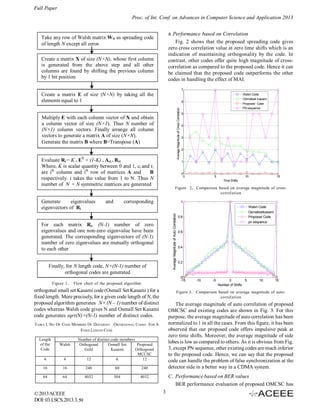
presented in Fig. 1.
IV. SIMULATION RESULTS AND ITS ANALYSIS
The code generation algorithm as described in above section has been implemented using MATLAB 7.10. The simulation results presented in this section comprises performance
analysis based on number of code generation, correlation
values and BER values of the generated codes.

B. Minimum Correlation Spreading Code
A minimum correlation spreading code is a code that
minimizes average magnitude of auto correlation values except
zero time shift and minimizes the average value of cross
correlation simultaneously [7]. For minimum auto correlation,
let’s consider a spreading code, s, of length N, which can be
represented as [X1, X2, . , XN-1, XN ]T, where T is the transpose
operator. It is required to obtain the following for minimum
autocorrelation.
Which is nothing but minimization of function G1=sT . E.
s, such that sT . s=1.Here, the eigenvector of a symmetric
© 2013 ACEEE
DOI: 03.LSCS.2013.3.59

CODE

A. Performance based on number of codes generation.
The number of codes generated by the proposed
algorithm has been listed in Table I. In this perspective, some
of the existing codes have also been included in Table I.
given below. This table shows that the proposed OMCSC
algorithm is capable of generating a large number of codes in
comparison with existing codes like Walsh code and
2
Full Paper
Proc. of Int. Conf. on Advances in Computer Science and Application 2013
B. Performance

based on Correlation
Fig. 2 shows that the proposed spreading code gives
zero cross correlation value at zero time shifts which is an
indication of maintaining orthogonality by the code. In
contrast, other codes offer quite high magnitude of crosscorrelation as compared to the proposed code. Hence it can
be claimed that the proposed code outperforms the other
codes in handling the effect of MAI.

Take any row of Walsh matrix WN as spreading code
of length N except all zeros
Create a matrix X of size (N×N), whose first column
is generated from the above step and all other
columns are found by shifting the previous column
by 1 bit position

7

Create a matrix E of size (N×N) by taking all the
elements equal to 1
Average Magnitude of Cross Correlation

6

Multiply E with each column vector of X and obtain
a column vector of size (N×1). Thus N number of
(N×1) column vectors. Finally arrange all column
vectors to generate a matrix A of size (N×N).
Generate the matrix B where B=Transpose (A)
Evaluate Ri = K . ET + (1-K) . Aci . Bri
Where, K is scalar quantity between 0 and 1, ci and ri
are ith column and ith row of matrices A and
B
respectively. i takes the value from 1 to N. Thus N
number of N × N symmetric matrices are generated
and

3

2

orthogonal small set Kasami code (Osmall Set Kasami ) for a
fixed length. More precisely, for a given code length of N, the
proposed algorithm generates N× (N – 1) number of distinct
codes whereas Walsh code gives N and Osmall Set Kasami
code generates sqrt(N)×(N-1) number of distinct codes.

0.6

0.4

0.2

16

16

240

60

64

4032

504

-5

0
5
Number of Shifts

10

15

The average magnitude of auto correlation of proposed
OMCSC and existing codes are shown in Fig. 3. For this
purpose, the average magnitude of auto correlation has been
normalized to 1 in all the cases. From this figure, it has been
observed that our proposed code offers impulsive peak at
zero time shifts. Moreover, the average magnitude of side
lobes is low as compared to others. As it is obvious from Fig.
3, except PN sequence, other existing codes are much inferior
to the proposed code. Hence, we can say that the proposed
code can handle the problem of false synchronization at the
detector side in a better way in a CDMA system.

240

64

-10

Figure 3. Comparison based on average magnitude of autocorrelation

TABLE I. NO OF CODE MEMBERS OF DIFFERENT ORTHOGONAL C ODES FOR A
FIXED LENGTH CODE

4

Walsh Code
Osmallsetkasami
Proposed Code
pn sequence

0.8

0
-15

4

15

1

Flow chart of the proposed algorithm

Walsh

10

Figure 2. Comparison based on average magnitude of crosscorrelation

corresponding

Length
of the
Code

5
Time Shifts

Finally, for N length code, N×(N-1) number of
orthogonal codes are generated

Number of distinct code members
Orthogonal
Osmall Set
Proposed
Gold
Kasami
Orthogonal
MCCSC
12
6
12

4032

© 2013 ACEEE
DOI: 03.LSCS.2013.3.59

4

0
0

For each matrix Ri, (N-1) number of zero
eigenvalues and one non-zero eigenvalue have been
generated. The corresponding eigenvectors of (N-1)
number of zero eigenvalues are mutually orthogonal
to each other

Figure 1.

5

1

Average Magnitude of Auto Correlation

Generate
eigenvalues
eigenvectors of Ri

Walsh Code
OSmallset kasami
Proposed Code
PN sequence

C. Performance based on BER values
BER performance evaluation of proposed OMCSC has
3
Full Paper
Proc. of Int. Conf. on Advances in Computer Science and Application 2013

0.4

Bit Error Rate

0.3

Walsh Code
O all set Kasam
sm
i
Proposed Code

0.2

Walsh Code
Osmall set Kasam
i
Proposed C
ode

0.15
0.1
0.05
0
0

0.2

5
10
15
Signal to Noise Ratio(dB)

20

Figure 6. Comparison of BER performances for synchronous
downlink communication under 12 user scenario in AWGN channel

0.1
0
0

5
10
15
Signal to N R (dB)
oise atio

20

Figure 4. Comparison of BER performances for synchronous
downlink communication under 8 user scenario in AWGN channel

0.25
0.2

Bit Error R
ate

0.25

Bit Error R
ate

been carried out using Additive White Gaussian Noise
(AWGN) channel under multiuser scenario. For this purpose,
SIMULINK-based downlink CDMA system model has been
used. The Signal to Noise Ratio (SNR) in dB verses BER
plots have been shown in Fig. 4, 5 and 6 for 8, 10 and 12 users
respectively. For the purpose of comparison, the BER
performances of two existing spreading codes have also been
included in this study.

Walsh C
ode
O all set Kasam
sm
i
Proposed C
ode

REFERENCES

0.15
0.1
0.05
0
0

5
10
15
Signal to N R
oise atio(dB)

impulsive peak auto correlation and BER performance play a
major role. To meet all these criteria, a novel code generation
algorithm has been proposed in this paper. From above
discussion it is clear that the proposed OMCSC gives low
correlation value and better BER performance in various
scenarios without sacrificing the number of codes. Less
correlation value and better BER performances makes the
system less prone to MAI effect. Hence it can be concluded
that proposed OMCSC outperforms other existing codes and
provides an optimum solution for future CDMA
communication system.

20

Figure 5. Comparison of BER performances for synchronous
downlink communication under 10 user scenario in AWGN channel

A close inspection of the above figures reveals the fact
that the proposed orthogonal code offers a lower value of
BER irrespective of the number of users. Whereas, the degradation in the performance of the other codes is considerable with the increase in number of users. Hence the proposed code also outperforms the others in this respect.
V. CONCLUSIONS
In a CDMA communication system availability of more
number of codes, minimum magnitude of cross correlation,
4
© 2013 ACEEE
DOI: 03.LSCS.2013.3.59

[1] Dixon R.C. “Spread spectrum systems , John Wiley & sons,
Inc.; New York, 1976.
[2] M.Pal and S.Chattopadhyay. “ANovel Orthogonal Minimum
Cross-correlation Spreading Code in CDMA System”,
Emerging trends in Robotics and Communicarion
Techonologies (INTERACT), International Conference on 35 Dec 2010.
[3] Esmael H. Dinan & Bijan Jabbari, “Spreading codes for direct
sequence CDMA and wideband CDMA
cellular networks,
IEEE Communication Magazine, Sep. 1998 .
[4] Natarajan, B., Wu, Z., Nassar, C. R., & Shattil, S. . “Large set
of CI spreading codes for high-capacity MC-CDMA”. IEEE
Transactions on Communications, 1862–1866, 2004.
[5] Amayreh, A. I., & Farraj, A. K. “Minimum autocorrelation
spreading codes”. Wireless Personal Communications, 40(1),
107–115, 2007.
[6] Farraj, A. K., & Amayreh, A. I. “Minimum cross correlation
spreading codes. Wireless Personal Communications Journal,
48(3), 385–394, 2009.
[7] Farraj, A. K. “Minimum correlation spreading codes design”.
Wireless Personal Communications Journal, 55, 395–405,
2010.
[8] H. Donelan and T.O’ Farrell, “Methods for generating sets of
orthogonal sequences’’, Electronics Letters, vol. 35, no. 18,
pp. 1537-1538, September 1999.
[9] A. Chandra and S. Chattopadhyay, “Small set orthogonal Kasami
codes for CDMA system”, in Proc. Computers and Devices
for Communication (CODEC-2009), Kolkata, December 2009.
Full Paper
Proc. of Int. Conf. on Advances in Computer Science and Application 2013
[10] A.N. Akansu and R. Poluri, “ Walsh-like nonlinear phase
orthogonal codes for direct sequence CDMA communications”,
IEEE Transactions on Signal Processing, vol. 55, no.7, pp.
3800-3806, July, 2007.

© 2013 ACEEE
DOI: 03.LSCS.2013.3.59

[11] Wu, Z., & Nassar, C. R. (2002). Novel orthogonal codes for
DS-CDMA with improved crosscorrelation characteristics in
multipath fading channels. The 5th International Symposium
on Wireless Personal Multimedia Communications (Vol. 3,
pp. 1128–1132).

5

Generation of Orthogonal Minimum Correlation Spreading Code for CDMA System

  • 1.
    Full Paper Proc. ofInt. Conf. on Advances in Computer Science and Application 2013 Generation of Orthogonal Minimum Correlation Spreading Code for CDMA System Shibashis Pradhan1, Sudipta Chattopadhyay2 and Sharmila Meinam3 Department of Electronics & Telecommunication Engineering, Jadavpur University, Kolkata-700 032, India Email: shibashispradhan@gmail.com,sudiptachat@yahoo.com,sharmila_meinam@yahoo.com Abstract- Code Division Multiple Access (CDMA) is one of the most promising tools for multiple access in future generation wireless communication systems. In CDMA system, within the specific bandwidth a large number of users could be served by assigning specific code to each user. In this paper, an attempt has been made to generate a novel orthogonal spreading code to support a large number of users for CDMA system by maintaining minimum correlation values between them. The proposed “Orthogonal Minimum Correlation Spreading Code” (OMCSC) would be able to provide a large number of spreading codes by simultaneously reducing the effect of M ultiple Access Interference (MAI) in CDM A system. Moreover, the Bit Error Rate (BER) performance of the proposed code has been compared with different existing codes in order to establish the supremacy of the proposed code over the others under multi-user scenario. Index Terms- BER, CDMA, MAI, Walsh code, OMCSC. I. INTRODUCTION Code Division Multiple Access (CDMA) cellular network is a promising wireless technology and it has been in the focus of academic research since many years. In comparison with Time Division Multiple Access (TDMA) and Frequency Division Multiple Access (FDMA), CDMA is proved to be attractive for wireless access for its numerous advantages [1]. It is based on spread spectrum technique [1] which requires user specific pseudo- random codes. In spread spectrum CDMA technique the transmitted signal is spread over a wide frequency band, more than the minimum bandwidth required to transmit the required information [2]. It generates a waveform that appears random to anyone for all purposes [3] but the intended receiver of the transmitter waveform. The pseudo random code is mixed with the data to spread the signal, which can be generated mathematically by following a specific rule, but statistically it nearly satisfies the requirements of a truly random sequence. Multiple Access Interference (MAI) generally occurs in CDMA system users due to non-orthogonality between spreading codes [2], and so it restricts the capacity of CDMA systems. To increase CDMA system capacity, ‘‘Large Set of CI Spreading Codes for High Capacity MC-CDMA” has been proposed [4].This paper introduced two group of orthogonal complex spreading codes with minimum correlation between them. By employing this large set of CI codes they found 100% increase in system capacity with no extra expense in bandwidth. Minimum auto correlation codes have been proposed in 1 © 2013 ACEEE DOI: 03.LSCS.2013.3.59 order to minimize the average magnitude of auto correlation with impulsive peak between spreading codes thereby minimizing the effect of ISI. It is shown that these codes have better average magnitude of auto correlation than Hadamard codes [5]. For example, for codes of lengths 8 and 16 the achievement in gain was 408% and 530% respectively at one shift. The generation of minimum cross correlation spreading codes has been suggested in [6] in order to minimize the magnitude of cross correlation between different spreading codes. The average magnitude of cross correlation of the proposed code has been compared with that of Hadamard and Gold codes, and a noticeable enhancement over Hadamard and Gold codes has been achieved. In [7], minimum correlation spreading codes are presented in order to minimize the magnitude of auto correlation and cross correlation between spreading codes other than zero shift. The disadvantage of the work described in [5]-[7] is that each of them produces N-1 number of spreading codes for a N length sequence which is less than Walsh code. A novel systematic method of generating orthogonal sets of sequences with good correlation properties has been described in [8]. This method generates N × (N-1) number of unique code sequences, each of length N. For different sizes of codes the zero shift peak cross correlation value between any two distinct code members has been calculated and presented. In order to generate a new family of orthogonal code sets that can be employed as a spreading sequence in a DS-CDMA communication system, a small set of Kasami sequence has been utilized [9]. New sets of Walsh-like nonlinear phase orthogonal codes for synchronous and asynchronous CDMA communication system has been proposed in [10]. It has been directed that the proposed code outperforms Walsh code and their performances closely match with the nearly orthogonal Gold codes in AWGN channel with more number of codes than Walsh code. It has also been mentioned that the performances of all the binary codes are comparable to each other in Rayleigh flat-fading channels. Wu and Nassar et al. [11] proposed a set of novel complex spreading codes called Carrier Interferometry (CI) codes and described how these novel orthogonal spreading codes achieved cross-correlations independent of the phase offsets between different paths after transmission over a multi-path fading channel. This improved cross-correlation property relative to Walsh codes leads to higher Signal to Interference Ratio (SIR) in the DS-CDMA RAKE receiver, and, as a direct
  • 2.
    Full Paper Proc. ofInt. Conf. on Advances in Computer Science and Application 2013 result, better performance in terms of probability of error had achieved. In this paper, a novel code generation algorithm has been proposed to accommodate a large number of users in CDMA system. The performance of the proposed code has been studied and compared to other existing codes in terms of various attribute, like number of generated codes, cross correlation and auto correlation values. To study the BER performance of the generated code, SIMULINK based downlink CDMA system model has been used under different channel and user conditions. This paper is structured as follows: section II, mathematical background of spreading codes; section III, proposed algorithm; section IV, simulation and result analysis; section V, conclusion discussed in details. II. MATHEMATICAL BACKGROUND OF (1) matrix of rank 1 as desihnated by Ra gives minimum autocorelation spreading code as expressed by the relation Ra=E, where E is a (N×N) matrix with all elements one. In minimum cross corelation code the objective is to minimize the cross correlation values with a known spreading code and all its shifts.For this let us assume a spreading code, x, of length N and find a code s that minimizes the average magnitude of cross correlation. where x and s can be represented as [X1 X2.................XN] T and [Y1, Y2......................YN] T, respectively. For minimum cross correlation it is required to obtain SPREADING CODES A. Walsh code Walsh code offers valuable code sets for CDMA wireless systems where all codes are orthogonal to each other [3]. Walsh codes are produced by mapping codeword rows of special square matrix called Hadamard matrix. The length N of a Walsh code is of power 2, i.e. N=2n, where n is any positive integer. The matrix contains one row of all zeros and the other rows each have equal number of ones and zeros. Walsh codes can be generated by following recursive procedure: W1=[0], W 2 0   0 0 1  , and W W 2 N 4 0 0   0  0 W   W N N 0 1 0 1 (2) To achieve minimum cross correlation relation (2) can be formulated by minimizing the function G2=xT. E . s, such that sT. s=1. In this case the eigenvector of a symmetric and rank 1 matrix Rc gives minimum crosscorelation spreading code in the following relation Rc =E.x.xT.ET.Then R=K×E+(1K)×(E.x.xT.ET) produces eigenvector of a symmetric matrix of rank 1 for minimum corelation spreading code.Here, R generates N-1 number of eigenvector of zero eigenvalues which are orthogonal to each other. 0 1   1  1 0  0 0 1 WN   WN  III. FLOW CHART REPRESENTATION OF T HE PROPOSED GENERATION ALGORITHM where, N is a power of 2 and over-score implies the binary complement of corresponding bits in the matrix. Each row of the matrix represents a Walsh code by mapping 0 to 1 and 1 to -1. So, N length Walsh code can provide N number of codes which can serve maximum N number of CDMA users [3]. These codes are orthogonal to each other and thus have zero cross-correlation between any pair at zero time shifts. The proposed code generation algorithm for CDMA system has been represented in the form of a flowchart as presented in Fig. 1. IV. SIMULATION RESULTS AND ITS ANALYSIS The code generation algorithm as described in above section has been implemented using MATLAB 7.10. The simulation results presented in this section comprises performance analysis based on number of code generation, correlation values and BER values of the generated codes. B. Minimum Correlation Spreading Code A minimum correlation spreading code is a code that minimizes average magnitude of auto correlation values except zero time shift and minimizes the average value of cross correlation simultaneously [7]. For minimum auto correlation, let’s consider a spreading code, s, of length N, which can be represented as [X1, X2, . , XN-1, XN ]T, where T is the transpose operator. It is required to obtain the following for minimum autocorrelation. Which is nothing but minimization of function G1=sT . E. s, such that sT . s=1.Here, the eigenvector of a symmetric © 2013 ACEEE DOI: 03.LSCS.2013.3.59 CODE A. Performance based on number of codes generation. The number of codes generated by the proposed algorithm has been listed in Table I. In this perspective, some of the existing codes have also been included in Table I. given below. This table shows that the proposed OMCSC algorithm is capable of generating a large number of codes in comparison with existing codes like Walsh code and 2
  • 3.
    Full Paper Proc. ofInt. Conf. on Advances in Computer Science and Application 2013 B. Performance based on Correlation Fig. 2 shows that the proposed spreading code gives zero cross correlation value at zero time shifts which is an indication of maintaining orthogonality by the code. In contrast, other codes offer quite high magnitude of crosscorrelation as compared to the proposed code. Hence it can be claimed that the proposed code outperforms the other codes in handling the effect of MAI. Take any row of Walsh matrix WN as spreading code of length N except all zeros Create a matrix X of size (N×N), whose first column is generated from the above step and all other columns are found by shifting the previous column by 1 bit position 7 Create a matrix E of size (N×N) by taking all the elements equal to 1 Average Magnitude of Cross Correlation 6 Multiply E with each column vector of X and obtain a column vector of size (N×1). Thus N number of (N×1) column vectors. Finally arrange all column vectors to generate a matrix A of size (N×N). Generate the matrix B where B=Transpose (A) Evaluate Ri = K . ET + (1-K) . Aci . Bri Where, K is scalar quantity between 0 and 1, ci and ri are ith column and ith row of matrices A and B respectively. i takes the value from 1 to N. Thus N number of N × N symmetric matrices are generated and 3 2 orthogonal small set Kasami code (Osmall Set Kasami ) for a fixed length. More precisely, for a given code length of N, the proposed algorithm generates N× (N – 1) number of distinct codes whereas Walsh code gives N and Osmall Set Kasami code generates sqrt(N)×(N-1) number of distinct codes. 0.6 0.4 0.2 16 16 240 60 64 4032 504 -5 0 5 Number of Shifts 10 15 The average magnitude of auto correlation of proposed OMCSC and existing codes are shown in Fig. 3. For this purpose, the average magnitude of auto correlation has been normalized to 1 in all the cases. From this figure, it has been observed that our proposed code offers impulsive peak at zero time shifts. Moreover, the average magnitude of side lobes is low as compared to others. As it is obvious from Fig. 3, except PN sequence, other existing codes are much inferior to the proposed code. Hence, we can say that the proposed code can handle the problem of false synchronization at the detector side in a better way in a CDMA system. 240 64 -10 Figure 3. Comparison based on average magnitude of autocorrelation TABLE I. NO OF CODE MEMBERS OF DIFFERENT ORTHOGONAL C ODES FOR A FIXED LENGTH CODE 4 Walsh Code Osmallsetkasami Proposed Code pn sequence 0.8 0 -15 4 15 1 Flow chart of the proposed algorithm Walsh 10 Figure 2. Comparison based on average magnitude of crosscorrelation corresponding Length of the Code 5 Time Shifts Finally, for N length code, N×(N-1) number of orthogonal codes are generated Number of distinct code members Orthogonal Osmall Set Proposed Gold Kasami Orthogonal MCCSC 12 6 12 4032 © 2013 ACEEE DOI: 03.LSCS.2013.3.59 4 0 0 For each matrix Ri, (N-1) number of zero eigenvalues and one non-zero eigenvalue have been generated. The corresponding eigenvectors of (N-1) number of zero eigenvalues are mutually orthogonal to each other Figure 1. 5 1 Average Magnitude of Auto Correlation Generate eigenvalues eigenvectors of Ri Walsh Code OSmallset kasami Proposed Code PN sequence C. Performance based on BER values BER performance evaluation of proposed OMCSC has 3
  • 4.
    Full Paper Proc. ofInt. Conf. on Advances in Computer Science and Application 2013 0.4 Bit Error Rate 0.3 Walsh Code O all set Kasam sm i Proposed Code 0.2 Walsh Code Osmall set Kasam i Proposed C ode 0.15 0.1 0.05 0 0 0.2 5 10 15 Signal to Noise Ratio(dB) 20 Figure 6. Comparison of BER performances for synchronous downlink communication under 12 user scenario in AWGN channel 0.1 0 0 5 10 15 Signal to N R (dB) oise atio 20 Figure 4. Comparison of BER performances for synchronous downlink communication under 8 user scenario in AWGN channel 0.25 0.2 Bit Error R ate 0.25 Bit Error R ate been carried out using Additive White Gaussian Noise (AWGN) channel under multiuser scenario. For this purpose, SIMULINK-based downlink CDMA system model has been used. The Signal to Noise Ratio (SNR) in dB verses BER plots have been shown in Fig. 4, 5 and 6 for 8, 10 and 12 users respectively. For the purpose of comparison, the BER performances of two existing spreading codes have also been included in this study. Walsh C ode O all set Kasam sm i Proposed C ode REFERENCES 0.15 0.1 0.05 0 0 5 10 15 Signal to N R oise atio(dB) impulsive peak auto correlation and BER performance play a major role. To meet all these criteria, a novel code generation algorithm has been proposed in this paper. From above discussion it is clear that the proposed OMCSC gives low correlation value and better BER performance in various scenarios without sacrificing the number of codes. Less correlation value and better BER performances makes the system less prone to MAI effect. Hence it can be concluded that proposed OMCSC outperforms other existing codes and provides an optimum solution for future CDMA communication system. 20 Figure 5. Comparison of BER performances for synchronous downlink communication under 10 user scenario in AWGN channel A close inspection of the above figures reveals the fact that the proposed orthogonal code offers a lower value of BER irrespective of the number of users. Whereas, the degradation in the performance of the other codes is considerable with the increase in number of users. Hence the proposed code also outperforms the others in this respect. V. CONCLUSIONS In a CDMA communication system availability of more number of codes, minimum magnitude of cross correlation, 4 © 2013 ACEEE DOI: 03.LSCS.2013.3.59 [1] Dixon R.C. “Spread spectrum systems , John Wiley & sons, Inc.; New York, 1976. [2] M.Pal and S.Chattopadhyay. “ANovel Orthogonal Minimum Cross-correlation Spreading Code in CDMA System”, Emerging trends in Robotics and Communicarion Techonologies (INTERACT), International Conference on 35 Dec 2010. [3] Esmael H. Dinan & Bijan Jabbari, “Spreading codes for direct sequence CDMA and wideband CDMA cellular networks, IEEE Communication Magazine, Sep. 1998 . [4] Natarajan, B., Wu, Z., Nassar, C. R., & Shattil, S. . “Large set of CI spreading codes for high-capacity MC-CDMA”. IEEE Transactions on Communications, 1862–1866, 2004. [5] Amayreh, A. I., & Farraj, A. K. “Minimum autocorrelation spreading codes”. Wireless Personal Communications, 40(1), 107–115, 2007. [6] Farraj, A. K., & Amayreh, A. I. “Minimum cross correlation spreading codes. Wireless Personal Communications Journal, 48(3), 385–394, 2009. [7] Farraj, A. K. “Minimum correlation spreading codes design”. Wireless Personal Communications Journal, 55, 395–405, 2010. [8] H. Donelan and T.O’ Farrell, “Methods for generating sets of orthogonal sequences’’, Electronics Letters, vol. 35, no. 18, pp. 1537-1538, September 1999. [9] A. Chandra and S. Chattopadhyay, “Small set orthogonal Kasami codes for CDMA system”, in Proc. Computers and Devices for Communication (CODEC-2009), Kolkata, December 2009.
  • 5.
    Full Paper Proc. ofInt. Conf. on Advances in Computer Science and Application 2013 [10] A.N. Akansu and R. Poluri, “ Walsh-like nonlinear phase orthogonal codes for direct sequence CDMA communications”, IEEE Transactions on Signal Processing, vol. 55, no.7, pp. 3800-3806, July, 2007. © 2013 ACEEE DOI: 03.LSCS.2013.3.59 [11] Wu, Z., & Nassar, C. R. (2002). Novel orthogonal codes for DS-CDMA with improved crosscorrelation characteristics in multipath fading channels. The 5th International Symposium on Wireless Personal Multimedia Communications (Vol. 3, pp. 1128–1132). 5