CDI 11 ADVANCED
Term 3
Revision Notes
3D Printing Technology
• 3D printing technology uses this method.
• A process that adds material layer by
layer to create an object.
• Benefit - Objects can be created without
the use of moulds or dies.
• Traditional manufacturing techniques.
• This process involves starting with a raw
material such as stone or wood and removing
the unnecessary material until you are left
with the product you wanted to manufacture.
SUBTRACTIVE MANUFACTURING ADDITIVE MANUFACTURING
CNC: COMPUTER NUMERICAL CONTROL
• A computer converts the design produced by Computer Aided Design software
(CAD) like 123D Design, into numbers (like coordinates of a graph).
• Numbers - control the movement of the cutter ; Computer - controls the cutter
speed, and direction to cut and shape of the material.
• CNC can create fine and detailed pieces.
3D Printing Types
STEREO-LITHOGRAPHY
(SLA)
SELECTIVE LASER SINTERING
(SLS)
FUSED DEPOSITION MODELLING
(FDM)
• Stereo-solid + Lithography-printing
• 1986 – Charles Hull – created first
SLA device.
• Resin-a light sensitive glue-like
liquid substance-becomes solid
when a specific frequency of light
shines on it.
• Lasers-controlled by computer;
draw the outline of the 3D model,
slice by slice until the layer is
completely hardened.
• 1987 – Carl Deckard– created first
SLS device
• Advantage – powders from plastic,
ceramic, glass or metal to create
objects with extreme detail and
complexity.
• After each layer is bonded the model is
repositioned so that a roller can apply
a new coat of powder. The lasers then
bond that layer and so the process is
repeated until the model is complete.
• Expensive process.
• The printer generally uses plastic
filament (a roll of plastic much like
a roll of string) and adds many
layers to build solid objects.
• Cost effective process.
PARTS OF 3D FDM PRINTER
Filament : Used to produce
printed object
Extruder : It is a mechanical system that
forces filament into the heated nozzle at a
controlled rate.
Heated nozzle: Tools that
melts the filament at high
temp.(180-220 0 Celsius)
Print bed/ build platform: A surface on
which final object is printed.
3D PRINTING PROCESS
Modelling : Process of designing and
creating digital representation of an object
using 3D modelling application (123D design )
Printing setup : Setting up the 3D model
so that it can be printed using the printer
by setting the parameters.
You have used -
FlashPrint to
make your
project – 3d car. 3D Printing
Formats
.stl
.gx
Filament And Material Types
PLA
• Thermoplastic.
• Most commonly used.
• Biodegradable and eco-friendly .
• Used in items such as water bottles,
plastic cups and mugs, food containers
and small electronic product casings.
ABS
• Thermoplastic
• Higher temperature for melting so not all
3D printers have a heated nozzle and
extruder than can support ABS
• Not biodegradable or eco-friendly
• Commonly used in manufacturing plastic
industrial pipes, Lego blocks, car parts
and in kitchen appliances.
• Strong, durable and less flexible than
PLA
• Quite heat resistant.
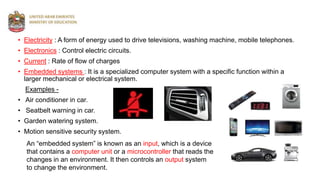
• Electricity : A form of energy used to drive televisions, washing machine, mobile telephones.
• Electronics : Control electric circuits.
• Current : Rate of flow of charges
• Embedded systems : It is a specialized computer system with a specific function within a
larger mechanical or electrical system.
Examples -
• Air conditioner in car.
• Seatbelt warning in car.
• Garden watering system.
• Motion sensitive security system.
An “embedded system” is known as an input, which is a device
that contains a computer unit or a microcontroller that reads the
changes in an environment. It then controls an output system
to change the environment.
Electric Circuit : Group of
electric components
connected by conductors for
current flow
Voltage
Source
Conductive
Path Load
It causes the
current to flow
through circuit.
Consumes electric
power.
Through which
current flows.
Types of Voltage Source
Alternating Current :
Wall Socket
Direct Current :
Battery
ELECTRICAL SCHEMATIC
Ohm’s Law
• Voltage is the
difference in charge
between two points.
• Measured in Volts(V).
• Resistance is a
material’s tendency
to resist the flow of
charge (current).
• Measured in
Ohms(Ω).
• Current is the rate at
which charge is
flowing.
• Measured in
Amperes(A).
Batteries : Change chemical to
electrical energy, consists of many
cells.
Resistor : Electrical
component for electrical
resistance.
Breadboard : It is a solder
less board that can be
used to make temporary
circuits.
4-band
Resistor
5-band
Resistor
How to
calculate
resistor
value:
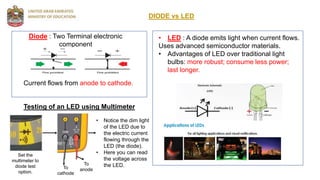
Diode : Two Terminal electronic
component
Current flows from anode to cathode.
DIODE vs LED
• LED : A diode emits light when current flows.
Uses advanced semiconductor materials.
• Advantages of LED over traditional light
bulbs: more robust; consume less power;
last longer.
Testing of an LED using Multimeter
Set the
multimeter to
diode test
option.
To
anodeTo
cathode
• Notice the dim light
of the LED due to
the electric current
flowing through the
LED (the diode).
• Here you can read
the voltage across
the LED.
EXAMPLE:LED Flash Task
SCHEMATIC DIAGRAM:
1. Students will be required to
design or complete a circuit
diagram related to a product or
process suggested. (Sample as
shown aside.)
2. There will also be a written
element in relation to the circuit
diagram.
e.g. How many LEDs are connected?
To which pin LED is connected to?
CODING:
A code will be provided and students will be
asked to redesign or adjust the program code
by adding appropriate component parts.
(a) Int ledPin = 10; (wrong)
int ledPin = 10; (correct)
(b) void loop() (wrong)
void loop() { (correct)
(c) Make the LED off for 5 secs.
delay(5000);
Int ledPin = 10;
// the setup function runs once when you press reset or power the board
void setup() {
pinMode(ledPin, OUTPUT);
}
// the loop function runs over and over again forever
void loop()
digitalWrite(ledPin, HIGH);// turn the LED on (HIGH is the voltage level)
delay(2000); // wait for 2 seconds
digitalWrite(ledPin, LOW); // turn the LED off by making the voltage LOW
delay(2000); // wait for 2 seconds
}
MOTORS
1. Have two leads – red(positive)
and black(negative).
2. It runs at high RPM(revolutions
per minute).
3. Controlling DC motor directly
from Arduino board will damage
it.
1. Have three leads –
orange(control), red(power) and
brown(ground).
2. It takes angle commands from a
series of pulses(sent every 20
milliseconds) sent from Arduino.
3. Controlling servo motor is done
from a special library called -
‘Servo’.
DC Motors Servo Motors
Applications Fan, Hair dryers, car,
lifts, cranes
Robots, Camera auto
focus, Automatic
Door openers
PWM Signal
• Pulse Width Modulation (PWM), is a technique for
generating an analog signal using digital means.
Toff
T = Time Period (secs) = Ton + Toff ;
Frequency (Hertz)
Duty Cycle
Ton

11 adv revision_notes_term_3

  • 1.
    CDI 11 ADVANCED Term3 Revision Notes
  • 2.
    3D Printing Technology •3D printing technology uses this method. • A process that adds material layer by layer to create an object. • Benefit - Objects can be created without the use of moulds or dies. • Traditional manufacturing techniques. • This process involves starting with a raw material such as stone or wood and removing the unnecessary material until you are left with the product you wanted to manufacture. SUBTRACTIVE MANUFACTURING ADDITIVE MANUFACTURING CNC: COMPUTER NUMERICAL CONTROL • A computer converts the design produced by Computer Aided Design software (CAD) like 123D Design, into numbers (like coordinates of a graph). • Numbers - control the movement of the cutter ; Computer - controls the cutter speed, and direction to cut and shape of the material. • CNC can create fine and detailed pieces.
  • 3.
    3D Printing Types STEREO-LITHOGRAPHY (SLA) SELECTIVELASER SINTERING (SLS) FUSED DEPOSITION MODELLING (FDM) • Stereo-solid + Lithography-printing • 1986 – Charles Hull – created first SLA device. • Resin-a light sensitive glue-like liquid substance-becomes solid when a specific frequency of light shines on it. • Lasers-controlled by computer; draw the outline of the 3D model, slice by slice until the layer is completely hardened. • 1987 – Carl Deckard– created first SLS device • Advantage – powders from plastic, ceramic, glass or metal to create objects with extreme detail and complexity. • After each layer is bonded the model is repositioned so that a roller can apply a new coat of powder. The lasers then bond that layer and so the process is repeated until the model is complete. • Expensive process. • The printer generally uses plastic filament (a roll of plastic much like a roll of string) and adds many layers to build solid objects. • Cost effective process.
  • 4.
    PARTS OF 3DFDM PRINTER Filament : Used to produce printed object Extruder : It is a mechanical system that forces filament into the heated nozzle at a controlled rate. Heated nozzle: Tools that melts the filament at high temp.(180-220 0 Celsius) Print bed/ build platform: A surface on which final object is printed.
  • 5.
    3D PRINTING PROCESS Modelling: Process of designing and creating digital representation of an object using 3D modelling application (123D design ) Printing setup : Setting up the 3D model so that it can be printed using the printer by setting the parameters. You have used - FlashPrint to make your project – 3d car. 3D Printing Formats .stl .gx
  • 6.
    Filament And MaterialTypes PLA • Thermoplastic. • Most commonly used. • Biodegradable and eco-friendly . • Used in items such as water bottles, plastic cups and mugs, food containers and small electronic product casings. ABS • Thermoplastic • Higher temperature for melting so not all 3D printers have a heated nozzle and extruder than can support ABS • Not biodegradable or eco-friendly • Commonly used in manufacturing plastic industrial pipes, Lego blocks, car parts and in kitchen appliances. • Strong, durable and less flexible than PLA • Quite heat resistant.
  • 7.
    • Electricity :A form of energy used to drive televisions, washing machine, mobile telephones. • Electronics : Control electric circuits. • Current : Rate of flow of charges • Embedded systems : It is a specialized computer system with a specific function within a larger mechanical or electrical system. Examples - • Air conditioner in car. • Seatbelt warning in car. • Garden watering system. • Motion sensitive security system. An “embedded system” is known as an input, which is a device that contains a computer unit or a microcontroller that reads the changes in an environment. It then controls an output system to change the environment.
  • 8.
    Electric Circuit :Group of electric components connected by conductors for current flow Voltage Source Conductive Path Load It causes the current to flow through circuit. Consumes electric power. Through which current flows. Types of Voltage Source Alternating Current : Wall Socket Direct Current : Battery
  • 9.
    ELECTRICAL SCHEMATIC Ohm’s Law •Voltage is the difference in charge between two points. • Measured in Volts(V). • Resistance is a material’s tendency to resist the flow of charge (current). • Measured in Ohms(Ω). • Current is the rate at which charge is flowing. • Measured in Amperes(A).
  • 10.
    Batteries : Changechemical to electrical energy, consists of many cells. Resistor : Electrical component for electrical resistance. Breadboard : It is a solder less board that can be used to make temporary circuits. 4-band Resistor 5-band Resistor How to calculate resistor value:
  • 12.
    Diode : TwoTerminal electronic component Current flows from anode to cathode. DIODE vs LED • LED : A diode emits light when current flows. Uses advanced semiconductor materials. • Advantages of LED over traditional light bulbs: more robust; consume less power; last longer. Testing of an LED using Multimeter Set the multimeter to diode test option. To anodeTo cathode • Notice the dim light of the LED due to the electric current flowing through the LED (the diode). • Here you can read the voltage across the LED.
  • 13.
    EXAMPLE:LED Flash Task SCHEMATICDIAGRAM: 1. Students will be required to design or complete a circuit diagram related to a product or process suggested. (Sample as shown aside.) 2. There will also be a written element in relation to the circuit diagram. e.g. How many LEDs are connected? To which pin LED is connected to? CODING: A code will be provided and students will be asked to redesign or adjust the program code by adding appropriate component parts. (a) Int ledPin = 10; (wrong) int ledPin = 10; (correct) (b) void loop() (wrong) void loop() { (correct) (c) Make the LED off for 5 secs. delay(5000); Int ledPin = 10; // the setup function runs once when you press reset or power the board void setup() { pinMode(ledPin, OUTPUT); } // the loop function runs over and over again forever void loop() digitalWrite(ledPin, HIGH);// turn the LED on (HIGH is the voltage level) delay(2000); // wait for 2 seconds digitalWrite(ledPin, LOW); // turn the LED off by making the voltage LOW delay(2000); // wait for 2 seconds }
  • 14.
    MOTORS 1. Have twoleads – red(positive) and black(negative). 2. It runs at high RPM(revolutions per minute). 3. Controlling DC motor directly from Arduino board will damage it. 1. Have three leads – orange(control), red(power) and brown(ground). 2. It takes angle commands from a series of pulses(sent every 20 milliseconds) sent from Arduino. 3. Controlling servo motor is done from a special library called - ‘Servo’. DC Motors Servo Motors Applications Fan, Hair dryers, car, lifts, cranes Robots, Camera auto focus, Automatic Door openers PWM Signal • Pulse Width Modulation (PWM), is a technique for generating an analog signal using digital means. Toff T = Time Period (secs) = Ton + Toff ; Frequency (Hertz) Duty Cycle Ton