

Copyright © www.networkel.com
8- QUALITY OF SERVICE
8.1 Basics Of QoS
8.2 QoS Mechanisms
Copyright © www.networkel.com
8.1 Basics Of QoS
Copyright © www.networkel.com
QoSOVERVIEW
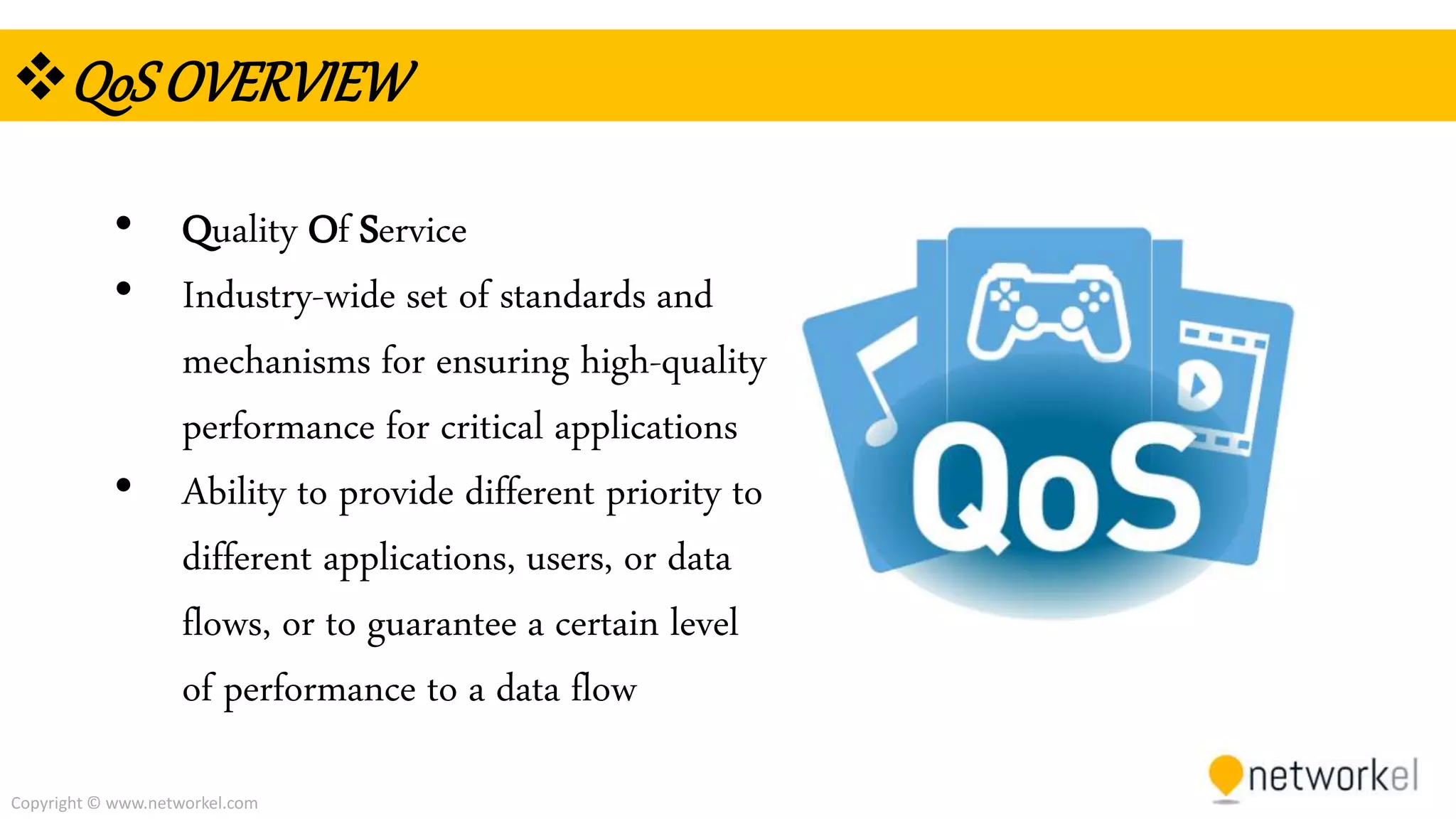
• Quality Of Service
• Industry-wide set of standards and
mechanisms for ensuring high-quality
performance for critical applications
• Ability to provide different priority to
different applications, users, or data
flows, or to guarantee a certain level
of performance to a data flow
Copyright © www.networkel.com
BONUSSLIDE( PROMOTIONOFFER!)
• To get our CCNA 200-125 Full Video Training with %90 discount
click the link below now !
CCNA 200-125 VIDEO TRAINING (GET WITH %90 DISCOUNT)
Copyright © www.networkel.com
PRIORITIZATIONOFNETWORKTRAFFIC
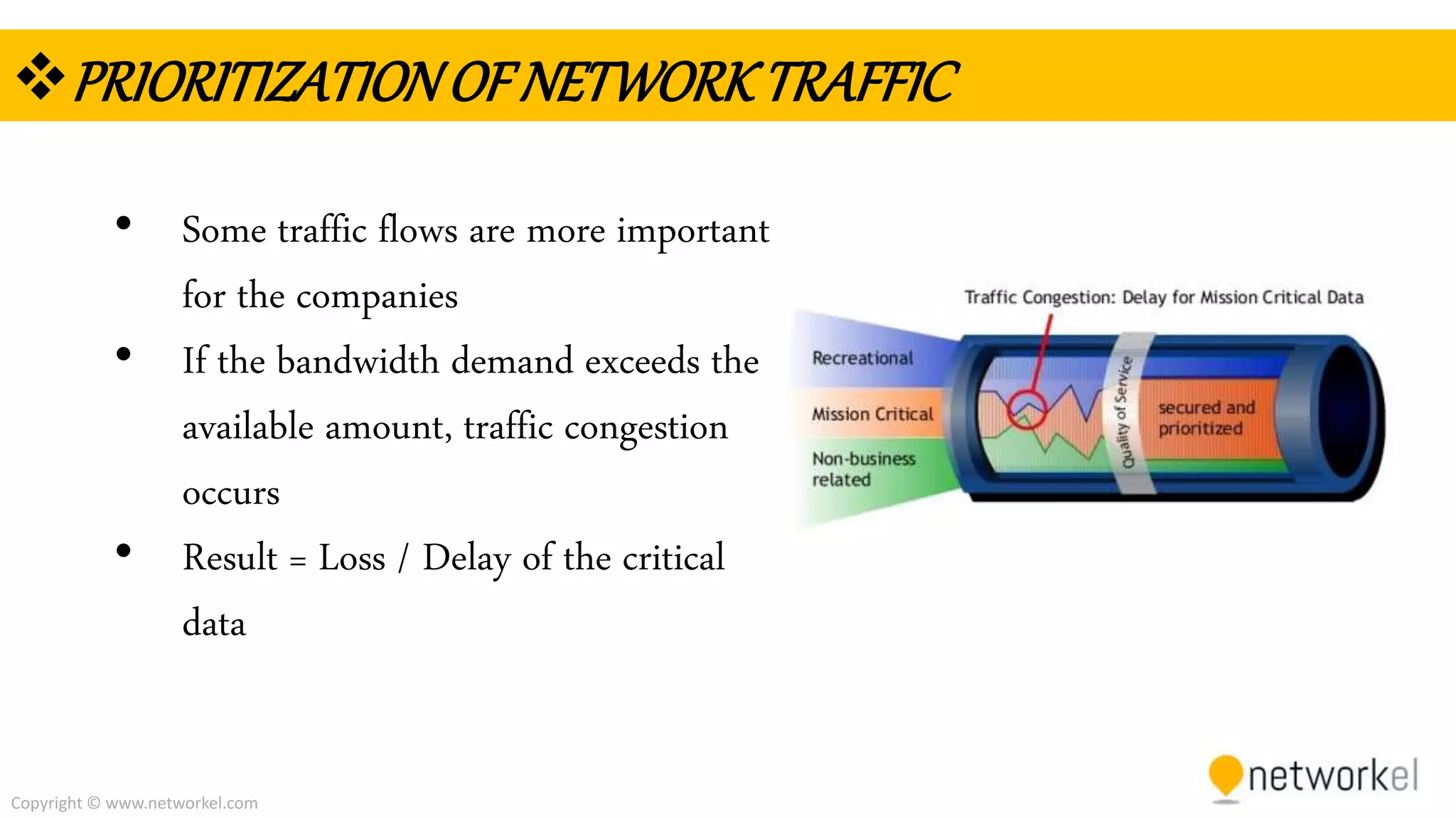
• Some traffic flows are more important
for the companies
• If the bandwidth demand exceeds the
available amount, traffic congestion
occurs
• Result = Loss / Delay of the critical
data
Copyright © www.networkel.com
NETWORKCHARACHTERIST. MANAGEDBY QOS
• Bandwidth : The rate at which traffic
is carried by the network
• Latency : The delay in data
transmission from source to
destination
• Jitter : The variation in latency.
• Reliability : The percentage of packets
discarded by a router
Copyright © www.networkel.com
VOICETRAFFIC
• Sensitive for delays / drops
• No retransmission if the packet is lost
(UDP Based)
• Smooth (Flows at even rate, doesn’t burst)
• Benign (Not greedy for lots of BW fairly
low per call)
Copyright © www.networkel.com
VIDEOTRAFFIC
• Sensitive for delays / drops
• No retransmission if the packet is lost
(UDP Based)
• Bursty (Part of picture moves rest is
static on screen cause of keyframes)
• Greedy (More BW you define, better
the picture quality is)
Copyright © www.networkel.com
DATATRAFFIC
• Insensitive for delays / drops
• Smooth/Bursty
• Benign/Greedy
• TCP-based retransmits.
Copyright © www.networkel.com
QUEUINGALGORITHMS
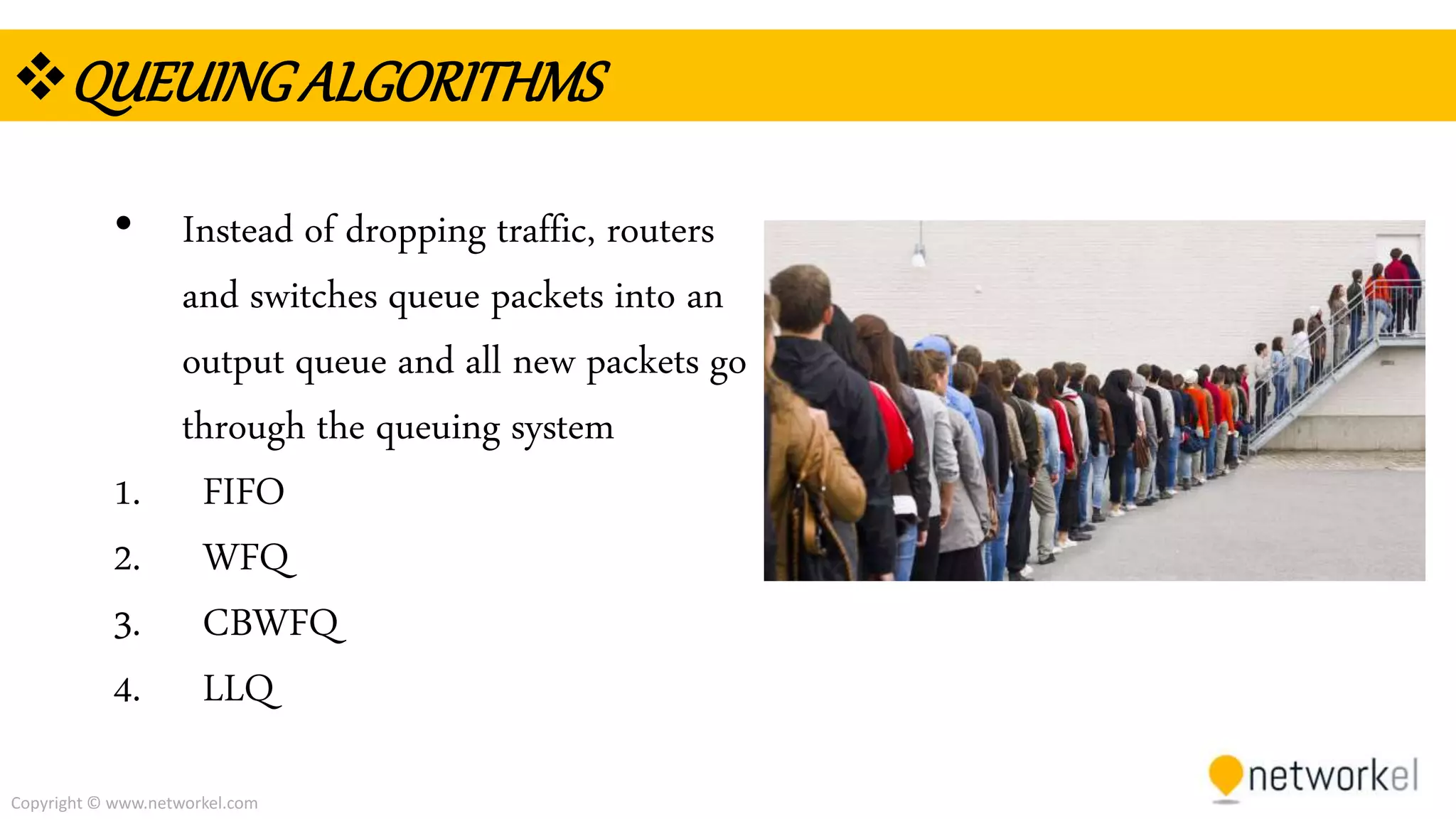
• Instead of dropping traffic, routers
and switches queue packets into an
output queue and all new packets go
through the queuing system
1. FIFO
2. WFQ
3. CBWFQ
4. LLQ
Copyright © www.networkel.com
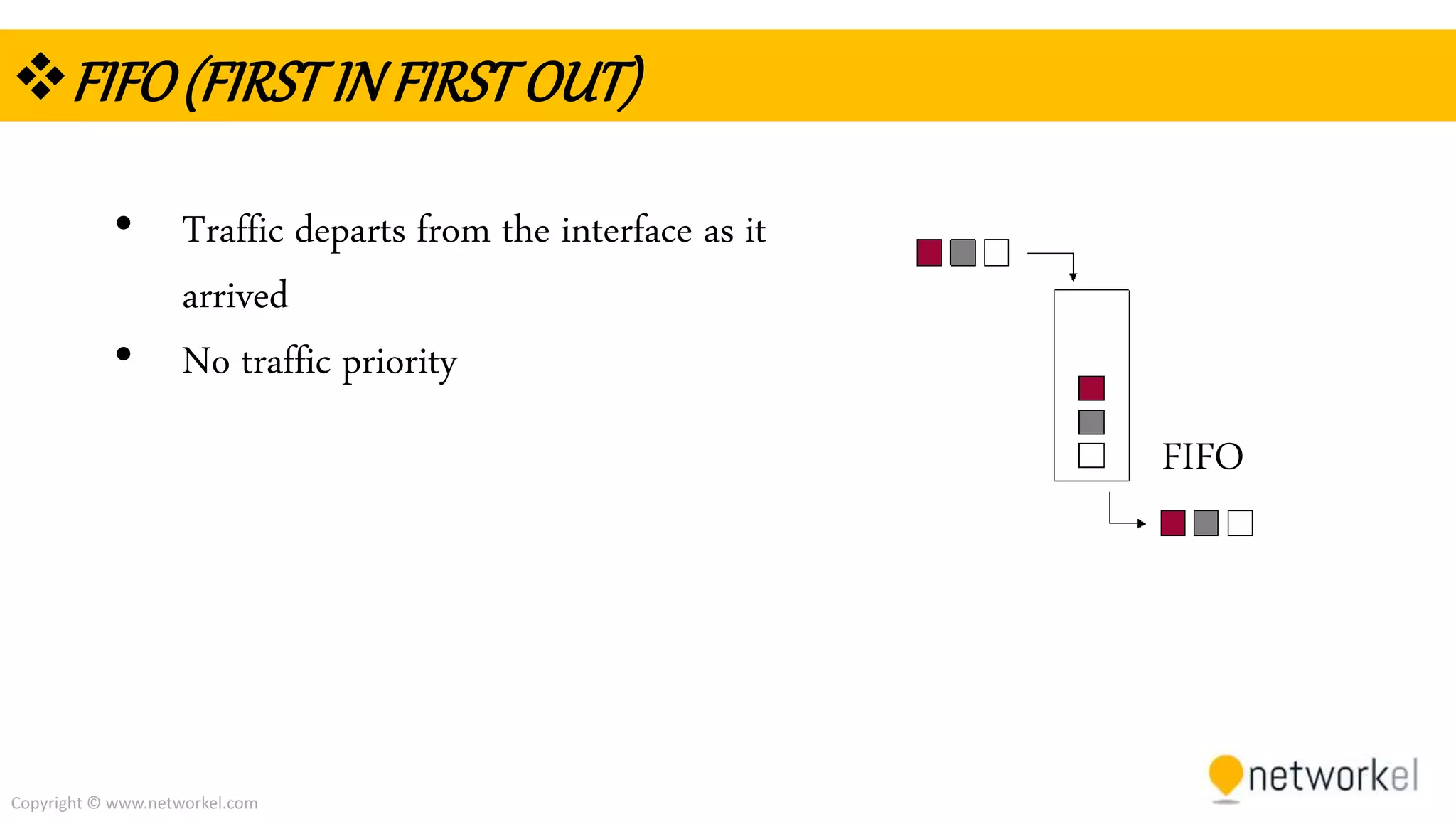
FIFO(FIRSTINFIRSTOUT)
• Traffic departs from the interface as it
arrived
• No traffic priority
FIFO
Copyright © www.networkel.com
WFQ(WEIGHTEDFAIRQUEUING)
• Flow-based queuing algorithm
• Schedules interactive traffic to the
front of the queue to reduce response
time
• Fairly shares the remaining bandwidth
between high bandwidth flows.
Copyright © www.networkel.com
CBWFQ(CLASSBASEDWEIGHTEDFAIRQUEUIN)
• Extends the standard WFQ
functionality to provide support for
user-defined traffic classes
• A queue is reserved for each class, and
traffic belonging to a class is directed
to the queue for that class
Copyright © www.networkel.com
LLQ(LOWLATENCYQUEUING)
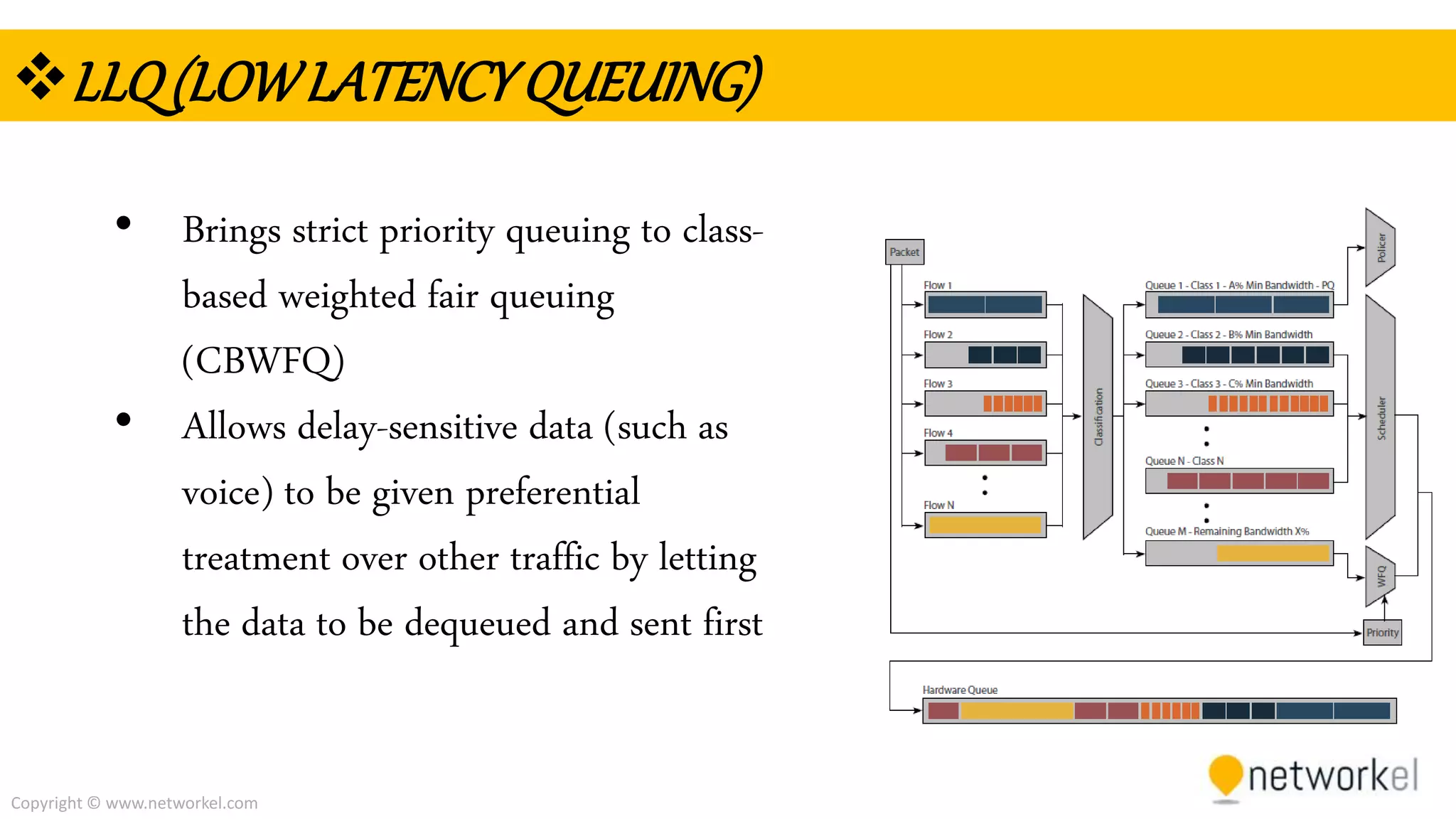
• Brings strict priority queuing to class-
based weighted fair queuing
(CBWFQ)
• Allows delay-sensitive data (such as
voice) to be given preferential
treatment over other traffic by letting
the data to be dequeued and sent first
Copyright © www.networkel.com
8.2 QoS Mechanisms
Copyright © www.networkel.com
QoSTECHNOLOGIES
• Used to provide improved network
"service" to the applications at the
edges of the network
1. Best Effort
2. Integrated Services
3. Differentiated Services
Copyright © www.networkel.com
BESTEFFORT
• Network does not provide any
guarantees that data is delivered
Users obtain unspecified variable bit
rate and delivery time, depending
on the current traffic load
Copyright © www.networkel.com
INTEGRATEDSERVICES
• Provides a way to deliver the QoS that
real-time applications require by
explicitly managing network resources
to provide QoS to specific user packet
streams
• Uses "resource reservation" and
"admission control" mechanisms
Copyright © www.networkel.com
INTEGRATEDSERVICES(cont…)
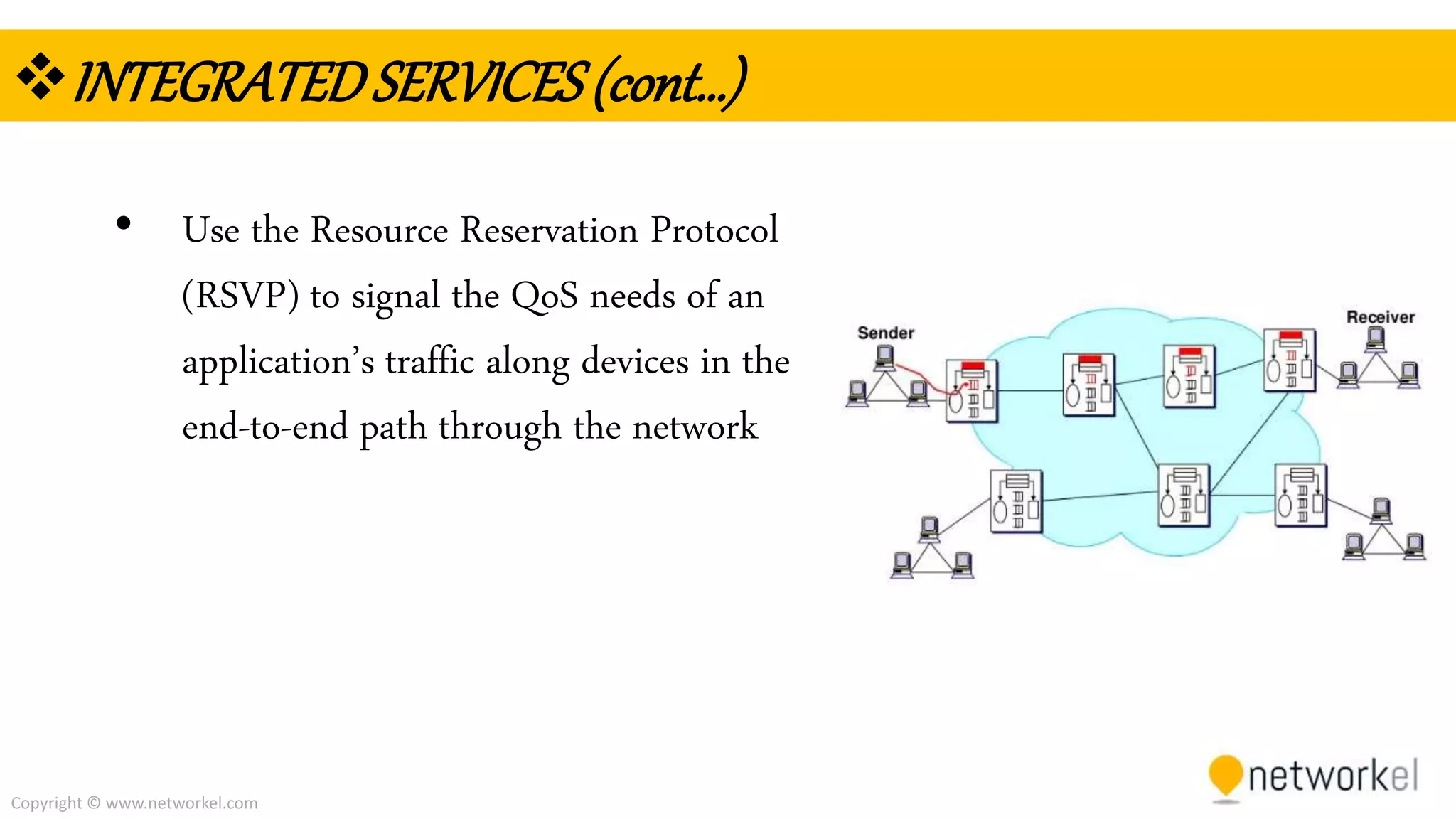
• Use the Resource Reservation Protocol
(RSVP) to signal the QoS needs of an
application’s traffic along devices in the
end-to-end path through the network
Copyright © www.networkel.com
DIFFERENTIATEDSERVICES
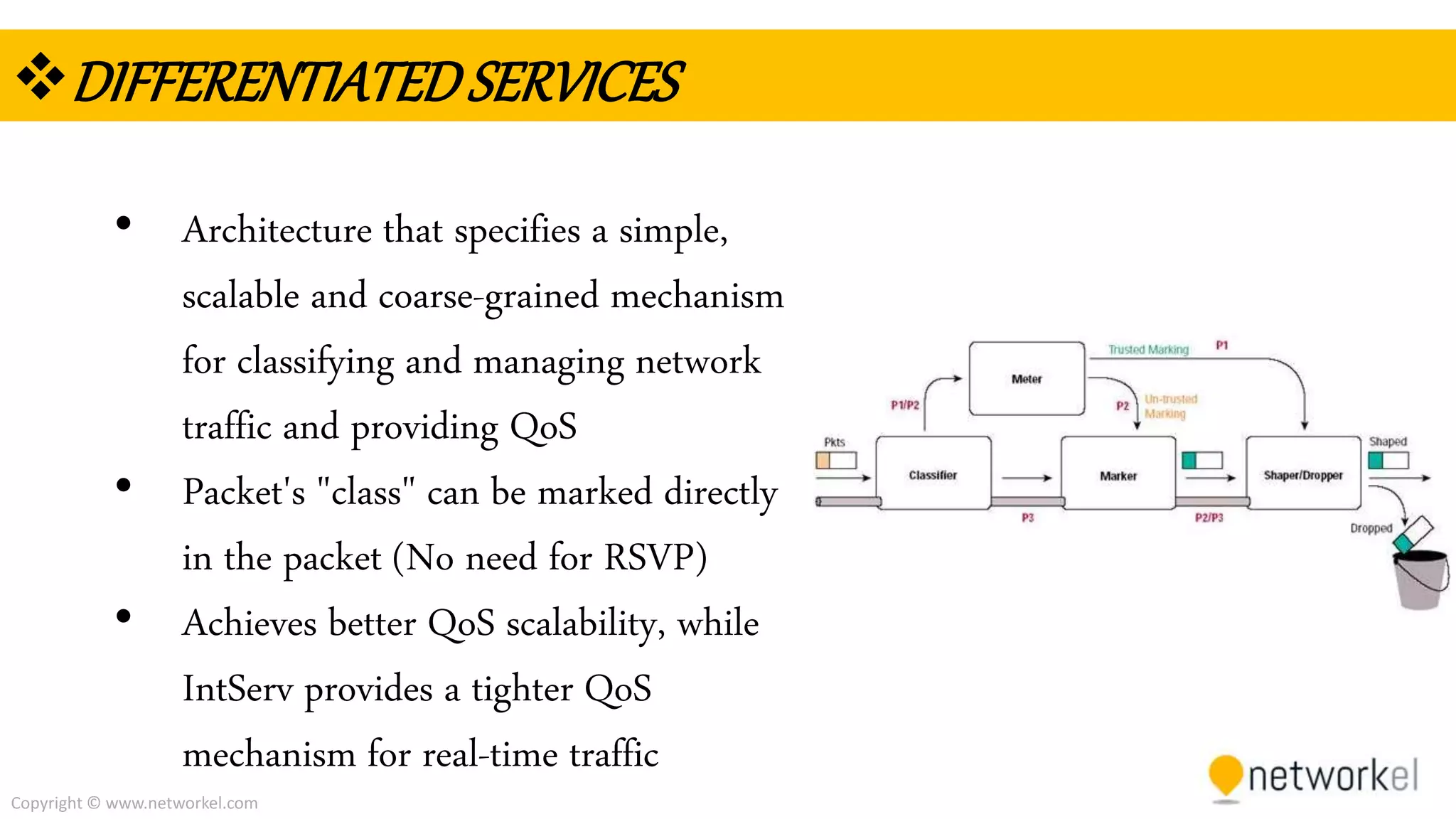
• Architecture that specifies a simple,
scalable and coarse-grained mechanism
for classifying and managing network
traffic and providing QoS
• Packet's "class" can be marked directly
in the packet (No need for RSVP)
• Achieves better QoS scalability, while
IntServ provides a tighter QoS
mechanism for real-time traffic
Copyright © www.networkel.com
DIFFERENTIATEDSERVICES(cont…)
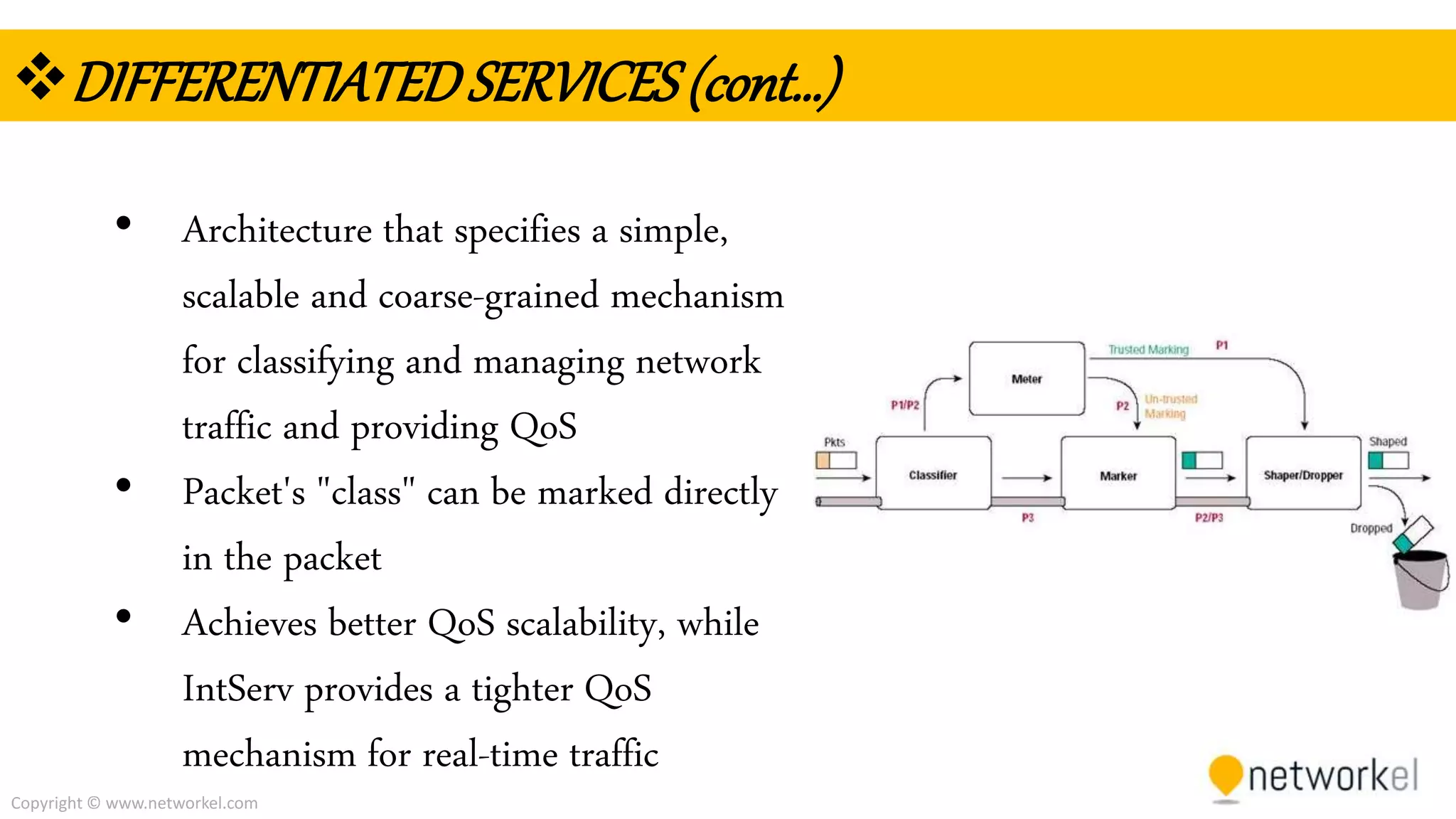
• Architecture that specifies a simple,
scalable and coarse-grained mechanism
for classifying and managing network
traffic and providing QoS
• Packet's "class" can be marked directly
in the packet
• Achieves better QoS scalability, while
IntServ provides a tighter QoS
mechanism for real-time traffic
Copyright © www.networkel.com
QoSTOOLS
• QoS technologies refer to the set of
tools and techniques to manage
network resources
• QoS Tools :
1. Classification & Marking Tools
2. Congestion Avoidence Tools
3. Congestion Management Tools
Copyright © www.networkel.com
CLASSIFICATIONANDMARKING
• Traffic is analyzed to discover that
which class it belongs to and packets
are marked after discovery process
• Classification of the traffic is made via
ACLs or Class-Maps
• Marking network traffic allows to set or
modify the attributes for a specific class
of traffic ( Layer -2 or Layer-3 )
Copyright © www.networkel.com
LAYER-2MARKING
• Implemented via 3 bit priority code
point field (which identifies class of
service markings) in TCI field of
Ethernet header
• Ethernet frames are marked with 8
levels of priority
VALUE DESCRIPTION
7 Reserved
6 Reserved
5 Voice
4 Video Conference
3 Call Signal
2 High Priority Data
1 Medium Priority Data
0 Best Effort Data
Copyright © www.networkel.com
LAYER-3MARKING
• Implemented via 8 bit Type Of Service
Field (IPv4) or Traffic Class Field
(IPv6) in IP header
• In Diffserv model packet is marked
using DiffServ Code Point (DSCP) bits
(6 bits)
VALUE DESCRIPTION
7 Network
6 Internet
5 Critical
4 Flash-Override
3 Flash
2 Immediate
1 Priority
0 Routine
Copyright © www.networkel.com
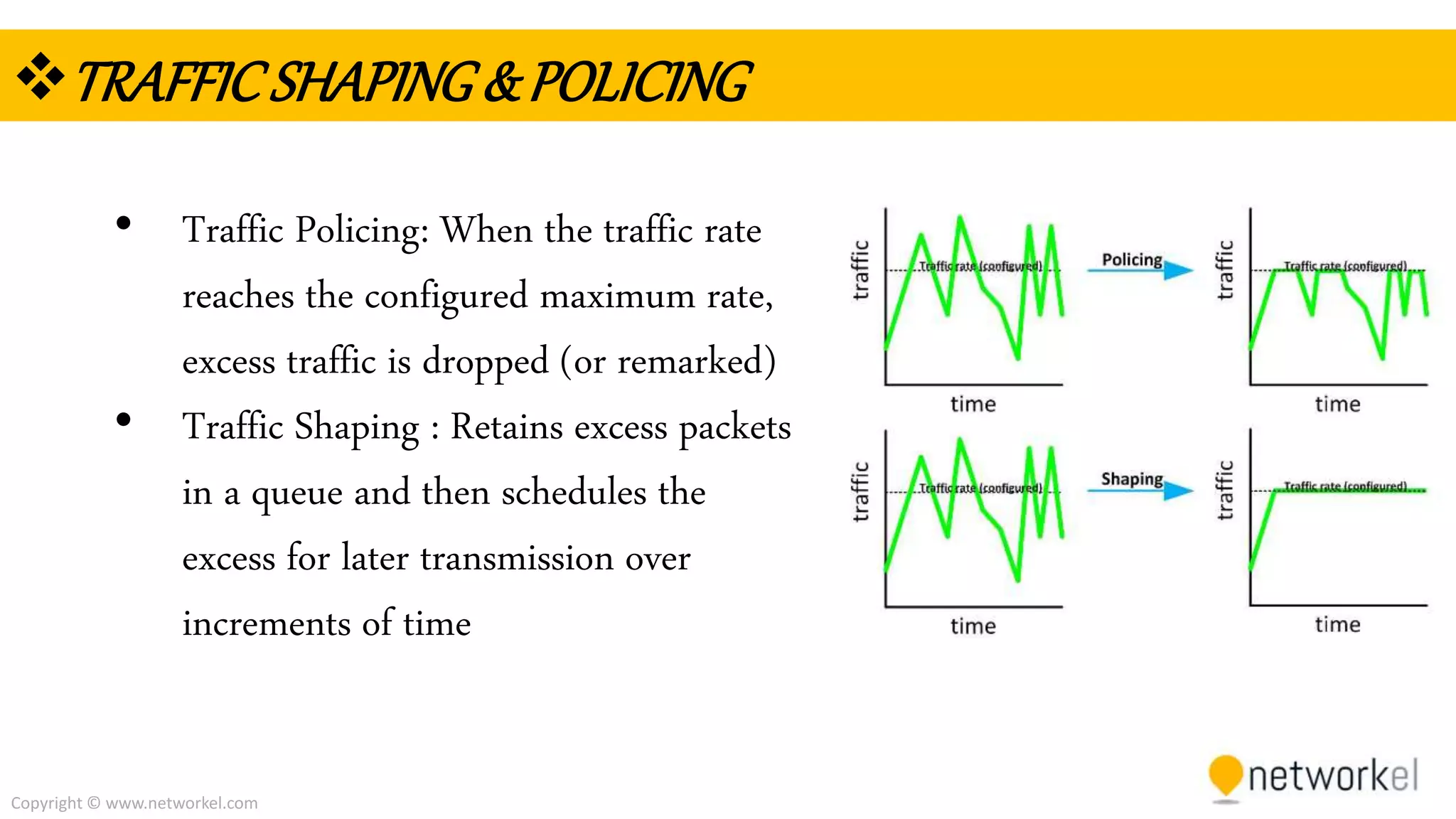
TRAFFICSHAPING&POLICING
• Traffic Policing: When the traffic rate
reaches the configured maximum rate,
excess traffic is dropped (or remarked)
• Traffic Shaping : Retains excess packets
in a queue and then schedules the
excess for later transmission over
increments of time
Copyright © www.networkel.com
BONUSSLIDE( PROMOTIONOFFER!)
• To get our CCNA 200-125 Full Video Training with %90 discount
click the link below now !
CCNA 200-125 VIDEO TRAINING (GET WITH %90 DISCOUNT)

CCNA Quality of Services (QoS)