Nadar Saraswati college
of arts and science
Digital image processing
Ip goals,Assumption and Requirements
B.kohila
M.Sc Information technology
Mobile IP: Goals and Assumptions
• The goal of a mobile IP can be summarized as: 'supporting end-system mobility
while maintaining scalability, efficiency, and compatibility in all respects with
existing applications and Internet protocols'.
Mobile IP is an internet protocol designed to support host mobility. Its goal is to
provide the ability of a host to stay connected to the internet regardless of their
location. Mobile IP is able to track a mobile host without needing to change the
mobile host's long-term IP address.
Mobile Internet Protocol (IP)
• Mobile Internet Protocol (IP) is a new recommended Internet protocol
designed to support the mobility of a user (host). Host mobility is
becoming important because of the recent blossoming of laptop
computers and the high desire to have continuous network connectivity
anywhere the host happens to be. The development of Mobile IP makes
this possible. This paper describes and summarizes the characteristics of
the current Internet draft for Mobile IP. In addition to the current internet
draft, this paper also discusses alternative Mobile IP proposals so that the
reader may understand the different design issues associated with the
different protocol.
• Mobile Internet Protocol (IP) is a new recommended Internet protocol designed to support the mobility of a user (host).
Host mobility is becoming important because of the recent blossoming of laptop computers and the high desire to have
continuous network connectivity anywhere the host happens to be. The development of Mobile IP makes this possible. This
paper describes and summarizes the characteristics of the current Internet draft for Mobile IP. In addition to the current
internet draft, this paper also discusses alternative Mobile IP proposals so that the reader may understand the different
design issues associated with the different protocol.
•
•
•
•
•
Mobile IP: Tunnelling
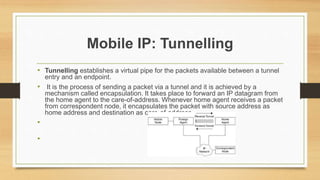
• Tunnelling establishes a virtual pipe for the packets available between a tunnel
entry and an endpoint.
• It is the process of sending a packet via a tunnel and it is achieved by a
mechanism called encapsulation. It takes place to forward an IP datagram from
the home agent to the care-of-address. Whenever home agent receives a packet
from correspondent node, it encapsulates the packet with source address as
home address and destination as care-of-address.
•
•
Encapsulation
• Encapsulation is the mechanisms of taking a packet consisting of
packet header and data and putting it into the data part of new
packet.
Route Optimization in Mobile IP:
• The route optimization adds a conceptual data structure, the
binding cache, to the correspondent node. The binding cache
contains bindings for mobile node’s home address and its current
care-of-address. Every time the home agent receives a IP
datagram that is destined to a mobile node currently away from the
home network, it sends a binding update to the correspondent node
to update the information in the correspondent node’s binding
cache. After this the correspondent node can directly tunnel
packets to the mobile node.
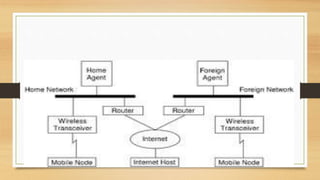
Mobile IP: Entities and Terminology
• Mobile Node (MN):
It is the hand-held communication device that the user caries e.g. Cell phone.
• Home Network:
It is a network to which the mobile node originally belongs to as per its assigned IP address
(home address).
• Home Agent (HA):
It is a router in home network to which the mobile node was originally connected
• Home Address:
It is the permanent IP address assigned to the mobile node (within its home network).
• Foreign Network:
It is the current network to which the mobile node is visiting (away from its home network).
• Foreign Agent (FA):
It is a router in foreign network to which mobile node is currently
connected. The packets from the home agent are sent to the foreign
agent which delivers it to the mobile node.
• Correspondent Node (CN):
It is a device on the internet communicating to the mobile node.
• Care of Address (COA):
It is the temporary address used by a mobile node while it is moving away
from its home network.
Thank you

ipgoals,assumption requirements

  • 1.
    Nadar Saraswati college ofarts and science Digital image processing Ip goals,Assumption and Requirements B.kohila M.Sc Information technology
  • 2.
    Mobile IP: Goalsand Assumptions • The goal of a mobile IP can be summarized as: 'supporting end-system mobility while maintaining scalability, efficiency, and compatibility in all respects with existing applications and Internet protocols'. Mobile IP is an internet protocol designed to support host mobility. Its goal is to provide the ability of a host to stay connected to the internet regardless of their location. Mobile IP is able to track a mobile host without needing to change the mobile host's long-term IP address.
  • 3.
    Mobile Internet Protocol(IP) • Mobile Internet Protocol (IP) is a new recommended Internet protocol designed to support the mobility of a user (host). Host mobility is becoming important because of the recent blossoming of laptop computers and the high desire to have continuous network connectivity anywhere the host happens to be. The development of Mobile IP makes this possible. This paper describes and summarizes the characteristics of the current Internet draft for Mobile IP. In addition to the current internet draft, this paper also discusses alternative Mobile IP proposals so that the reader may understand the different design issues associated with the different protocol.
  • 4.
    • Mobile InternetProtocol (IP) is a new recommended Internet protocol designed to support the mobility of a user (host). Host mobility is becoming important because of the recent blossoming of laptop computers and the high desire to have continuous network connectivity anywhere the host happens to be. The development of Mobile IP makes this possible. This paper describes and summarizes the characteristics of the current Internet draft for Mobile IP. In addition to the current internet draft, this paper also discusses alternative Mobile IP proposals so that the reader may understand the different design issues associated with the different protocol. • • • • •
  • 5.
    Mobile IP: Tunnelling •Tunnelling establishes a virtual pipe for the packets available between a tunnel entry and an endpoint. • It is the process of sending a packet via a tunnel and it is achieved by a mechanism called encapsulation. It takes place to forward an IP datagram from the home agent to the care-of-address. Whenever home agent receives a packet from correspondent node, it encapsulates the packet with source address as home address and destination as care-of-address. • •
  • 6.
    Encapsulation • Encapsulation isthe mechanisms of taking a packet consisting of packet header and data and putting it into the data part of new packet.
  • 7.
    Route Optimization inMobile IP: • The route optimization adds a conceptual data structure, the binding cache, to the correspondent node. The binding cache contains bindings for mobile node’s home address and its current care-of-address. Every time the home agent receives a IP datagram that is destined to a mobile node currently away from the home network, it sends a binding update to the correspondent node to update the information in the correspondent node’s binding cache. After this the correspondent node can directly tunnel packets to the mobile node.
  • 8.
    Mobile IP: Entitiesand Terminology • Mobile Node (MN): It is the hand-held communication device that the user caries e.g. Cell phone. • Home Network: It is a network to which the mobile node originally belongs to as per its assigned IP address (home address). • Home Agent (HA): It is a router in home network to which the mobile node was originally connected • Home Address: It is the permanent IP address assigned to the mobile node (within its home network). • Foreign Network: It is the current network to which the mobile node is visiting (away from its home network).
  • 9.
    • Foreign Agent(FA): It is a router in foreign network to which mobile node is currently connected. The packets from the home agent are sent to the foreign agent which delivers it to the mobile node. • Correspondent Node (CN): It is a device on the internet communicating to the mobile node. • Care of Address (COA): It is the temporary address used by a mobile node while it is moving away from its home network.
  • 10.