Chapter 7: IP Addressing
CCNA Routing and Switching
Introduction to Networks v6.0
2
© 2016 Cisco and/or its affiliates. All rights reserved. Cisco Confidential
 7.1 IPv4 Network Addresses
 Explain the use of IPv4 addresses to provide connectivity in small to medium-sized business networks
• Convert between binary and decimal numbering systems.
• Describe the structure of an IPv4 address including the network portion, the host portion, and the subnet
mask.
• Compare the characteristics and uses of the unicast, broadcast and multicast IPv4 addresses.
• Explain public, private, and reserved IPv4 addresses.
 7.2 IPv6 Network Addresses
 Configure IPv6 addresses to provide connectivity in small to medium-sized business networks.
• Explain the need for IPv6 addressing.
• Describe the representation of an IPv6 address.
• Compare types of IPv6 network addresses.
• Configure global unicast addresses.
• Describe multicast addresses.
Chapter 7 - Sections & Objectives
3
© 2016 Cisco and/or its affiliates. All rights reserved. Cisco Confidential
 7.3 Connectivity Verification
 Use common testing utilities to verify and test network connectivity.
• Explain how ICMP is used to test network connectivity.
• Use ping and traceroute utilities to test network connectivity.
Chapter 7 - Sections & Objectives (Cont.)
4
© 2016 Cisco and/or its affiliates. All rights reserved. Cisco Confidential
7.1 IPv4 Network Addresses
5
© 2016 Cisco and/or its affiliates. All rights reserved. Cisco Confidential
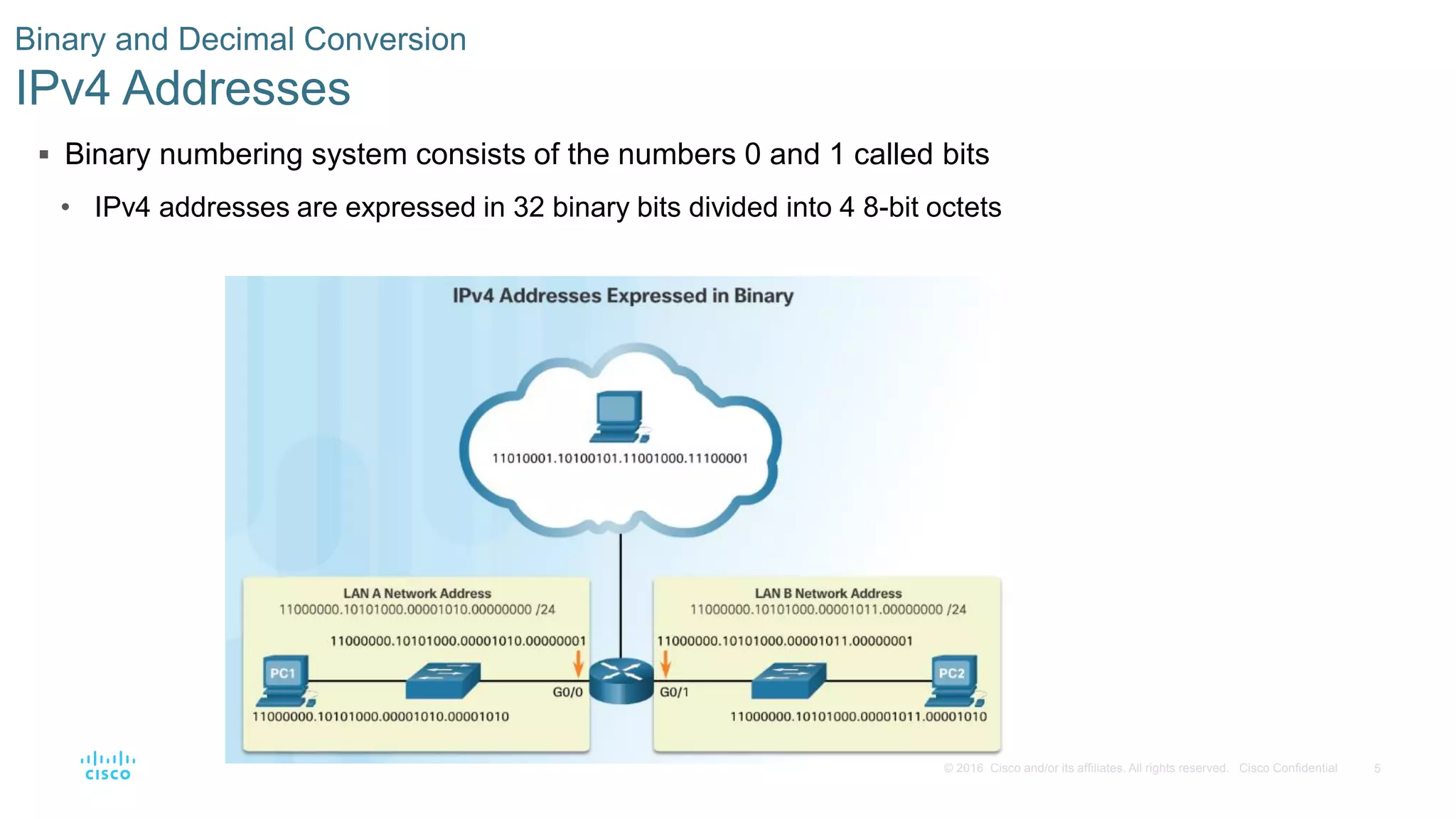
 Binary numbering system consists of the numbers 0 and 1 called bits
• IPv4 addresses are expressed in 32 binary bits divided into 4 8-bit octets
Binary and Decimal Conversion
IPv4 Addresses
6
© 2016 Cisco and/or its affiliates. All rights reserved. Cisco Confidential
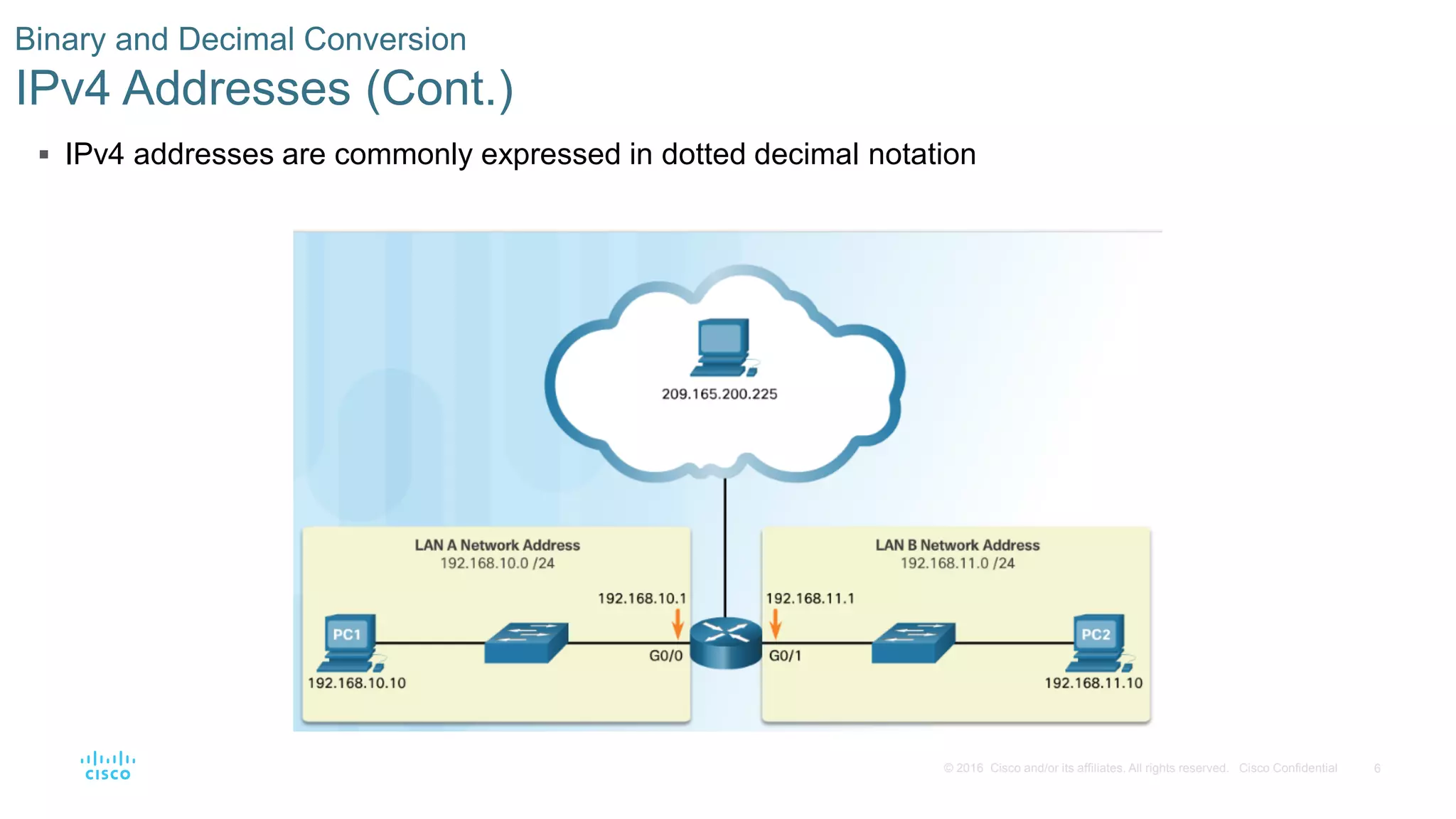
 IPv4 addresses are commonly expressed in dotted decimal notation
Binary and Decimal Conversion
IPv4 Addresses (Cont.)
7
© 2016 Cisco and/or its affiliates. All rights reserved. Cisco Confidential
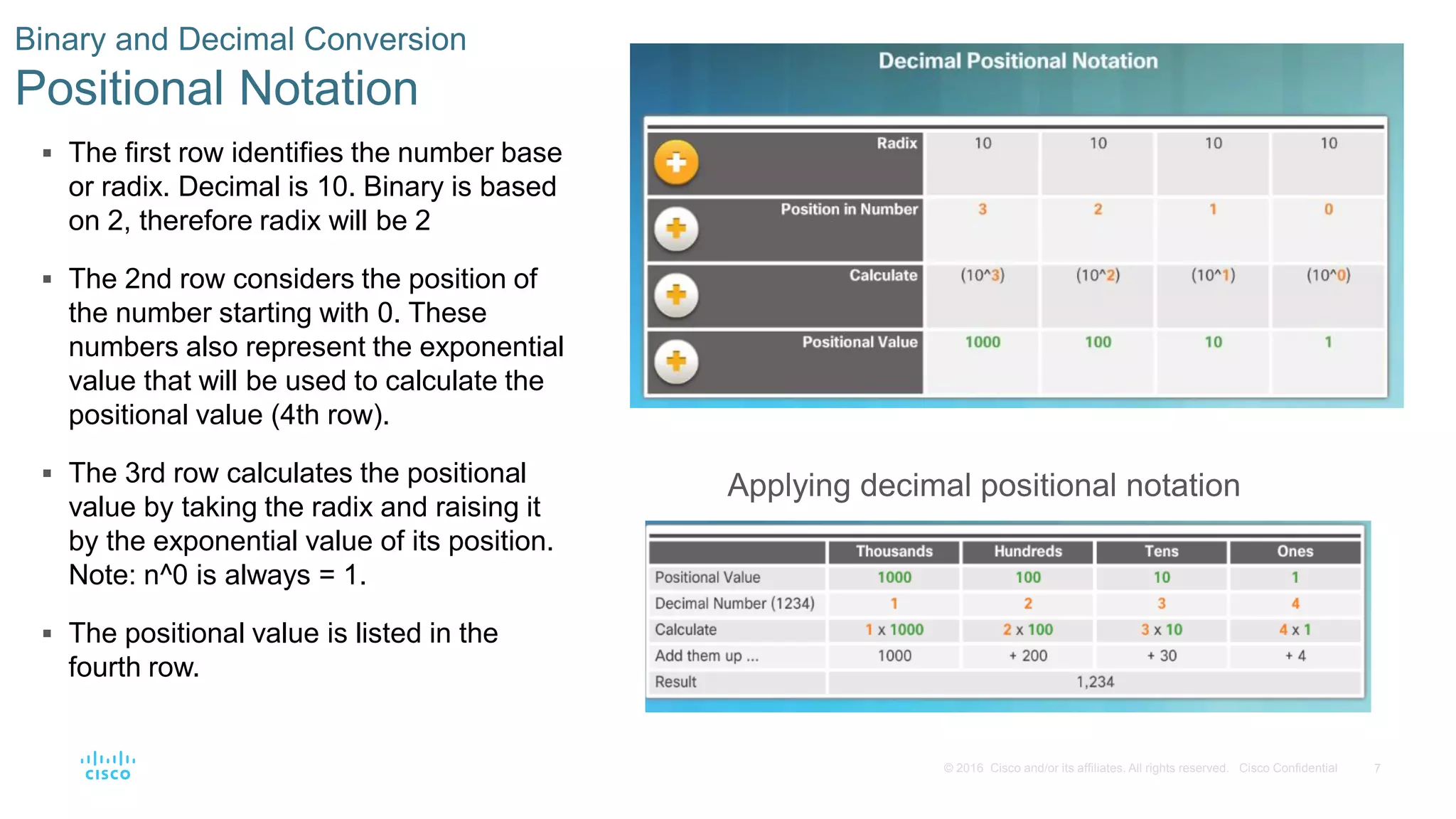
 The first row identifies the number base
or radix. Decimal is 10. Binary is based
on 2, therefore radix will be 2
 The 2nd row considers the position of
the number starting with 0. These
numbers also represent the exponential
value that will be used to calculate the
positional value (4th row).
 The 3rd row calculates the positional
value by taking the radix and raising it
by the exponential value of its position.
Note: n^0 is always = 1.
 The positional value is listed in the
fourth row.
Binary and Decimal Conversion
Positional Notation
Applying decimal positional notation
8
© 2016 Cisco and/or its affiliates. All rights reserved. Cisco Confidential
Binary and Decimal Conversion
Positional Notation (Cont.)
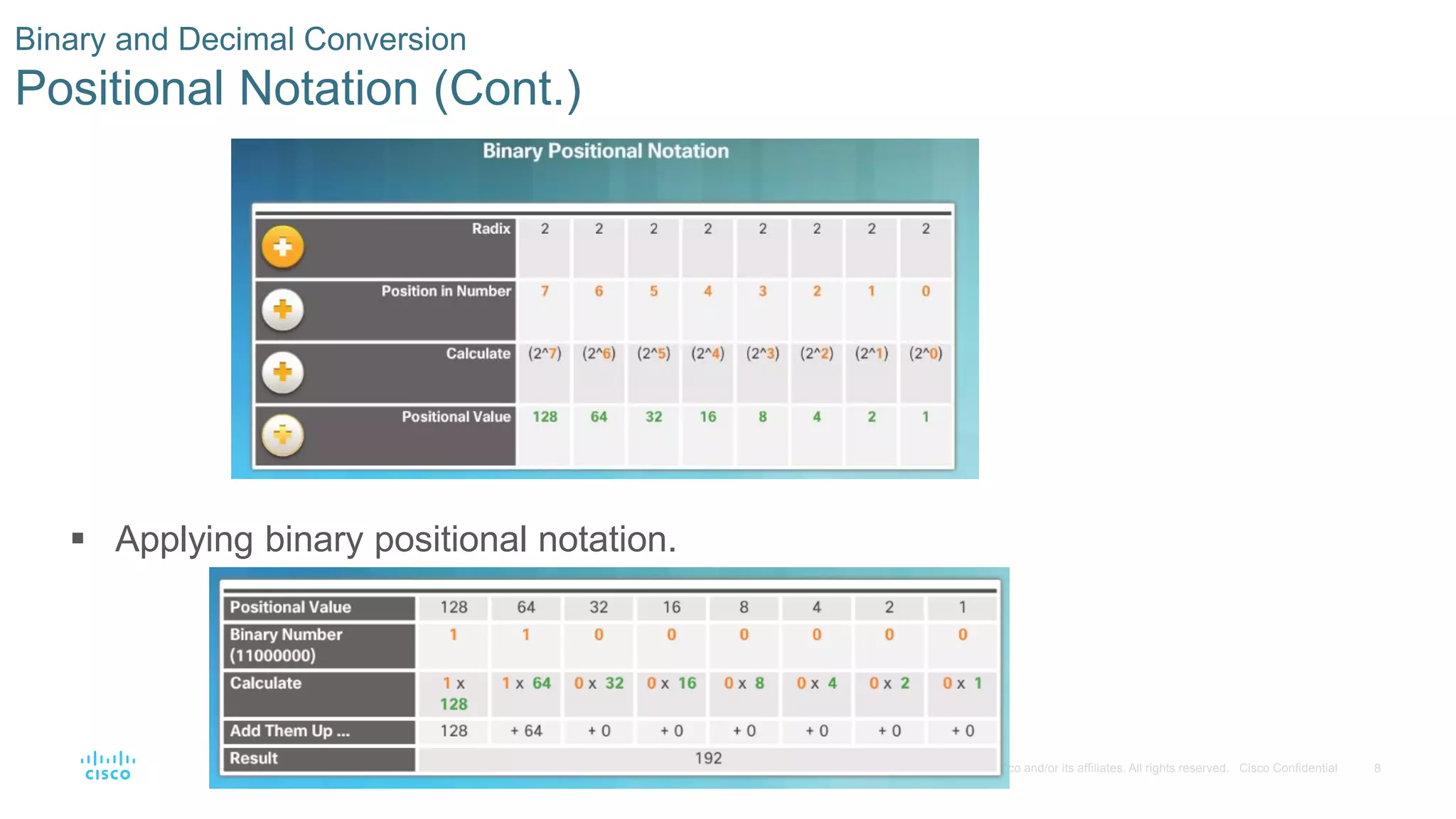
 Applying binary positional notation.
9
© 2016 Cisco and/or its affiliates. All rights reserved. Cisco Confidential
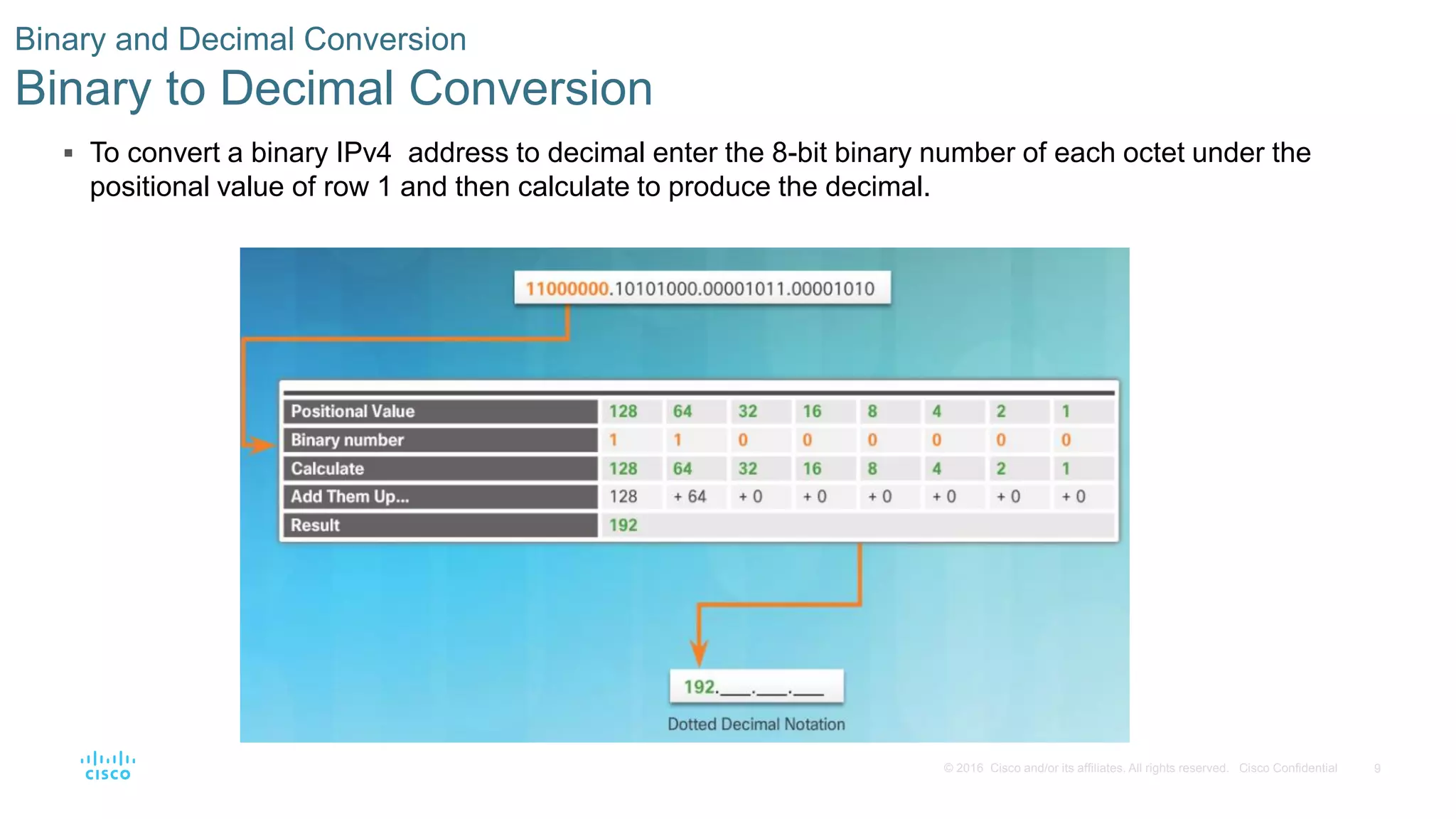
 To convert a binary IPv4 address to decimal enter the 8-bit binary number of each octet under the
positional value of row 1 and then calculate to produce the decimal.
Binary and Decimal Conversion
Binary to Decimal Conversion
10
© 2016 Cisco and/or its affiliates. All rights reserved. Cisco Confidential
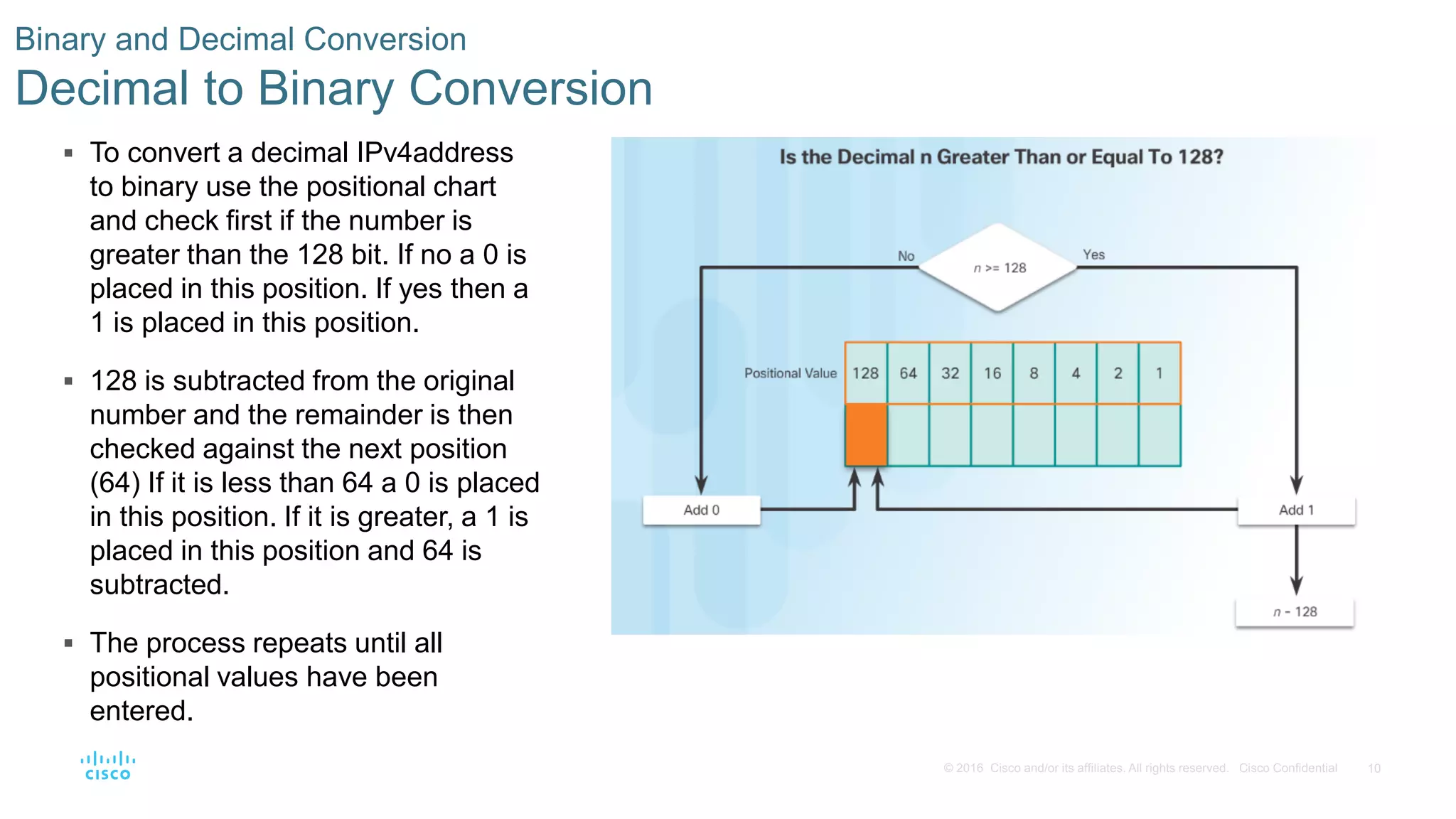
 To convert a decimal IPv4address
to binary use the positional chart
and check first if the number is
greater than the 128 bit. If no a 0 is
placed in this position. If yes then a
1 is placed in this position.
 128 is subtracted from the original
number and the remainder is then
checked against the next position
(64) If it is less than 64 a 0 is placed
in this position. If it is greater, a 1 is
placed in this position and 64 is
subtracted.
 The process repeats until all
positional values have been
entered.
Binary and Decimal Conversion
Decimal to Binary Conversion
11
© 2016 Cisco and/or its affiliates. All rights reserved. Cisco Confidential
Binary and Decimal Conversion
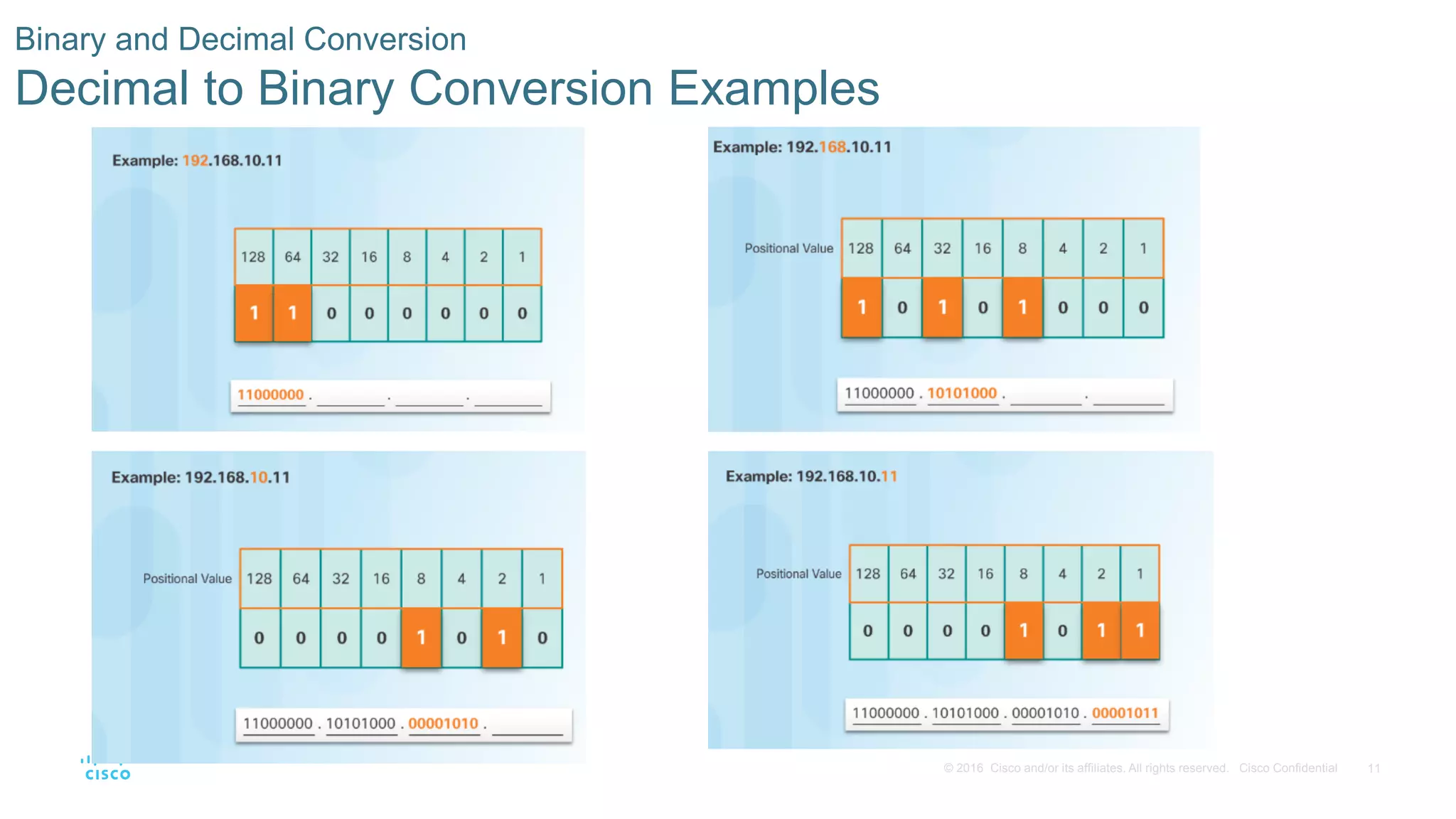
Decimal to Binary Conversion Examples
12
© 2016 Cisco and/or its affiliates. All rights reserved. Cisco Confidential
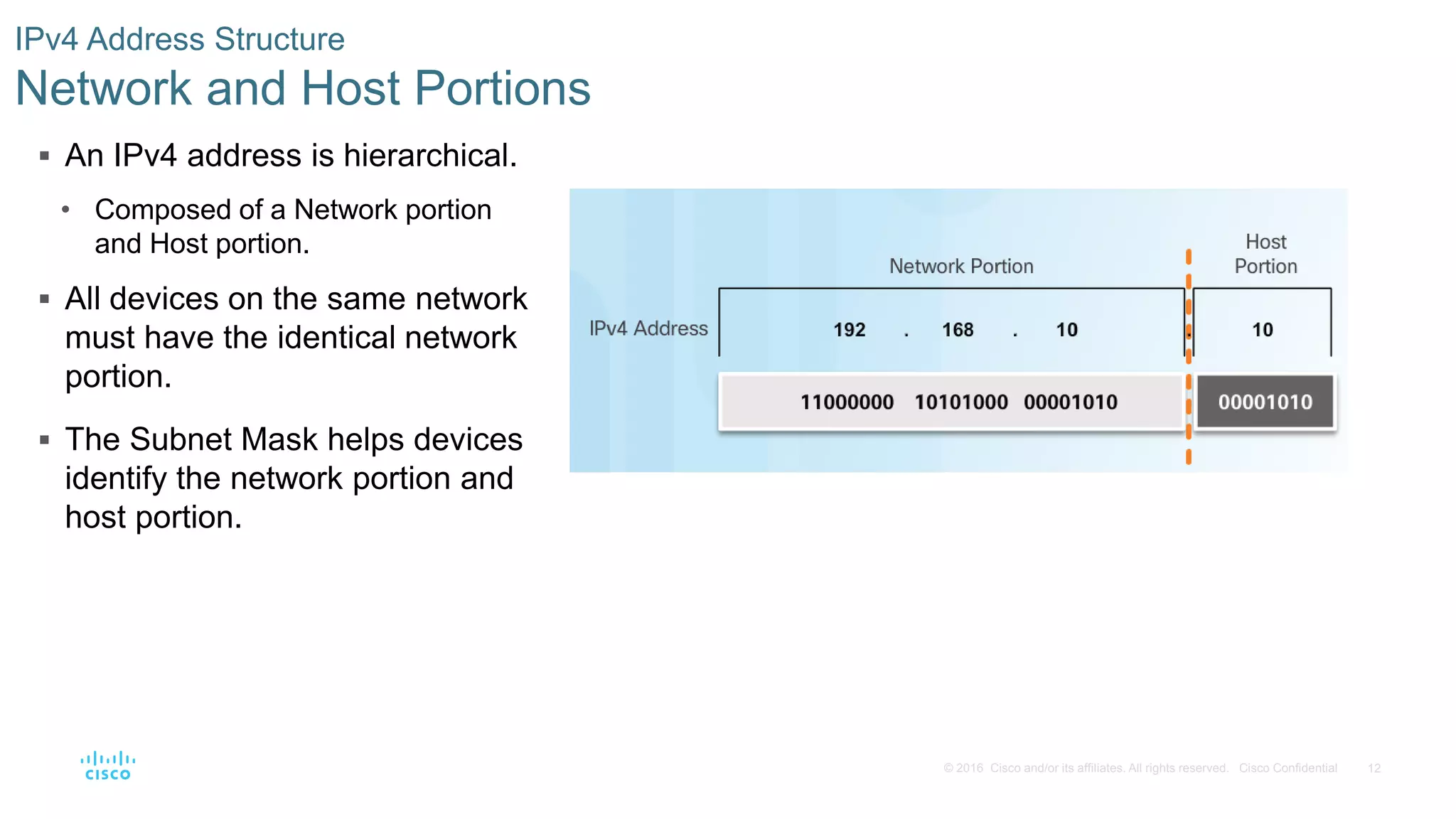
 An IPv4 address is hierarchical.
• Composed of a Network portion
and Host portion.
 All devices on the same network
must have the identical network
portion.
 The Subnet Mask helps devices
identify the network portion and
host portion.
IPv4 Address Structure
Network and Host Portions
13
© 2016 Cisco and/or its affiliates. All rights reserved. Cisco Confidential
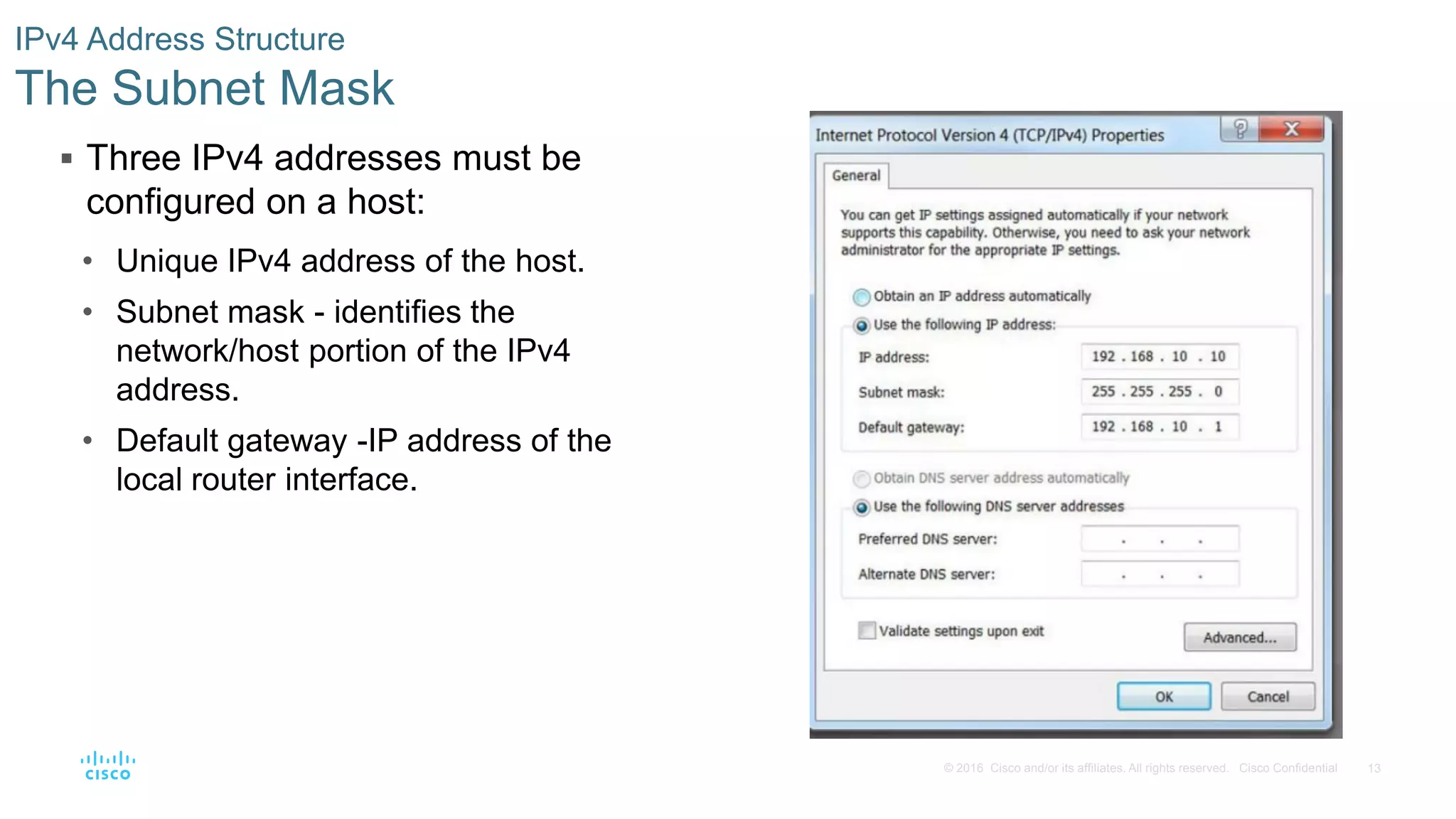
 Three IPv4 addresses must be
configured on a host:
• Unique IPv4 address of the host.
• Subnet mask - identifies the
network/host portion of the IPv4
address.
• Default gateway -IP address of the
local router interface.
IPv4 Address Structure
The Subnet Mask
14
© 2016 Cisco and/or its affiliates. All rights reserved. Cisco Confidential
IPv4 Address Structure
The Subnet Mask (Cont.)
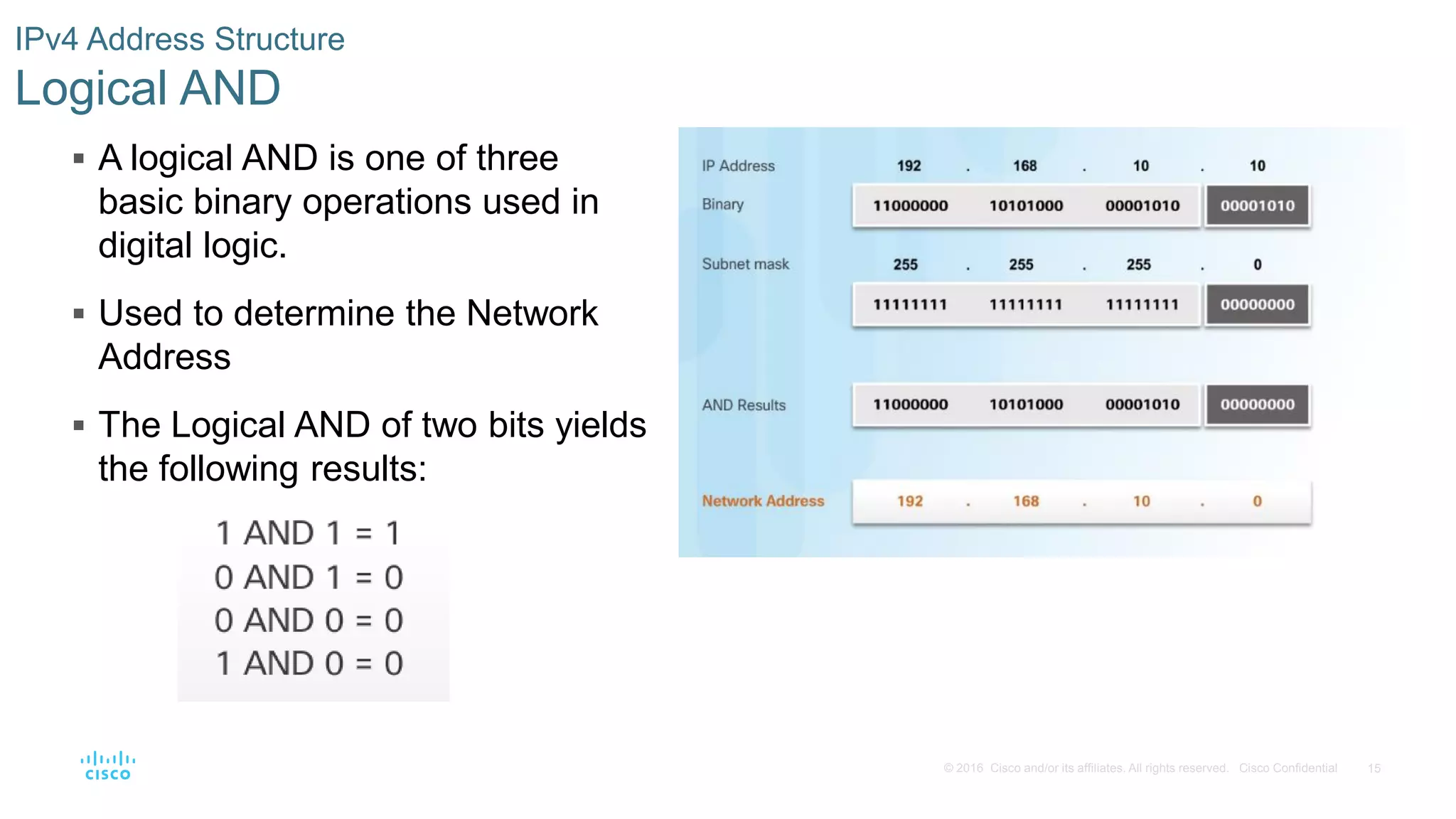
 The IPv4 address is compared to the subnet mask bit by bit, from left to right.
 A 1 in the subnet mask indicates that the corresponding bit in the IPv4 address is a
network bit.
15
© 2016 Cisco and/or its affiliates. All rights reserved. Cisco Confidential
IPv4 Address Structure
Logical AND
 A logical AND is one of three
basic binary operations used in
digital logic.
 Used to determine the Network
Address
 The Logical AND of two bits yields
the following results:
16
© 2016 Cisco and/or its affiliates. All rights reserved. Cisco Confidential
IPv4 Address Structure
The Prefix Length
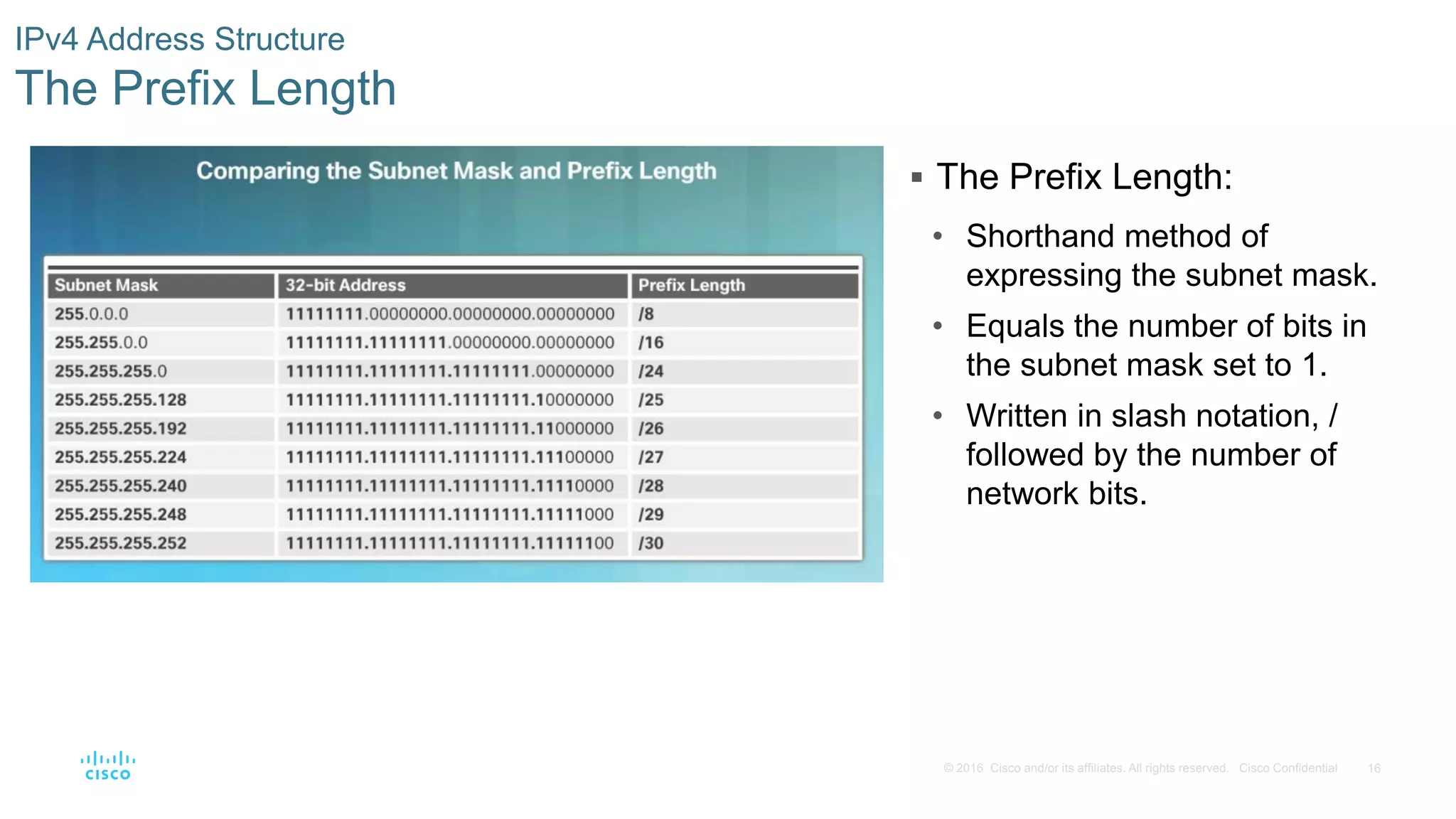
 The Prefix Length:
• Shorthand method of
expressing the subnet mask.
• Equals the number of bits in
the subnet mask set to 1.
• Written in slash notation, /
followed by the number of
network bits.
17
© 2016 Cisco and/or its affiliates. All rights reserved. Cisco Confidential
IPv4 Address Structure
Network, Host, and Broadcast Addresses
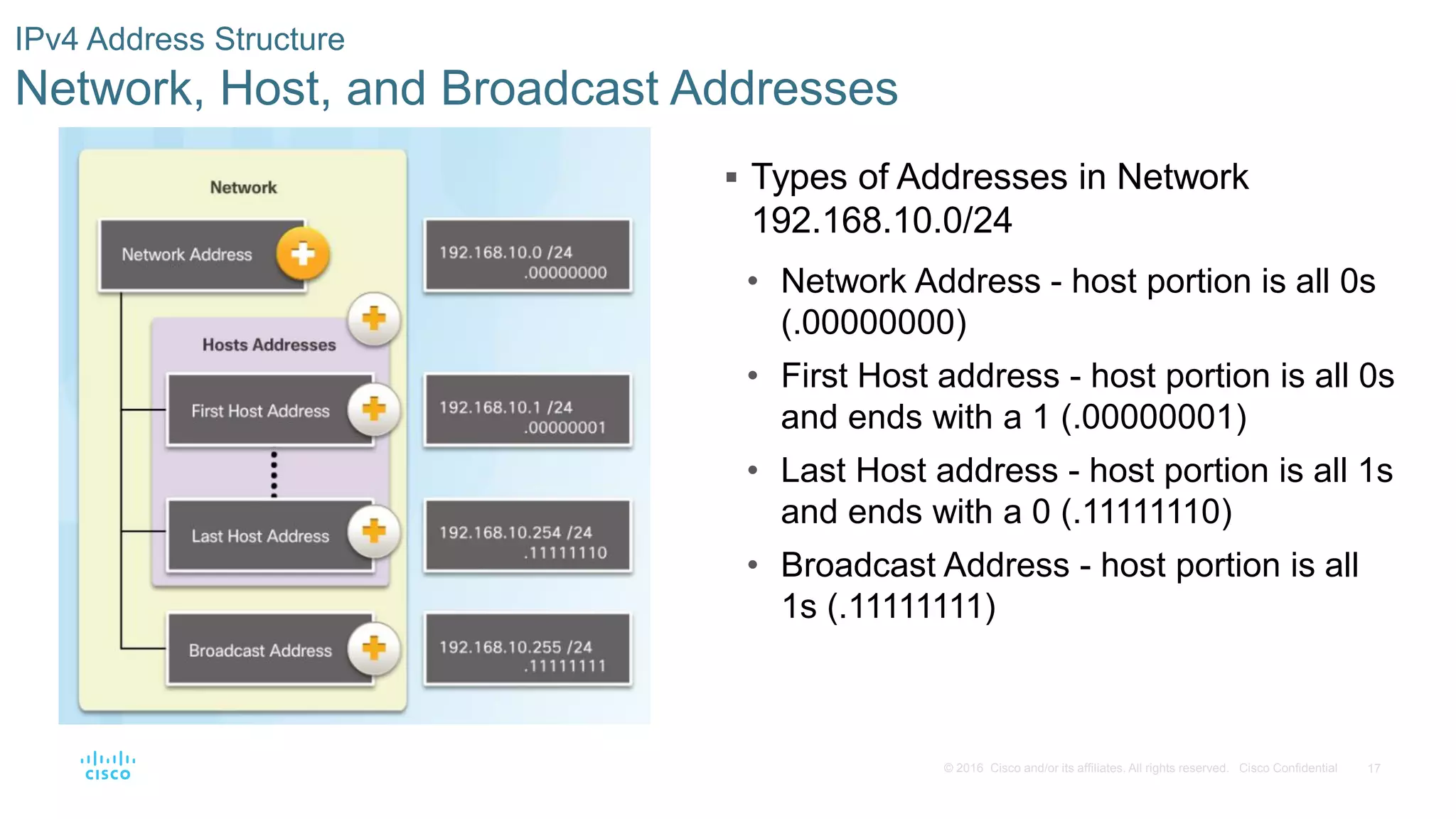
 Types of Addresses in Network
192.168.10.0/24
• Network Address - host portion is all 0s
(.00000000)
• First Host address - host portion is all 0s
and ends with a 1 (.00000001)
• Last Host address - host portion is all 1s
and ends with a 0 (.11111110)
• Broadcast Address - host portion is all
1s (.11111111)
18
© 2016 Cisco and/or its affiliates. All rights reserved. Cisco Confidential
IPv4 Unicast, Broadcast, and Multicast
Static IPv4 Address Assignment to a Host
 Some devices like printers, servers
and network devices require a fixed
IP address.
 Hosts in a small network can also be
configured with static addresses.
19
© 2016 Cisco and/or its affiliates. All rights reserved. Cisco Confidential
IPv4 Unicast, Broadcast, and Multicast
Dynamic IPv4 Address Assignment to a Host
 Most networks use Dynamic Host
Configuration Protocol (DHCP) to
assign IPv4 addresses dynamically.
 The DHCP server provides an IPv4
address, subnet mask, default
gateway, and other configuration
information.
 DHCP leases the addresses to hosts
for a certain length of time.
 If the host is powered down or taken
off the network, the address is
returned to the pool for reuse.
20
© 2016 Cisco and/or its affiliates. All rights reserved. Cisco Confidential
IPv4 Unicast, Broadcast, and Multicast
IPv4 Communication
 Unicast – one to one
communication.
 Broadcast– one to
all.
 Multicast – one to a
select group.
21
© 2016 Cisco and/or its affiliates. All rights reserved. Cisco Confidential
IPv4 Unicast, Broadcast, and Multicast
Unicast Transmission
 Unicast – one to one
communication.
• Use the address of the
destination device as the
destination address.
22
© 2016 Cisco and/or its affiliates. All rights reserved. Cisco Confidential
IPv4 Unicast, Broadcast, and Multicast
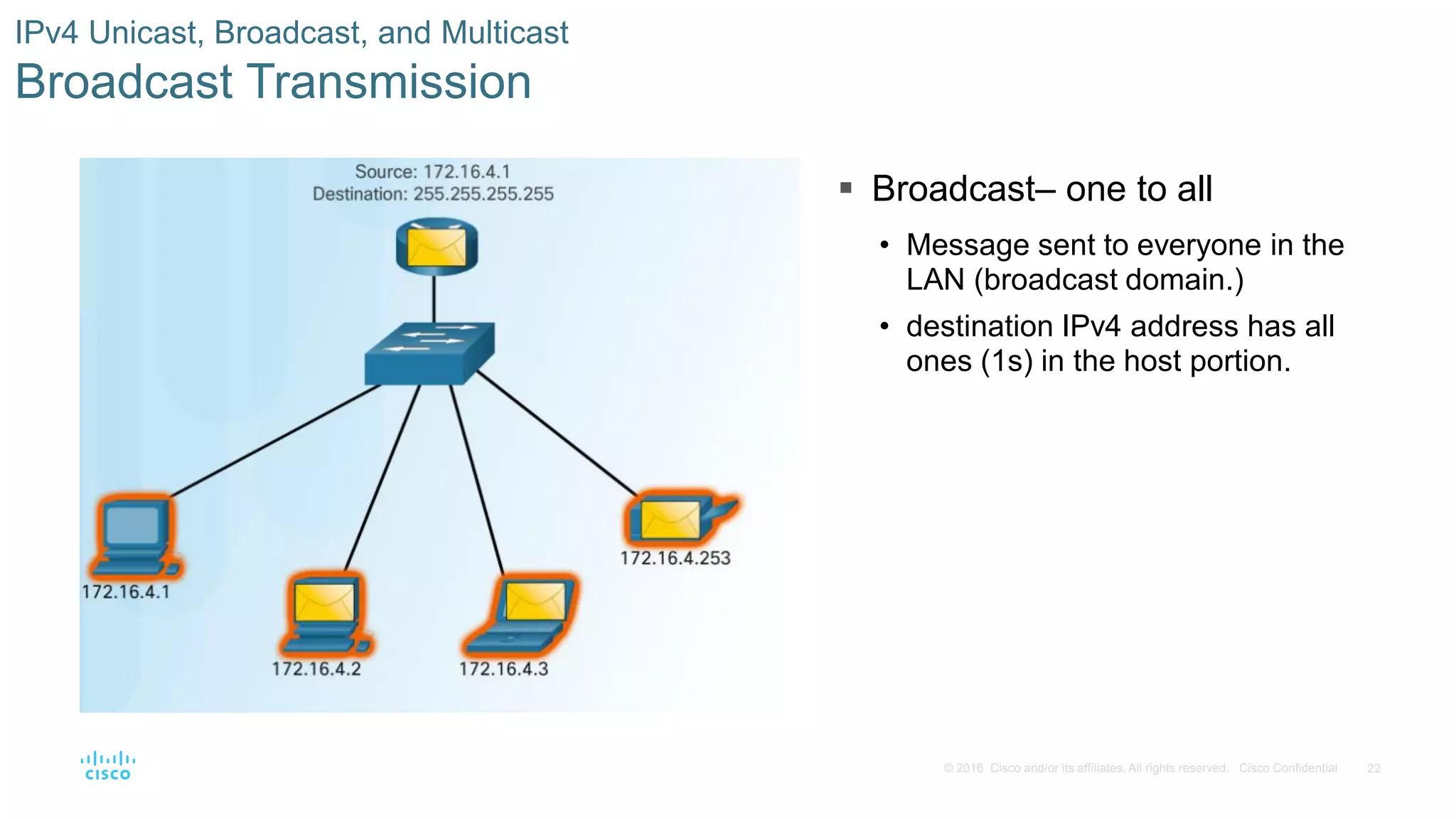
Broadcast Transmission
 Broadcast– one to all
• Message sent to everyone in the
LAN (broadcast domain.)
• destination IPv4 address has all
ones (1s) in the host portion.
23
© 2016 Cisco and/or its affiliates. All rights reserved. Cisco Confidential
IPv4 Unicast, Broadcast, and Multicast
Multicast Transmission
 Multicast– one to a select group.
• 224.0.0.0 to 239.255.255.255
addresses reserved for multicast.
• routing protocols use multicast
transmission to exchange routing
information.
24
© 2016 Cisco and/or its affiliates. All rights reserved. Cisco Confidential
Types of IPv4 Addresses
Public and Private IPv4 Addresses
 Private Addresses
• Not routable
• Introduced in mid 1990s due to depletion of IPv4
addresses
• Used only in internal networks.
• Must be translated to a public IPv4 to be routable.
• Defined by RFC 1918
 Private Address Blocks
• 10.0.0.0 /8 or 10.0.0.0 to 10.255.255.255
• 172.16.0.0 /12 or 172.16.0.0 to
172.31.255.255192.168.0.0 /16
• 192.168.0.0 to 192.168.255.255
25
© 2016 Cisco and/or its affiliates. All rights reserved. Cisco Confidential
Types of IPv4 Addresses
Special User IPv4 Addresses
 Loopback addresses (127.0.0.0 /8 or
127.0.0.1)
• Used on a host to test if the TCP/IP
configuration is operational.
 Link-Local addresses (169.254.0.0 /16 or
169.254.0.1)
• Commonly known as Automatic Private IP
Addressing (APIPA) addresses.
• Used by Windows client to self configure if no
DHCP server available.
 TEST-NET addresses (192.0.2.0/24 or 192.0.2.0 to
192.0.2.255)
• Used for teaching and learning.
26
© 2016 Cisco and/or its affiliates. All rights reserved. Cisco Confidential
Types of IPv4 Addresses
Legacy Classful Addressing
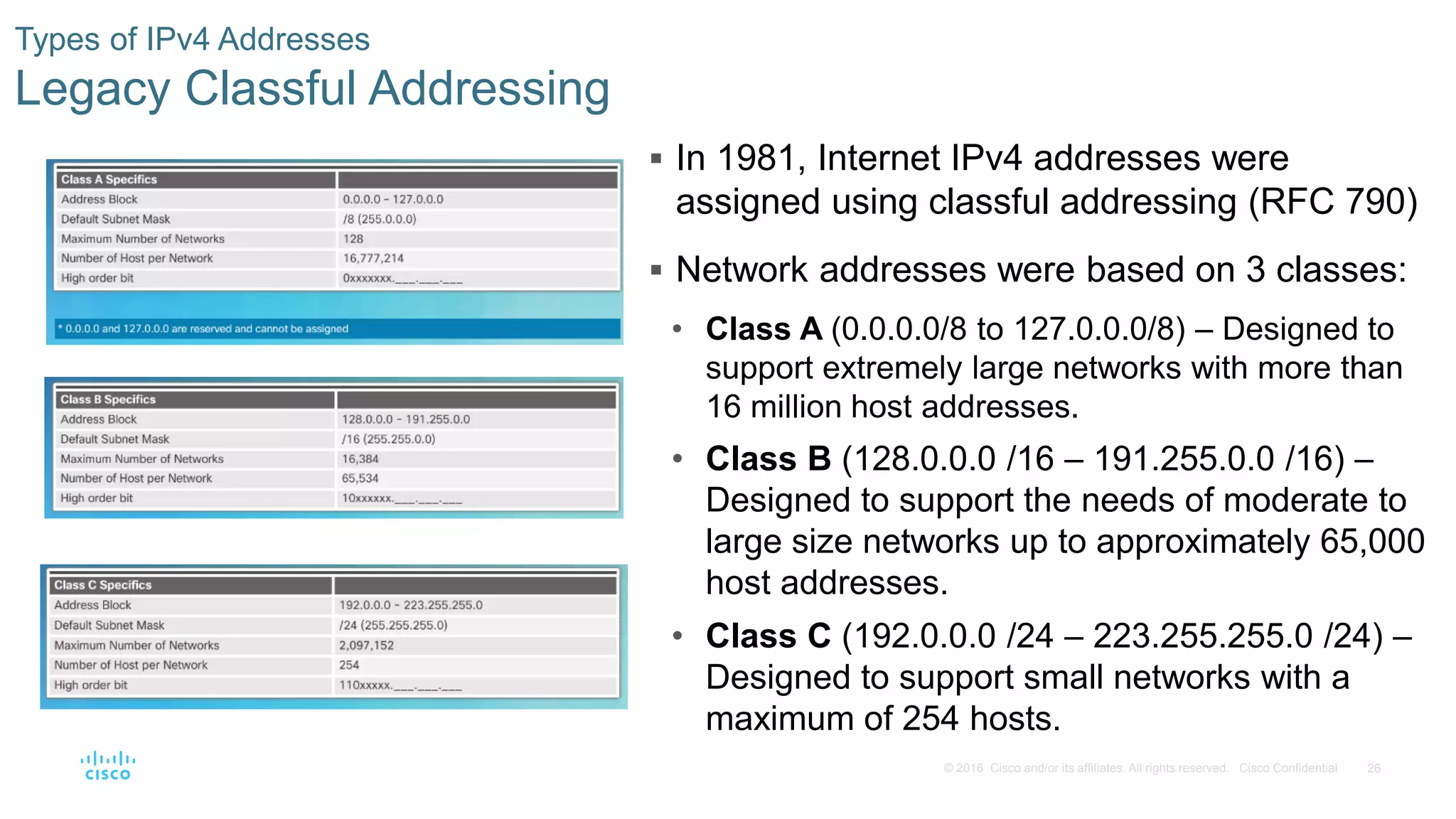
 In 1981, Internet IPv4 addresses were
assigned using classful addressing (RFC 790)
 Network addresses were based on 3 classes:
• Class A (0.0.0.0/8 to 127.0.0.0/8) – Designed to
support extremely large networks with more than
16 million host addresses.
• Class B (128.0.0.0 /16 – 191.255.0.0 /16) –
Designed to support the needs of moderate to
large size networks up to approximately 65,000
host addresses.
• Class C (192.0.0.0 /24 – 223.255.255.0 /24) –
Designed to support small networks with a
maximum of 254 hosts.
27
© 2016 Cisco and/or its affiliates. All rights reserved. Cisco Confidential
Types of IPv4 Addresses
Classless Addressing
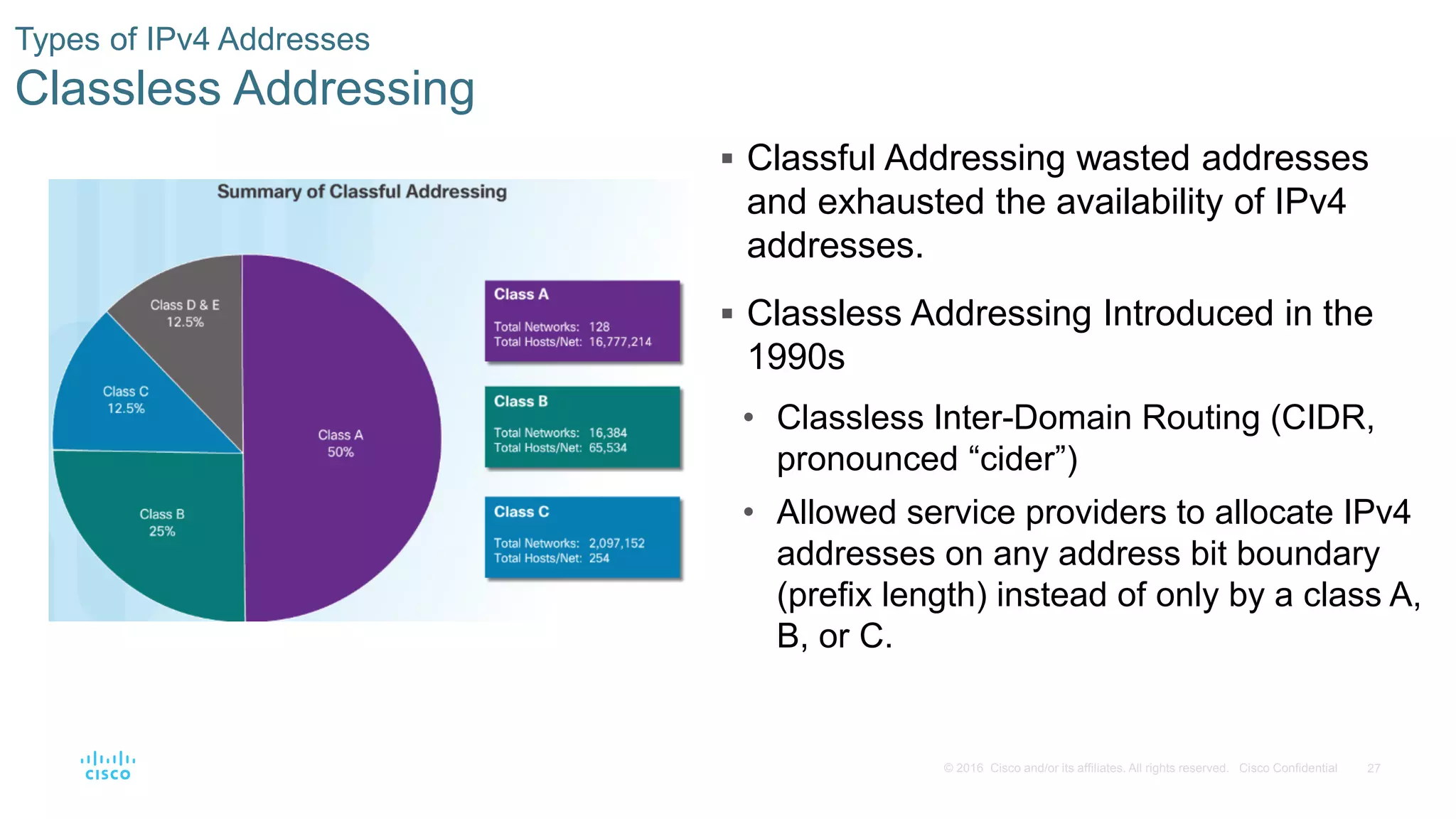
 Classful Addressing wasted addresses
and exhausted the availability of IPv4
addresses.
 Classless Addressing Introduced in the
1990s
• Classless Inter-Domain Routing (CIDR,
pronounced “cider”)
• Allowed service providers to allocate IPv4
addresses on any address bit boundary
(prefix length) instead of only by a class A,
B, or C.
28
© 2016 Cisco and/or its affiliates. All rights reserved. Cisco Confidential
Types of IPv4 Addresses
Assignment of IP Addresses
 The following organizations manage and
maintain IPv4 and IPv6 addresses for the
various regions.
• American Registry for Internet Numbers
(ARIN)- North America.
• Réseaux IP Europeans (RIPE) - Europe, the
Middle East, and Central Asia
• Asia Pacific Network Information Centre
(APNIC) - Asia and Pacific regions
• African Network Information Centre (AfriNIC) –
Africa
• Regional Latin-American and Caribbean IP
Address Registry (LACNIC) - Latin America
and some Caribbean islands
29
© 2016 Cisco and/or its affiliates. All rights reserved. Cisco Confidential
7.2 IPv6 Network Addresses
30
© 2016 Cisco and/or its affiliates. All rights reserved. Cisco Confidential
IPv4 Issues
The Need for IPv6
 IPv6 versus IPv4:
• Has a larger 128-bit address space
• 340 undecillion addresses
• Solves limitations with IPv4
• Adds enhancement like address auto-
configuration.
 Why IPv6 is needed:
• Rapidly increasing Internet
population
• Depletion of IPv4
• Issues with NAT
• Internet of Things
31
© 2016 Cisco and/or its affiliates. All rights reserved. Cisco Confidential
IPv4 Issues
IPv4 and IPv6 Coexistence
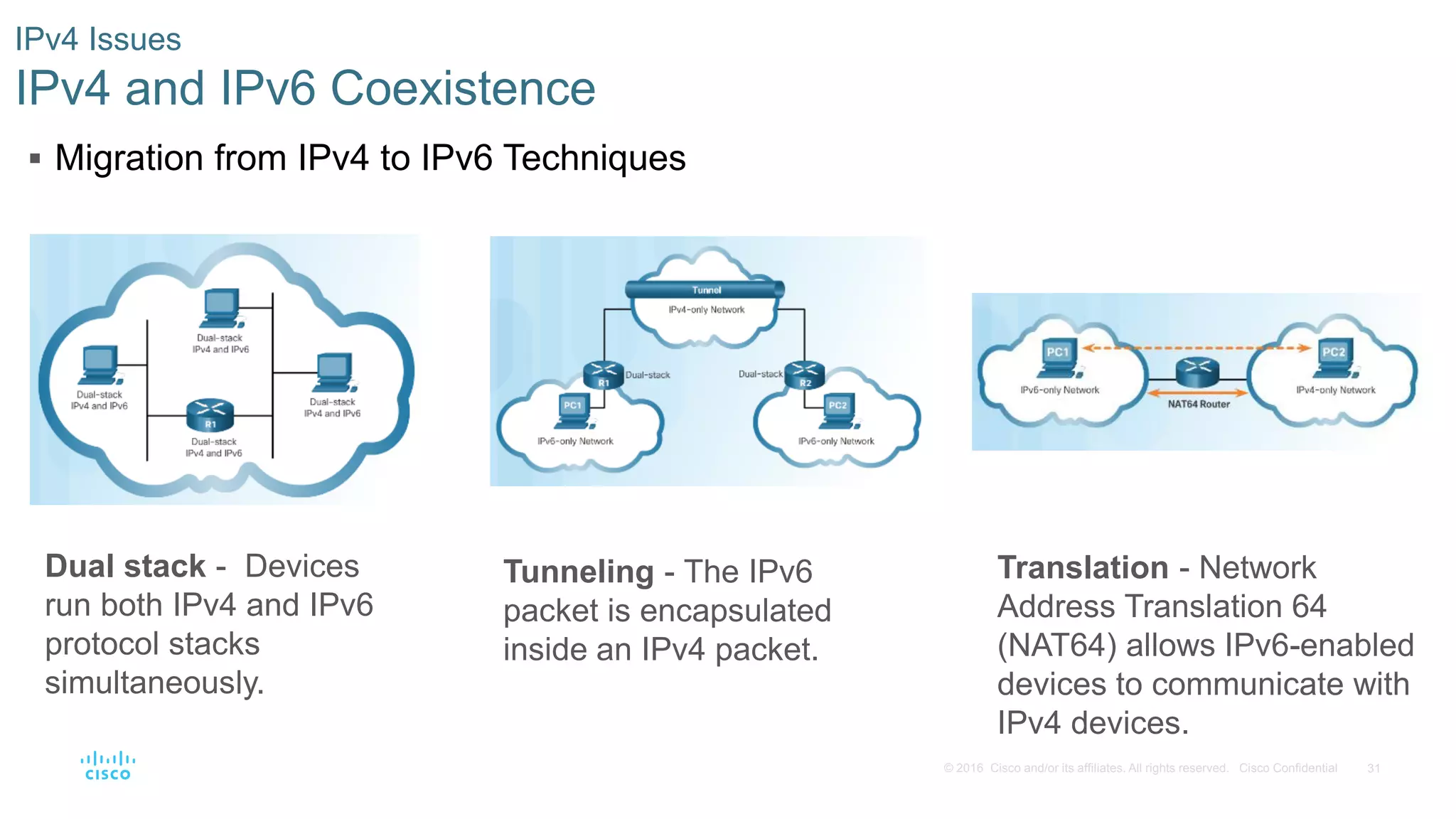
 Migration from IPv4 to IPv6 Techniques
Translation - Network
Address Translation 64
(NAT64) allows IPv6-enabled
devices to communicate with
IPv4 devices.
Tunneling - The IPv6
packet is encapsulated
inside an IPv4 packet.
Dual stack - Devices
run both IPv4 and IPv6
protocol stacks
simultaneously.
32
© 2016 Cisco and/or its affiliates. All rights reserved. Cisco Confidential
IPv6 Addressing
IPv6 Address Representation
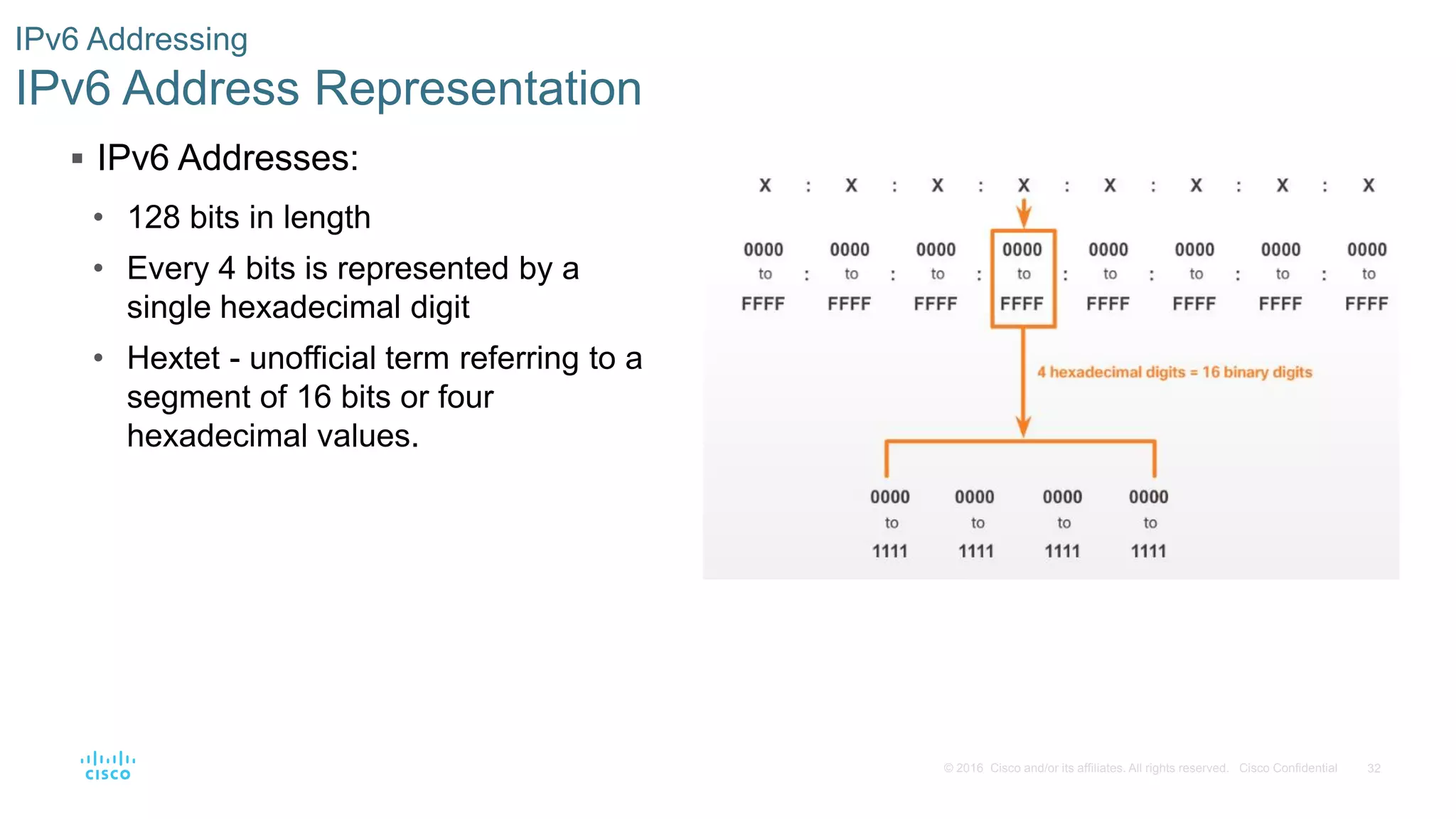
 IPv6 Addresses:
• 128 bits in length
• Every 4 bits is represented by a
single hexadecimal digit
• Hextet - unofficial term referring to a
segment of 16 bits or four
hexadecimal values.
33
© 2016 Cisco and/or its affiliates. All rights reserved. Cisco Confidential
IPv6 Addressing
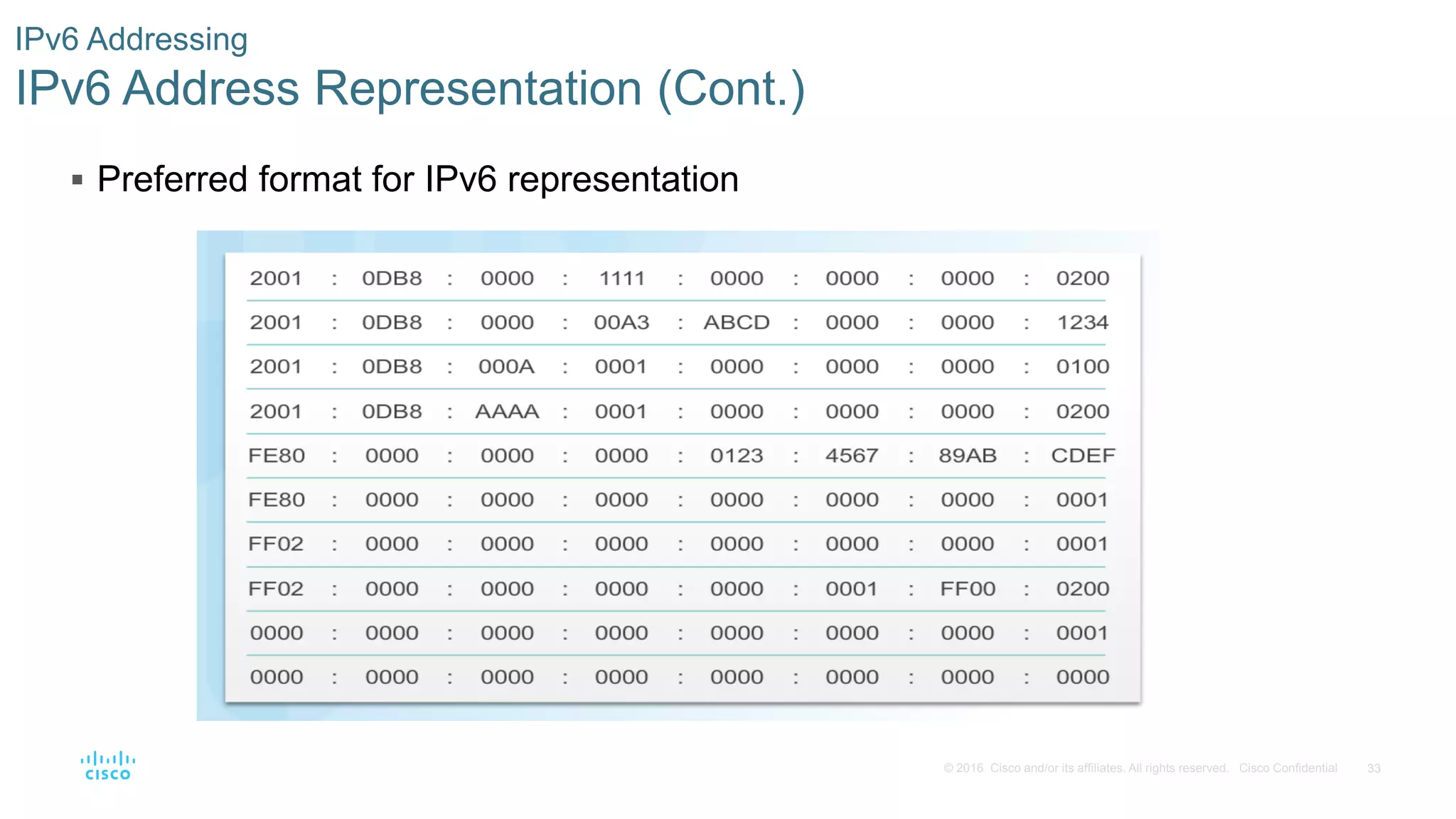
IPv6 Address Representation (Cont.)
 Preferred format for IPv6 representation
34
© 2016 Cisco and/or its affiliates. All rights reserved. Cisco Confidential
IPv6 Addressing
Rule 1 – Omit Leading 0s
 In order to reduce or compress IPv6
• First rule is to omit leading zeros in any hextet.
35
© 2016 Cisco and/or its affiliates. All rights reserved. Cisco Confidential
IPv6 Addressing
Rule 2 – Omit All 0 Segments
 Rule 2 – Omit All 0 Segments
• A double colon (::) can replace any single, contiguous
string of one or more 16-bit segments (hextets) consisting
of all 0s.
36
© 2016 Cisco and/or its affiliates. All rights reserved. Cisco Confidential
IPv6 Addressing
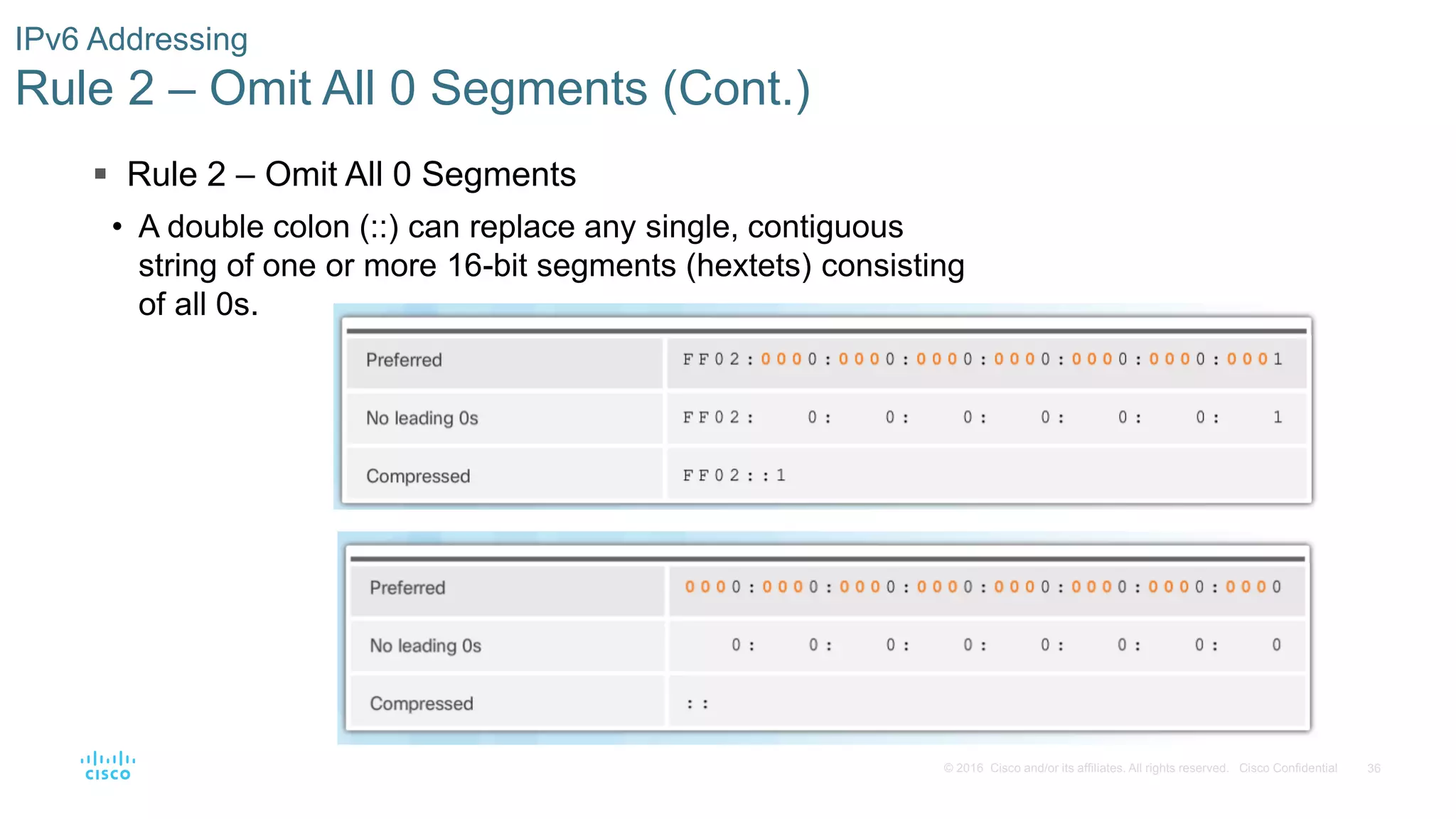
Rule 2 – Omit All 0 Segments (Cont.)
 Rule 2 – Omit All 0 Segments
• A double colon (::) can replace any single, contiguous
string of one or more 16-bit segments (hextets) consisting
of all 0s.
37
© 2016 Cisco and/or its affiliates. All rights reserved. Cisco Confidential
Types of IPv6 Addresses
IPv6 Address Types
 Three types of IPv6 addresses:
• Unicast- Single source IPv6
address.
• Multicast - An IPv6 multicast
address is used to send a single
IPv6 packet to multiple destinations.
• Anycast - An IPv6 anycast address
is any IPv6 unicast address that can
be assigned to multiple devices.
38
© 2016 Cisco and/or its affiliates. All rights reserved. Cisco Confidential
Types of IPv6 Addresses
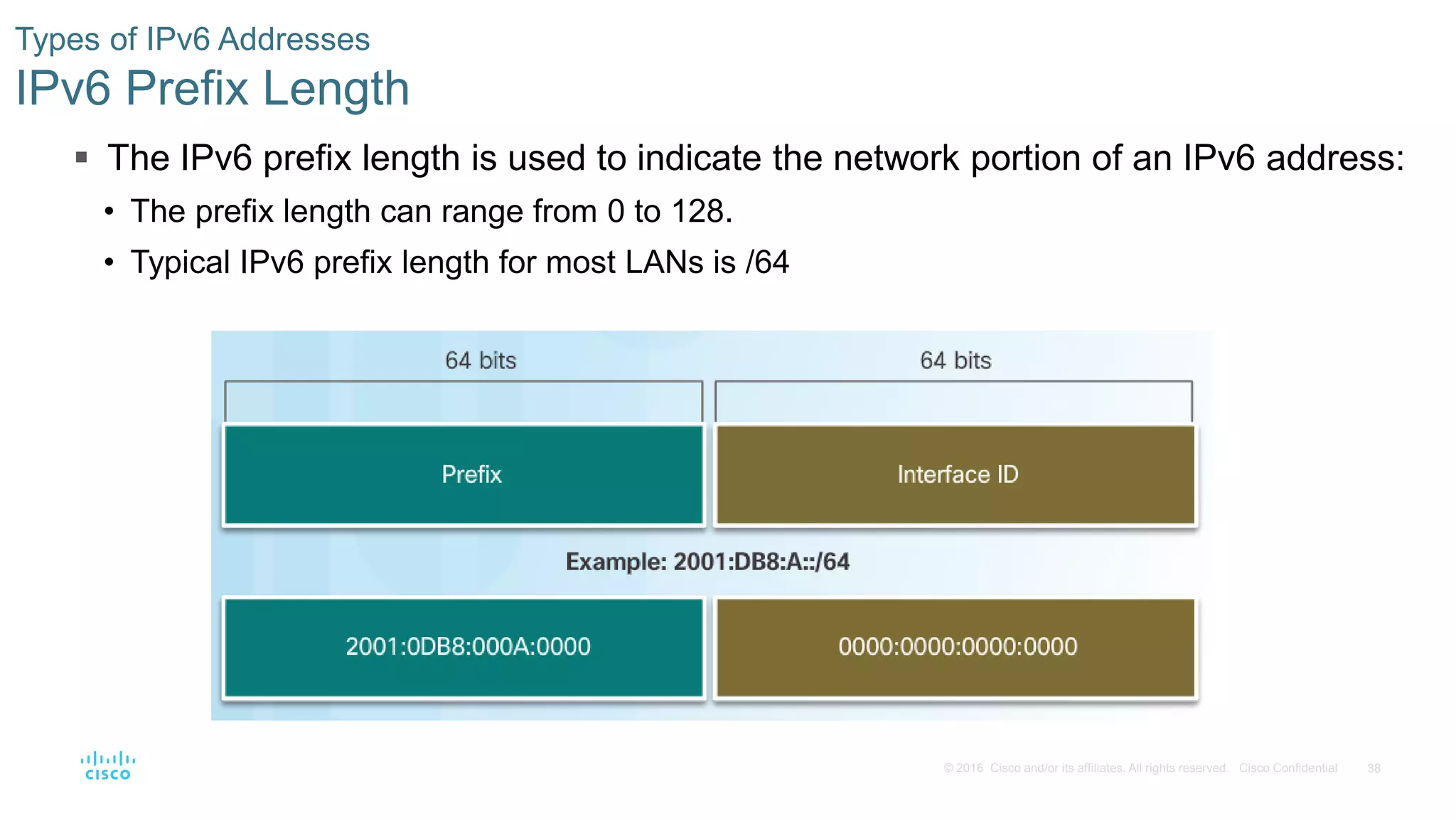
IPv6 Prefix Length
 The IPv6 prefix length is used to indicate the network portion of an IPv6 address:
• The prefix length can range from 0 to 128.
• Typical IPv6 prefix length for most LANs is /64
39
© 2016 Cisco and/or its affiliates. All rights reserved. Cisco Confidential
Types of IPv6 Addresses
IPv6 Unicast Addresses
 Global Unicast - These are
globally unique, Internet
routable addresses.
 Link-local - used to
communicate with other
devices on the same local
link. Confined to a single
link.
 Unique Local - used for
local addressing within a site
or between a limited number
of sites.
40
© 2016 Cisco and/or its affiliates. All rights reserved. Cisco Confidential
Types of IPv6 Addresses
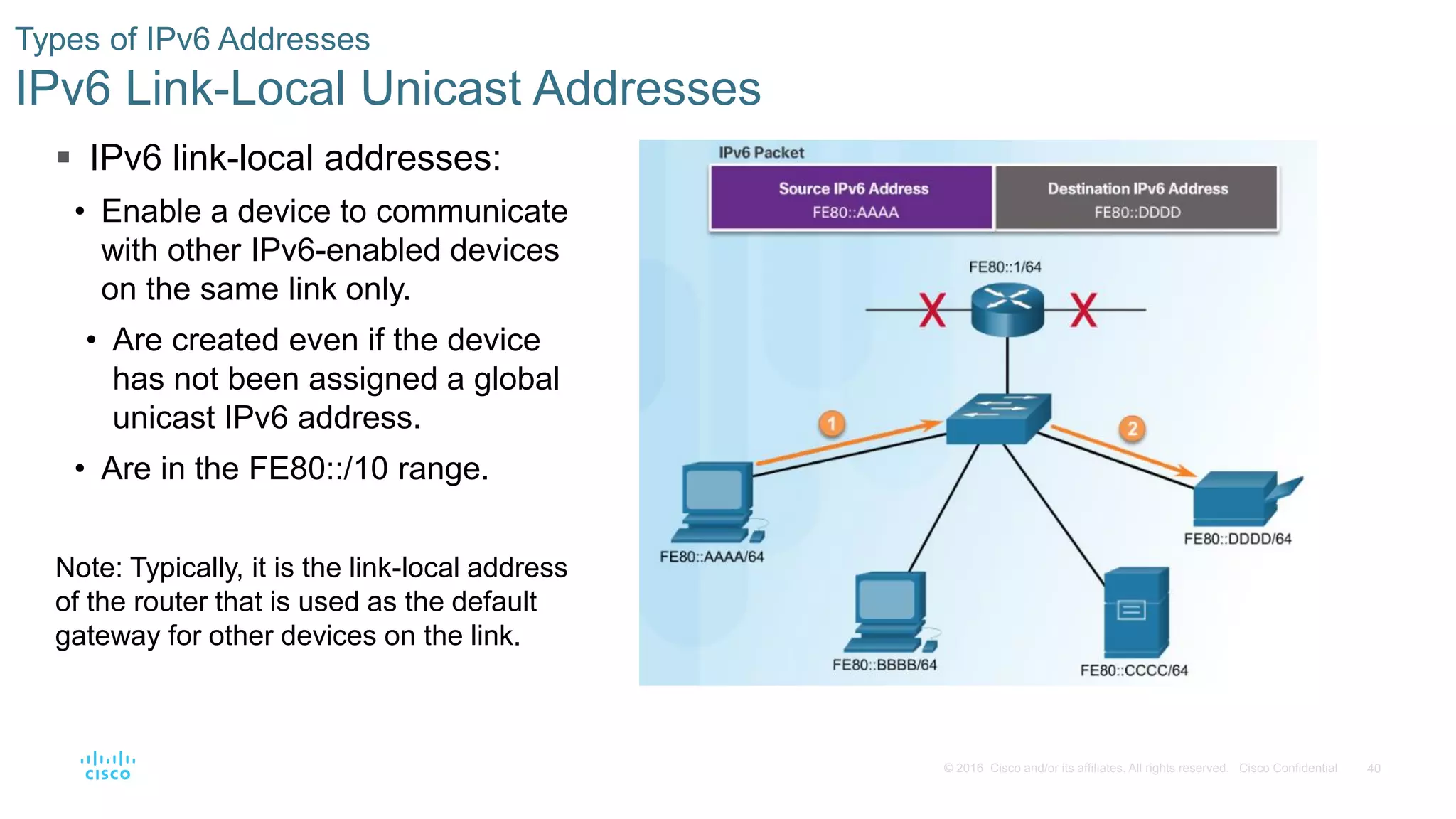
IPv6 Link-Local Unicast Addresses
 IPv6 link-local addresses:
• Enable a device to communicate
with other IPv6-enabled devices
on the same link only.
• Are created even if the device
has not been assigned a global
unicast IPv6 address.
• Are in the FE80::/10 range.
Note: Typically, it is the link-local address
of the router that is used as the default
gateway for other devices on the link.
41
© 2016 Cisco and/or its affiliates. All rights reserved. Cisco Confidential
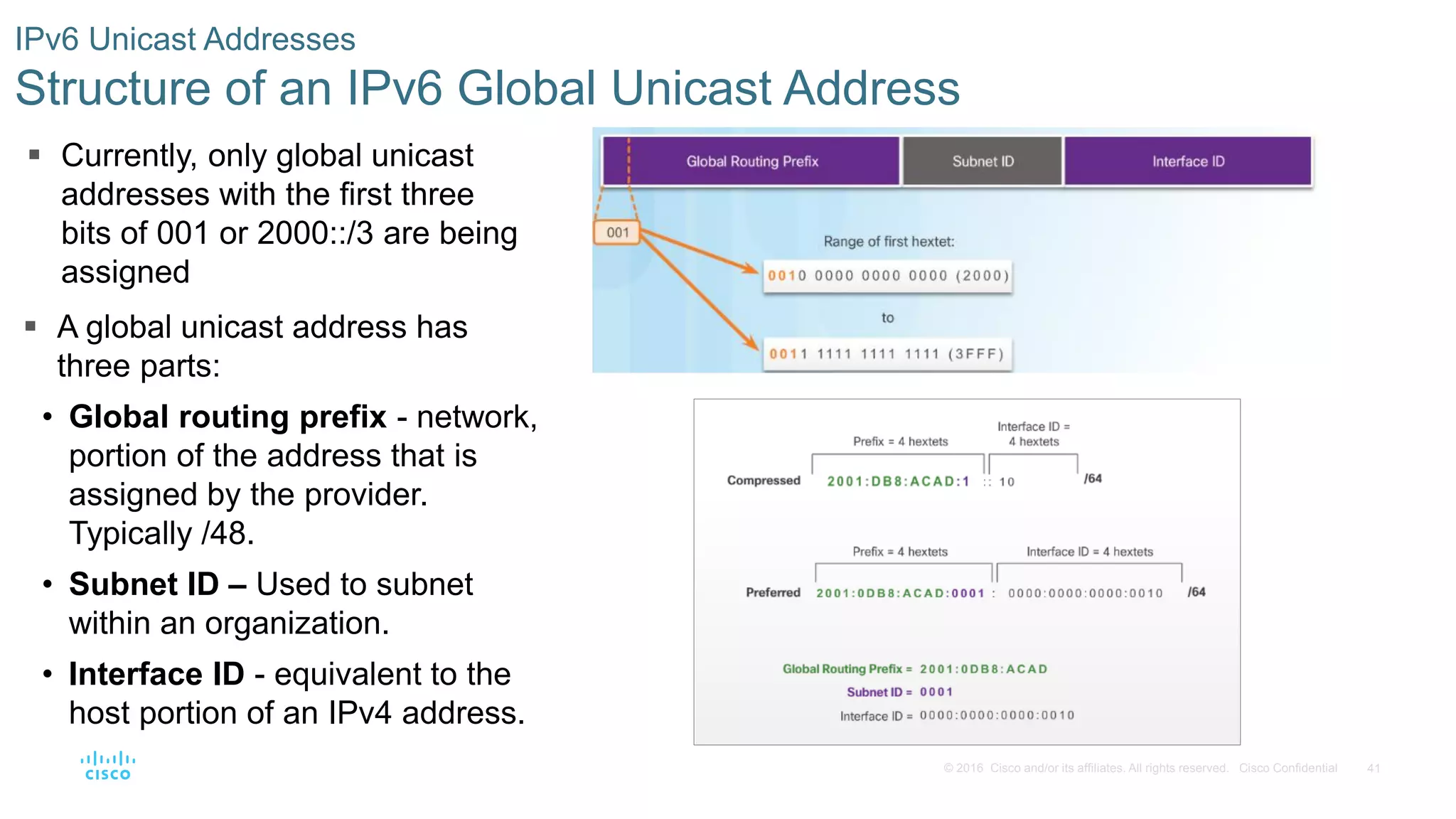
IPv6 Unicast Addresses
Structure of an IPv6 Global Unicast Address
 A global unicast address has
three parts:
• Global routing prefix - network,
portion of the address that is
assigned by the provider.
Typically /48.
• Subnet ID – Used to subnet
within an organization.
• Interface ID - equivalent to the
host portion of an IPv4 address.
 Currently, only global unicast
addresses with the first three
bits of 001 or 2000::/3 are being
assigned
42
© 2016 Cisco and/or its affiliates. All rights reserved. Cisco Confidential
IPv6 Unicast Addresses
Static Configuration of a Global Unicast Address
 Router Configuration:
 Similar commands to IPv4,
replace IPv4 with IPv6
 Command to configure andIPv6
global unicast on an interface is
ipv6 address ipv6-
address/prefix-length
43
© 2016 Cisco and/or its affiliates. All rights reserved. Cisco Confidential
IPv6 Unicast Addresses
Static Configuration of a Global Unicast Address (Cont.)
 Host Configuration:
• Manually configuring the IPv6 address
on a host is similar to configuring an
IPv4 address
• Default gateway address can be
configured to match the link-local or
global unicast address of the Gigabit
Ethernet interface.
 Dynamic assignment of IPv6
addresses:
• Stateless Address Autoconfiguration
(SLAAC)
• Stateful DHCPv6
44
© 2016 Cisco and/or its affiliates. All rights reserved. Cisco Confidential
IPv6 Unicast Addresses
Dynamic Configuration - SLAAC
 Stateless Address
Autoconfiguration (SLAAC):
• A device can obtain its prefix, prefix
length, default gateway address,
and other information from an IPv6
router.
• Uses the local router’s ICMPv6
Router Advertisement (RA)
messages
 ICMPv6 RA messages sent every
200 seconds to all IPv6-enabled
devices on the network.
Option 1 (SLAAC Only) – "I'm everything you need (Prefix,
Prefix-length, Default Gateway)"
Option 2 (SLAAC and DHCPv6) – "Here is my information
but you need to get other information such as DNS
addresses from a DHCPv6 server."
Option 3 (DHCPv6 Only) – "I can’t help you. Ask a DHCPv6
server for all your information."
45
© 2016 Cisco and/or its affiliates. All rights reserved. Cisco Confidential
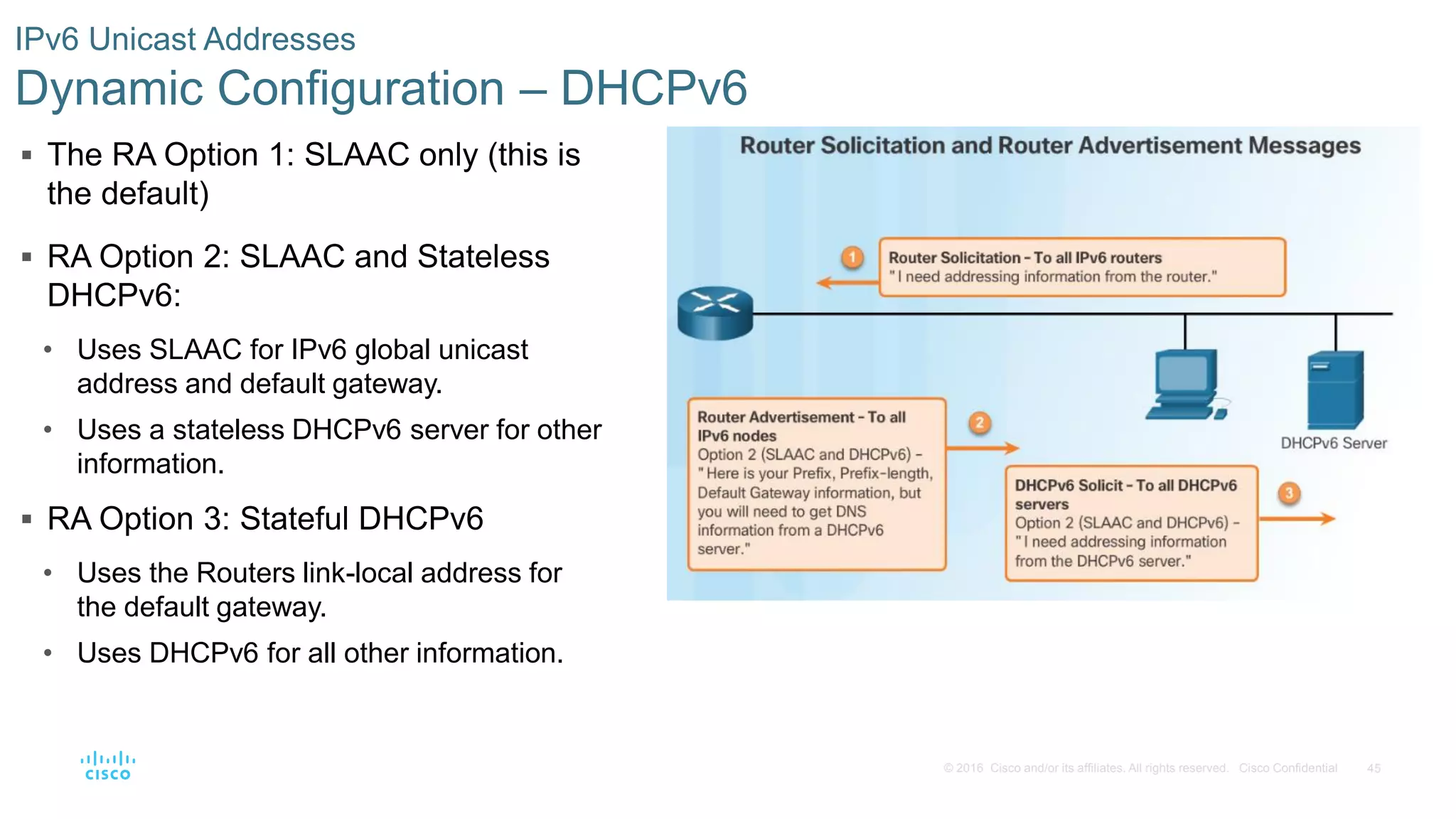
IPv6 Unicast Addresses
Dynamic Configuration – DHCPv6
 The RA Option 1: SLAAC only (this is
the default)
 RA Option 2: SLAAC and Stateless
DHCPv6:
• Uses SLAAC for IPv6 global unicast
address and default gateway.
• Uses a stateless DHCPv6 server for other
information.
 RA Option 3: Stateful DHCPv6
• Uses the Routers link-local address for
the default gateway.
• Uses DHCPv6 for all other information.
46
© 2016 Cisco and/or its affiliates. All rights reserved. Cisco Confidential
IPv6 Unicast Addresses
EUI-64 Process and Randomly Generated
 When the RA message is SLAAC or
SLAAC with stateless DHCPv6, the client
must generate its own Interface ID
• The Interface ID can be created using the
EUI-64 process or a randomly generated 64-
bit number
 An EUI-64 Interface ID is represented in
binary and is made up of three parts:
• 24-bit OUI from the client MAC address, but
the 7th bit (the Universally/Locally (U/L) bit)
is reversed.
• The inserted 16-bit value FFFE (in
hexadecimal).
• 24-bit Device Identifier from the client MAC
address.
47
© 2016 Cisco and/or its affiliates. All rights reserved. Cisco Confidential
IPv6 Unicast Addresses
EUI-64 Process and Randomly Generated (Cont.)
 Randomly Generated Interface IDs
• Windows uses a randomly generated Interface ID
48
© 2016 Cisco and/or its affiliates. All rights reserved. Cisco Confidential
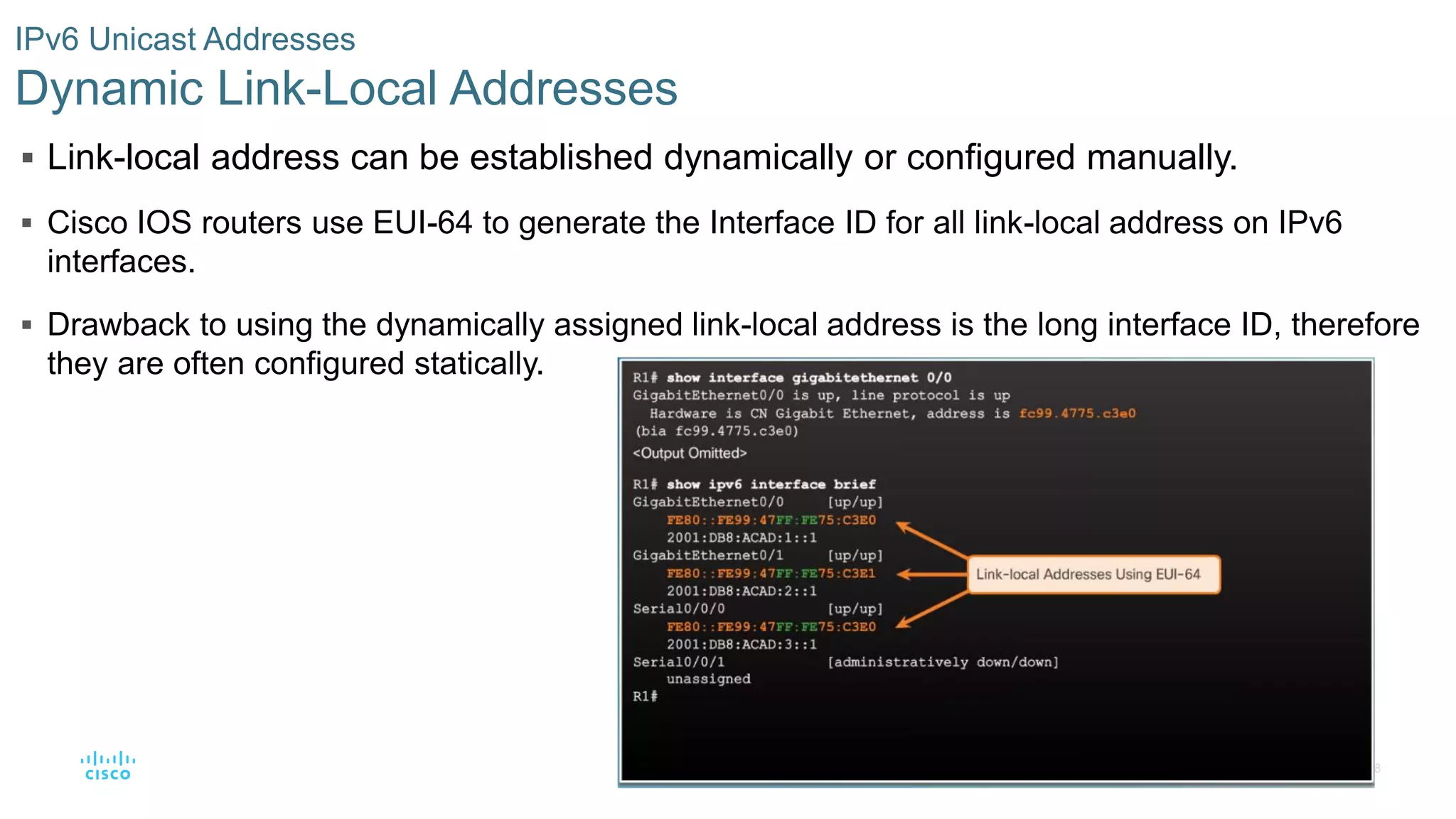
IPv6 Unicast Addresses
Dynamic Link-Local Addresses
 Link-local address can be established dynamically or configured manually.
 Cisco IOS routers use EUI-64 to generate the Interface ID for all link-local address on IPv6
interfaces.
 Drawback to using the dynamically assigned link-local address is the long interface ID, therefore
they are often configured statically.
49
© 2016 Cisco and/or its affiliates. All rights reserved. Cisco Confidential
IPv6 Unicast Addresses
Static Link-Local Addresses
 Manual Configuration of the link-local address allows the creation of a simple, easy to
remember address.
50
© 2016 Cisco and/or its affiliates. All rights reserved. Cisco Confidential
IPv6 Unicast Addresses
Verifying IPv6 Address Configuration
 The commands to verify IPv6 configuration are similar to IPv4
• show ipv6 interface brief
• show ipv6 route
 The ping command for IPv6 is identical to the command used with IPv4, except that
an IPv6 address is used.
51
© 2016 Cisco and/or its affiliates. All rights reserved. Cisco Confidential
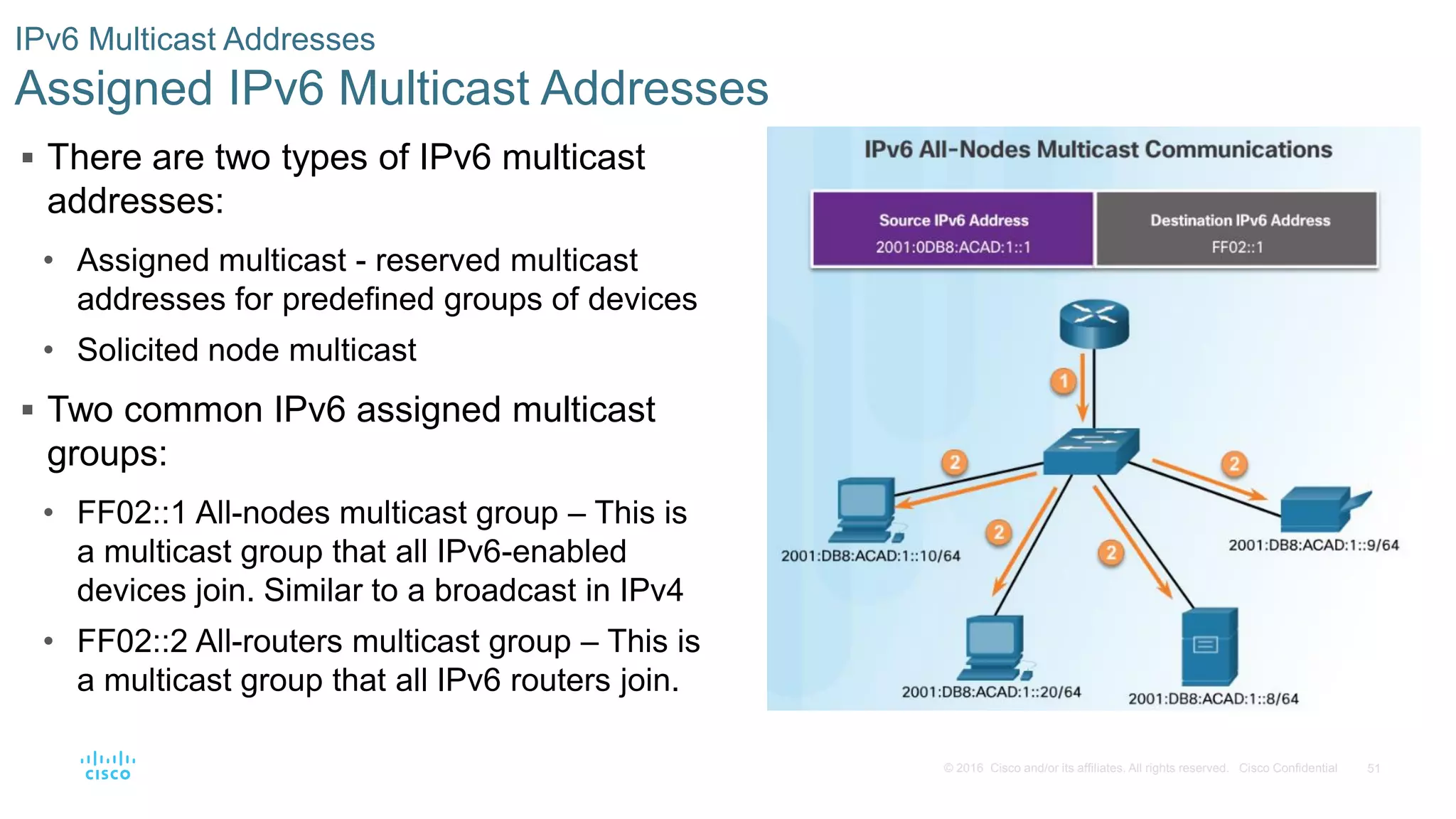
IPv6 Multicast Addresses
Assigned IPv6 Multicast Addresses
 There are two types of IPv6 multicast
addresses:
• Assigned multicast - reserved multicast
addresses for predefined groups of devices
• Solicited node multicast
 Two common IPv6 assigned multicast
groups:
• FF02::1 All-nodes multicast group – This is
a multicast group that all IPv6-enabled
devices join. Similar to a broadcast in IPv4
• FF02::2 All-routers multicast group – This is
a multicast group that all IPv6 routers join.
52
© 2016 Cisco and/or its affiliates. All rights reserved. Cisco Confidential
IPv6 Multicast Addresses
Solicited-Node IPv6 Multicast Addresses
 Solicited-node multicast address:
• Mapped to .a special Ethernet multicast address
• Allows Ethernet NIC to filter frame on destination
MAC.
53
© 2016 Cisco and/or its affiliates. All rights reserved. Cisco Confidential
7.3 Connectivity Verification
54
© 2016 Cisco and/or its affiliates. All rights reserved. Cisco Confidential
ICMP
ICMPv4 and ICMPv6
 ICMPv4 is the messaging protocol for
IPv4. ICMPv6 provides the same
services for IPv6
 ICMP messages common to both
include:
• Host confirmation
• Destination or Service Unreachable
• Time exceeded
• Route redirection
55
© 2016 Cisco and/or its affiliates. All rights reserved. Cisco Confidential
ICMP
ICMPv6 Router Solicitation and Router Advertisement Messages
 ICMPv6 includes four new protocols as part
of the Neighbor Discovery Protocol (ND or
NDP)
• Router Solicitation (RS) message
• Router Advertisement (RA) message
 RA messages used to provide addressing
information to hosts
• Neighbor Solicitation (NS) message
• Neighbor Advertisement (NA) message
 Neighbor Solicitation and Neighbor
Advertisement messages are used for
Address resolution and Duplicate Address
Detection (DAD).
56
© 2016 Cisco and/or its affiliates. All rights reserved. Cisco Confidential
Testing and Verification
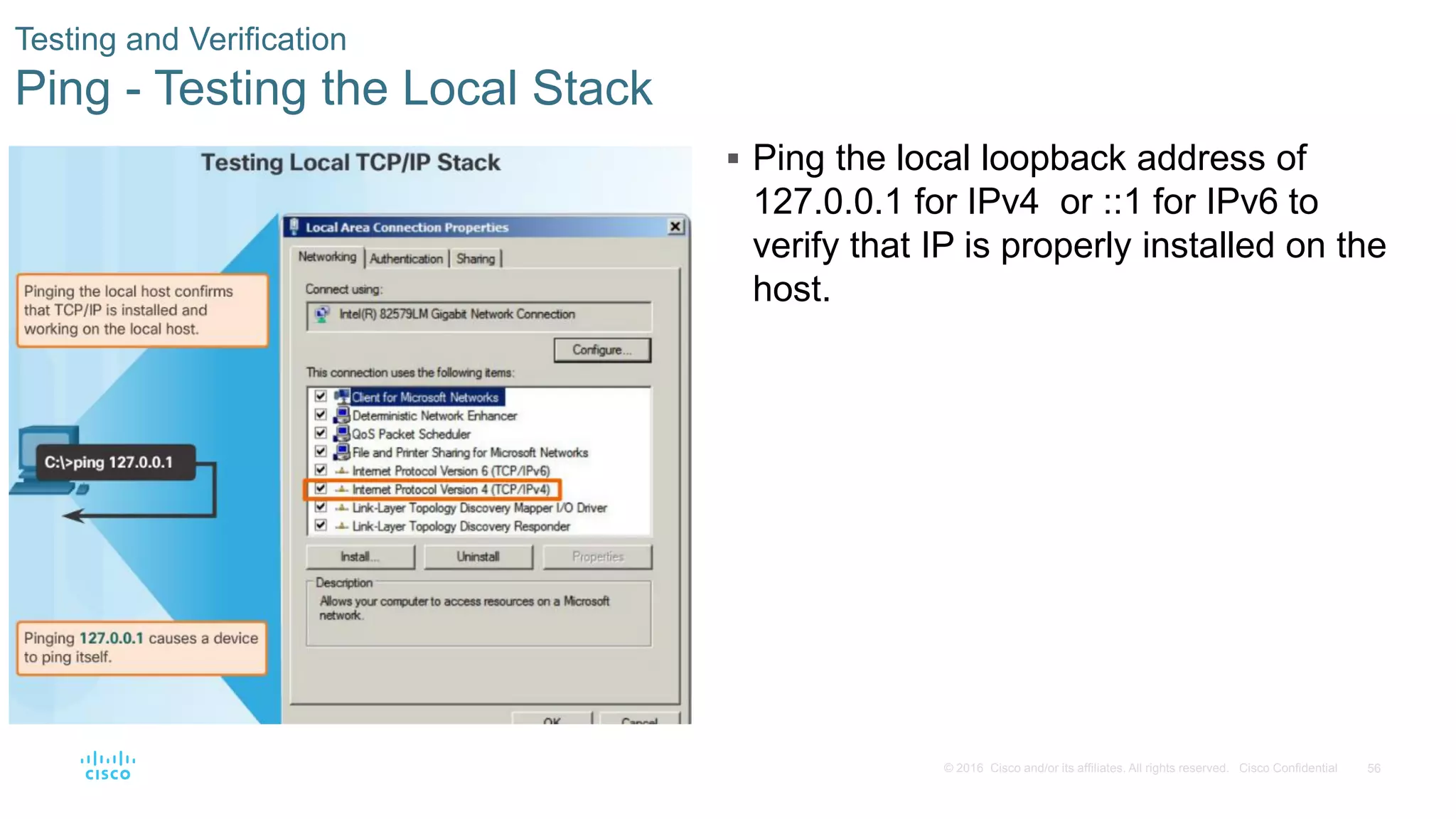
Ping - Testing the Local Stack
 Ping the local loopback address of
127.0.0.1 for IPv4 or ::1 for IPv6 to
verify that IP is properly installed on the
host.
57
© 2016 Cisco and/or its affiliates. All rights reserved. Cisco Confidential
Testing and Verification
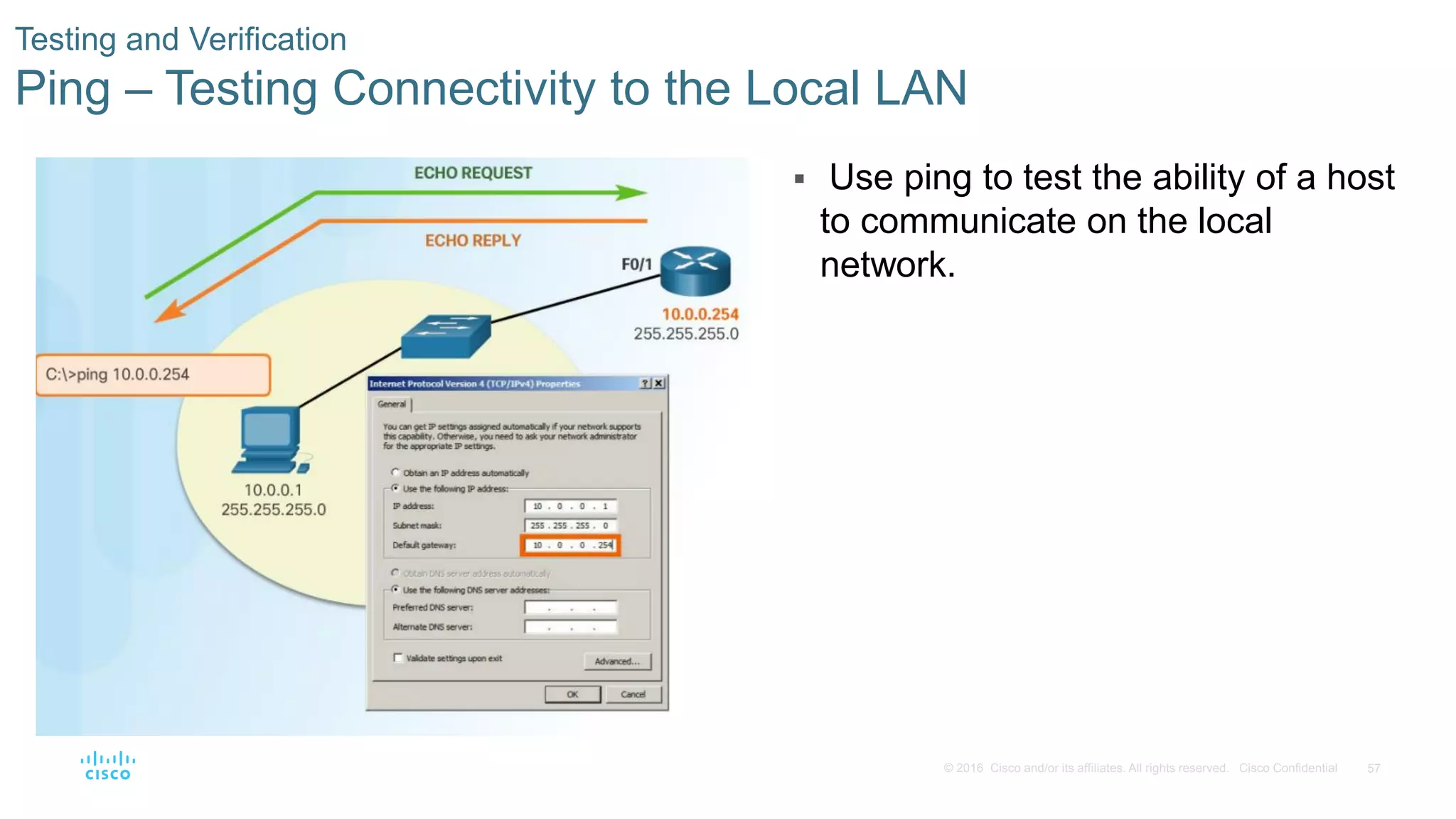
Ping – Testing Connectivity to the Local LAN
 Use ping to test the ability of a host
to communicate on the local
network.
58
© 2016 Cisco and/or its affiliates. All rights reserved. Cisco Confidential
Testing and Verification
Ping – Testing Connectivity to a Remote Host
 Use ping to test the ability of a host
to communicate across an
internetwork.
59
© 2016 Cisco and/or its affiliates. All rights reserved. Cisco Confidential
Testing and Verification
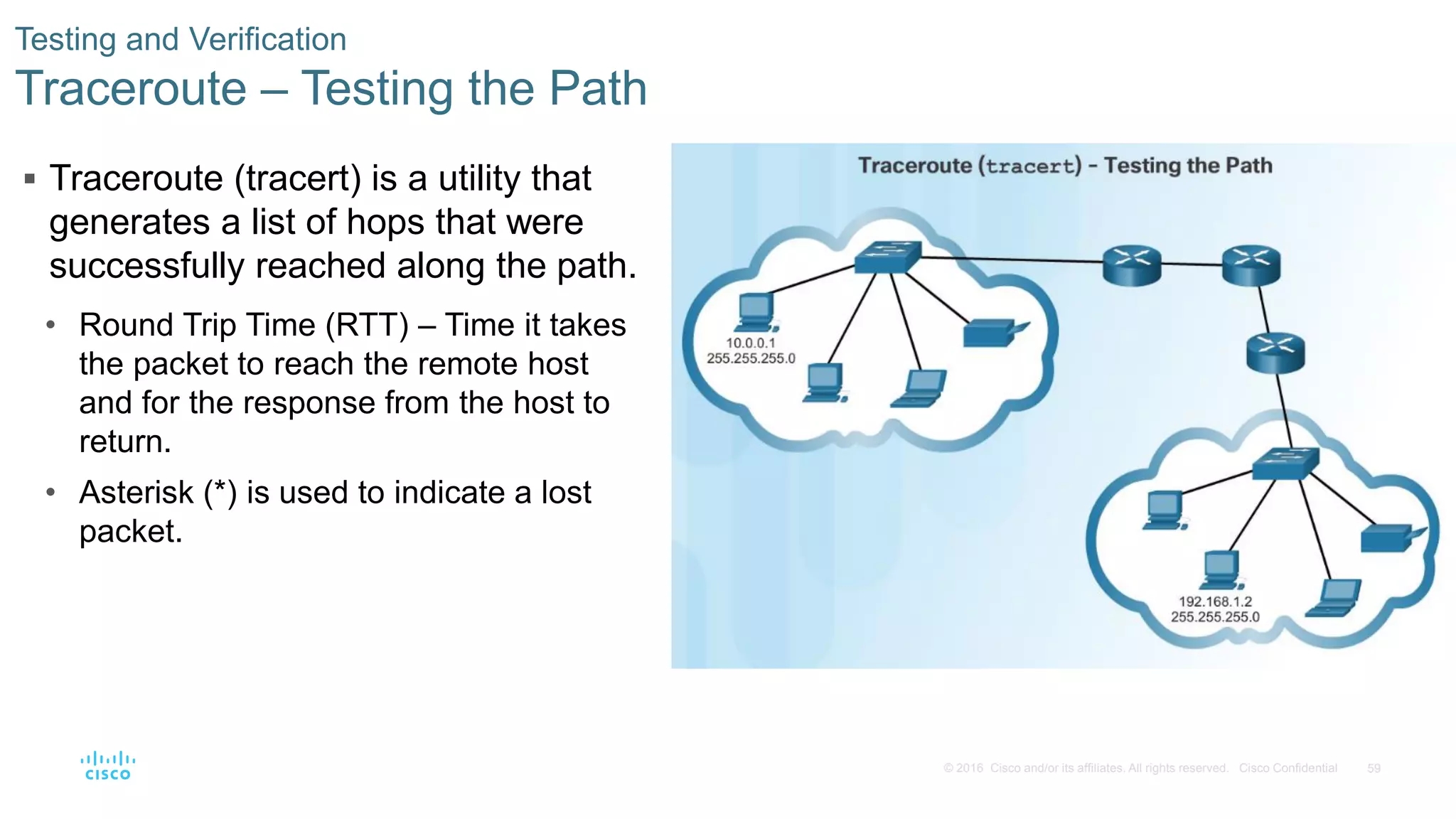
Traceroute – Testing the Path
 Traceroute (tracert) is a utility that
generates a list of hops that were
successfully reached along the path.
• Round Trip Time (RTT) – Time it takes
the packet to reach the remote host
and for the response from the host to
return.
• Asterisk (*) is used to indicate a lost
packet.
60
© 2016 Cisco and/or its affiliates. All rights reserved. Cisco Confidential
7.4 Chapter Summary
61
© 2016 Cisco and/or its affiliates. All rights reserved. Cisco Confidential
Conclusion
Chapter 7: IP Addressing
 Explain the use of IPv4 addresses to provide connectivity in small to
medium-sized business networks
 Configure IPv6 addresses to provide connectivity in small to
medium-sized business networks.
 Use common testing utilities to verify and test network connectivity.
07_IP_Addressing.pdf

07_IP_Addressing.pdf

  • 1.
    Chapter 7: IPAddressing CCNA Routing and Switching Introduction to Networks v6.0
  • 2.
    2 © 2016 Ciscoand/or its affiliates. All rights reserved. Cisco Confidential  7.1 IPv4 Network Addresses  Explain the use of IPv4 addresses to provide connectivity in small to medium-sized business networks • Convert between binary and decimal numbering systems. • Describe the structure of an IPv4 address including the network portion, the host portion, and the subnet mask. • Compare the characteristics and uses of the unicast, broadcast and multicast IPv4 addresses. • Explain public, private, and reserved IPv4 addresses.  7.2 IPv6 Network Addresses  Configure IPv6 addresses to provide connectivity in small to medium-sized business networks. • Explain the need for IPv6 addressing. • Describe the representation of an IPv6 address. • Compare types of IPv6 network addresses. • Configure global unicast addresses. • Describe multicast addresses. Chapter 7 - Sections & Objectives
  • 3.
    3 © 2016 Ciscoand/or its affiliates. All rights reserved. Cisco Confidential  7.3 Connectivity Verification  Use common testing utilities to verify and test network connectivity. • Explain how ICMP is used to test network connectivity. • Use ping and traceroute utilities to test network connectivity. Chapter 7 - Sections & Objectives (Cont.)
  • 4.
    4 © 2016 Ciscoand/or its affiliates. All rights reserved. Cisco Confidential 7.1 IPv4 Network Addresses
  • 5.
    5 © 2016 Ciscoand/or its affiliates. All rights reserved. Cisco Confidential  Binary numbering system consists of the numbers 0 and 1 called bits • IPv4 addresses are expressed in 32 binary bits divided into 4 8-bit octets Binary and Decimal Conversion IPv4 Addresses
  • 6.
    6 © 2016 Ciscoand/or its affiliates. All rights reserved. Cisco Confidential  IPv4 addresses are commonly expressed in dotted decimal notation Binary and Decimal Conversion IPv4 Addresses (Cont.)
  • 7.
    7 © 2016 Ciscoand/or its affiliates. All rights reserved. Cisco Confidential  The first row identifies the number base or radix. Decimal is 10. Binary is based on 2, therefore radix will be 2  The 2nd row considers the position of the number starting with 0. These numbers also represent the exponential value that will be used to calculate the positional value (4th row).  The 3rd row calculates the positional value by taking the radix and raising it by the exponential value of its position. Note: n^0 is always = 1.  The positional value is listed in the fourth row. Binary and Decimal Conversion Positional Notation Applying decimal positional notation
  • 8.
    8 © 2016 Ciscoand/or its affiliates. All rights reserved. Cisco Confidential Binary and Decimal Conversion Positional Notation (Cont.)  Applying binary positional notation.
  • 9.
    9 © 2016 Ciscoand/or its affiliates. All rights reserved. Cisco Confidential  To convert a binary IPv4 address to decimal enter the 8-bit binary number of each octet under the positional value of row 1 and then calculate to produce the decimal. Binary and Decimal Conversion Binary to Decimal Conversion
  • 10.
    10 © 2016 Ciscoand/or its affiliates. All rights reserved. Cisco Confidential  To convert a decimal IPv4address to binary use the positional chart and check first if the number is greater than the 128 bit. If no a 0 is placed in this position. If yes then a 1 is placed in this position.  128 is subtracted from the original number and the remainder is then checked against the next position (64) If it is less than 64 a 0 is placed in this position. If it is greater, a 1 is placed in this position and 64 is subtracted.  The process repeats until all positional values have been entered. Binary and Decimal Conversion Decimal to Binary Conversion
  • 11.
    11 © 2016 Ciscoand/or its affiliates. All rights reserved. Cisco Confidential Binary and Decimal Conversion Decimal to Binary Conversion Examples
  • 12.
    12 © 2016 Ciscoand/or its affiliates. All rights reserved. Cisco Confidential  An IPv4 address is hierarchical. • Composed of a Network portion and Host portion.  All devices on the same network must have the identical network portion.  The Subnet Mask helps devices identify the network portion and host portion. IPv4 Address Structure Network and Host Portions
  • 13.
    13 © 2016 Ciscoand/or its affiliates. All rights reserved. Cisco Confidential  Three IPv4 addresses must be configured on a host: • Unique IPv4 address of the host. • Subnet mask - identifies the network/host portion of the IPv4 address. • Default gateway -IP address of the local router interface. IPv4 Address Structure The Subnet Mask
  • 14.
    14 © 2016 Ciscoand/or its affiliates. All rights reserved. Cisco Confidential IPv4 Address Structure The Subnet Mask (Cont.)  The IPv4 address is compared to the subnet mask bit by bit, from left to right.  A 1 in the subnet mask indicates that the corresponding bit in the IPv4 address is a network bit.
  • 15.
    15 © 2016 Ciscoand/or its affiliates. All rights reserved. Cisco Confidential IPv4 Address Structure Logical AND  A logical AND is one of three basic binary operations used in digital logic.  Used to determine the Network Address  The Logical AND of two bits yields the following results:
  • 16.
    16 © 2016 Ciscoand/or its affiliates. All rights reserved. Cisco Confidential IPv4 Address Structure The Prefix Length  The Prefix Length: • Shorthand method of expressing the subnet mask. • Equals the number of bits in the subnet mask set to 1. • Written in slash notation, / followed by the number of network bits.
  • 17.
    17 © 2016 Ciscoand/or its affiliates. All rights reserved. Cisco Confidential IPv4 Address Structure Network, Host, and Broadcast Addresses  Types of Addresses in Network 192.168.10.0/24 • Network Address - host portion is all 0s (.00000000) • First Host address - host portion is all 0s and ends with a 1 (.00000001) • Last Host address - host portion is all 1s and ends with a 0 (.11111110) • Broadcast Address - host portion is all 1s (.11111111)
  • 18.
    18 © 2016 Ciscoand/or its affiliates. All rights reserved. Cisco Confidential IPv4 Unicast, Broadcast, and Multicast Static IPv4 Address Assignment to a Host  Some devices like printers, servers and network devices require a fixed IP address.  Hosts in a small network can also be configured with static addresses.
  • 19.
    19 © 2016 Ciscoand/or its affiliates. All rights reserved. Cisco Confidential IPv4 Unicast, Broadcast, and Multicast Dynamic IPv4 Address Assignment to a Host  Most networks use Dynamic Host Configuration Protocol (DHCP) to assign IPv4 addresses dynamically.  The DHCP server provides an IPv4 address, subnet mask, default gateway, and other configuration information.  DHCP leases the addresses to hosts for a certain length of time.  If the host is powered down or taken off the network, the address is returned to the pool for reuse.
  • 20.
    20 © 2016 Ciscoand/or its affiliates. All rights reserved. Cisco Confidential IPv4 Unicast, Broadcast, and Multicast IPv4 Communication  Unicast – one to one communication.  Broadcast– one to all.  Multicast – one to a select group.
  • 21.
    21 © 2016 Ciscoand/or its affiliates. All rights reserved. Cisco Confidential IPv4 Unicast, Broadcast, and Multicast Unicast Transmission  Unicast – one to one communication. • Use the address of the destination device as the destination address.
  • 22.
    22 © 2016 Ciscoand/or its affiliates. All rights reserved. Cisco Confidential IPv4 Unicast, Broadcast, and Multicast Broadcast Transmission  Broadcast– one to all • Message sent to everyone in the LAN (broadcast domain.) • destination IPv4 address has all ones (1s) in the host portion.
  • 23.
    23 © 2016 Ciscoand/or its affiliates. All rights reserved. Cisco Confidential IPv4 Unicast, Broadcast, and Multicast Multicast Transmission  Multicast– one to a select group. • 224.0.0.0 to 239.255.255.255 addresses reserved for multicast. • routing protocols use multicast transmission to exchange routing information.
  • 24.
    24 © 2016 Ciscoand/or its affiliates. All rights reserved. Cisco Confidential Types of IPv4 Addresses Public and Private IPv4 Addresses  Private Addresses • Not routable • Introduced in mid 1990s due to depletion of IPv4 addresses • Used only in internal networks. • Must be translated to a public IPv4 to be routable. • Defined by RFC 1918  Private Address Blocks • 10.0.0.0 /8 or 10.0.0.0 to 10.255.255.255 • 172.16.0.0 /12 or 172.16.0.0 to 172.31.255.255192.168.0.0 /16 • 192.168.0.0 to 192.168.255.255
  • 25.
    25 © 2016 Ciscoand/or its affiliates. All rights reserved. Cisco Confidential Types of IPv4 Addresses Special User IPv4 Addresses  Loopback addresses (127.0.0.0 /8 or 127.0.0.1) • Used on a host to test if the TCP/IP configuration is operational.  Link-Local addresses (169.254.0.0 /16 or 169.254.0.1) • Commonly known as Automatic Private IP Addressing (APIPA) addresses. • Used by Windows client to self configure if no DHCP server available.  TEST-NET addresses (192.0.2.0/24 or 192.0.2.0 to 192.0.2.255) • Used for teaching and learning.
  • 26.
    26 © 2016 Ciscoand/or its affiliates. All rights reserved. Cisco Confidential Types of IPv4 Addresses Legacy Classful Addressing  In 1981, Internet IPv4 addresses were assigned using classful addressing (RFC 790)  Network addresses were based on 3 classes: • Class A (0.0.0.0/8 to 127.0.0.0/8) – Designed to support extremely large networks with more than 16 million host addresses. • Class B (128.0.0.0 /16 – 191.255.0.0 /16) – Designed to support the needs of moderate to large size networks up to approximately 65,000 host addresses. • Class C (192.0.0.0 /24 – 223.255.255.0 /24) – Designed to support small networks with a maximum of 254 hosts.
  • 27.
    27 © 2016 Ciscoand/or its affiliates. All rights reserved. Cisco Confidential Types of IPv4 Addresses Classless Addressing  Classful Addressing wasted addresses and exhausted the availability of IPv4 addresses.  Classless Addressing Introduced in the 1990s • Classless Inter-Domain Routing (CIDR, pronounced “cider”) • Allowed service providers to allocate IPv4 addresses on any address bit boundary (prefix length) instead of only by a class A, B, or C.
  • 28.
    28 © 2016 Ciscoand/or its affiliates. All rights reserved. Cisco Confidential Types of IPv4 Addresses Assignment of IP Addresses  The following organizations manage and maintain IPv4 and IPv6 addresses for the various regions. • American Registry for Internet Numbers (ARIN)- North America. • Réseaux IP Europeans (RIPE) - Europe, the Middle East, and Central Asia • Asia Pacific Network Information Centre (APNIC) - Asia and Pacific regions • African Network Information Centre (AfriNIC) – Africa • Regional Latin-American and Caribbean IP Address Registry (LACNIC) - Latin America and some Caribbean islands
  • 29.
    29 © 2016 Ciscoand/or its affiliates. All rights reserved. Cisco Confidential 7.2 IPv6 Network Addresses
  • 30.
    30 © 2016 Ciscoand/or its affiliates. All rights reserved. Cisco Confidential IPv4 Issues The Need for IPv6  IPv6 versus IPv4: • Has a larger 128-bit address space • 340 undecillion addresses • Solves limitations with IPv4 • Adds enhancement like address auto- configuration.  Why IPv6 is needed: • Rapidly increasing Internet population • Depletion of IPv4 • Issues with NAT • Internet of Things
  • 31.
    31 © 2016 Ciscoand/or its affiliates. All rights reserved. Cisco Confidential IPv4 Issues IPv4 and IPv6 Coexistence  Migration from IPv4 to IPv6 Techniques Translation - Network Address Translation 64 (NAT64) allows IPv6-enabled devices to communicate with IPv4 devices. Tunneling - The IPv6 packet is encapsulated inside an IPv4 packet. Dual stack - Devices run both IPv4 and IPv6 protocol stacks simultaneously.
  • 32.
    32 © 2016 Ciscoand/or its affiliates. All rights reserved. Cisco Confidential IPv6 Addressing IPv6 Address Representation  IPv6 Addresses: • 128 bits in length • Every 4 bits is represented by a single hexadecimal digit • Hextet - unofficial term referring to a segment of 16 bits or four hexadecimal values.
  • 33.
    33 © 2016 Ciscoand/or its affiliates. All rights reserved. Cisco Confidential IPv6 Addressing IPv6 Address Representation (Cont.)  Preferred format for IPv6 representation
  • 34.
    34 © 2016 Ciscoand/or its affiliates. All rights reserved. Cisco Confidential IPv6 Addressing Rule 1 – Omit Leading 0s  In order to reduce or compress IPv6 • First rule is to omit leading zeros in any hextet.
  • 35.
    35 © 2016 Ciscoand/or its affiliates. All rights reserved. Cisco Confidential IPv6 Addressing Rule 2 – Omit All 0 Segments  Rule 2 – Omit All 0 Segments • A double colon (::) can replace any single, contiguous string of one or more 16-bit segments (hextets) consisting of all 0s.
  • 36.
    36 © 2016 Ciscoand/or its affiliates. All rights reserved. Cisco Confidential IPv6 Addressing Rule 2 – Omit All 0 Segments (Cont.)  Rule 2 – Omit All 0 Segments • A double colon (::) can replace any single, contiguous string of one or more 16-bit segments (hextets) consisting of all 0s.
  • 37.
    37 © 2016 Ciscoand/or its affiliates. All rights reserved. Cisco Confidential Types of IPv6 Addresses IPv6 Address Types  Three types of IPv6 addresses: • Unicast- Single source IPv6 address. • Multicast - An IPv6 multicast address is used to send a single IPv6 packet to multiple destinations. • Anycast - An IPv6 anycast address is any IPv6 unicast address that can be assigned to multiple devices.
  • 38.
    38 © 2016 Ciscoand/or its affiliates. All rights reserved. Cisco Confidential Types of IPv6 Addresses IPv6 Prefix Length  The IPv6 prefix length is used to indicate the network portion of an IPv6 address: • The prefix length can range from 0 to 128. • Typical IPv6 prefix length for most LANs is /64
  • 39.
    39 © 2016 Ciscoand/or its affiliates. All rights reserved. Cisco Confidential Types of IPv6 Addresses IPv6 Unicast Addresses  Global Unicast - These are globally unique, Internet routable addresses.  Link-local - used to communicate with other devices on the same local link. Confined to a single link.  Unique Local - used for local addressing within a site or between a limited number of sites.
  • 40.
    40 © 2016 Ciscoand/or its affiliates. All rights reserved. Cisco Confidential Types of IPv6 Addresses IPv6 Link-Local Unicast Addresses  IPv6 link-local addresses: • Enable a device to communicate with other IPv6-enabled devices on the same link only. • Are created even if the device has not been assigned a global unicast IPv6 address. • Are in the FE80::/10 range. Note: Typically, it is the link-local address of the router that is used as the default gateway for other devices on the link.
  • 41.
    41 © 2016 Ciscoand/or its affiliates. All rights reserved. Cisco Confidential IPv6 Unicast Addresses Structure of an IPv6 Global Unicast Address  A global unicast address has three parts: • Global routing prefix - network, portion of the address that is assigned by the provider. Typically /48. • Subnet ID – Used to subnet within an organization. • Interface ID - equivalent to the host portion of an IPv4 address.  Currently, only global unicast addresses with the first three bits of 001 or 2000::/3 are being assigned
  • 42.
    42 © 2016 Ciscoand/or its affiliates. All rights reserved. Cisco Confidential IPv6 Unicast Addresses Static Configuration of a Global Unicast Address  Router Configuration:  Similar commands to IPv4, replace IPv4 with IPv6  Command to configure andIPv6 global unicast on an interface is ipv6 address ipv6- address/prefix-length
  • 43.
    43 © 2016 Ciscoand/or its affiliates. All rights reserved. Cisco Confidential IPv6 Unicast Addresses Static Configuration of a Global Unicast Address (Cont.)  Host Configuration: • Manually configuring the IPv6 address on a host is similar to configuring an IPv4 address • Default gateway address can be configured to match the link-local or global unicast address of the Gigabit Ethernet interface.  Dynamic assignment of IPv6 addresses: • Stateless Address Autoconfiguration (SLAAC) • Stateful DHCPv6
  • 44.
    44 © 2016 Ciscoand/or its affiliates. All rights reserved. Cisco Confidential IPv6 Unicast Addresses Dynamic Configuration - SLAAC  Stateless Address Autoconfiguration (SLAAC): • A device can obtain its prefix, prefix length, default gateway address, and other information from an IPv6 router. • Uses the local router’s ICMPv6 Router Advertisement (RA) messages  ICMPv6 RA messages sent every 200 seconds to all IPv6-enabled devices on the network. Option 1 (SLAAC Only) – "I'm everything you need (Prefix, Prefix-length, Default Gateway)" Option 2 (SLAAC and DHCPv6) – "Here is my information but you need to get other information such as DNS addresses from a DHCPv6 server." Option 3 (DHCPv6 Only) – "I can’t help you. Ask a DHCPv6 server for all your information."
  • 45.
    45 © 2016 Ciscoand/or its affiliates. All rights reserved. Cisco Confidential IPv6 Unicast Addresses Dynamic Configuration – DHCPv6  The RA Option 1: SLAAC only (this is the default)  RA Option 2: SLAAC and Stateless DHCPv6: • Uses SLAAC for IPv6 global unicast address and default gateway. • Uses a stateless DHCPv6 server for other information.  RA Option 3: Stateful DHCPv6 • Uses the Routers link-local address for the default gateway. • Uses DHCPv6 for all other information.
  • 46.
    46 © 2016 Ciscoand/or its affiliates. All rights reserved. Cisco Confidential IPv6 Unicast Addresses EUI-64 Process and Randomly Generated  When the RA message is SLAAC or SLAAC with stateless DHCPv6, the client must generate its own Interface ID • The Interface ID can be created using the EUI-64 process or a randomly generated 64- bit number  An EUI-64 Interface ID is represented in binary and is made up of three parts: • 24-bit OUI from the client MAC address, but the 7th bit (the Universally/Locally (U/L) bit) is reversed. • The inserted 16-bit value FFFE (in hexadecimal). • 24-bit Device Identifier from the client MAC address.
  • 47.
    47 © 2016 Ciscoand/or its affiliates. All rights reserved. Cisco Confidential IPv6 Unicast Addresses EUI-64 Process and Randomly Generated (Cont.)  Randomly Generated Interface IDs • Windows uses a randomly generated Interface ID
  • 48.
    48 © 2016 Ciscoand/or its affiliates. All rights reserved. Cisco Confidential IPv6 Unicast Addresses Dynamic Link-Local Addresses  Link-local address can be established dynamically or configured manually.  Cisco IOS routers use EUI-64 to generate the Interface ID for all link-local address on IPv6 interfaces.  Drawback to using the dynamically assigned link-local address is the long interface ID, therefore they are often configured statically.
  • 49.
    49 © 2016 Ciscoand/or its affiliates. All rights reserved. Cisco Confidential IPv6 Unicast Addresses Static Link-Local Addresses  Manual Configuration of the link-local address allows the creation of a simple, easy to remember address.
  • 50.
    50 © 2016 Ciscoand/or its affiliates. All rights reserved. Cisco Confidential IPv6 Unicast Addresses Verifying IPv6 Address Configuration  The commands to verify IPv6 configuration are similar to IPv4 • show ipv6 interface brief • show ipv6 route  The ping command for IPv6 is identical to the command used with IPv4, except that an IPv6 address is used.
  • 51.
    51 © 2016 Ciscoand/or its affiliates. All rights reserved. Cisco Confidential IPv6 Multicast Addresses Assigned IPv6 Multicast Addresses  There are two types of IPv6 multicast addresses: • Assigned multicast - reserved multicast addresses for predefined groups of devices • Solicited node multicast  Two common IPv6 assigned multicast groups: • FF02::1 All-nodes multicast group – This is a multicast group that all IPv6-enabled devices join. Similar to a broadcast in IPv4 • FF02::2 All-routers multicast group – This is a multicast group that all IPv6 routers join.
  • 52.
    52 © 2016 Ciscoand/or its affiliates. All rights reserved. Cisco Confidential IPv6 Multicast Addresses Solicited-Node IPv6 Multicast Addresses  Solicited-node multicast address: • Mapped to .a special Ethernet multicast address • Allows Ethernet NIC to filter frame on destination MAC.
  • 53.
    53 © 2016 Ciscoand/or its affiliates. All rights reserved. Cisco Confidential 7.3 Connectivity Verification
  • 54.
    54 © 2016 Ciscoand/or its affiliates. All rights reserved. Cisco Confidential ICMP ICMPv4 and ICMPv6  ICMPv4 is the messaging protocol for IPv4. ICMPv6 provides the same services for IPv6  ICMP messages common to both include: • Host confirmation • Destination or Service Unreachable • Time exceeded • Route redirection
  • 55.
    55 © 2016 Ciscoand/or its affiliates. All rights reserved. Cisco Confidential ICMP ICMPv6 Router Solicitation and Router Advertisement Messages  ICMPv6 includes four new protocols as part of the Neighbor Discovery Protocol (ND or NDP) • Router Solicitation (RS) message • Router Advertisement (RA) message  RA messages used to provide addressing information to hosts • Neighbor Solicitation (NS) message • Neighbor Advertisement (NA) message  Neighbor Solicitation and Neighbor Advertisement messages are used for Address resolution and Duplicate Address Detection (DAD).
  • 56.
    56 © 2016 Ciscoand/or its affiliates. All rights reserved. Cisco Confidential Testing and Verification Ping - Testing the Local Stack  Ping the local loopback address of 127.0.0.1 for IPv4 or ::1 for IPv6 to verify that IP is properly installed on the host.
  • 57.
    57 © 2016 Ciscoand/or its affiliates. All rights reserved. Cisco Confidential Testing and Verification Ping – Testing Connectivity to the Local LAN  Use ping to test the ability of a host to communicate on the local network.
  • 58.
    58 © 2016 Ciscoand/or its affiliates. All rights reserved. Cisco Confidential Testing and Verification Ping – Testing Connectivity to a Remote Host  Use ping to test the ability of a host to communicate across an internetwork.
  • 59.
    59 © 2016 Ciscoand/or its affiliates. All rights reserved. Cisco Confidential Testing and Verification Traceroute – Testing the Path  Traceroute (tracert) is a utility that generates a list of hops that were successfully reached along the path. • Round Trip Time (RTT) – Time it takes the packet to reach the remote host and for the response from the host to return. • Asterisk (*) is used to indicate a lost packet.
  • 60.
    60 © 2016 Ciscoand/or its affiliates. All rights reserved. Cisco Confidential 7.4 Chapter Summary
  • 61.
    61 © 2016 Ciscoand/or its affiliates. All rights reserved. Cisco Confidential Conclusion Chapter 7: IP Addressing  Explain the use of IPv4 addresses to provide connectivity in small to medium-sized business networks  Configure IPv6 addresses to provide connectivity in small to medium-sized business networks.  Use common testing utilities to verify and test network connectivity.