MESSUREMENT METHODS
OF JUNCTION-DEPTH & SHEET
RESITANCE OF DIFFUSED LAYER
Hoang Tuan Linh
Nguyen Van Long
Nguyen Minh
Hanoi, Dec 2nd 2016
CONTENT
• Overview of diffused layer
• Junction-depth measurement techniques
• Sheet-resitance measurement techniques
2
I. Junction-depth measurement techniques
1. Groove-and-Stain Method
2. Angle-lap Method
3
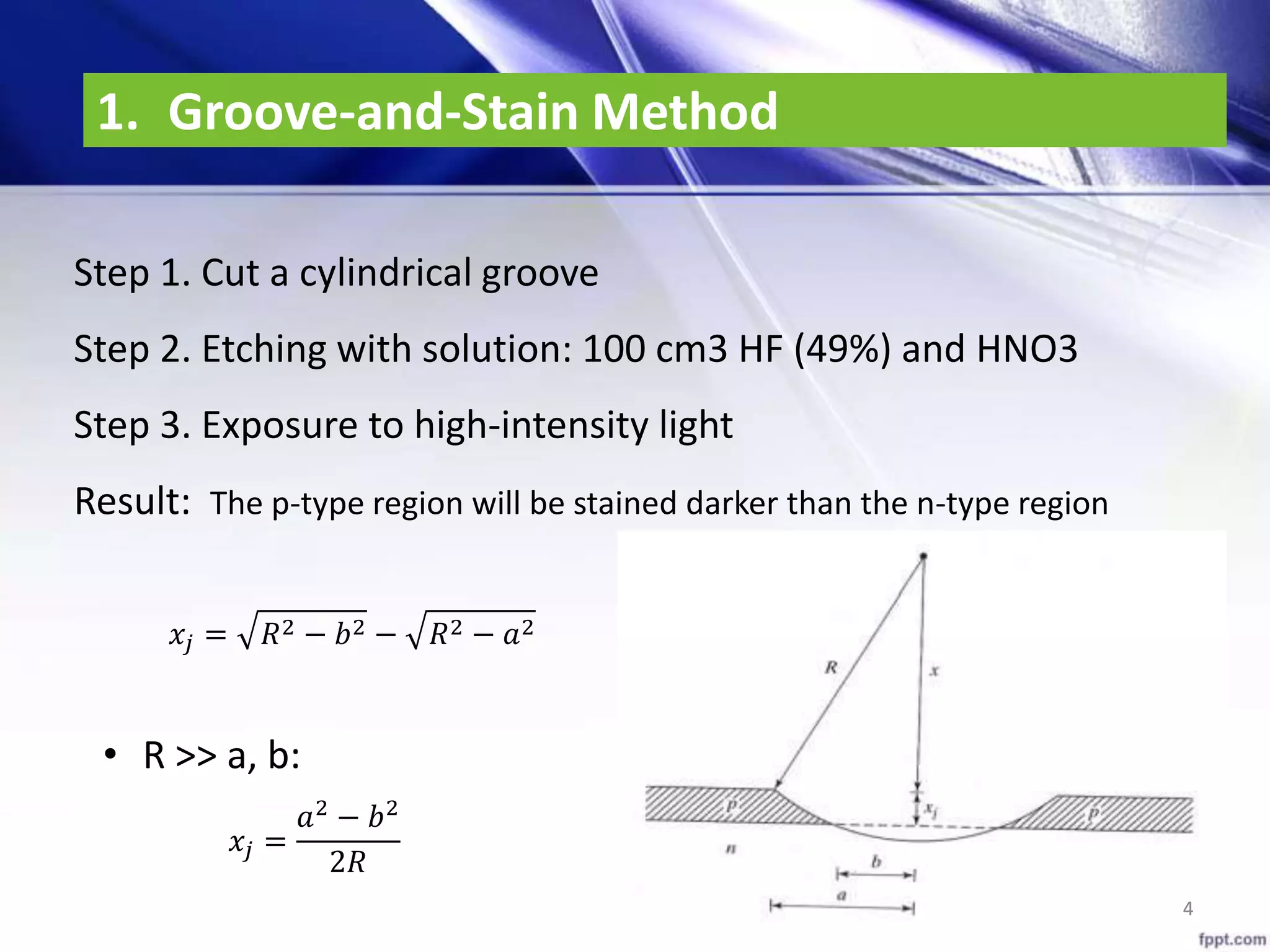
1. Groove-and-Stain Method
44
Step 1. Cut a cylindrical groove
Step 2. Etching with solution: 100 cm3 HF (49%) and HNO3
Step 3. Exposure to high-intensity light
Result: The p-type region will be stained darker than the n-type region
𝑥𝑗 = 𝑅2 − 𝑏2 − 𝑅2 − 𝑎2
𝑥𝑗 =
𝑎2 − 𝑏2
2𝑅
• R >> a, b:
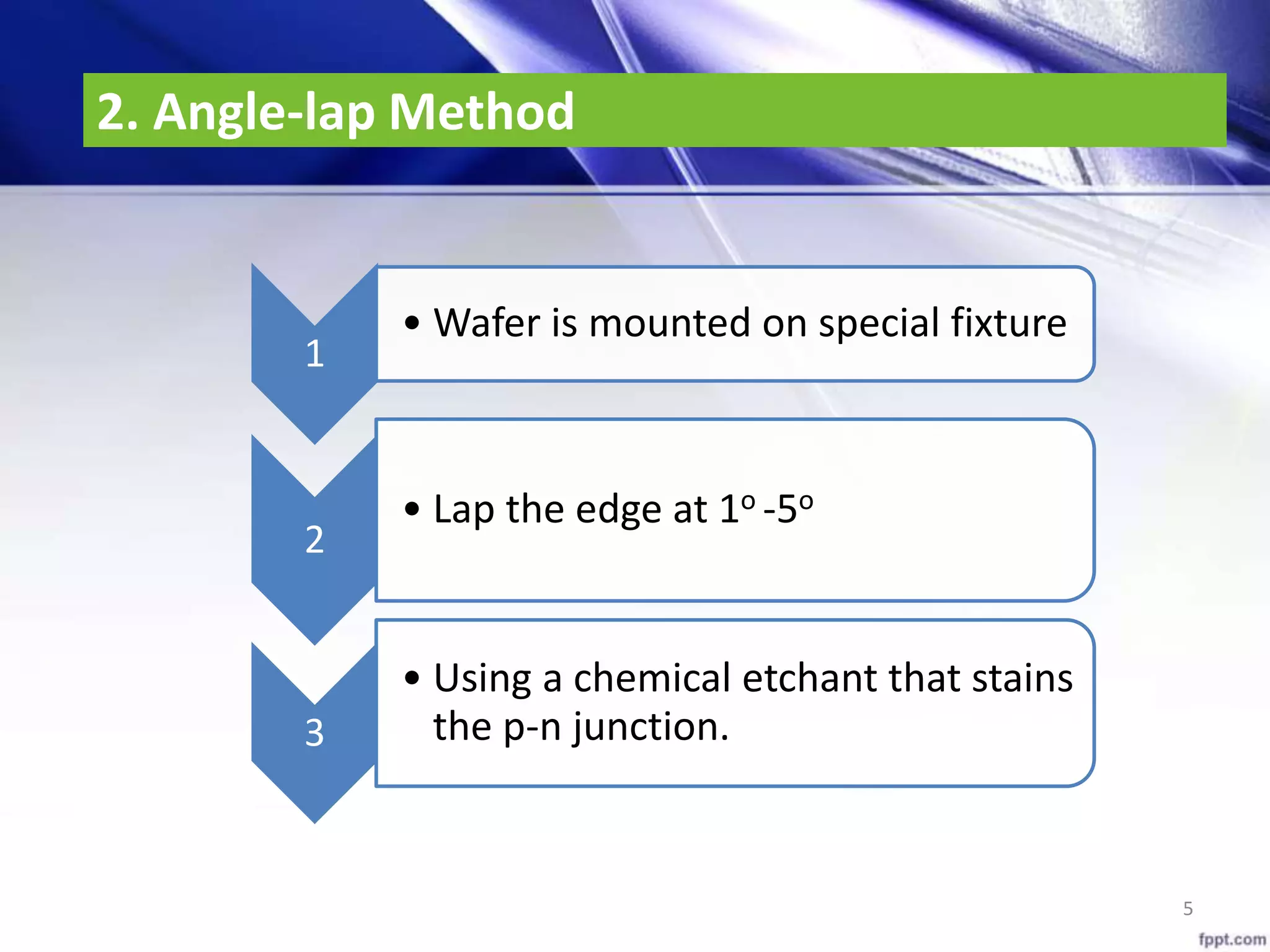
2. Angle-lap Method
5
1
• Wafer is mounted on special fixture
2
• Lap the edge at 1o -5o
3
• Using a chemical etchant that stains
the p-n junction.
2. Angle-lap Method
6
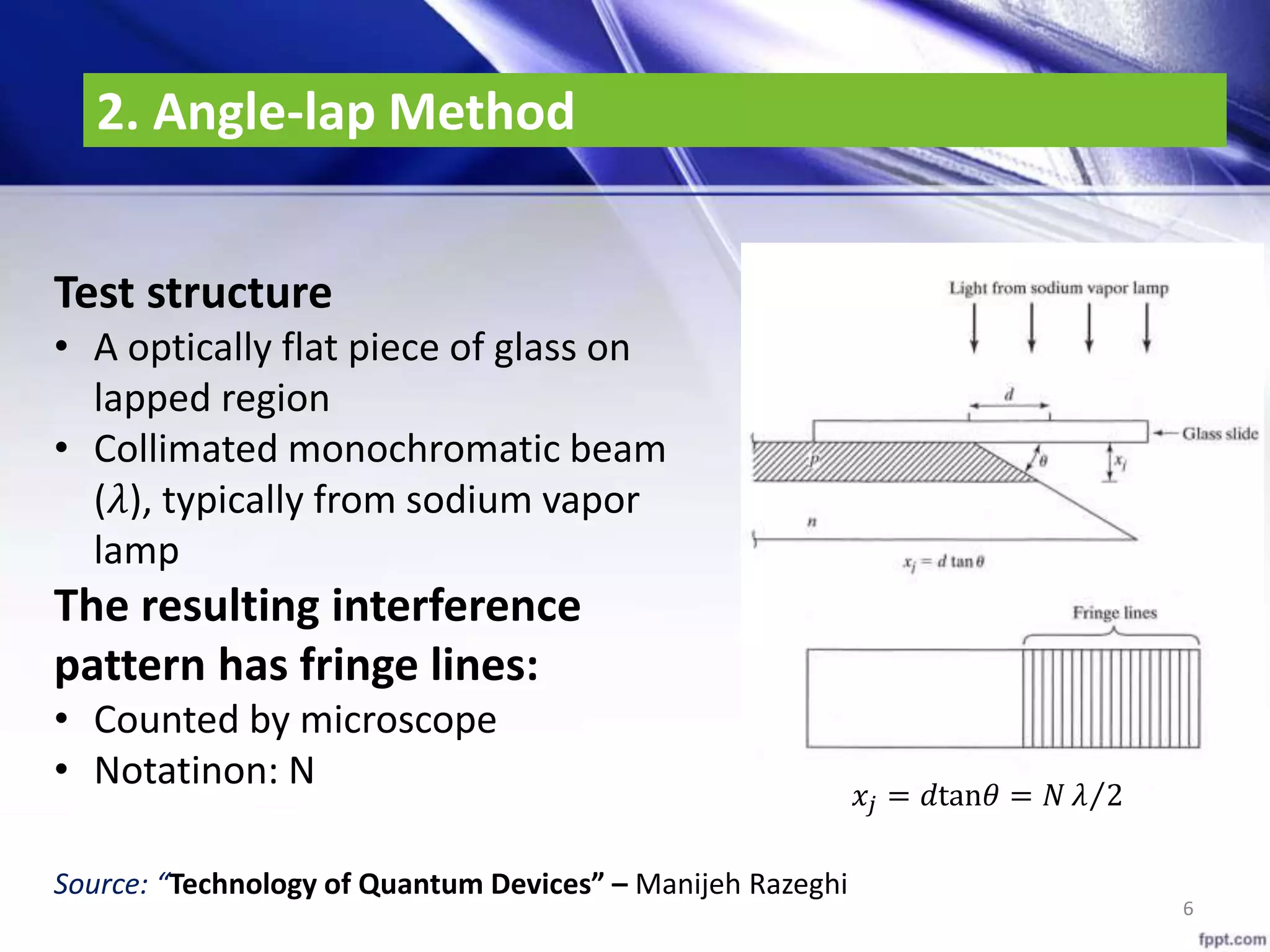
𝑥𝑗 = 𝑑tan𝜃 = 𝑁 𝜆 2
Test structure
• A optically flat piece of glass on
lapped region
• Collimated monochromatic beam
(𝜆), typically from sodium vapor
lamp
The resulting interference
pattern has fringe lines:
• Counted by microscope
• Notatinon: N
Source: “Technology of Quantum Devices” – Manijeh Razeghi
II. Sheet-resitance measurement techniques
7
Sheet-resitance = Ω/□ (ohm per square) (*)
𝑹 𝑺 = [𝒒 𝝁 𝑪 𝑪 𝒆 𝒙 𝒅𝒙]−𝟏
[𝜴 /□]
𝐶𝑒 𝑥 : dopant concentration; 𝜇 𝐶 : mobility depend on concentration
𝑅 𝑆: square-resistance
When it expresses the electrical
resistance of a sheet (such as a thin
film or a film-like substance), this
sheet-resitance is used. R = ρ × L/A = L/W ×ρs
ρ 𝑺 = ρ/t (t: thickness)
For semiconductors:
(*) Source: http://en.napson.co.jp/technique/
II. Sheet-resitance measurement techniques
8
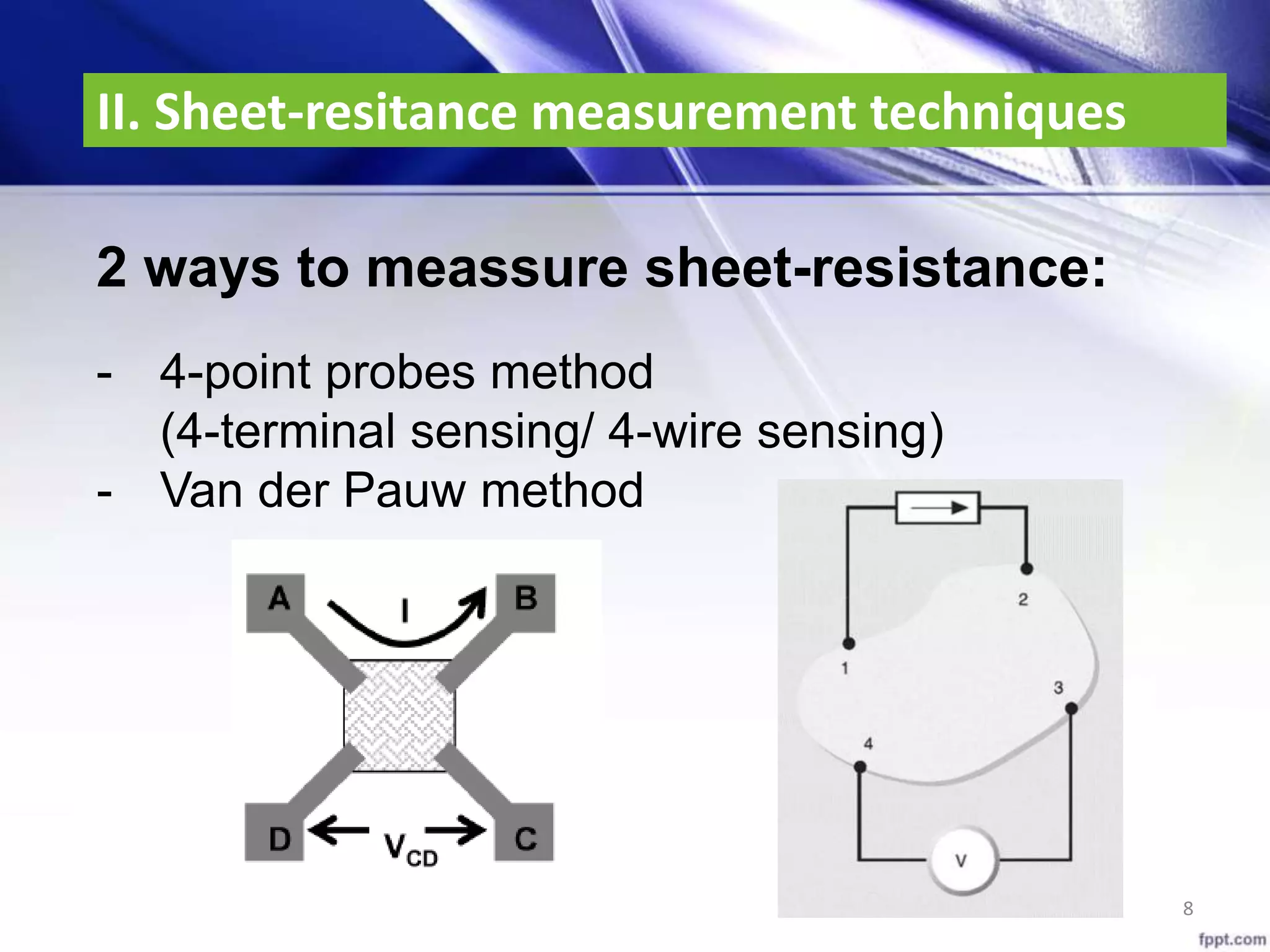
2 ways to meassure sheet-resistance:
- 4-point probes method
(4-terminal sensing/ 4-wire sensing)
- Van der Pauw method
II. Sheet-resitance measurement techniques
9
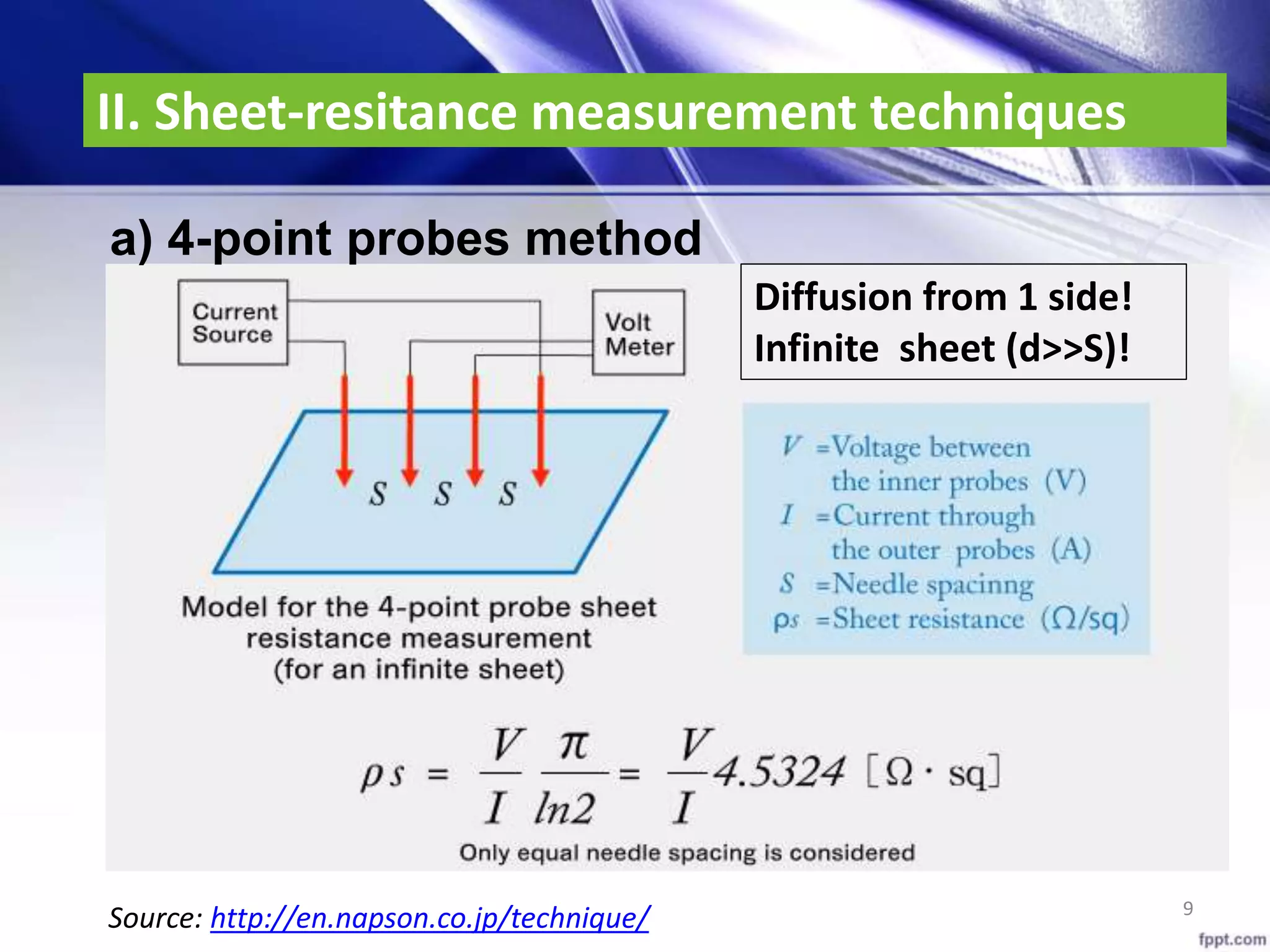
a) 4-point probes method
Source: http://en.napson.co.jp/technique/
Diffusion from 1 side!
Infinite sheet (d>>S)!
II. Sheet-resitance measurement techniques
10
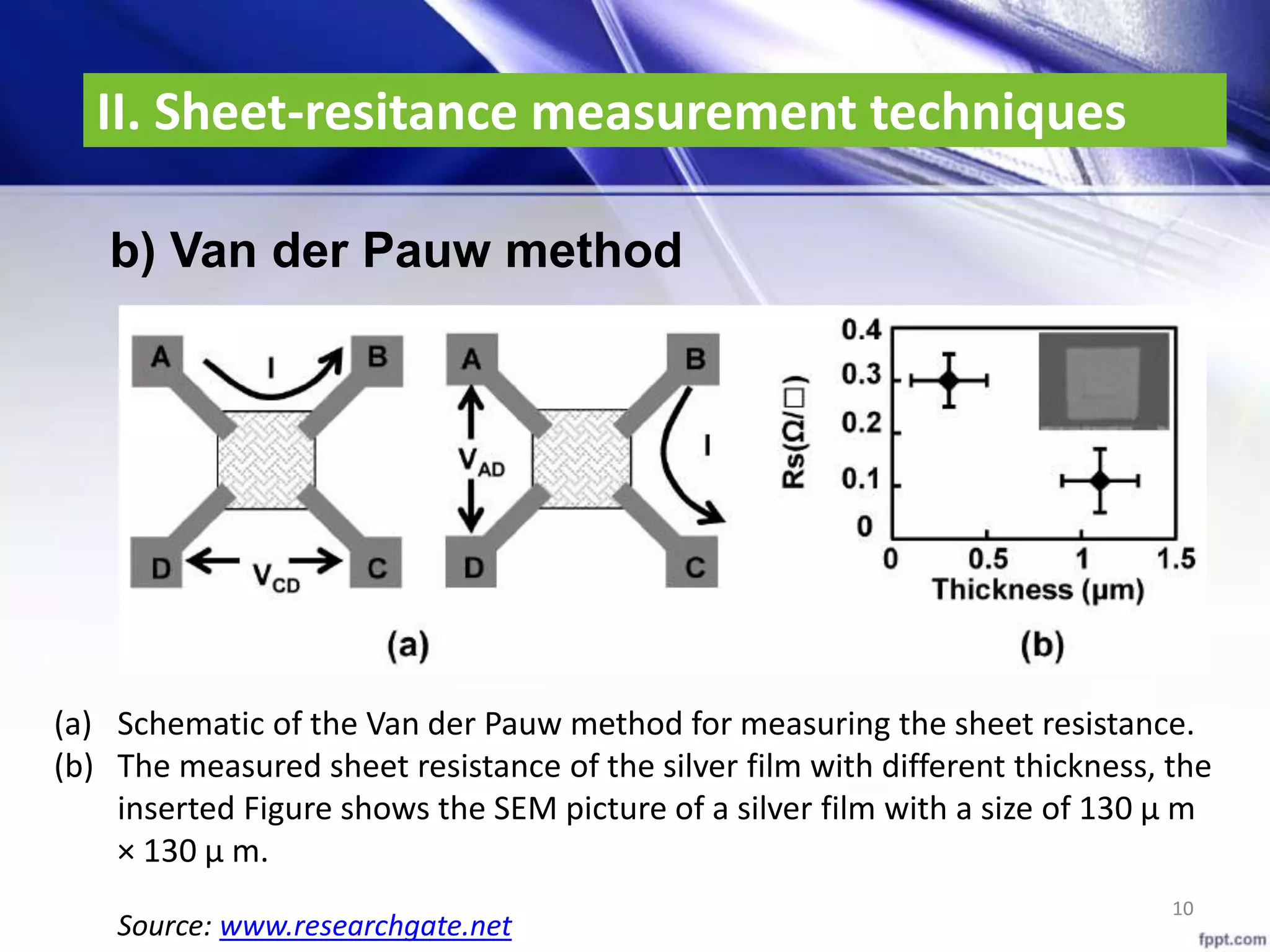
b) Van der Pauw method
Source: www.researchgate.net
(a) Schematic of the Van der Pauw method for measuring the sheet resistance.
(b) The measured sheet resistance of the silver film with different thickness, the
inserted Figure shows the SEM picture of a silver film with a size of 130 μ m
× 130 μ m.
II. Sheet-resitance measurement techniques
11
b) Van der Pauw method
𝑹 =
𝟏
𝟒
[
𝑽 𝟏𝟐
𝑰 𝟑𝟒
+
𝑽 𝟐𝟑
𝑰 𝟒𝟏
+
𝑽 𝟑𝟒
𝑰 𝟏𝟐
+
𝑽 𝟒𝟏
𝑰 𝟐𝟑
]
𝑹 𝑺 =
𝝅
𝒍𝒏𝟐
𝑭 𝑸 . 𝑹
F(Q): correction factor (depend
on the shape of the sample)
Square => F(Q) = 1; 𝑅 𝑆 = 4.53𝑅
Source: “Công nghệ chế tạo mạch vi điện tử”
– GS.Nguyễn Đức Chiến
12
THANKS FOR
YOUR LISTENING!

Junction-depth & Sheet-resitance meassurement

  • 1.
    MESSUREMENT METHODS OF JUNCTION-DEPTH& SHEET RESITANCE OF DIFFUSED LAYER Hoang Tuan Linh Nguyen Van Long Nguyen Minh Hanoi, Dec 2nd 2016
  • 2.
    CONTENT • Overview ofdiffused layer • Junction-depth measurement techniques • Sheet-resitance measurement techniques 2
  • 3.
    I. Junction-depth measurementtechniques 1. Groove-and-Stain Method 2. Angle-lap Method 3
  • 4.
    1. Groove-and-Stain Method 44 Step1. Cut a cylindrical groove Step 2. Etching with solution: 100 cm3 HF (49%) and HNO3 Step 3. Exposure to high-intensity light Result: The p-type region will be stained darker than the n-type region 𝑥𝑗 = 𝑅2 − 𝑏2 − 𝑅2 − 𝑎2 𝑥𝑗 = 𝑎2 − 𝑏2 2𝑅 • R >> a, b:
  • 5.
    2. Angle-lap Method 5 1 •Wafer is mounted on special fixture 2 • Lap the edge at 1o -5o 3 • Using a chemical etchant that stains the p-n junction.
  • 6.
    2. Angle-lap Method 6 𝑥𝑗= 𝑑tan𝜃 = 𝑁 𝜆 2 Test structure • A optically flat piece of glass on lapped region • Collimated monochromatic beam (𝜆), typically from sodium vapor lamp The resulting interference pattern has fringe lines: • Counted by microscope • Notatinon: N Source: “Technology of Quantum Devices” – Manijeh Razeghi
  • 7.
    II. Sheet-resitance measurementtechniques 7 Sheet-resitance = Ω/□ (ohm per square) (*) 𝑹 𝑺 = [𝒒 𝝁 𝑪 𝑪 𝒆 𝒙 𝒅𝒙]−𝟏 [𝜴 /□] 𝐶𝑒 𝑥 : dopant concentration; 𝜇 𝐶 : mobility depend on concentration 𝑅 𝑆: square-resistance When it expresses the electrical resistance of a sheet (such as a thin film or a film-like substance), this sheet-resitance is used. R = ρ × L/A = L/W ×ρs ρ 𝑺 = ρ/t (t: thickness) For semiconductors: (*) Source: http://en.napson.co.jp/technique/
  • 8.
    II. Sheet-resitance measurementtechniques 8 2 ways to meassure sheet-resistance: - 4-point probes method (4-terminal sensing/ 4-wire sensing) - Van der Pauw method
  • 9.
    II. Sheet-resitance measurementtechniques 9 a) 4-point probes method Source: http://en.napson.co.jp/technique/ Diffusion from 1 side! Infinite sheet (d>>S)!
  • 10.
    II. Sheet-resitance measurementtechniques 10 b) Van der Pauw method Source: www.researchgate.net (a) Schematic of the Van der Pauw method for measuring the sheet resistance. (b) The measured sheet resistance of the silver film with different thickness, the inserted Figure shows the SEM picture of a silver film with a size of 130 μ m × 130 μ m.
  • 11.
    II. Sheet-resitance measurementtechniques 11 b) Van der Pauw method 𝑹 = 𝟏 𝟒 [ 𝑽 𝟏𝟐 𝑰 𝟑𝟒 + 𝑽 𝟐𝟑 𝑰 𝟒𝟏 + 𝑽 𝟑𝟒 𝑰 𝟏𝟐 + 𝑽 𝟒𝟏 𝑰 𝟐𝟑 ] 𝑹 𝑺 = 𝝅 𝒍𝒏𝟐 𝑭 𝑸 . 𝑹 F(Q): correction factor (depend on the shape of the sample) Square => F(Q) = 1; 𝑅 𝑆 = 4.53𝑅 Source: “Công nghệ chế tạo mạch vi điện tử” – GS.Nguyễn Đức Chiến
  • 12.

Editor's Notes

  • #8  𝐶 𝑒 𝑥 : nồng độ hạt dẫn 𝜇 𝐶 : độ linh động phụ thuộc nồng độ 𝑅 𝑆 : square-resistance Lý do đo sheet-resistance: xác định diffusion profile (phân bố nồng độ tạp) theo chiều ngang
  • #9 non-contact: không tiếp xúc
  • #10 - S: needle spacing (khoảng cách giữa các kim) - inner probe: đầu dò bên trong outer probe: đầu dò bên ngoài Diffsion from 1 side! (đế là cách điện hoặc có điện trở suất lớn hơn nhiều lớp khuếch tán)