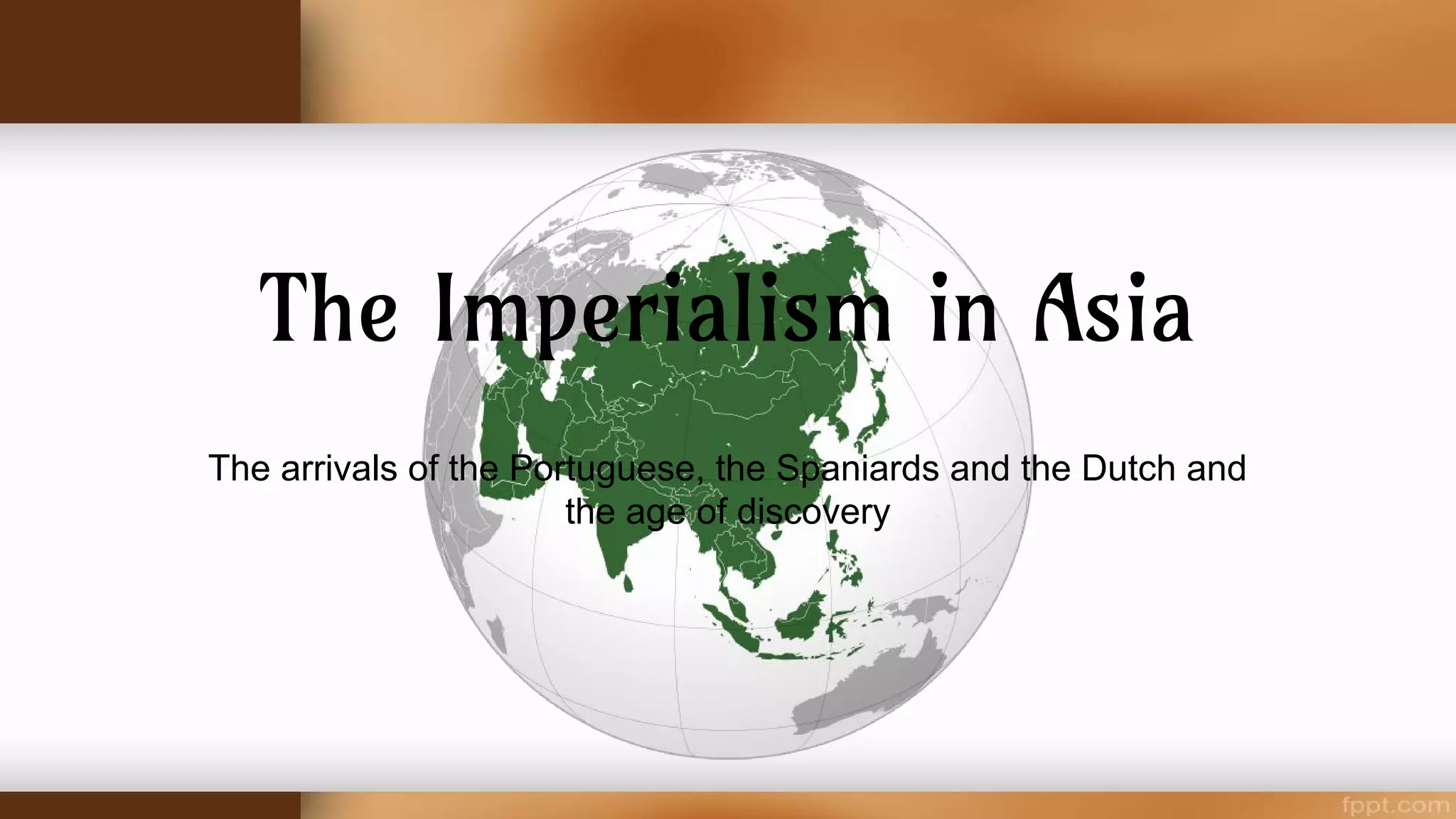
The Imperialism in Asia
The arrivals of the Portuguese, the Spaniards and the Dutch and
the age of discovery
Peer Assessment (01/12/2015)
• Lau Hui Ming
• Wong Yun Teng
• Farah
• Tee Jane
• Alison
• Christina
• Ngu Wei King
• Voo Zat Ting
• Khoo Zi Lin
Introduction
• Imperialism can be defined as a policy of extending a country’s power and
influence through diplomacy or military force. It is a political and
economic control either formally or informally.
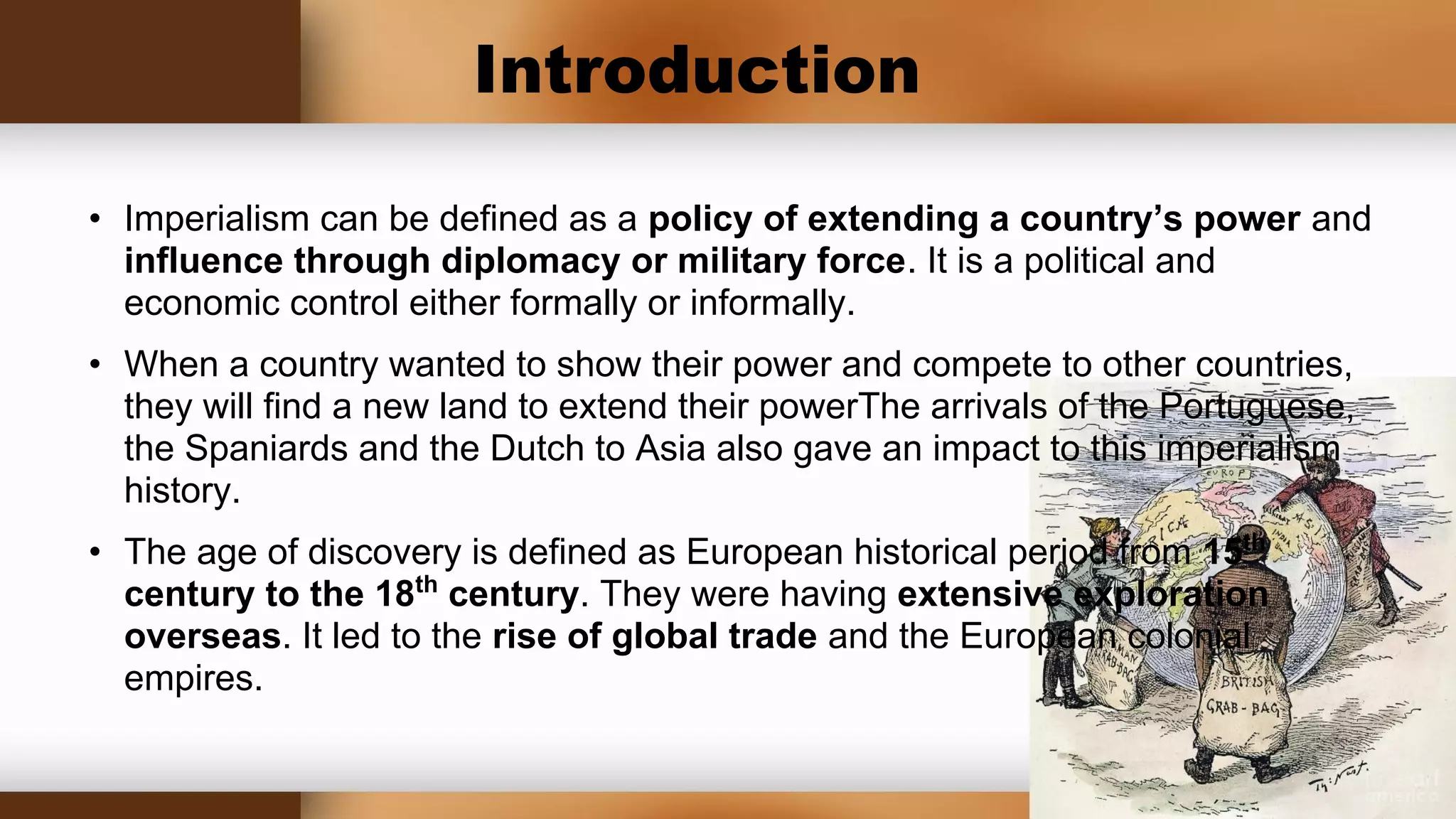
• When a country wanted to show their power and compete to other countries,
they will find a new land to extend their powerThe arrivals of the Portuguese,
the Spaniards and the Dutch to Asia also gave an impact to this imperialism
history.
• The age of discovery is defined as European historical period from 15th
century to the 18th century. They were having extensive exploration
overseas. It led to the rise of global trade and the European colonial
empires.
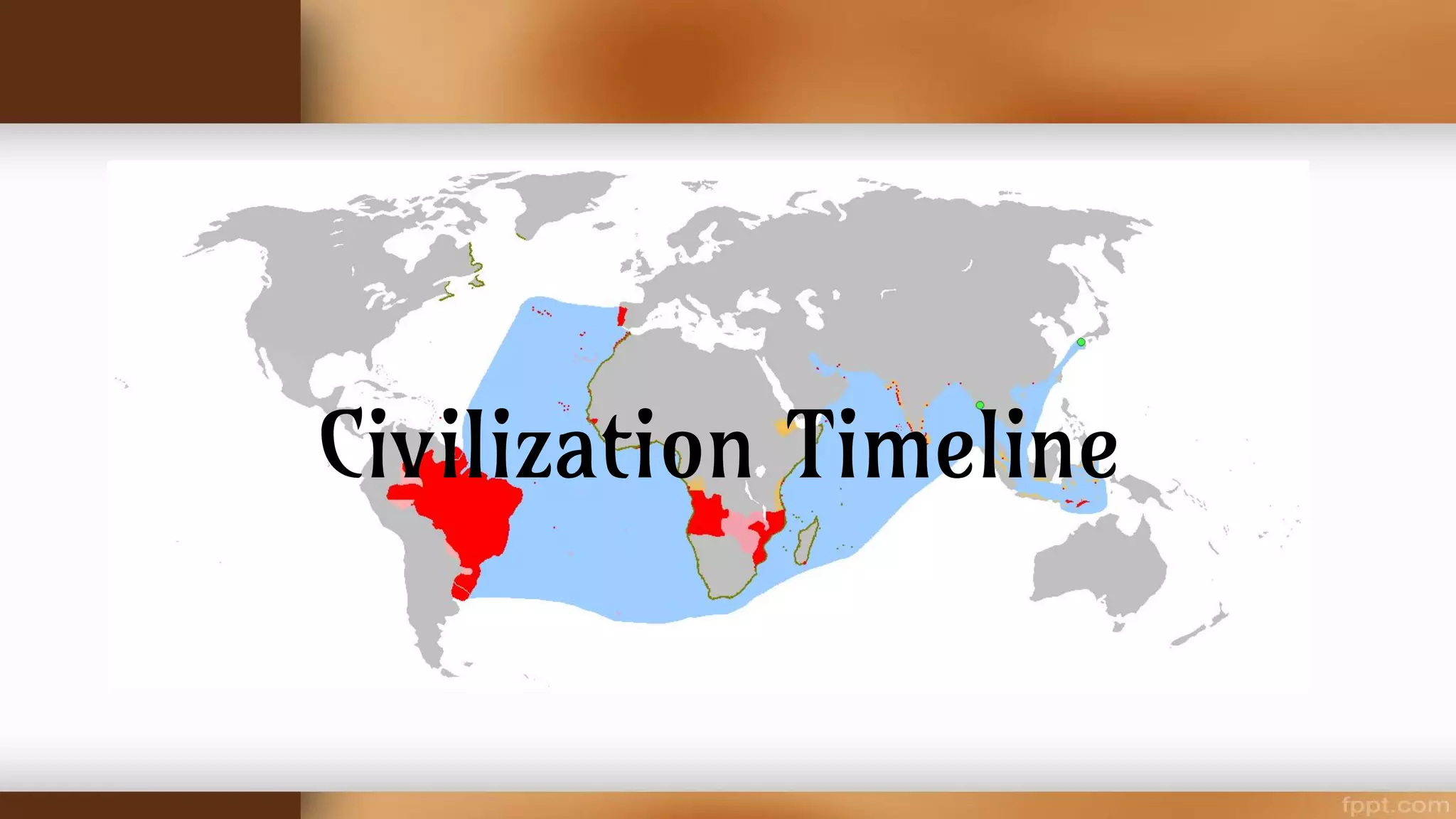
Civilization Timeline
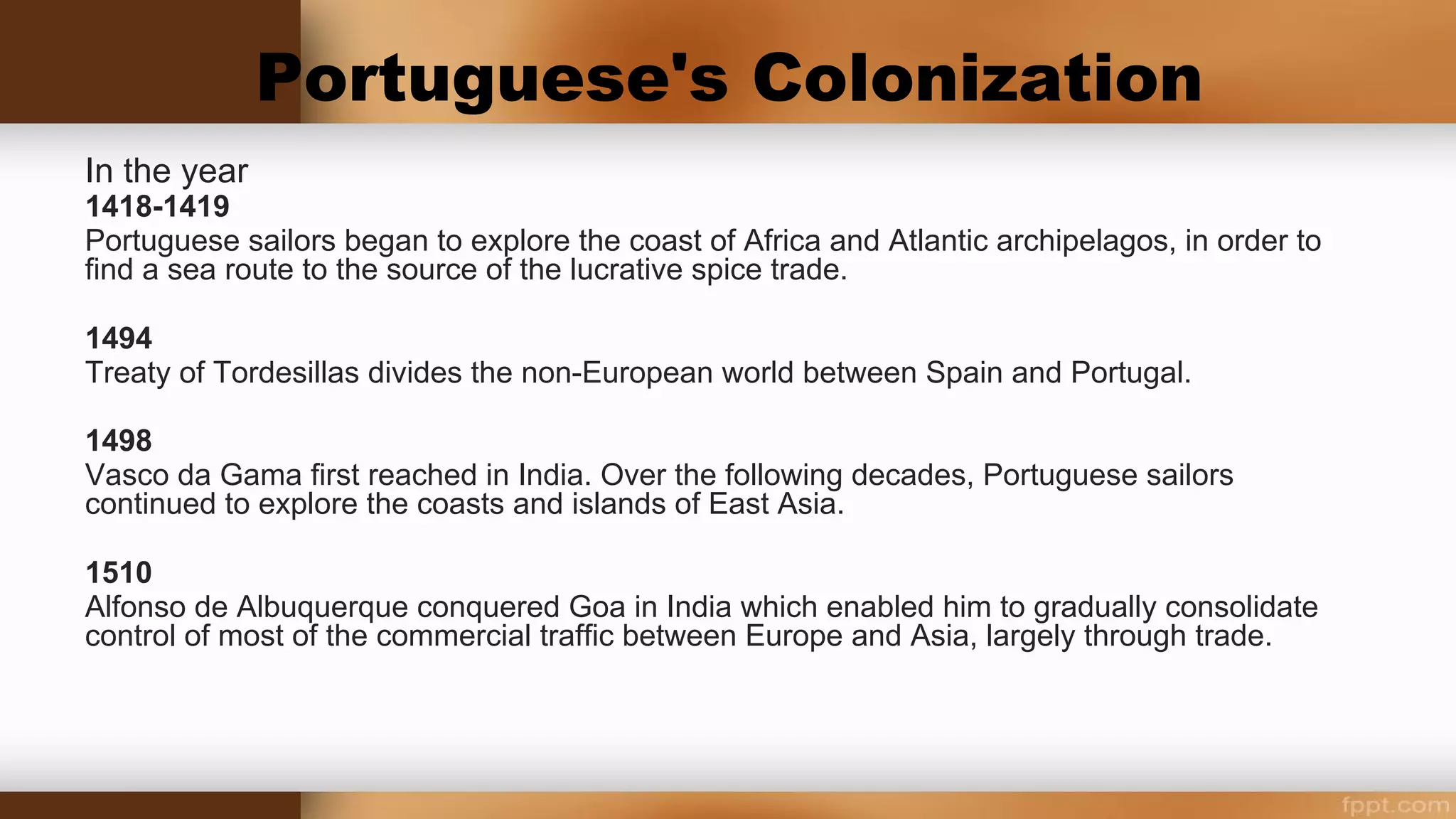
Portuguese's Colonization
In the year of...
1418-1419
Portuguese sailors began to explore the coast of Africa and Atlantic archipelagos, in order to find a sea
route to the source of the lucrative spice trade.
1494
Treaty of Tordesillas divides the non-European world between Spain and Portugal.
1498
Vasco da Gama first reached in India. Over the following decades, Portuguese sailors continued to
explore the coasts and islands of East Asia.
1510
Alfonso de Albuquerque conquered Goa in India which enabled him to gradually consolidate control of
most of the commercial traffic between Europe and Asia, largely through trade.
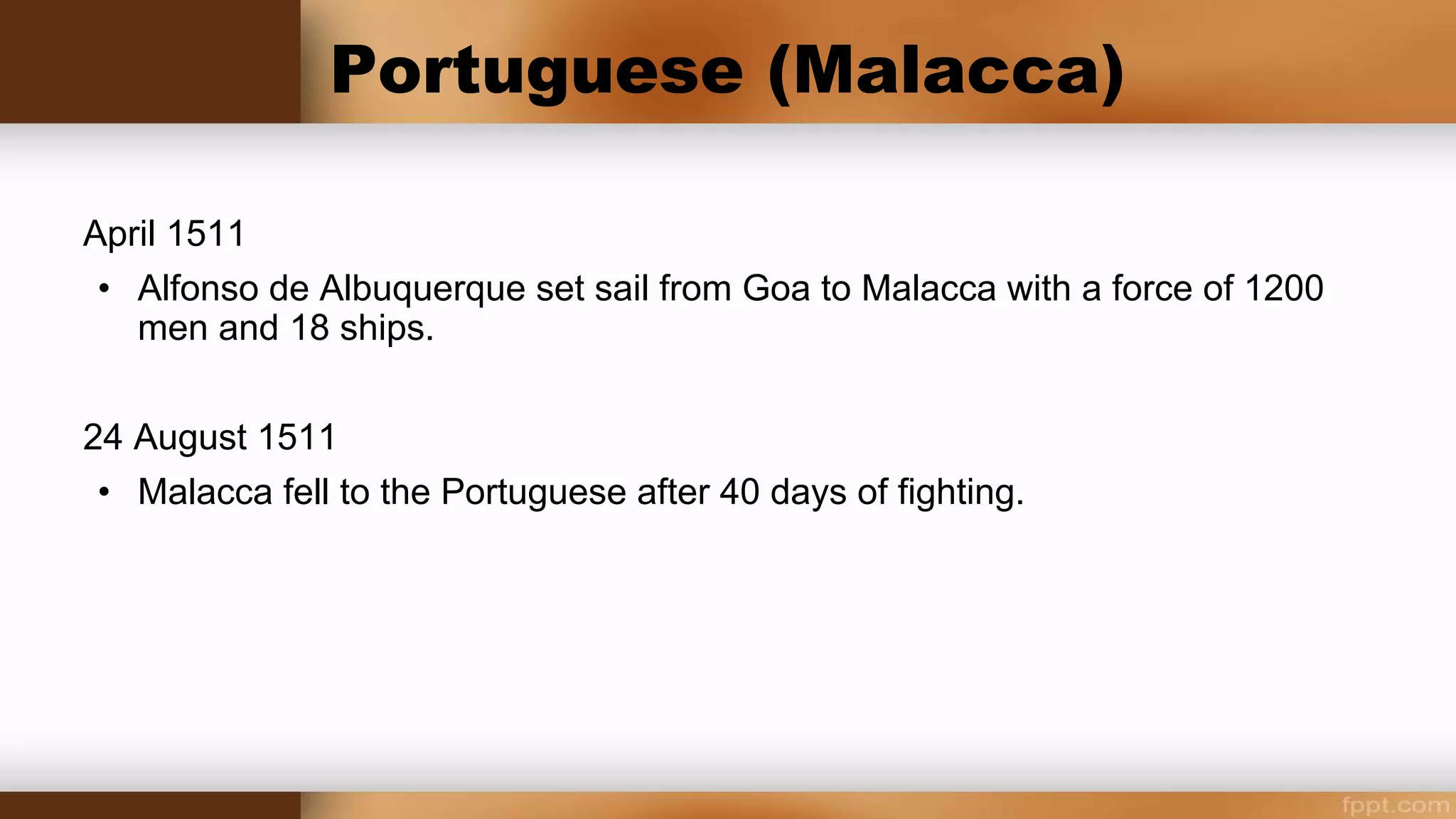
Portuguese Malacca
April 1511
Alfonso de Albuquerque set sail from Goa to Malacca with a force of some 1200 men
and seventeen or eighteen ships.
24 August 1511
Conflict was unavoidable, and after 40 days of fighting, Malacca fell to the Portuguese.
It soon became clear that Portuguese control of Malacca did not also mean they
controlled Asian trade centered there. Their Malaccan rule was severely hampered by
administrative and economic difficulties.
Portuguese Macau
1513
Portuguese landed on Lintin Island, claimed island for King of
Portugal.
1516
Portuguese traders used Macau as staging port.
The first Portuguese ships had reached Canton on the
Southern coasts of China.
1521
Chinese expelled Portuguese adventurers from coast of
Guangdong.
1536
Portuguese traders allowed to anchor at Haojingao following a
shipwreck.
1540
Portuguese helped China in eliminating coastal pirates.
1542
Portuguese introduce firearms.
1552 - 1553
Portuguese received permission to erect storage sheds onshore.
1557
China ceded Macau to Portugal in recognition of their help in
defeating pirates.
1557
Portuguese opened first trading post in Asia in Macau.
1564
Portuguese established western trade with India, Japan and China.
1570
The Portuguese bought part of a Japanese port where they founded a
small part of the city of Nagasaki, and it became the major trading port in
Japan in the triangular trade with China and Europe.
1571
A string of naval outposts connected Libson to Nagasaki along the coasts
of Africa, the Middle East, India and South Africa.
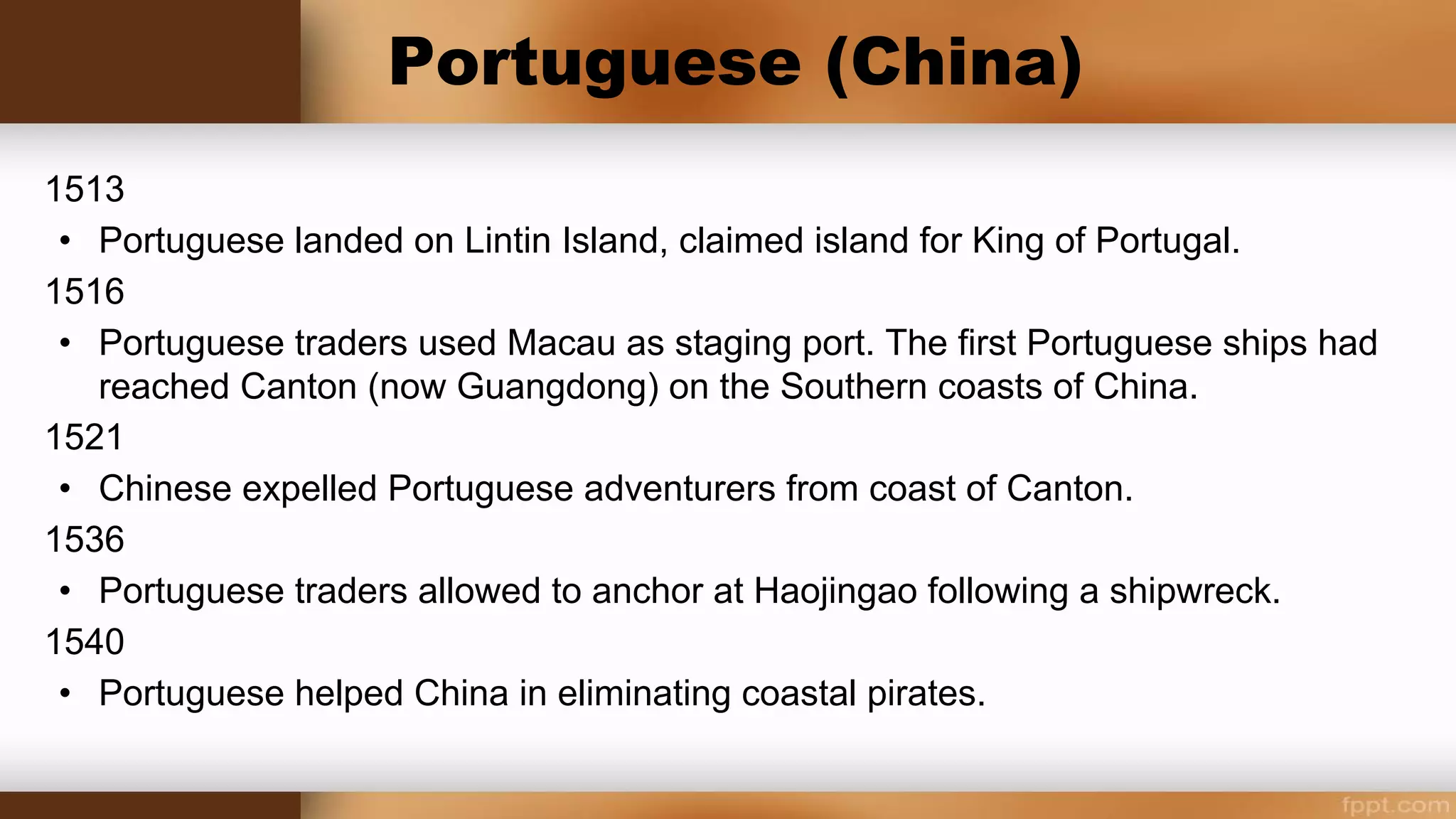
Portuguese in China
1513
Portuguese landed on Lintin Island, claimed island for King of Portugal.
1516
Portuguese traders used Macau as staging port. The first Portuguese ships had
reached Canton (now Guangdong) on the Southern coasts of China.
1521
Chinese expelled Portuguese adventurers from coast of Canton.
1536
Portuguese traders allowed to anchor at Haojingao following a shipwreck.
1540
Portuguese helped China in eliminating coastal pirates.
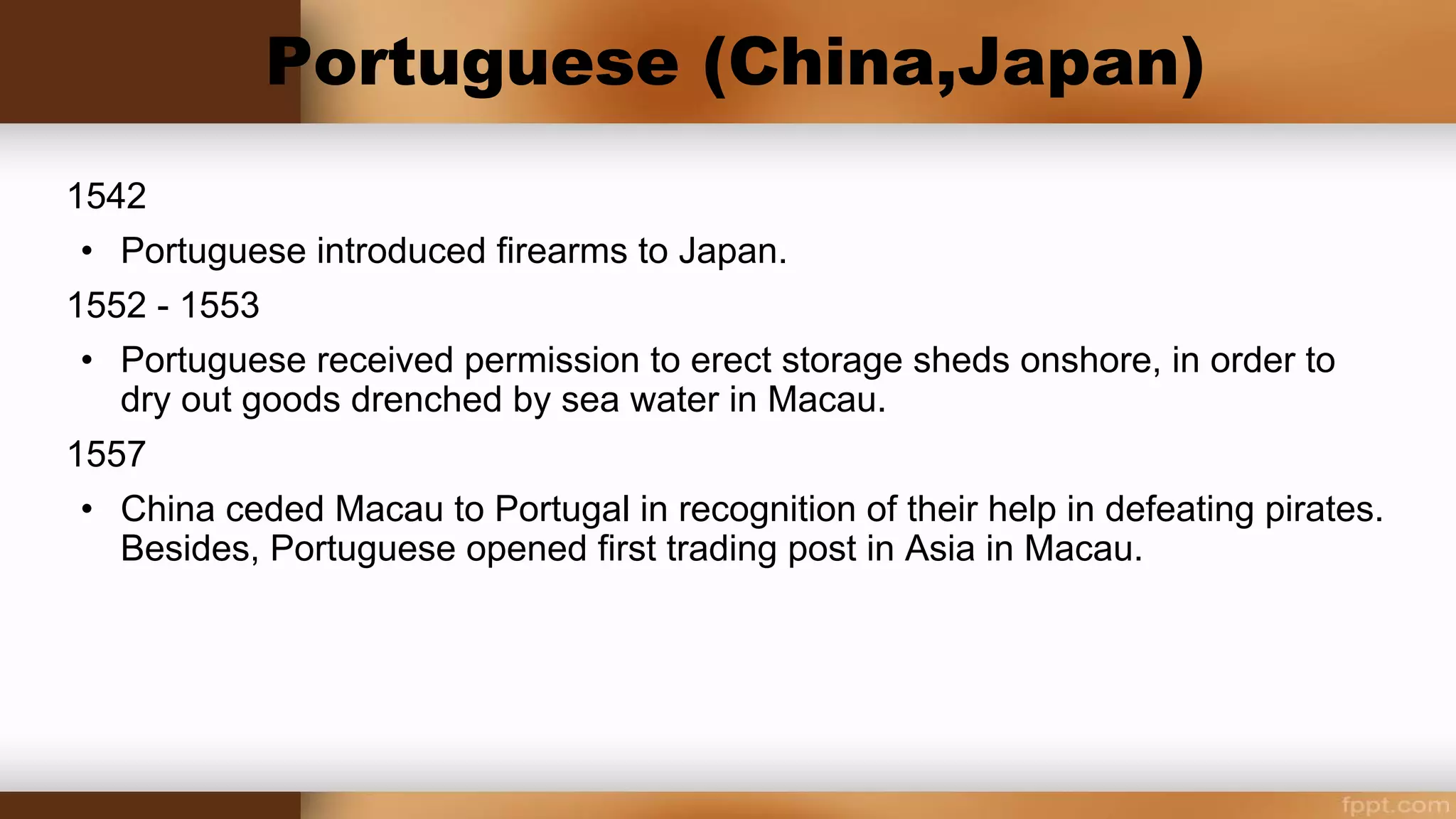
Portuguese (China, Japan)
1542
Portuguese introduced firearms to Japan.
1552 - 1553
Portuguese received permission to erect storage sheds onshore, in order to dry out goods
drenched by sea water in Macau.
1557
China ceded Macau to Portugal in recognition of their help in defeating pirates. Besides,
Portuguese opened first trading post in Asia in Macau.
Spanish Philippines
In the year...
1520
Spanish under Ferdinand Magellan reach the Philippines and East Indonesia –
circumnavigation of the globe
March 1521
The Portuguese navigator and explorer Ferdinand Magellan headed the first Spanish
foray to the Philippines when he made landfall on Cebu.
1565
After King Philip II had dispatched three further expeditions that ended in disaster, he
sent out Miguel Lopez de Legazpi, who established the first permanent Spanish
settlement.
1570
Spanish capture of Manila – they decide to stay in the Philippines
1571
The Spanish city of Manila was founded and by the end of 16th century most of the coastal and
lowland areas from Luzon to northern Mindanao were under Spanish control.
1863
The public education in the Philippines and even the church controlled the curriculum. Less than
one-fifth of those who went to school could read and write Spanish, and far fewer could speak it
properly.
1880
The limited higher education in the colony was entirely under clerical direction but by the year
1880s many sons of the wealthy were sent to Europe to study.
1896
Rizal was quickly arrested by the overly fearful Spanish, exiled to a remote island in
the south and finally being executed.
1892
Shocked by the arrest of Rizal, these activists quickly formed the Katipunan under
the leadership of Andres Bonifacio, a self-educated warehouseman.
1896
Spanish friars uncovered evidence of the Katipunan's plans and its leaders were
forced into premature action.
1897
Revolts broke out in several provinces around Manila. After months of fighting,
severe Spanish retaliation forced the revolutionary armies to retreat to the hills.
Finally, a truce was concluded with the Spanish.
23 December 1897
Aguinaldo and other revolutionary officials departed for Hong Kong to enter voluntary
exile.
12 June 1898
Independence was declared.
September 1898
A constitutional congress met in Malolos, north of Manila, which drew up a fundamental law
derived from European and Latin American precedent.
January 1899
With Aguinaldo as president of the new country, popularly known as the "Malolos Republic".
Spaniards (Indonesia, Japan, Taiwan)
1606
Spaniards established some form of trade links with the Maluku Islands and remained until
1663.
1611
Spanish contacted with Japan were established. Sebastián Vizcaíno was sent as ambassador
until Japan closed its trading post in 1630.
1626
On the north eastern coastal region of Taiwan, the Spaniards built Fort Santo Domingo near
Keelung.
Dutch
1619
The Dutch found what they were looking for in Jakarta, conquered by Jan Coen.
Later renamed Batavia after the putative Dutch ancestors the Batavians, and which
would become the capital of the Dutch East Indies.
1641
The Dutch continued to drive out the Portuguese from their bases in Asia. Malacca
finally succumbed in 1641.
1603 &1610
Goa, the capital of the Portuguese Empire in the East, was unsuccessfully attacked
by the Dutch.
1639
Dutch were unable in four attempts to capture Macau from where Portugal
monopolized the lucrative China-Japan trade, the Japanese shogunate's
increasing suspicion of the intentions of the Catholic Portuguese led to their
expulsion
1639-1854
The Dutch were the only European power allowed to operate in Japan, confined in 1639 to
Hirado and then from 1641 at Deshima. In the mid 17th century the Dutch also explored the
western Australian coasts, naming many places.
1638
The Dutch colonized Mauritius in 1638, several decades after three ships out of the Dutch
Second Fleet sent to the Spice Islands were blown off course in a storm and landed in
1598.
1642
The Dutch took northern Formosa from the Spanish by force.
1646
The Dutch tried to take the Spanish colony in the Philippines. The Dutch had a large force at their
disposal but when they tried to take Manila, they were defeated at the Battles of La Naval de
Manila. After this defeat, the Dutch abandoned their efforts to take Manila and the Philippines.
Important Events
Portuguese
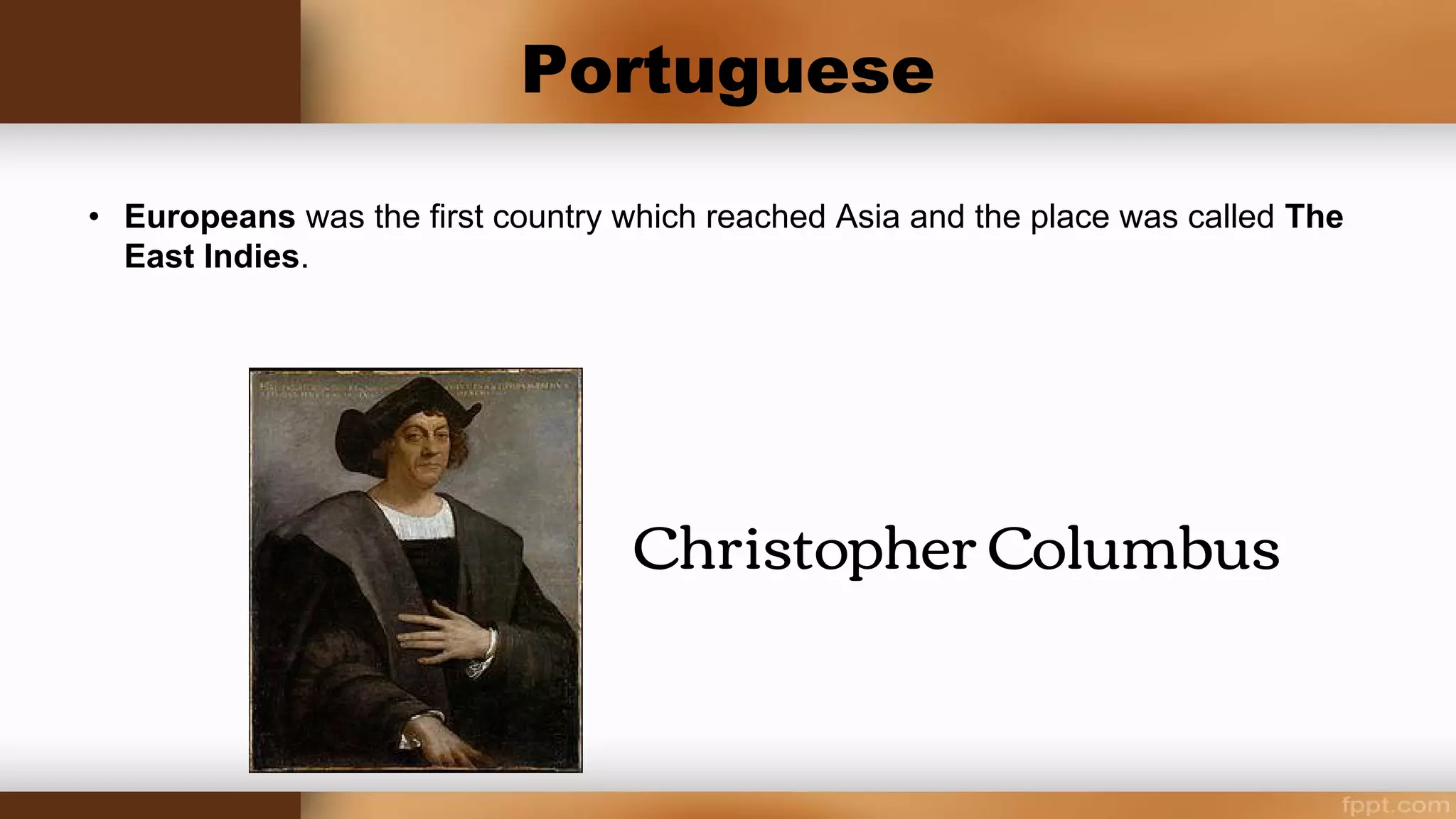
• Europeans was the first country which reached Asia and the place was called The
East Indies.
Christopher Columbus
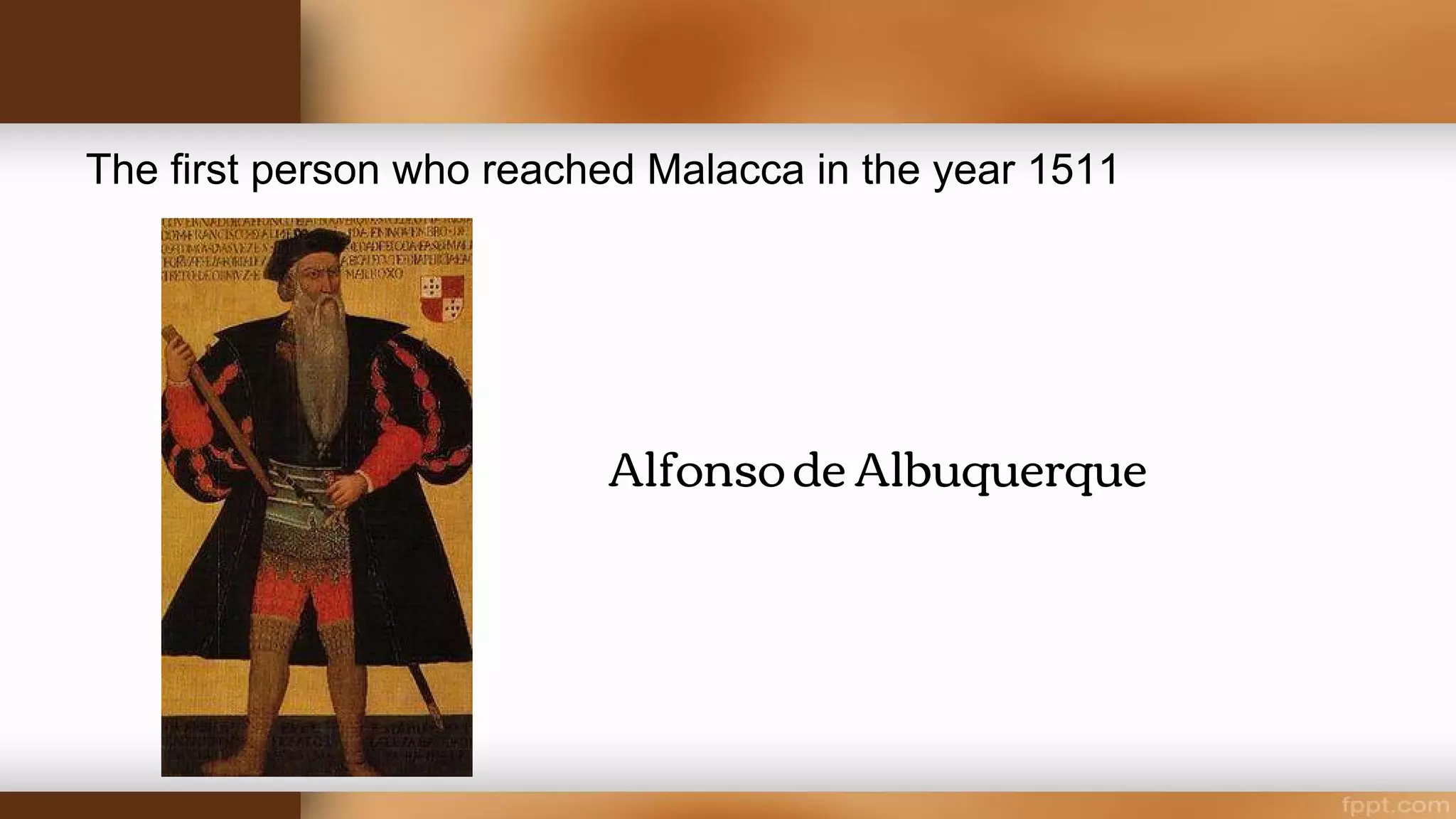
Alfonso de Albuquerque
The first person who reached Malacca in the year 1511
Spaniards
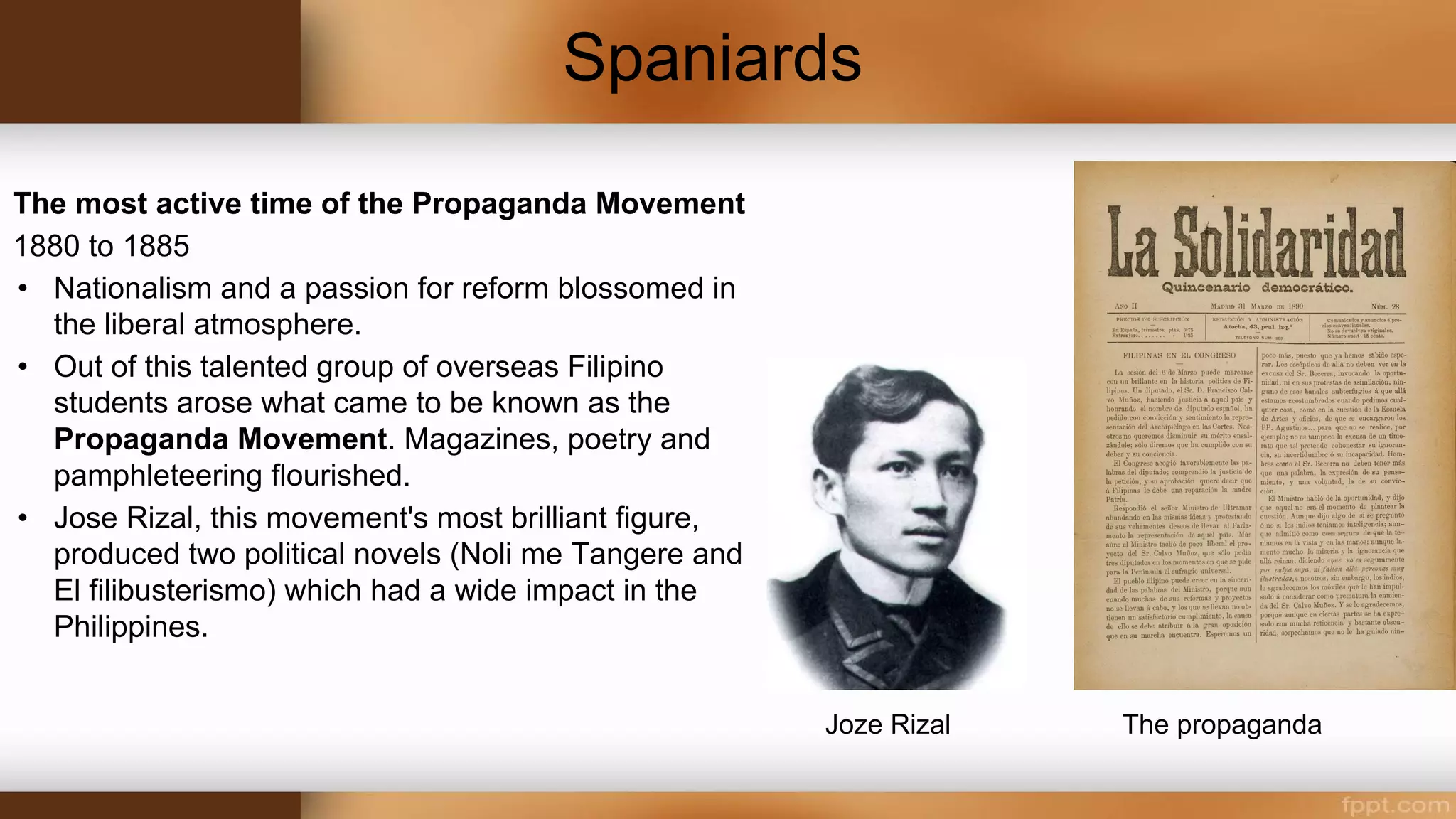
The most active time of the Propaganda Movement
1880 to 1885
• Nationalism and a passion for reform blossomed in
the liberal atmosphere.
• Out of this talented group of overseas Filipino
students arose what came to be known as the
Propaganda Movement. Magazines, poetry and
pamphleteering flourished.
• Jose Rizal, this movement's most brilliant figure,
produced two political novels (Noli me Tangere and
El filibusterismo) which had a wide impact in the
Philippines.
Joze Rizal The propaganda
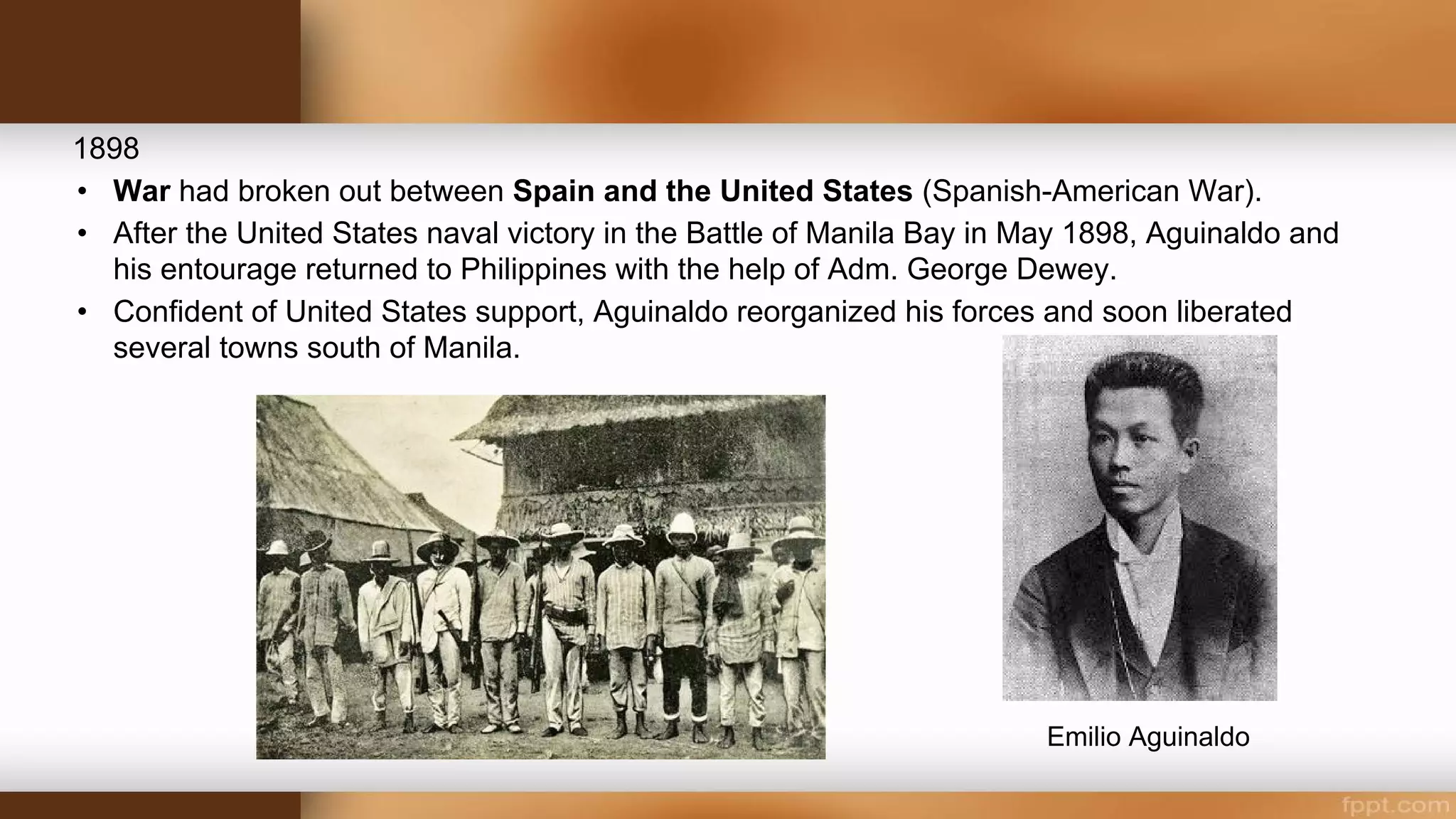
1898
• War had broken out between Spain and the United States (Spanish-American War).
• After the United States naval victory in the Battle of Manila Bay in May 1898, Aguinaldo and
his entourage returned to Philippines with the help of Adm. George Dewey.
• Confident of United States support, Aguinaldo reorganized his forces and soon liberated
several towns south of Manila.
Emilio Aguinaldo
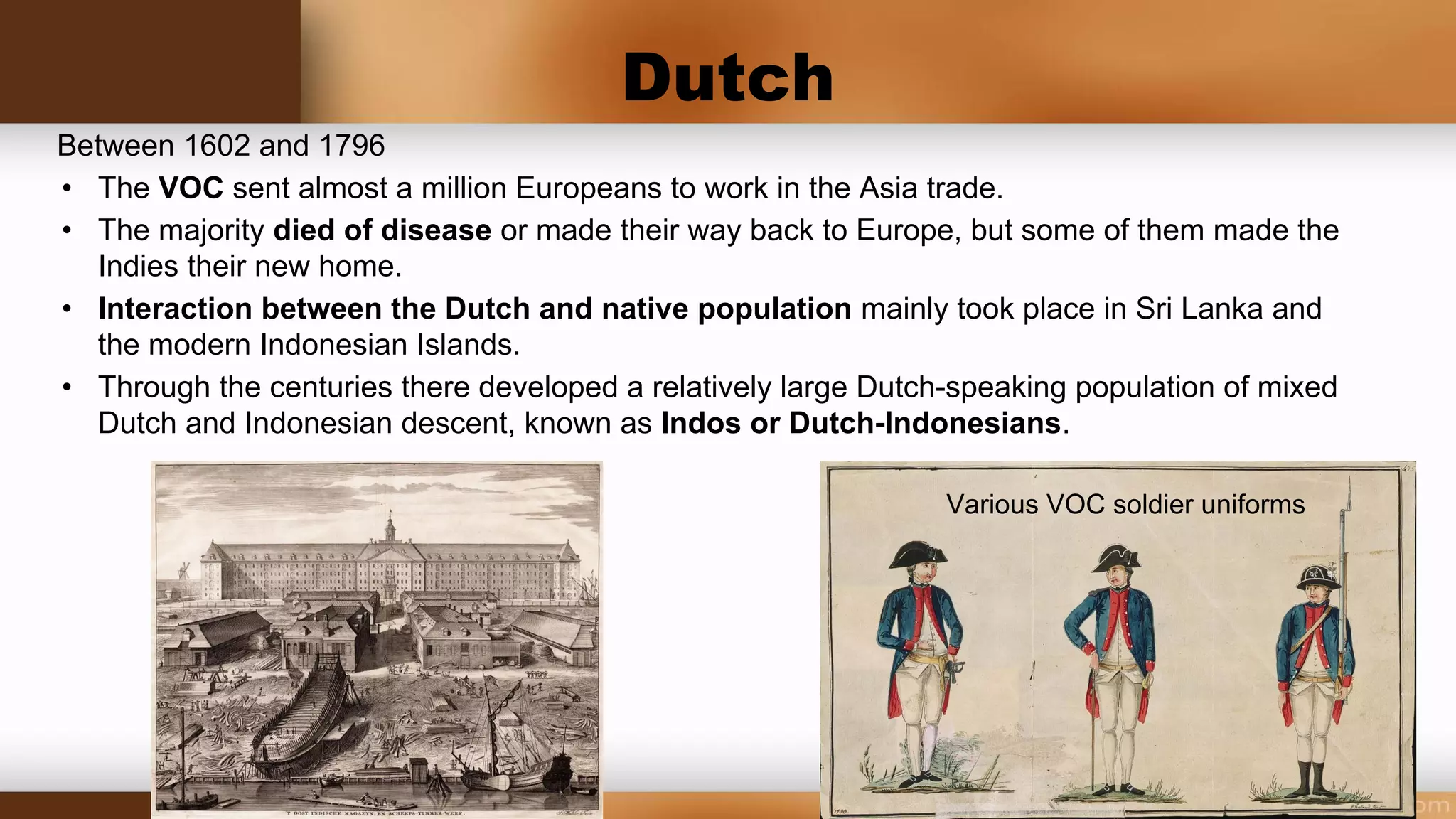
Dutch
Between 1602 and 1796
• The VOC sent almost a million Europeans to work in the Asia trade.
• The majority died of disease or made their way back to Europe, but some of them made the
Indies their new home.
• Interaction between the Dutch and native population mainly took place in Sri Lanka and
the modern Indonesian Islands.
• Through the centuries there developed a relatively large Dutch-speaking population of mixed
Dutch and Indonesian descent, known as Indos or Dutch-Indonesians.
Various VOC soldier uniforms
Culture
Portuguese in India
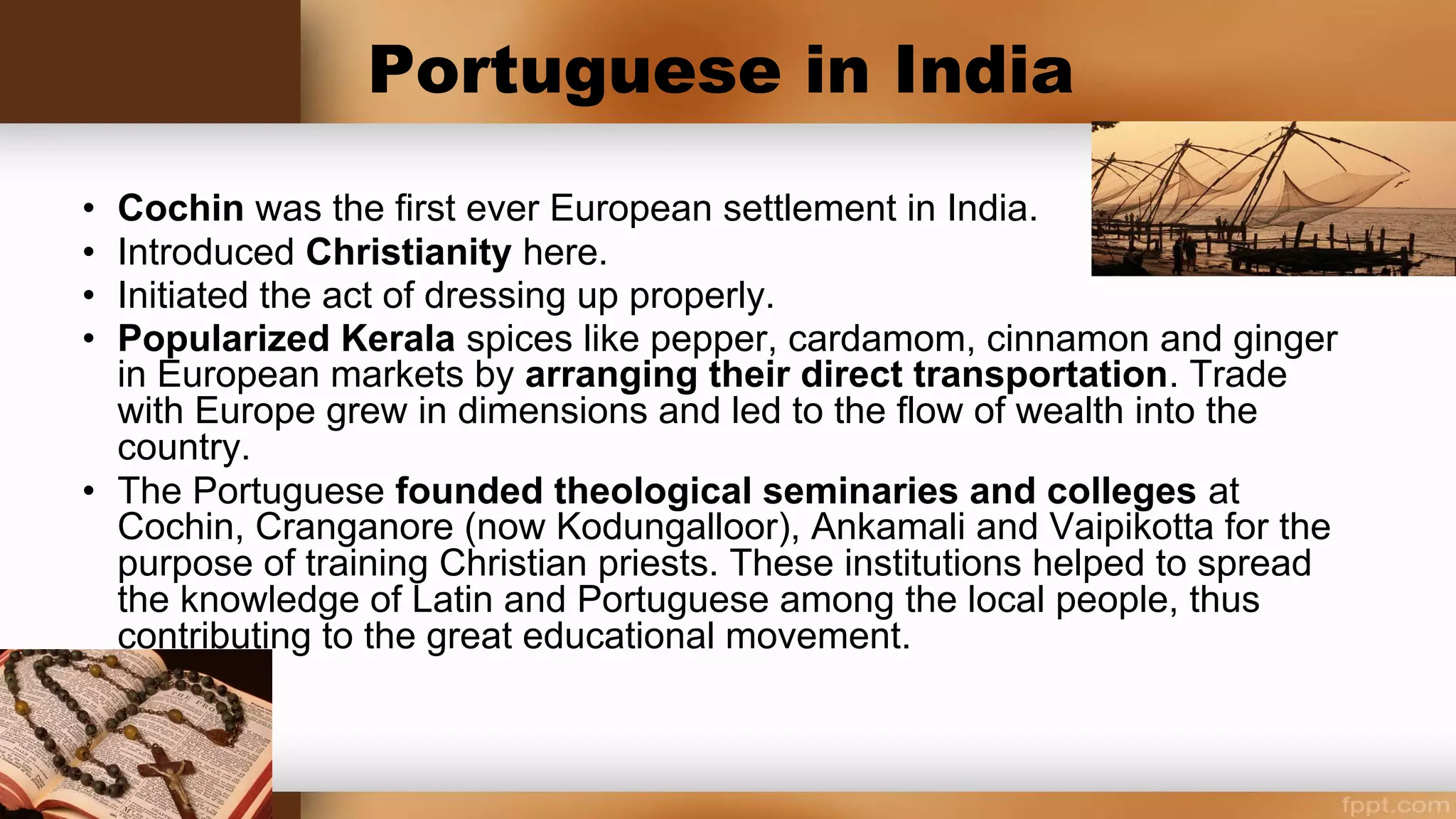
• Cochin was the first ever European settlement in India.
• Introduced Christianity here.
• Initiated the act of dressing up properly.
• Popularized Kerala spices like pepper, cardamom, cinnamon and
ginger in European markets by arranging their direct transportation.
Trade with Europe grew in dimensions and led to the flow of wealth into
the country.
• The Portuguese founded theological seminaries and colleges at
Cochin, Cranganore (now Kodungalloor), Ankamali and Vaipikotta for the
purpose of training Christian priests. These institutions helped to spread
the knowledge of Latin and Portuguese among the local people, thus
contributing to the great educational movement.
• Portuguese encouraged the cultivation of coconut commercially. They
introduced the use of coconut fibre in making sturdy coir ropes and made coir and
copra articles of world trade. They brought a new strain of coconuts from Africa
which produced bigger and 10 better fruits. It is these Portuguese coconuts that are
planted in abundance along the Kerala coast now.
• Christian art of Kerala is highly inspired from the Portuguese culture. The
Chavittunaatakam, the Christian counterpart of the Hindu Kathakali, originated and
grew into a popular form of entertainment under the patronage of the Portuguese
missionaries. 12 The Cochin Carnival, which is celebrated in Cochin during the
Christmas and New Year is also a tradition started by the Portuguese.
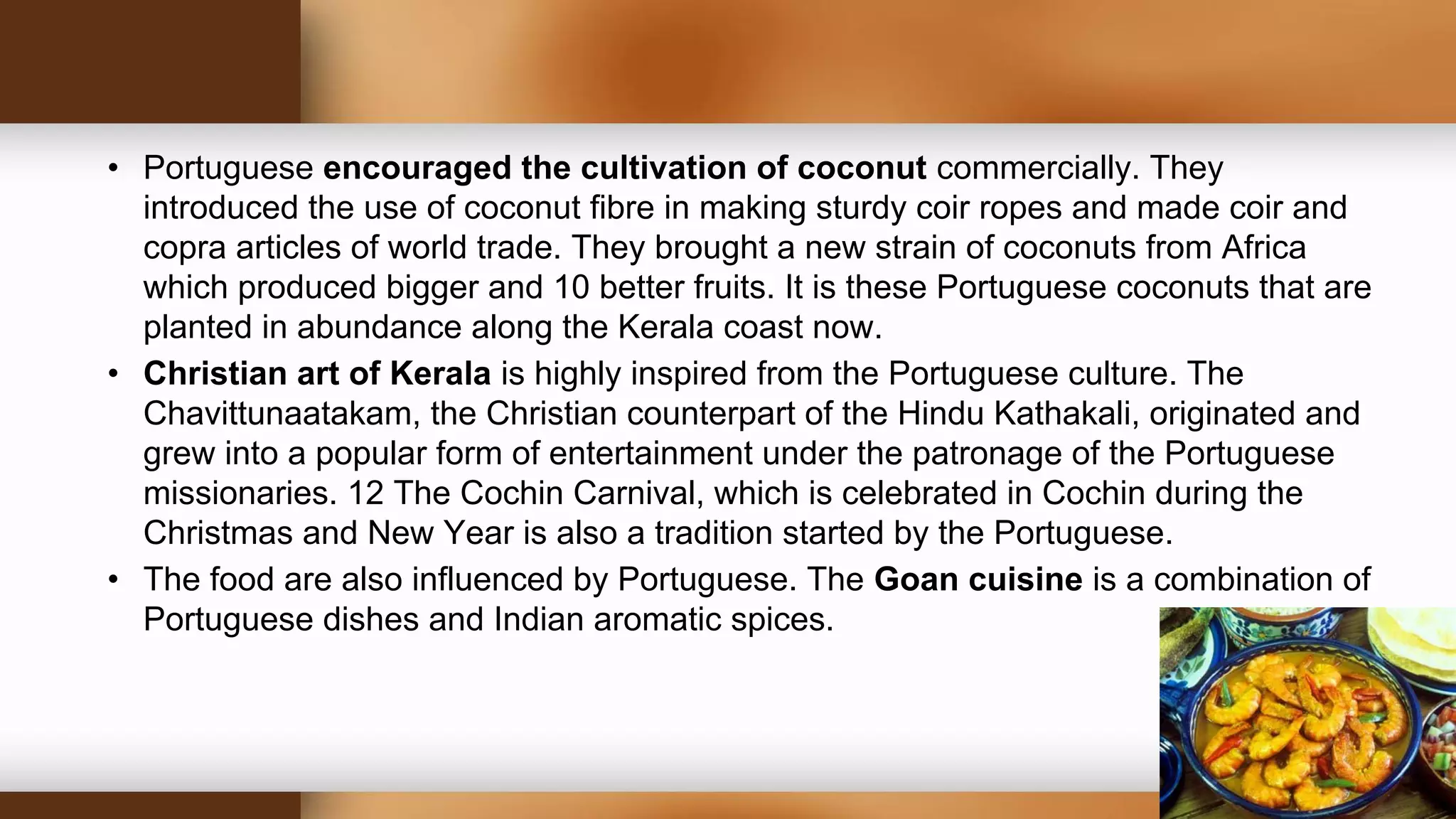
• The food are also influenced by Portuguese. The Goan cuisine is a combination of
Portuguese dishes and Indian aromatic spices.
Architecture
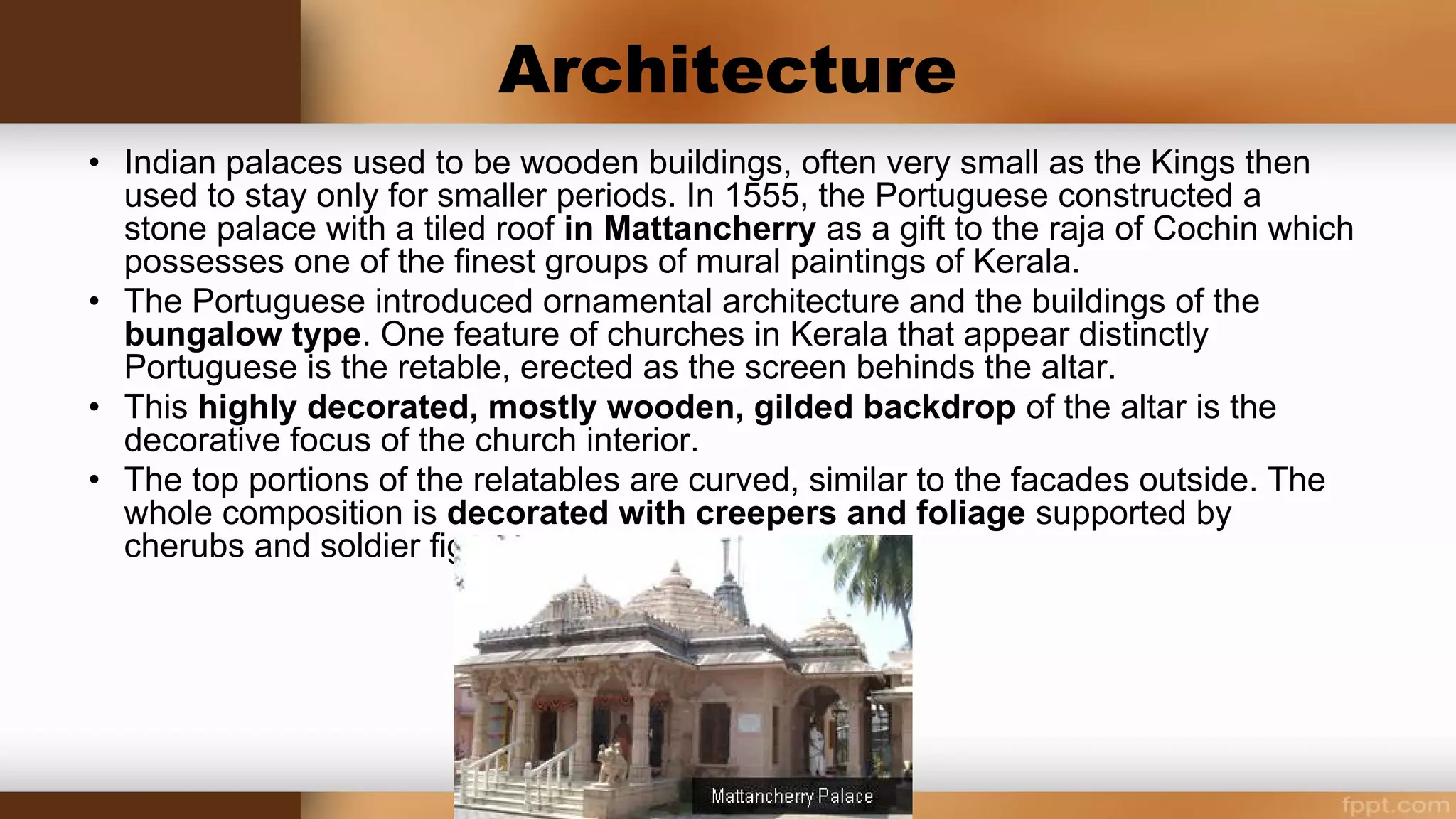
• Indian palaces used to be wooden buildings, often very small as the Kings then
used to stay only for smaller periods. In 1555, the Portuguese constructed a stone
palace with a tiled roof in Mattancherry as a gift to the raja of Cochin which
possesses one of the finest groups of mural paintings of Kerala.
• The Portuguese introduced ornamental architecture and the buildings of the
bungalow type. One feature of churches in Kerala that appear distinctly
Portuguese is the retable, erected as the screen behinds the altar.
• This highly decorated, mostly wooden, gilded backdrop of the altar is the
decorative focus of the church interior.
• The top portions of the relatables are curved, similar to the facades outside. The
whole composition is decorated with creepers and foliage supported by cherubs
and soldier figures.
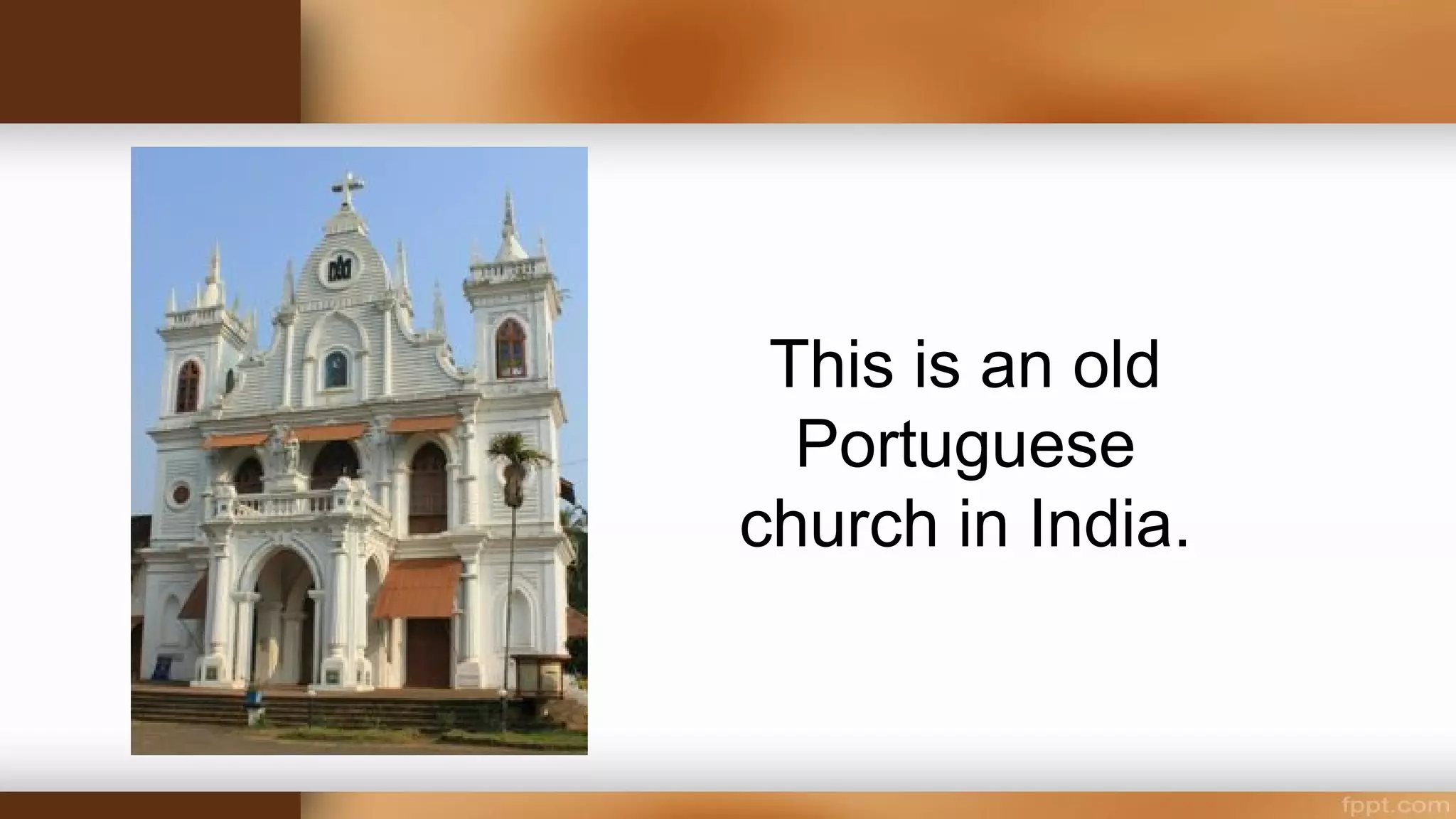
This is an old
Portuguese
church in India.
Portuguese in Malacca
• They introduced Christianity
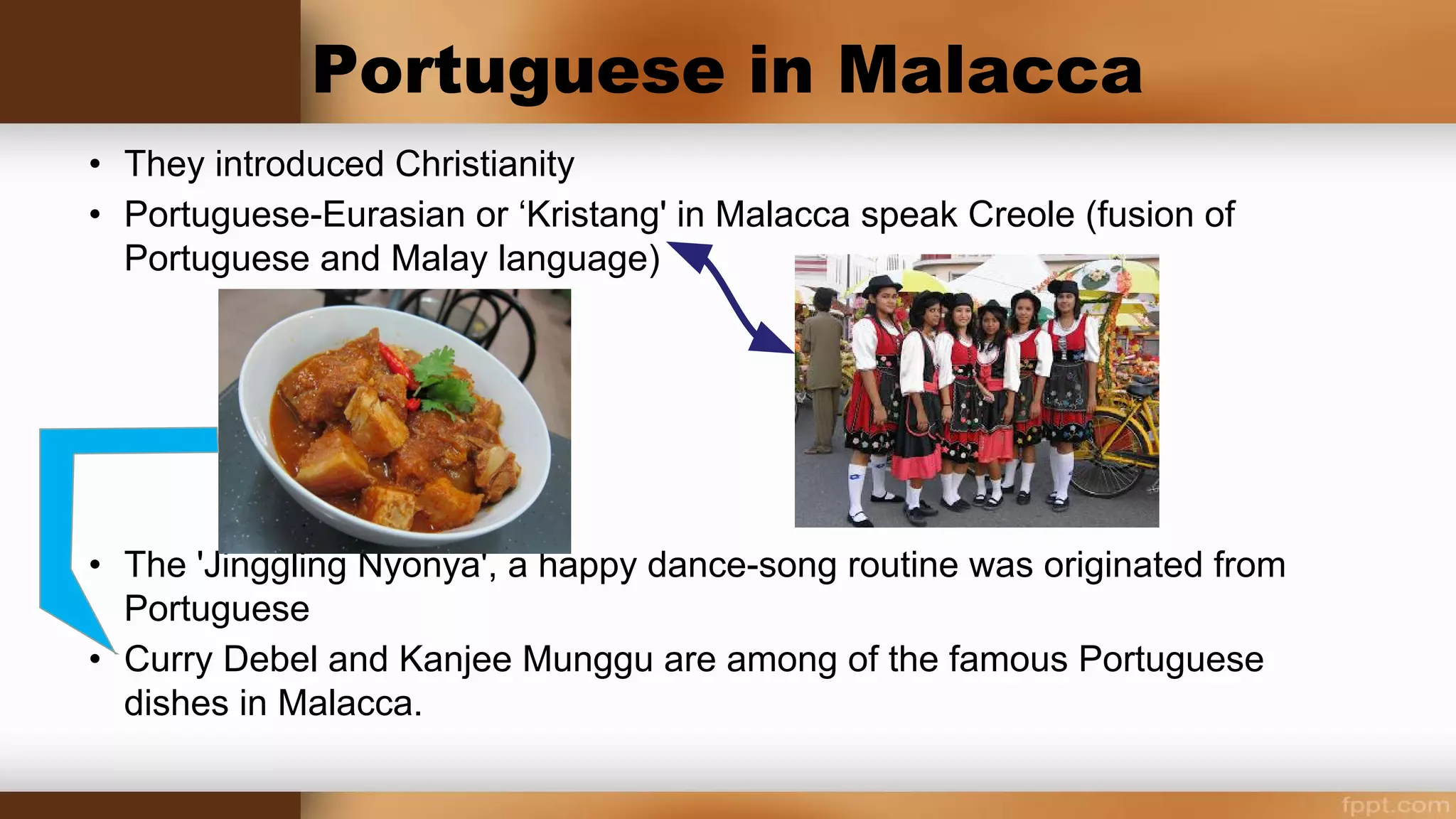
• Portuguese-Eurasian or ‘Kristang' in Malacca speak Creole (fusion of
Portuguese and Malay language)
• The 'Jinggling Nyonya', a happy dance-song routine was originated from
Portuguese
• Curry Debel and Kanjee Munggu are among of the famous Portuguese
dishes in Malacca.
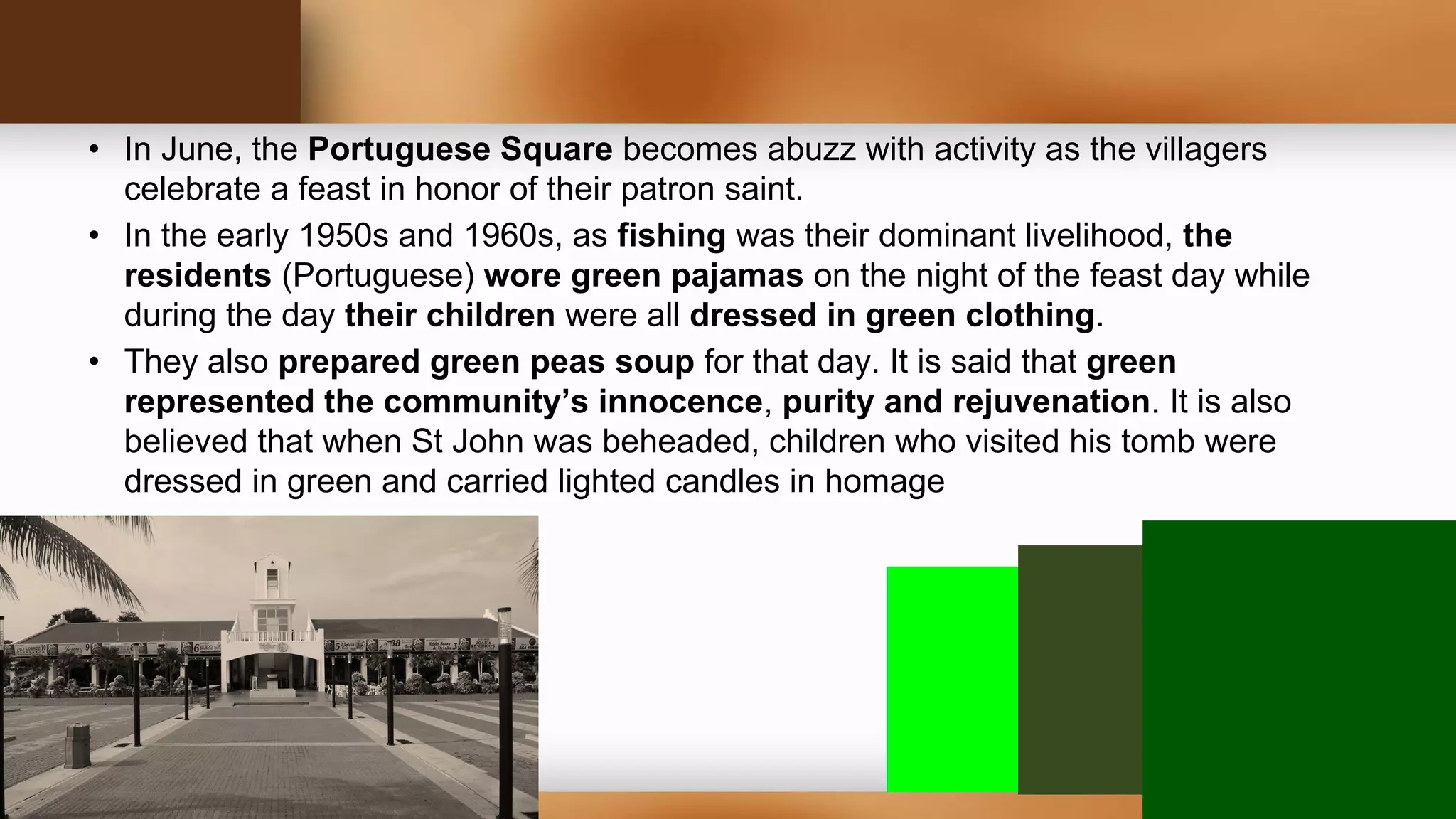
• In June, the Portuguese Square becomes abuzz with activity as the villagers
celebrate a feast in honor of their patron saint.
• In the early 1950s and 1960s, as fishing was their dominant livelihood, the
residents (Portuguese) wore green pajamas on the night of the feast day while
during the day their children were all dressed in green clothing.
• They also prepared green peas soup for that day. It is said that green
represented the community’s innocence, purity and rejuvenation. It is also
believed that when St John was beheaded, children who visited his tomb were
dressed in green and carried lighted candles in homage
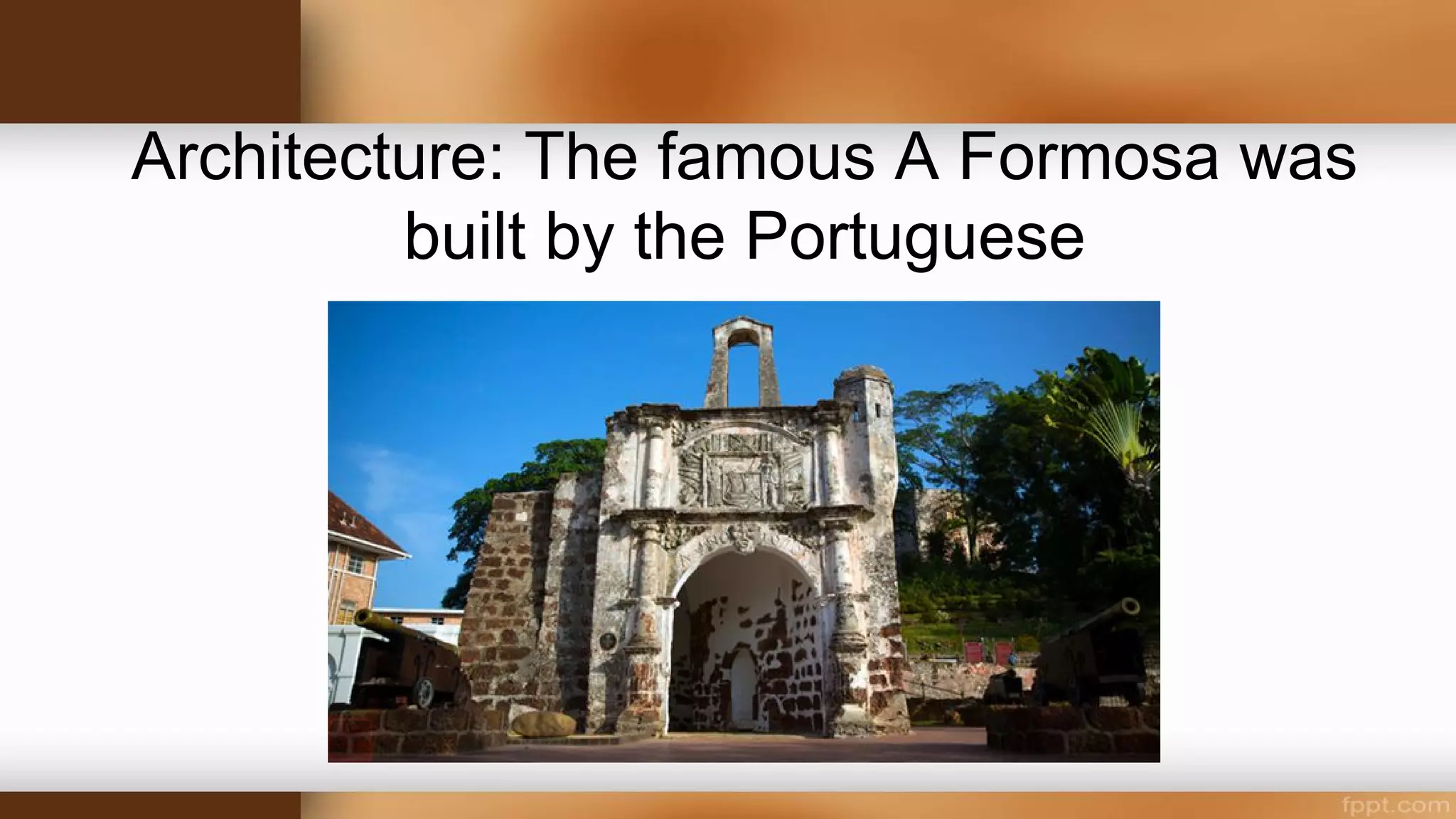
Architecture: The famous A Formosa was
built by the Portuguese
Dutch
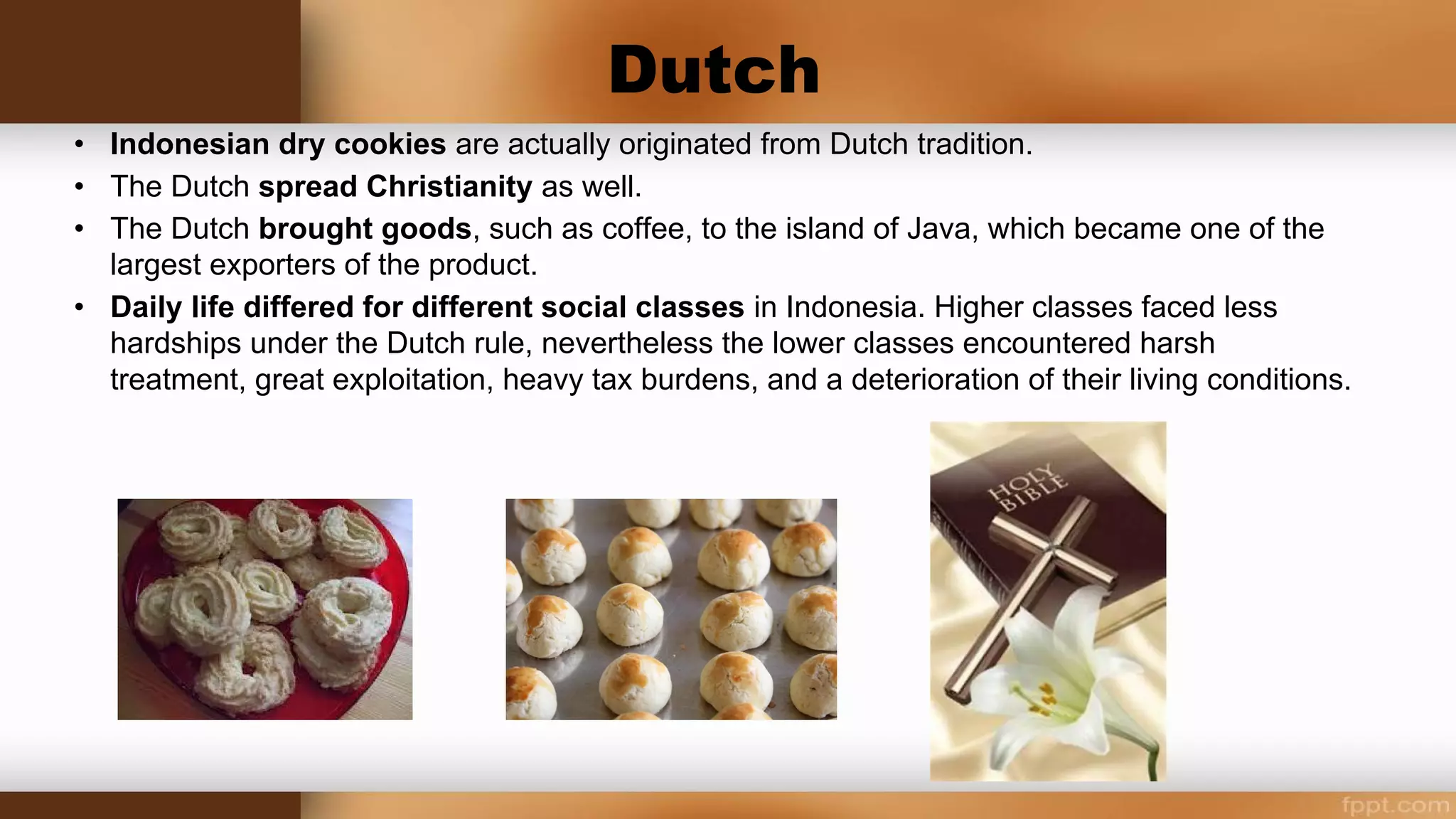
• Indonesian dry cookies are actually originated from Dutch tradition.
• The Dutch spread Christianity as well.
• The Dutch brought goods, such as coffee, to the island of Java, which became one of the
largest exporters of the product.
• Daily life differed for different social classes in Indonesia. Higher classes faced less
hardships under the Dutch rule, nevertheless the lower classes encountered harsh
treatment, great exploitation, heavy tax burdens, and a deterioration of their living conditions.
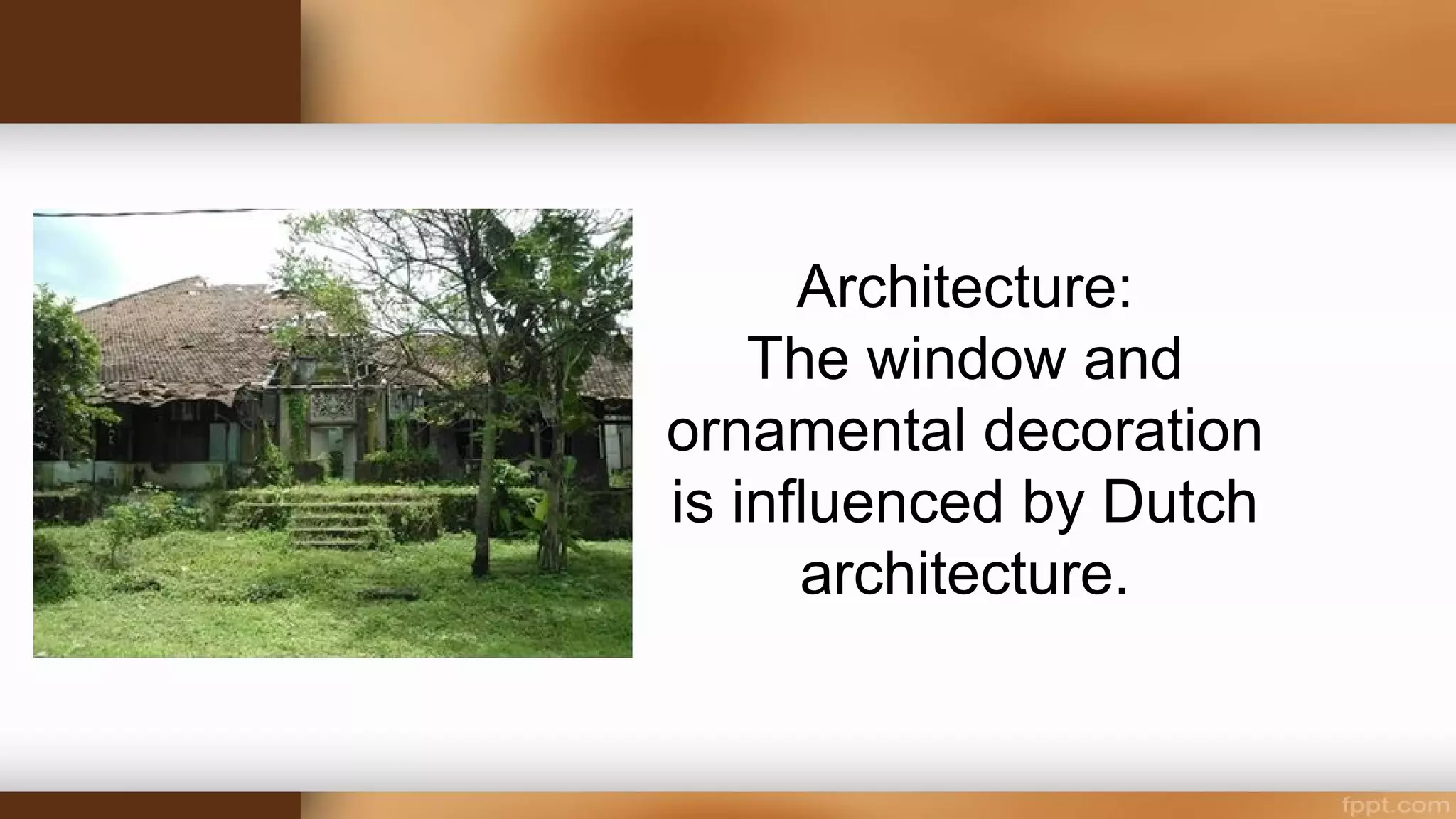
Architecture:
The window and
ornamental decoration
is influenced by Dutch
architecture.
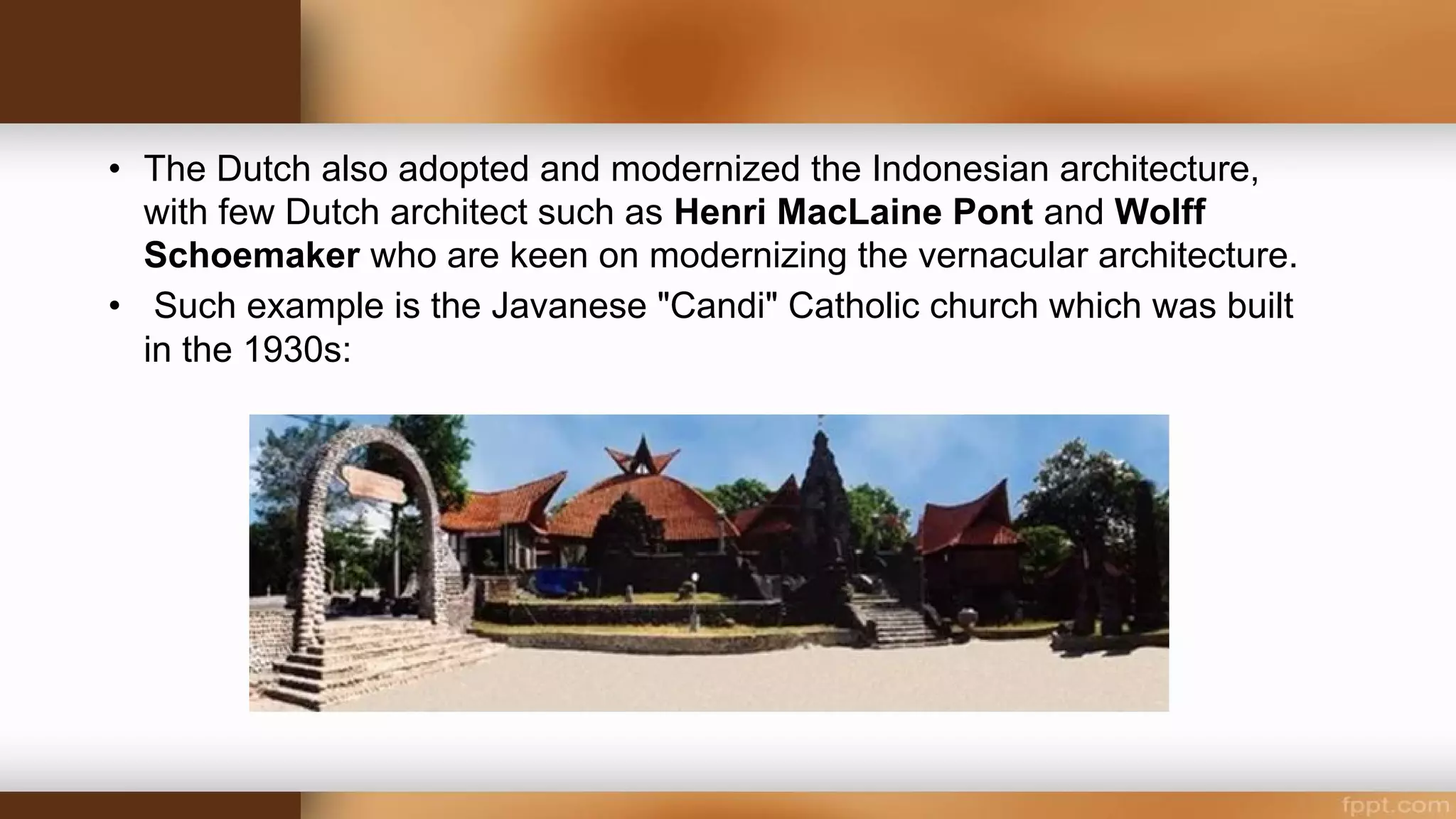
• The Dutch also adopted and modernized the Indonesian architecture,
with few Dutch architect such as Henri MacLaine Pont and Wolff
Schoemaker who are keen on modernizing the vernacular architecture.
• Such example is the Javanese "Candi" Catholic church which was built
in the 1930s:
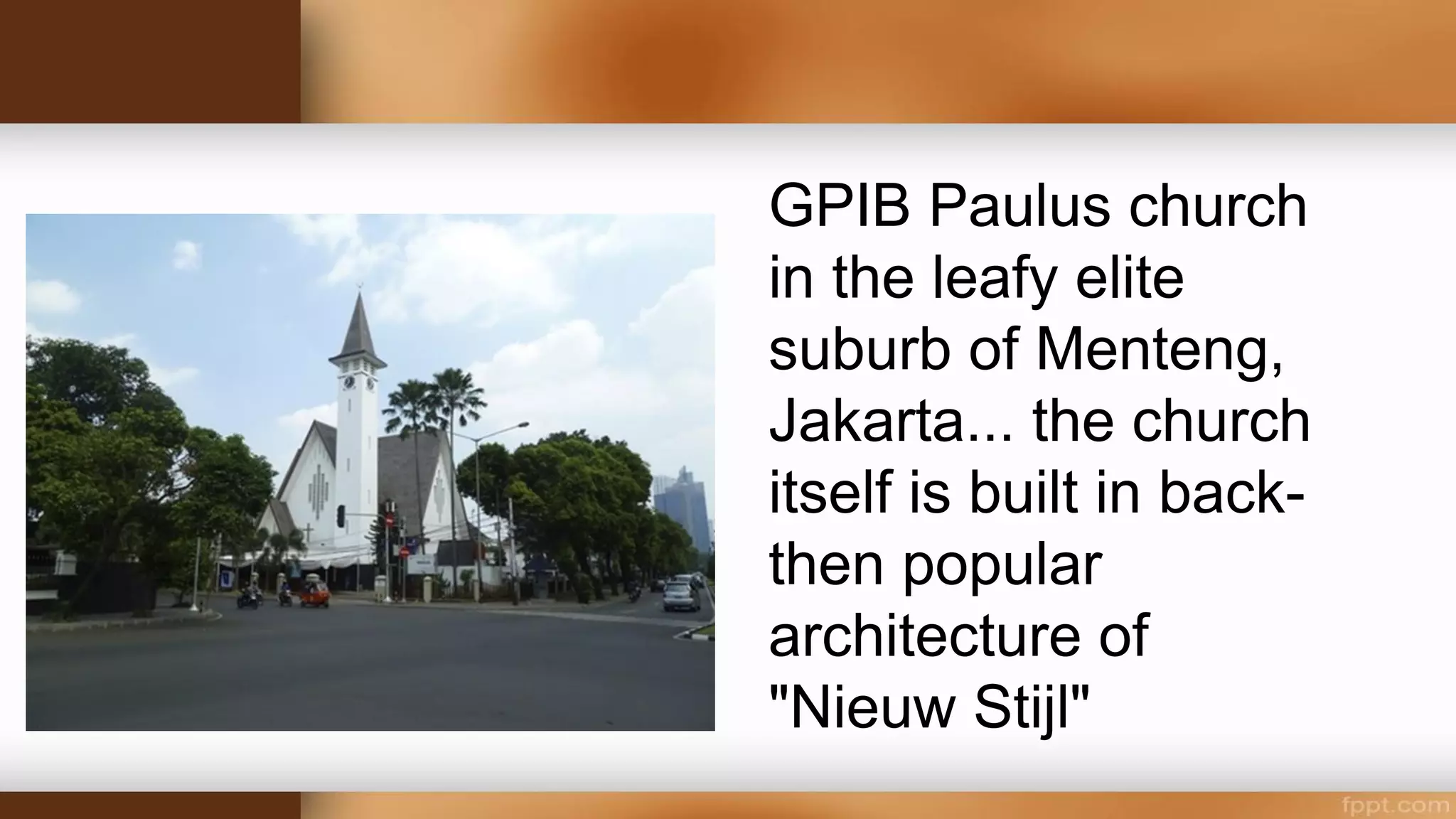
GPIB Paulus church
in the leafy elite
suburb of Menteng,
Jakarta... the church
itself is built in back-
then popular
architecture of
"Nieuw Stijl"
Achievements
Portuguese in Malacca
1) Malacca Towns
 Tranqueira
o Tranqueira was the most important suburb of Malacca. The suburb was rectangular in shape,
with a northern walled boundary, the straits of Malacca to the south and the river of Malacca
(Rio de Malaca) and the fortaleza's wall to the east. It was the main residential quarters of the
city. However, in war, the residents of the quarters would be evacuated to the fortress.
Tranqueira was divided into a further two parishes, São Tomé and São Estêvão. The parish of
S.Tomé was called Campon Chelim (Malay: Kampung Keling). It was described that this area
was populated by the Chelis of Choromandel. The other suburb of São Estêvão was also
called Campon China (Kampung Cina).
o Erédia described the houses as made of timber but roofed by tiles. A stone bridge with sentry
crosses the river Malacca to provide access to the Malacca Fortress via the eastern Custome
House Terrace. The center of trade of the city was also located in Tranqueira near the beach
on the mouth of the river called the Bazaar of the Jaos (Jowo/Jawa i.e. Javanese).
o In the present day, this part of the city is called Tengkera
 Yler
o The district of Yler (Hilir) roughly covered Buquet China (Bukit Cina) and the south-
eastern coastal area. The Well of Buquet China was one of the most important water
sources for the community. Notable landmarks included the Church of the Madre De
Deus and the Convent of the Capuchins of São Francisco. Other notable landmarks
included Buquetpiatto (Bukit Piatu). The boundaries of this unwalled suburb were said to
extend as far as Buquetpipi and Tanjonpacer.
o Tanjonpacer (Malay: Tanjung Pasir) was later renamed Ujong Pasir. A community
descended from Portuguese settlers is still located here in present-day Malacca.
However, this suburb of Yler is now known as Banda Hilir. Modern land reclamations (for
the purpose of building the commercial district of Melaka Raya) have, however, denied
Banda Hilir the access to the sea that it formerly had.
 Sabba
o The houses of this suburb were built along the edges of the river. Some of the
original Muslim Malay inhabitants of Malacca lived in the swamps of Nypeiras
tree, where they were known to make Nypa (Nipah) wine by distillation for trade.
This suburb was considered the most rural, being a transition to the Malacca
hinterland, where timber and charcoal traffic passed through into the city.
Several Christian parishes also lay outside the city along the river; São Lázaro,
Our Lady of Guadalupe, Our Lady of Hope. While Muslim Malays inhabited the
farmlands deeper into the hinterland.
o In later periods of Dutch, British and modern day Malacca, the name of Sabba
was made obsolete. However, its area encompassed parts of what is now Banda
Kaba, Bunga Raya and Kampung Jawa; and the modern city center of Malacca
Architecture
A Famosa Fortress (built 1511 onwards)
• A Famosa, or "The Famous" in
Portuguese, is one of the oldest
surviving remnants of European
architecture in Asia. Once part of a
mighty fortress, this tiny gate (called
the Porta de Santiago) is all that
history has spared.
• St. Paul's Church
• is a historic church building in
Malacca, Malaysia that was
originally built in 1521. It is located
at the summit of St. Paul's Hill and
is today part of the Malacca
Museum Complex comprising the
A Famosa ruins, the Stadthuys
and other historical building
Spain in the Philippines
• Spanish Heritage
• Spain ruled the Philippines for three centuries (1565-1898)
• Spain’s cultural legacy was more beneficial and comprehensive than her political
and economic endowments.
• Christianity
• Spain’s greatest legacy
• The Roman Catholic religion
• - originated in Asia, being founded by Jesus Christ in Palestine; spread to
Western Europe after Christ’s crucifixion, in the 16th and 17th centuries, propagated
across the Atlantic to the New World and across the Pacific to the Philippines,
making her then the greatest power.
• --- the most outstanding achievement of Spanish missionaries who came with the
Spanish conquistadores.
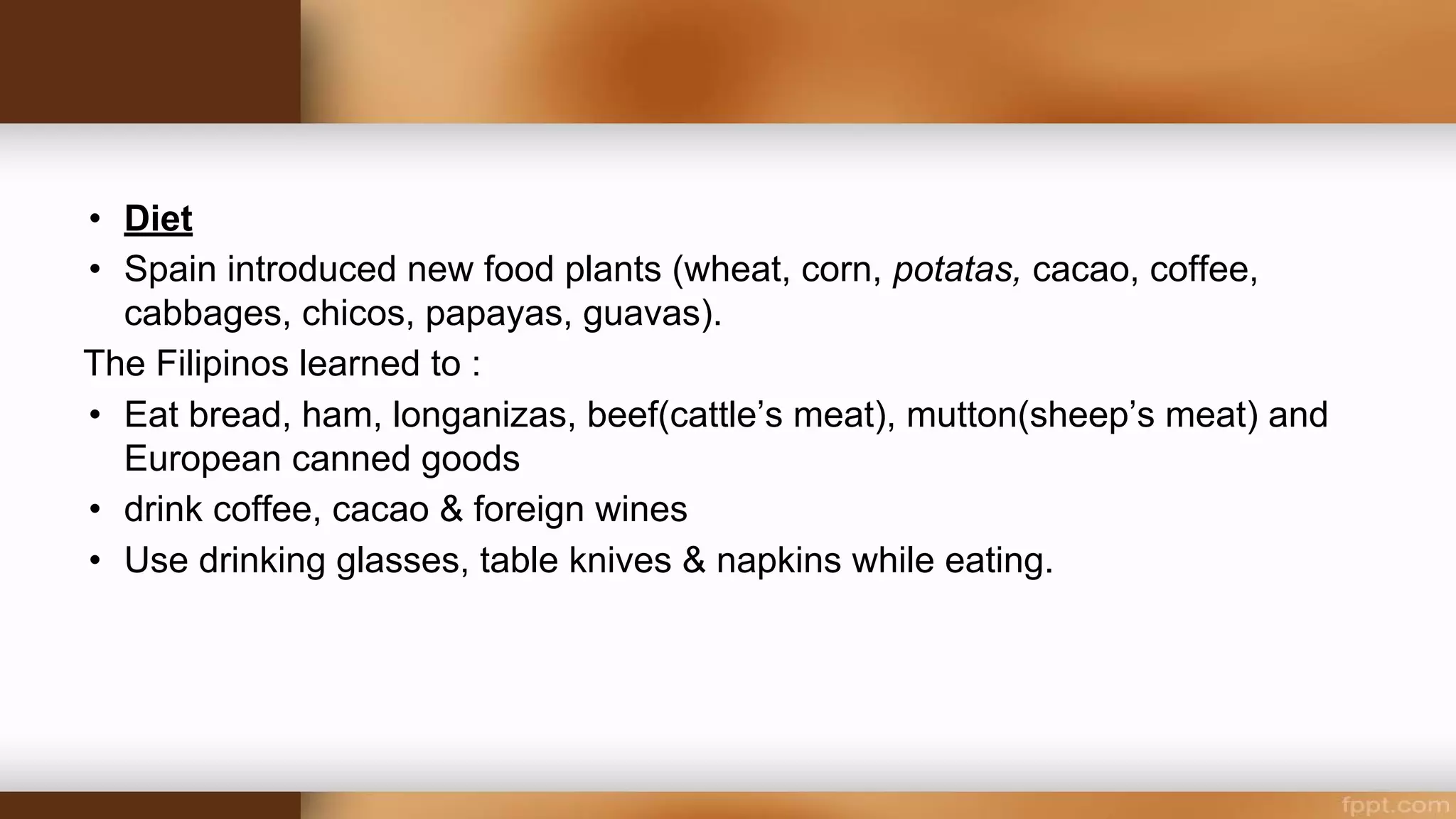
• Diet
• Spain introduced new food plants (wheat, corn, potatas, cacao, coffee,
cabbages, chicos, papayas, guavas).
The Filipinos learned to :
• Eat bread, ham, longanizas, beef(cattle’s meat), mutton(sheep’s meat) and
European canned goods
• drink coffee, cacao & foreign wines
• Use drinking glasses, table knives & napkins while eating.
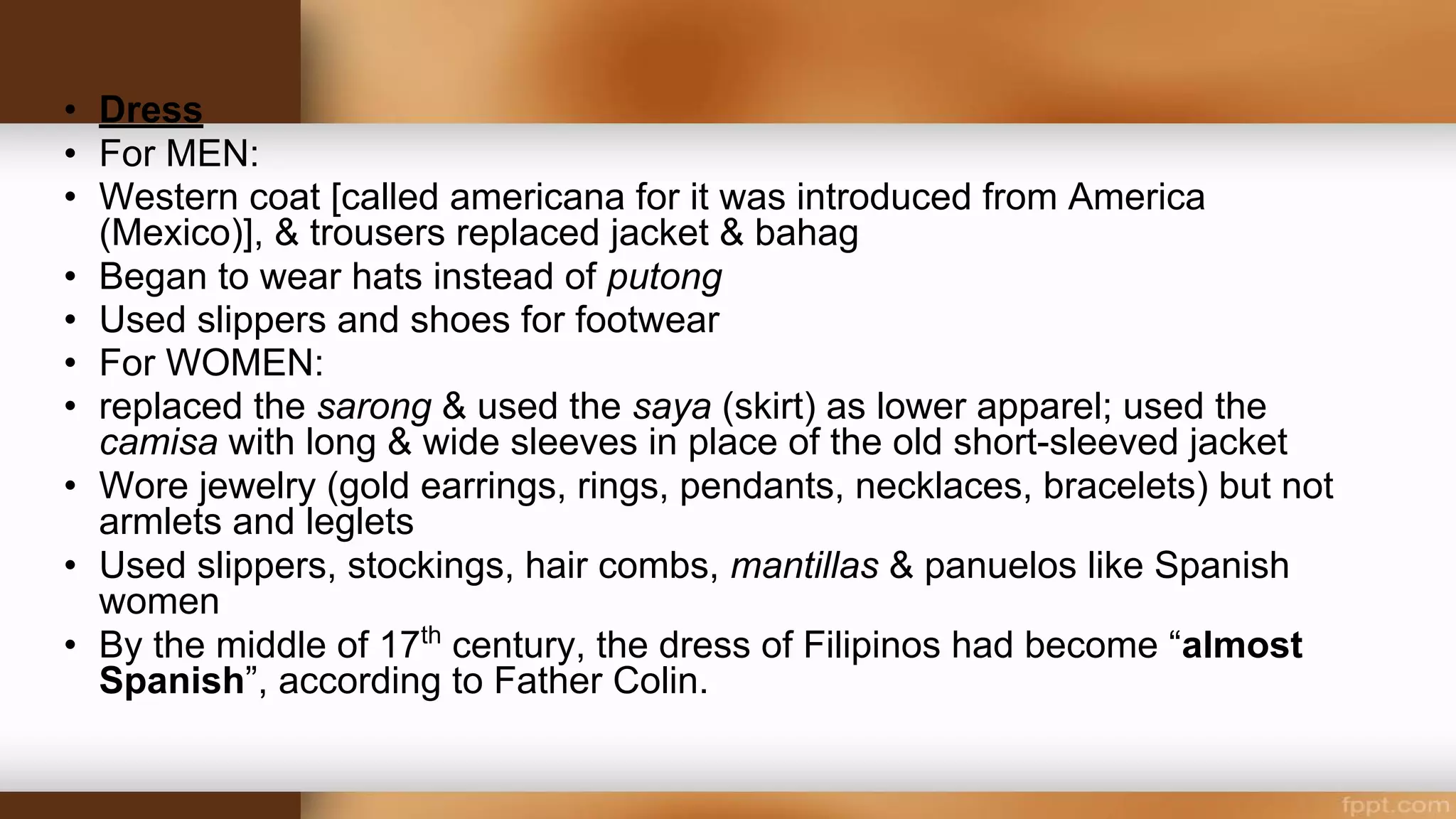
• Dress
• For MEN:
• Western coat [called americana for it was introduced from America
(Mexico)], & trousers replaced jacket & bahag
• Began to wear hats instead of putong
• Used slippers and shoes for footwear
• For WOMEN:
• replaced the sarong & used the saya (skirt) as lower apparel; used the
camisa with long & wide sleeves in place of the old short-sleeved jacket
• Wore jewelry (gold earrings, rings, pendants, necklaces, bracelets) but not
armlets and leglets
• Used slippers, stockings, hair combs, mantillas & panuelos like Spanish
women
• By the middle of 17th century, the dress of Filipinos had become “almost
Spanish”, according to Father Colin.
• Family Life
• Simple & wholesome because of Christianity’s influence
• The father was the master of the family yet he consults his wife regarding
family matters
• The mother was the first TUTOR of the children (taught them the alphabet &
Christian prayers), and the custodian of the family fund & keys
• Parents & children prayed the Angelus & rosary every night, prayed before
each meal, and went to Church every Sunday, town fiestas & religious
holidays
• Broken homes were rare
• Children kiss their parents’ hands after evening prayers, upon leaving their
home & upon returning home
• Filipino Women
• Position of Filipino WOMEN were elevated
• Respected by men
• If unmarried, they were chaperoned in attending social gatherings
• Had NO freedom to study in universities, engage in professions (law,
medicine, engineering,etc.) and to mix freely with men
• Permitted to engage in business
• Entered exclusive schools for girls operated by nuns were they were
trained on the “HOW To’s” of being a good wife or mother
• Those who had no intention of marrying entered the nunnery in
service of GOD
• Maria Clara of Rizal’s novels represented the Filipino womanhood of
the Spanish era – with traits of charm, modesty and religious
devotion
• Introduction of the GREGORIAN CALENDAR
• Until 1845, the Phil. Calendar was 1 day behind that of European time
• Gov. Gen. Narciso Claveria corrected the Philippine Calendar.
• Aug. 16,1844 - He issued an order proclaiming Tuesday, Dec.31,1844, to be
Wednesday, Jan.1,1844, advancing the calendar by one day so that it
would be in accord with world standard time.
• Spanish surnames for Filipinos
• First names of Filipinos were from the saints
ex. Juan from San Juan
• Gov. Gen. Narciso Claveria issued an order on Nov. 21, 1849 which gave
Spanish surnames to the Filipino families. He sent lists of Spanish family
names to the authorities of provinces & towns (ex. Gomez, Reyes, Santos).
• Many Filipino families became loyal to their Malayan descendants’ surnames
(ex. Batungbakal, Magbanua, Sumulong, Tonogbanua, Kalaw, Makapagal)
• LATIN ALPHABET & SPANISH LANGUAGE
• Filipinos easily adopted Latin alphabet & Spanish language
• Enriched our national language called PILIPINO– there are
5,000 Spanish loan-words in our national language
• Filipinos became the sole Spanish-speaking nation in Asia.
• Preservation of Philippine languages
• Spanish friars studied & used our native language in spreading Christianity
instead of the Spanish language
• Spanish missionaries were the first to write grammars & dictionaries for
Filipino languages
• 1610 – 1st tagalog grammar was published, entitled Arte y reglas de la
lengua tagala, written by Fr. Francisco Blancas de San Jose, a Spanish
Dominican missionary, who was known as the “Demosthenes of the
Tagalog Language”, because of his mastery in Tagalog
• Printing
• 1593- the Dominicans in Manila established the 1st
Filipino press (47 years before the appearance of the 1st
printing press in U.S)
• Printed books by means of old xylographic method
(printing using engraved wood blocks). It still exists at the
University of Santo Tomas Press & is one of the oldest
printing establishments in the world.
• Early Filipino printers
• Tomas Pinpin – 1st Filipino printer, “Prince of Filipino Printers”.
• -- 1st Tagalog author, wrote the first tagalog book published entitled,
Librong pag-aaralan nang manga Tagalog nang uicang Castila (Book
that the Tagalogs Should Study to Learn Spanish), w/c was printed in
Bataan in 1610.
• --- had a worthy son, Simon, who was also a good printer.
• Other pioneer Filipino Printers : Diego Talaghay, Nicolas de la Cruz
bagay, Laureano Atlas, Domingo Loag & Cipriano Bagay.
• 1st books printed in the Philippines
• Doctrina Christiana en lengua española y tagala, (Manila, 1593)
• Doctrina Christiana en letra y lengua China (by Keng Yong
(Chinese), in the Parian, Manila
• Tratado de la Doctrina de la Santa Iglesia y de Ciencias
naturales (by Fr. Juan de Cobo, O.P., Manila, 1593)
• Education
• Spain introduced the European system of education in the
Philippines
• First schools established were parochial schools, with Spanish
missionaries as teachers. Filipino children were taught the Catholic
doctrine, the 3 R’s (reading, writing, arithmetic), music, arts and
trades
• The JESUITS
• Founded the 1st college for boys(1589).
• -- originally called College of Manila, the name was changed to
Colegio de San Ignacio.
• Founded College of San Ildefonso in Cebu(1595)
• Founded College of San Jose in Manila
• --took charge of Escuela Pia, public school for boys in Manila &
transformed it into Ateneo de Manila
• The DOMINICANS
• College of Our Lady of the Rosary(1611), whose name
later changed to College of Santo Tomas and still later,
University of Santo Tomas
• College of San Juan de Letran (1630)
• -- oldest existing college for boys in the Philippines
• UNIVERSITIES
• University education in the Philippines is much older than the U.S
• 1st university: University of San Ignacio
• – oldest university in the Philippines ; founded in 1589 as a college but was elevated to
university rank by Pope Gregory XV in 1621. It was closed in 1768 when Jesuits were expelled
in the Philippines.
• The College of San Ildefonso also closed but was reopened in 1783 as Colegio-Seminario de
San Carlos (became University of San Carlos in 1948)
• 2nd university: University of Santo Tomas
• -- originally founded as a college in 1611 by Miguel de Buenavides, a Domincan prelate who
is also the third Archbishop of Manila
• -- raised to university rank in 1645 by Pope Innocent X upon request of King Philip IV of Spain,
making it the only Royal & Pontifical University in all Asia.
• UST is 25 years older than Harvard University, the oldest university in the U.S
• 3rd University: University of San Felipe
• -- a government sponsored university, established in Manila by a royal decree of King Philip V
of Spain.
• -- never gained popularity & was closed in 1726
• ALL universities during the Spanish times were exclusively for MEN.
Dutch in Indonesia
• FOOD
• There is not many culinary tradition which was inherited (even Dutch food is not
popular at all), but there is some degree of culinary technique which were
imported.
• Incorporation of the kitchen style gave birth to dishes such as Bistik Jawa, Sop
Kacang Merah, Roti Bakar, Selat Solo, Semur Daging, etc.
• The Dutch also introduced European foodies as the Butter, Bread, Margarine,
Cheese, Ice Cream and Pancake. And as it is famous for, the Dutch gave
Indonesia their sweets and pastry tradition (and beers too):
• hagelslaags in Indonesian supermarket rack.
• Indonesian dry cookies, many are influenced by Dutch tradition..
• ​Indonesian Panekuk (pannekoek)
• Tradition
• Several tradition such as Christmas, Easter, New Year and Birthday
celebration.
• Saint-Nicholas day wasn't really adopted into the Indonesian society,
however it was largely celebrated by the Dutch community during colonial
era.
• I guest it was seen as being too foreign by the Indonesian society or was it
because it is too Catholic that it wasn't promoted. The poor queuing culture
was probably inherited from the Dutch society themselves, who are notorious
for bumping in line. (while ex-British colonies usually have better manner)
• Arts, Music and Dances
• There is small yet significant impact from the following as well. In
terms of art, an example would be the introduction of oil painting
which flourished in the 19th century. One of the examples of
westernized painter is Raden Saleh, who are educated in Europe
and had become of Indonesia's earlier painter. (you may even see
his artwork here in wiki: Raden Saleh)
• In terms of music, obviously introduction musical insrument of
Violin, Cello, Guitar and Piano is something to be mentioned. One
of the musical insrument that were developed uniquely in the
Indies is Kroncong. Western style songs also became fashionable
as the Dutch rule in the country.
• Westernization
• ​Javanese stained glass decor in Kraton
Mangkunegaraan, this is an example of the trend of
Indonesian Sultans adopting western influence. As the
Dutch have adopted the Indonesian tropical life.
• Religion
• There is also significant influence of Christianity which was first
introduced by the Portuguese. As a former Dutch colony majority
of Indonesian Christian today are Protestant rather than Catholic.
• The bible were also translated by the Dutch into Malay and
various indigenous languages such as Javanese, Batak,
Menadonese, etc (in total 22 indigenous languages).
• Today Christian terms such as most of the Biblical Saints have
been absorbed into the Indonesian language. The church
structure also followed the Netherlands' Protestant and Catholic
body.
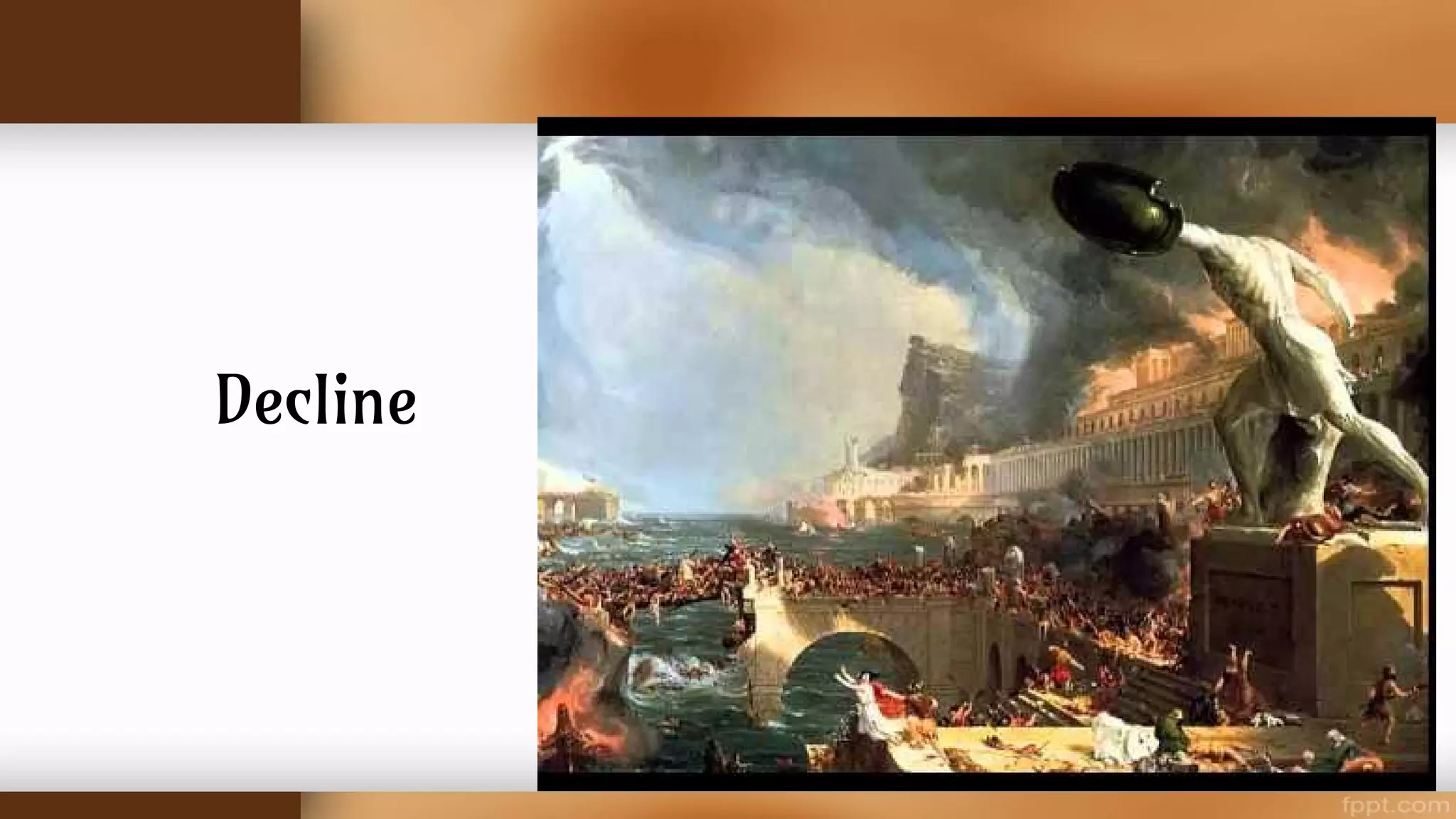
Decline
Portuguese
- From 1580 to 1640, the throne of Portugal was held by the Habsburg kings of
Spain, which marked a phase of decline for the Portuguese Empire.
- Spain's enemies, such as the Netherlands and England, coveted their
overseas wealth, and in many cases found it easier to attack poorly-defended
Portuguese outposts than Spanish ones.
- Spain also pursued a policy of neglect of the Portuguese colonies it now
controlled. - -- During the 17th century the Dutch were able to occupy Ceylon,
the Cape of Good Hope, and the East Indies, and took over the trade with
Japan at Nagasaki. Portugal's Pacific territories were reduced to the bases at
Macao and East Timor.
In 1661
-the Portuguese gave Bombay to England as part of a dowry. Over
the next hundred years the British became the dominant power in
India, excluding other powers from trade. Portugal retained Goa and
several minor bases throughout the colonial period.
- The Portuguese Empire ended when Portugal handed Macau over
to China in 1999 under the terms of a negotiated agreement similar
to the one under which the United Kingdom handed over Hong
Kong.
Dutch
-Since the 17th century, The VOC (Dutch South East Asia Company)
had been buying pepper and tin from various Southeast Asian
countries and was exporting most of that to China by the 18th
century.
-From the 1720s, the VOC began sending ships to Guangzhou
(Canton), the only port open to Western ships, to keep up with the
soaring demand for Chinese tea in Holland and England.
-But by the middle of the 18th century, the VOC was having trouble
obtaining sufficient supply of goods tailored to the Chinese market.
- They attempted to secure a monopoly over the pepper and tin
trades through exclusive purchasing agreements with rulers of the
pepper-producing centers on the east coast of Sumatra (Jambi,
Palembang) and South Kalimantan (Banten, Banjarmasin) and tin-
production centers on the west coast of the Malay Peninsula (Perak)
and Bangka Island.
-However their attempts backfired as the Chinese and English
merchants would circumvent the VOC’s exclusive contracts by
visiting production sites on the sly and offering higher prices.
-The English had privately owned ships carrying guns and
gunpowder along with textiles and opium from India frequently
visited Riau to purchase goods for the Chinese market. By
supplying the Chinese with various goods from Southeast Asia,
together with Indian cotton and opium, the English secured a more
advantageous position in the Guangzhou trade.
- The VOC’s position was further weakened by the loss of
ships in the Fourth Anglo-Dutch War (1780–84). The
erosion of the VOC’s intra-Asian trade, together with
internal problems and the birth of a new government in the
Netherlands, eventually led to the company’s dissolution in
1799.
Conclusion
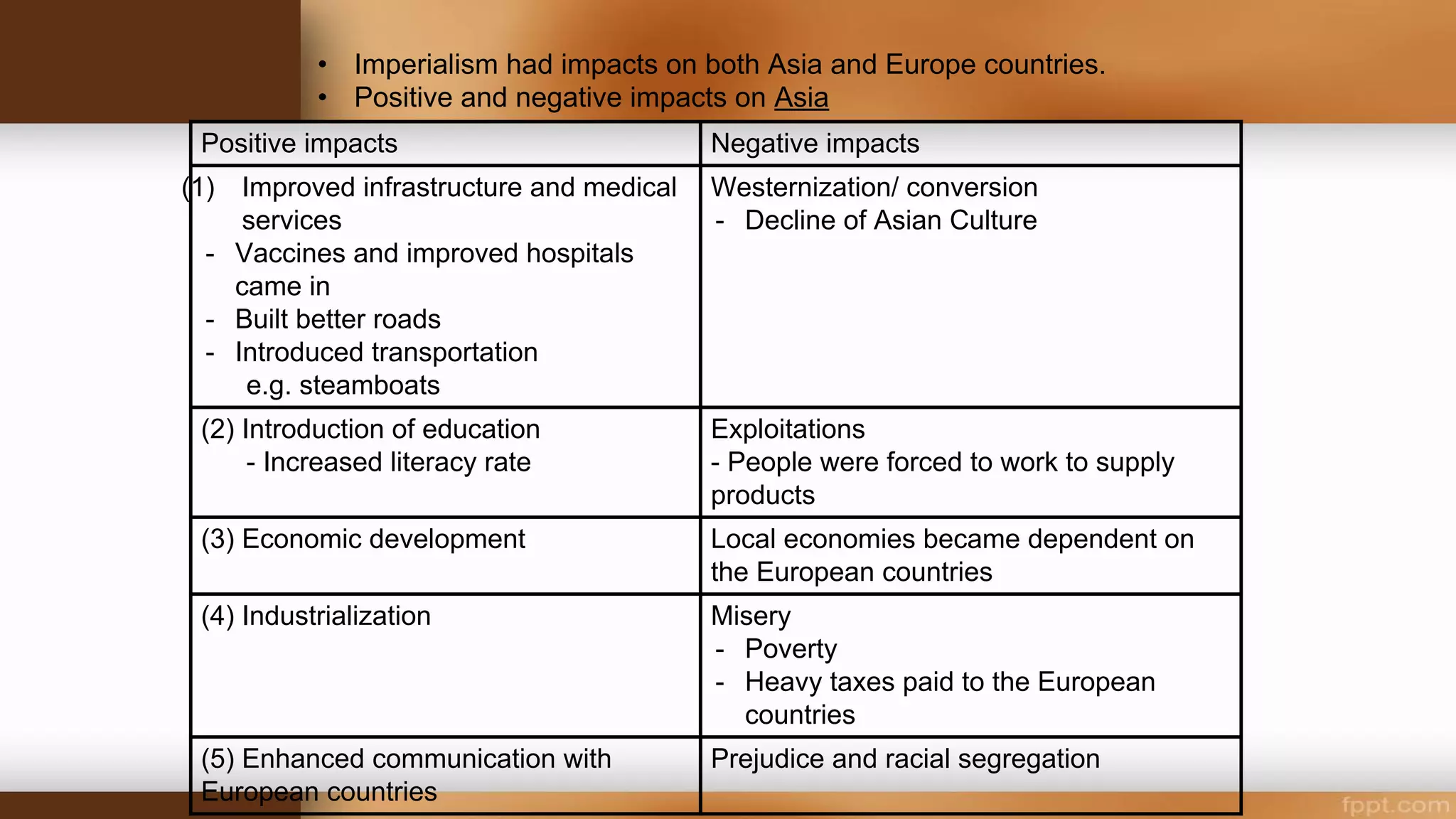
• Imperialism had impacts on both Asia and Europe countries.
• Positive and negative impacts on Asia
Positive impacts Negative impacts
(1) Improved infrastructure and medical
services
- Vaccines and improved hospitals
came in
- Built better roads
- Introduced transportation
e.g. steamboats
Westernization/ conversion
- Decline of Asian Culture
(2) Introduction of education
- Increased literacy rate
Exploitations
- People were forced to work to supply
products
(3) Economic development Local economies became dependent on
the European countries
(4) Industrialization Misery
- Poverty
- Heavy taxes paid to the European
countries
(5) Enhanced communication with
European countries
Prejudice and racial segregation
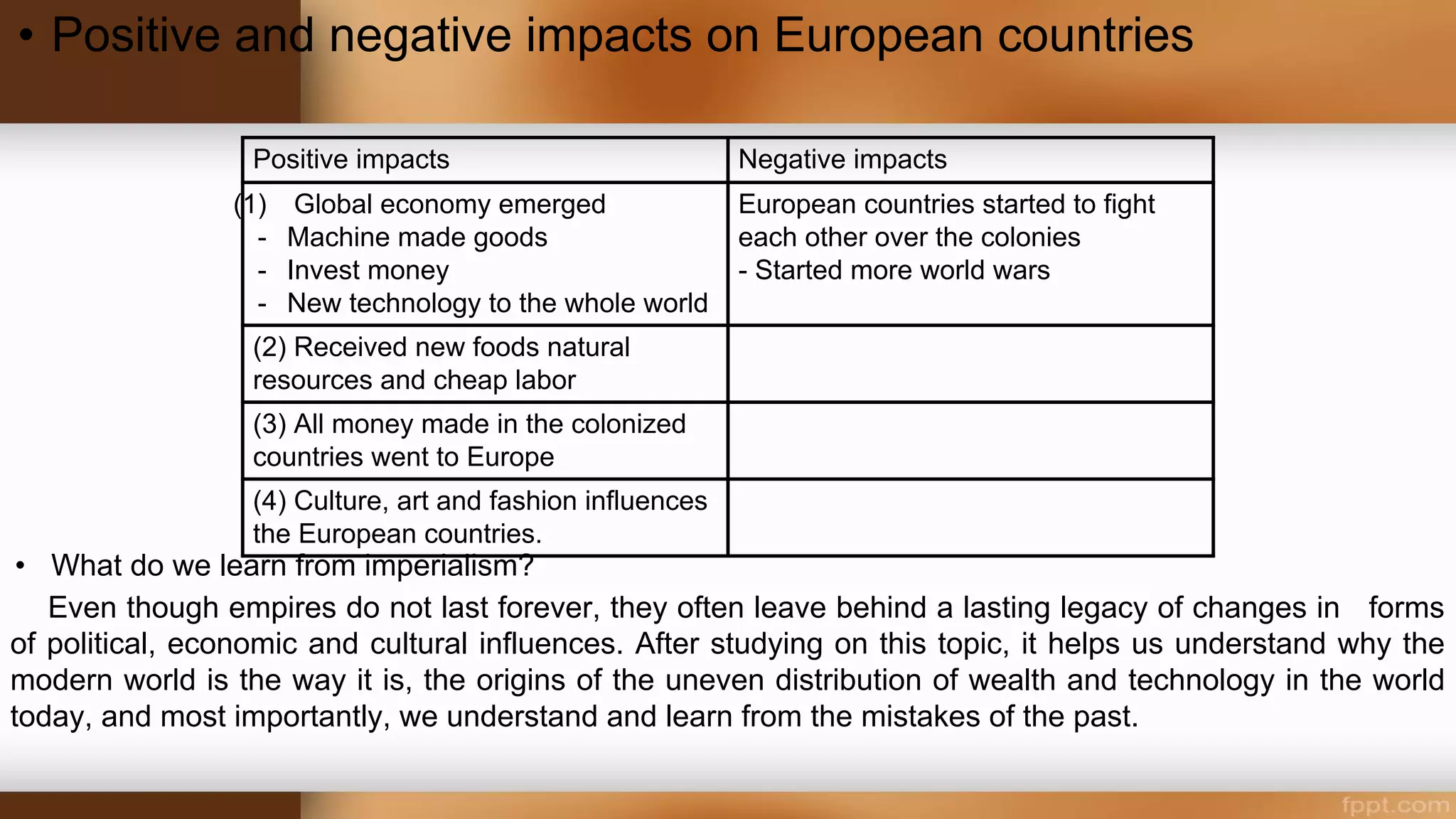
• Positive and negative impacts on European countries
• What do we learn from imperialism?
Even though empires do not last forever, they often leave behind a lasting legacy of changes in forms
of political, economic and cultural influences. After studying on this topic, it helps us understand why the
modern world is the way it is, the origins of the uneven distribution of wealth and technology in the world
today, and most importantly, we understand and learn from the mistakes of the past.
Positive impacts Negative impacts
(1) Global economy emerged
- Machine made goods
- Invest money
- New technology to the whole world
European countries started to fight
each other over the colonies
- Started more world wars
(2) Received new foods natural
resources and cheap labor
(3) All money made in the colonized
countries went to Europe
(4) Culture, art and fashion influences
the European countries.
C&C group presentation

C&C group presentation

  • 1.
    The Imperialism inAsia The arrivals of the Portuguese, the Spaniards and the Dutch and the age of discovery
  • 2.
    Peer Assessment (01/12/2015) •Lau Hui Ming • Wong Yun Teng • Farah • Tee Jane • Alison • Christina • Ngu Wei King • Voo Zat Ting • Khoo Zi Lin
  • 3.
    Introduction • Imperialism canbe defined as a policy of extending a country’s power and influence through diplomacy or military force. It is a political and economic control either formally or informally. • When a country wanted to show their power and compete to other countries, they will find a new land to extend their powerThe arrivals of the Portuguese, the Spaniards and the Dutch to Asia also gave an impact to this imperialism history. • The age of discovery is defined as European historical period from 15th century to the 18th century. They were having extensive exploration overseas. It led to the rise of global trade and the European colonial empires.
  • 4.
  • 5.
    Portuguese's Colonization In theyear of... 1418-1419 Portuguese sailors began to explore the coast of Africa and Atlantic archipelagos, in order to find a sea route to the source of the lucrative spice trade. 1494 Treaty of Tordesillas divides the non-European world between Spain and Portugal. 1498 Vasco da Gama first reached in India. Over the following decades, Portuguese sailors continued to explore the coasts and islands of East Asia. 1510 Alfonso de Albuquerque conquered Goa in India which enabled him to gradually consolidate control of most of the commercial traffic between Europe and Asia, largely through trade.
  • 6.
    Portuguese Malacca April 1511 Alfonsode Albuquerque set sail from Goa to Malacca with a force of some 1200 men and seventeen or eighteen ships. 24 August 1511 Conflict was unavoidable, and after 40 days of fighting, Malacca fell to the Portuguese. It soon became clear that Portuguese control of Malacca did not also mean they controlled Asian trade centered there. Their Malaccan rule was severely hampered by administrative and economic difficulties.
  • 7.
    Portuguese Macau 1513 Portuguese landedon Lintin Island, claimed island for King of Portugal. 1516 Portuguese traders used Macau as staging port. The first Portuguese ships had reached Canton on the Southern coasts of China.
  • 8.
    1521 Chinese expelled Portugueseadventurers from coast of Guangdong. 1536 Portuguese traders allowed to anchor at Haojingao following a shipwreck. 1540 Portuguese helped China in eliminating coastal pirates.
  • 9.
    1542 Portuguese introduce firearms. 1552- 1553 Portuguese received permission to erect storage sheds onshore. 1557 China ceded Macau to Portugal in recognition of their help in defeating pirates. 1557 Portuguese opened first trading post in Asia in Macau.
  • 10.
    1564 Portuguese established westerntrade with India, Japan and China. 1570 The Portuguese bought part of a Japanese port where they founded a small part of the city of Nagasaki, and it became the major trading port in Japan in the triangular trade with China and Europe. 1571 A string of naval outposts connected Libson to Nagasaki along the coasts of Africa, the Middle East, India and South Africa.
  • 11.
    Portuguese in China 1513 Portugueselanded on Lintin Island, claimed island for King of Portugal. 1516 Portuguese traders used Macau as staging port. The first Portuguese ships had reached Canton (now Guangdong) on the Southern coasts of China. 1521 Chinese expelled Portuguese adventurers from coast of Canton.
  • 12.
    1536 Portuguese traders allowedto anchor at Haojingao following a shipwreck. 1540 Portuguese helped China in eliminating coastal pirates.
  • 13.
    Portuguese (China, Japan) 1542 Portugueseintroduced firearms to Japan. 1552 - 1553 Portuguese received permission to erect storage sheds onshore, in order to dry out goods drenched by sea water in Macau. 1557 China ceded Macau to Portugal in recognition of their help in defeating pirates. Besides, Portuguese opened first trading post in Asia in Macau.
  • 14.
    Spanish Philippines In theyear... 1520 Spanish under Ferdinand Magellan reach the Philippines and East Indonesia – circumnavigation of the globe March 1521 The Portuguese navigator and explorer Ferdinand Magellan headed the first Spanish foray to the Philippines when he made landfall on Cebu. 1565 After King Philip II had dispatched three further expeditions that ended in disaster, he sent out Miguel Lopez de Legazpi, who established the first permanent Spanish settlement. 1570 Spanish capture of Manila – they decide to stay in the Philippines
  • 15.
    1571 The Spanish cityof Manila was founded and by the end of 16th century most of the coastal and lowland areas from Luzon to northern Mindanao were under Spanish control. 1863 The public education in the Philippines and even the church controlled the curriculum. Less than one-fifth of those who went to school could read and write Spanish, and far fewer could speak it properly. 1880 The limited higher education in the colony was entirely under clerical direction but by the year 1880s many sons of the wealthy were sent to Europe to study.
  • 16.
    1896 Rizal was quicklyarrested by the overly fearful Spanish, exiled to a remote island in the south and finally being executed. 1892 Shocked by the arrest of Rizal, these activists quickly formed the Katipunan under the leadership of Andres Bonifacio, a self-educated warehouseman. 1896 Spanish friars uncovered evidence of the Katipunan's plans and its leaders were forced into premature action. 1897 Revolts broke out in several provinces around Manila. After months of fighting, severe Spanish retaliation forced the revolutionary armies to retreat to the hills. Finally, a truce was concluded with the Spanish.
  • 17.
    23 December 1897 Aguinaldoand other revolutionary officials departed for Hong Kong to enter voluntary exile. 12 June 1898 Independence was declared. September 1898 A constitutional congress met in Malolos, north of Manila, which drew up a fundamental law derived from European and Latin American precedent. January 1899 With Aguinaldo as president of the new country, popularly known as the "Malolos Republic".
  • 18.
    Spaniards (Indonesia, Japan,Taiwan) 1606 Spaniards established some form of trade links with the Maluku Islands and remained until 1663. 1611 Spanish contacted with Japan were established. Sebastián Vizcaíno was sent as ambassador until Japan closed its trading post in 1630. 1626 On the north eastern coastal region of Taiwan, the Spaniards built Fort Santo Domingo near Keelung.
  • 19.
    Dutch 1619 The Dutch foundwhat they were looking for in Jakarta, conquered by Jan Coen. Later renamed Batavia after the putative Dutch ancestors the Batavians, and which would become the capital of the Dutch East Indies. 1641 The Dutch continued to drive out the Portuguese from their bases in Asia. Malacca finally succumbed in 1641. 1603 &1610 Goa, the capital of the Portuguese Empire in the East, was unsuccessfully attacked by the Dutch.
  • 20.
    1639 Dutch were unablein four attempts to capture Macau from where Portugal monopolized the lucrative China-Japan trade, the Japanese shogunate's increasing suspicion of the intentions of the Catholic Portuguese led to their expulsion 1639-1854 The Dutch were the only European power allowed to operate in Japan, confined in 1639 to Hirado and then from 1641 at Deshima. In the mid 17th century the Dutch also explored the western Australian coasts, naming many places. 1638 The Dutch colonized Mauritius in 1638, several decades after three ships out of the Dutch Second Fleet sent to the Spice Islands were blown off course in a storm and landed in 1598.
  • 21.
    1642 The Dutch tooknorthern Formosa from the Spanish by force. 1646 The Dutch tried to take the Spanish colony in the Philippines. The Dutch had a large force at their disposal but when they tried to take Manila, they were defeated at the Battles of La Naval de Manila. After this defeat, the Dutch abandoned their efforts to take Manila and the Philippines.
  • 22.
  • 23.
    Portuguese • Europeans wasthe first country which reached Asia and the place was called The East Indies. Christopher Columbus
  • 24.
    Alfonso de Albuquerque Thefirst person who reached Malacca in the year 1511
  • 25.
    Spaniards The most activetime of the Propaganda Movement 1880 to 1885 • Nationalism and a passion for reform blossomed in the liberal atmosphere. • Out of this talented group of overseas Filipino students arose what came to be known as the Propaganda Movement. Magazines, poetry and pamphleteering flourished. • Jose Rizal, this movement's most brilliant figure, produced two political novels (Noli me Tangere and El filibusterismo) which had a wide impact in the Philippines. Joze Rizal The propaganda
  • 26.
    1898 • War hadbroken out between Spain and the United States (Spanish-American War). • After the United States naval victory in the Battle of Manila Bay in May 1898, Aguinaldo and his entourage returned to Philippines with the help of Adm. George Dewey. • Confident of United States support, Aguinaldo reorganized his forces and soon liberated several towns south of Manila. Emilio Aguinaldo
  • 27.
    Dutch Between 1602 and1796 • The VOC sent almost a million Europeans to work in the Asia trade. • The majority died of disease or made their way back to Europe, but some of them made the Indies their new home. • Interaction between the Dutch and native population mainly took place in Sri Lanka and the modern Indonesian Islands. • Through the centuries there developed a relatively large Dutch-speaking population of mixed Dutch and Indonesian descent, known as Indos or Dutch-Indonesians. Various VOC soldier uniforms
  • 28.
  • 29.
    Portuguese in India •Cochin was the first ever European settlement in India. • Introduced Christianity here. • Initiated the act of dressing up properly. • Popularized Kerala spices like pepper, cardamom, cinnamon and ginger in European markets by arranging their direct transportation. Trade with Europe grew in dimensions and led to the flow of wealth into the country. • The Portuguese founded theological seminaries and colleges at Cochin, Cranganore (now Kodungalloor), Ankamali and Vaipikotta for the purpose of training Christian priests. These institutions helped to spread the knowledge of Latin and Portuguese among the local people, thus contributing to the great educational movement.
  • 30.
    • Portuguese encouragedthe cultivation of coconut commercially. They introduced the use of coconut fibre in making sturdy coir ropes and made coir and copra articles of world trade. They brought a new strain of coconuts from Africa which produced bigger and 10 better fruits. It is these Portuguese coconuts that are planted in abundance along the Kerala coast now. • Christian art of Kerala is highly inspired from the Portuguese culture. The Chavittunaatakam, the Christian counterpart of the Hindu Kathakali, originated and grew into a popular form of entertainment under the patronage of the Portuguese missionaries. 12 The Cochin Carnival, which is celebrated in Cochin during the Christmas and New Year is also a tradition started by the Portuguese. • The food are also influenced by Portuguese. The Goan cuisine is a combination of Portuguese dishes and Indian aromatic spices.
  • 31.
    Architecture • Indian palacesused to be wooden buildings, often very small as the Kings then used to stay only for smaller periods. In 1555, the Portuguese constructed a stone palace with a tiled roof in Mattancherry as a gift to the raja of Cochin which possesses one of the finest groups of mural paintings of Kerala. • The Portuguese introduced ornamental architecture and the buildings of the bungalow type. One feature of churches in Kerala that appear distinctly Portuguese is the retable, erected as the screen behinds the altar. • This highly decorated, mostly wooden, gilded backdrop of the altar is the decorative focus of the church interior. • The top portions of the relatables are curved, similar to the facades outside. The whole composition is decorated with creepers and foliage supported by cherubs and soldier figures.
  • 32.
    This is anold Portuguese church in India.
  • 33.
    Portuguese in Malacca •They introduced Christianity • Portuguese-Eurasian or ‘Kristang' in Malacca speak Creole (fusion of Portuguese and Malay language) • The 'Jinggling Nyonya', a happy dance-song routine was originated from Portuguese • Curry Debel and Kanjee Munggu are among of the famous Portuguese dishes in Malacca.
  • 34.
    • In June,the Portuguese Square becomes abuzz with activity as the villagers celebrate a feast in honor of their patron saint. • In the early 1950s and 1960s, as fishing was their dominant livelihood, the residents (Portuguese) wore green pajamas on the night of the feast day while during the day their children were all dressed in green clothing. • They also prepared green peas soup for that day. It is said that green represented the community’s innocence, purity and rejuvenation. It is also believed that when St John was beheaded, children who visited his tomb were dressed in green and carried lighted candles in homage
  • 35.
    Architecture: The famousA Formosa was built by the Portuguese
  • 36.
    Dutch • Indonesian drycookies are actually originated from Dutch tradition. • The Dutch spread Christianity as well. • The Dutch brought goods, such as coffee, to the island of Java, which became one of the largest exporters of the product. • Daily life differed for different social classes in Indonesia. Higher classes faced less hardships under the Dutch rule, nevertheless the lower classes encountered harsh treatment, great exploitation, heavy tax burdens, and a deterioration of their living conditions.
  • 37.
    Architecture: The window and ornamentaldecoration is influenced by Dutch architecture.
  • 38.
    • The Dutchalso adopted and modernized the Indonesian architecture, with few Dutch architect such as Henri MacLaine Pont and Wolff Schoemaker who are keen on modernizing the vernacular architecture. • Such example is the Javanese "Candi" Catholic church which was built in the 1930s:
  • 39.
    GPIB Paulus church inthe leafy elite suburb of Menteng, Jakarta... the church itself is built in back- then popular architecture of "Nieuw Stijl"
  • 40.
  • 41.
    Portuguese in Malacca 1)Malacca Towns  Tranqueira o Tranqueira was the most important suburb of Malacca. The suburb was rectangular in shape, with a northern walled boundary, the straits of Malacca to the south and the river of Malacca (Rio de Malaca) and the fortaleza's wall to the east. It was the main residential quarters of the city. However, in war, the residents of the quarters would be evacuated to the fortress. Tranqueira was divided into a further two parishes, São Tomé and São Estêvão. The parish of S.Tomé was called Campon Chelim (Malay: Kampung Keling). It was described that this area was populated by the Chelis of Choromandel. The other suburb of São Estêvão was also called Campon China (Kampung Cina). o Erédia described the houses as made of timber but roofed by tiles. A stone bridge with sentry crosses the river Malacca to provide access to the Malacca Fortress via the eastern Custome House Terrace. The center of trade of the city was also located in Tranqueira near the beach on the mouth of the river called the Bazaar of the Jaos (Jowo/Jawa i.e. Javanese). o In the present day, this part of the city is called Tengkera
  • 42.
     Yler o Thedistrict of Yler (Hilir) roughly covered Buquet China (Bukit Cina) and the south- eastern coastal area. The Well of Buquet China was one of the most important water sources for the community. Notable landmarks included the Church of the Madre De Deus and the Convent of the Capuchins of São Francisco. Other notable landmarks included Buquetpiatto (Bukit Piatu). The boundaries of this unwalled suburb were said to extend as far as Buquetpipi and Tanjonpacer. o Tanjonpacer (Malay: Tanjung Pasir) was later renamed Ujong Pasir. A community descended from Portuguese settlers is still located here in present-day Malacca. However, this suburb of Yler is now known as Banda Hilir. Modern land reclamations (for the purpose of building the commercial district of Melaka Raya) have, however, denied Banda Hilir the access to the sea that it formerly had.
  • 43.
     Sabba o Thehouses of this suburb were built along the edges of the river. Some of the original Muslim Malay inhabitants of Malacca lived in the swamps of Nypeiras tree, where they were known to make Nypa (Nipah) wine by distillation for trade. This suburb was considered the most rural, being a transition to the Malacca hinterland, where timber and charcoal traffic passed through into the city. Several Christian parishes also lay outside the city along the river; São Lázaro, Our Lady of Guadalupe, Our Lady of Hope. While Muslim Malays inhabited the farmlands deeper into the hinterland. o In later periods of Dutch, British and modern day Malacca, the name of Sabba was made obsolete. However, its area encompassed parts of what is now Banda Kaba, Bunga Raya and Kampung Jawa; and the modern city center of Malacca
  • 44.
    Architecture A Famosa Fortress(built 1511 onwards) • A Famosa, or "The Famous" in Portuguese, is one of the oldest surviving remnants of European architecture in Asia. Once part of a mighty fortress, this tiny gate (called the Porta de Santiago) is all that history has spared.
  • 45.
    • St. Paul'sChurch • is a historic church building in Malacca, Malaysia that was originally built in 1521. It is located at the summit of St. Paul's Hill and is today part of the Malacca Museum Complex comprising the A Famosa ruins, the Stadthuys and other historical building
  • 46.
    Spain in thePhilippines • Spanish Heritage • Spain ruled the Philippines for three centuries (1565-1898) • Spain’s cultural legacy was more beneficial and comprehensive than her political and economic endowments. • Christianity • Spain’s greatest legacy • The Roman Catholic religion • - originated in Asia, being founded by Jesus Christ in Palestine; spread to Western Europe after Christ’s crucifixion, in the 16th and 17th centuries, propagated across the Atlantic to the New World and across the Pacific to the Philippines, making her then the greatest power. • --- the most outstanding achievement of Spanish missionaries who came with the Spanish conquistadores.
  • 47.
    • Diet • Spainintroduced new food plants (wheat, corn, potatas, cacao, coffee, cabbages, chicos, papayas, guavas). The Filipinos learned to : • Eat bread, ham, longanizas, beef(cattle’s meat), mutton(sheep’s meat) and European canned goods • drink coffee, cacao & foreign wines • Use drinking glasses, table knives & napkins while eating.
  • 48.
    • Dress • ForMEN: • Western coat [called americana for it was introduced from America (Mexico)], & trousers replaced jacket & bahag • Began to wear hats instead of putong • Used slippers and shoes for footwear • For WOMEN: • replaced the sarong & used the saya (skirt) as lower apparel; used the camisa with long & wide sleeves in place of the old short-sleeved jacket • Wore jewelry (gold earrings, rings, pendants, necklaces, bracelets) but not armlets and leglets • Used slippers, stockings, hair combs, mantillas & panuelos like Spanish women • By the middle of 17th century, the dress of Filipinos had become “almost Spanish”, according to Father Colin.
  • 49.
    • Family Life •Simple & wholesome because of Christianity’s influence • The father was the master of the family yet he consults his wife regarding family matters • The mother was the first TUTOR of the children (taught them the alphabet & Christian prayers), and the custodian of the family fund & keys • Parents & children prayed the Angelus & rosary every night, prayed before each meal, and went to Church every Sunday, town fiestas & religious holidays • Broken homes were rare • Children kiss their parents’ hands after evening prayers, upon leaving their home & upon returning home
  • 50.
    • Filipino Women •Position of Filipino WOMEN were elevated • Respected by men • If unmarried, they were chaperoned in attending social gatherings • Had NO freedom to study in universities, engage in professions (law, medicine, engineering,etc.) and to mix freely with men • Permitted to engage in business • Entered exclusive schools for girls operated by nuns were they were trained on the “HOW To’s” of being a good wife or mother • Those who had no intention of marrying entered the nunnery in service of GOD • Maria Clara of Rizal’s novels represented the Filipino womanhood of the Spanish era – with traits of charm, modesty and religious devotion
  • 51.
    • Introduction ofthe GREGORIAN CALENDAR • Until 1845, the Phil. Calendar was 1 day behind that of European time • Gov. Gen. Narciso Claveria corrected the Philippine Calendar. • Aug. 16,1844 - He issued an order proclaiming Tuesday, Dec.31,1844, to be Wednesday, Jan.1,1844, advancing the calendar by one day so that it would be in accord with world standard time. • Spanish surnames for Filipinos • First names of Filipinos were from the saints ex. Juan from San Juan • Gov. Gen. Narciso Claveria issued an order on Nov. 21, 1849 which gave Spanish surnames to the Filipino families. He sent lists of Spanish family names to the authorities of provinces & towns (ex. Gomez, Reyes, Santos). • Many Filipino families became loyal to their Malayan descendants’ surnames (ex. Batungbakal, Magbanua, Sumulong, Tonogbanua, Kalaw, Makapagal)
  • 52.
    • LATIN ALPHABET& SPANISH LANGUAGE • Filipinos easily adopted Latin alphabet & Spanish language • Enriched our national language called PILIPINO– there are 5,000 Spanish loan-words in our national language • Filipinos became the sole Spanish-speaking nation in Asia.
  • 53.
    • Preservation ofPhilippine languages • Spanish friars studied & used our native language in spreading Christianity instead of the Spanish language • Spanish missionaries were the first to write grammars & dictionaries for Filipino languages • 1610 – 1st tagalog grammar was published, entitled Arte y reglas de la lengua tagala, written by Fr. Francisco Blancas de San Jose, a Spanish Dominican missionary, who was known as the “Demosthenes of the Tagalog Language”, because of his mastery in Tagalog
  • 54.
    • Printing • 1593-the Dominicans in Manila established the 1st Filipino press (47 years before the appearance of the 1st printing press in U.S) • Printed books by means of old xylographic method (printing using engraved wood blocks). It still exists at the University of Santo Tomas Press & is one of the oldest printing establishments in the world.
  • 55.
    • Early Filipinoprinters • Tomas Pinpin – 1st Filipino printer, “Prince of Filipino Printers”. • -- 1st Tagalog author, wrote the first tagalog book published entitled, Librong pag-aaralan nang manga Tagalog nang uicang Castila (Book that the Tagalogs Should Study to Learn Spanish), w/c was printed in Bataan in 1610. • --- had a worthy son, Simon, who was also a good printer. • Other pioneer Filipino Printers : Diego Talaghay, Nicolas de la Cruz bagay, Laureano Atlas, Domingo Loag & Cipriano Bagay.
  • 56.
    • 1st booksprinted in the Philippines • Doctrina Christiana en lengua española y tagala, (Manila, 1593) • Doctrina Christiana en letra y lengua China (by Keng Yong (Chinese), in the Parian, Manila • Tratado de la Doctrina de la Santa Iglesia y de Ciencias naturales (by Fr. Juan de Cobo, O.P., Manila, 1593) • Education • Spain introduced the European system of education in the Philippines • First schools established were parochial schools, with Spanish missionaries as teachers. Filipino children were taught the Catholic doctrine, the 3 R’s (reading, writing, arithmetic), music, arts and trades
  • 57.
    • The JESUITS •Founded the 1st college for boys(1589). • -- originally called College of Manila, the name was changed to Colegio de San Ignacio. • Founded College of San Ildefonso in Cebu(1595) • Founded College of San Jose in Manila • --took charge of Escuela Pia, public school for boys in Manila & transformed it into Ateneo de Manila
  • 58.
    • The DOMINICANS •College of Our Lady of the Rosary(1611), whose name later changed to College of Santo Tomas and still later, University of Santo Tomas • College of San Juan de Letran (1630) • -- oldest existing college for boys in the Philippines
  • 59.
    • UNIVERSITIES • Universityeducation in the Philippines is much older than the U.S • 1st university: University of San Ignacio • – oldest university in the Philippines ; founded in 1589 as a college but was elevated to university rank by Pope Gregory XV in 1621. It was closed in 1768 when Jesuits were expelled in the Philippines. • The College of San Ildefonso also closed but was reopened in 1783 as Colegio-Seminario de San Carlos (became University of San Carlos in 1948) • 2nd university: University of Santo Tomas • -- originally founded as a college in 1611 by Miguel de Buenavides, a Domincan prelate who is also the third Archbishop of Manila • -- raised to university rank in 1645 by Pope Innocent X upon request of King Philip IV of Spain, making it the only Royal & Pontifical University in all Asia. • UST is 25 years older than Harvard University, the oldest university in the U.S • 3rd University: University of San Felipe • -- a government sponsored university, established in Manila by a royal decree of King Philip V of Spain. • -- never gained popularity & was closed in 1726 • ALL universities during the Spanish times were exclusively for MEN.
  • 60.
    Dutch in Indonesia •FOOD • There is not many culinary tradition which was inherited (even Dutch food is not popular at all), but there is some degree of culinary technique which were imported. • Incorporation of the kitchen style gave birth to dishes such as Bistik Jawa, Sop Kacang Merah, Roti Bakar, Selat Solo, Semur Daging, etc. • The Dutch also introduced European foodies as the Butter, Bread, Margarine, Cheese, Ice Cream and Pancake. And as it is famous for, the Dutch gave Indonesia their sweets and pastry tradition (and beers too): • hagelslaags in Indonesian supermarket rack. • Indonesian dry cookies, many are influenced by Dutch tradition.. • ​Indonesian Panekuk (pannekoek)
  • 61.
    • Tradition • Severaltradition such as Christmas, Easter, New Year and Birthday celebration. • Saint-Nicholas day wasn't really adopted into the Indonesian society, however it was largely celebrated by the Dutch community during colonial era. • I guest it was seen as being too foreign by the Indonesian society or was it because it is too Catholic that it wasn't promoted. The poor queuing culture was probably inherited from the Dutch society themselves, who are notorious for bumping in line. (while ex-British colonies usually have better manner)
  • 62.
    • Arts, Musicand Dances • There is small yet significant impact from the following as well. In terms of art, an example would be the introduction of oil painting which flourished in the 19th century. One of the examples of westernized painter is Raden Saleh, who are educated in Europe and had become of Indonesia's earlier painter. (you may even see his artwork here in wiki: Raden Saleh) • In terms of music, obviously introduction musical insrument of Violin, Cello, Guitar and Piano is something to be mentioned. One of the musical insrument that were developed uniquely in the Indies is Kroncong. Western style songs also became fashionable as the Dutch rule in the country.
  • 63.
    • Westernization • ​Javanesestained glass decor in Kraton Mangkunegaraan, this is an example of the trend of Indonesian Sultans adopting western influence. As the Dutch have adopted the Indonesian tropical life.
  • 64.
    • Religion • Thereis also significant influence of Christianity which was first introduced by the Portuguese. As a former Dutch colony majority of Indonesian Christian today are Protestant rather than Catholic. • The bible were also translated by the Dutch into Malay and various indigenous languages such as Javanese, Batak, Menadonese, etc (in total 22 indigenous languages). • Today Christian terms such as most of the Biblical Saints have been absorbed into the Indonesian language. The church structure also followed the Netherlands' Protestant and Catholic body.
  • 65.
  • 66.
    Portuguese - From 1580to 1640, the throne of Portugal was held by the Habsburg kings of Spain, which marked a phase of decline for the Portuguese Empire. - Spain's enemies, such as the Netherlands and England, coveted their overseas wealth, and in many cases found it easier to attack poorly-defended Portuguese outposts than Spanish ones. - Spain also pursued a policy of neglect of the Portuguese colonies it now controlled. - -- During the 17th century the Dutch were able to occupy Ceylon, the Cape of Good Hope, and the East Indies, and took over the trade with Japan at Nagasaki. Portugal's Pacific territories were reduced to the bases at Macao and East Timor.
  • 67.
    In 1661 -the Portuguesegave Bombay to England as part of a dowry. Over the next hundred years the British became the dominant power in India, excluding other powers from trade. Portugal retained Goa and several minor bases throughout the colonial period. - The Portuguese Empire ended when Portugal handed Macau over to China in 1999 under the terms of a negotiated agreement similar to the one under which the United Kingdom handed over Hong Kong.
  • 68.
    Dutch -Since the 17thcentury, The VOC (Dutch South East Asia Company) had been buying pepper and tin from various Southeast Asian countries and was exporting most of that to China by the 18th century. -From the 1720s, the VOC began sending ships to Guangzhou (Canton), the only port open to Western ships, to keep up with the soaring demand for Chinese tea in Holland and England.
  • 69.
    -But by themiddle of the 18th century, the VOC was having trouble obtaining sufficient supply of goods tailored to the Chinese market. - They attempted to secure a monopoly over the pepper and tin trades through exclusive purchasing agreements with rulers of the pepper-producing centers on the east coast of Sumatra (Jambi, Palembang) and South Kalimantan (Banten, Banjarmasin) and tin- production centers on the west coast of the Malay Peninsula (Perak) and Bangka Island.
  • 70.
    -However their attemptsbackfired as the Chinese and English merchants would circumvent the VOC’s exclusive contracts by visiting production sites on the sly and offering higher prices. -The English had privately owned ships carrying guns and gunpowder along with textiles and opium from India frequently visited Riau to purchase goods for the Chinese market. By supplying the Chinese with various goods from Southeast Asia, together with Indian cotton and opium, the English secured a more advantageous position in the Guangzhou trade.
  • 71.
    - The VOC’sposition was further weakened by the loss of ships in the Fourth Anglo-Dutch War (1780–84). The erosion of the VOC’s intra-Asian trade, together with internal problems and the birth of a new government in the Netherlands, eventually led to the company’s dissolution in 1799.
  • 72.
  • 73.
    • Imperialism hadimpacts on both Asia and Europe countries. • Positive and negative impacts on Asia Positive impacts Negative impacts (1) Improved infrastructure and medical services - Vaccines and improved hospitals came in - Built better roads - Introduced transportation e.g. steamboats Westernization/ conversion - Decline of Asian Culture (2) Introduction of education - Increased literacy rate Exploitations - People were forced to work to supply products (3) Economic development Local economies became dependent on the European countries (4) Industrialization Misery - Poverty - Heavy taxes paid to the European countries (5) Enhanced communication with European countries Prejudice and racial segregation
  • 74.
    • Positive andnegative impacts on European countries • What do we learn from imperialism? Even though empires do not last forever, they often leave behind a lasting legacy of changes in forms of political, economic and cultural influences. After studying on this topic, it helps us understand why the modern world is the way it is, the origins of the uneven distribution of wealth and technology in the world today, and most importantly, we understand and learn from the mistakes of the past. Positive impacts Negative impacts (1) Global economy emerged - Machine made goods - Invest money - New technology to the whole world European countries started to fight each other over the colonies - Started more world wars (2) Received new foods natural resources and cheap labor (3) All money made in the colonized countries went to Europe (4) Culture, art and fashion influences the European countries.