
Whole-farm models – some recent trends


Michael Robertson
CSIRO Sustainable Agriculture Flagship and Ecosystem Sciences

David Pannell & Morteza Chalak
University of Western Australia
The issue

• Extrapolating from field to farm
  scale
• Guidelines on types of
  approach
   • Comprehensiveness vs.
     complexity
   • Optimisation vs. non-optimisation
     approaches
   • Accounting for variability
     (seasonal, spatial, economic)
   • Interactions between activities
• Ex-ante research evaluation vs.
  engagement with farmers and
  advisors.
• Emergence of a focus on
  smallholder in developing
  world
• One tool or many tools?
Review of the literature

•   Papers using WFMs 2006 -2011
•   53 studies utilising 42 models
•   21% studies on smallholders in LDCs
•   Classified according to criteria:

     •   Constrained resources
     •   Dynamics – within year, between years
     •   Seasonal and price variation
     •   Mixed farming or monoculture
     •   Spatial heterogeneity
     •   Real vs. “representative” farms
     •   Objective – profit, risk, natural resources etc
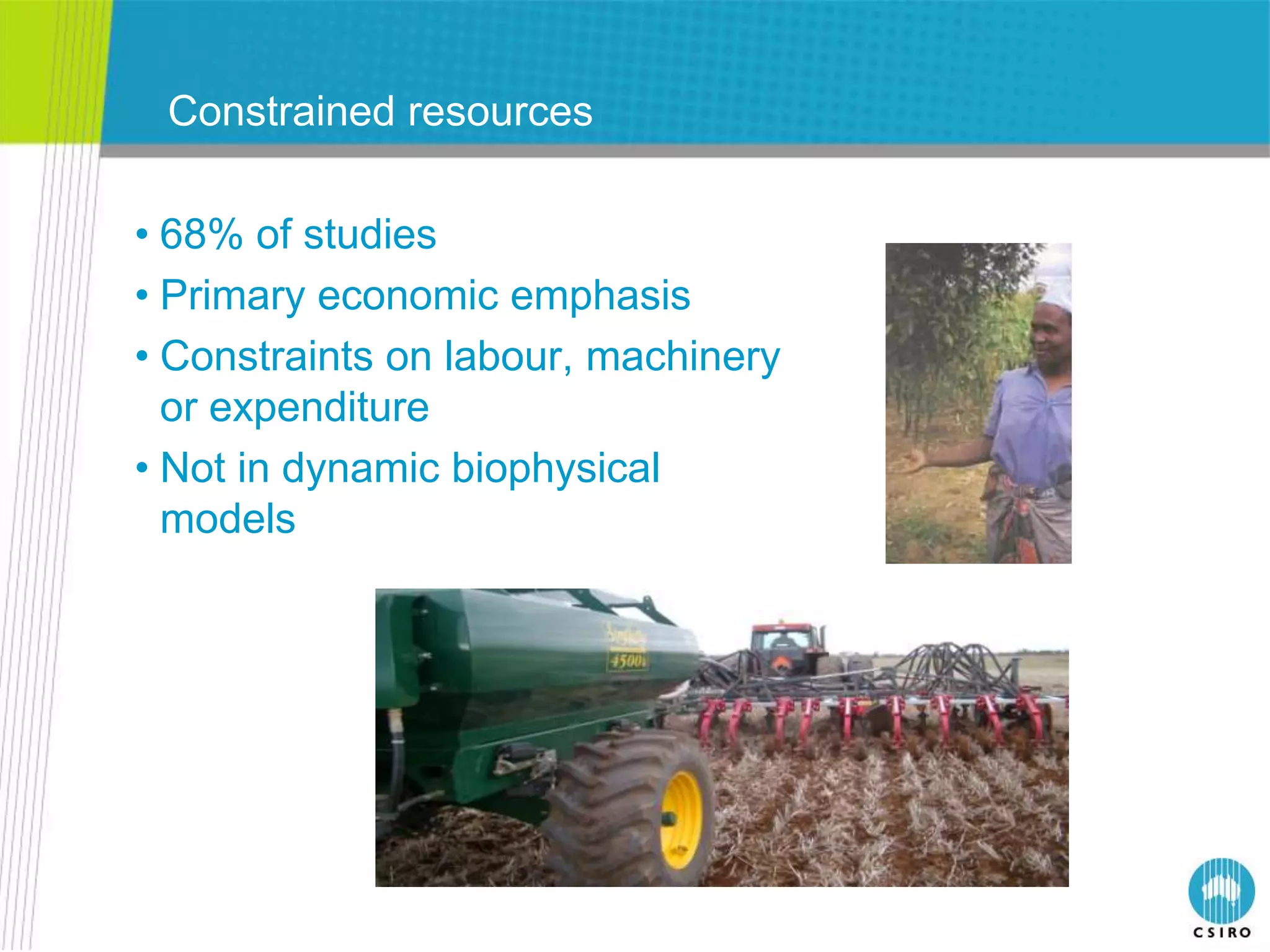
Constrained resources

• 68% of studies
• Primary economic emphasis
• Constraints on labour, machinery of
                          “This small amount
                          fertiliser is all you need
  or expenditure                      plant”
                          for each plant”


• Not in dynamic biophysical
  models
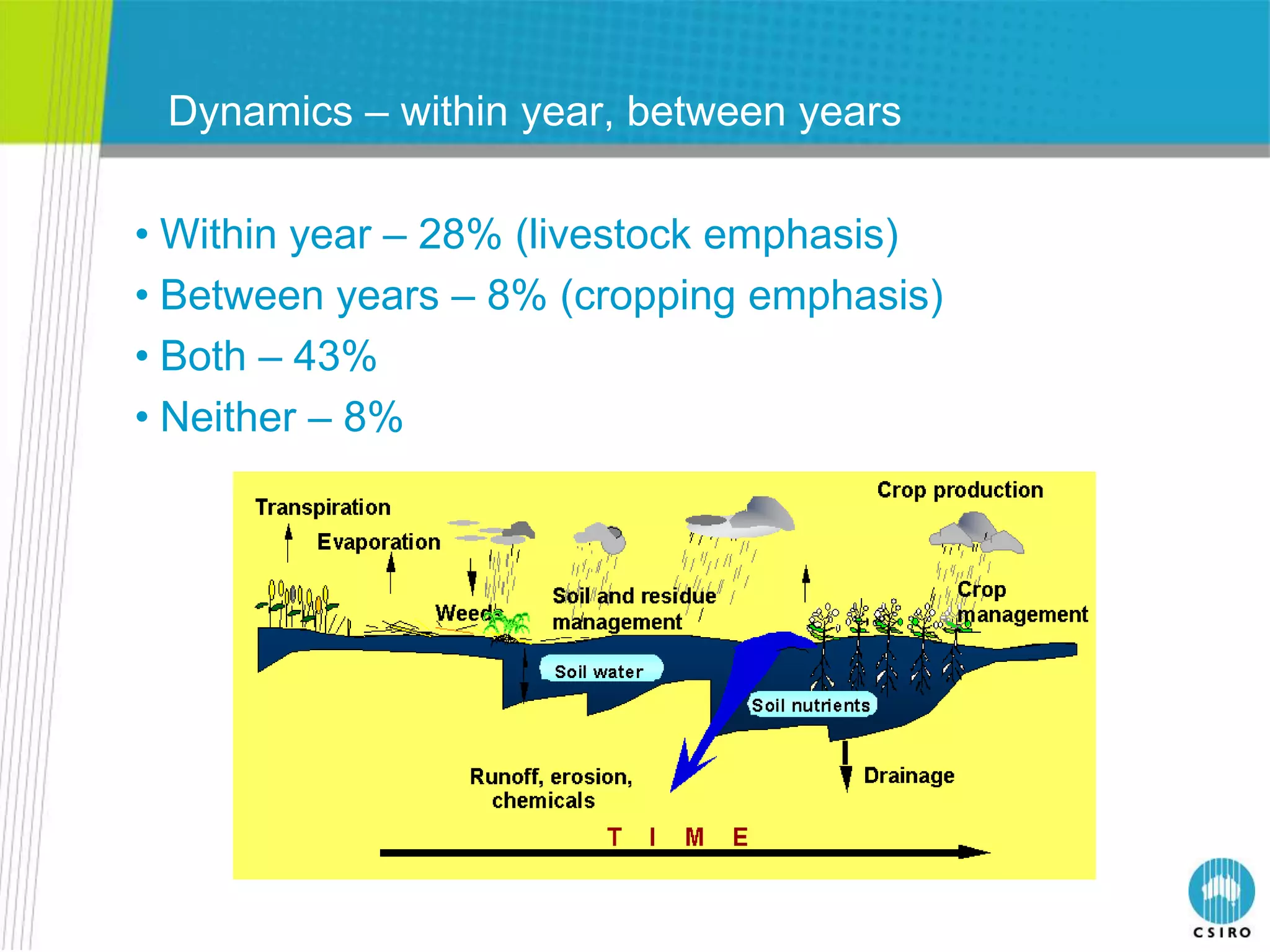
Dynamics – within year, between years

• Within year – 28% (livestock emphasis)
• Between years – 8% (cropping emphasis)
• Both – 43%
• Neither – 8%
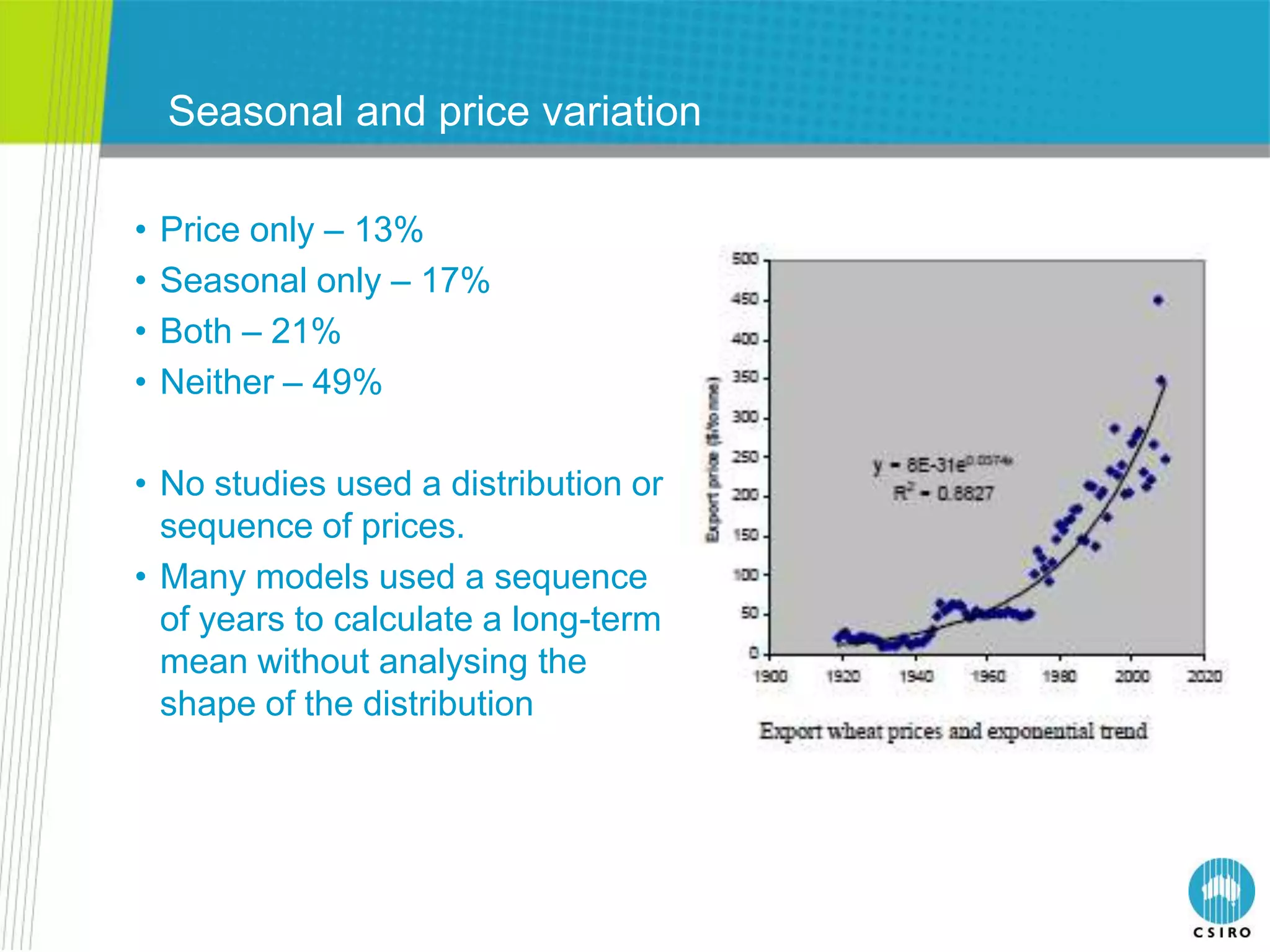
Seasonal and price variation

•   Price only – 13%
•   Seasonal only – 17%
•   Both – 21%
•   Neither – 49%

• No studies used a distribution or
  sequence of prices.
• Many models used a sequence
  of years to calculate a long-term
  mean without analysing the
  shape of the distribution
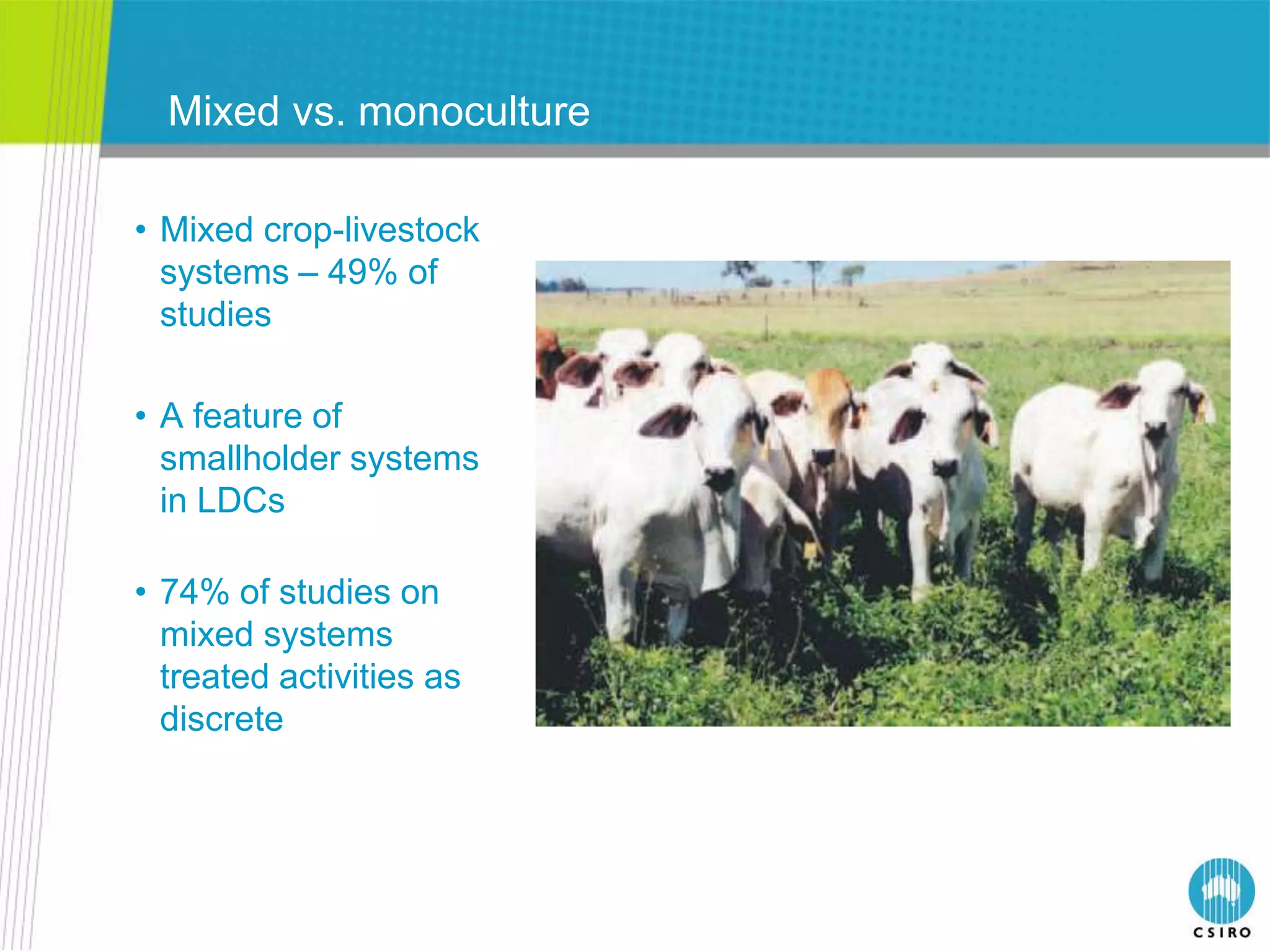
Mixed vs. monoculture

• Mixed crop-livestock
  systems – 49% of
  studies

• A feature of
  smallholder systems
  in LDCs

• 74% of studies on
  mixed systems
  treated activities as
  discrete
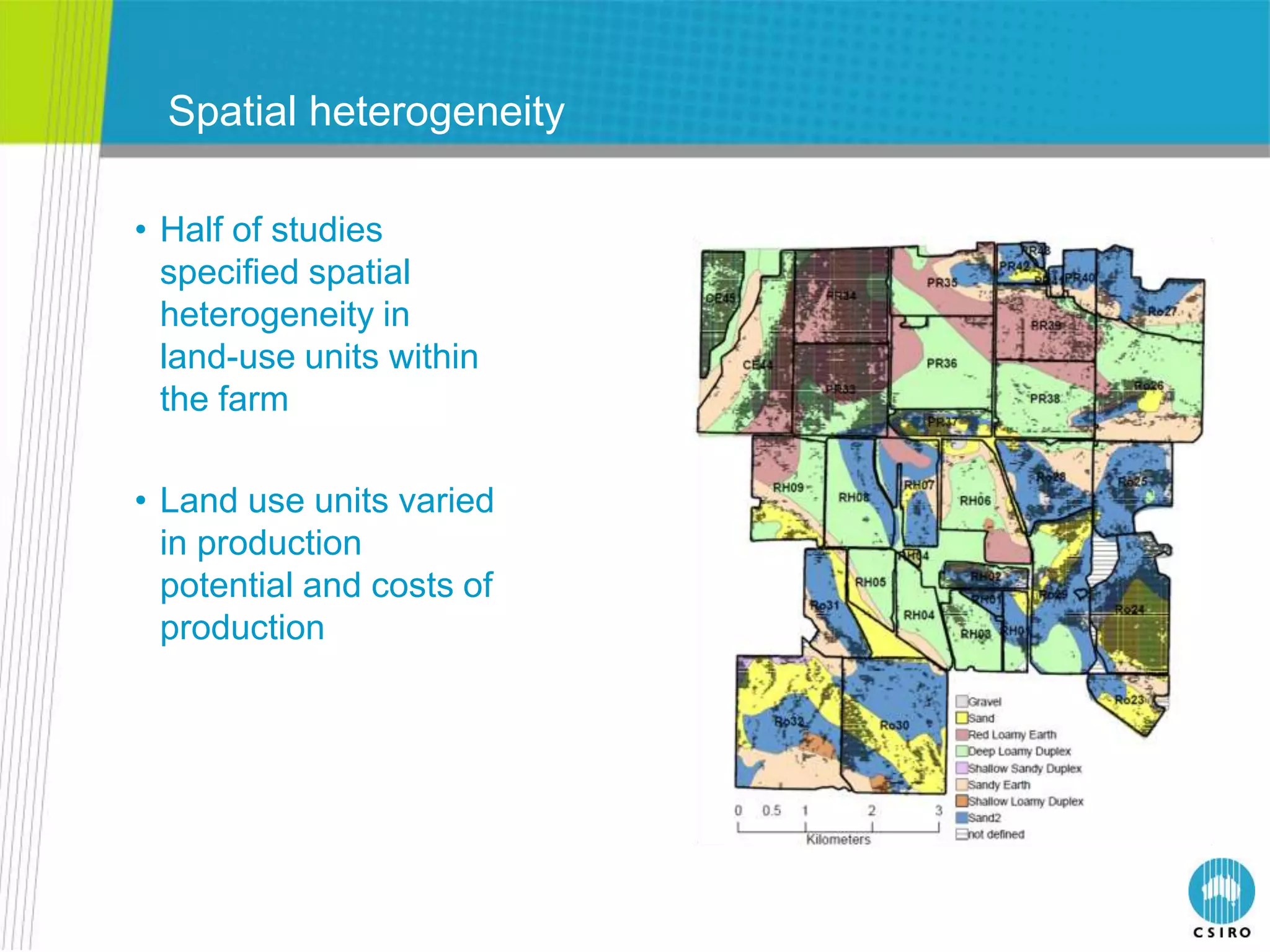
Spatial heterogeneity

• Half of studies
  specified spatial
  heterogeneity in
  land-use units within
  the farm

• Land use units varied
  in production
  potential and costs of
  production
Real vs. “representative” farms

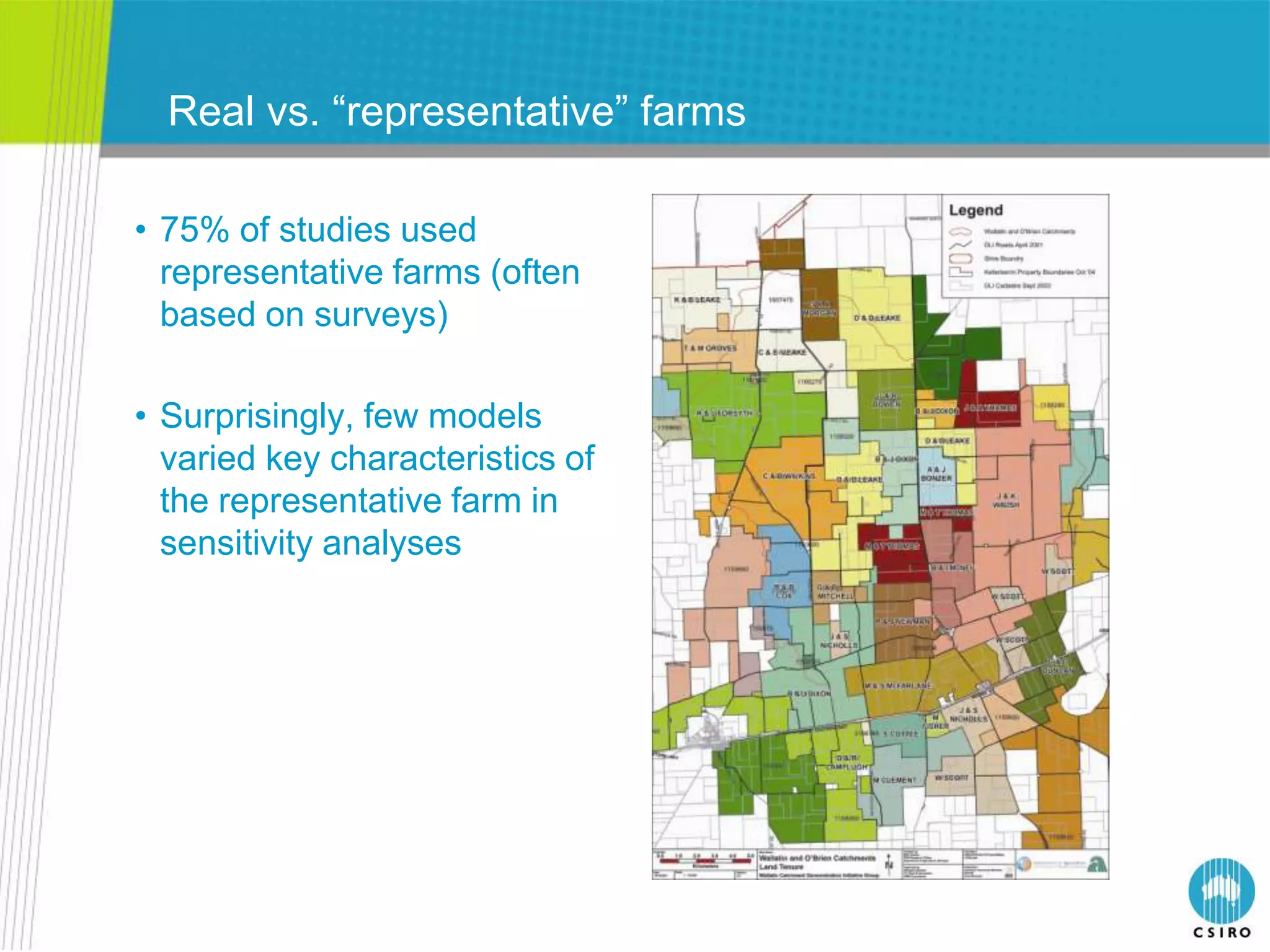
• 75% of studies used
  representative farms (often
  based on surveys)

• Surprisingly, few models
  varied key characteristics of
  the representative farm in
  sensitivity analyses
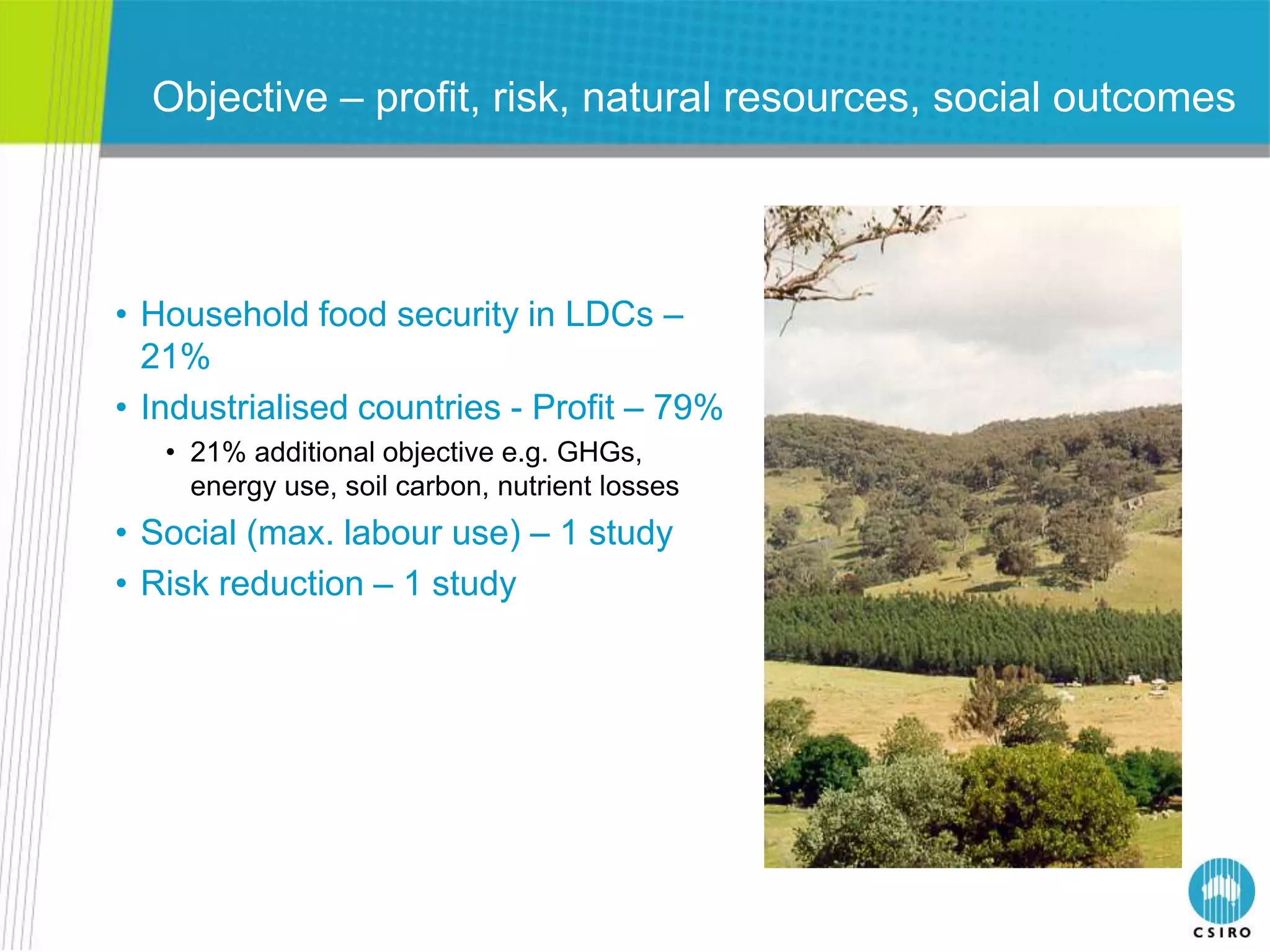
Objective – profit, risk, natural resources, social outcomes


• Household food security in LDCs –
  21%
• Industrialised countries - Profit – 79%
   • 21% additional objective e.g. GHGs,
     energy use, soil carbon, nutrient losses
• Social (max. labour use) – 1 study
• Risk reduction – 1 study
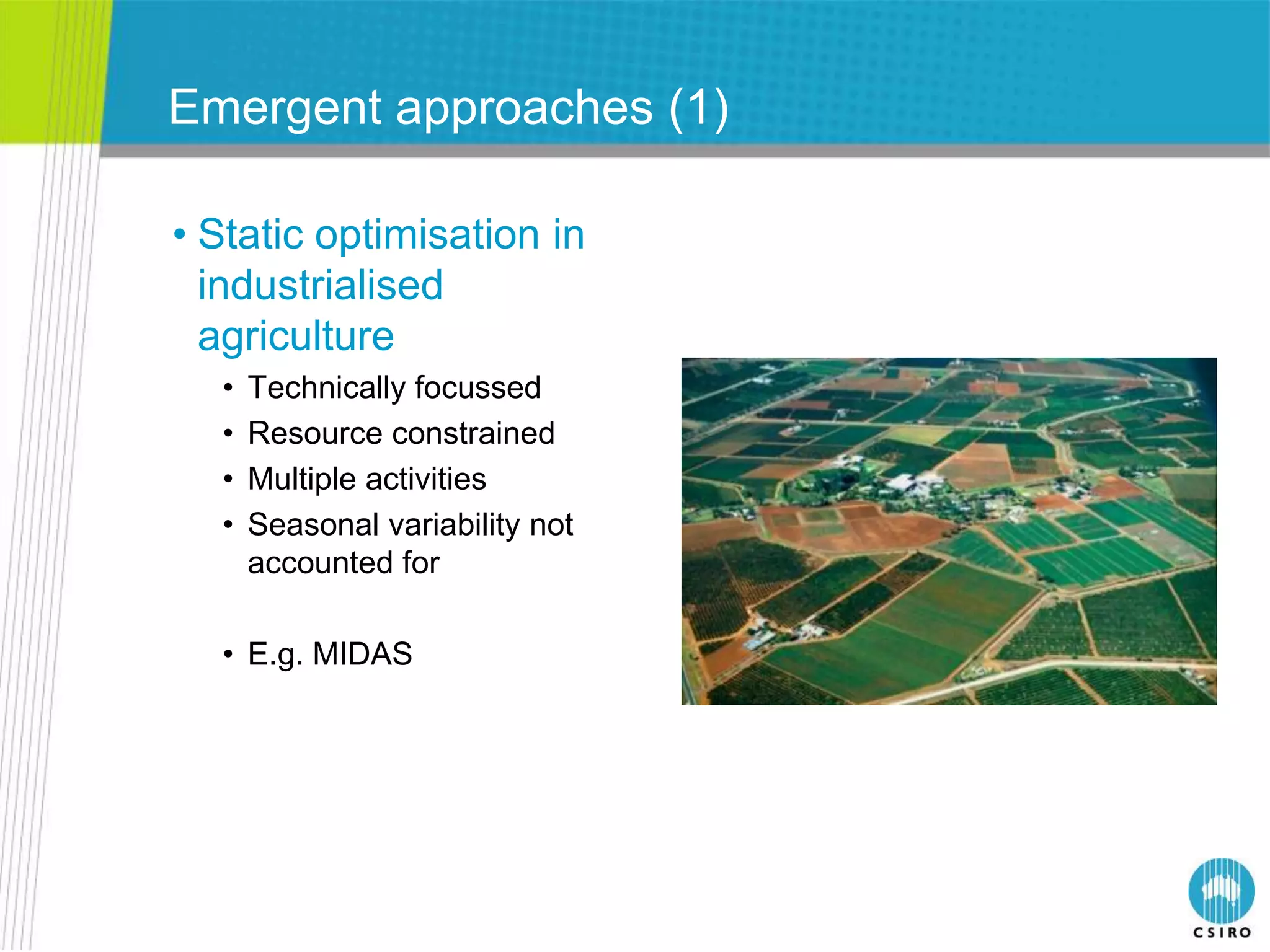
Emergent approaches (1)

• Static optimisation in
  industrialised
  agriculture
  •   Technically focussed
  •   Resource constrained
  •   Multiple activities
  •   Seasonal variability not
      accounted for

  • E.g. MIDAS
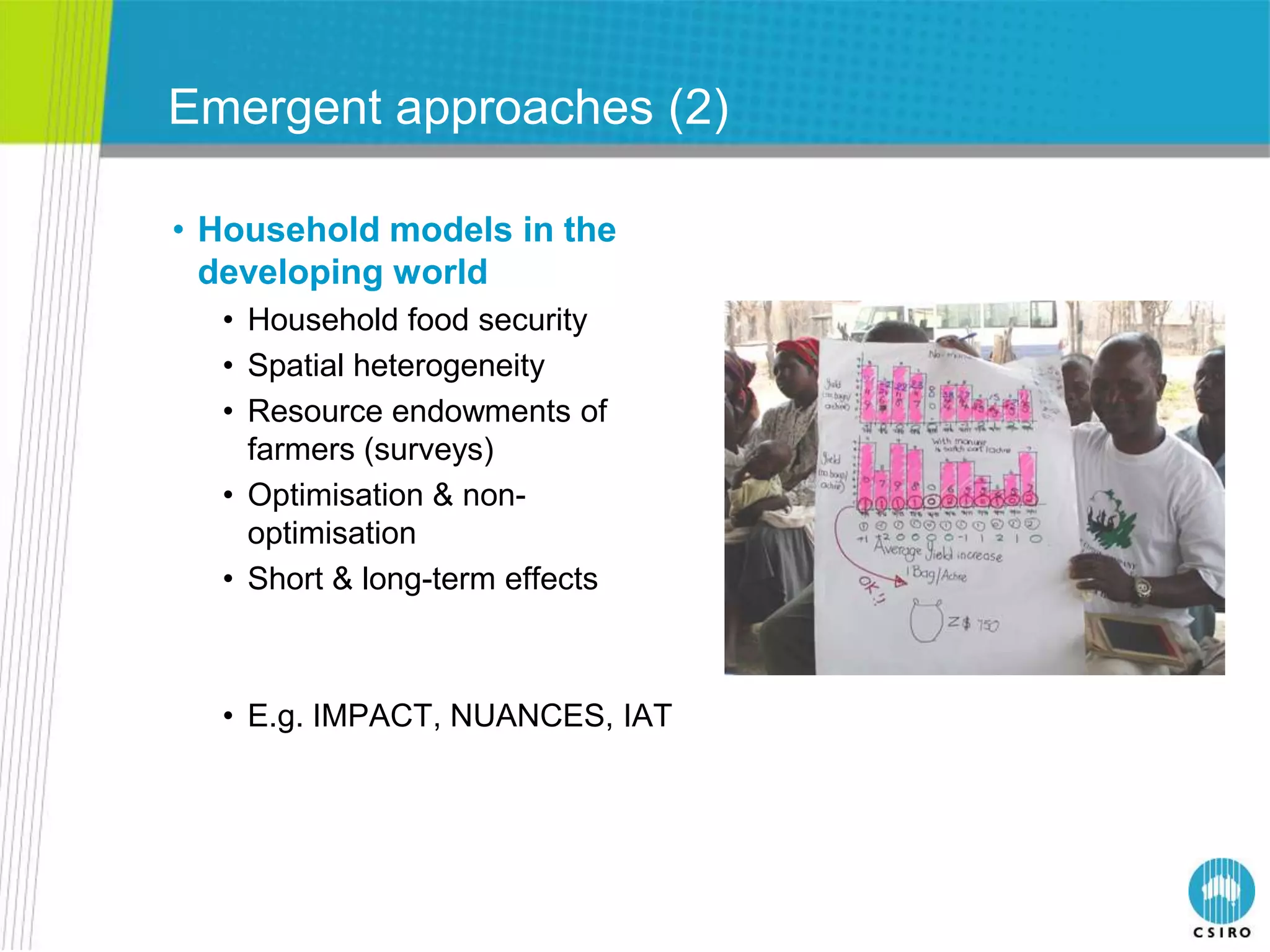
Emergent approaches (2)

• Household models in the
  developing world
  • Household food security
  • Spatial heterogeneity
  • Resource endowments of
    farmers (surveys)
  • Optimisation & non-
    optimisation
  • Short & long-term effects


  • E.g. IMPACT, NUANCES, IAT
Emergent approaches (3)

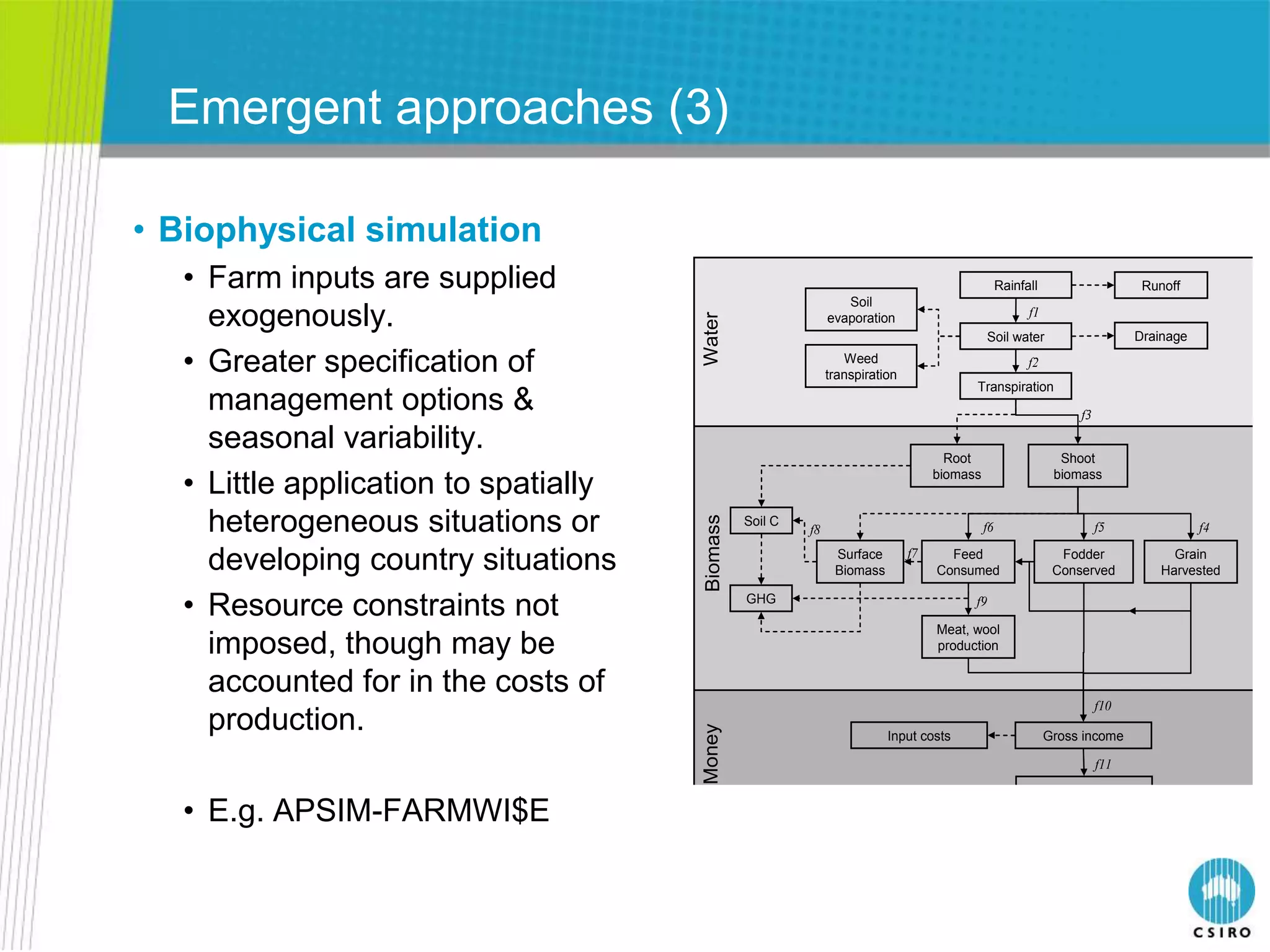
• Biophysical simulation
  • Farm inputs are supplied                                                                      Rainfall                    Runoff
                                                                 Soil
    exogenously.                                                                                        f1


                                      Water
                                                              evaporation
                                                                                              Soil water                     Drainage

  • Greater specification of                                     Weed
                                                              transpiration
                                                                                                        f2
                                                                                         Transpiration
    management options &                                                                                          f3

    seasonal variability.                                                            Root                      Shoot

  • Little application to spatially                                                biomass                    biomass


    heterogeneous situations or


                                      Biomass
                                                Soil C                                       f6                        f5               f4
                                                         f8

    developing country situations                              Surface
                                                               Biomass
                                                                              f7     Feed
                                                                                   Consumed
                                                                                                               Fodder
                                                                                                              Conserved
                                                                                                                                   Grain
                                                                                                                                 Harvested

  • Resource constraints not                    GHG                                      f9

                                                                                   Meat, wool
    imposed, though may be                                                         production


    accounted for in the costs of
                                                                                                                       f10
    production.                       Money
                                                                         Input costs                         Gross income

                                                                                                                       f11
                                                                                                             Gross Margin
  • E.g. APSIM-FARMWI$E
“New” approaches: Dynamic simulation
 under resource constraints

•Two approaches:
 • Resource constrained models used to define
   farm configuration for dynamic simulation
 • Resource use an output variable, against
   which scenarios evaluated
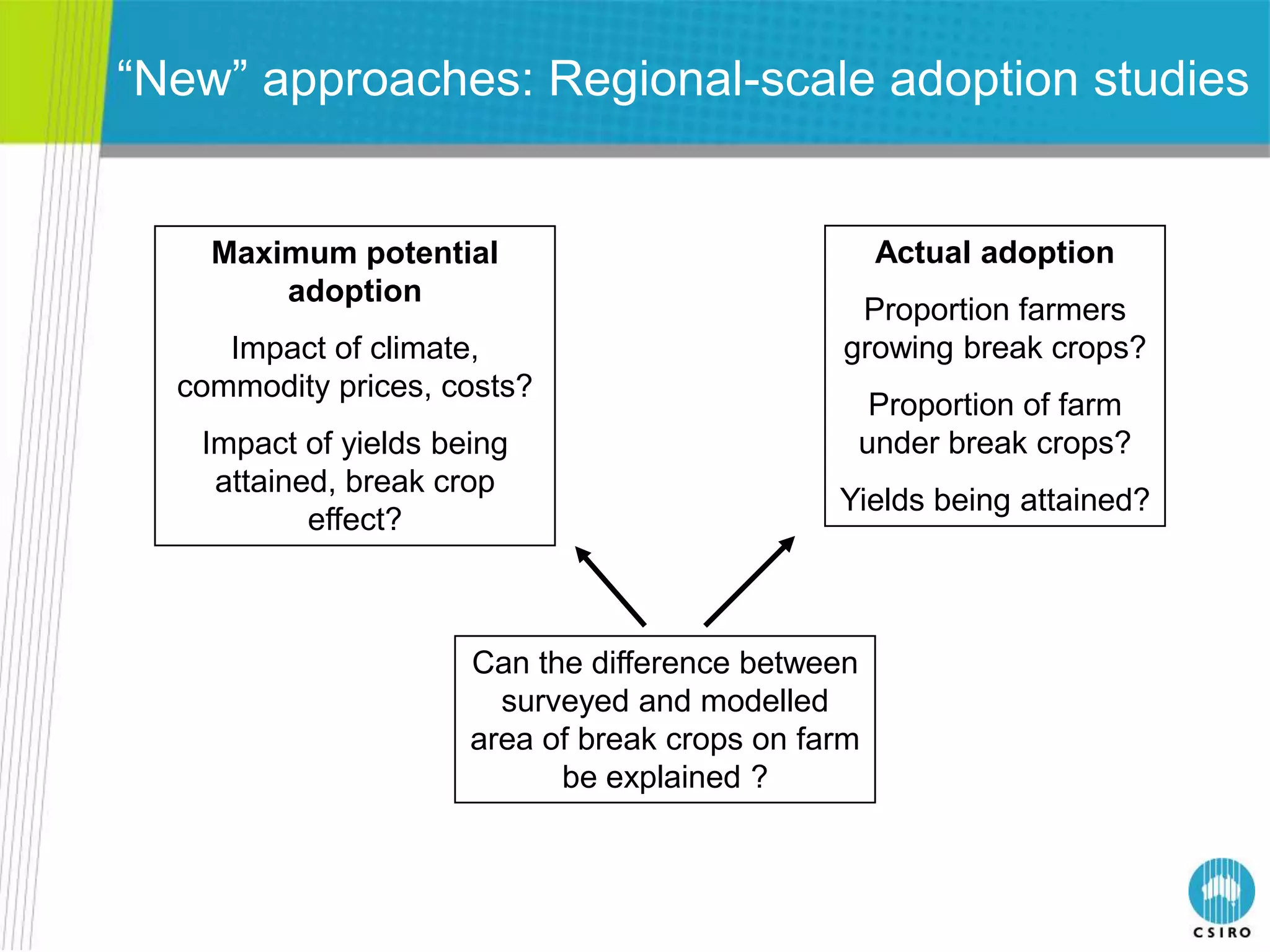
“New” approaches: Regional-scale adoption studies


    Maximum potential                               Actual adoption
        adoption
                                                Proportion farmers
     Impact of climate,                        growing break crops?
  commodity prices, costs?
                                                 Proportion of farm
   Impact of yields being                       under break crops?
    attained, break crop
                                               Yields being attained?
           effect?


                      Can the difference between
                        surveyed and modelled
                      area of break crops on farm
                            be explained ?
Overall observations
• Deficiencies:
   • Clear description of audience for the work
   • Justification for biophysical parameters
   • Assumptions about resource endowments of farmers
   • Explicit statement of what inputs are exogenous or endogenous
     to the model
   • Sensitivity analysis around prices, seasonal conditions and
     farm configuration.
   • “Validation” - combination of subjective (“sensibility testing”)
     and objective methods (comparisons with farm surveys, etc).
• The focus on most studies is still policy guidance and
  research prioritisation,
• Few studies attempting to engage with farm managers
Evidence of impact?
• Lessons from engagement with MIDAS in Western Australia
  (Pannell 1997)
  • brought together researchers (of various disciplines) and
    extension agents who otherwise would interact little
  • allows scientists and extension agents to assess the economic
    significance of particular biological or physical information
  • influenced the thinking of researchers and extension agents
    about the whole-farm system
  • highlighted a large number of data deficiencies and allowed
    prioritization of research to overcome them
Thank you
                                      Contact Us
         Phone: 1300 363 400 or +61 3 9545 2176
      Email: enquiries@csiro.au Web: www.csiro.au

Whole-farm models - some recent trends. Mike Robertson

  • 1.
    Whole-farm models –some recent trends Michael Robertson CSIRO Sustainable Agriculture Flagship and Ecosystem Sciences David Pannell & Morteza Chalak University of Western Australia
  • 2.
    The issue • Extrapolatingfrom field to farm scale • Guidelines on types of approach • Comprehensiveness vs. complexity • Optimisation vs. non-optimisation approaches • Accounting for variability (seasonal, spatial, economic) • Interactions between activities • Ex-ante research evaluation vs. engagement with farmers and advisors. • Emergence of a focus on smallholder in developing world • One tool or many tools?
  • 3.
    Review of theliterature • Papers using WFMs 2006 -2011 • 53 studies utilising 42 models • 21% studies on smallholders in LDCs • Classified according to criteria: • Constrained resources • Dynamics – within year, between years • Seasonal and price variation • Mixed farming or monoculture • Spatial heterogeneity • Real vs. “representative” farms • Objective – profit, risk, natural resources etc
  • 4.
    Constrained resources • 68%of studies • Primary economic emphasis • Constraints on labour, machinery of “This small amount fertiliser is all you need or expenditure plant” for each plant” • Not in dynamic biophysical models
  • 5.
    Dynamics – withinyear, between years • Within year – 28% (livestock emphasis) • Between years – 8% (cropping emphasis) • Both – 43% • Neither – 8%
  • 6.
    Seasonal and pricevariation • Price only – 13% • Seasonal only – 17% • Both – 21% • Neither – 49% • No studies used a distribution or sequence of prices. • Many models used a sequence of years to calculate a long-term mean without analysing the shape of the distribution
  • 7.
    Mixed vs. monoculture •Mixed crop-livestock systems – 49% of studies • A feature of smallholder systems in LDCs • 74% of studies on mixed systems treated activities as discrete
  • 8.
    Spatial heterogeneity • Halfof studies specified spatial heterogeneity in land-use units within the farm • Land use units varied in production potential and costs of production
  • 9.
    Real vs. “representative”farms • 75% of studies used representative farms (often based on surveys) • Surprisingly, few models varied key characteristics of the representative farm in sensitivity analyses
  • 10.
    Objective – profit,risk, natural resources, social outcomes • Household food security in LDCs – 21% • Industrialised countries - Profit – 79% • 21% additional objective e.g. GHGs, energy use, soil carbon, nutrient losses • Social (max. labour use) – 1 study • Risk reduction – 1 study
  • 11.
    Emergent approaches (1) •Static optimisation in industrialised agriculture • Technically focussed • Resource constrained • Multiple activities • Seasonal variability not accounted for • E.g. MIDAS
  • 12.
    Emergent approaches (2) •Household models in the developing world • Household food security • Spatial heterogeneity • Resource endowments of farmers (surveys) • Optimisation & non- optimisation • Short & long-term effects • E.g. IMPACT, NUANCES, IAT
  • 13.
    Emergent approaches (3) •Biophysical simulation • Farm inputs are supplied Rainfall Runoff Soil exogenously. f1 Water evaporation Soil water Drainage • Greater specification of Weed transpiration f2 Transpiration management options & f3 seasonal variability. Root Shoot • Little application to spatially biomass biomass heterogeneous situations or Biomass Soil C f6 f5 f4 f8 developing country situations Surface Biomass f7 Feed Consumed Fodder Conserved Grain Harvested • Resource constraints not GHG f9 Meat, wool imposed, though may be production accounted for in the costs of f10 production. Money Input costs Gross income f11 Gross Margin • E.g. APSIM-FARMWI$E
  • 14.
    “New” approaches: Dynamicsimulation under resource constraints •Two approaches: • Resource constrained models used to define farm configuration for dynamic simulation • Resource use an output variable, against which scenarios evaluated
  • 15.
    “New” approaches: Regional-scaleadoption studies Maximum potential Actual adoption adoption Proportion farmers Impact of climate, growing break crops? commodity prices, costs? Proportion of farm Impact of yields being under break crops? attained, break crop Yields being attained? effect? Can the difference between surveyed and modelled area of break crops on farm be explained ?
  • 16.
    Overall observations • Deficiencies: • Clear description of audience for the work • Justification for biophysical parameters • Assumptions about resource endowments of farmers • Explicit statement of what inputs are exogenous or endogenous to the model • Sensitivity analysis around prices, seasonal conditions and farm configuration. • “Validation” - combination of subjective (“sensibility testing”) and objective methods (comparisons with farm surveys, etc). • The focus on most studies is still policy guidance and research prioritisation, • Few studies attempting to engage with farm managers
  • 17.
    Evidence of impact? •Lessons from engagement with MIDAS in Western Australia (Pannell 1997) • brought together researchers (of various disciplines) and extension agents who otherwise would interact little • allows scientists and extension agents to assess the economic significance of particular biological or physical information • influenced the thinking of researchers and extension agents about the whole-farm system • highlighted a large number of data deficiencies and allowed prioritization of research to overcome them
  • 18.
    Thank you Contact Us Phone: 1300 363 400 or +61 3 9545 2176 Email: enquiries@csiro.au Web: www.csiro.au