VII
Mechanical Wave
Mechanical Wave
Classification of waves
(i). Medium
;Mechanical and Electromagnetic waves
(ii). Direction of particles of medium
;Transverse and Longitudinal waves
(iii). Motion of wave
;Stationary and progressive waves
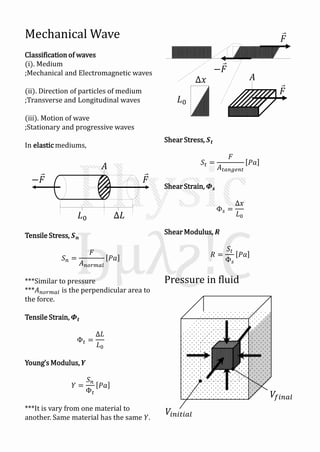
In elastic mediums,
Tensile Stress, 𝑺 𝒏
𝑆 𝑛 =
𝐹
𝐴 𝑛𝑜𝑟𝑚𝑎𝑙
𝑃𝑎
***Similar to pressure
***𝐴 𝑛𝑜𝑟𝑚𝑎𝑙 is the perpendicular area to
the force.
Tensile Strain, 𝜱 𝒕
Φ 𝑡 =
∆𝐿
𝐿0
Young’s Modulus, 𝒀
𝑌 =
𝑆 𝑛
Φ 𝑡
𝑃𝑎
***It is vary from one material to
another. Same material has the same 𝑌.
Shear Stress, 𝑺 𝒕
𝑆𝑡 =
𝐹
𝐴 𝑡𝑎𝑛𝑔𝑒𝑛𝑡
𝑃𝑎
Shear Strain, 𝜱 𝒔
Φ 𝑠 =
∆𝑥
𝐿0
Shear Modulus, 𝑹
𝑅 =
𝑆𝑡
Φ 𝑠
𝑃𝑎
Pressure in fluid
𝐹−𝐹
𝐿0 ∆𝐿
𝐴
𝐹
−𝐹
𝐿0
∆𝑥 𝐴
𝐹
𝑉𝑖𝑛𝑖𝑡𝑖𝑎𝑙
𝑉𝑓𝑖𝑛𝑎𝑙
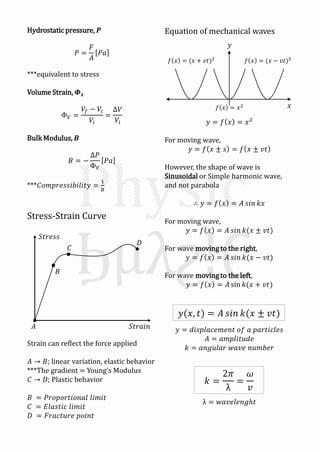
Hydrostatic pressure, 𝑷
𝑃 =
𝐹
𝐴
𝑃𝑎
***equivalent to stress
Volume Strain, 𝜱 𝒔
Φ 𝑉 =
𝑉𝑓 − 𝑉𝑖
𝑉𝑖
=
∆𝑉
𝑉𝑖
Bulk Modulus, 𝑩
𝐵 = −
∆𝑃
Φ 𝑉
𝑃𝑎
***𝐶𝑜𝑚𝑝𝑟𝑒𝑠𝑠𝑖𝑏𝑖𝑙𝑖𝑡𝑦 =
1
𝐵
Stress-Strain Curve
Strain can reflect the force applied
𝐴 → 𝐵; linear variation, elastic behavior
***The gradient = Young’s Modulus
𝐶 → 𝐷; Plastic behavior
𝐵 = 𝑃𝑟𝑜𝑝𝑜𝑟𝑡𝑖𝑜𝑛𝑎𝑙 𝑙𝑖𝑚𝑖𝑡
𝐶 = 𝐸𝑙𝑎𝑠𝑡𝑖𝑐 𝑙𝑖𝑚𝑖𝑡
𝐷 = 𝐹𝑟𝑎𝑐𝑡𝑢𝑟𝑒 𝑝𝑜𝑖𝑛𝑡
𝑆𝑡𝑟𝑒𝑠𝑠
𝑆𝑡𝑟𝑎𝑖𝑛𝐴
𝐵
𝐶
𝐷
Equation of mechanical waves
𝑦 = 𝑓 𝑥 = 𝑥2
For moving wave,
𝑦 = 𝑓 𝑥 ± 𝑠 = 𝑓 𝑥 ± 𝑣𝑡
However, the shape of wave is
Sinusoidal or Simple harmonic wave,
and not parabola
∴ 𝑦 = 𝑓 𝑥 = 𝐴 𝑠𝑖𝑛 𝑘𝑥
For moving wave,
𝑦 = 𝑓 𝑥 = 𝐴 𝑠𝑖𝑛 𝑘(𝑥 ± 𝑣𝑡)
For wave movingto the right,
𝑦 = 𝑓 𝑥 = 𝐴 𝑠𝑖𝑛 𝑘(𝑥 − 𝑣𝑡)
For wave movingto the left,
𝑦 = 𝑓 𝑥 = 𝐴 sin 𝑘(𝑥 + 𝑣𝑡)
𝑦 = 𝑑𝑖𝑠𝑝𝑙𝑎𝑐𝑒𝑚𝑒𝑛𝑡 𝑜𝑓 𝑎 𝑝𝑎𝑟𝑡𝑖𝑐𝑙𝑒𝑠
𝐴 = 𝑎𝑚𝑝𝑙𝑖𝑡𝑢𝑑𝑒
𝑘 = 𝑎𝑛𝑔𝑢𝑙𝑎𝑟 𝑤𝑎𝑣𝑒 𝑛𝑢𝑚𝑏𝑒𝑟
λ = 𝑤𝑎𝑣𝑒𝑙𝑒𝑛𝑔ℎ𝑡
𝑓 𝑥 = 𝑥2
𝑓 𝑥 = (𝑥 − 𝑣𝑡)2
𝑓 𝑥 = (𝑥 + 𝑣𝑡)2
𝑥
𝑦
𝑦(𝑥, 𝑡) = 𝐴 𝑠𝑖𝑛 𝑘(𝑥 ± 𝑣𝑡)
𝑘 =
2𝜋
λ
=
𝜔
𝑣
𝑦(𝑥, 𝑡) = 𝐴 𝑠𝑖𝑛 𝑘(𝑥 ± 𝑣𝑡)
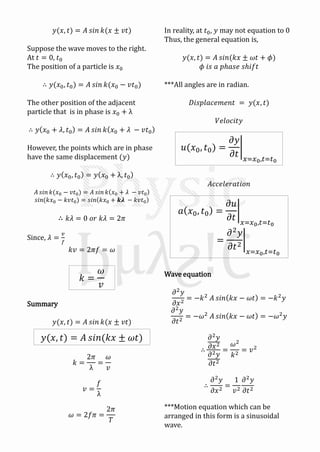
Suppose the wave moves to the right.
At 𝑡 = 0, 𝑡0
The position of a particle is 𝑥0
∴ 𝑦(𝑥0, 𝑡0) = 𝐴 𝑠𝑖𝑛 𝑘(𝑥0 − 𝑣𝑡0)
The other position of the adjacent
particle that is in phase is 𝑥0 + λ
∴ 𝑦 𝑥0 + 𝜆, 𝑡0 = 𝐴 𝑠𝑖𝑛 𝑘 𝑥0 + 𝜆 − 𝑣𝑡0
However, the points which are in phase
have the same displacement (𝑦)
∴ 𝑦 𝑥0, 𝑡0 = 𝑦 𝑥0 + λ, 𝑡0
𝐴 𝑠𝑖𝑛 𝑘(𝑥0 − 𝑣𝑡0) = 𝐴 𝑠𝑖𝑛 𝑘 𝑥0 + 𝜆 − 𝑣𝑡0
𝑠𝑖𝑛(𝑘𝑥0 − 𝑘𝑣𝑡0) = 𝑠𝑖𝑛 𝑘𝑥0 + 𝒌𝝀 − 𝑘𝑣𝑡0
∴ 𝑘𝜆 = 0 𝑜𝑟 𝑘𝜆 = 2𝜋
Since, 𝜆 =
𝑣
𝑓
𝑘𝑣 = 2𝜋𝑓 = 𝜔
Summary
𝑦(𝑥, 𝑡) = 𝐴 𝑠𝑖𝑛 𝑘(𝑥 ± 𝑣𝑡)
𝑘 =
2𝜋
λ
=
𝜔
𝑣
𝑣 =
𝑓
λ
𝜔 = 2𝑓𝜋 =
2𝜋
𝑇
𝑘 =
𝜔
𝑣
In reality, at 𝑡0, 𝑦 may not equation to 0
Thus, the general equation is,
𝑦(𝑥, 𝑡) = 𝐴 𝑠𝑖𝑛(𝑘𝑥 ± 𝜔𝑡 + 𝜙)
𝜙 𝑖𝑠 𝑎 𝑝ℎ𝑎𝑠𝑒 𝑠ℎ𝑖𝑓𝑡
***All angles are in radian.
𝐷𝑖𝑠𝑝𝑙𝑎𝑐𝑒𝑚𝑒𝑛𝑡 = 𝑦(𝑥, 𝑡)
𝑉𝑒𝑙𝑜𝑐𝑖𝑡𝑦
𝐴𝑐𝑐𝑒𝑙𝑒𝑟𝑎𝑡𝑖𝑜𝑛
Wave equation
𝜕2
𝑦
𝜕𝑥2
= −𝑘2
𝐴 𝑠𝑖𝑛 𝑘𝑥 − 𝜔𝑡 = −𝑘2
𝑦
𝜕2
𝑦
𝜕𝑡2
= −𝜔2
𝐴 𝑠𝑖𝑛 𝑘𝑥 − 𝜔𝑡 = −𝜔2
𝑦
∴
𝜕2 𝑦
𝜕𝑥2
𝜕2 𝑦
𝜕𝑡2
=
𝜔2
𝑘2
= 𝑣2
∴
𝜕2
𝑦
𝜕𝑥2
=
1
𝑣2
𝜕2
𝑦
𝜕𝑡2
***Motion equation which can be
arranged in this form is a sinusoidal
wave.
𝑦(𝑥, 𝑡) = 𝐴 𝑠𝑖𝑛(𝑘𝑥 ± 𝜔𝑡)
𝑢(𝑥0, 𝑡0) =
𝜕𝑦
𝜕𝑡 𝑥=𝑥0,𝑡=𝑡0
𝑎 𝑥0, 𝑡0 =
𝜕𝑢
𝜕𝑡 𝑥=𝑥0,𝑡=𝑡0
=
𝜕2 𝑦
𝜕𝑡2
𝑥=𝑥0,𝑡=𝑡0
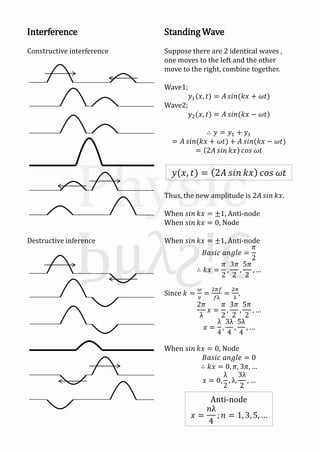
Interference
Constructive interference
Destructive inference
Standing Wave
Suppose there are 2 identical waves ,
one moves to the left and the other
move to the right, combine together.
Wave1;
𝑦1(𝑥, 𝑡) = 𝐴 𝑠𝑖𝑛(𝑘𝑥 + 𝜔𝑡)
Wave2;
𝑦2(𝑥, 𝑡) = 𝐴 𝑠𝑖𝑛(𝑘𝑥 − 𝜔𝑡)
∴ 𝑦 = 𝑦1 + 𝑦1
= 𝐴 𝑠𝑖𝑛(𝑘𝑥 + 𝜔𝑡) + 𝐴 𝑠𝑖𝑛(𝑘𝑥 − 𝜔𝑡)
= 2𝐴 𝑠𝑖𝑛 𝑘𝑥 𝑐𝑜𝑠 𝜔𝑡
Thus, the new amplitude is 2𝐴 𝑠𝑖𝑛 𝑘𝑥.
When 𝑠𝑖𝑛 𝑘𝑥 = ±1, Anti-node
When 𝑠𝑖𝑛 𝑘𝑥 = 0, Node
When 𝑠𝑖𝑛 𝑘𝑥 = ±1, Anti-node
𝐵𝑎𝑠𝑖𝑐 𝑎𝑛𝑔𝑙𝑒 =
𝜋
2
∴ 𝑘𝑥 =
𝜋
2
,
3𝜋
2
,
5𝜋
2
, …
Since 𝑘 =
𝜔
𝑣
=
2𝜋𝑓
𝑓λ
=
2𝜋
λ
,
2𝜋
λ
𝑥 =
𝜋
2
,
3𝜋
2
,
5𝜋
2
, …
𝑥 =
λ
4
,
3λ
4
,
5λ
4
, …
When 𝑠𝑖𝑛 𝑘𝑥 = 0, Node
𝐵𝑎𝑠𝑖𝑐 𝑎𝑛𝑔𝑙𝑒 = 0
∴ 𝑘𝑥 = 0, 𝜋, 3𝜋, …
𝑥 = 0,
λ
2
, λ,
3λ
2
, …
𝑦(𝑥, 𝑡) = 2𝐴 𝑠𝑖𝑛 𝑘𝑥 𝑐𝑜𝑠 𝜔𝑡
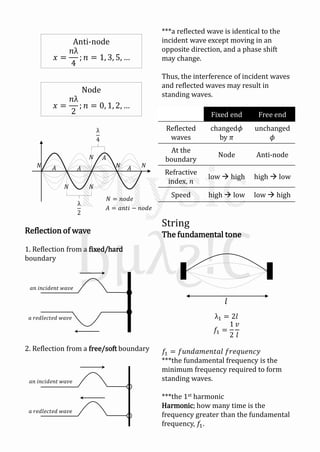
Anti-node
𝑥 =
𝑛λ
4
; 𝑛 = 1, 3, 5, …
Fixed end Free end
Reflected
waves
changed𝜙
by 𝜋
unchanged
𝜙
At the
boundary
Node Anti-node
Refractive
index, 𝑛
low  high high  low
Speed high  low low  high
Reflection of wave
1. Reflection from a fixed/hard
boundary
2. Reflection from a free/soft boundary
Anti-node
𝑥 =
𝑛λ
4
; 𝑛 = 1, 3, 5, …
Node
𝑥 =
𝑛λ
2
; 𝑛 = 0, 1, 2, …
𝑎𝑛 𝑖𝑛𝑐𝑖𝑑𝑒𝑛𝑡 𝑤𝑎𝑣𝑒
𝑎 𝑟𝑒𝑑𝑙𝑒𝑐𝑡𝑒𝑑 𝑤𝑎𝑣𝑒
𝑎𝑛 𝑖𝑛𝑐𝑖𝑑𝑒𝑛𝑡 𝑤𝑎𝑣𝑒
𝑎 𝑟𝑒𝑑𝑙𝑒𝑐𝑡𝑒𝑑 𝑤𝑎𝑣𝑒
***a reflected wave is identical to the
incident wave except moving in an
opposite direction, and a phase shift
may change.
Thus, the interference of incident waves
and reflected waves may result in
standing waves.
String
The fundamental tone
λ1 = 2𝑙
𝑓1 =
1
2
𝑣
𝑙
𝑓1 = 𝑓𝑢𝑛𝑑𝑎𝑚𝑒𝑛𝑡𝑎𝑙 𝑓𝑟𝑒𝑞𝑢𝑒𝑛𝑐𝑦
***the fundamental frequency is the
minimum frequency required to form
standing waves.
***the 1st harmonic
Harmonic; how many time is the
frequency greater than the fundamental
frequency, 𝑓1.
𝑁
𝐴
𝐴𝐴
𝑁
𝐴 𝑁𝑁
λ
2
λ
4
𝑁 = 𝑛𝑜𝑑𝑒
𝐴 = 𝑎𝑛𝑡𝑖 − 𝑛𝑜𝑑𝑒
𝑁
𝑁
𝑙
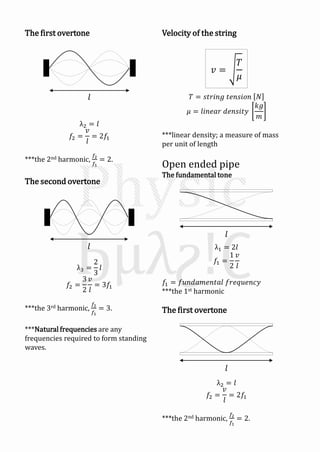
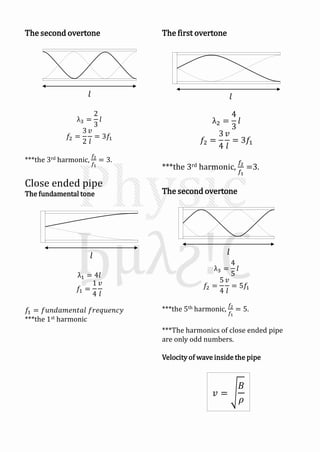
The first overtone
λ2 = 𝑙
𝑓2 =
𝑣
𝑙
= 2𝑓1
***the 2nd harmonic,
𝑓2
𝑓1
= 2.
The second overtone
λ3 =
2
3
𝑙
𝑓2 =
3
2
𝑣
𝑙
= 3𝑓1
***the 3rd harmonic,
𝑓2
𝑓1
= 3.
***Natural frequencies are any
frequencies required to form standing
waves.
𝑙
𝑙
𝑣 =
𝑇
𝜇
Velocity of the string
𝑇 = 𝑠𝑡𝑟𝑖𝑛𝑔 𝑡𝑒𝑛𝑠𝑖𝑜𝑛 𝑁
𝜇 = 𝑙𝑖𝑛𝑒𝑎𝑟 𝑑𝑒𝑛𝑠𝑖𝑡𝑦
𝑘𝑔
𝑚
***linear density; a measure of mass
per unit of length
Open ended pipe
The fundamental tone
λ1 = 2𝑙
𝑓1 =
1
2
𝑣
𝑙
𝑓1 = 𝑓𝑢𝑛𝑑𝑎𝑚𝑒𝑛𝑡𝑎𝑙 𝑓𝑟𝑒𝑞𝑢𝑒𝑛𝑐𝑦
***the 1st harmonic
The first overtone
λ2 = 𝑙
𝑓2 =
𝑣
𝑙
= 2𝑓1
***the 2nd harmonic,
𝑓2
𝑓1
= 2.
𝑙
𝑙
The second overtone
λ3 =
2
3
𝑙
𝑓2 =
3
2
𝑣
𝑙
= 3𝑓1
***the 3rd harmonic,
𝑓2
𝑓1
= 3.
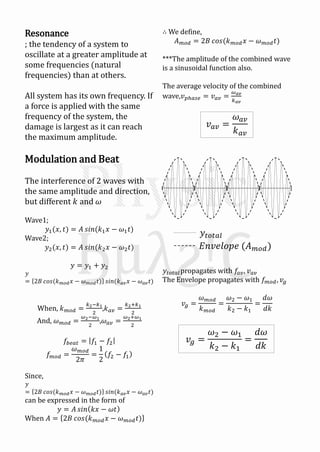
Close ended pipe
The fundamental tone
λ1 = 4𝑙
𝑓1 =
1
4
𝑣
𝑙
𝑓1 = 𝑓𝑢𝑛𝑑𝑎𝑚𝑒𝑛𝑡𝑎𝑙 𝑓𝑟𝑒𝑞𝑢𝑒𝑛𝑐𝑦
***the 1st harmonic
The first overtone
λ2 =
4
3
𝑙
𝑓2 =
3
4
𝑣
𝑙
= 3𝑓1
***the 3rd harmonic,
𝑓2
𝑓1
=3.
The second overtone
λ3 =
4
5
𝑙
𝑓2 =
5
4
𝑣
𝑙
= 5𝑓1
***the 5th harmonic,
𝑓2
𝑓1
= 5.
***The harmonics of close ended pipe
are only odd numbers.
Velocity of wave inside the pipe
𝑙
𝑙
𝑙
𝑙
𝑣 =
𝐵
𝜌
Resonance
; the tendency of a system to
oscillate at a greater amplitude at
some frequencies (natural
frequencies) than at others.
All system has its own frequency. If
a force is applied with the same
frequency of the system, the
damage is largest as it can reach
the maximum amplitude.
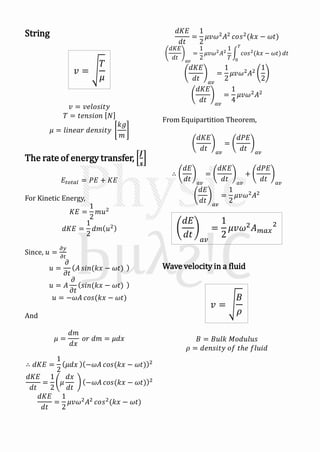
Modulation and Beat
The interference of 2 waves with
the same amplitude and direction,
but different 𝑘 and 𝜔
Wave1;
𝑦1(𝑥, 𝑡) = 𝐴 𝑠𝑖𝑛(𝑘1 𝑥 − 𝜔1 𝑡)
Wave2;
𝑦2(𝑥, 𝑡) = 𝐴 𝑠𝑖𝑛(𝑘2 𝑥 − 𝜔2 𝑡)
𝑦 = 𝑦1 + 𝑦2
𝑦
= 2𝐵 𝑐𝑜𝑠(𝑘 𝑚𝑜𝑑 𝑥 − 𝜔 𝑚𝑜𝑑 𝑡) 𝑠𝑖𝑛(𝑘 𝑎𝑣 𝑥 − 𝜔 𝑎𝑣 𝑡)
When, 𝑘 𝑚𝑜𝑑 =
𝑘2−𝑘1
2
,𝑘 𝑎𝑣 =
𝑘2+𝑘1
2
And, 𝜔 𝑚𝑜𝑑 =
𝜔2−𝜔1
2
,𝜔 𝑎𝑣 =
𝜔2+𝜔1
2
𝑓𝑏𝑒𝑎𝑡 = 𝑓1 − 𝑓2
𝑓 𝑚𝑜𝑑 =
𝜔 𝑚𝑜𝑑
2𝜋
=
1
2
𝑓2 − 𝑓1
Since,
𝑦
= 2𝐵 𝑐𝑜𝑠(𝑘 𝑚𝑜𝑑 𝑥 − 𝜔 𝑚𝑜𝑑 𝑡) 𝑠𝑖𝑛(𝑘 𝑎𝑣 𝑥 − 𝜔 𝑎𝑣 𝑡)
can be expressed in the form of
𝑦 = 𝐴 𝑠𝑖𝑛 𝑘𝑥 − 𝜔𝑡
When 𝐴 = 2𝐵 𝑐𝑜𝑠(𝑘 𝑚𝑜𝑑 𝑥 − 𝜔 𝑚𝑜𝑑 𝑡)
∴ We define,
𝐴 𝑚𝑜𝑑 = 2𝐵 𝑐𝑜𝑠(𝑘 𝑚𝑜𝑑 𝑥 − 𝜔 𝑚𝑜𝑑 𝑡)
***The amplitude of the combined wave
is a sinusoidal function also.
The average velocity of the combined
wave,𝑣 𝑝ℎ𝑎𝑠𝑒 = 𝑣 𝑎𝑣 =
𝜔 𝑎𝑣
𝑘 𝑎𝑣
𝑦𝑡𝑜𝑡𝑎𝑙propagates with 𝑓𝑎 𝑣, 𝑣 𝑎𝑣
The Envelope propagates with 𝑓 𝑚𝑜𝑑, 𝑣𝑔
𝑣𝑔 =
𝜔 𝑚𝑜𝑑
𝑘 𝑚𝑜𝑑
=
𝜔2 − 𝜔1
𝑘2 − 𝑘1
=
𝑑𝜔
𝑑𝑘
𝑣 𝑎𝑣 =
𝜔 𝑎𝑣
𝑘 𝑎𝑣
𝑦𝑡𝑜𝑡𝑎𝑙
𝐸𝑛𝑣𝑒𝑙𝑜𝑝𝑒 (𝐴 𝑚𝑜𝑑)
𝑣𝑔 =
𝜔2 − 𝜔1
𝑘2 − 𝑘1
=
𝑑𝜔
𝑑𝑘
String
𝑣 = 𝑣𝑒𝑙𝑜𝑠𝑖𝑡𝑦
𝑇 = 𝑡𝑒𝑛𝑠𝑖𝑜𝑛 𝑁
𝜇 = 𝑙𝑖𝑛𝑒𝑎𝑟 𝑑𝑒𝑛𝑠𝑖𝑡𝑦
𝑘𝑔
𝑚
The rate of energy transfer,
𝑱
𝒔
𝐸𝑡𝑜𝑡𝑎𝑙 = 𝑃𝐸 + 𝐾𝐸
For Kinetic Energy,
𝐾𝐸 =
1
2
𝑚𝑢2
𝑑𝐾𝐸 =
1
2
𝑑𝑚 𝑢2
Since, 𝑢 =
𝜕𝑦
𝜕𝑡
𝑢 =
𝜕
𝜕𝑡
𝐴 𝑠𝑖𝑛(𝑘𝑥 − 𝜔𝑡)
𝑢 = 𝐴
𝜕
𝜕𝑡
𝑠𝑖𝑛(𝑘𝑥 − 𝜔𝑡)
𝑢 = −𝜔𝐴 𝑐𝑜𝑠(𝑘𝑥 − 𝜔𝑡)
And
𝜇 =
𝑑𝑚
𝑑𝑥
𝑜𝑟 𝑑𝑚 = 𝜇𝑑𝑥
∴ 𝑑𝐾𝐸 =
1
2
𝜇𝑑𝑥 −𝜔𝐴 𝑐𝑜𝑠(𝑘𝑥 − 𝜔𝑡) 2
𝑑𝐾𝐸
𝑑𝑡
=
1
2
𝜇
𝑑𝑥
𝑑𝑡
−𝜔𝐴 𝑐𝑜𝑠(𝑘𝑥 − 𝜔𝑡) 2
𝑑𝐾𝐸
𝑑𝑡
=
1
2
𝜇𝑣𝜔2
𝐴2
𝑐𝑜𝑠2
(𝑘𝑥 − 𝜔𝑡)
𝑑𝐾𝐸
𝑑𝑡
=
1
2
𝜇𝑣𝜔2
𝐴2
𝑐𝑜𝑠2
(𝑘𝑥 − 𝜔𝑡)
𝑑𝐾𝐸
𝑑𝑡 𝑎𝑣
=
1
2
𝜇𝑣𝜔2
𝐴2
1
𝑇
𝑐𝑜𝑠2
(𝑘𝑥 − 𝜔𝑡)
𝑇
0
𝑑𝑡
𝑑𝐾𝐸
𝑑𝑡 𝑎𝑣
=
1
2
𝜇𝑣𝜔2
𝐴2
1
2
𝑑𝐾𝐸
𝑑𝑡 𝑎𝑣
=
1
4
𝜇𝑣𝜔2
𝐴2
From Equipartition Theorem,
𝑑𝐾𝐸
𝑑𝑡 𝑎𝑣
=
𝑑𝑃𝐸
𝑑𝑡 𝑎𝑣
∴
𝑑𝐸
𝑑𝑡 𝑎𝑣
=
𝑑𝐾𝐸
𝑑𝑡 𝑎𝑣
+
𝑑𝑃𝐸
𝑑𝑡 𝑎𝑣
𝑑𝐸
𝑑𝑡 𝑎𝑣
=
1
2
𝜇𝑣𝜔2
𝐴2
Wave velocity in a fluid
𝐵 = 𝐵𝑢𝑙𝑘 𝑀𝑜𝑑𝑢𝑙𝑢𝑠
𝜌 = 𝑑𝑒𝑛𝑠𝑖𝑡𝑦 𝑜𝑓 𝑡ℎ𝑒 𝑓𝑙𝑢𝑖𝑑
𝑣 =
𝑇
𝜇
𝑑𝐸
𝑑𝑡 𝑎𝑣
=
1
2
𝜇𝑣𝜔2 𝐴 𝑚𝑎𝑥
2
𝑣 =
𝐵
𝜌
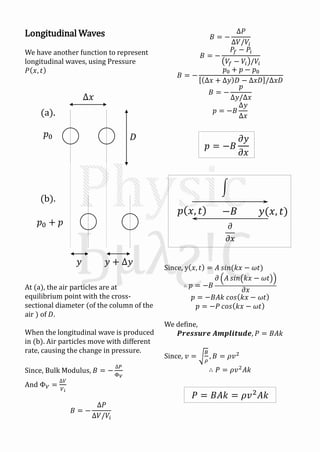
Longitudinal Waves
We have another function to represent
longitudinal waves, using Pressure
𝑃 𝑥, 𝑡
At (a), the air particles are at
equilibrium point with the cross-
sectional diameter (of the column of the
air ) of 𝐷.
When the longitudinal wave is produced
in (b). Air particles move with different
rate, causing the change in pressure.
Since, Bulk Modulus, 𝐵 = −
∆𝑃
Φ 𝑉
And Φ 𝑉 =
∆𝑉
𝑉𝑖
𝐵 = −
∆𝑃
∆𝑉/𝑉𝑖
(a).
(b).
𝑦 𝑦 + ∆𝑦
𝐷
∆𝑥
𝑝0
𝑝0 + 𝑝
𝐵 = −
∆𝑃
∆𝑉/𝑉𝑖
𝐵 = −
𝑃𝑓 − 𝑃𝑖
𝑉𝑓 − 𝑉𝑖 /𝑉𝑖
𝐵 = −
𝑝0 + 𝑝 − 𝑝0
∆𝑥 + ∆𝑦 𝐷 − ∆𝑥𝐷 /∆𝑥𝐷
𝐵 = −
𝑝
∆𝑦/∆𝑥
𝑝 = −𝐵
∆𝑦
∆𝑥
Since, y 𝑥, 𝑡 = 𝐴 𝑠𝑖𝑛(𝑘𝑥 − 𝜔𝑡)
∴ 𝑝 = −𝐵
𝜕 𝐴 𝑠𝑖𝑛 𝑘𝑥 − 𝜔𝑡
𝜕𝑥
𝑝 = −𝐵𝐴𝑘 𝑐𝑜𝑠 𝑘𝑥 − 𝜔𝑡
𝑝 = −𝑃 𝑐𝑜𝑠 𝑘𝑥 − 𝜔𝑡
We define,
𝑷𝒓𝒆𝒔𝒔𝒖𝒓𝒆 𝑨𝒎𝒑𝒍𝒊𝒕𝒖𝒅𝒆, 𝑃 = 𝐵𝐴𝑘
Since, 𝑣 =
𝐵
𝜌
, 𝐵 = 𝜌𝑣2
∴ 𝑃 = 𝜌𝑣2
𝐴𝑘
𝑝 = −𝐵
𝜕𝑦
𝜕𝑥
𝑦(𝑥, 𝑡)𝑝 𝑥, 𝑡 −𝐵
𝜕
𝜕𝑥
𝑃 = 𝐵𝐴𝑘 = 𝜌𝑣2 𝐴𝑘
Since,
When y 𝑥, 𝑡 = 𝐴 𝑠𝑖𝑛(𝑘𝑥 − 𝜔𝑡),
𝑝 = −𝑃 𝑐𝑜𝑠 𝑘𝑥 − 𝜔𝑡
We can express,
𝑝 = 𝑃 𝑠𝑖𝑛 𝑘𝑥 − 𝜔𝑡 −
𝜋
2
Therefore, the shapes of the 2 graphs are
the same.
However, the 𝑝ℎ𝑎𝑠𝑒 𝑠ℎ𝑖𝑓𝑡, 𝜙 =
𝜋
2
𝑜𝑟 90°
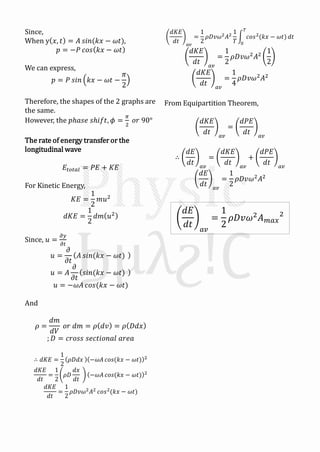
The rate of energy transfer or the
longitudinal wave
𝐸𝑡𝑜𝑡𝑎𝑙 = 𝑃𝐸 + 𝐾𝐸
For Kinetic Energy,
𝐾𝐸 =
1
2
𝑚𝑢2
𝑑𝐾𝐸 =
1
2
𝑑𝑚 𝑢2
Since, 𝑢 =
𝜕𝑦
𝜕𝑡
𝑢 =
𝜕
𝜕𝑡
𝐴 𝑠𝑖𝑛(𝑘𝑥 − 𝜔𝑡)
𝑢 = 𝐴
𝜕
𝜕𝑡
𝑠𝑖𝑛(𝑘𝑥 − 𝜔𝑡)
𝑢 = −𝜔𝐴 𝑐𝑜𝑠(𝑘𝑥 − 𝜔𝑡)
And
𝜌 =
𝑑𝑚
𝑑𝑉
𝑜𝑟 𝑑𝑚 = 𝜌 𝑑𝑣 = 𝜌 𝐷𝑑𝑥
; 𝐷 = 𝑐𝑟𝑜𝑠𝑠 𝑠𝑒𝑐𝑡𝑖𝑜𝑛𝑎𝑙 𝑎𝑟𝑒𝑎
∴ 𝑑𝐾𝐸 =
1
2
𝜌𝐷𝑑𝑥 −𝜔𝐴 𝑐𝑜𝑠(𝑘𝑥 − 𝜔𝑡) 2
𝑑𝐾𝐸
𝑑𝑡
=
1
2
𝜌𝐷
𝑑𝑥
𝑑𝑡
−𝜔𝐴 𝑐𝑜𝑠(𝑘𝑥 − 𝜔𝑡) 2
𝑑𝐾𝐸
𝑑𝑡
=
1
2
𝜌𝐷𝑣𝜔2 𝐴2 𝑐𝑜𝑠2(𝑘𝑥 − 𝜔𝑡)
𝑑𝐾𝐸
𝑑𝑡 𝑎𝑣
=
1
2
𝜌𝐷𝑣𝜔2 𝐴2
1
𝑇
𝑐𝑜𝑠2(𝑘𝑥 − 𝜔𝑡)
𝑇
0
𝑑𝑡
𝑑𝐾𝐸
𝑑𝑡 𝑎𝑣
=
1
2
𝜌𝐷𝑣𝜔2
𝐴2
1
2
𝑑𝐾𝐸
𝑑𝑡 𝑎𝑣
=
1
4
𝜌𝐷𝑣𝜔2
𝐴2
From Equipartition Theorem,
𝑑𝐾𝐸
𝑑𝑡 𝑎𝑣
=
𝑑𝑃𝐸
𝑑𝑡 𝑎𝑣
∴
𝑑𝐸
𝑑𝑡 𝑎𝑣
=
𝑑𝐾𝐸
𝑑𝑡 𝑎𝑣
+
𝑑𝑃𝐸
𝑑𝑡 𝑎𝑣
𝑑𝐸
𝑑𝑡 𝑎𝑣
=
1
2
𝜌𝐷𝑣𝜔2
𝐴2
𝑑𝐸
𝑑𝑡 𝑎𝑣
=
1
2
𝜌𝐷𝑣𝜔2 𝐴 𝑚𝑎𝑥
2

7). mechanical waves (finished)

  • 1.
  • 2.
    Mechanical Wave Classification ofwaves (i). Medium ;Mechanical and Electromagnetic waves (ii). Direction of particles of medium ;Transverse and Longitudinal waves (iii). Motion of wave ;Stationary and progressive waves In elastic mediums, Tensile Stress, 𝑺 𝒏 𝑆 𝑛 = 𝐹 𝐴 𝑛𝑜𝑟𝑚𝑎𝑙 𝑃𝑎 ***Similar to pressure ***𝐴 𝑛𝑜𝑟𝑚𝑎𝑙 is the perpendicular area to the force. Tensile Strain, 𝜱 𝒕 Φ 𝑡 = ∆𝐿 𝐿0 Young’s Modulus, 𝒀 𝑌 = 𝑆 𝑛 Φ 𝑡 𝑃𝑎 ***It is vary from one material to another. Same material has the same 𝑌. Shear Stress, 𝑺 𝒕 𝑆𝑡 = 𝐹 𝐴 𝑡𝑎𝑛𝑔𝑒𝑛𝑡 𝑃𝑎 Shear Strain, 𝜱 𝒔 Φ 𝑠 = ∆𝑥 𝐿0 Shear Modulus, 𝑹 𝑅 = 𝑆𝑡 Φ 𝑠 𝑃𝑎 Pressure in fluid 𝐹−𝐹 𝐿0 ∆𝐿 𝐴 𝐹 −𝐹 𝐿0 ∆𝑥 𝐴 𝐹 𝑉𝑖𝑛𝑖𝑡𝑖𝑎𝑙 𝑉𝑓𝑖𝑛𝑎𝑙
  • 3.
    Hydrostatic pressure, 𝑷 𝑃= 𝐹 𝐴 𝑃𝑎 ***equivalent to stress Volume Strain, 𝜱 𝒔 Φ 𝑉 = 𝑉𝑓 − 𝑉𝑖 𝑉𝑖 = ∆𝑉 𝑉𝑖 Bulk Modulus, 𝑩 𝐵 = − ∆𝑃 Φ 𝑉 𝑃𝑎 ***𝐶𝑜𝑚𝑝𝑟𝑒𝑠𝑠𝑖𝑏𝑖𝑙𝑖𝑡𝑦 = 1 𝐵 Stress-Strain Curve Strain can reflect the force applied 𝐴 → 𝐵; linear variation, elastic behavior ***The gradient = Young’s Modulus 𝐶 → 𝐷; Plastic behavior 𝐵 = 𝑃𝑟𝑜𝑝𝑜𝑟𝑡𝑖𝑜𝑛𝑎𝑙 𝑙𝑖𝑚𝑖𝑡 𝐶 = 𝐸𝑙𝑎𝑠𝑡𝑖𝑐 𝑙𝑖𝑚𝑖𝑡 𝐷 = 𝐹𝑟𝑎𝑐𝑡𝑢𝑟𝑒 𝑝𝑜𝑖𝑛𝑡 𝑆𝑡𝑟𝑒𝑠𝑠 𝑆𝑡𝑟𝑎𝑖𝑛𝐴 𝐵 𝐶 𝐷 Equation of mechanical waves 𝑦 = 𝑓 𝑥 = 𝑥2 For moving wave, 𝑦 = 𝑓 𝑥 ± 𝑠 = 𝑓 𝑥 ± 𝑣𝑡 However, the shape of wave is Sinusoidal or Simple harmonic wave, and not parabola ∴ 𝑦 = 𝑓 𝑥 = 𝐴 𝑠𝑖𝑛 𝑘𝑥 For moving wave, 𝑦 = 𝑓 𝑥 = 𝐴 𝑠𝑖𝑛 𝑘(𝑥 ± 𝑣𝑡) For wave movingto the right, 𝑦 = 𝑓 𝑥 = 𝐴 𝑠𝑖𝑛 𝑘(𝑥 − 𝑣𝑡) For wave movingto the left, 𝑦 = 𝑓 𝑥 = 𝐴 sin 𝑘(𝑥 + 𝑣𝑡) 𝑦 = 𝑑𝑖𝑠𝑝𝑙𝑎𝑐𝑒𝑚𝑒𝑛𝑡 𝑜𝑓 𝑎 𝑝𝑎𝑟𝑡𝑖𝑐𝑙𝑒𝑠 𝐴 = 𝑎𝑚𝑝𝑙𝑖𝑡𝑢𝑑𝑒 𝑘 = 𝑎𝑛𝑔𝑢𝑙𝑎𝑟 𝑤𝑎𝑣𝑒 𝑛𝑢𝑚𝑏𝑒𝑟 λ = 𝑤𝑎𝑣𝑒𝑙𝑒𝑛𝑔ℎ𝑡 𝑓 𝑥 = 𝑥2 𝑓 𝑥 = (𝑥 − 𝑣𝑡)2 𝑓 𝑥 = (𝑥 + 𝑣𝑡)2 𝑥 𝑦 𝑦(𝑥, 𝑡) = 𝐴 𝑠𝑖𝑛 𝑘(𝑥 ± 𝑣𝑡) 𝑘 = 2𝜋 λ = 𝜔 𝑣
  • 4.
    𝑦(𝑥, 𝑡) =𝐴 𝑠𝑖𝑛 𝑘(𝑥 ± 𝑣𝑡) Suppose the wave moves to the right. At 𝑡 = 0, 𝑡0 The position of a particle is 𝑥0 ∴ 𝑦(𝑥0, 𝑡0) = 𝐴 𝑠𝑖𝑛 𝑘(𝑥0 − 𝑣𝑡0) The other position of the adjacent particle that is in phase is 𝑥0 + λ ∴ 𝑦 𝑥0 + 𝜆, 𝑡0 = 𝐴 𝑠𝑖𝑛 𝑘 𝑥0 + 𝜆 − 𝑣𝑡0 However, the points which are in phase have the same displacement (𝑦) ∴ 𝑦 𝑥0, 𝑡0 = 𝑦 𝑥0 + λ, 𝑡0 𝐴 𝑠𝑖𝑛 𝑘(𝑥0 − 𝑣𝑡0) = 𝐴 𝑠𝑖𝑛 𝑘 𝑥0 + 𝜆 − 𝑣𝑡0 𝑠𝑖𝑛(𝑘𝑥0 − 𝑘𝑣𝑡0) = 𝑠𝑖𝑛 𝑘𝑥0 + 𝒌𝝀 − 𝑘𝑣𝑡0 ∴ 𝑘𝜆 = 0 𝑜𝑟 𝑘𝜆 = 2𝜋 Since, 𝜆 = 𝑣 𝑓 𝑘𝑣 = 2𝜋𝑓 = 𝜔 Summary 𝑦(𝑥, 𝑡) = 𝐴 𝑠𝑖𝑛 𝑘(𝑥 ± 𝑣𝑡) 𝑘 = 2𝜋 λ = 𝜔 𝑣 𝑣 = 𝑓 λ 𝜔 = 2𝑓𝜋 = 2𝜋 𝑇 𝑘 = 𝜔 𝑣 In reality, at 𝑡0, 𝑦 may not equation to 0 Thus, the general equation is, 𝑦(𝑥, 𝑡) = 𝐴 𝑠𝑖𝑛(𝑘𝑥 ± 𝜔𝑡 + 𝜙) 𝜙 𝑖𝑠 𝑎 𝑝ℎ𝑎𝑠𝑒 𝑠ℎ𝑖𝑓𝑡 ***All angles are in radian. 𝐷𝑖𝑠𝑝𝑙𝑎𝑐𝑒𝑚𝑒𝑛𝑡 = 𝑦(𝑥, 𝑡) 𝑉𝑒𝑙𝑜𝑐𝑖𝑡𝑦 𝐴𝑐𝑐𝑒𝑙𝑒𝑟𝑎𝑡𝑖𝑜𝑛 Wave equation 𝜕2 𝑦 𝜕𝑥2 = −𝑘2 𝐴 𝑠𝑖𝑛 𝑘𝑥 − 𝜔𝑡 = −𝑘2 𝑦 𝜕2 𝑦 𝜕𝑡2 = −𝜔2 𝐴 𝑠𝑖𝑛 𝑘𝑥 − 𝜔𝑡 = −𝜔2 𝑦 ∴ 𝜕2 𝑦 𝜕𝑥2 𝜕2 𝑦 𝜕𝑡2 = 𝜔2 𝑘2 = 𝑣2 ∴ 𝜕2 𝑦 𝜕𝑥2 = 1 𝑣2 𝜕2 𝑦 𝜕𝑡2 ***Motion equation which can be arranged in this form is a sinusoidal wave. 𝑦(𝑥, 𝑡) = 𝐴 𝑠𝑖𝑛(𝑘𝑥 ± 𝜔𝑡) 𝑢(𝑥0, 𝑡0) = 𝜕𝑦 𝜕𝑡 𝑥=𝑥0,𝑡=𝑡0 𝑎 𝑥0, 𝑡0 = 𝜕𝑢 𝜕𝑡 𝑥=𝑥0,𝑡=𝑡0 = 𝜕2 𝑦 𝜕𝑡2 𝑥=𝑥0,𝑡=𝑡0
  • 5.
    Interference Constructive interference Destructive inference StandingWave Suppose there are 2 identical waves , one moves to the left and the other move to the right, combine together. Wave1; 𝑦1(𝑥, 𝑡) = 𝐴 𝑠𝑖𝑛(𝑘𝑥 + 𝜔𝑡) Wave2; 𝑦2(𝑥, 𝑡) = 𝐴 𝑠𝑖𝑛(𝑘𝑥 − 𝜔𝑡) ∴ 𝑦 = 𝑦1 + 𝑦1 = 𝐴 𝑠𝑖𝑛(𝑘𝑥 + 𝜔𝑡) + 𝐴 𝑠𝑖𝑛(𝑘𝑥 − 𝜔𝑡) = 2𝐴 𝑠𝑖𝑛 𝑘𝑥 𝑐𝑜𝑠 𝜔𝑡 Thus, the new amplitude is 2𝐴 𝑠𝑖𝑛 𝑘𝑥. When 𝑠𝑖𝑛 𝑘𝑥 = ±1, Anti-node When 𝑠𝑖𝑛 𝑘𝑥 = 0, Node When 𝑠𝑖𝑛 𝑘𝑥 = ±1, Anti-node 𝐵𝑎𝑠𝑖𝑐 𝑎𝑛𝑔𝑙𝑒 = 𝜋 2 ∴ 𝑘𝑥 = 𝜋 2 , 3𝜋 2 , 5𝜋 2 , … Since 𝑘 = 𝜔 𝑣 = 2𝜋𝑓 𝑓λ = 2𝜋 λ , 2𝜋 λ 𝑥 = 𝜋 2 , 3𝜋 2 , 5𝜋 2 , … 𝑥 = λ 4 , 3λ 4 , 5λ 4 , … When 𝑠𝑖𝑛 𝑘𝑥 = 0, Node 𝐵𝑎𝑠𝑖𝑐 𝑎𝑛𝑔𝑙𝑒 = 0 ∴ 𝑘𝑥 = 0, 𝜋, 3𝜋, … 𝑥 = 0, λ 2 , λ, 3λ 2 , … 𝑦(𝑥, 𝑡) = 2𝐴 𝑠𝑖𝑛 𝑘𝑥 𝑐𝑜𝑠 𝜔𝑡 Anti-node 𝑥 = 𝑛λ 4 ; 𝑛 = 1, 3, 5, …
  • 6.
    Fixed end Freeend Reflected waves changed𝜙 by 𝜋 unchanged 𝜙 At the boundary Node Anti-node Refractive index, 𝑛 low  high high  low Speed high  low low  high Reflection of wave 1. Reflection from a fixed/hard boundary 2. Reflection from a free/soft boundary Anti-node 𝑥 = 𝑛λ 4 ; 𝑛 = 1, 3, 5, … Node 𝑥 = 𝑛λ 2 ; 𝑛 = 0, 1, 2, … 𝑎𝑛 𝑖𝑛𝑐𝑖𝑑𝑒𝑛𝑡 𝑤𝑎𝑣𝑒 𝑎 𝑟𝑒𝑑𝑙𝑒𝑐𝑡𝑒𝑑 𝑤𝑎𝑣𝑒 𝑎𝑛 𝑖𝑛𝑐𝑖𝑑𝑒𝑛𝑡 𝑤𝑎𝑣𝑒 𝑎 𝑟𝑒𝑑𝑙𝑒𝑐𝑡𝑒𝑑 𝑤𝑎𝑣𝑒 ***a reflected wave is identical to the incident wave except moving in an opposite direction, and a phase shift may change. Thus, the interference of incident waves and reflected waves may result in standing waves. String The fundamental tone λ1 = 2𝑙 𝑓1 = 1 2 𝑣 𝑙 𝑓1 = 𝑓𝑢𝑛𝑑𝑎𝑚𝑒𝑛𝑡𝑎𝑙 𝑓𝑟𝑒𝑞𝑢𝑒𝑛𝑐𝑦 ***the fundamental frequency is the minimum frequency required to form standing waves. ***the 1st harmonic Harmonic; how many time is the frequency greater than the fundamental frequency, 𝑓1. 𝑁 𝐴 𝐴𝐴 𝑁 𝐴 𝑁𝑁 λ 2 λ 4 𝑁 = 𝑛𝑜𝑑𝑒 𝐴 = 𝑎𝑛𝑡𝑖 − 𝑛𝑜𝑑𝑒 𝑁 𝑁 𝑙
  • 7.
    The first overtone λ2= 𝑙 𝑓2 = 𝑣 𝑙 = 2𝑓1 ***the 2nd harmonic, 𝑓2 𝑓1 = 2. The second overtone λ3 = 2 3 𝑙 𝑓2 = 3 2 𝑣 𝑙 = 3𝑓1 ***the 3rd harmonic, 𝑓2 𝑓1 = 3. ***Natural frequencies are any frequencies required to form standing waves. 𝑙 𝑙 𝑣 = 𝑇 𝜇 Velocity of the string 𝑇 = 𝑠𝑡𝑟𝑖𝑛𝑔 𝑡𝑒𝑛𝑠𝑖𝑜𝑛 𝑁 𝜇 = 𝑙𝑖𝑛𝑒𝑎𝑟 𝑑𝑒𝑛𝑠𝑖𝑡𝑦 𝑘𝑔 𝑚 ***linear density; a measure of mass per unit of length Open ended pipe The fundamental tone λ1 = 2𝑙 𝑓1 = 1 2 𝑣 𝑙 𝑓1 = 𝑓𝑢𝑛𝑑𝑎𝑚𝑒𝑛𝑡𝑎𝑙 𝑓𝑟𝑒𝑞𝑢𝑒𝑛𝑐𝑦 ***the 1st harmonic The first overtone λ2 = 𝑙 𝑓2 = 𝑣 𝑙 = 2𝑓1 ***the 2nd harmonic, 𝑓2 𝑓1 = 2. 𝑙 𝑙
  • 8.
    The second overtone λ3= 2 3 𝑙 𝑓2 = 3 2 𝑣 𝑙 = 3𝑓1 ***the 3rd harmonic, 𝑓2 𝑓1 = 3. Close ended pipe The fundamental tone λ1 = 4𝑙 𝑓1 = 1 4 𝑣 𝑙 𝑓1 = 𝑓𝑢𝑛𝑑𝑎𝑚𝑒𝑛𝑡𝑎𝑙 𝑓𝑟𝑒𝑞𝑢𝑒𝑛𝑐𝑦 ***the 1st harmonic The first overtone λ2 = 4 3 𝑙 𝑓2 = 3 4 𝑣 𝑙 = 3𝑓1 ***the 3rd harmonic, 𝑓2 𝑓1 =3. The second overtone λ3 = 4 5 𝑙 𝑓2 = 5 4 𝑣 𝑙 = 5𝑓1 ***the 5th harmonic, 𝑓2 𝑓1 = 5. ***The harmonics of close ended pipe are only odd numbers. Velocity of wave inside the pipe 𝑙 𝑙 𝑙 𝑙 𝑣 = 𝐵 𝜌
  • 9.
    Resonance ; the tendencyof a system to oscillate at a greater amplitude at some frequencies (natural frequencies) than at others. All system has its own frequency. If a force is applied with the same frequency of the system, the damage is largest as it can reach the maximum amplitude. Modulation and Beat The interference of 2 waves with the same amplitude and direction, but different 𝑘 and 𝜔 Wave1; 𝑦1(𝑥, 𝑡) = 𝐴 𝑠𝑖𝑛(𝑘1 𝑥 − 𝜔1 𝑡) Wave2; 𝑦2(𝑥, 𝑡) = 𝐴 𝑠𝑖𝑛(𝑘2 𝑥 − 𝜔2 𝑡) 𝑦 = 𝑦1 + 𝑦2 𝑦 = 2𝐵 𝑐𝑜𝑠(𝑘 𝑚𝑜𝑑 𝑥 − 𝜔 𝑚𝑜𝑑 𝑡) 𝑠𝑖𝑛(𝑘 𝑎𝑣 𝑥 − 𝜔 𝑎𝑣 𝑡) When, 𝑘 𝑚𝑜𝑑 = 𝑘2−𝑘1 2 ,𝑘 𝑎𝑣 = 𝑘2+𝑘1 2 And, 𝜔 𝑚𝑜𝑑 = 𝜔2−𝜔1 2 ,𝜔 𝑎𝑣 = 𝜔2+𝜔1 2 𝑓𝑏𝑒𝑎𝑡 = 𝑓1 − 𝑓2 𝑓 𝑚𝑜𝑑 = 𝜔 𝑚𝑜𝑑 2𝜋 = 1 2 𝑓2 − 𝑓1 Since, 𝑦 = 2𝐵 𝑐𝑜𝑠(𝑘 𝑚𝑜𝑑 𝑥 − 𝜔 𝑚𝑜𝑑 𝑡) 𝑠𝑖𝑛(𝑘 𝑎𝑣 𝑥 − 𝜔 𝑎𝑣 𝑡) can be expressed in the form of 𝑦 = 𝐴 𝑠𝑖𝑛 𝑘𝑥 − 𝜔𝑡 When 𝐴 = 2𝐵 𝑐𝑜𝑠(𝑘 𝑚𝑜𝑑 𝑥 − 𝜔 𝑚𝑜𝑑 𝑡) ∴ We define, 𝐴 𝑚𝑜𝑑 = 2𝐵 𝑐𝑜𝑠(𝑘 𝑚𝑜𝑑 𝑥 − 𝜔 𝑚𝑜𝑑 𝑡) ***The amplitude of the combined wave is a sinusoidal function also. The average velocity of the combined wave,𝑣 𝑝ℎ𝑎𝑠𝑒 = 𝑣 𝑎𝑣 = 𝜔 𝑎𝑣 𝑘 𝑎𝑣 𝑦𝑡𝑜𝑡𝑎𝑙propagates with 𝑓𝑎 𝑣, 𝑣 𝑎𝑣 The Envelope propagates with 𝑓 𝑚𝑜𝑑, 𝑣𝑔 𝑣𝑔 = 𝜔 𝑚𝑜𝑑 𝑘 𝑚𝑜𝑑 = 𝜔2 − 𝜔1 𝑘2 − 𝑘1 = 𝑑𝜔 𝑑𝑘 𝑣 𝑎𝑣 = 𝜔 𝑎𝑣 𝑘 𝑎𝑣 𝑦𝑡𝑜𝑡𝑎𝑙 𝐸𝑛𝑣𝑒𝑙𝑜𝑝𝑒 (𝐴 𝑚𝑜𝑑) 𝑣𝑔 = 𝜔2 − 𝜔1 𝑘2 − 𝑘1 = 𝑑𝜔 𝑑𝑘
  • 10.
    String 𝑣 = 𝑣𝑒𝑙𝑜𝑠𝑖𝑡𝑦 𝑇= 𝑡𝑒𝑛𝑠𝑖𝑜𝑛 𝑁 𝜇 = 𝑙𝑖𝑛𝑒𝑎𝑟 𝑑𝑒𝑛𝑠𝑖𝑡𝑦 𝑘𝑔 𝑚 The rate of energy transfer, 𝑱 𝒔 𝐸𝑡𝑜𝑡𝑎𝑙 = 𝑃𝐸 + 𝐾𝐸 For Kinetic Energy, 𝐾𝐸 = 1 2 𝑚𝑢2 𝑑𝐾𝐸 = 1 2 𝑑𝑚 𝑢2 Since, 𝑢 = 𝜕𝑦 𝜕𝑡 𝑢 = 𝜕 𝜕𝑡 𝐴 𝑠𝑖𝑛(𝑘𝑥 − 𝜔𝑡) 𝑢 = 𝐴 𝜕 𝜕𝑡 𝑠𝑖𝑛(𝑘𝑥 − 𝜔𝑡) 𝑢 = −𝜔𝐴 𝑐𝑜𝑠(𝑘𝑥 − 𝜔𝑡) And 𝜇 = 𝑑𝑚 𝑑𝑥 𝑜𝑟 𝑑𝑚 = 𝜇𝑑𝑥 ∴ 𝑑𝐾𝐸 = 1 2 𝜇𝑑𝑥 −𝜔𝐴 𝑐𝑜𝑠(𝑘𝑥 − 𝜔𝑡) 2 𝑑𝐾𝐸 𝑑𝑡 = 1 2 𝜇 𝑑𝑥 𝑑𝑡 −𝜔𝐴 𝑐𝑜𝑠(𝑘𝑥 − 𝜔𝑡) 2 𝑑𝐾𝐸 𝑑𝑡 = 1 2 𝜇𝑣𝜔2 𝐴2 𝑐𝑜𝑠2 (𝑘𝑥 − 𝜔𝑡) 𝑑𝐾𝐸 𝑑𝑡 = 1 2 𝜇𝑣𝜔2 𝐴2 𝑐𝑜𝑠2 (𝑘𝑥 − 𝜔𝑡) 𝑑𝐾𝐸 𝑑𝑡 𝑎𝑣 = 1 2 𝜇𝑣𝜔2 𝐴2 1 𝑇 𝑐𝑜𝑠2 (𝑘𝑥 − 𝜔𝑡) 𝑇 0 𝑑𝑡 𝑑𝐾𝐸 𝑑𝑡 𝑎𝑣 = 1 2 𝜇𝑣𝜔2 𝐴2 1 2 𝑑𝐾𝐸 𝑑𝑡 𝑎𝑣 = 1 4 𝜇𝑣𝜔2 𝐴2 From Equipartition Theorem, 𝑑𝐾𝐸 𝑑𝑡 𝑎𝑣 = 𝑑𝑃𝐸 𝑑𝑡 𝑎𝑣 ∴ 𝑑𝐸 𝑑𝑡 𝑎𝑣 = 𝑑𝐾𝐸 𝑑𝑡 𝑎𝑣 + 𝑑𝑃𝐸 𝑑𝑡 𝑎𝑣 𝑑𝐸 𝑑𝑡 𝑎𝑣 = 1 2 𝜇𝑣𝜔2 𝐴2 Wave velocity in a fluid 𝐵 = 𝐵𝑢𝑙𝑘 𝑀𝑜𝑑𝑢𝑙𝑢𝑠 𝜌 = 𝑑𝑒𝑛𝑠𝑖𝑡𝑦 𝑜𝑓 𝑡ℎ𝑒 𝑓𝑙𝑢𝑖𝑑 𝑣 = 𝑇 𝜇 𝑑𝐸 𝑑𝑡 𝑎𝑣 = 1 2 𝜇𝑣𝜔2 𝐴 𝑚𝑎𝑥 2 𝑣 = 𝐵 𝜌
  • 11.
    Longitudinal Waves We haveanother function to represent longitudinal waves, using Pressure 𝑃 𝑥, 𝑡 At (a), the air particles are at equilibrium point with the cross- sectional diameter (of the column of the air ) of 𝐷. When the longitudinal wave is produced in (b). Air particles move with different rate, causing the change in pressure. Since, Bulk Modulus, 𝐵 = − ∆𝑃 Φ 𝑉 And Φ 𝑉 = ∆𝑉 𝑉𝑖 𝐵 = − ∆𝑃 ∆𝑉/𝑉𝑖 (a). (b). 𝑦 𝑦 + ∆𝑦 𝐷 ∆𝑥 𝑝0 𝑝0 + 𝑝 𝐵 = − ∆𝑃 ∆𝑉/𝑉𝑖 𝐵 = − 𝑃𝑓 − 𝑃𝑖 𝑉𝑓 − 𝑉𝑖 /𝑉𝑖 𝐵 = − 𝑝0 + 𝑝 − 𝑝0 ∆𝑥 + ∆𝑦 𝐷 − ∆𝑥𝐷 /∆𝑥𝐷 𝐵 = − 𝑝 ∆𝑦/∆𝑥 𝑝 = −𝐵 ∆𝑦 ∆𝑥 Since, y 𝑥, 𝑡 = 𝐴 𝑠𝑖𝑛(𝑘𝑥 − 𝜔𝑡) ∴ 𝑝 = −𝐵 𝜕 𝐴 𝑠𝑖𝑛 𝑘𝑥 − 𝜔𝑡 𝜕𝑥 𝑝 = −𝐵𝐴𝑘 𝑐𝑜𝑠 𝑘𝑥 − 𝜔𝑡 𝑝 = −𝑃 𝑐𝑜𝑠 𝑘𝑥 − 𝜔𝑡 We define, 𝑷𝒓𝒆𝒔𝒔𝒖𝒓𝒆 𝑨𝒎𝒑𝒍𝒊𝒕𝒖𝒅𝒆, 𝑃 = 𝐵𝐴𝑘 Since, 𝑣 = 𝐵 𝜌 , 𝐵 = 𝜌𝑣2 ∴ 𝑃 = 𝜌𝑣2 𝐴𝑘 𝑝 = −𝐵 𝜕𝑦 𝜕𝑥 𝑦(𝑥, 𝑡)𝑝 𝑥, 𝑡 −𝐵 𝜕 𝜕𝑥 𝑃 = 𝐵𝐴𝑘 = 𝜌𝑣2 𝐴𝑘
  • 12.
    Since, When y 𝑥,𝑡 = 𝐴 𝑠𝑖𝑛(𝑘𝑥 − 𝜔𝑡), 𝑝 = −𝑃 𝑐𝑜𝑠 𝑘𝑥 − 𝜔𝑡 We can express, 𝑝 = 𝑃 𝑠𝑖𝑛 𝑘𝑥 − 𝜔𝑡 − 𝜋 2 Therefore, the shapes of the 2 graphs are the same. However, the 𝑝ℎ𝑎𝑠𝑒 𝑠ℎ𝑖𝑓𝑡, 𝜙 = 𝜋 2 𝑜𝑟 90° The rate of energy transfer or the longitudinal wave 𝐸𝑡𝑜𝑡𝑎𝑙 = 𝑃𝐸 + 𝐾𝐸 For Kinetic Energy, 𝐾𝐸 = 1 2 𝑚𝑢2 𝑑𝐾𝐸 = 1 2 𝑑𝑚 𝑢2 Since, 𝑢 = 𝜕𝑦 𝜕𝑡 𝑢 = 𝜕 𝜕𝑡 𝐴 𝑠𝑖𝑛(𝑘𝑥 − 𝜔𝑡) 𝑢 = 𝐴 𝜕 𝜕𝑡 𝑠𝑖𝑛(𝑘𝑥 − 𝜔𝑡) 𝑢 = −𝜔𝐴 𝑐𝑜𝑠(𝑘𝑥 − 𝜔𝑡) And 𝜌 = 𝑑𝑚 𝑑𝑉 𝑜𝑟 𝑑𝑚 = 𝜌 𝑑𝑣 = 𝜌 𝐷𝑑𝑥 ; 𝐷 = 𝑐𝑟𝑜𝑠𝑠 𝑠𝑒𝑐𝑡𝑖𝑜𝑛𝑎𝑙 𝑎𝑟𝑒𝑎 ∴ 𝑑𝐾𝐸 = 1 2 𝜌𝐷𝑑𝑥 −𝜔𝐴 𝑐𝑜𝑠(𝑘𝑥 − 𝜔𝑡) 2 𝑑𝐾𝐸 𝑑𝑡 = 1 2 𝜌𝐷 𝑑𝑥 𝑑𝑡 −𝜔𝐴 𝑐𝑜𝑠(𝑘𝑥 − 𝜔𝑡) 2 𝑑𝐾𝐸 𝑑𝑡 = 1 2 𝜌𝐷𝑣𝜔2 𝐴2 𝑐𝑜𝑠2(𝑘𝑥 − 𝜔𝑡) 𝑑𝐾𝐸 𝑑𝑡 𝑎𝑣 = 1 2 𝜌𝐷𝑣𝜔2 𝐴2 1 𝑇 𝑐𝑜𝑠2(𝑘𝑥 − 𝜔𝑡) 𝑇 0 𝑑𝑡 𝑑𝐾𝐸 𝑑𝑡 𝑎𝑣 = 1 2 𝜌𝐷𝑣𝜔2 𝐴2 1 2 𝑑𝐾𝐸 𝑑𝑡 𝑎𝑣 = 1 4 𝜌𝐷𝑣𝜔2 𝐴2 From Equipartition Theorem, 𝑑𝐾𝐸 𝑑𝑡 𝑎𝑣 = 𝑑𝑃𝐸 𝑑𝑡 𝑎𝑣 ∴ 𝑑𝐸 𝑑𝑡 𝑎𝑣 = 𝑑𝐾𝐸 𝑑𝑡 𝑎𝑣 + 𝑑𝑃𝐸 𝑑𝑡 𝑎𝑣 𝑑𝐸 𝑑𝑡 𝑎𝑣 = 1 2 𝜌𝐷𝑣𝜔2 𝐴2 𝑑𝐸 𝑑𝑡 𝑎𝑣 = 1 2 𝜌𝐷𝑣𝜔2 𝐴 𝑚𝑎𝑥 2