Health and
Consumers
Cost-benefit analysis of
reference laboratories for
human pathogens
Aisha SAUER
DG SANTE C3 – Crisis Management and Preparedness in Health
Health and
Consumers
EU Health Programme
• The EU Health Programme contributes to the EU
obligation to ensure that human health is protected as part
of all its policies, and to work with Member States to
improve and protect the health of its citizens.
• The third EU Health Programme 2014-2020 was published
in March 2014 and provides funding of 446 million € for a
7-year period.
• One objective is to identify and develop coherent
approaches and implement for better preparedness and
coordination in health emergencies.
• Several EU initiatives on laboratory support for
preparedness have been funded under the Public Health
Programme in the past.
Health and
Consumers
EURLOP study
•
•
• At present, there is no EU-wide system for reference
laboratory networks for human pathogens that would
consolidate operating standards of microbiological reference
laboratories or provide resilience when significant cross-
border outbreaks occur.
• The EU Human Pathogen Reference Laboratories
Options Project (EURLOP) developed strategic options for
an overarching EU reference laboratory system for different
classes of pathogens.
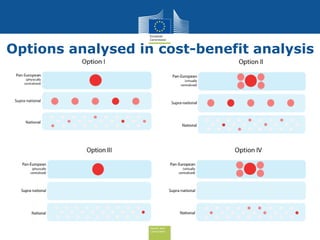
• The EURLOP study proposed a tier-based system of EURLs
designed to provide an EU-wide system that is
accessible to all Member States. Several options for EURLs
were developed, each based on a different levels of service
provision.
Health and
Consumers
EURLOP conclusions
•
•
• The report concluded that there is a need to improve EU-
wide provision of reference microbiology for human
pathogens.
• However, no option was considered wholly appropriate
for an overarching EU-wide Reference laboratory
provision.
• A cost-benefit analysis on the options to strengthen the
existing coordination of reference microbiology provision in
the EU was not included in the EURLOP study.
Health and
Consumers
Cost-benefit analysis on reference
laboratories for human pathogens
• The recently published cost-benefit analysis on
reference laboratories for human pathogens builds
the EU Human Pathogen Reference Laboratories Options
Project (EURLOP).
• The purpose of the study was to provide a cost-benefit
analysis and analysis of regulatory options to strengthen
the existing coordination of reference microbiology
provision in the EU, in order to support the European
response coordination to outbreaks of relevant infectious
agents.
Health and
Consumers
Options analysed in cost-benefit analysis
Health and
Consumers
•
Core functions of an EU-RL network
1. Reference diagnostics
2. Reference material resources
3. Scientific advice
4. External Quality Assurance (EQA)
5. Training
6. Collaboration and research
7. Monitoring, alert and response
8. Governance of the network
Based also: ECDC Technical Report on Core functions of microbiology
reference laboratories for communicable diseases, June 2010
Health and
Consumers
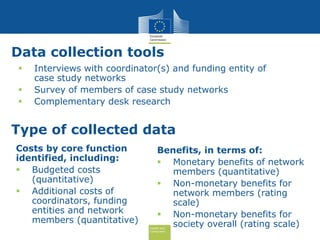
Data collection tools
 Interviews with coordinator(s) and funding entity of
case study networks
 Survey of members of case study networks
 Complementary desk research
Type of collected data
Costs by core function
identified, including:
 Budgeted costs
(quantitative)
 Additional costs of
coordinators, funding
entities and network
members (quantitative)
Benefits, in terms of:
 Monetary benefits of network
members (quantitative)
 Non-monetary benefits for
network members (rating
scale)
 Non-monetary benefits for
society overall (rating scale)
Health and
Consumers
• The final report will be available in June 2016
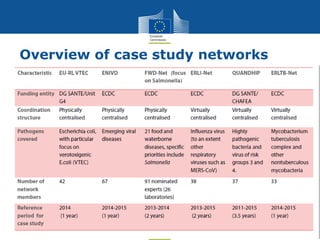
Overview of case study networks
Health and
Consumers
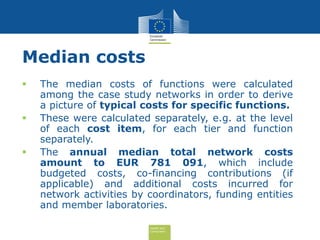
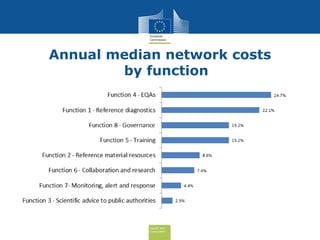
Median costs
 The median costs of functions were calculated
among the case study networks in order to derive
a picture of typical costs for specific functions.
 These were calculated separately, e.g. at the level
of each cost item, for each tier and function
separately.
 The annual median total network costs
amount to EUR 781 091, which include
budgeted costs, co-financing contributions (if
applicable) and additional costs incurred for
network activities by coordinators, funding entities
and member laboratories.
Health and
Consumers
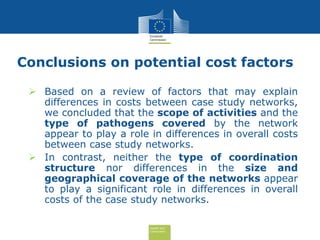
Conclusions on potential cost factors
 Based on a review of factors that may explain
differences in costs between case study networks,
we concluded that the scope of activities and the
type of pathogens covered by the network
appear to play a role in differences in overall costs
between case study networks.
 In contrast, neither the type of coordination
structure nor differences in the size and
geographical coverage of the networks appear
to play a significant role in differences in overall
costs of the case study networks.
Health and
Consumers
Annual median network costs
by function
Health and
Consumers
Assessed non-monetary benefits
for network members
 Methods employed
 Staff expertise
 Quality and accuracy of data/results produced
 Image or reputation
 Access to information, communication and/or
collaboration among laboratories in the network
Health and
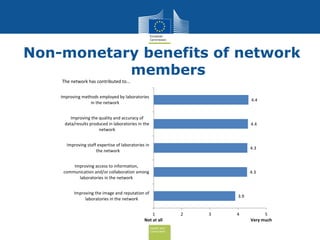
Consumers
3.9
4.3
4.3
4.4
4.4
1 2 3 4 5
Improving the image and reputation of
laboratories in the network
Improving access to information,
communication and/or collaboration among
laboratories in the network
Improving staff expertise of laboratories in
the network
Improving the quality and accuracy of
data/results produced in laboratories in the
network
Improving methods employed by laboratories
in the network
Not at all Very much
The network has contributed to...
Non-monetary benefits of network
members
Health and
Consumers
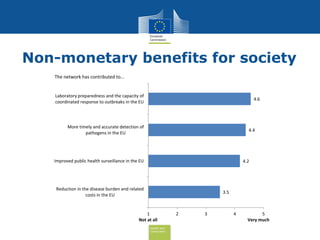
Non-monetary benefits for society
overall assessed
 Reduction in the disease burden and related
costs in the EU
 Improved public health surveillance in the EU
 More timely and accurate detection of
pathogens in the EU
 Improved laboratory preparedness and the
capacity of coordinated response to outbreaks in
the EU
Health and
Consumers
Non-monetary benefits for society
3.5
4.2
4.4
4.6
1 2 3 4 5
Reduction in the disease burden and related
costs in the EU
Improved public health surveillance in the EU
More timely and accurate detection of
pathogens in the EU
Laboratory preparedness and the capacity of
coordinated response to outbreaks in the EU
Not at all Very much
The network has contributed to...
Health and
Consumers
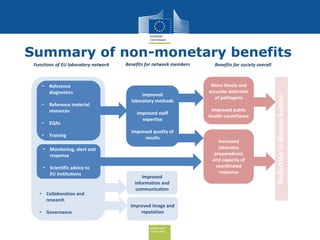
Summary of non-monetary benefits
• Collaboration and
research
• Governance
• Reference
diagnostics
• Reference material
resources
• EQAs
• Training
Improved
information and
communication
Improved image and
reputation
Functions of EU laboratory network Benefits for network members
Improved
laboratory methods
Improved staff
expertise
Improved quality of
results
Benefits for society overall
More timely and
accurate detection
of pathogens
Improved public
health surveillance
• Monitoring, alert and
response
• Scientific advice to
EU institutions
Increased
laboratoy
preparedness
and capacity of
coordinated
response
Reductionindiseaseburden
Health and
Consumers
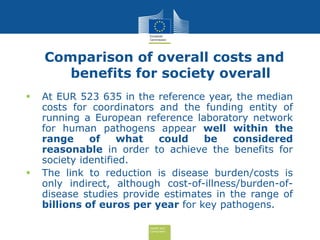
Comparison of overall costs and
benefits for society overall
 At EUR 523 635 in the reference year, the median
costs for coordinators and the funding entity of
running a European reference laboratory network
for human pathogens appear well within the
range of what could be considered
reasonable in order to achieve the benefits for
society identified.
 The link to reduction is disease burden/costs is
only indirect, although cost-of-illness/burden-of-
disease studies provide estimates in the range of
billions of euros per year for key pathogens.
Health and
Consumers
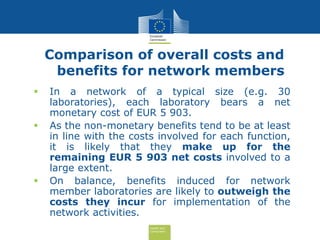
Comparison of overall costs and
benefits for network members
 In a network of a typical size (e.g. 30
laboratories), each laboratory bears a net
monetary cost of EUR 5 903.
 As the non-monetary benefits tend to be at least
in line with the costs involved for each function,
it is likely that they make up for the
remaining EUR 5 903 net costs involved to a
large extent.
 On balance, benefits induced for network
member laboratories are likely to outweigh the
costs they incur for implementation of the
network activities.
Health and
Consumers
The case for an EU-RL system
 In conclusion, the results of this study indicate
that the benefits (monetary and non-
monetary) of maintaining a formally-defined
overarching system of EU reference laboratory
networks are likely to outweigh costs, both
in a Member State (participating member
laboratory) and in an EU perspective
(coordinator and funding entity).
Health and
Consumers
Issues to be addressed in creating a
reference laboratory system
 The need for adequate reference laboratory
infrastructure at national level
 The need to provide sustainable funding, including
for emergency situations
 The need to define the focus of the networks,
potentially by grouping diseases in line with
existing approaches
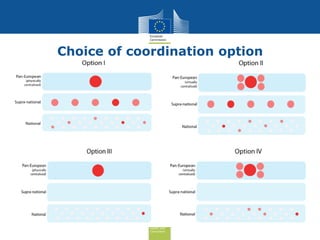
 The need to choose the coordination options most
suitable in specific cases
Health and
Consumers
National reference lab infrastructure
 There is substantial variation in the reference
laboratory infrastructure across Member States
 The EURLOP study already emphasised that an
overarching EU-RL system must be underpinned by
an efficient and co-ordinated system of primary
laboratories at the individual Member State level
 Any future system of EU reference laboratory
networks will require that adequate and
sustainable reference laboratory services are in
place at the national level
Health and
Consumers
23
Choice of coordination option
Health and
Consumers
Questions?
Aisha SAUER
DG SANTE C3 – Crisis Management and Preparedness in Health
http://ec.europa.eu/health/preparedness_response
/publications/index_en.htm

CBA on reference laboratories human pathogens

  • 1.
    Health and Consumers Cost-benefit analysisof reference laboratories for human pathogens Aisha SAUER DG SANTE C3 – Crisis Management and Preparedness in Health
  • 2.
    Health and Consumers EU HealthProgramme • The EU Health Programme contributes to the EU obligation to ensure that human health is protected as part of all its policies, and to work with Member States to improve and protect the health of its citizens. • The third EU Health Programme 2014-2020 was published in March 2014 and provides funding of 446 million € for a 7-year period. • One objective is to identify and develop coherent approaches and implement for better preparedness and coordination in health emergencies. • Several EU initiatives on laboratory support for preparedness have been funded under the Public Health Programme in the past.
  • 3.
    Health and Consumers EURLOP study • • •At present, there is no EU-wide system for reference laboratory networks for human pathogens that would consolidate operating standards of microbiological reference laboratories or provide resilience when significant cross- border outbreaks occur. • The EU Human Pathogen Reference Laboratories Options Project (EURLOP) developed strategic options for an overarching EU reference laboratory system for different classes of pathogens. • The EURLOP study proposed a tier-based system of EURLs designed to provide an EU-wide system that is accessible to all Member States. Several options for EURLs were developed, each based on a different levels of service provision.
  • 4.
    Health and Consumers EURLOP conclusions • • •The report concluded that there is a need to improve EU- wide provision of reference microbiology for human pathogens. • However, no option was considered wholly appropriate for an overarching EU-wide Reference laboratory provision. • A cost-benefit analysis on the options to strengthen the existing coordination of reference microbiology provision in the EU was not included in the EURLOP study.
  • 5.
    Health and Consumers Cost-benefit analysison reference laboratories for human pathogens • The recently published cost-benefit analysis on reference laboratories for human pathogens builds the EU Human Pathogen Reference Laboratories Options Project (EURLOP). • The purpose of the study was to provide a cost-benefit analysis and analysis of regulatory options to strengthen the existing coordination of reference microbiology provision in the EU, in order to support the European response coordination to outbreaks of relevant infectious agents.
  • 6.
    Health and Consumers Options analysedin cost-benefit analysis
  • 7.
    Health and Consumers • Core functionsof an EU-RL network 1. Reference diagnostics 2. Reference material resources 3. Scientific advice 4. External Quality Assurance (EQA) 5. Training 6. Collaboration and research 7. Monitoring, alert and response 8. Governance of the network Based also: ECDC Technical Report on Core functions of microbiology reference laboratories for communicable diseases, June 2010
  • 8.
    Health and Consumers Data collectiontools  Interviews with coordinator(s) and funding entity of case study networks  Survey of members of case study networks  Complementary desk research Type of collected data Costs by core function identified, including:  Budgeted costs (quantitative)  Additional costs of coordinators, funding entities and network members (quantitative) Benefits, in terms of:  Monetary benefits of network members (quantitative)  Non-monetary benefits for network members (rating scale)  Non-monetary benefits for society overall (rating scale)
  • 9.
    Health and Consumers • Thefinal report will be available in June 2016 Overview of case study networks
  • 10.
    Health and Consumers Median costs The median costs of functions were calculated among the case study networks in order to derive a picture of typical costs for specific functions.  These were calculated separately, e.g. at the level of each cost item, for each tier and function separately.  The annual median total network costs amount to EUR 781 091, which include budgeted costs, co-financing contributions (if applicable) and additional costs incurred for network activities by coordinators, funding entities and member laboratories.
  • 11.
    Health and Consumers Conclusions onpotential cost factors  Based on a review of factors that may explain differences in costs between case study networks, we concluded that the scope of activities and the type of pathogens covered by the network appear to play a role in differences in overall costs between case study networks.  In contrast, neither the type of coordination structure nor differences in the size and geographical coverage of the networks appear to play a significant role in differences in overall costs of the case study networks.
  • 12.
    Health and Consumers Annual mediannetwork costs by function
  • 13.
    Health and Consumers Assessed non-monetarybenefits for network members  Methods employed  Staff expertise  Quality and accuracy of data/results produced  Image or reputation  Access to information, communication and/or collaboration among laboratories in the network
  • 14.
    Health and Consumers 3.9 4.3 4.3 4.4 4.4 1 23 4 5 Improving the image and reputation of laboratories in the network Improving access to information, communication and/or collaboration among laboratories in the network Improving staff expertise of laboratories in the network Improving the quality and accuracy of data/results produced in laboratories in the network Improving methods employed by laboratories in the network Not at all Very much The network has contributed to... Non-monetary benefits of network members
  • 15.
    Health and Consumers Non-monetary benefitsfor society overall assessed  Reduction in the disease burden and related costs in the EU  Improved public health surveillance in the EU  More timely and accurate detection of pathogens in the EU  Improved laboratory preparedness and the capacity of coordinated response to outbreaks in the EU
  • 16.
    Health and Consumers Non-monetary benefitsfor society 3.5 4.2 4.4 4.6 1 2 3 4 5 Reduction in the disease burden and related costs in the EU Improved public health surveillance in the EU More timely and accurate detection of pathogens in the EU Laboratory preparedness and the capacity of coordinated response to outbreaks in the EU Not at all Very much The network has contributed to...
  • 17.
    Health and Consumers Summary ofnon-monetary benefits • Collaboration and research • Governance • Reference diagnostics • Reference material resources • EQAs • Training Improved information and communication Improved image and reputation Functions of EU laboratory network Benefits for network members Improved laboratory methods Improved staff expertise Improved quality of results Benefits for society overall More timely and accurate detection of pathogens Improved public health surveillance • Monitoring, alert and response • Scientific advice to EU institutions Increased laboratoy preparedness and capacity of coordinated response Reductionindiseaseburden
  • 18.
    Health and Consumers Comparison ofoverall costs and benefits for society overall  At EUR 523 635 in the reference year, the median costs for coordinators and the funding entity of running a European reference laboratory network for human pathogens appear well within the range of what could be considered reasonable in order to achieve the benefits for society identified.  The link to reduction is disease burden/costs is only indirect, although cost-of-illness/burden-of- disease studies provide estimates in the range of billions of euros per year for key pathogens.
  • 19.
    Health and Consumers Comparison ofoverall costs and benefits for network members  In a network of a typical size (e.g. 30 laboratories), each laboratory bears a net monetary cost of EUR 5 903.  As the non-monetary benefits tend to be at least in line with the costs involved for each function, it is likely that they make up for the remaining EUR 5 903 net costs involved to a large extent.  On balance, benefits induced for network member laboratories are likely to outweigh the costs they incur for implementation of the network activities.
  • 20.
    Health and Consumers The casefor an EU-RL system  In conclusion, the results of this study indicate that the benefits (monetary and non- monetary) of maintaining a formally-defined overarching system of EU reference laboratory networks are likely to outweigh costs, both in a Member State (participating member laboratory) and in an EU perspective (coordinator and funding entity).
  • 21.
    Health and Consumers Issues tobe addressed in creating a reference laboratory system  The need for adequate reference laboratory infrastructure at national level  The need to provide sustainable funding, including for emergency situations  The need to define the focus of the networks, potentially by grouping diseases in line with existing approaches  The need to choose the coordination options most suitable in specific cases
  • 22.
    Health and Consumers National referencelab infrastructure  There is substantial variation in the reference laboratory infrastructure across Member States  The EURLOP study already emphasised that an overarching EU-RL system must be underpinned by an efficient and co-ordinated system of primary laboratories at the individual Member State level  Any future system of EU reference laboratory networks will require that adequate and sustainable reference laboratory services are in place at the national level
  • 23.
  • 24.
    Health and Consumers Questions? Aisha SAUER DGSANTE C3 – Crisis Management and Preparedness in Health http://ec.europa.eu/health/preparedness_response /publications/index_en.htm